Congregation Leaving the Reformed Church in Nuenen

by Vincent van Gogh

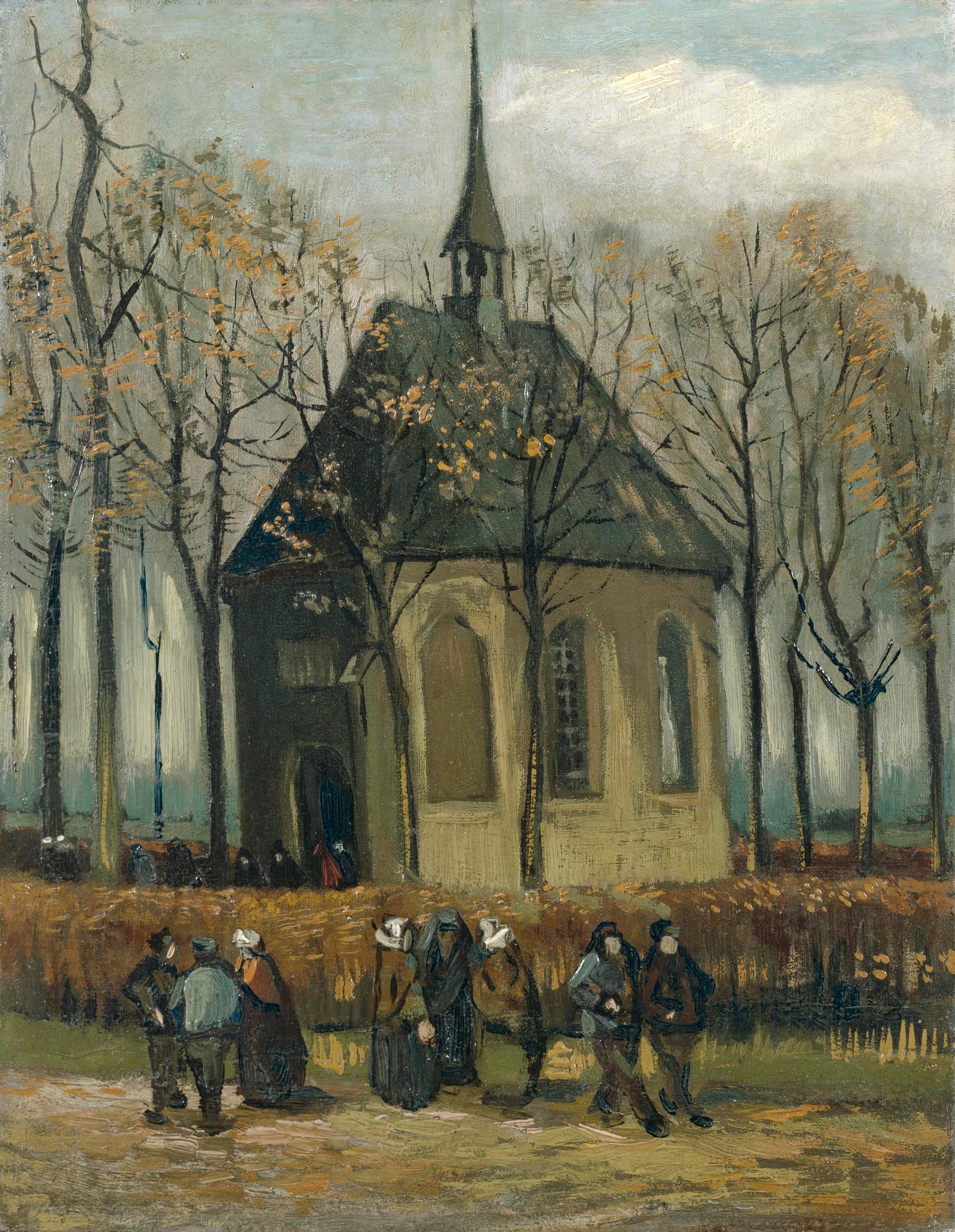
Vincent van Gogh’s Congregation Leaving the Reformed Church in Nuenen turns a modest village service into a meditation on mourning, community, and thresholds. The low steeple, clipped hedge, and bundled figures in black shawls and white caps file past autumn-tinted, near-bare trees, shifting the scene from ordinary Sunday ritual to public grief. Painted in 1884 and reworked in 1885 with the congregation and ocher leaves, the canvas folds private loss into rural Protestant life [1][2][3].

Study Print Studio

Create a personal study print

Build a companion study sheet around the part of this painting that speaks to you most. Choose a detail, shape an interpretation, and walk away with something personal and display-worthy.

Fast Facts

Year
1884; reworked 1885
Medium
Oil on canvas
Dimensions
41.5 × 32.2 cm
Location
Van Gogh Museum, Amsterdam
See all Vincent van Gogh paintings in Amsterdam
Congregation Leaving the Reformed Church in Nuenen by Vincent van Gogh (1884; reworked 1885) featuring Open church door, Clipped hedge, Procession in black shawls and white caps, Low steeple and bell-cote

Click on any numbered symbol to learn more about its meaning

Meaning & Symbolism

Van Gogh builds the painting’s narrative around a quiet exit rather than a dramatic sermon. The church’s small bell-cote and plain windows declare Reformed austerity, while the hedge draws a literal boundary between sanctuary and street. Along this threshold, a file of villagers moves left to right: women in dark shawls and white caps, shoulders hunched, hands clasped at their waists. Their procession reads not as chatter after worship but as collective mourning—a reading anchored by the artist’s 1885 repainting, when he introduced these congregants after his pastor-father’s death 23. The door stands ajar, and a tiny figure with a blue skirt and red accent recedes into the gloom, punctuating the passage from interior devotion to exterior weather. Overhead, wiry trees carry sparse, ocher leaves against a cool, gray sky. Those added autumn notes, together with the churned, pale-brown path, set a damp, elegiac climate that binds season to sentiment—an intentional shift from the earlier, leafless 1884 state documented by imaging 2. The painting’s meaning crystallizes in what Van Gogh removed and what he added. Technical study shows that the original foreground contained a solitary peasant with a spade—labor as the emblem of rural life—later painted out in favor of a community in grief 2. This substitution pushes the narrative from individual toil to shared ritual, aligning the village’s cadence with cycles of loss and consolation. The clipped hedge becomes a metaphorical bar: inside, faith and memory; outside, endurance and daily return. As the figures cross it, their bent silhouettes echo the thin, leaf-stripped trunks, so that bodies and landscape rhyme in a single, autumnal register. Such visual parallelism turns a small provincial chapel into a stage for passage: from service to weekday, from private bereavement to public bearing, from winter’s starkness to autumn’s faded color. The restrained Dutch palette—greens muddied to gray, earths cooled by sky—belongs to Van Gogh’s Nuenen period, yet the brush’s nervous, calligraphic flicks in the trees already prefigure his later expressive mark-making 45. Why Congregation Leaving the Reformed Church in Nuenen is important is bound up with this two-act structure. Material evidence confirms that Van Gogh revised the work to register life events, a habit that would underwrite later masterpieces in which place and feeling are inseparable 2. It is also a rare instance where letters, iconography, and conservation science converge: he states he painted the church for his injured mother; imaging shows he later overlaid the scene with congregants and autumn leaves; curators link the new mourning shawls to his father’s death 123. Read with the eye, the painting narrates a Sunday in a Brabant village. Read with the hands of the conservator and the words of the letters, it narrates a son’s attempt to console his mother and to translate grief into paint. The low steeple, modest wall, and narrow path resist grandeur; instead, they grant dignity to an ordinary congregation stepping back into the wind. In that modest exit lies Van Gogh’s early thesis: that art can bind family, faith, season, and sorrow into one spare, truthful image 345.

Explore Deeper with AI

Ask questions about Congregation Leaving the Reformed Church in Nuenen

Popular questions:

Powered by AI • Get instant insights about this artwork

💬 Ask questions about this artwork!

Interpretations

Conservation/Technical Palimpsest

X‑radiography and layer analysis reveal the canvas as a two‑act object: an 1884 winter scene with a lone spade‑bearing peasant, and an 1885 autumnal revision populated by mourners. That stratigraphy is not merely forensic; it encodes biography as material change. The removal of the foreground laborer and the insertion of a black‑clad procession register a pivot from rural work to ritualized grief, probably after Theodorus van Gogh’s death. Conservators’ decision to retain the likely historical saturation layer while removing a discolored 1961 varnish preserves the legibility of this narrative in paint, allowing viewers to read the canvas as a palimpsest of feeling and time rather than a flattened image 26.

Source: npj Heritage Science (Van Gogh Museum conservation study)

Gendered Ritual and Calvinist Habitus

The procession is led visually by women in dark shawls and white caps, an index of gendered codes of mourning in a Dutch Reformed milieu. Their bowed heads and clasped hands inscribe a choreography of modesty consonant with Calvinist decorum, while the men recede or remain indistinct—centering female piety as the visible carrier of communal loss. Read sociologically, Van Gogh reframes the village’s social fabric: the church exit becomes a stage where women’s ritual presence articulates memory, duty, and continuity within a sober religious habitus. This lens nuances the painting beyond family biography, grounding its affect in local Protestant customs and the semiotics of dress 23.

Source: Van Gogh Museum (Unravel Van Gogh) and npj Heritage Science

Liminal Space and Threshold Aesthetics

The clipped hedge and narrow path operate as a limen between precinct and street, belief and weather. Van Gogh’s blocking of bodies along this seam echoes his Nuenen meditations on mortality and faith (cf. Old Church Tower at Nuenen), where hedges, walls, and churchyards mark passages between states. Here, the ajar door and a figure receding into shadow script a bidirectional flow—devotion moving outward into laboring life, and memory turning inward toward sanctuary. The result is a spatial allegory of transition: not drama inside the nave, but the ordinary, wind‑met step back into the world where grief must be borne 45.

Source: Van Gogh Museum gallery texts; contextual comparison via Old Church Tower at Nuenen

Biography as Method: Consolation by Image

Van Gogh paints the church as a gift for his injured mother, then reenters the canvas after his father’s death—folding private events into public ritual. This is biography not as anecdote but as method: revision becomes the instrument by which experience is translated into pictorial structure (added leaves, altered figures, tonal recalibration). The painting thus models a practice he will carry forward—letting place absorb feeling so thoroughly that motif and mood become inseparable. Read against his letter describing the original gift, the later congregation functions as a filial attempt at consolation, offering steadiness in the cadence of Sunday return 132.

Source: Vincent van Gogh Letters (let. 428); Van Gogh Museum (Unravel Van Gogh); npj Heritage Science

Form and Forecast: From Hague School Earth to Expressive Line

The chromatic register—cooled earths, muddied greens, leaden sky—roots the work in Van Gogh’s Dutch phase under the Hague School shadow. Yet the wiry, calligraphic treetops introduce a nervous linearity that anticipates his later expressive mark‑making. This stylistic braid—somber tonality plus agitated stroke—binds sentiment and scene: grief is not only depicted by subject but conducted by touch. The 1885 additions of ocher foliage also recalibrate the key from winter severity to autumnal elegy, showing Van Gogh already leveraging color and brush to time emotion in landscape, a tactic that will mature in Arles and Saint‑Rémy 42.

Source: Van Gogh Museum gallery texts; npj Heritage Science

Object Biography: Theft, Recovery, and Ethical Seeing

The painting’s 2002 theft and 2016 recovery shaped how we now see it. Post‑recovery conservation removed a yellowed 1961 varnish, clarifying tonal contrasts critical to reading the two campaigns, while respecting likely original saturation layers. The episode underscores a broader museological point: object histories—loss, damage, treatment—mediate interpretation. Here, conservation choices make the mourning procession and autumnal notes more perceptible, reinforcing the reading of the work as a time‑layered memorial. The canvas thus bears not one but multiple afterlives: village Sunday, familial bereavement, and its own modern saga of disappearance and return 26.

Source: npj Heritage Science; The Guardian (reporting aligned with museum statements)

Related Themes

About Vincent van Gogh

Vincent van Gogh (1853–1890) developed a radical, emotion‑driven use of color after moving from Paris to Arles in 1888, seeking southern light and an artists’ community. In Arles he created the Sunflowers series to decorate the Yellow House ahead of Gauguin’s visit. His late work fused impasto, high chroma, and symbolic motifs that shaped modern painting [2][5].
View all works by Vincent van Gogh

More by Vincent van Gogh
Café Terrace at Night by Vincent van Gogh

Café Terrace at Night

Vincent van Gogh (1888)

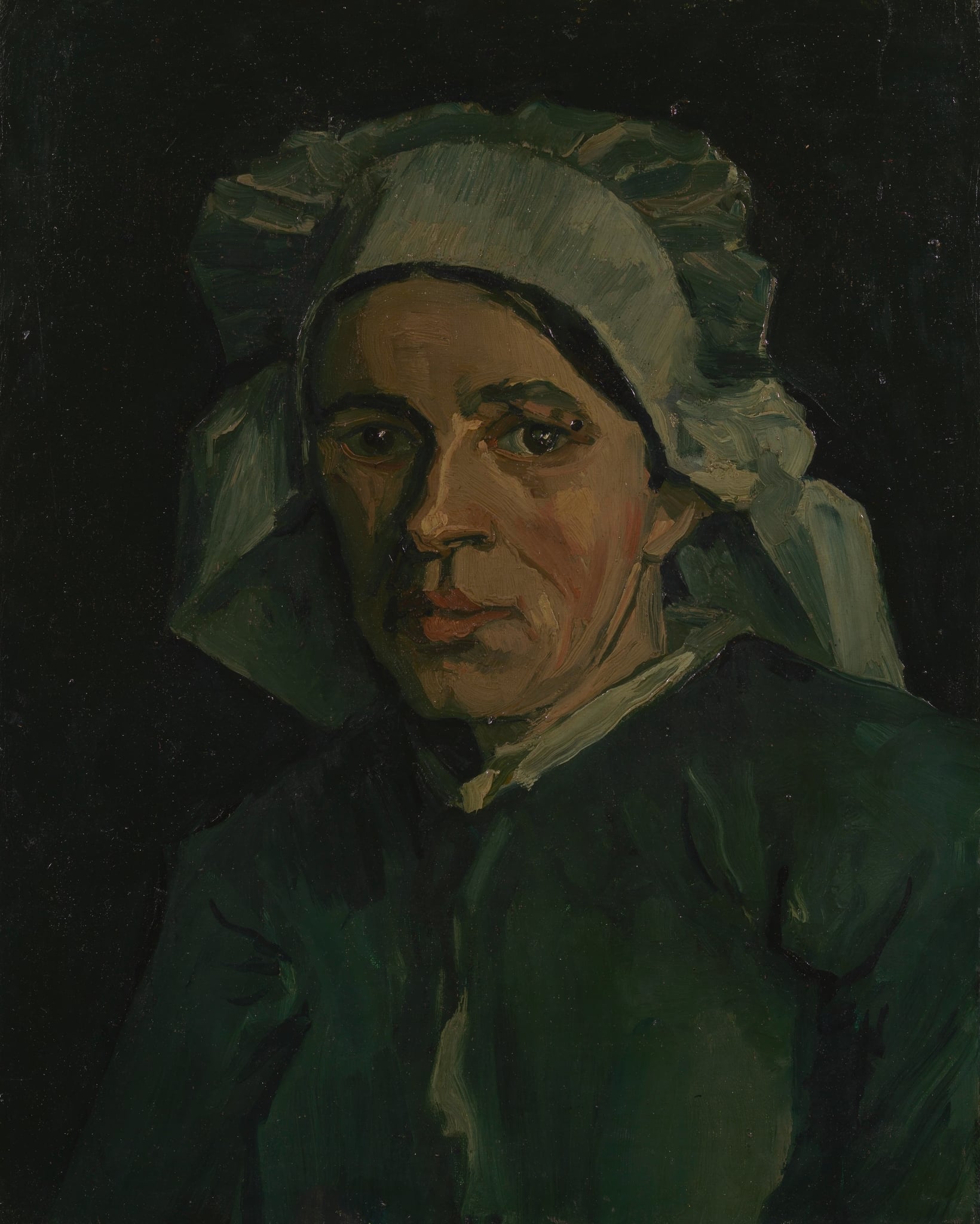
In Café Terrace at Night, Vincent van Gogh turns nocturne into <strong>luminous color</strong>: a gas‑lit terrace glows in yellows and oranges against a deep <strong>ultramarine sky</strong> pricked with stars. By building night “<strong>without black</strong>,” he stages a vivid encounter between human sociability and the vastness overhead <sup>[1]</sup><sup>[2]</sup>.
Irises by Vincent van Gogh

Irises

Vincent van Gogh (1889)

Painted in May 1889 at the Saint-Rémy asylum garden, Vincent van Gogh’s <strong>Irises</strong> turns close observation into an act of repair. Dark contours, a cropped, print-like vantage, and vibrating complements—violet/blue blossoms against <strong>yellow-green</strong> ground—stage a living frieze whose lone <strong>white iris</strong> punctuates the field with arresting clarity <sup>[1]</sup><sup>[2]</sup>.
Sunflowers by Vincent van Gogh

Sunflowers

Vincent van Gogh (1888)

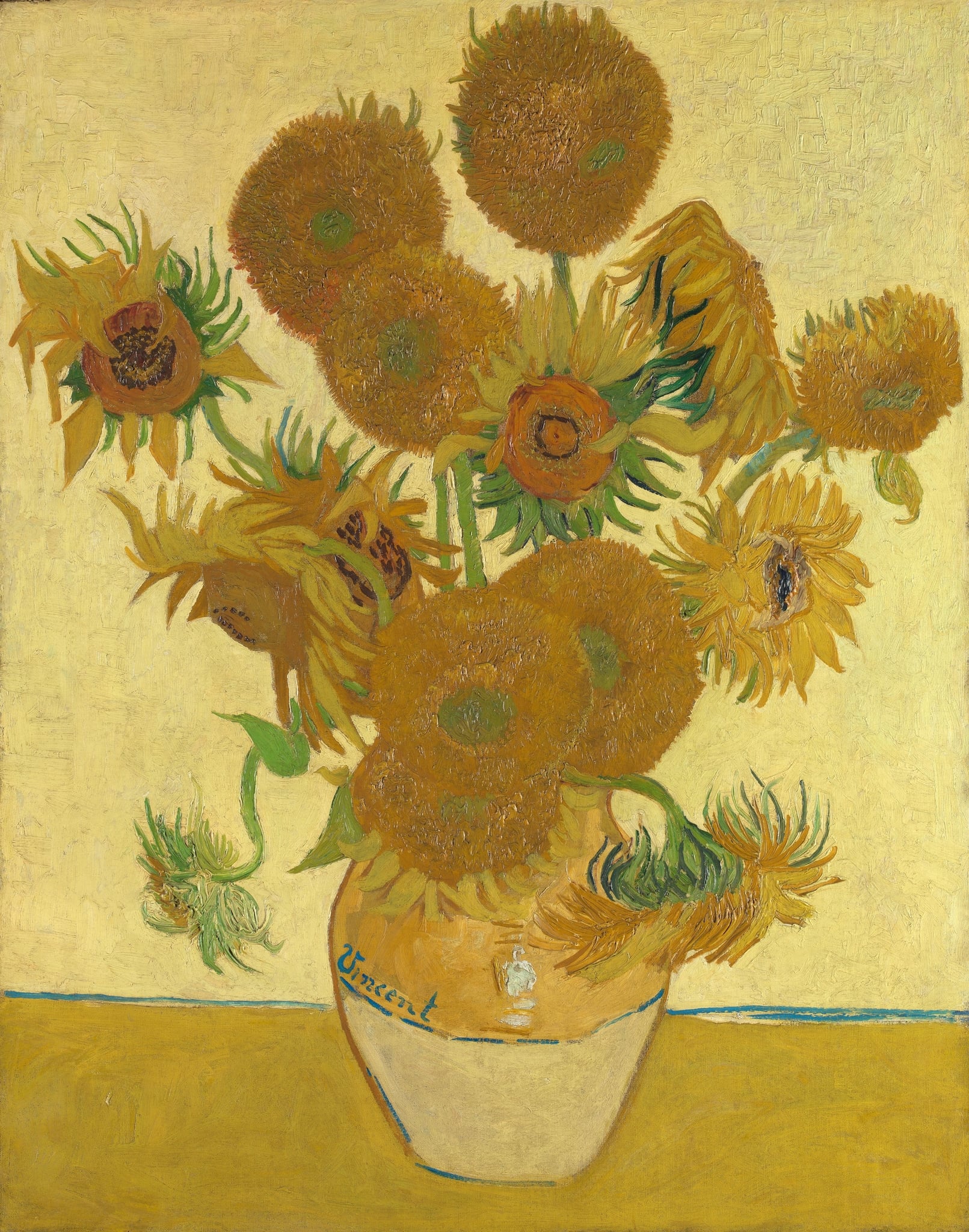
Vincent van Gogh’s Sunflowers (1888) is a <strong>yellow-on-yellow</strong> still life that stages a full <strong>cycle of life</strong> in fifteen blooms, from fresh buds to brittle seed heads. The thick impasto, green shocks of stem and bract, and the vase signed <strong>“Vincent”</strong> turn a humble bouquet into an emblem of endurance and fellowship <sup>[1]</sup><sup>[2]</sup>.
The Red Vineyard by Vincent van Gogh

The Red Vineyard

Vincent van Gogh (1888)

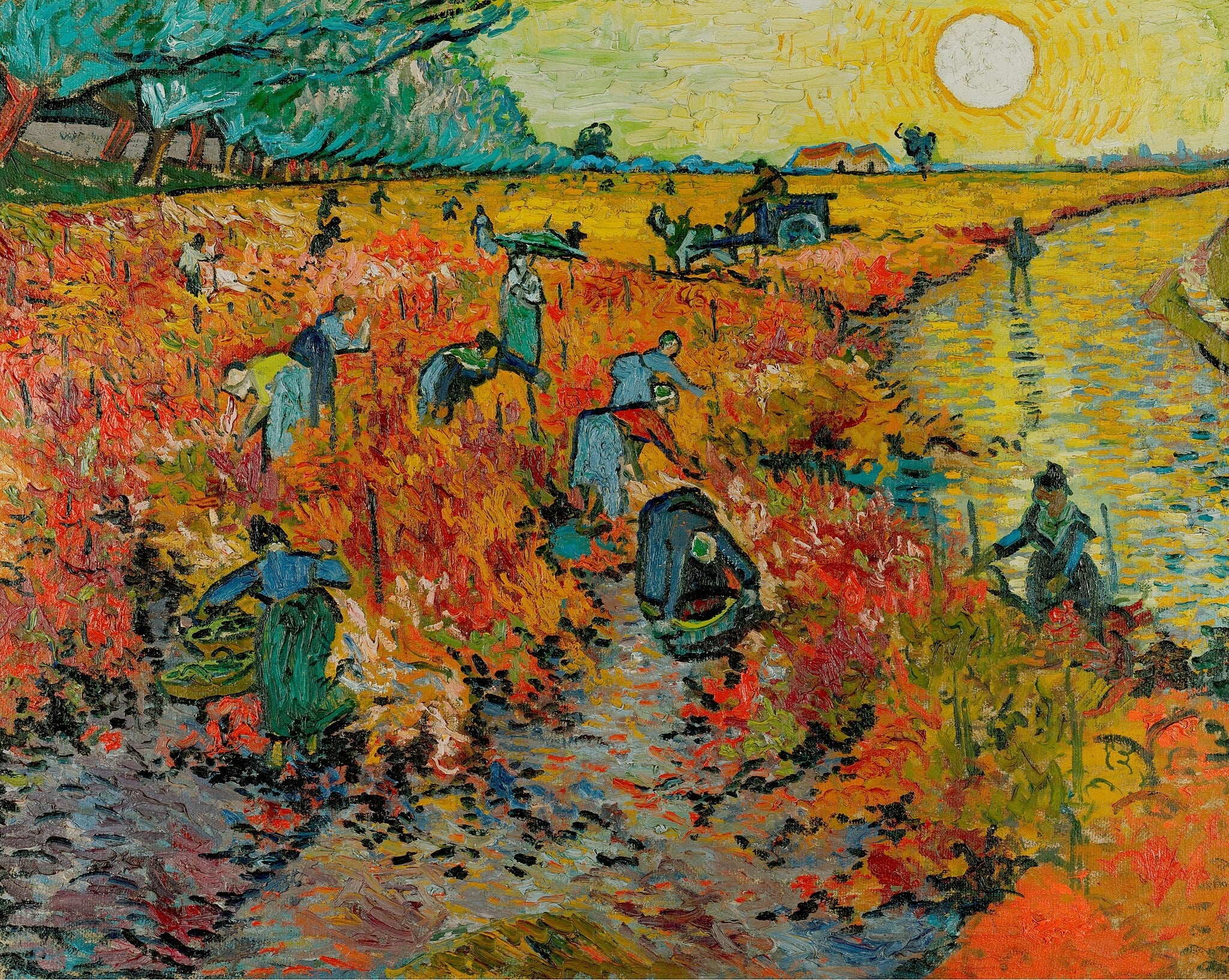
In The Red Vineyard, Vincent van Gogh forges a vision of <strong>autumn labor under a blazing sun</strong>, where harvesters flow diagonally through scarlet vines while a band of <strong>yellow light</strong> flares along a reflective roadway. The scene fuses <strong>exhaustion and ripeness</strong>, turning work into a rhythmic, almost liturgical procession <sup>[1]</sup><sup>[3]</sup>.

The Bedroom by Vincent van Gogh

The Bedroom

Vincent van Gogh (1889)

Vincent van Gogh’s The Bedroom turns a modest room into a psychological stage, using <strong>clashing color</strong> and <strong>tilted space</strong> to test whether color alone can evoke rest. The bright yellow bed, twin chairs, and green‑shuttered window press forward as the floor tilts and pictures cant, so that <strong>refuge and unease</strong> exist side by side <sup>[1]</sup><sup>[2]</sup>.

Self-Portrait with Bandaged Ear by Vincent van Gogh

Self-Portrait with Bandaged Ear

Vincent van Gogh (1889)

In Self-Portrait with Bandaged Ear (1889), Vincent van Gogh converts a recent crisis into an image of <strong>resolve</strong>. The frontal, slightly turned pose forces attention to the white bandage at the viewer’s right, while the fur cap, heavy coat, and the nearby <strong>Japanese print</strong> declare persistence and ideals that steady him in the wake of trauma <sup>[1]</sup><sup>[2]</sup>. The painting’s cool, wintry palette and insistent strokes make suffering legible yet disciplined, transforming pain into <strong>artistic purpose</strong> <sup>[2]</sup>.