Red Cabbages and Onions

by Vincent van Gogh

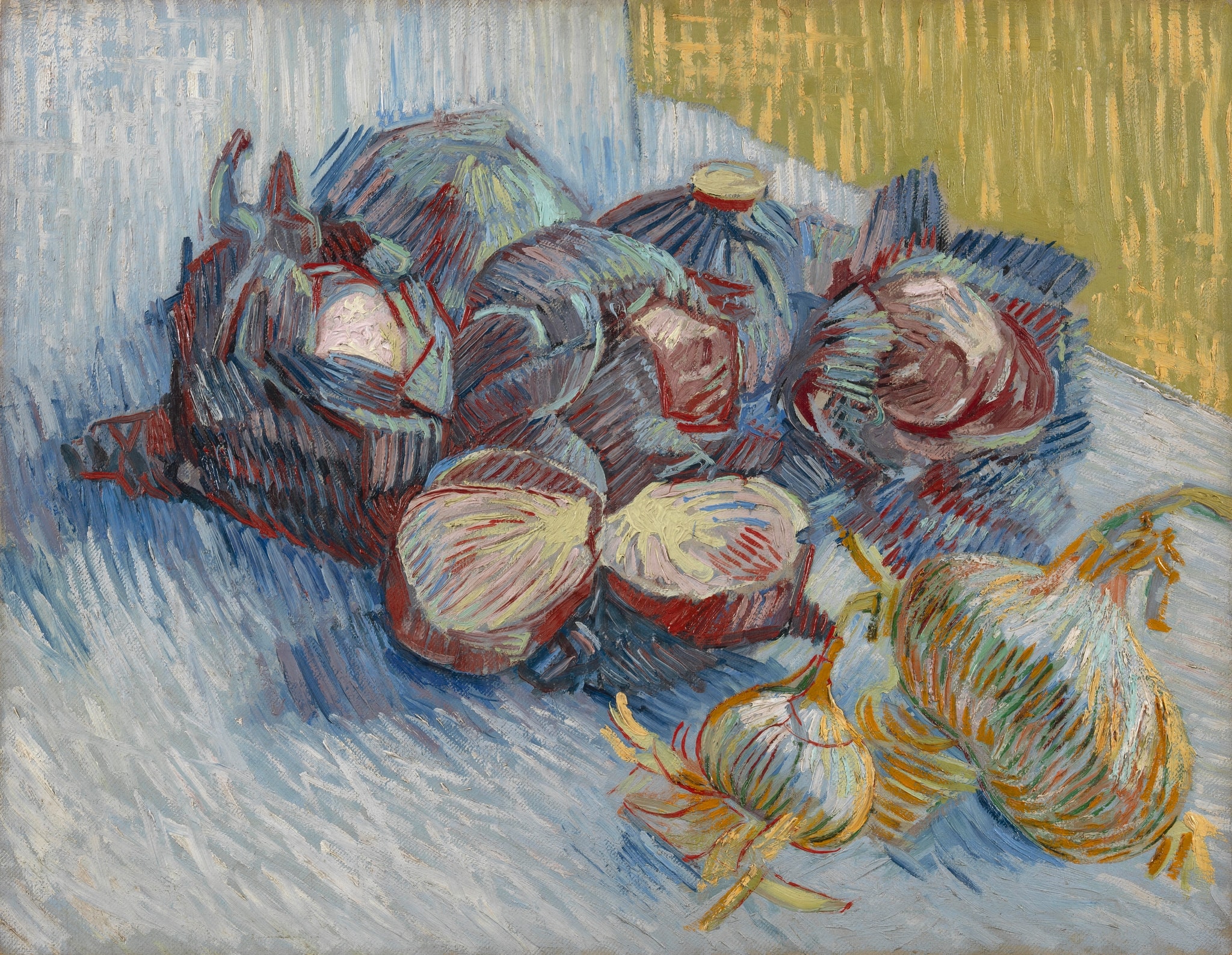
In Red Cabbages and Onions, Vincent van Gogh turns everyday produce into a drama of complementary color and restless brushwork. Hot red contours cinch violet cabbages and pale yellow bulbs against a cool, striated blue table, while a mustard‑yellow patch in the upper right tilts the space and sharpens the chromatic clash. The result asserts ordinary food as a locus of resilience and experimentation [1][2].

Study Print Studio

Create a personal study print

Build a companion study sheet around the part of this painting that speaks to you most. Choose a detail, shape an interpretation, and walk away with something personal and display-worthy.

Fast Facts

Year
1887
Medium
Oil on canvas
Dimensions
50.2 × 64.3 cm
Location
Van Gogh Museum, Amsterdam
See all Vincent van Gogh paintings in Amsterdam
Red Cabbages and Onions by Vincent van Gogh (1887) featuring Layered red cabbages, Red contour halo, Complementary yellow vs. violet/blue clash, Sliced bulbs (garlic/onions) revealing cores

Click on any numbered symbol to learn more about its meaning

Meaning & Symbolism

Van Gogh constructs the composition as a tight heap of cabbages bracketed by two striated bulbs that arc outward in the foreground, a counter‑rhythm that pushes the mass toward the viewer. Short, directional strokes run with and across form, so the blue tabletop is not neutral ground but an active field whose diagonal hatching accelerates around the produce. He binds contours with a hot, vermilion edge; this red halo is not mere outline but a chromatic fuse that ignites the cooler violets and blue‑greens of the cabbage leaves. The sliced bulbs—one at center left, another near the foreground—expose pale yellow interiors that act as local light sources. Set against what was originally a purple tablecloth, those yellows establish the painting’s governing complementary contrast, the very experiment Van Gogh sought in his Paris still lifes 123. The mustard‑yellow panel in the upper right—laid with vertical strokes that differ from the table’s diagonal grain—introduces a second color field and a new spatial tilt. That planar interruption compresses depth and weights the pile of vegetables, making the provisions feel at once heavy and animate. The meaning of Red Cabbages and Onions is not allegory first but method: it proposes that emotion can be generated by calibrated clashes of hue and touch. By selecting cheap, durable fare—layered cabbages, pungent bulbs—Van Gogh frames sustenance as a site of dignity and resolve, then amplifies those values through his handling. The red contour reads as warmth held at the edges of cold tones, a pulse that keeps the heap together under pressure. The sliced bulbs suggest disclosure and interiority; their segmented cloves and the cabbages’ banded leaves echo each other, so structure itself becomes a motif of endurance. Crucially, the museum’s technical record explains that the tablecloth was once purple and has faded toward grey‑blue due to the instability of red lake pigments, a well‑documented issue in Van Gogh’s palette 14. Knowing this sharpens the intended chromatic stakes: the present blue field, already vibrant against the garlic’s yellow, originally struck an even fiercer yellow‑purple chord. In other words, the painting stages both a perceptual experiment and, over time, an unintended experiment in material change—why Red Cabbages and Onions is important to historians and conservators alike 14. Within the Paris period, this canvas demonstrates Van Gogh’s adoption of complementary pairs learned from Delacroix and color theorists, translated into an assertive Post‑Impressionist syntax of short, directional marks and heightened local color 123. The compositional choices are precise: the foreground bulbs angle diagonally to pry open the cluster; the yellow patch above tugs the eye upward and rightward; the repeated hatchings stitch figure to ground while keeping tensions alive. Even the misnaming that long persisted—these bulbs are identified by the museum as garlic rather than onions—ironically underscores the work’s priority: what matters is their yellow mass and layered form as agents of contrast, not their market label 12. Read this way, the still life becomes a compact treatise on visual resilience: common food, restless strokes, and complementary color working together to turn necessity into radiance.

Explore Deeper with AI

Ask questions about Red Cabbages and Onions

Popular questions:

Powered by AI • Get instant insights about this artwork

💬 Ask questions about this artwork!

Interpretations

Technical Art History: Material Change as Content

The picture’s present look encodes its own aging. The Van Gogh Museum notes the tablecloth was originally purple but shifted to grey‑blue as fugitive red lakes faded, weakening the intended yellow–purple opposition that structured the study 1. Conservation science has documented this drift in van Gogh’s palette—particularly “geranium lake” and related eosin dyes—whose photochemical instability selectively erases reds, leaving blues to dominate 3. In this canvas, that shift doesn’t just alter appearance; it becomes part of the work’s meaning, turning a color experiment into a case study in impermanence and curatorial reconstruction. Viewers encounter a palimpsest: van Gogh’s Paris‑era chromatic daring overlaid by time’s chemical edits, a dialogue between original intent and current perception that conservation must constantly negotiate 13.

Source: Van Gogh Museum; npj Heritage Science

Museology & Historiography: The Title as Evidence

The 2023 retitling to Red Cabbages and Garlic clarifies that the bulbs are garlic, not onions—an apparently small fix with interpretive stakes 1. For decades, partner pages still circulated the older title, showing how cataloging lag can sediment misreadings in public discourse 5. Yet the correction ultimately underscores the painting’s priority: regardless of label, van Gogh sought a yellow mass to counter the purple field—a functional role within complementary design 15. The title’s revision is thus a museological lesson in evidence‑based attribution and the limits of nominal categories for works whose meaning is grounded less in iconography than in perceptual structure. It also models how curatorial language evolves alongside technical scrutiny and cross‑domain expertise (here, even culinary knowledge aided identification) 15.

Source: Van Gogh Museum; Google Arts & Culture (Van Gogh Museum partner page)

Color Theory Lineage: Delacroix to Paris Practice

This still life translates nineteenth‑century color theory—Chevreul’s complementaries as filtered through Delacroix—into van Gogh’s compact, post‑Impressionist syntax 2. The garlic’s yellows were pitched against a now‑faded purple ground to produce simultaneous contrast, while a hot red contour “ignites” adjacent cools, a device he also applies in cognate Paris still lifes like Basket of Apples (Saint Louis) 4. These choices show color operating as structure: the upper‑right yellow field counterbalances the tabletop’s diagonals, engineering tension across the rectangle. Rather than imitate Neo‑Impressionist divisionism, van Gogh mobilizes short, directional touches as a plastic equivalent for vibration, harnessing complements to conjure luminosity without systematic pointillism—a pragmatic Paris‑era solution marrying theory and touch 24.

Source: Van Gogh Museum (Vincent’s colours); Saint Louis Art Museum

Haptics & Support: A Tactile Modernism

Paint handling and twill canvas support collaborate to make matter feel graspable. The cross‑grain weave catches oblique strokes so that hatching “runs with and across form,” producing a tactile drag that acts like relief against the eye 14. Red cabbages are not merely seen; they are felt through a haptic rhetoric of faceting, scumbling, and vermilion edging that binds forms under pressure. This aligns with Paris‑period still lifes where van Gogh’s assertive contouring and built‑up impasto turn tabletop motifs into studies of pressure and release—surface as a register of exertion. In Red Cabbages and Garlic, facture doubles as phenomenology: how a hand, moving briskly in the city’s tempo, can convert cheap produce into a modernist laboratory of touch 14.

Source: Van Gogh Museum; Saint Louis Art Museum

Social Art History: Sustenance, Class, and Dignity

Van Gogh repeatedly used inexpensive provisions as testbeds for color because they were accessible and emblematic of everyday survival in Paris 7. Here, the densely layered cabbages and pungent garlic are cast as sustenance with dignity, their structural toughness mirrored by banded leaves and segmented cloves—motifs of endurance pressed into painterly syntax 17. This is not moralizing allegory so much as an ethics of attention: giving working‑class staples the chromatic intensity often reserved for luxury flowers or silverware. By fusing complementary drama with ordinary fare, the canvas reads as a small politics of the table—asserting value through amplified looking, and suggesting that resilience can be composed from common materials, both in life and in paint 17.

Source: Van Gogh Museum; Penn State Open Publishing (scholarly survey on van Gogh’s still lifes)

Related Themes

About Vincent van Gogh

Vincent van Gogh (1853–1890) developed a radical, emotion‑driven use of color after moving from Paris to Arles in 1888, seeking southern light and an artists’ community. In Arles he created the Sunflowers series to decorate the Yellow House ahead of Gauguin’s visit. His late work fused impasto, high chroma, and symbolic motifs that shaped modern painting [2][5].
View all works by Vincent van Gogh

More by Vincent van Gogh
Café Terrace at Night by Vincent van Gogh

Café Terrace at Night

Vincent van Gogh (1888)

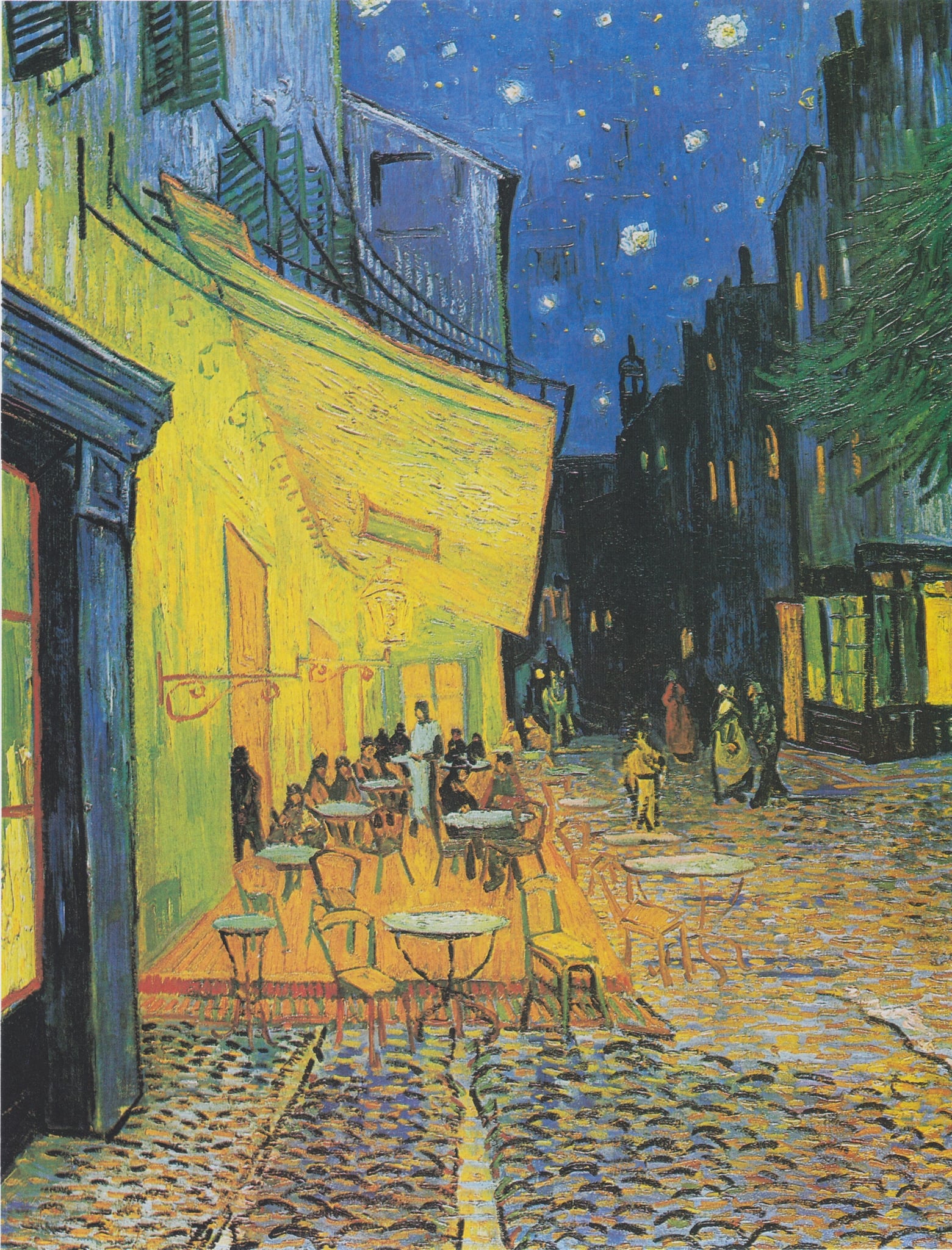
In Café Terrace at Night, Vincent van Gogh turns nocturne into <strong>luminous color</strong>: a gas‑lit terrace glows in yellows and oranges against a deep <strong>ultramarine sky</strong> pricked with stars. By building night “<strong>without black</strong>,” he stages a vivid encounter between human sociability and the vastness overhead <sup>[1]</sup><sup>[2]</sup>.

Irises by Vincent van Gogh

Irises

Vincent van Gogh (1889)

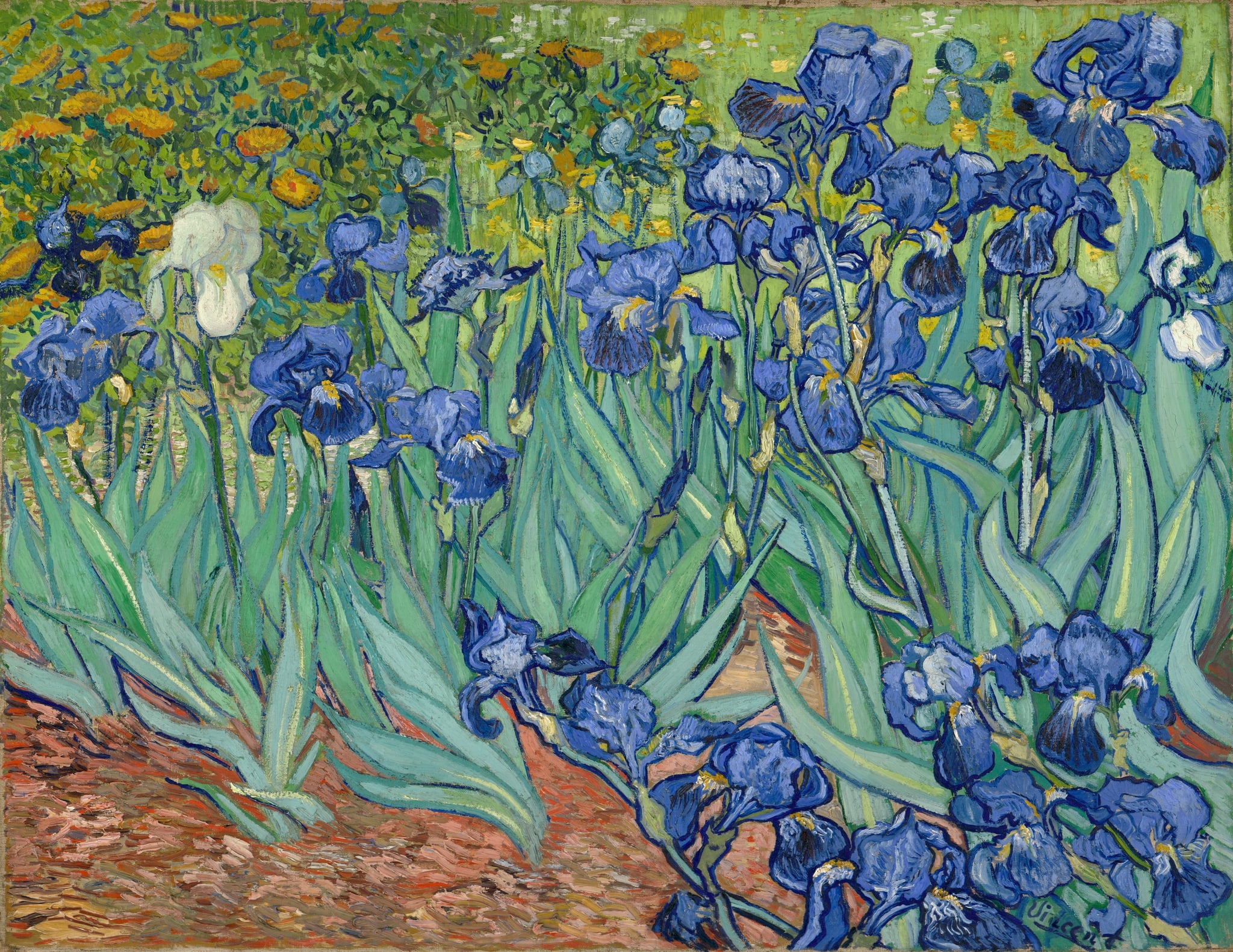
Painted in May 1889 at the Saint-Rémy asylum garden, Vincent van Gogh’s <strong>Irises</strong> turns close observation into an act of repair. Dark contours, a cropped, print-like vantage, and vibrating complements—violet/blue blossoms against <strong>yellow-green</strong> ground—stage a living frieze whose lone <strong>white iris</strong> punctuates the field with arresting clarity <sup>[1]</sup><sup>[2]</sup>.

Sunflowers by Vincent van Gogh

Sunflowers

Vincent van Gogh (1888)

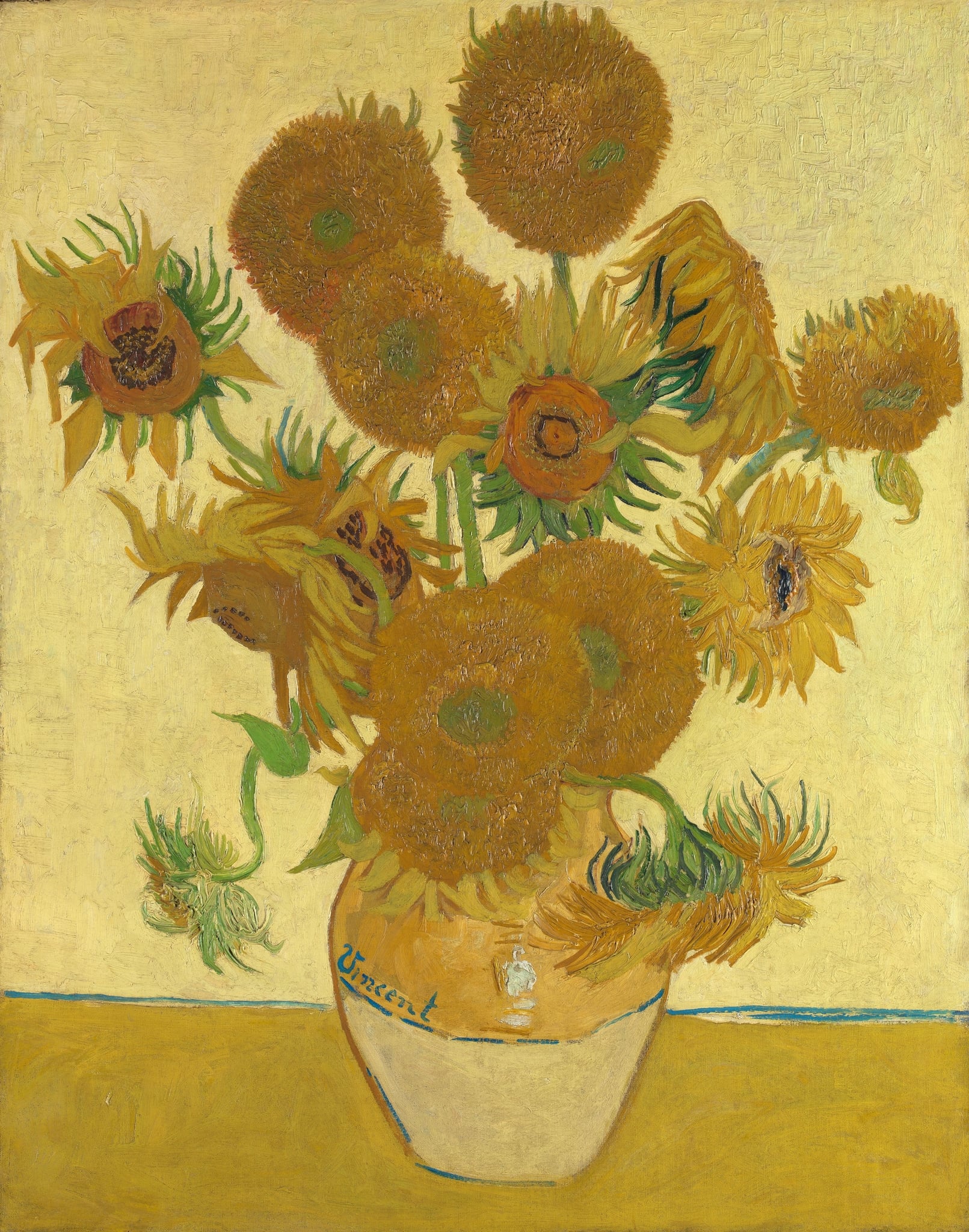
Vincent van Gogh’s Sunflowers (1888) is a <strong>yellow-on-yellow</strong> still life that stages a full <strong>cycle of life</strong> in fifteen blooms, from fresh buds to brittle seed heads. The thick impasto, green shocks of stem and bract, and the vase signed <strong>“Vincent”</strong> turn a humble bouquet into an emblem of endurance and fellowship <sup>[1]</sup><sup>[2]</sup>.

Garden with Courting Couples: Square Saint-Pierre by Vincent van Gogh

Garden with Courting Couples: Square Saint-Pierre

Vincent van Gogh (1887)

In Garden with Courting Couples: Square Saint-Pierre, Vincent van Gogh turns a small Montmartre park into a stage where <strong>spring</strong>, <strong>intimacy</strong>, and <strong>urban leisure</strong> converge. Short, shimmering strokes fuse pink chestnut blossoms, curving paths, and paired figures into one pulse of <strong>renewal</strong> and <strong>togetherness</strong> <sup>[1]</sup><sup>[2]</sup>.

In the Café: Agostina Segatori in Le Tambourin by Vincent van Gogh

In the Café: Agostina Segatori in Le Tambourin

Vincent van Gogh (1887 (Jan–Mar))

Van Gogh casts Agostina Segatori at a tiny, tambourine‑like café table, turning Le Tambourin into a <strong>stage of modern life</strong>. Cool greens and greys make the red <strong>flame‑plume hat</strong> and the foaming <strong>beer</strong> flare, while folded arms and a set‑aside <strong>parasol</strong> register private fatigue amid public display <sup>[1]</sup><sup>[2]</sup><sup>[3]</sup>.
Boulevard de Clichy by Vincent van Gogh

Boulevard de Clichy

Vincent van Gogh (1887)

Vincent van Gogh’s Boulevard de Clichy crystallizes a cool, wintry Paris into a <strong>vibrating field of light</strong> and motion. With leafless trees echoing lamp posts and façades stitched from lilac, blue, and sulfurous yellow strokes, the boulevard bends like a <strong>slow river of modernity</strong>. Tiny bundled figures drift across the cobbles, signaling the city’s <strong>anonymous flow</strong>.