How Much Is Roses Worth?
Last updated: June 27, 2026
Quick Facts
- Methodology
- comparable analysis
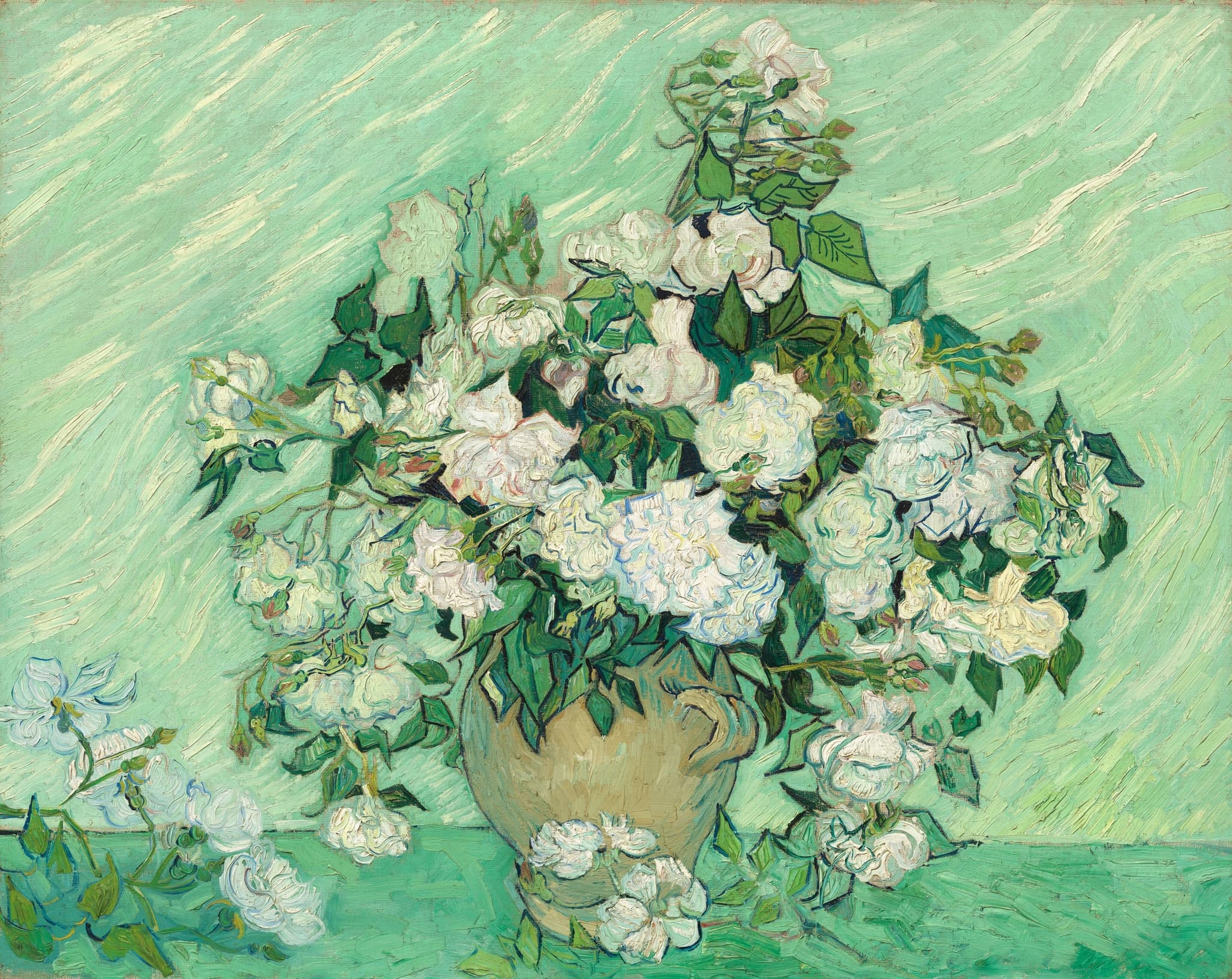
Roses (1890) is a major late Saint-Rémy still life by Vincent van Gogh, held by the National Gallery of Art. Anchored by the $61.8m 2014 sale of a related late floral, the $117.2m Van Gogh auction record (2022), and the iconic Irises benchmark, a current notional auction value of $120–180 million (incl. premium) is appropriate.
Valuation Analysis
Estimated value (auction, incl. premium): $120–180 million. This range is derived from a structured comparable analysis of closely related Van Gogh late florals and prime Saint‑Rémy period oils, calibrated to recent top-tier results. The 2014 sale of Still Life, Vase with Daisies and Poppies at $61.8m establishes a modern anchor for late floral still lifes [1]. The artist’s current auction record, Orchard with Cypresses, achieved $117.2m in 2022, indicating demonstrated headroom for A‑period masterpieces [3]. Irises (1889)—the paradigmatic near‑period floral—achieved $53.9m in 1987 (well over $150m in today’s dollars), providing a historical ceiling for the category’s most iconic examples [2].
Additional Saint‑Rémy comparables support depth in the $50–80m band for prime late oils: Cabanes de bois parmi les oliviers et cyprès realized $71.35m (with fees) in 2021, and Champs près des Alpilles made $51.9m in 2022 [4][5]. The market also confirmed robust appetite for quality still lifes with the $62.71m 2025 result for Piles de romans parisiens et roses dans un verre (Paris, 1887), underscoring sustained demand for the genre at the high end [6]. Taken together, these data points place NGA’s Roses—an A‑period, museum‑grade late floral—comfortably in the low‑to‑mid nine‑figure zone.
Qualitative merit and art‑historical standing. Painted in May 1890, Roses belongs to the celebrated Irises/Roses ensemble from Saint‑Rémy. Its status within that quartet has been underscored by focused scholarship and exhibitions, including The Met’s 2015 presentation, which cemented its importance among Van Gogh’s late still lifes [7]. Large scale, vigorous impasto, and exceptional visibility further elevate its desirability. The work’s early provenance—from Johanna van Gogh‑Bonger to Paul Gallimard, and later via Bernheim‑Jeune and Knoedler to W. Averell Harriman—culminates in its current home at the National Gallery of Art; the NGA object record documents this chain clearly [8].
Positioning and price logic. Benchmarking a prime late floral above the 2014 $61.8m comp, but below the absolute, landscape‑led record of $117.2m, produces a rational $120–180m corridor. The upper bound recognizes the work’s ensemble significance and trophy appeal; the lower bound reflects a disciplined read of recent late‑period Saint‑Rémy results and the still‑life category’s demonstrated maxima. Under neutral market conditions and assuming excellent condition, a central tendency around the mid‑$100m level is defensible.
Assumptions and sensitivities. This valuation presumes clear title, first‑rate conservation (notably preservation of thick impasto and surface), and top‑tier sale mechanics (global tour, robust guarantee). While 2024 showed softness in parts of the Modern category, the 2025–26 rebound for marquee consignments suggests that a museum‑caliber Van Gogh of this quality would attract deep, competitive bidding today [6]. As a museum‑held painting, any pricing remains hypothetical; however, the comp set and qualitative profile support the stated range with high confidence.
Key Valuation Factors
Art Historical Significance
High ImpactRoses (1890) belongs to Van Gogh’s pivotal late Saint‑Rémy period and is integrally related to the Irises/Roses ensemble painted just before he left the asylum. This small corpus has been the focus of extensive scholarship and high‑profile exhibitions, notably The Met’s 2015 presentation that explicitly reunited variants and framed their artistic ambition. The painting’s scale, energy, and visibility in the literature place it well above a routine still life. Within Van Gogh’s oeuvre, while landscapes like Cypresses or certain portraits draw record prices, the late florals occupy a near‑top tier: instantly recognizable, saturated with period resonance, and essential to the artist’s final chapter.
Rarity and Supply
High ImpactTop‑quality late Van Gogh florals are exceptionally scarce in private hands; most reside in major museums. Since 2014, only a handful of late-period comparables have surfaced publicly, and the best‑in‑class results for Saint‑Rémy oils consistently show deep bidding. The 2014 Sotheby’s result for a late floral at $61.8m set a modern floor for the category, and the majority of comparable works of similar stature (by date, subject, and finish) are institutionally held. This acute scarcity—coupled with global trophy demand—supports step‑change pricing when a work of this caliber emerges, justifying a low‑to‑mid nine‑figure valuation.
Subject, Period, and Scale Appeal
High ImpactThe market prizes Van Gogh’s Arles and Saint‑Rémy periods, and late still lifes from 1889–90 are particularly desirable due to their bold coloration, thick impasto, and emotive intensity. Roses checks these boxes with a large horizontal format and a dynamic, highly worked surface that reads powerfully at auction scale. Price data from late 2021–2022 Saint‑Rémy oils (≈$52–71m) and the 2014 and 2025 still‑life benchmarks underscore that subject and period alignment can elevate results markedly. Among still lifes, late florals sit just below the most iconic landscapes and portraits—a profile consistent with the $120–180m range.
Provenance and Museum Visibility
High ImpactThe painting’s provenance—from Johanna van Gogh‑Bonger to Paul Gallimard, through Bernheim‑Jeune and Knoedler to W. Averell Harriman, and ultimately the National Gallery of Art—offers exceptional legitimacy. Long‑term museum visibility compounds brand value: repeated publication, scholarly analysis, and major exhibitions significantly increase recognition and bidder confidence. Works with this caliber of documentation and institutional profile are primed for ‘trophy’ positioning by auction houses, attracting international underbidders and aggressive guarantee terms. The stability and transparency of its ownership history meaningfully de‑risk the transaction, reinforcing a premium valuation placement within the Van Gogh market.
Sale History
Private sale (Paris)
Sold by Johanna van Gogh-Bonger to Paul Gallimard for 400 francs; USD not recorded. Documented in the NGA object record.
National Gallery of Art, Washington, DC
Gift of Pamela Harriman in memory of W. Averell Harriman; accession completed 1997 (not a sale).
Vincent van Gogh's Market
Vincent van Gogh sits at the apex of global blue‑chip demand, with extremely limited supply of A‑period oils and consistent international competition. The artist’s auction record stands at $117.2m for Orchard with Cypresses (Christie’s, 2022), while still‑life and Saint‑Rémy benchmarks include $71.35m for a prime 1889 oil (2021) and $61.8m for a late floral in 2014. A 2025 still‑life result at $62.71m reinforced category strength. Although selective softness appeared in 2024, top‑end appetite rebounded in late 2025–2026 for museum‑quality consignments. In this context, late‑period Van Gogh masterpieces with pristine provenance, high visibility, and trophy appeal reliably command nine‑figure estimates and results.
Comparable Sales
Nature morte, vase aux marguerites et coquelicots (Still Life, Vase with Daisies and Poppies)
Vincent van Gogh
Closest direct comp: late 1890 floral still life by Van Gogh; same subject category, similar date and A‑period quality.
$61.8M
2014, Sotheby's New York
~$81.5M adjusted
Irises
Vincent van Gogh
Iconic 1889 Saint‑Rémy floral still life; same late period, closely related subject and scale.
$53.9M
1987, Sotheby's New York
~$153.6M adjusted
Piles de romans parisiens et roses dans un verre (Romans parisiens)
Vincent van Gogh
Still life including roses (1887); strong market benchmark for Van Gogh still lifes in the 2025 environment.
$62.7M
2025, Sotheby's New York
Orchard with Cypresses
Vincent van Gogh
Near‑period Arles (1888) masterpiece and current Van Gogh auction record; calibrates the ceiling for A+ works.
$117.2M
2022, Christie's New York
~$127.7M adjusted
Cabanes de bois parmi les oliviers et cyprès
Vincent van Gogh
Prime 1889 Saint‑Rémy oil; shows pricing for top late works in recent marquee sales.
$71.3M
2021, Christie's New York
~$82.8M adjusted
Champs près des Alpilles
Vincent van Gogh
1889 Saint‑Rémy landscape; indicates price depth just below the very top tier of late oils.
$51.9M
2022, Christie's New York
~$56.6M adjusted
Current Market Trends
After a contraction in 2024, the marquee segment re‑energized in late 2025–spring 2026, with buyers stretching for fresh, museum‑quality works while remaining selective elsewhere. Within Impressionist and Post‑Impressionist art, pricing has polarized: mid‑tier material faces disciplined bidding, but A‑period masterpieces with top provenance and marketing continue to clear at or above expectations. Van Gogh remains a bellwether: late Saint‑Rémy and Arles oils consistently lead category totals, and strong still‑life results confirm depth beneath the artist’s landscape record. Guarantees, global touring, and sale choreography remain critical drivers of outcome dispersion at the very top.
Study print
Study this painting as a print
Pair the full artwork with a museum-style study sheet focused on one meaningful detail.
Sources
- The Independent — Rare Van Gogh artwork sells for $61.8m at Sotheby’s
- The Washington Post — $53.9 million for Van Gogh
- The Art Newspaper — A Van Gogh record: Orchard with Cypresses soars to $117m at Paul Allen auction
- Seydoux & Associates — Market Perspective: Impressionist & Twentieth Century Art, Nov 2021
- The Art Newspaper — Christie’s evening sales hit $831m
- Sotheby’s — New York Sales November 2025 Evening Results
- The Metropolitan Museum of Art — Van Gogh: Irises and Roses (2015)
- National Gallery of Art — Roses (object record)