Roses

by Vincent van Gogh

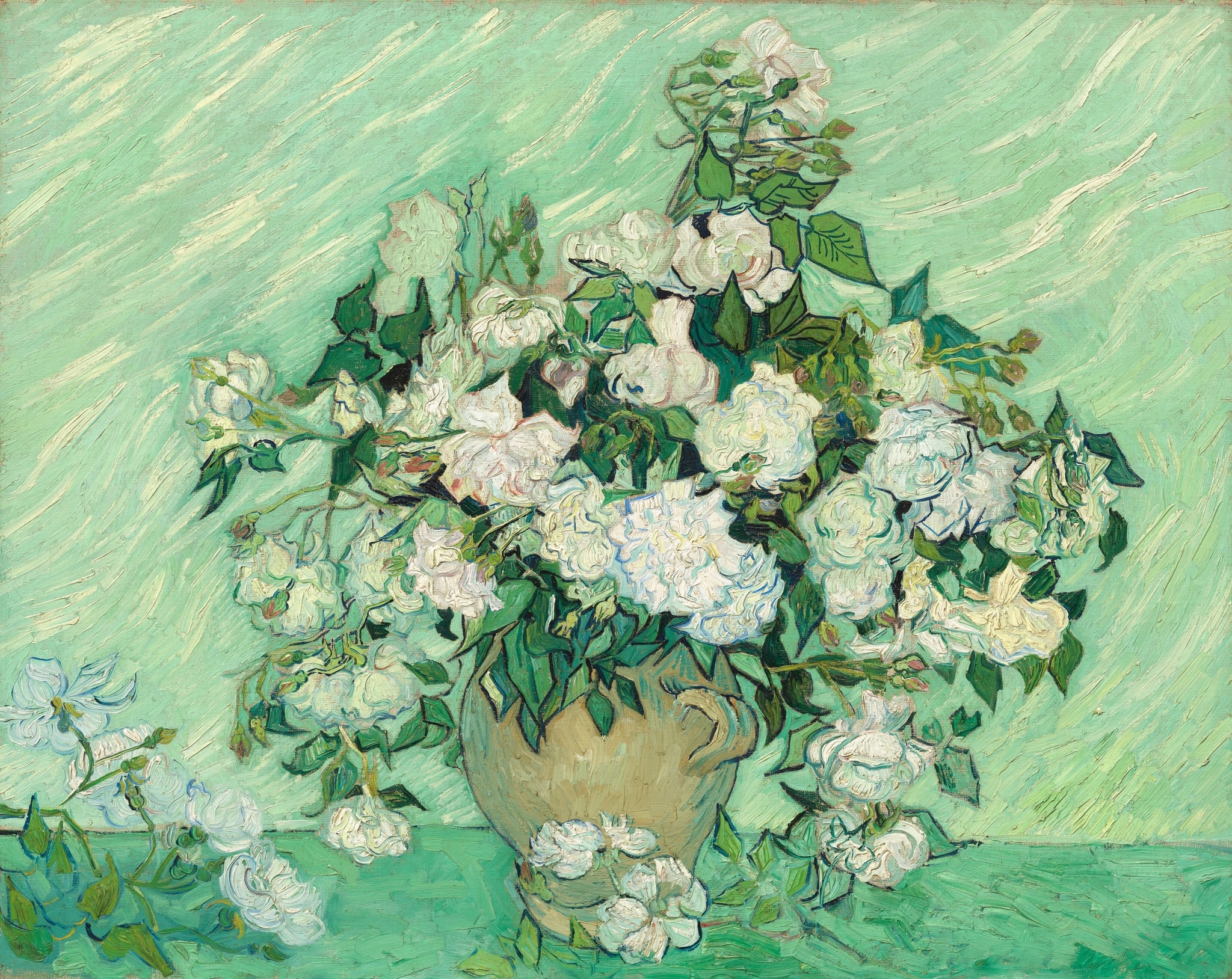
Roses gathers a bursting bouquet in a simple earthen pot against a sea of mint-green strokes, its blooms tipping, spilling, and glowing a cool white. Van Gogh’s thick, directional brushwork charges the still life with restless vitality, while the restrained green-and-pale palette creates a restorative calm [1]. Conservation shows the flowers were once pink, their fading altering the intended pink–green complement that anchored the ensemble of Irises and Roses from May 1890 [1][2][4].
💰

Market Value

$120-180 million

How much is Roses worth?

Study Print Studio

Create a personal study print

Build a companion study sheet around the part of this painting that speaks to you most. Choose a detail, shape an interpretation, and walk away with something personal and display-worthy.

Fast Facts

Year
1890
Medium
Oil on canvas
Dimensions
71 × 90 cm
Location
National Gallery of Art, Washington, DC
See all Vincent van Gogh paintings in Tokyo
Roses by Vincent van Gogh (1890) featuring White roses in bloom, Fallen blossoms and stems, Earthen vase, Swirling mint‑green field

Click on any numbered symbol to learn more about its meaning

Meaning & Symbolism

Van Gogh builds Roses on orchestrated contrasts: a massed bouquet, aggressively cropped and bristling with dark green contours, pushes forward from a light, rippling field of mint. The brushwork runs in diagonal, wave-like ribbons across background, tabletop, and leaves, so that no area sits still; even the negative space seems to breathe. Against this swaying ground, the earthen vase anchors the heap of stems that arc and droop, with several blossoms slipping onto the table at left and along the base. These compositional moves are not decorative flourishes; they stage a drama of vitality under gravity. The bouquet is full, fresh, and springlike, yet its weight drags blooms downward; open roses face us while others crumple or turn away. The result is a declarative image of renewal under pressure, a thesis Van Gogh pursued repeatedly in Saint‑Rémy as he prepared to leave the asylum: blossoming plants as celebrations of life, but never sentimentalized, always bound to time’s pull 1. Color is the work’s structural engine. In letters of 11–12 May 1890, Van Gogh wrote that he was painting “a canvas of roses with a light green background,” seeking deliberate complementary interaction between the pink of the roses and the surrounding greens 3. Conservation now demonstrates that the reds were largely fugitive lakes; as these faded, the roses shifted toward white and pale yellow, flattening the pink–green charge that originally keyed the ensemble of two Roses and two Irises 124. Read with that knowledge, the painting articulates two simultaneous truths. In the present, its cool tonality suggests convalescence: a balm of mint and milk-white, a measured, lucid calm. In its intended state, the picture would have pulsed with warmer pinks striking against the green field, a more extroverted harmony aligned with Van Gogh’s pursuit of “calm, unremitting ardor” in this final Saint‑Rémy campaign 2. Either way, the chromatic plan is purposeful—color as mood, not emblem—and it affirms the artist’s late conviction that optical contrast can deliver feeling more directly than literary symbol. Material facture clinches the argument. The impasto is sculptural on the petals—cresting ridges that catch light—while leaves are knifed with darker outlines that snap the forms into focus. Those outlines are not mere style; they are a stabilizing counterbeat to the flowing ground, a way to hold life-in-motion within a coherent frame. Notice, too, the fallen stems at the foot of the vase and the stray blossoms at lower left: not a memento mori in the academic sense, but a candid admission of transience that sharpens the sensation of abundance. The bouquet is overflowing precisely because it is fleeting. Biography tightens the screw. Painted in May 1890, in the final days before leaving Saint‑Rémy, Roses was so thickly painted that Van Gogh left it behind to dry, a practical index of the urgency he described when he told his sister he had worked “like a man in a frenzy… big bouquets of roses” 13. In that light, the painting’s meaning resolves: a confident, last Provence manifesto about life pushing forward—color against color, stroke against stroke—even as petals drift. That is why Roses is important: it fuses late-style energy, color theory, lived circumstance, and the afterlife of materials into one lucid demonstration of how painting can carry hope without denying change 1245.

Explore Deeper with AI

Ask questions about Roses

Popular questions:

Powered by AI • Get instant insights about this artwork

💬 Ask questions about this artwork!

Interpretations

Material Urgency: Facture as Timeline

The painting reads like a studio diary of May 1890. Impasto piled on petals, dark knife‑edged contours on leaves, and sweeping diagonal ribbons testify to speed and wet‑in‑wet handling. This was labor under a deadline: Van Gogh left both Roses behind to dry when he departed the asylum on May 16; they reached Auvers by June 24. His letter to Wilhelmina—he worked “like a man in a frenzy… big bouquets of roses”—and to Theo about the “light green background” align with what the surface shows: a campaign resolved through matter itself, where thickness, drying time, and logistics are structural constraints shaping the image we see 145.

Source: National Gallery of Art; Van Gogh Letters (WebExhibits)

Medical Humanities: Painting Convalescence

Read beside the asylum timeline, the palette’s present mint and milk‑white register as self‑prescribed calm—an image of convalescence rather than triumph. NGA cautions against fixed flower allegory, yet Van Gogh consistently cast “blossoming plants as celebrations of birth and renewal,” here staged on the eve of release. The bouquet’s vigor is counterweighted by droop and fallen stems, acknowledging relapse risk without surrendering to it. This is recovery visualized as regulated stimulation: directional brush‑rhythms energize, while cool tonality soothes—a therapeutic balance before the intense Auvers sprint that would follow only weeks later 16.

Source: National Gallery of Art; Van Gogh Museum (biography)

Conservation Science: Reconstructing Lost Pinks

The present coolness of NGA’s Roses is partly an artifact of chemistry. Van Gogh’s pinks were built with fugitive red lake pigments whose organic dyes have faded, shifting blossoms toward white and muting the intended pink–green complementarity. Technical studies (cross‑sections, multispectral imaging) across the Irises and Roses ensemble document this loss and model plausible original chroma, clarifying that the series once pulsed with higher saturation and warmer accents. That shift is not cosmetic; it reframes mood and structure, altering balance between bouquet and mint ground and the set’s inter‑canvas dialogue. Conservation thus supplies an interpretive key: the painting was conceived as a work of chromatic tension, not the pale serenity we now see 123.

Source: npj Heritage Science (Met Scientific Research); National Gallery of Art; The Metropolitan Museum of Art

Ensemble Logic: A Four‑Canvas Thesis

Roses belongs to a deliberately paired quartet—two Irises and two Roses—planned in contrasting formats and color schemes as Van Gogh’s “last touch of the brush” at Saint‑Rémy. Seeing the works together (as the Met did in 2015) clarifies a program: complementary dyads (pink/green; violet/yellow‑citron), horizontal vs. vertical staging, and variations in brush‑rhythm that create a synthetic “calm, unremitting ardor.” Dispersal and color fading fragment that logic, but the ensemble lens shows Roses as a structural counterpoint within a cycle, not an isolated bouquet. The NGA canvas’s expansive horizontal field and rippling ground likely answered a more upright partner, testing how format governs pictorial energy and chromatic charge across the set 213.

Source: The Metropolitan Museum of Art (Irises and Roses, 2015); National Gallery of Art

Perception over Symbol: Optical Ethics

Van Gogh’s own letters argue for optical contrast as the most direct vehicle of feeling—“color as mood, not emblem.” In Roses, the green ground corrals the bouquet’s pinks (now faded), while dark contours stabilize swells of impasto into legible forms. The result is a still life that privileges seen sensation—stroke direction, value edges, chroma friction—over literary symbol. Even the negative space “seems to breathe,” shifting the truth claim from what roses mean to how painting can make vitality felt through calibrated perception. It’s a late Post‑Impressionist ethic: mimesis refined by facture to intensify experience rather than to narrate it 142.

Source: National Gallery of Art; Van Gogh Letters; The Metropolitan Museum of Art

Related Themes

About Vincent van Gogh

Vincent van Gogh (1853–1890) developed a radical, emotion‑driven use of color after moving from Paris to Arles in 1888, seeking southern light and an artists’ community. In Arles he created the Sunflowers series to decorate the Yellow House ahead of Gauguin’s visit. His late work fused impasto, high chroma, and symbolic motifs that shaped modern painting [2][5].
View all works by Vincent van Gogh

More by Vincent van Gogh
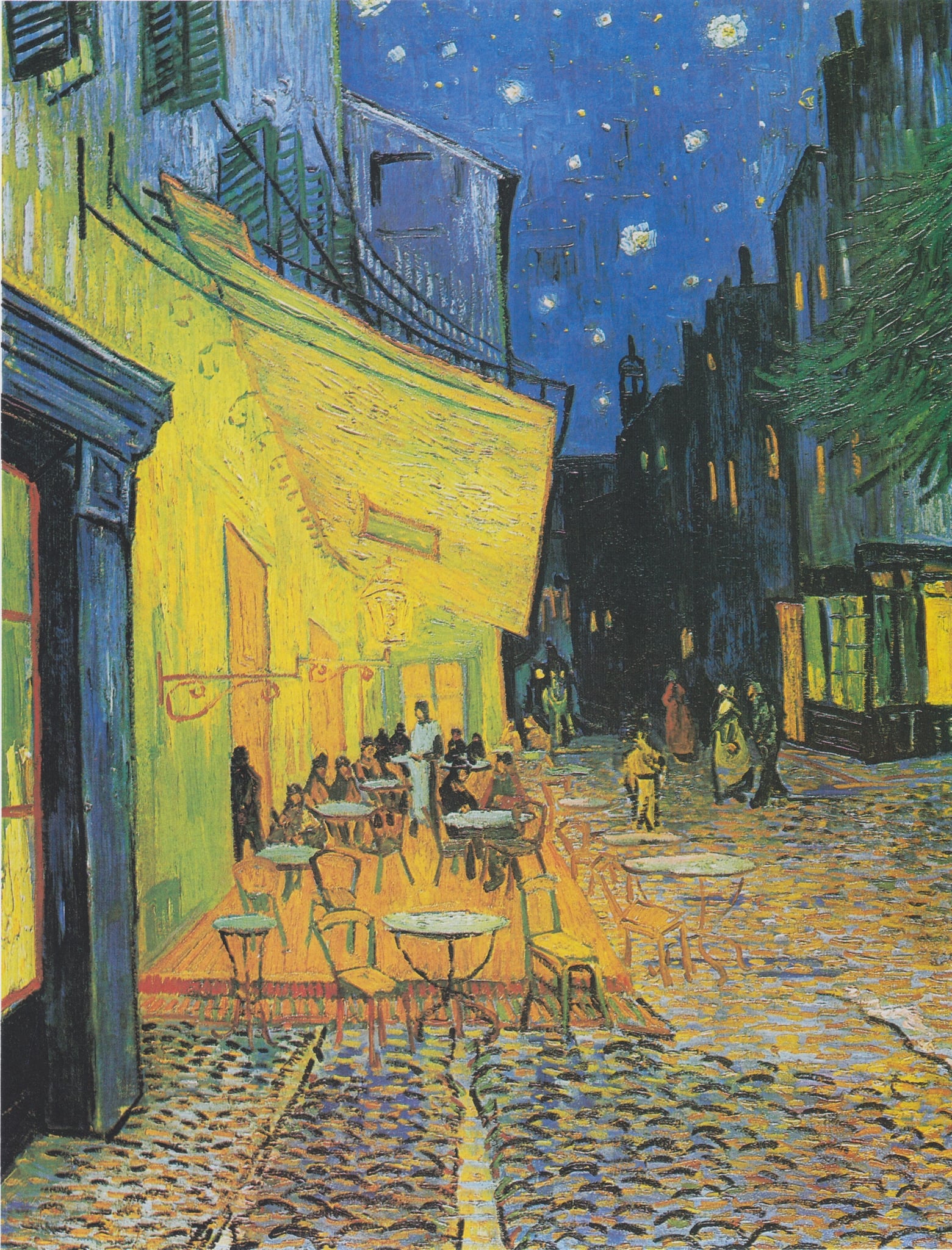
Café Terrace at Night by Vincent van Gogh

Café Terrace at Night

Vincent van Gogh (1888)

In Café Terrace at Night, Vincent van Gogh turns nocturne into <strong>luminous color</strong>: a gas‑lit terrace glows in yellows and oranges against a deep <strong>ultramarine sky</strong> pricked with stars. By building night “<strong>without black</strong>,” he stages a vivid encounter between human sociability and the vastness overhead <sup>[1]</sup><sup>[2]</sup>.
Red Cabbages and Onions by Vincent van Gogh

Red Cabbages and Onions

Vincent van Gogh (1887)

In Red Cabbages and Onions, Vincent van Gogh turns everyday produce into a drama of <strong>complementary color</strong> and <strong>restless brushwork</strong>. Hot red contours cinch violet cabbages and pale yellow bulbs against a cool, striated blue table, while a mustard‑yellow patch in the upper right tilts the space and sharpens the chromatic clash. The result asserts ordinary food as a locus of <strong>resilience</strong> and <strong>experimentation</strong> <sup>[1]</sup><sup>[2]</sup>.

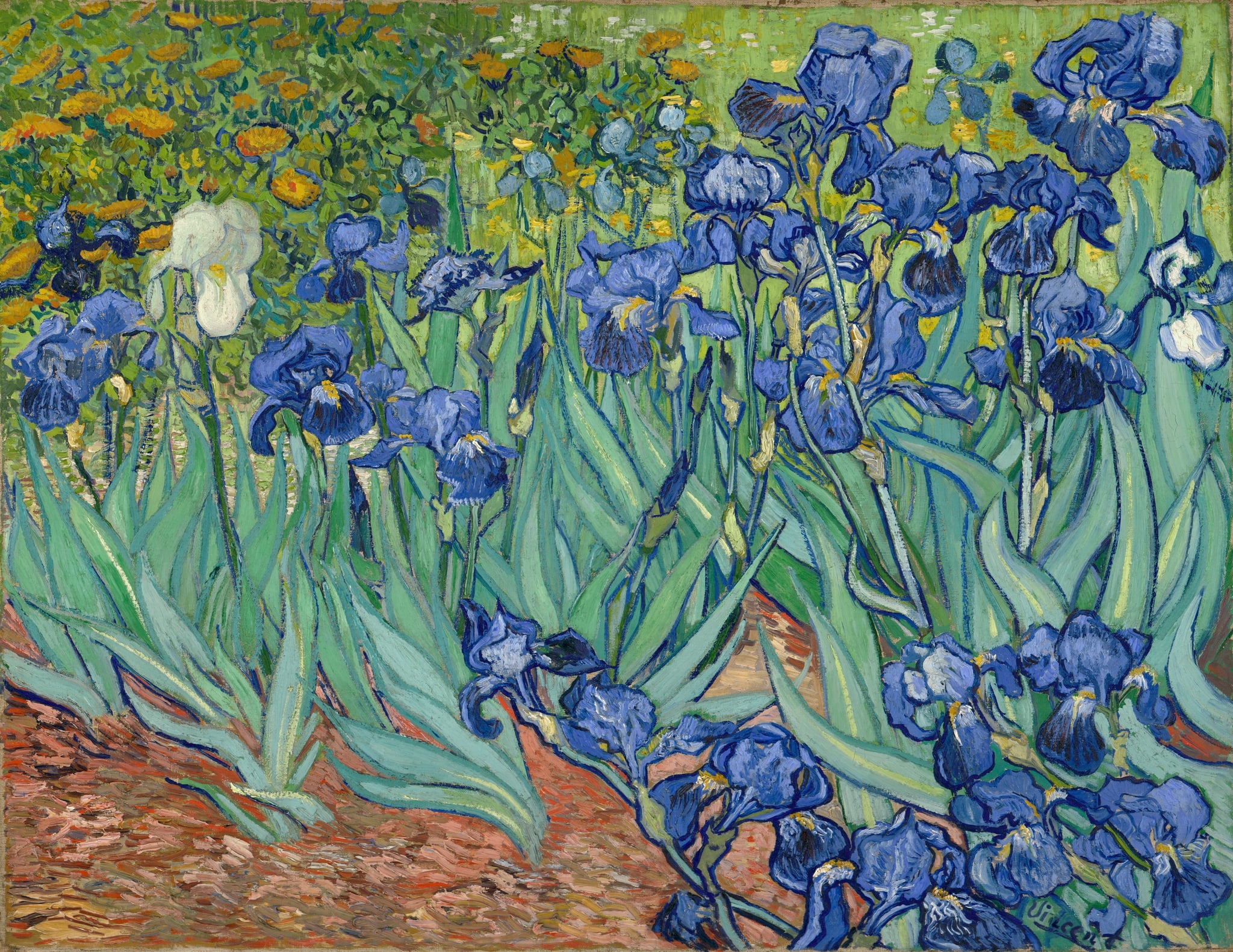
Irises by Vincent van Gogh

Irises

Vincent van Gogh (1889)

Painted in May 1889 at the Saint-Rémy asylum garden, Vincent van Gogh’s <strong>Irises</strong> turns close observation into an act of repair. Dark contours, a cropped, print-like vantage, and vibrating complements—violet/blue blossoms against <strong>yellow-green</strong> ground—stage a living frieze whose lone <strong>white iris</strong> punctuates the field with arresting clarity <sup>[1]</sup><sup>[2]</sup>.
Sunflowers by Vincent van Gogh

Sunflowers

Vincent van Gogh (1888)

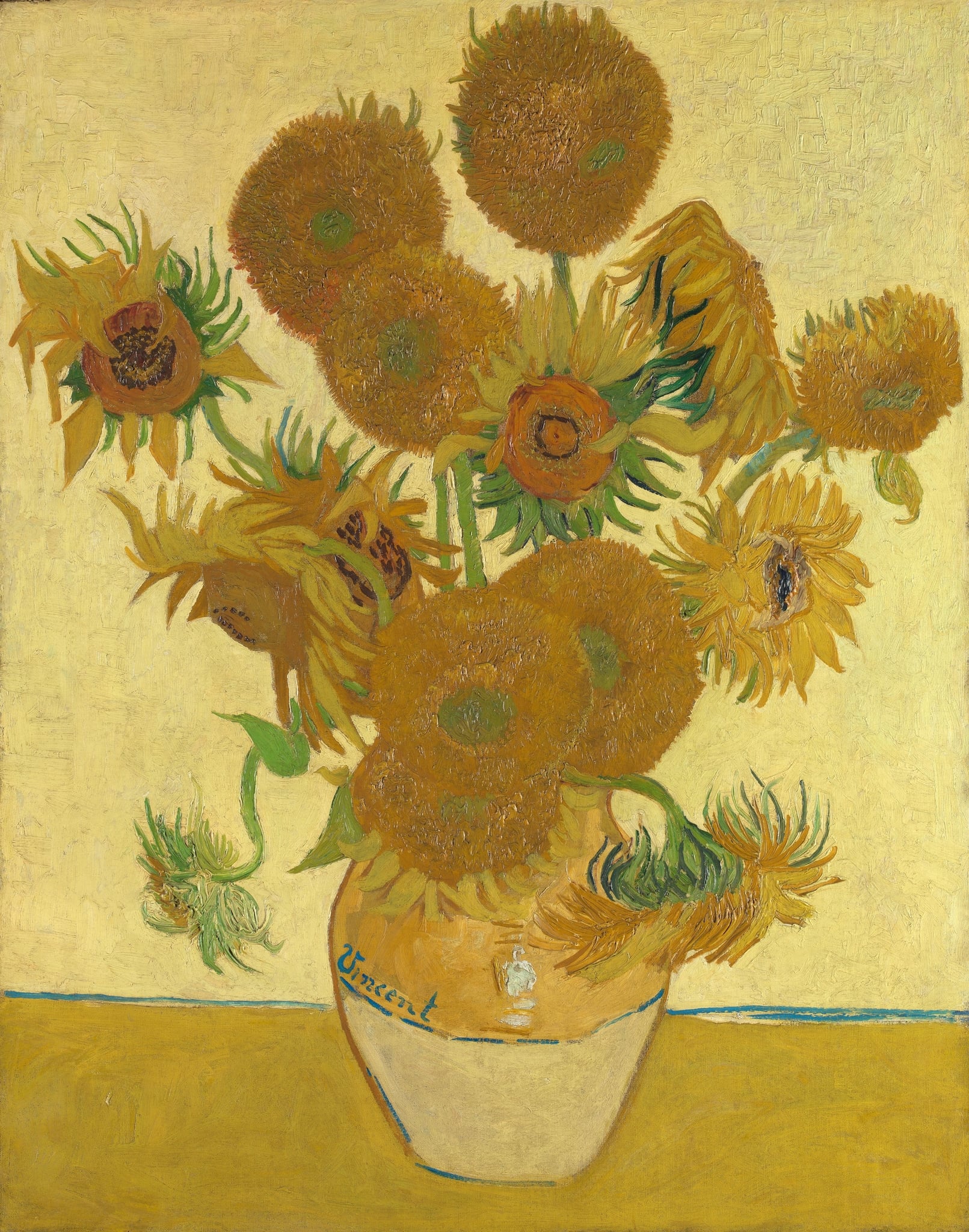
Vincent van Gogh’s Sunflowers (1888) is a <strong>yellow-on-yellow</strong> still life that stages a full <strong>cycle of life</strong> in fifteen blooms, from fresh buds to brittle seed heads. The thick impasto, green shocks of stem and bract, and the vase signed <strong>“Vincent”</strong> turn a humble bouquet into an emblem of endurance and fellowship <sup>[1]</sup><sup>[2]</sup>.

Garden with Courting Couples: Square Saint-Pierre by Vincent van Gogh

Garden with Courting Couples: Square Saint-Pierre

Vincent van Gogh (1887)

In Garden with Courting Couples: Square Saint-Pierre, Vincent van Gogh turns a small Montmartre park into a stage where <strong>spring</strong>, <strong>intimacy</strong>, and <strong>urban leisure</strong> converge. Short, shimmering strokes fuse pink chestnut blossoms, curving paths, and paired figures into one pulse of <strong>renewal</strong> and <strong>togetherness</strong> <sup>[1]</sup><sup>[2]</sup>.

In the Café: Agostina Segatori in Le Tambourin by Vincent van Gogh

In the Café: Agostina Segatori in Le Tambourin

Vincent van Gogh (1887 (Jan–Mar))

Van Gogh casts Agostina Segatori at a tiny, tambourine‑like café table, turning Le Tambourin into a <strong>stage of modern life</strong>. Cool greens and greys make the red <strong>flame‑plume hat</strong> and the foaming <strong>beer</strong> flare, while folded arms and a set‑aside <strong>parasol</strong> register private fatigue amid public display <sup>[1]</sup><sup>[2]</sup><sup>[3]</sup>.