How Much Is Farms near Auvers Worth?
Last updated: June 26, 2026
Quick Facts
- Methodology
- comparable analysis
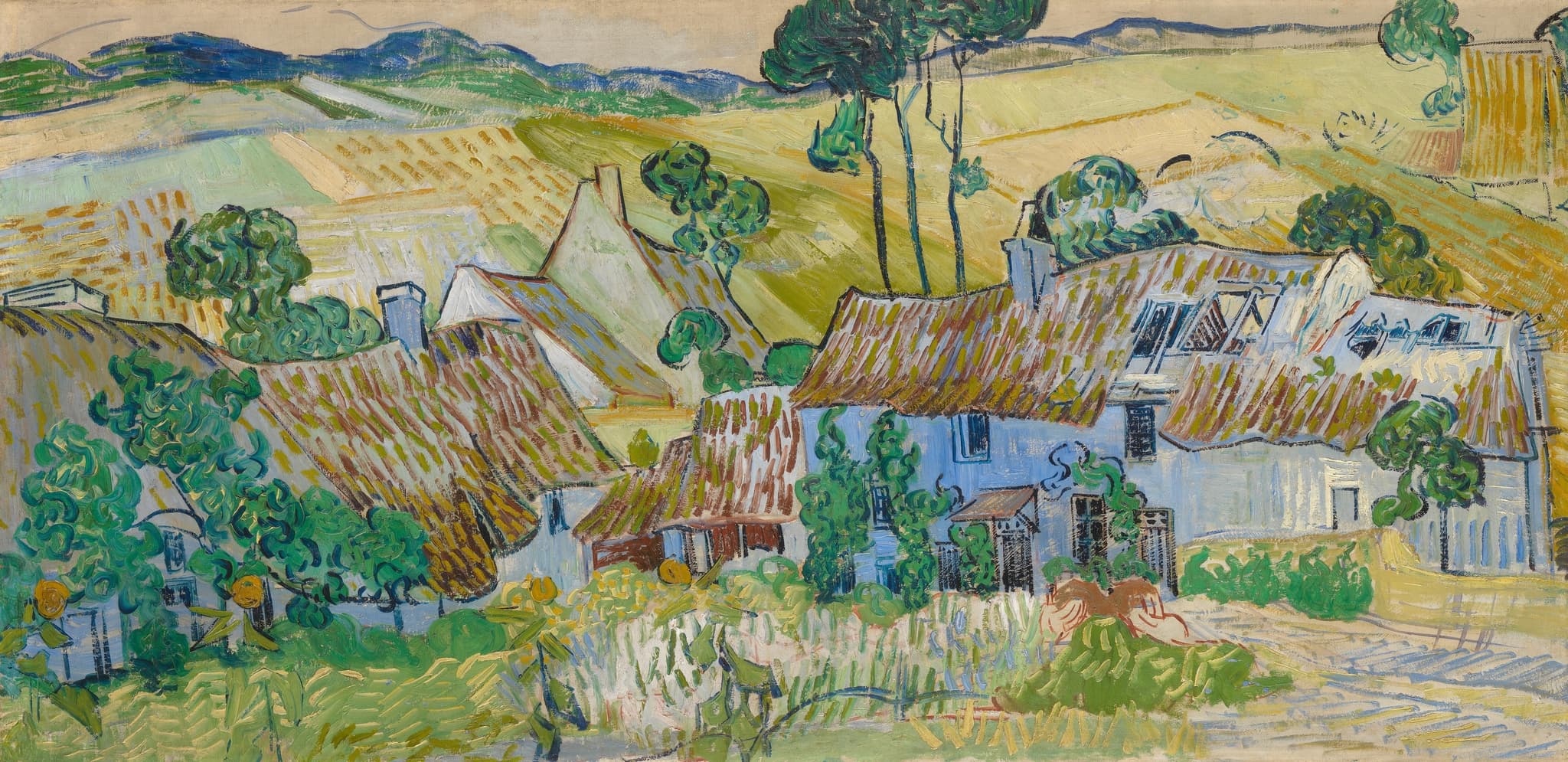
Farms near Auvers (1890) is a rare late-Auvers, double‑square landscape by Vincent van Gogh, owned by Tate and on long‑term loan to the National Gallery, London. Benchmarked against the artist’s $117.2m record and late Saint‑Rémy landscapes in the $52–71m range, we estimate fair‑market value at $85–110 million under optimal sale conditions. The work’s prime date, format and series position it near the top tier of van Gogh landscapes, tempered slightly by passages described as unfinished.
Valuation Analysis
Conclusion: Based on direct comparables and the work’s prime period, format and stature, Vincent van Gogh’s Farms near Auvers (1890; double‑square, Auvers‑sur‑Oise) would command approximately $85–110 million in a fully marketed evening sale or top‑tier private treaty today. The painting is owned by Tate and on long‑term loan to the National Gallery, London, where it is catalogued as a late Auvers landscape—one of the rare double‑square canvases, with areas often noted as appearing unfinished [1].
Market anchors: Van Gogh’s auction record stands at $117.18 million for Orchard with Cypresses (1888) at Christie’s in 2022, establishing the contemporary ceiling for top‑tier, luminous landscapes by the artist [2]. Within the closely adjacent late period, two Saint‑Rémy landscapes provide robust anchors: Cabanes de bois parmi les oliviers et cyprès (1889) at $71.35 million (Cox Collection, 2021) [3], and Champs près des Alpilles (1889) at $51.915 million (2022) [4]. A 2024 New York evening sale result for the earlier garden landscape Coin de jardin avec papillons at $33.2 million helps to define a lower band for non‑iconic but desirable van Goghs on canvas [5].
Positioning of Farms near Auvers: The July 1890 Auvers cottage and rural views are among van Gogh’s most coveted late subjects, and the double‑square format (about 50 × 100 cm) is scarce and prized. These are powerful positive drivers. While the work’s partially unresolved passages are art‑historically engaging, they may curb bidding at the very top of van Gogh’s price spectrum relative to the most universally iconic, fully resolved images. Balancing these considerations—and acknowledging the painting’s museum‑level visibility, prime date, and format—supports a value range just below the artist’s all‑time record, but well above the $50–70 million late‑landscape benchmarks.
Market conditions and liquidity: Blue‑chip Modern masters have shown resilience even through the 2024 slowdown, with a continuing flight to quality in 2025–2026 marquee auctions. Van Gogh remains an absolute trophy name with globally diversified demand. In that context, a prime late‑Auvers double‑square would be expected to draw deep competition, particularly if fresh to market and offered with best‑in‑class presentation and global outreach.
Final estimate: Synthesizing period/subject desirability, rarity of the double‑square format, recent late‑landscape comparables, and the artist’s record market, we assign a fair‑market estimate of $85–110 million. This presumes strong condition consistent with museum display and optimal sale choreography; it is a hypothetical valuation, as the work is in a UK national collection and not realistically available [1][2][3][4][5].
Key Valuation Factors
Period and Subject Desirability (Auvers, 1890, double‑square)
High ImpactPainted in July 1890 at Auvers-sur-Oise during van Gogh’s final months, Farms near Auvers belongs to one of the most sought-after phases of his career. The Auvers thatched-cottage and rural motifs carry exceptional collector appeal, and the double-square format (roughly 50 × 100 cm) is scarce, conferring added importance. Works from this period synthesize the emotional intensity of Saint‑Rémy with a brighter northern light and broader, cinematic compositions. In the current market, prime-period van Goghs exhibit outsized liquidity because they anchor major collections and museums. This alignment of date, motif, and format places the painting near the top tier of desirability for landscapes in the oeuvre, just below the handful of mass‑iconic images that transcend category.
Rarity, Scale, and Format
High ImpactThe double‑square format is unusually wide and relatively rare in van Gogh’s output, associated with some of the artist’s most dramatic late panoramas. Collectors and institutions prize this format for its visual impact and canonical status within the late series. Scale tends to correlate positively with price for van Gogh on canvas, particularly when coupled with a distinctive format related to key series. In this case, the 50.2 × 100.3 cm dimensions amplify wall presence and curatorial significance, supporting a premium over more conventional formats of similar subject and date. Rarity in both subject subgroup (Auvers cottages) and format (double‑square) meaningfully elevates the expected price band.
Condition and Degree of Finish
Medium ImpactThe National Gallery notes passages that appear ‘unfinished.’ For some connoisseurs, this late stylistic trait enhances immediacy and connection to the artist’s process; for others, it slightly tempers willingness to pay at the very top of the market relative to the most fully resolved icons. As a museum‑held work, structural condition is presumed sound and display‑ready absent contrary documentation, which sustains liquidity at high price levels. Nonetheless, the perceived partial resolution is likely a modest headwind against record-challenging outcomes, keeping the piece in a strong but not absolute peak tier relative to fully finished, universally emblematic images such as Orchard with Cypresses or the most famous Arles subjects.
Market Liquidity and Recent Comparables
High ImpactVan Gogh is among the most liquid artists at the top end, with consistent $50m+ depth for late landscapes and a $117.18m record setting the contemporary ceiling. Recent anchors include Cabanes de bois parmi les oliviers et cyprès (1889) at $71.35m and Champs près des Alpilles (1889) at $51.915m, while a 2024 New York garden landscape achieved $33.2m. These data points frame a robust market with clear stratification: non‑iconic yet desirable canvases in the $25–35m zone; strong late landscapes in the $50–70m+ zone; and a select group of masterpieces exceeding $100m. A rare Auvers double‑square of 1890 justifies a premium into the $85–110m range under optimal sale conditions.
Sale History
Farms near Auvers has never been sold at public auction.
Vincent van Gogh's Market
Vincent van Gogh’s market is one of the deepest and most global in fine art. The current auction record is $117.18 million for Orchard with Cypresses (1888) at Christie’s in 2022, and multiple late landscapes have traded consistently above $50 million in recent marquee sales. Collectors—both private and institutional—prize prime‑period works from Arles, Saint‑Rémy, and Auvers, with strong competition across the US, Europe, and Asia. Scarcity is a powerful driver: few museum‑caliber late landscapes enter the market in any given cycle. Even amid cyclical slowdowns, top‑quality van Goghs exhibit reliable liquidity and outperform broader market indices. The artist’s cross‑cultural resonance, exhibition draw, and blue‑chip status underpin enduring demand.
Comparable Sales
Cabanes de bois parmi les oliviers et cyprès
Vincent van Gogh
Late (1889) Saint-Rémy landscape of high quality; closely adjacent in period and desirability to Auvers 1890 landscapes; strong benchmark for top-tier van Gogh rural scenes, though not the rare double-square format.
$71.3M
2021, Christie's New York
~$84.9M adjusted
Champs près des Alpilles
Vincent van Gogh
Late (1889) Saint-Rémy wheatfield landscape; subject, date and market tier comparable to an Auvers 1890 rural scene; good mid-high anchor for late-period van Gogh on canvas.
$51.9M
2022, Christie's New York
~$57.1M adjusted
Orchard with Cypresses
Vincent van Gogh
Peak Arles (1888) landscape and the artist’s auction record; sets an upper-bound for luminous, museum-caliber van Gogh landscapes even if earlier than Auvers and not double-square.
$117.2M
2022, Christie's New York
~$128.9M adjusted
Coin de jardin avec papillons
Vincent van Gogh
Oil-on-canvas garden landscape (1887); demonstrates pricing for non-iconic but desirable van Gogh landscapes, useful as a lower anchor relative to an Auvers 1890 double-square.
$33.2M
2024, Christie's New York
~$34.2M adjusted
Jardin devant le Mas Debray
Vincent van Gogh
Earlier (1887) Paris-period landscape; calibrates market depth for smaller, non-icon Van Gogh landscapes versus late Auvers works.
$23.3M
2023, Sotheby's New York
~$24.7M adjusted
Les canots amarrés
Vincent van Gogh
1887 riverside/boat landscape; APAC marquee result showing international demand and a circa-$30m floor for non-Arles/Saint-Rémy works—useful lower-bound context.
$32.4M
2024, Christie's Hong Kong
~$33.3M adjusted
Current Market Trends
Impressionist and Post‑Impressionist ‘Modern’ masters have remained relatively resilient at the top end. After a value contraction in 2024, buyers gravitated to blue‑chip names with proven records, and marquee evening sales in 2025–2026 signaled stabilization with strong results for masterpieces. Price stratification has sharpened: canonical works with prime dates, scale, and strong provenance attract deep bidding, while secondary examples face more selective demand. For this category, global appetite—particularly from US and Asian buyers—continues to support robust pricing for rare, museum‑quality pictures. Against this backdrop, a late Auvers van Gogh with a coveted double‑square format sits squarely within the most competitive segment of the market.
Study print
Study this painting as a print
Pair the full artwork with a museum-style study sheet focused on one meaningful detail.
Sources
- National Gallery, London — Van Gogh: Farms near Auvers
- The Art Newspaper — Van Gogh record: Orchard with Cypresses sells for $117m (2022)
- Seydoux & Associates — Market Perspective (Cox Collection, 2021)
- Artprice — The Art Market in 2022 (includes Champs près des Alpilles)
- Christie’s — 20th Century Evening Sale totals $413.3m (includes van Gogh result, May 2024)