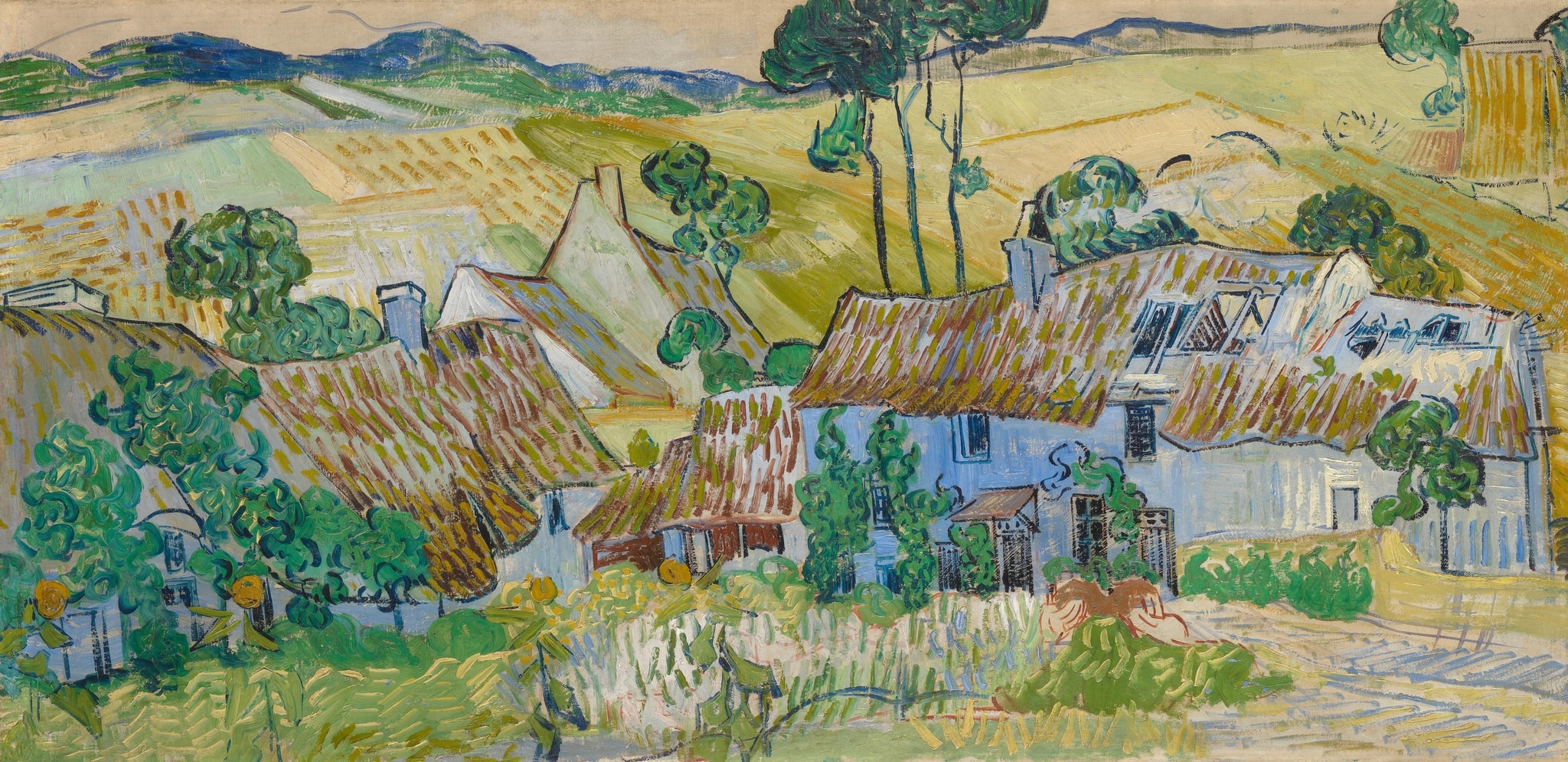
Farms near Auvers

by Vincent van Gogh

Painted in July 1890, Vincent van Gogh’s Farms near Auvers is a late, "double‑square" panorama where thatched cottages, wheat plots, and wind‑bent trees pulse with rhythmic energy. The high horizon and criss‑crossing roofs compress the village into a living weave of color and line, turning ordinary farms into a scene of charged stillness [1][3].

Study Print Studio

Create a personal study print

Build a companion study sheet around the part of this painting that speaks to you most. Choose a detail, shape an interpretation, and walk away with something personal and display-worthy.

Fast Facts

Year
1890
Medium
Oil on canvas
Dimensions
50.2 × 100.3 cm
Location
National Gallery, London (on loan from Tate)
See all Vincent van Gogh paintings in London
Farms near Auvers by Vincent van Gogh (1890) featuring Thatched roofs, Blue‑white cottage walls, Wheat fields and tilled plots, Tall wind‑bent trees

Click on any numbered symbol to learn more about its meaning

Meaning & Symbolism

Set on the edge of Auvers at Cordeville, Farms near Auvers turns village margins into a stage where roofs, hedges, paths, and plots move as one organism. The canvas’s "double‑square" breadth (about 50 × 100 cm) lets Van Gogh sweep from foreground gardens to distant blue hills without breaking momentum; the eye rides the diagonal run of reddish thatch, then tilts upward across tilled stripes to the high, pale horizon 13. This pressure of a raised skyline compresses the cottages into a protective huddle while making them feel precarious, as though buffeted by invisible weather. Thick outlines and rapid strokes wire the scene together: the blue‑white walls read as cool refuge; the ochre‑green fields radiate heat and harvest; the trees—thin, upright sentinels—anchor the vertical against all the horizontal thrusts 1. Everywhere, brushwork becomes rhythm: scalloped greens in the shrubs, hatching on the roofs, and syncopated dashes in the wheat. That shared pulse is not mere description; it asserts a unifying energy in nature that enframes human life, a late Van Gogh theme echoed across his Auvers fields 6. Symbolically, the thatched cottages do double duty. They point to the "real country" Van Gogh sought on arrival—motifs he knew were disappearing—and they extend his long empathy for peasant dwellings into the Île‑de‑France, decades after Nuenen 14. In this picture the roofs are not quaint; they are working forms, stitched to gardens and furrows that declare labor without showing laborers. The absence of figures intensifies implied presence: staked vines, trimmed shrubs, cut paths, and open dormers narrate communal habit without portraiture. Color becomes moral weather. Cool ceramic blues on the walls promise shade and rest; the hot yellows of adjacent fields and the scarified strokes along the lanes register time’s cycle—sowing, reaping, return. Even the slight, raw edges at the sky and along some rooflines, which curators read as likely unfinished, act here as a kind of breath; the scene feels caught mid‑becoming, aligning the work’s facture with the seasonal becoming it depicts 1. Formally, Farms near Auvers demonstrates how Van Gogh’s late composition elevates structure into meaning. Crossing diagonals lock cottages, slopes, and hedges into a tense grid, a crowded interlock that holds the panorama together while quickening it with instability 1. The unusual width of the support was a deliberate, non‑commercial choice in this period, used to stage wide horizons and village fringes; it announces ambition as much as subject 3. Within this frame, the marks themselves negotiate solace and intensity: curving arabesques bind shrubs to facades; straight, slashing hatchings accelerate the fields; and the tall trees on the right rise like tuning forks that set the whole village vibrating. Read against the speed of his Auvers campaign—dozens of works in some seventy days—and the painting becomes an ethical claim: ordinary farms can bear spiritual charge when seen through color and rhythm 45. That is the meaning of Farms near Auvers. And because it stands among his very last works, likely from July 1890, the canvas also serves as a summation: a vision of rural endurance articulated with precarious, living paint—a final wager that art can still the flux of nature by moving with it 13.

Explore Deeper with AI

Ask questions about Farms near Auvers

Popular questions:

Powered by AI • Get instant insights about this artwork

💬 Ask questions about this artwork!

Interpretations

Formal Analysis: Double‑Square Engineering and Horizon Pressure

The unusually broad double‑square canvas is not a neutral container but a compositional engine: it stretches lateral movement (roofs, hedges) then clamps it under a high horizon, compressing depth into a dynamic shallow stage. Crossing diagonals lock plots to cottages in a tense interlock, while emphatic contours keep forms legible amid rhythmic brushwork. Curators note likely unfinished passages at the sky and roof junctions; rather than flaw, these lacunae act as breathing seams that modulate speed across the span. The wide support—part of a late series of such formats—was a deliberate, non‑commercial choice that advertises ambition: a panoramic field for structuring force, not mere description. Composition here becomes content: pressure, breadth, and montage‑like diagonals enact the painting’s living unity and precarious balance.

Source: National Gallery, London; Musée d’Orsay

Social History: Vernacular Modernity and Disappearing Thatch

Van Gogh arrived in Auvers seeking “many old thatched roofs, which are becoming rare,” turning to cottages as emblems of a vernacular lifeway under modernization’s pressure. Far from picturesque props, these roofs are working forms, stitched to gardens and furrows that signal subsistence, tenure, and local know‑how. Read socially, the canvas registers a cusp moment: the endurance of pre‑industrial building alongside encroaching change. By staging cottages at the village edge, Van Gogh positions rural culture at a literal and figurative threshold. The painting thus doubles as quiet documentation of material culture and as a critique of its precarity—an image of dwelling practices that modernization will soon standardize or erase. The choice of motif is historiographic as much as aesthetic.

Source: National Gallery, London; Van Gogh Museum

Iconography of Work: Labor Without Laborers

The absent figure is a purposeful device. Instead of staffage peasants, Van Gogh composes an index of labor: staked vines, cut paths, scalloped hedges, and tilled chords across the slope. These signs make the farm a self‑evident actor—habitation and toil inscribed directly into place. Such indirect portraiture reorients rural iconography from bodies to infrastructures of care and cultivation. It echoes his long empathy for peasant life while updating it for Auvers: labor is distributed across household, field, and season, not centralized in a single figure. By presenting work as patterned maintenance, the scene suggests continuity and communal habit rather than heroic exertion, aligning with his late ethic that ordinary lifeworlds, seen rightly, disclose dignity.

Source: National Gallery, London; Metropolitan Museum of Art (Pickvance)

Temporalities: Season, Urgency, and Late Style

July 1890 supplies a double time signature. On one hand, chroma and stroke mark seasonal time—hot yellows, striated fields, and hedgerow growth cue ripeness and return. On the other, the painting’s accelerated facture and open edges register human time: the urgency of Van Gogh’s final weeks and his Auvers campaign’s rapid tempo. Curators place the work among his very last, perhaps even penultimate, with unfinished passages reinforcing an aesthetic of the provisional. This coupling of cyclical and biographical time yields a poignant tension: nature’s repeating pulse vs. an artist’s dwindling days. The canvas becomes a temporal palimpsest where season and mortality intersect—an ethical wager that form and color can hold, if only briefly, what passes.

Source: National Gallery, London; Musée d’Orsay

Ecology of Mark: Unifying Energy and Embodied Viewing

Brushwork in the Auvers landscapes performs ontology: clustered dashes, scallops, and hatched roofs transmit a unifying energy that sutures cottages, shrubs, and tilled bands into one vibrating field. In related works like Green Wheat Fields, curators describe this pulse as nature’s animating force; the same visual physics obtain here. The eye is made to move—riding red thatch diagonals, then tilting upward across stripes—so that seeing reenacts environmental dynamics. This phenomenological design collapses observer and motif: to perceive is to be carried by the scene’s currents. Far from decorative texture, the mark is ecological: it models interdependence across built and botanical forms, making the village not backdrop but organism.

Source: National Gallery of Art, Washington; National Gallery, London

Related Themes

About Vincent van Gogh

Vincent van Gogh (1853–1890) developed a radical, emotion‑driven use of color after moving from Paris to Arles in 1888, seeking southern light and an artists’ community. In Arles he created the Sunflowers series to decorate the Yellow House ahead of Gauguin’s visit. His late work fused impasto, high chroma, and symbolic motifs that shaped modern painting [2][5].
View all works by Vincent van Gogh

More by Vincent van Gogh
Café Terrace at Night by Vincent van Gogh

Café Terrace at Night

Vincent van Gogh (1888)

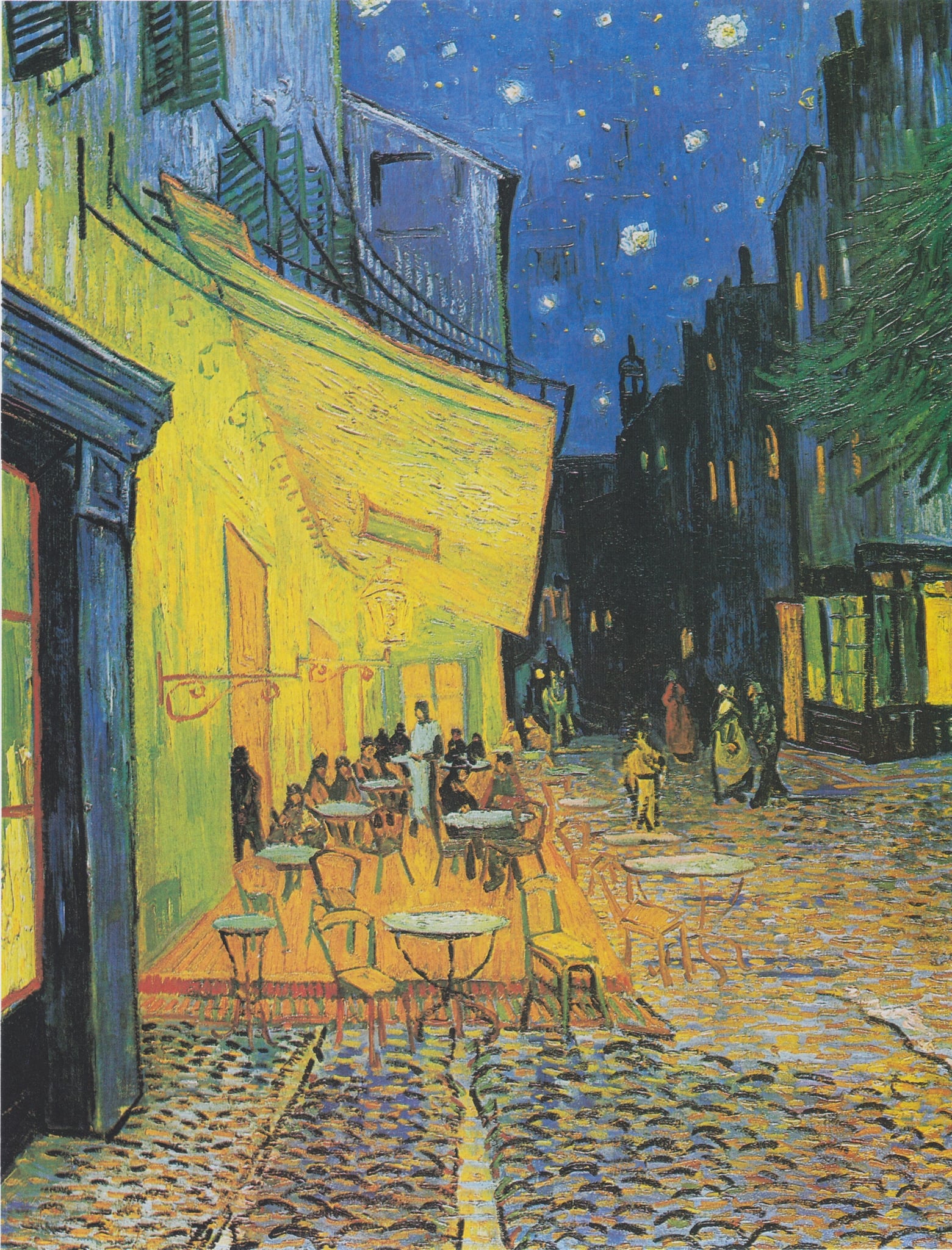
In Café Terrace at Night, Vincent van Gogh turns nocturne into <strong>luminous color</strong>: a gas‑lit terrace glows in yellows and oranges against a deep <strong>ultramarine sky</strong> pricked with stars. By building night “<strong>without black</strong>,” he stages a vivid encounter between human sociability and the vastness overhead <sup>[1]</sup><sup>[2]</sup>.
Red Cabbages and Onions by Vincent van Gogh

Red Cabbages and Onions

Vincent van Gogh (1887)

In Red Cabbages and Onions, Vincent van Gogh turns everyday produce into a drama of <strong>complementary color</strong> and <strong>restless brushwork</strong>. Hot red contours cinch violet cabbages and pale yellow bulbs against a cool, striated blue table, while a mustard‑yellow patch in the upper right tilts the space and sharpens the chromatic clash. The result asserts ordinary food as a locus of <strong>resilience</strong> and <strong>experimentation</strong> <sup>[1]</sup><sup>[2]</sup>.

Irises by Vincent van Gogh

Irises

Vincent van Gogh (1889)

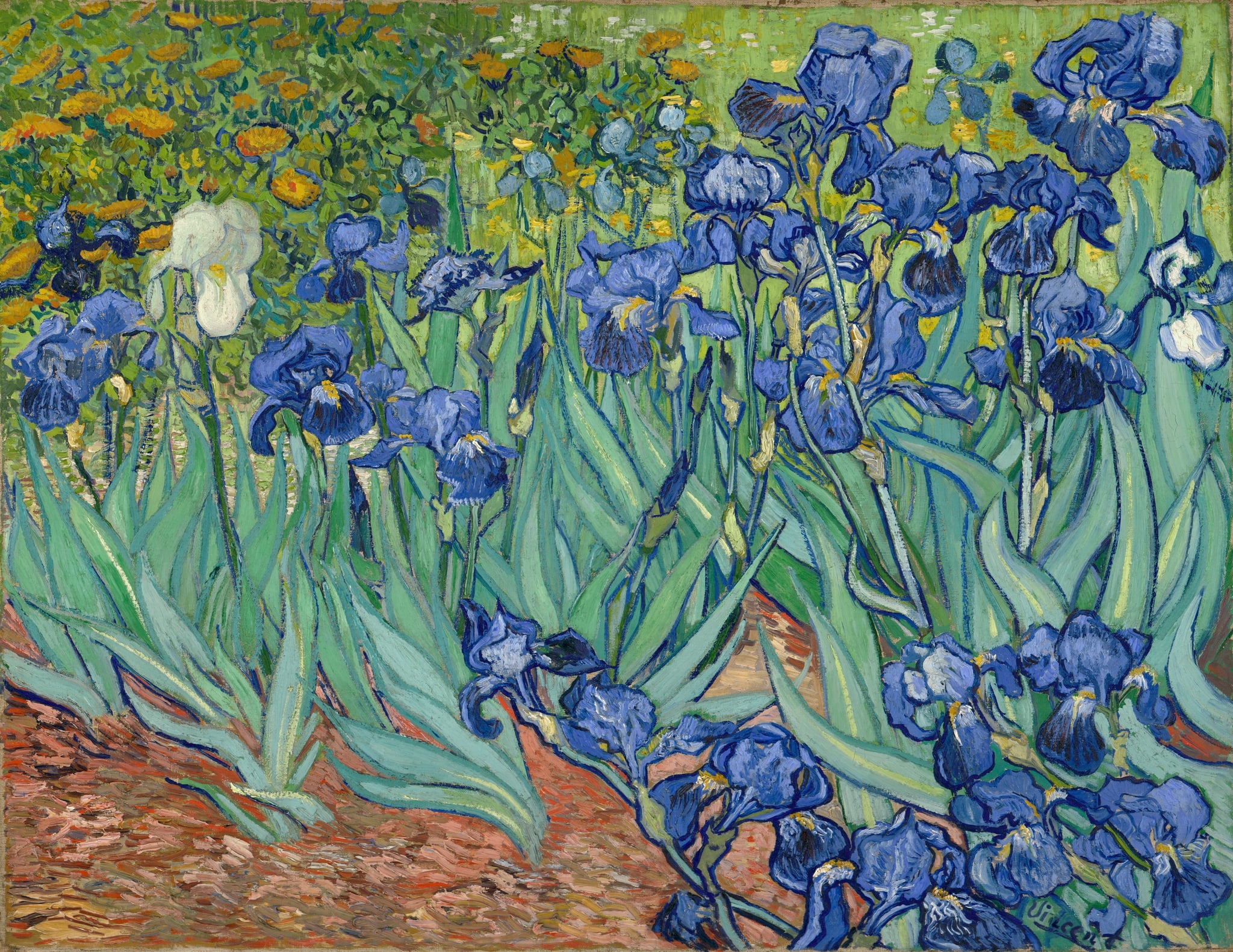
Painted in May 1889 at the Saint-Rémy asylum garden, Vincent van Gogh’s <strong>Irises</strong> turns close observation into an act of repair. Dark contours, a cropped, print-like vantage, and vibrating complements—violet/blue blossoms against <strong>yellow-green</strong> ground—stage a living frieze whose lone <strong>white iris</strong> punctuates the field with arresting clarity <sup>[1]</sup><sup>[2]</sup>.
Sunflowers by Vincent van Gogh

Sunflowers

Vincent van Gogh (1888)

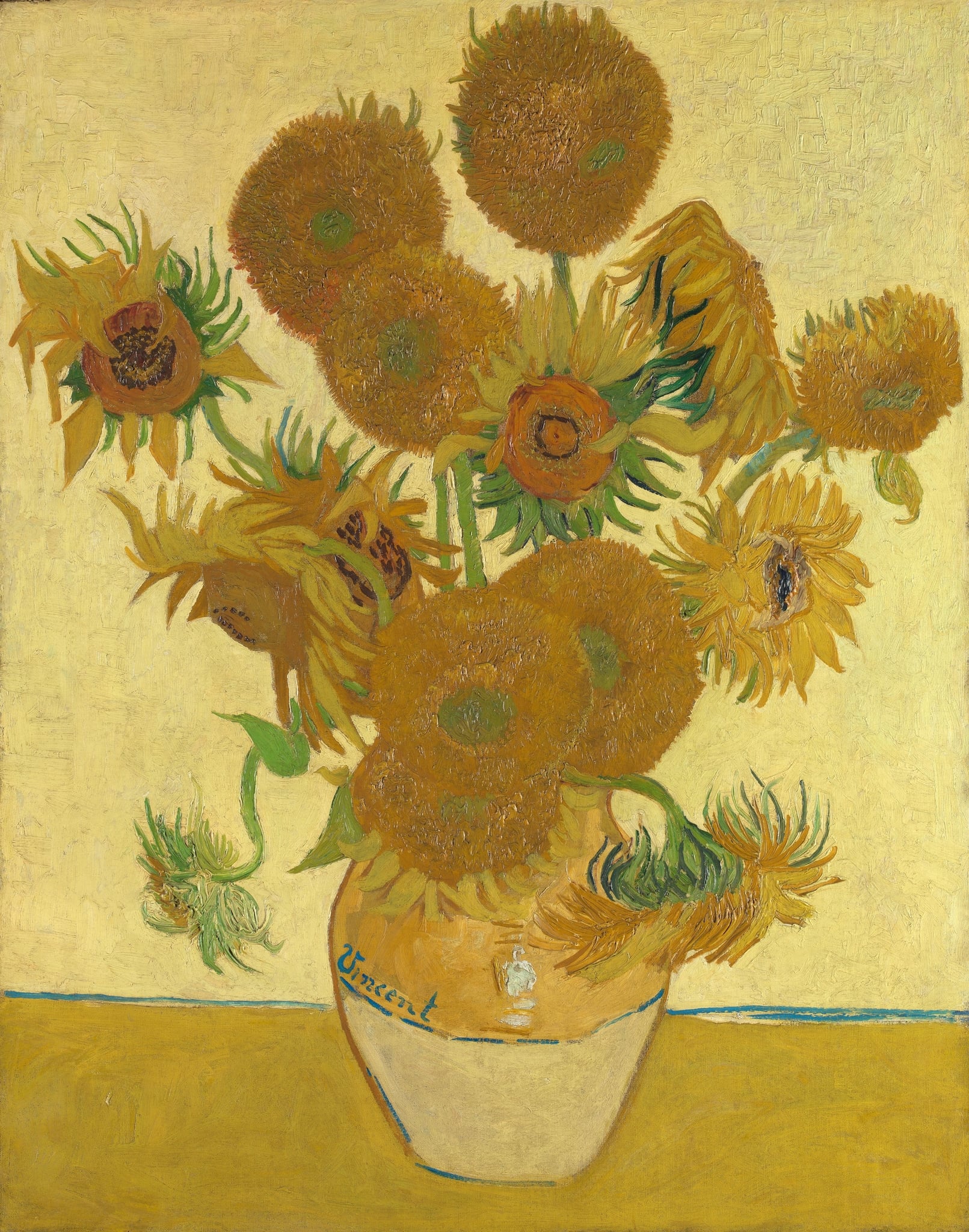
Vincent van Gogh’s Sunflowers (1888) is a <strong>yellow-on-yellow</strong> still life that stages a full <strong>cycle of life</strong> in fifteen blooms, from fresh buds to brittle seed heads. The thick impasto, green shocks of stem and bract, and the vase signed <strong>“Vincent”</strong> turn a humble bouquet into an emblem of endurance and fellowship <sup>[1]</sup><sup>[2]</sup>.

Garden with Courting Couples: Square Saint-Pierre by Vincent van Gogh

Garden with Courting Couples: Square Saint-Pierre

Vincent van Gogh (1887)

In Garden with Courting Couples: Square Saint-Pierre, Vincent van Gogh turns a small Montmartre park into a stage where <strong>spring</strong>, <strong>intimacy</strong>, and <strong>urban leisure</strong> converge. Short, shimmering strokes fuse pink chestnut blossoms, curving paths, and paired figures into one pulse of <strong>renewal</strong> and <strong>togetherness</strong> <sup>[1]</sup><sup>[2]</sup>.

In the Café: Agostina Segatori in Le Tambourin by Vincent van Gogh

In the Café: Agostina Segatori in Le Tambourin

Vincent van Gogh (1887 (Jan–Mar))

Van Gogh casts Agostina Segatori at a tiny, tambourine‑like café table, turning Le Tambourin into a <strong>stage of modern life</strong>. Cool greens and greys make the red <strong>flame‑plume hat</strong> and the foaming <strong>beer</strong> flare, while folded arms and a set‑aside <strong>parasol</strong> register private fatigue amid public display <sup>[1]</sup><sup>[2]</sup><sup>[3]</sup>.