Basket of Hyacinth Bulbs

by Vincent van Gogh

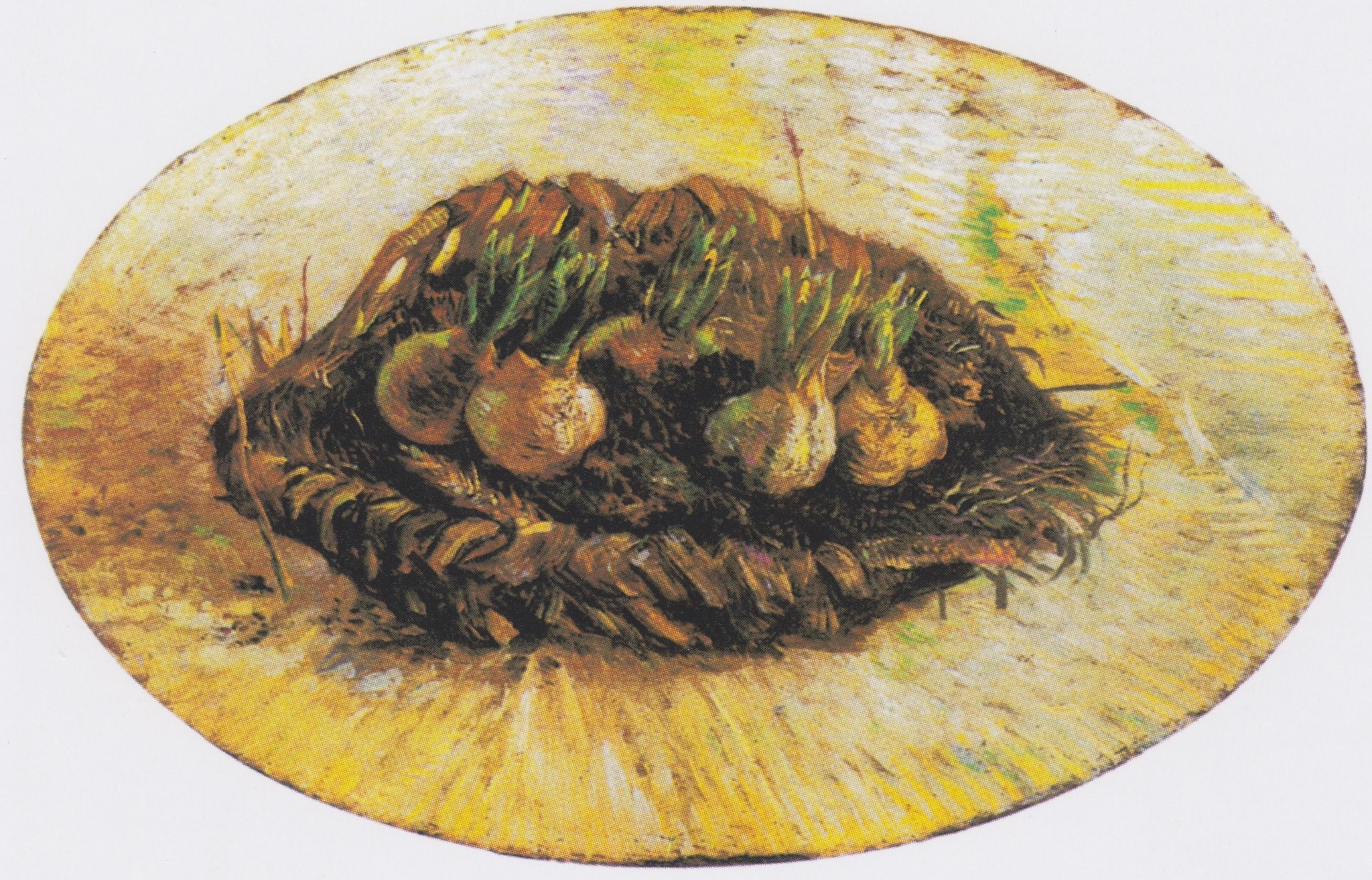
Basket of Hyacinth Bulbs turns a modest basket of soil‑caked bulbs into a scene of latent vitality, painted in warm ochres and radiant yellows that encircle the motif like light. On an oval wooden panel, short, tactile strokes press the weave of the basket and the papery skins while green shoots puncture the dark soil, declaring life on the verge of emergence [1][2].

Study Print Studio

Create a personal study print

Build a companion study sheet around the part of this painting that speaks to you most. Choose a detail, shape an interpretation, and walk away with something personal and display-worthy.

Fast Facts

Year
1887 (January–February)
Medium
Oil on wood (oval panel)
Dimensions
31.2 × 48.3 cm
Location
Van Gogh Museum, Amsterdam (Vincent van Gogh Foundation)
See all Vincent van Gogh paintings in Amsterdam
Basket of Hyacinth Bulbs by Vincent van Gogh (1887 (January–February)) featuring Dark soil, Hyacinth bulbs, Green shoots, Basket (coarse weave)

Click on any numbered symbol to learn more about its meaning

Meaning & Symbolism

Van Gogh constructs a drama of emergence through form before symbol. The entire composition sits within an oval that repeats the basket’s rim; this echo compresses the world to a single enclosure where life brews. Around the perimeter, ochres and lemon yellows radiate in quick, parallel hatches that feel like cast light, while the interior mass is a mound of black‑brown earth interlaced with strokes the color of peat and bark. Across this dark core, five or six bulbs catch flecks of warm highlight; their surfaces are built with staccato marks that imitate the papery skins, and from their crowns thin green blades push upward. The contrast is categorical—earth versus light, brown husk versus green shoot, dense impasto versus agile line—so the eye reads the picture not as a quiet still life but as a moment of becoming. The Neo‑Impressionist inflection of the touch—short, directional units that articulate texture—comes straight out of Van Gogh’s Paris laboratory and signals his interest in making matter feel alive at the surface 24. The symbolism is seasonal and precise. Hyacinths are later than crocuses; their appearance here as sprouting rather than blooming plants is a deliberate sign of early spring, a state of “gestation” Van Heugten links to Van Gogh’s wider program of seasonal images 3. That program, already foreshadowed in earlier Dutch bulb subjects and soon to expand into orchard blossoms, takes nature’s cycles as a structure for human feeling. In Basket of Hyacinth Bulbs, the bulbs’ dirt‑streaked forms and the humble domestic basket deny spectacle; beauty is imminent rather than displayed. The painting therefore argues for patience: growth is enclosed, protected, and slowly coaxed by warmth—the radiating yellows that ring the basket like a halo of nourishment. Even the tactile exaggeration of the basket’s coarse weave reads as labor and care; containment is not confinement but incubation. The oval format intensifies this reading, making the support itself a metaphor for cyclical return and organic continuity—an uncommon, intentional choice in Van Gogh’s oeuvre 2. At the same time the picture is a treatise on method. In Paris (1886–1888) Van Gogh lightened his palette, explored complementary contrasts, and experimented with Divisionist handling after encounters with Impressionism and Neo‑Impressionism 4. Basket of Hyacinth Bulbs shows that inquiry in miniature: yellow ground against violet‑brown earth, green shoots edging toward their red complements in the scattered warm highlights, and a mosaic of differentiated strokes that model substance without academic blending 24. The work’s small scale and wood support suggest a studio exercise, yet its tight synthesis of support shape, motif, and touch transforms experiment into statement. That is why Basket of Hyacinth Bulbs is important: it demonstrates how Van Gogh’s Paris investigations could crystallize into symbolic clarity without sacrificing material immediacy—a still life that breathes like a season turning 123.

Explore Deeper with AI

Ask questions about Basket of Hyacinth Bulbs

Popular questions:

Powered by AI • Get instant insights about this artwork

💬 Ask questions about this artwork!

Interpretations

Formal Analysis: Divisionist Touch as Botany

Van Gogh translates botanical morphology into a micro‑syntax of strokes: terse, directional marks mimic the bulbs’ papery skins, while agile green blades are not blended but articulated as discrete vectors. This Divisionist inflection—short, differentiated units—organizes substance without academic sfumato, so tactility becomes structure. The chromatic program is likewise analytical: a yellow ground plays a complementary foil to the violet‑brown earth, and warm glints edging the bulbs nudge toward red complements against the greens, heightening the sense of latent heat. What could read as a modest still life thus behaves like a laboratory plate in motion, where matter is observed by making it vibrate optically, a Paris lesson from Seurat/Signac absorbed yet kept materially immediate 12.

Source: National Gallery of Victoria (curatorial label); Van Gogh Museum (object record)

Historical Context: From Dutch Fields to Parisian Windowsill

Hyacinths are a Dutch cultural staple—Van Gogh had earlier mapped bulb agriculture at landscape scale in Bulb Fields (1883). By 1887 in Paris, the subject contracts to a basket: a domestic, portable ecology suited to a small studio. Forced bulbs were common in urban interiors; Van Gogh’s sprouting hyacinths register a metropolitan spring cultivated indoors, aligning seasonal feeling with modern apartment life. This continuity—Holland’s fields to Paris’s windowsill—reframes the motif from national agriculture to intimate nurture, preserving the seasonal arc while changing its social site. The work thus bridges geographies and scales, carrying Dutch springtime into the experimental Paris atelier where color theory and touch were being actively tested 135.

Source: Sjraar van Heugten; Van Gogh Museum; Wikipedia (contextual cross-check)

Medium/Material: Shaped Support as Meaning

The oval wood panel is not a neutral carrier but a compositional device: a rare format in Van Gogh’s oeuvre that literally repeats the basket’s curve, closing the image into an egg‑like incubator. Wood, less absorbent than canvas, helps strokes sit crisply on the surface, intensifying haptic description of weave, soil, and skin. The small scale suggests an étude, but the shaped support converts study into statement—structure and subject rhyme to model cyclical return. NGV notes only a handful of Van Gogh ovals survive; here the format fuses with motif so completely that containment becomes theme, and the edge of the panel reads as a second rim, a sculpted boundary for gestation 12.

Source: National Gallery of Victoria (curatorial label); Van Gogh Museum

Symbolic Reading: Serial Time and the Bulb Pair

Van Heugten reads the crocus and hyacinth baskets as a deliberate serial: early and slightly later spring, staged as “gestating still lifes.” The hyacinths’ sprouting—not bloom—marks promise withheld, aligning nature’s clock with a human ethic of patience. Taken with the companion Basket of Crocus Bulbs and followed by the orchard campaigns, this work functions like a seasonal calendar in parts—time parsed into motifs that rehearse emergence. The domestic vessel denies spectacle in favor of imminence, and the picture’s warm, radiating perimeter acts as a proxy for sheltering heat. In this serial logic, transformation is not sudden revelation but incremental tending, a slow pedagogy of renewal 3.

Source: Sjraar van Heugten (Princeton University Press)

Psychological Interpretation: Incubation as Artistic Self-Care

Paris (1886–88) was Van Gogh’s crucible for color theory, complementary contrast, and Neo‑Impressionist handling. Read autobiographically, the basket becomes a metaphor for the artist’s self‑incubation: an enclosure where experiments are protected from premature exposure. The radiating yellows around the rim—“like a halo of nourishment”—suggest warmth, support, and steadiness, resonating with Theo’s sustaining presence during these years. Containment is thus recoded as care rather than constraint; the image argues that new style requires shelter and repetition before bloom. The painting’s tight synthesis of support, stroke, and subject externalizes an inner discipline: growth through bounded practice until conditions are right to flower in Arles and beyond 24.

Source: Van Gogh Museum (Paris-period texts); National Gallery of Victoria

Related Themes

About Vincent van Gogh

Vincent van Gogh (1853–1890) developed a radical, emotion‑driven use of color after moving from Paris to Arles in 1888, seeking southern light and an artists’ community. In Arles he created the Sunflowers series to decorate the Yellow House ahead of Gauguin’s visit. His late work fused impasto, high chroma, and symbolic motifs that shaped modern painting [2][5].
View all works by Vincent van Gogh

More by Vincent van Gogh
Café Terrace at Night by Vincent van Gogh

Café Terrace at Night

Vincent van Gogh (1888)

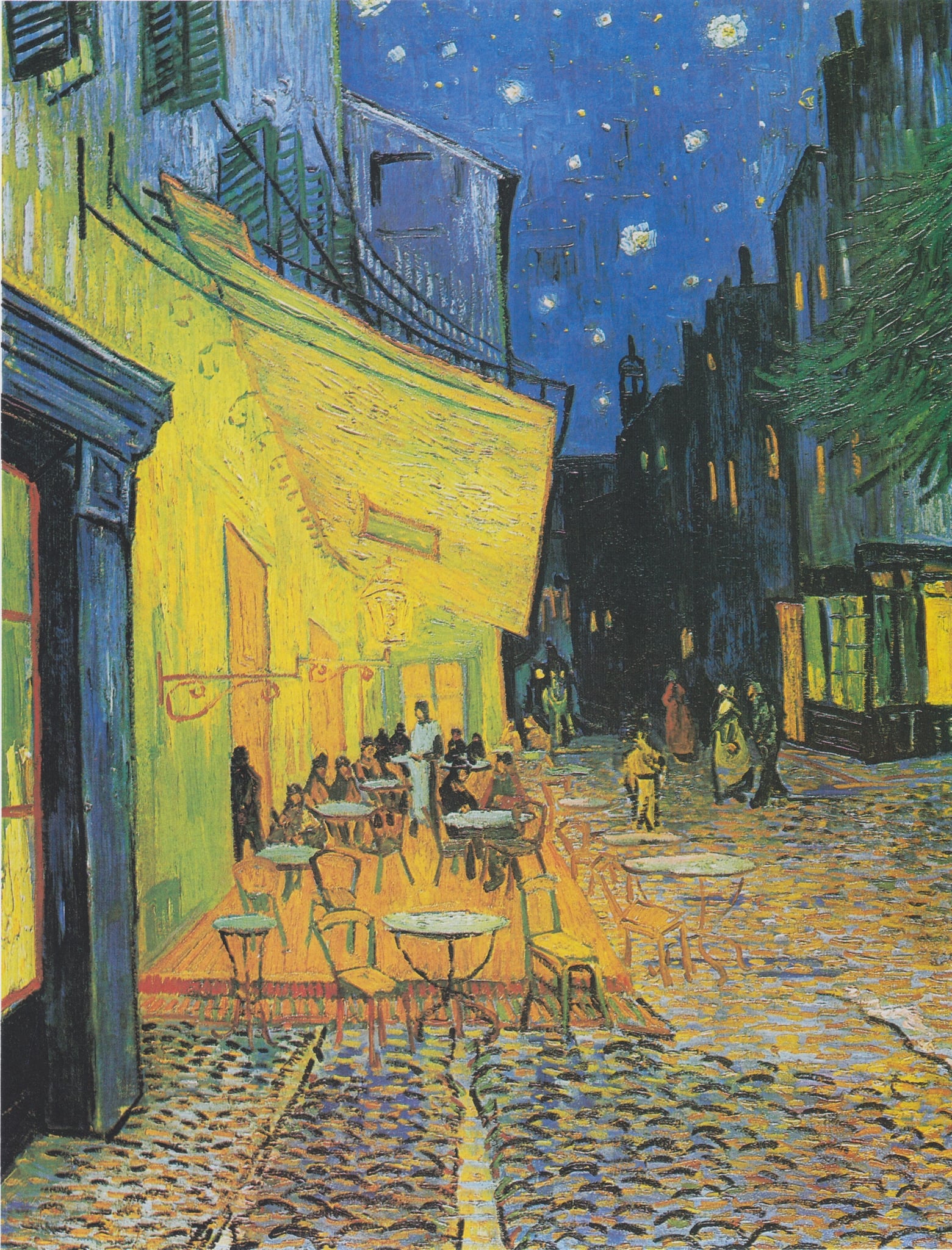
In Café Terrace at Night, Vincent van Gogh turns nocturne into <strong>luminous color</strong>: a gas‑lit terrace glows in yellows and oranges against a deep <strong>ultramarine sky</strong> pricked with stars. By building night “<strong>without black</strong>,” he stages a vivid encounter between human sociability and the vastness overhead <sup>[1]</sup><sup>[2]</sup>.
Irises by Vincent van Gogh

Irises

Vincent van Gogh (1889)

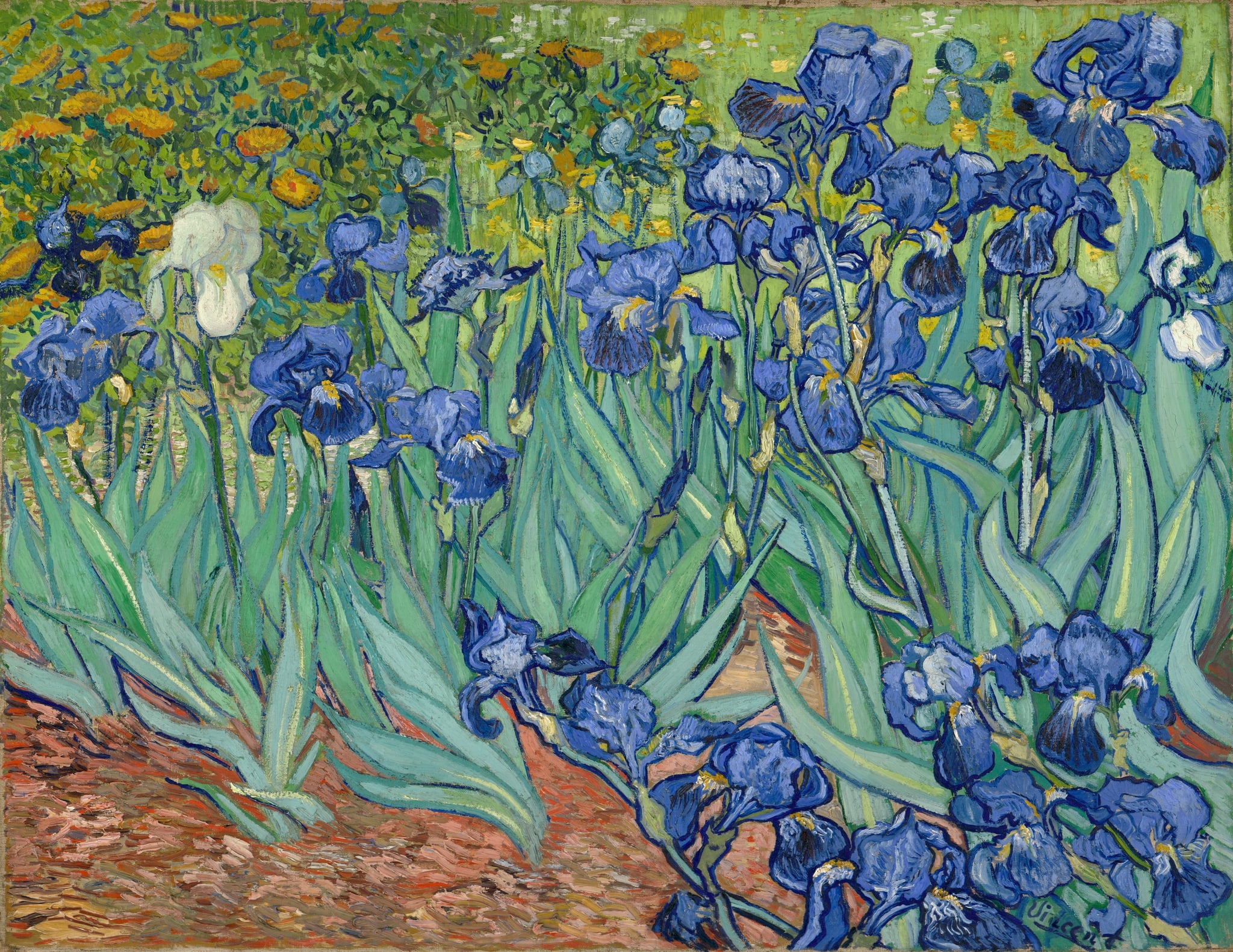
Painted in May 1889 at the Saint-Rémy asylum garden, Vincent van Gogh’s <strong>Irises</strong> turns close observation into an act of repair. Dark contours, a cropped, print-like vantage, and vibrating complements—violet/blue blossoms against <strong>yellow-green</strong> ground—stage a living frieze whose lone <strong>white iris</strong> punctuates the field with arresting clarity <sup>[1]</sup><sup>[2]</sup>.
Sunflowers by Vincent van Gogh

Sunflowers

Vincent van Gogh (1888)

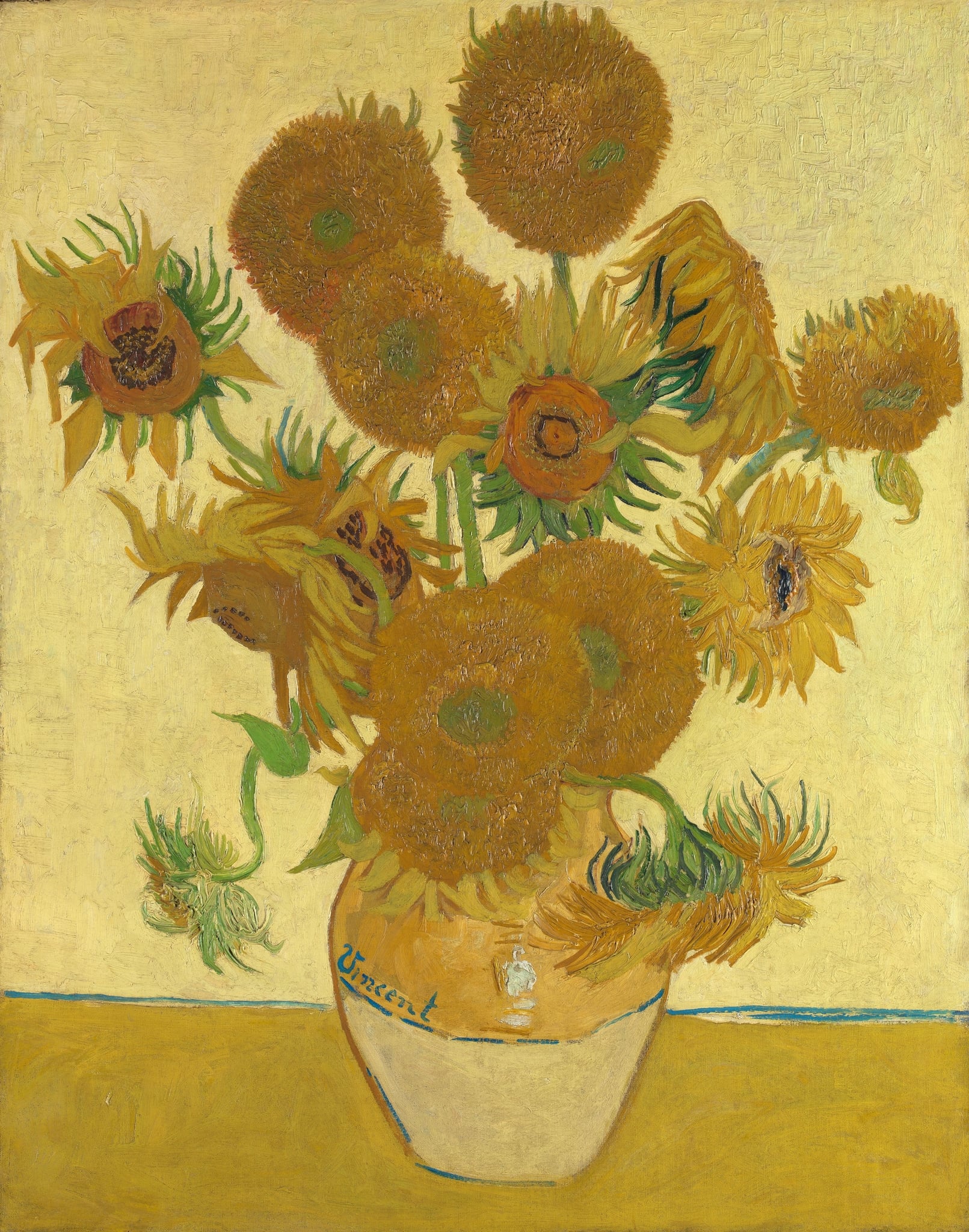
Vincent van Gogh’s Sunflowers (1888) is a <strong>yellow-on-yellow</strong> still life that stages a full <strong>cycle of life</strong> in fifteen blooms, from fresh buds to brittle seed heads. The thick impasto, green shocks of stem and bract, and the vase signed <strong>“Vincent”</strong> turn a humble bouquet into an emblem of endurance and fellowship <sup>[1]</sup><sup>[2]</sup>.

The Red Vineyard by Vincent van Gogh

The Red Vineyard

Vincent van Gogh (1888)

In The Red Vineyard, Vincent van Gogh forges a vision of <strong>autumn labor under a blazing sun</strong>, where harvesters flow diagonally through scarlet vines while a band of <strong>yellow light</strong> flares along a reflective roadway. The scene fuses <strong>exhaustion and ripeness</strong>, turning work into a rhythmic, almost liturgical procession <sup>[1]</sup><sup>[3]</sup>.

The Bedroom by Vincent van Gogh

The Bedroom

Vincent van Gogh (1889)

Vincent van Gogh’s The Bedroom turns a modest room into a psychological stage, using <strong>clashing color</strong> and <strong>tilted space</strong> to test whether color alone can evoke rest. The bright yellow bed, twin chairs, and green‑shuttered window press forward as the floor tilts and pictures cant, so that <strong>refuge and unease</strong> exist side by side <sup>[1]</sup><sup>[2]</sup>.

Self-Portrait with Bandaged Ear by Vincent van Gogh

Self-Portrait with Bandaged Ear

Vincent van Gogh (1889)

In Self-Portrait with Bandaged Ear (1889), Vincent van Gogh converts a recent crisis into an image of <strong>resolve</strong>. The frontal, slightly turned pose forces attention to the white bandage at the viewer’s right, while the fur cap, heavy coat, and the nearby <strong>Japanese print</strong> declare persistence and ideals that steady him in the wake of trauma <sup>[1]</sup><sup>[2]</sup>. The painting’s cool, wintry palette and insistent strokes make suffering legible yet disciplined, transforming pain into <strong>artistic purpose</strong> <sup>[2]</sup>.