Flowering Plum Orchard (after Hiroshige)

by Vincent van Gogh

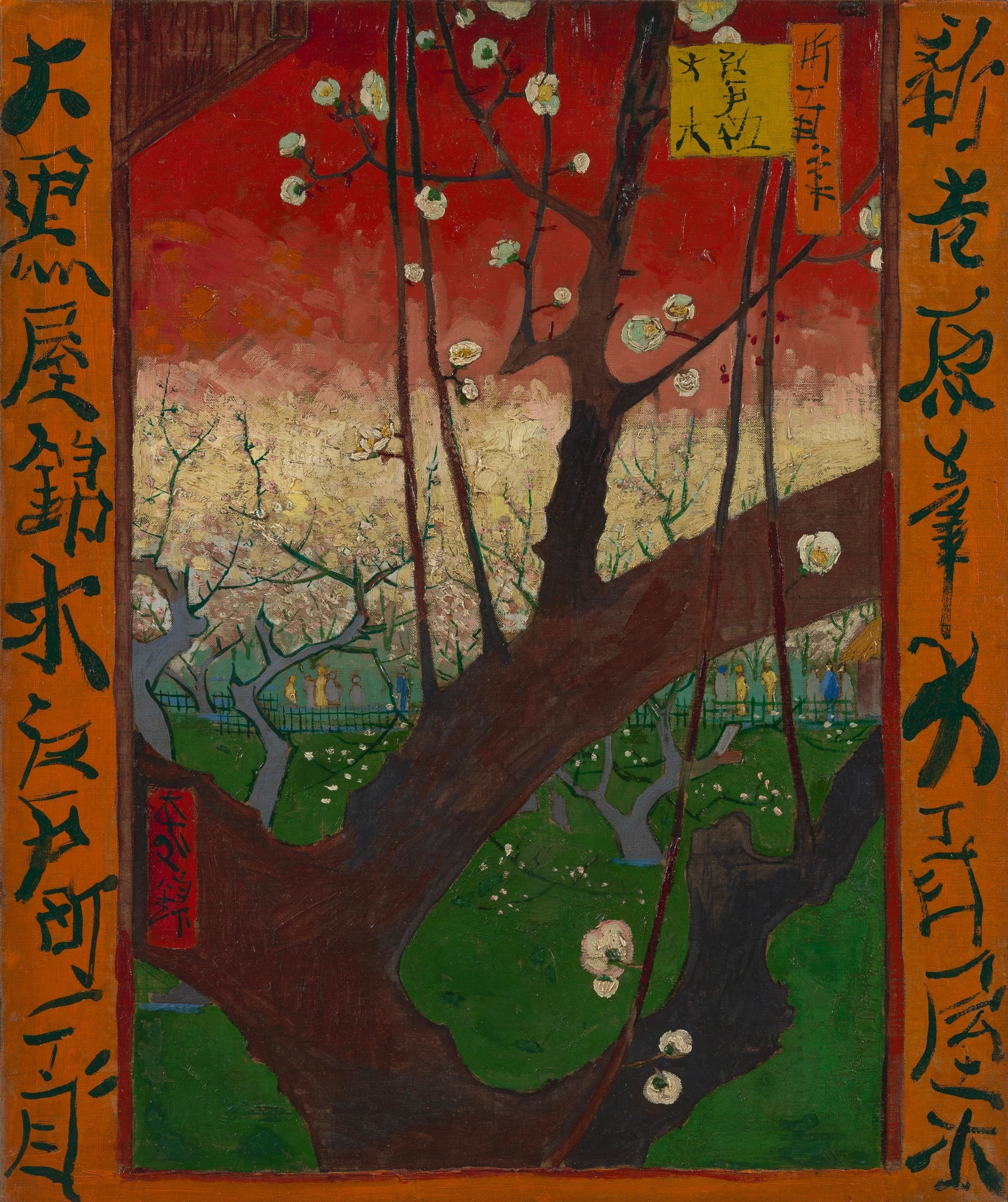
In Flowering Plum Orchard (after Hiroshige), Vincent van Gogh fuses ukiyo-e design with post‑Impressionist color. A diagonal, calligraphic trunk cuts across a saturated green orchard, set against a blazing red sky and framed by orange borders with Japanese characters. The result is a vivid translation of Hiroshige’s motif into an oil painting charged with renewal and resolve [1][2].

Study Print Studio

Create a personal study print

Build a companion study sheet around the part of this painting that speaks to you most. Choose a detail, shape an interpretation, and walk away with something personal and display-worthy.

Fast Facts

Year
1887
Medium
Oil on canvas
Dimensions
55.6 × 46.8 cm
Location
Van Gogh Museum, Amsterdam
See all Vincent van Gogh paintings in Amsterdam
Flowering Plum Orchard (after Hiroshige) by Vincent van Gogh (1887) featuring Diagonal gnarled trunk, Blazing red sky, Plum blossoms, Japanese-character borders

Click on any numbered symbol to learn more about its meaning

Meaning & Symbolism

Van Gogh seizes on Hiroshige’s famous device—a gnarled plum trunk thrusting diagonally across the foreground—and recasts it as a sign of tenacity. In the painting, the trunk arcs like a dark calligraphic stroke, but van Gogh pushes the palette toward red-browns and deep blue shadows, then crowns the limbs with thick, impastoed white blossoms that catch the light. Behind this assertive form, a carpet of saturated green and a band of pale blossom haze lead to a delicate fence with tiny, simplified figures. The motif is recognizably Hiroshige’s Kameido plum garden, yet the handling is not a facsimile: the sky burns from crimson to pink, converting a spring view into a stage of heightened emotion. By bordering the picture with orange side panels inscribed with bold Japanese characters, van Gogh turns the canvas into a cherished “print-page,” declaring its source while proclaiming his authorship. Museum research confirms that he preserved the composition yet made the colors much more intense, added the character borders for a deliberate decorative effect, and worked from prints he avidly collected in Paris in 1887 123. British Museum analysis further underscores that he was not copying a single impression but creatively translating across media and states of the print 4. That translation carries symbolic weight. In East Asian art, the early-blooming plum (Prunus mume) heralds spring and is associated with perseverance and renewal—flowers that open while winter still lingers 5. Van Gogh amplifies this message by setting blossoms against a searing red sky and by rendering petals as tactile, raised dabs, as if resilience could be felt as well as seen. The diagonal trunk reads like an energetic signature across the field, a statement of striving that mirrors the artist’s own search for a new pictorial language in Paris. At the same time, the distant fence and small procession of visitors flatten into patterned silhouettes, a lesson taken from ukiyo‑e about compressing space and simplifying forms into graphic rhythms 12. These choices align with van Gogh’s late‑1887 program to make painting more decorative, emphasizing contour, cropped composition, and unmodulated color fields—principles he showcased while exhibiting Japanese prints that year 13. In Flowering Plum Orchard (after Hiroshige), the border panels and abrupt cropping do not merely quote Japan; they reframe Western oil painting as something that can borrow print logic without surrendering to it. The blossoms’ impasto keeps the work firmly in the realm of oil’s material presence, even as the image reads with poster-like clarity. This hybrid clarity explains why the painting is pivotal in van Gogh’s development. It demonstrates how he learned from Japanese art to purge extraneous modeling, to trust flat color, and to let line and silhouette carry structure. The red sky, green ground, and dark trunk form a triad of saturated planes that communicate emotion directly, anticipating the chromatic audacity of his Arles period. Meanwhile, the orange side panels announce a cosmopolitan authorship—an artist who both venerates Hiroshige and insists on a contemporary, European intensity. Thus the picture’s narrative is twofold: at the level of motif, it celebrates spring’s first, resilient bloom; at the level of art history, it records a crucial experiment where van Gogh forges a language of modern painting from the encounter with Japan. In short, the work visualizes the promise of renewal—of nature, of self, and of painting itself 12345.

Explore Deeper with AI

Ask questions about Flowering Plum Orchard (after Hiroshige)

Popular questions:

Powered by AI • Get instant insights about this artwork

💬 Ask questions about this artwork!

Interpretations

Medium Translation & Material Tension

Van Gogh’s painting thematizes the gap between woodblock print and oil by fusing ukiyo‑e devices—cropped view, flat fields, emphatic contour—with thick, light‑catching impasto. The added character borders act as meta‑frames, declaring the work a “print‑page” while its oil body resists reproducibility. This friction is deliberate: museum analysis shows he preserved the layout yet made the colours much more intense, shifting neutrals to red‑browns and blues and turning the sky crimson‑pink 1. British Museum comparisons across print states argue he wasn’t copying a single impression but performing a cross‑media translation, calibrating line, field, and pigment to new ends 23. The result is a self‑conscious lesson in medium specificity—oil painting learning from, but not becoming, print.

Source: Van Gogh Museum; British Museum

Japonisme as Public Program

In Paris, 1887, van Gogh didn’t just admire Japanese prints—he exhibited them, sold them, and used them to argue for a more decorative modern painting. His two public shows that year positioned ukiyo‑e as a lingua franca for flat color, cropping, and silhouette, and this canvas is the first oil “after” a print in that campaign 45. The orange side panels and abrupt truncations broadcast Japonisme to café audiences habituated to posters and broadsides. Rather than private study, this was display culture: a strategic alignment with Paris’s boulevard image‑world, where print logic informed how art met viewers in convivial, commercial spaces 45. The painting thus functions as both homage and manifesto for a decorative, popular‑facing modernity.

Source: Van Gogh Museum; National Gallery of Art (US)

Iconography of the Plum: From Literati Virtue to Modern Affect

In East Asian traditions the early plum (Prunus mume) signifies perseverance, renewal, and integrity, blossoming against lingering cold 78. Van Gogh intensifies this iconography by staging white petals as raised, tactile nodes against a searing red sky, converting seasonal virtue into sensorial immediacy. The diagonal trunk becomes a calligraphic emblem of endurance—part botanical portrait, part existential sign. By amplifying chroma and surface, he re‑routes literati symbolism through Parisian colorism, making resilience not just allegorical but bodily felt. The work thus mediates between inherited meanings of the plum and a modern, affective register where color and facture carry ethical charge 178.

Source: Princeton University Art Museum; The Met (Asian Art); Van Gogh Museum

Modern Spectatorship: Tourism, Fences, and the Cropped View

Hiroshige’s source design famously turns the Kameido “Resting Dragon” plum into a tourist spectacle, with visitors glimpsed beyond a fence—an urban leisure scene framed by a dramatic near‑view 36. Van Gogh preserves the fence and tiny figures but flattens them into patterned silhouettes, sharpening the lesson in modern spectatorship: nature is consumed as a curated attraction. The assertive foreground trunk functions like a camera’s close‑up, while the distant band reads as a frieze of viewers, compressing space into registers of looking. This compositional theater—near vs. far, spectacle vs. audience—links Edo’s pleasure geography to Paris’s optical modernity, where images and crowds co‑produce experience 236.

Source: British Museum; Art Institute of Chicago

Chromatic Structure and the Arles Horizon

The painting’s architecture—dark trunk, saturated green ground, and red‑pink sky—forms a triadic system of unmixed color planes that carry emotion without extensive modeling. Van Gogh Museum curators note he intensified Hiroshige’s palette, pushing tonal contrasts toward expressive ends 1. This chromatic audacity anticipates Arles: fields keyed to mood, contours doing structural work, and impasto giving optical color a palpable skin. As the Met’s overview of van Gogh suggests, this period consolidates lessons from Impressionism and Japonisme into a personal language where line and silhouette organize space and color delivers affect directly 110. “Flowering Plum Orchard” is thus a hinge between Paris experiment and southern breakthrough.

Source: Van Gogh Museum; The Met (Heilbrunn Timeline of Art History)

Authorship on the Frame: Citation as Signature

The orange side panels with bold characters operate as overt citations of the print source and as a signature device: they acknowledge Hiroshige while staking van Gogh’s claim to a modern, hybrid authorship. Rather than passive borrowing, this is an active apparatus that both frames and brands the image—akin to a title cartouche turned into authorship rhetoric. The Association for Asian Studies notes how van Gogh’s Japonisme mixes indebtedness and transformation; here, appropriation is visible, legible, and thematized 19. In effect, the frame becomes content: a paratext that converts deference into authorship, aligning with late‑19th‑century debates on originality amid expanding image reproduction.

Source: Van Gogh Museum; Association for Asian Studies

Related Themes

About Vincent van Gogh

Vincent van Gogh (1853–1890) developed a radical, emotion‑driven use of color after moving from Paris to Arles in 1888, seeking southern light and an artists’ community. In Arles he created the Sunflowers series to decorate the Yellow House ahead of Gauguin’s visit. His late work fused impasto, high chroma, and symbolic motifs that shaped modern painting [2][5].
View all works by Vincent van Gogh

More by Vincent van Gogh
Café Terrace at Night by Vincent van Gogh

Café Terrace at Night

Vincent van Gogh (1888)

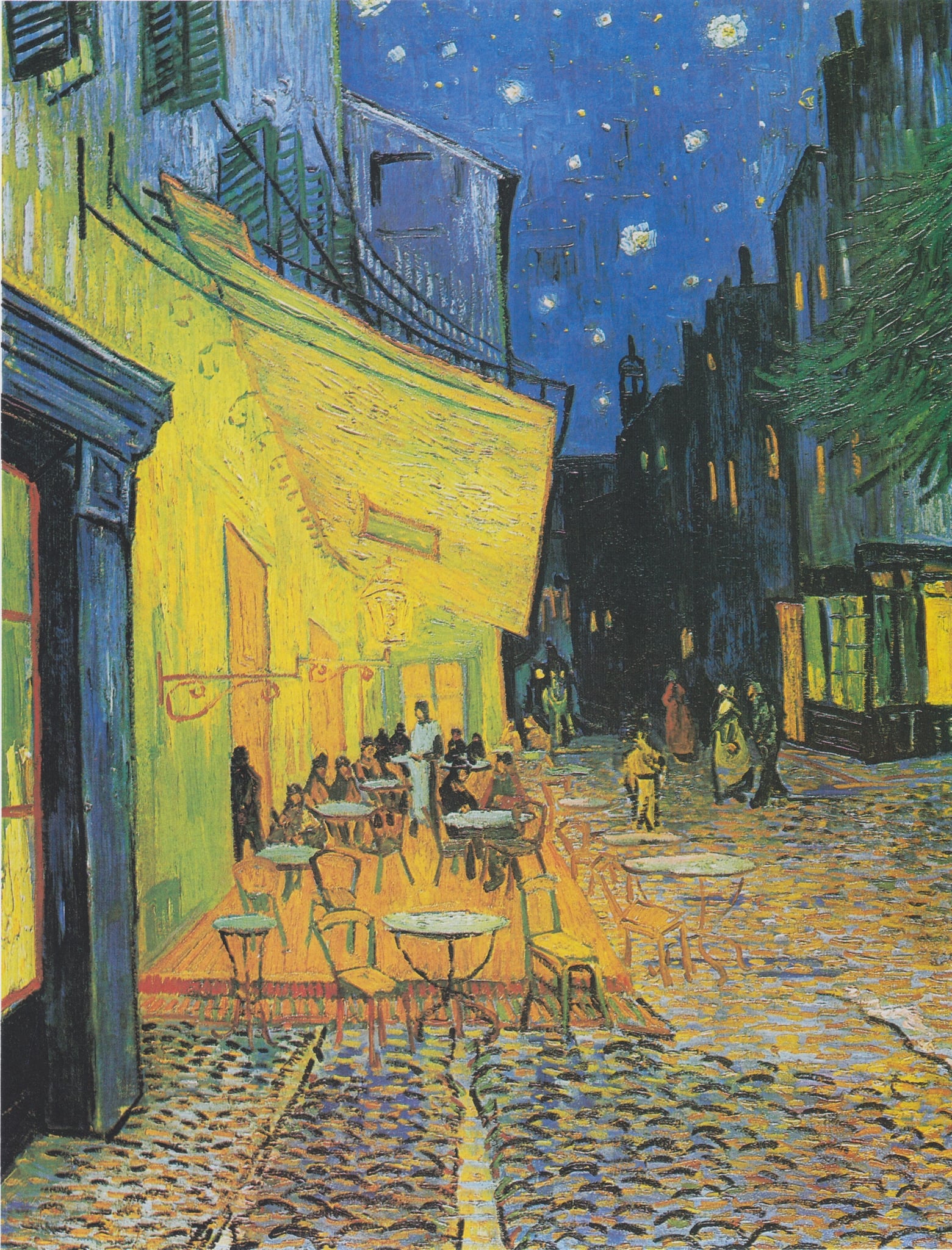
In Café Terrace at Night, Vincent van Gogh turns nocturne into <strong>luminous color</strong>: a gas‑lit terrace glows in yellows and oranges against a deep <strong>ultramarine sky</strong> pricked with stars. By building night “<strong>without black</strong>,” he stages a vivid encounter between human sociability and the vastness overhead <sup>[1]</sup><sup>[2]</sup>.
Red Cabbages and Onions by Vincent van Gogh

Red Cabbages and Onions

Vincent van Gogh (1887)

In Red Cabbages and Onions, Vincent van Gogh turns everyday produce into a drama of <strong>complementary color</strong> and <strong>restless brushwork</strong>. Hot red contours cinch violet cabbages and pale yellow bulbs against a cool, striated blue table, while a mustard‑yellow patch in the upper right tilts the space and sharpens the chromatic clash. The result asserts ordinary food as a locus of <strong>resilience</strong> and <strong>experimentation</strong> <sup>[1]</sup><sup>[2]</sup>.

Irises by Vincent van Gogh

Irises

Vincent van Gogh (1889)

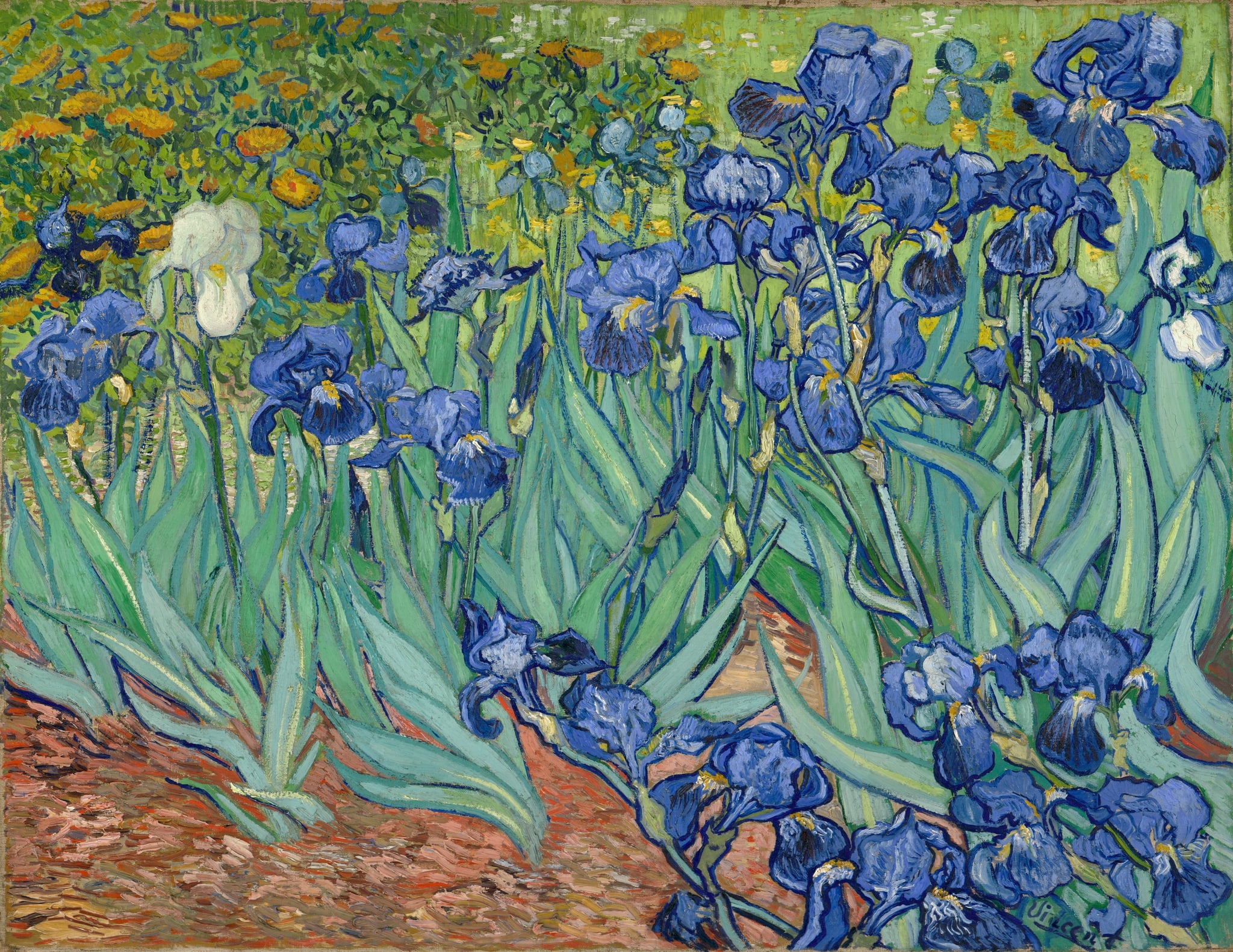
Painted in May 1889 at the Saint-Rémy asylum garden, Vincent van Gogh’s <strong>Irises</strong> turns close observation into an act of repair. Dark contours, a cropped, print-like vantage, and vibrating complements—violet/blue blossoms against <strong>yellow-green</strong> ground—stage a living frieze whose lone <strong>white iris</strong> punctuates the field with arresting clarity <sup>[1]</sup><sup>[2]</sup>.
Sunflowers by Vincent van Gogh

Sunflowers

Vincent van Gogh (1888)

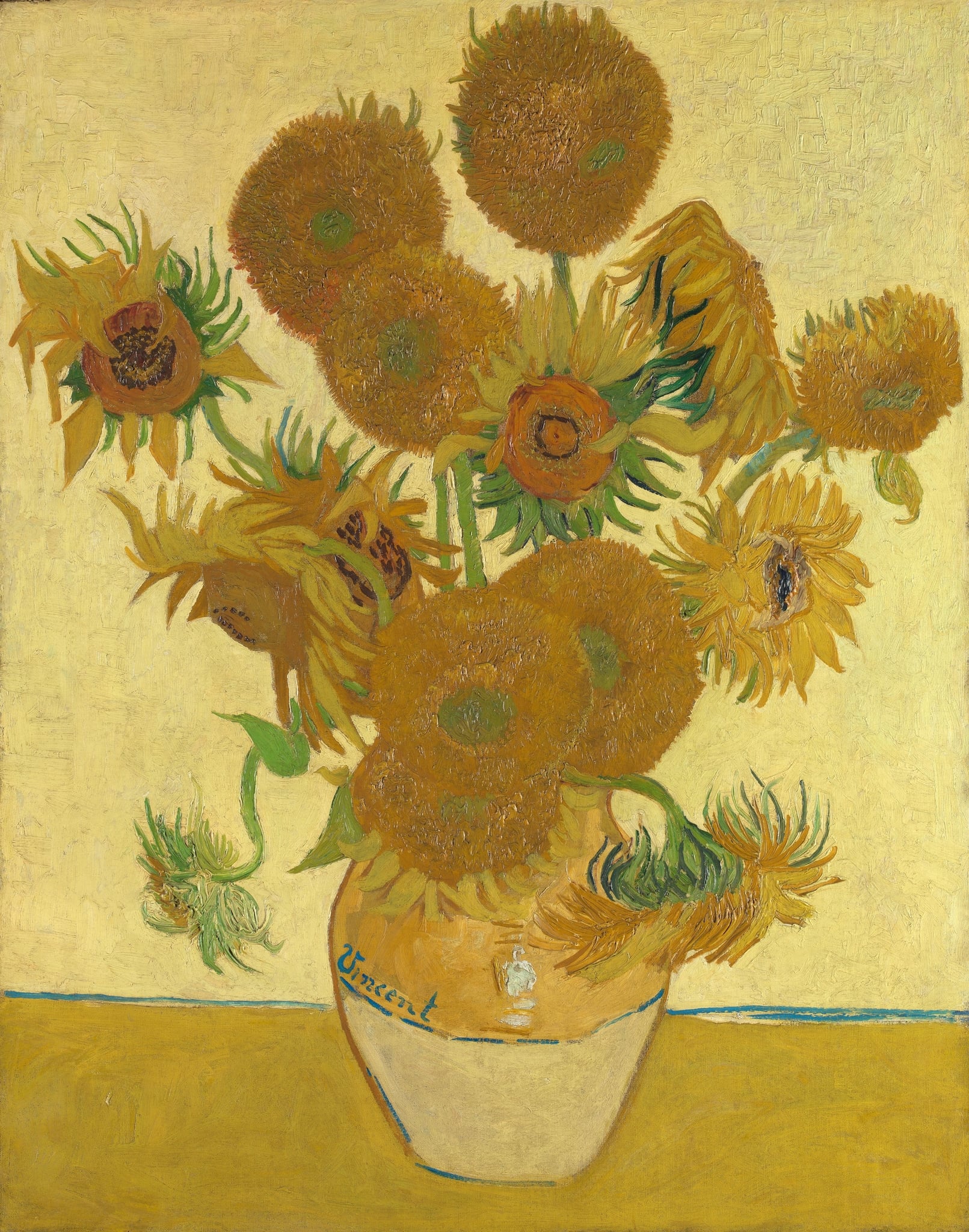
Vincent van Gogh’s Sunflowers (1888) is a <strong>yellow-on-yellow</strong> still life that stages a full <strong>cycle of life</strong> in fifteen blooms, from fresh buds to brittle seed heads. The thick impasto, green shocks of stem and bract, and the vase signed <strong>“Vincent”</strong> turn a humble bouquet into an emblem of endurance and fellowship <sup>[1]</sup><sup>[2]</sup>.

Garden with Courting Couples: Square Saint-Pierre by Vincent van Gogh

Garden with Courting Couples: Square Saint-Pierre

Vincent van Gogh (1887)

In Garden with Courting Couples: Square Saint-Pierre, Vincent van Gogh turns a small Montmartre park into a stage where <strong>spring</strong>, <strong>intimacy</strong>, and <strong>urban leisure</strong> converge. Short, shimmering strokes fuse pink chestnut blossoms, curving paths, and paired figures into one pulse of <strong>renewal</strong> and <strong>togetherness</strong> <sup>[1]</sup><sup>[2]</sup>.

In the Café: Agostina Segatori in Le Tambourin by Vincent van Gogh

In the Café: Agostina Segatori in Le Tambourin

Vincent van Gogh (1887 (Jan–Mar))

Van Gogh casts Agostina Segatori at a tiny, tambourine‑like café table, turning Le Tambourin into a <strong>stage of modern life</strong>. Cool greens and greys make the red <strong>flame‑plume hat</strong> and the foaming <strong>beer</strong> flare, while folded arms and a set‑aside <strong>parasol</strong> register private fatigue amid public display <sup>[1]</sup><sup>[2]</sup><sup>[3]</sup>.