How Much Is Flowering Plum Orchard (after Hiroshige) Worth?
Last updated: May 27, 2026
Quick Facts
- Methodology
- comparable analysis
Hypothetical fair-market value for Vincent van Gogh’s Flowering Plum Orchard (after Hiroshige) (1887) is $65–90 million. The estimate reflects its status as a museum-caliber, Paris-period oil central to Van Gogh’s Japonisme, balanced against the market discount typically applied to works executed “after” another artist.
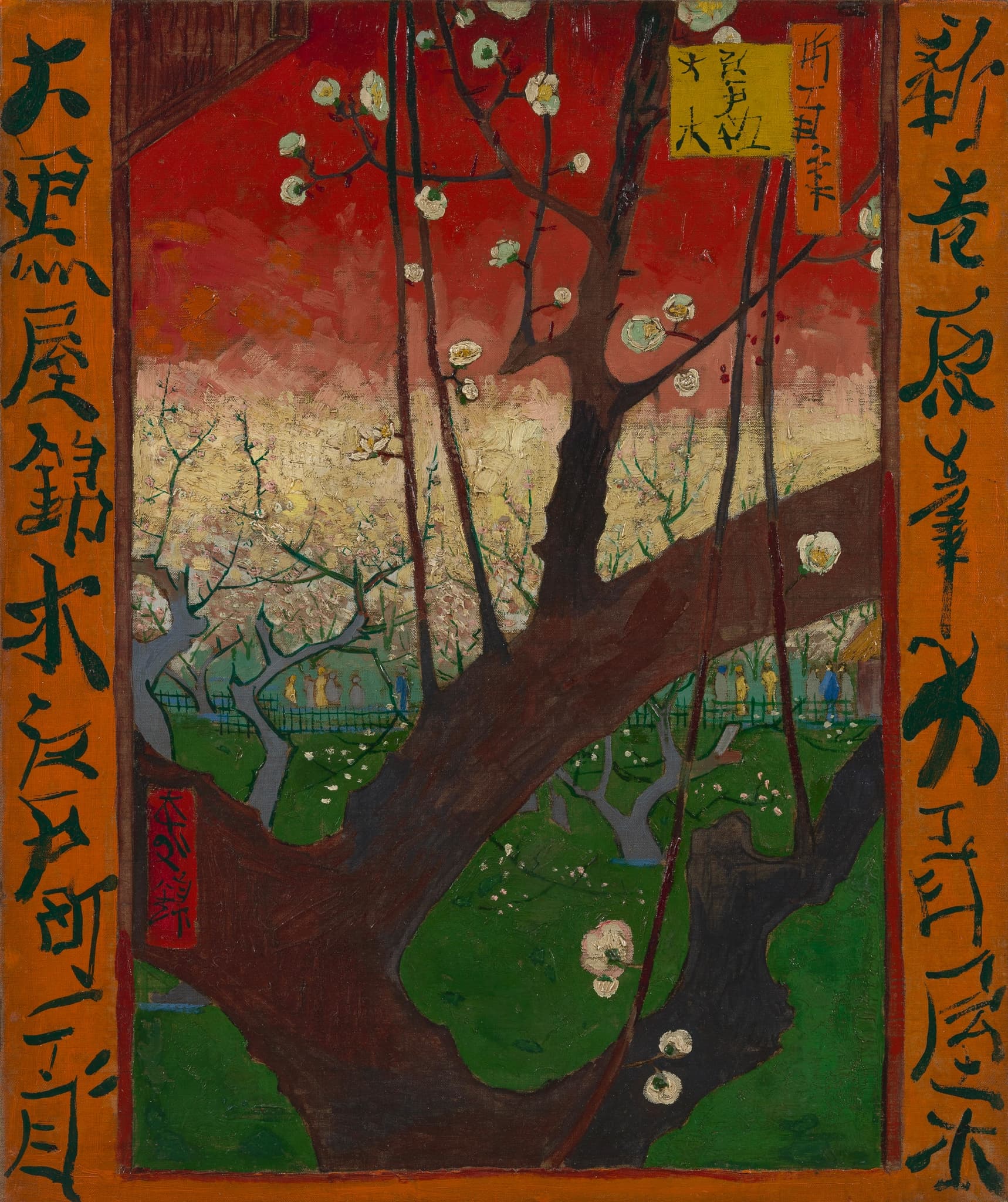
Flowering Plum Orchard (after Hiroshige)
Vincent van Gogh, 1887 • Oil on canvas
Read full analysis of Flowering Plum Orchard (after Hiroshige) →Valuation Analysis
Conclusion: If deaccessioned and offered in a marquee New York or London evening sale with optimal presentation and guarantee support, Vincent van Gogh’s Flowering Plum Orchard (after Hiroshige) (1887) would reasonably be expected to achieve $65–90 million. The painting is a core Paris-period canvas, a rare oil explicitly after a Japanese print (Hiroshige’s Plum Garden at Kameido), and a cornerstone of Van Gogh’s Japonisme—yet, as an intentional “after,” it trades below the very top tier of his original Arles/Saint-Rémy/Auvers compositions. The work is held by the Van Gogh Museum (Vincent van Gogh Foundation), with continuous family/Foundation provenance and no public sale history [1].
How this range was derived: We anchor the top of Van Gogh’s price curve with the artist’s auction record ($117.18m for Orchard with Cypresses, Christie’s, 2022), which captures the market’s appetite for prime, original Arles-period masterpieces [2]. Direct Paris-1887 comparables include high-quality garden and landscape oils that have realized roughly the mid–eight figures in 2023–24, establishing a durable band in the $20s–$30s for strong but non-iconic works. Within that context, this Hiroshige “after” canvas merits a premium over typical Paris garden scenes thanks to its outsized art-historical role in Van Gogh’s transition to saturated color, flattened space, and decorative contour. That premium is, however, bounded below late Arles/Saint-Rémy icons that command $70m–$100m+ at auction.
Key positives: Museum-level quality and unimpeachable provenance; a pivotal place in the narrative of Japonisme in Europe; frequent scholarly citation and display potential; and the structural scarcity of Van Gogh oils reaching market. The subject’s legible linkage to Hiroshige adds cross-category depth, appealing to collectors focused on Japonisme, cross-cultural dialogues, and the genealogy of modernism. Scale (c. 55.6 × 46.8 cm) is intimate but impactful; paint handling and chromatic intensity in this series are recognized touchpoints of the 1887 Paris evolution [1].
Offsets: The “after Hiroshige” status introduces a consistent market discount relative to wholly original Arles/Saint-Rémy/Auvers compositions, particularly the most coveted portraits, orchards, cypresses, and still lifes that define Van Gogh’s public iconography. While the work is famous in scholarship and in the museum context, it is less pop-culturally iconic than Sunflowers, Irises, or Dr. Gachet, moderating peak competitive bidding.
Market conditions and timing: High-end Modern and Impressionist/Post-Impressionist material has shown selective strength since late 2025, with trophy lots drawing deep global demand. The latest Art Basel & UBS report notes that this segment led growth in 2025, underscoring renewed confidence at the top end [3]. Under strong marketing (cross-category positioning with Japonisme and Hiroshige), favorable macro sentiment, and a third-party guarantee, the work would likely attract multiple committed bidders, supporting the $65–90 million bracket.
Upside/downside sensitivities: Clear, recent conservation and technical imaging supporting excellent condition, a broad literature/exhibition history, and carefully managed sale choreography could push the outcome toward the top of the range. Conversely, any condition constraints or suboptimal timing/venue could compress bidding into the lower-to-middle $60m–$70m area.
Key Valuation Factors
Art Historical Significance
High ImpactFlowering Plum Orchard (after Hiroshige) is a defining Paris-period work that crystallizes Van Gogh’s Japonisme—his embrace of saturated color, flattened pictorial space, and bold contour inspired by Japanese ukiyo-e. It is one of a very small number of oils he executed explicitly “after” a Japanese print (Hiroshige’s Plum Garden at Kameido), making it a touchstone for scholarship and exhibitions on cross-cultural influence and the making of modern painting. This scholarly centrality materially elevates desirability versus routine Paris garden views. Within museums and the literature, it is typically presented alongside Bridge in the Rain and Courtesan as a core didactic pivot in Van Gogh’s evolution, strengthening institutional and top-tier private appeal.
Provenance and Museum Status
High ImpactThe work has continuous Van Gogh family/Foundation provenance and is held by the Van Gogh Museum in Amsterdam, a gold-standard context for authenticity, conservation, and documentation. Blue-chip buyers consistently reward unbroken, well-documented provenance—especially when it originates with the artist’s immediate circle and culminates in a world-class institution. Although museum-held status limits real-world availability, it would likely amplify competition if a deaccession ever occurred: the combination of institutional imprimatur, long-term visibility, and canonical importance typically drives aggressive pre-auction interest, robust guarantees, and marquee-lot positioning. Such pedigree helps underpin values in the upper eight figures.
Market Comparables and Period Positioning
High ImpactRecent auction results show strong depth for 1887 Paris oils in the mid–eight figures, with standout examples achieving over $30 million, while prime late Arles/Saint-Rémy masterpieces command $70–$100+ million. This canvas, as a pivotal Japonisme work, justifies a premium over typical Paris garden subjects but still prices below the most coveted original Arles/Saint-Rémy/Auvers compositions. The estimated $65–90 million range triangulates between these bands: it sits above routine 1887 outcomes due to singular art-historical weight, but below the record-setting tier anchored by Orchard with Cypresses, Irises, and comparable late works. The result is a coherent, market-aligned bracket for a museum-caliber, secondary-tier (by type) but historically primary (by narrative) Van Gogh.
Work Type: 'After' Hiroshige
Medium ImpactWhile the painting’s explicit homage to Hiroshige is a core reason for its scholarly importance, the market typically applies a discount to works executed “after” another artist relative to original compositions of similar quality and date. Collectors at the ultra-trophy level often prize iconic originality in Arles/Saint-Rémy/Auvers subjects, which can clear $80–$120+ million. Here, the ‘after’ designation tempers peak pricing even as cross-cultural resonance broadens appeal. The net effect is a nuanced profile: academically and curatorially prized, with meaningful private demand, but positioned below the absolute apex of Van Gogh’s standalone inventions—hence our upper-eight-figure, sub-$100m valuation band.
Sale History
Flowering Plum Orchard (after Hiroshige) has never been sold at public auction.
Vincent van Gogh's Market
Vincent van Gogh’s market is one of the deepest and most internationally competitive in fine art. True masterpieces from Arles, Saint-Rémy, and Auvers are exceptionally scarce and attract multiple global bidders. The artist’s auction record stands at $117.18 million for Orchard with Cypresses (Christie’s, 2022), confirming sustained willingness to pay nine figures for apex-period works. Strong, fresh-to-market oils from the late 1880s routinely achieve mid- to high-eight figures, with select Paris-period works from 1887 posting $20–30+ million results and standout examples materially higher. Demand is fueled by universal name recognition, a compact oeuvre, strong museum programming, and broad cross-category appeal, keeping price discovery tight at the top end.
Comparable Sales
Piles de romans parisiens et roses dans un verre (Romans parisiens)
Vincent van Gogh
Same artist and same Paris year (1887) as Flowering Plum Orchard; a top-tier Paris-period benchmark showing current depth for 1887 oils.
$62.7M
2025, Sotheby's New York
Coin de jardin avec papillons
Vincent van Gogh
Same artist, Paris-period (1887) garden subject; broadly comparable scale and date to the Hiroshige after-image, reflecting demand for strong 1887 works.
$33.2M
2024, Christie's New York
~$34.0M adjusted
Jardin devant le Mas Debray
Vincent van Gogh
Same artist and same Paris year (1887); close subject matter (garden motif). Useful mid‑market anchor for non‑iconic Paris oils.
$23.3M
2023, Sotheby's New York
~$24.7M adjusted
L’Allée des Alyscamps
Vincent van Gogh
Arles 1888 landscape of major standing; while later and more coveted than Paris works, it frames the upper band for desirable non‑portrait oils.
$66.3M
2015, Sotheby's New York
~$90.3M adjusted
Laboureur dans un champ (Ploughman in the Field)
Vincent van Gogh
Saint‑Rémy 1889 oil of high importance; a late‑period benchmark indicating where top non‑portrait canvases can reach.
$81.3M
2017, Christie's New York
~$107.2M adjusted
Orchard with Cypresses (Verger avec cyprès)
Vincent van Gogh
Arles 1888 orchard scene that set the artist’s auction record; strongest subject‑adjacent anchor (orchard motif), though a later peak‑period masterpiece.
$117.2M
2022, Christie's New York
~$129.3M adjusted
Current Market Trends
The high-end Modern and Impressionist/Post‑Impressionist segment has reasserted strength since late 2025, with trophy works drawing deep global participation and selective records. While the broader market cooled in 2024, recent marquee seasons show renewed confidence at the top, led by blue-chip names and best-in-class examples. Quality and freshness are decisive: canonical works with strong provenance and scholarship outperform, while lesser or repetitive material remains price-sensitive. Against this backdrop, a museum-level Van Gogh with a strong narrative and exhibition potential is well-positioned to command an upper‑eight‑figure price, assuming supportive sale mechanics (marquee venue, robust marketing, and a third‑party guarantee).
Study print
Study this painting as a print
Pair the full artwork with a museum-style study sheet focused on one meaningful detail.