Fishing Boats on the Beach at Les Saintes-Maries-de-la-Mer

by Vincent van Gogh

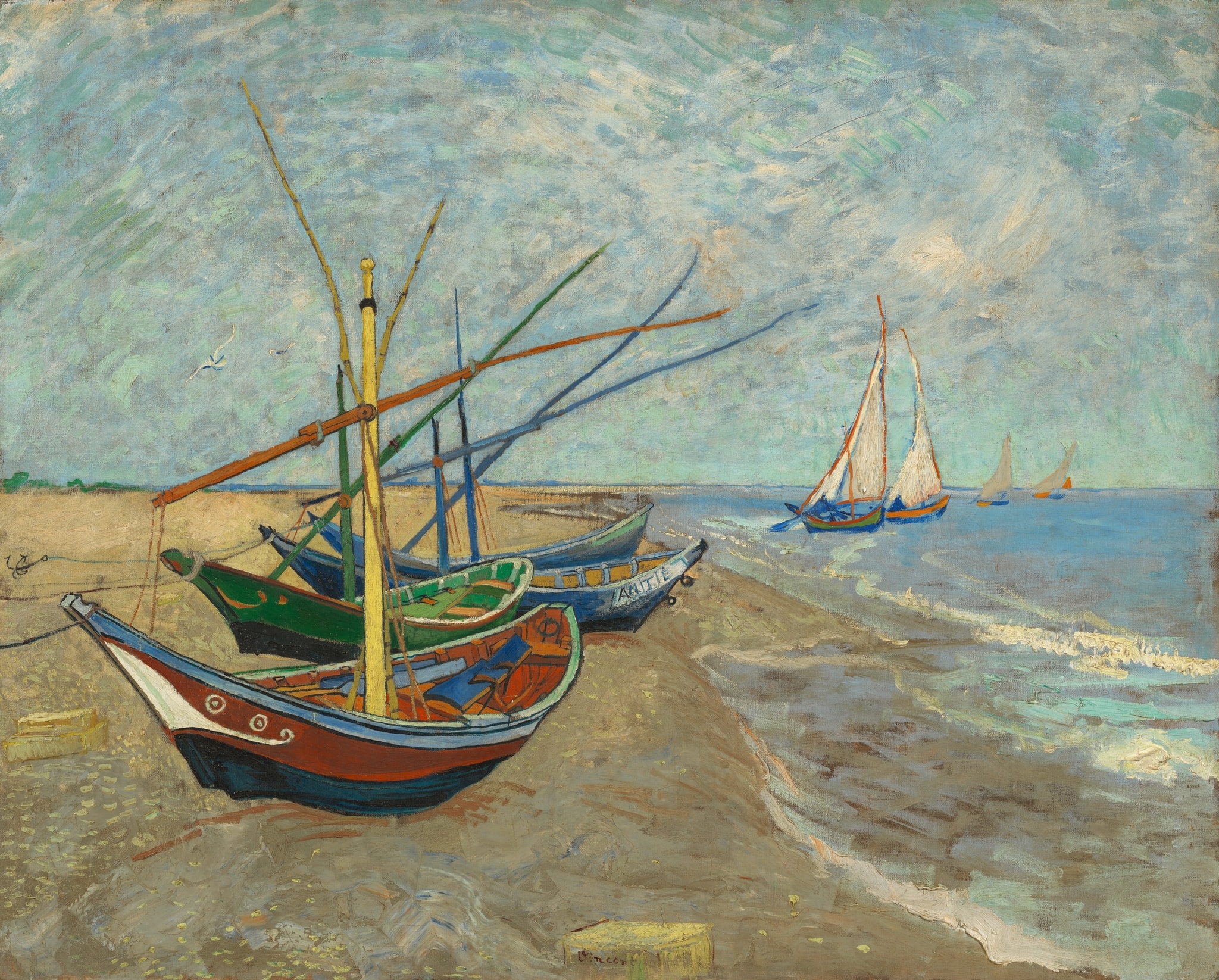
Vincent van Gogh lines up a file of beached craft like actors awaiting their cue, turning working boats into emblems of readiness and risk. Bold contours, flattened color, and the wind‑tossed sea and sky translate Mediterranean luminosity into a Japonisme/Cloisonnism idiom that clarifies form and heightens feeling. The scene suspends time at the edge of departure, where labor, hope, and the sea’s pull meet.

Study Print Studio

Create a personal study print

Build a companion study sheet around the part of this painting that speaks to you most. Choose a detail, shape an interpretation, and walk away with something personal and display-worthy.

Fast Facts

Year
1888
Medium
Oil on canvas
Dimensions
65 × 81.5 cm
Location
Van Gogh Museum, Amsterdam
See all Vincent van Gogh paintings in Amsterdam
Fishing Boats on the Beach at Les Saintes-Maries-de-la-Mer by Vincent van Gogh (1888) featuring Distant lateen sails, Beached working boats, Black-blue contours, Taut rigging leaning seaward

Click on any numbered symbol to learn more about its meaning

Meaning & Symbolism

Van Gogh composes the beach as a stage of potential energy. Four brightly painted boats—red, green, and blue—are pulled high on the sand, their curving prows thrusting diagonally toward the surf. Taut rigging makes a web of blue and ocher lines that lean seaward, and offshore a pair of lateen‑rigged sails repeats the boats’ triangular rhythms at a smaller scale, like a refrain. These calculated echoes turn the shoreline into a visual funnel that pours the eye toward the horizon. Van Gogh heightens this sense of launch by suppressing cast shadows and enclosing each hull in strong black-blue contours, a decision that flattens volume and makes the boats read as bold signs rather than modeled objects 1. The absence of deep shadow prevents the scene from settling; everything feels provisional, a pause between the night’s haul and the next departure. In this charged interval, the boats embody disciplined labor and the risk inherent in putting to sea—motifs that align with van Gogh’s sustained empathy for working communities 14. The painting’s authority comes from a fusion of perception and construction. Although the subject suggests plein air spontaneity, van Gogh could not paint the scene on the beach because the boats left very early; he drew them on site at Les Saintes‑Maries and then worked up the oil in Arles from those studies 12. That shift from shore to studio allowed him to orchestrate the composition’s Cloisonnist clarity: flat, high‑key color zones bounded by emphatic outlines, simplified geometry, and a deliberate omission of cast shadow 14. The sky’s short, arcing strokes and the water’s turquoise shivers are not casual dabs but patterned touches that register wind and glare while keeping the surface decorative and taut—evidence of planning rather than pure improvisation 3. This calculated facture serves an ideal van Gogh named explicitly in June 1888: to see the South with a more “Japanese eye,” meaning an art of exaggerated color, simplicity, and emblematic form 2. In the Saintes‑Maries boats, Japonisme is not quotation but structure: outline makes order; repetition of sails and prows composes a visual ethics of readiness; color—vermillion ribs against green decks, orange luffs threading blue rigging—renders Mediterranean light as conviction rather than report. As the surf frays into white tassels at the right edge and gulls cut small arcs into the upper left, the whole image binds daily work to the sea’s ceaseless motion. Thus the painting stands as a programmatic statement from Arles: nature energized, community dignified, and form made luminous and legible through design. In that synthesis lies the painting’s lasting power—and van Gogh’s blueprint for meaning after Impressionism 12345.

Explore Deeper with AI

Ask questions about Fishing Boats on the Beach at Les Saintes-Maries-de-la-Mer

Popular questions:

Powered by AI • Get instant insights about this artwork

💬 Ask questions about this artwork!

Interpretations

Formal/Process Analysis: Studio Design from Field Notes

Despite its breezy subject, the picture is a constructed orchestration. Van Gogh drew the fleet on site at Saintes‑Maries at daybreak and then translated those studies into oil back in Arles, where he could calibrate contours, chroma, and the omission of cast shadows with deliberation 2. Technical reading of the sky’s short arcs and the water’s turquoise tremors shows a patterned, non‑improvised facture aimed at decorative tautness rather than spontaneous notation 3. The result is a studio‑composed plein‑air fiction: observational data disciplined by design. This procedure lets him press the diagonals, echoes, and outlines into a directed visual flow, turning topography into rhetoric—proof that, for Van Gogh in Provence, truth of sensation could be engineered as much as witnessed 23.

Source: Van Gogh Museum — Unravel Van Gogh

Japonisme as Structure, Not Motif

Here Japonisme operates as syntax, not surface quote. Flat, high‑key zones bounded by emphatic contour recast volume as clarity; suppressed shadows and repeating triangular sails impose an ordering grid on incident 1. In a June 1888 letter, Van Gogh explicitly sought to see the South with a more “Japanese eye”—exaggerated color, simplicity, emblematic form—treating Provence as a laboratory for that ideal 2. This painting exemplifies that program: outline as ethical tool, color as conviction, repetition as compositional discipline. Rather than borrow a wave pattern or fan, he internalizes print logic to forge a southern classicism, a synthesis later noted in museum scholarship as central to his Arles project beyond Impressionism 15.

Source: Van Gogh Museum; Vincent van Gogh Letters; National Gallery of Art

Socio‑Ethical Reading: Dignity of Work

The beached craft register as signs of vocation. Stripped of cast shadow and modeled detail, each hull becomes an emblem for a collective of workers whose lives hinge on routine, risk, and mutual reliance. This moralizing of the ordinary accords with readings of Van Gogh’s wider project to sacralize labor—investing common tasks with ethical and even spiritual gravity 6. The calculated diagonals and taut rigging read as readiness; the offshore sails echo the promise and peril of departure, a cycle that binds bodies to weather and time. Rather than anecdote, the scene becomes a modern parable of disciplined work under elemental conditions, aligning with the artist’s sustained empathy for working communities in letters and curatorial texts 126.

Source: Debora Silverman

Environmental Phenomenology: Encoding Wind and Glare

Van Gogh converts Mediterranean weather into pictorial micro‑events. Short, arcing strokes in the sky and shivering turquoise in the sea operate as a sensorium for wind shear and glare, while the surf unravels into white tassels at the edge—localized touches that make climate legible without meteorological detail 3. His stated aim to exaggerate color in the South supports this phenomenological drive: chroma is not report but a proxy for intensity—how light feels on sand, deck, and sail 2. The painting thus reads as a diagram of forces: vectors of rigging vs. lateral gusts, prying surf vs. beached hulls. Nature is not backdrop but an active system inscribed in touch and hue 23.

Source: Van Gogh Museum — Unravel Van Gogh; Vincent van Gogh Letters

Serial Thinking: From Drawing to Canvas to Motif Family

This canvas belongs to a serial ecology of Saintes‑Maries studies—on‑site reed‑pen drawings, a watercolor after the drawing, and related seascapes with boats under sail 27. Tracking across the set shows how Van Gogh re‑weights elements: the drawing secures proportion and rigging; the watercolor tests chroma; the oil amplifies contour and suppresses shadow to achieve emblematic clarity. Such iteration is not redundancy but motif engineering, refining how diagonals funnel the gaze seaward and how color plates out into legible zones. Seen together, the series documents a method: observe, translate, synthesize—each step tightening the work’s program of clarity and readiness articulated in his Arles letters 27.

Source: Vincent van Gogh Letters; Saint Louis Art Museum

Related Themes

About Vincent van Gogh

Vincent van Gogh (1853–1890) developed a radical, emotion‑driven use of color after moving from Paris to Arles in 1888, seeking southern light and an artists’ community. In Arles he created the Sunflowers series to decorate the Yellow House ahead of Gauguin’s visit. His late work fused impasto, high chroma, and symbolic motifs that shaped modern painting [2][5].
View all works by Vincent van Gogh

More by Vincent van Gogh
Café Terrace at Night by Vincent van Gogh

Café Terrace at Night

Vincent van Gogh (1888)

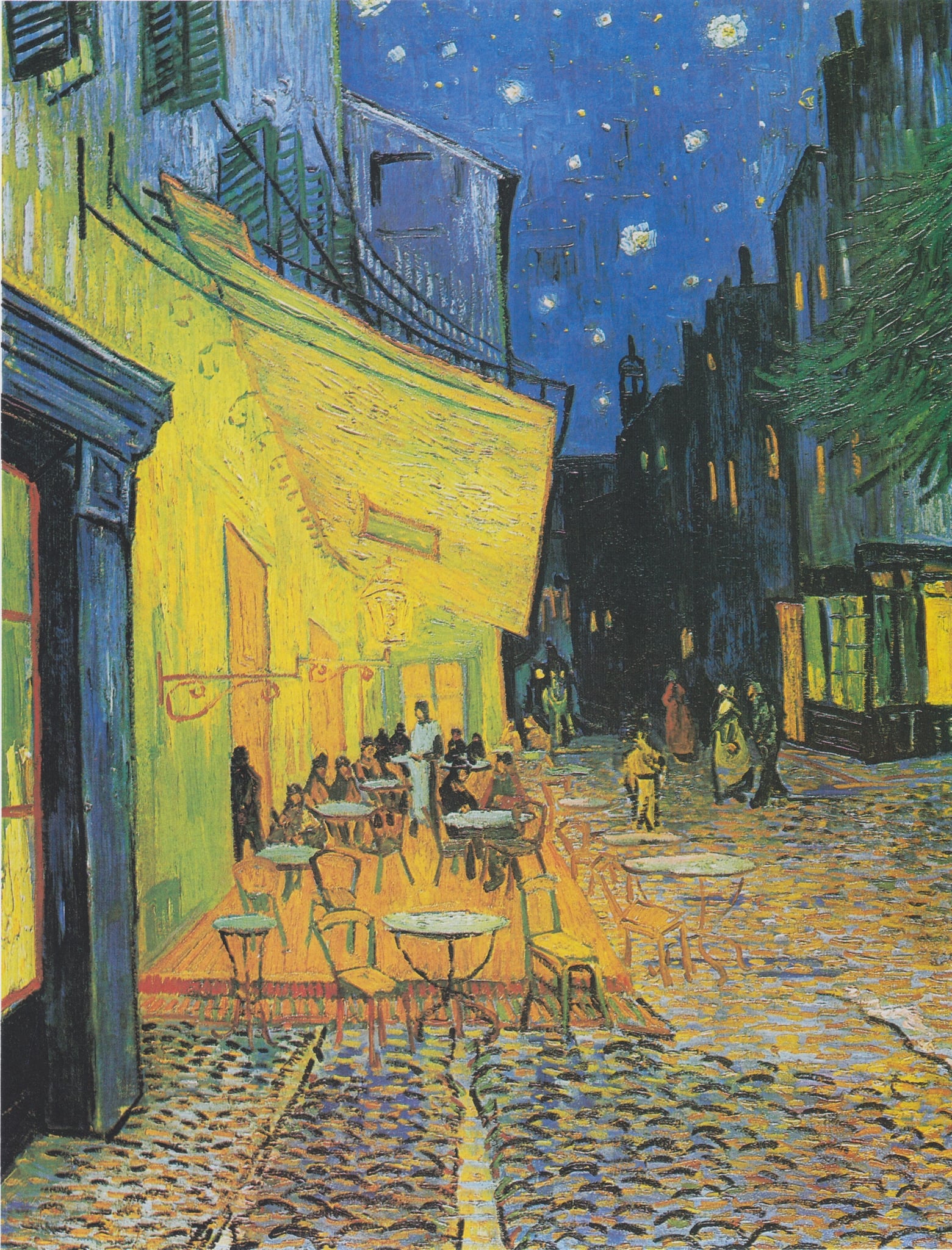
In Café Terrace at Night, Vincent van Gogh turns nocturne into <strong>luminous color</strong>: a gas‑lit terrace glows in yellows and oranges against a deep <strong>ultramarine sky</strong> pricked with stars. By building night “<strong>without black</strong>,” he stages a vivid encounter between human sociability and the vastness overhead <sup>[1]</sup><sup>[2]</sup>.
Red Cabbages and Onions by Vincent van Gogh

Red Cabbages and Onions

Vincent van Gogh (1887)

In Red Cabbages and Onions, Vincent van Gogh turns everyday produce into a drama of <strong>complementary color</strong> and <strong>restless brushwork</strong>. Hot red contours cinch violet cabbages and pale yellow bulbs against a cool, striated blue table, while a mustard‑yellow patch in the upper right tilts the space and sharpens the chromatic clash. The result asserts ordinary food as a locus of <strong>resilience</strong> and <strong>experimentation</strong> <sup>[1]</sup><sup>[2]</sup>.

Irises by Vincent van Gogh

Irises

Vincent van Gogh (1889)

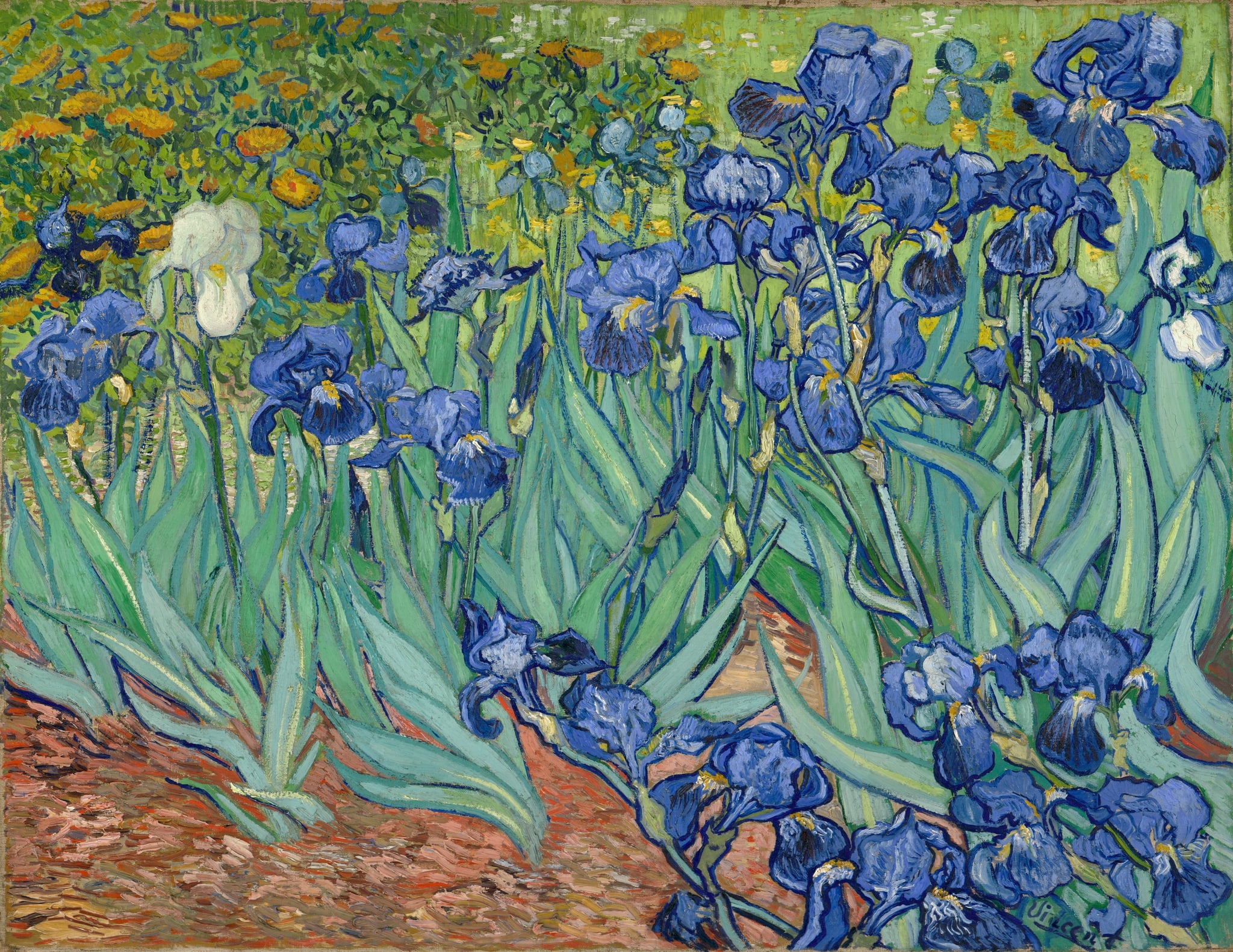
Painted in May 1889 at the Saint-Rémy asylum garden, Vincent van Gogh’s <strong>Irises</strong> turns close observation into an act of repair. Dark contours, a cropped, print-like vantage, and vibrating complements—violet/blue blossoms against <strong>yellow-green</strong> ground—stage a living frieze whose lone <strong>white iris</strong> punctuates the field with arresting clarity <sup>[1]</sup><sup>[2]</sup>.
Sunflowers by Vincent van Gogh

Sunflowers

Vincent van Gogh (1888)

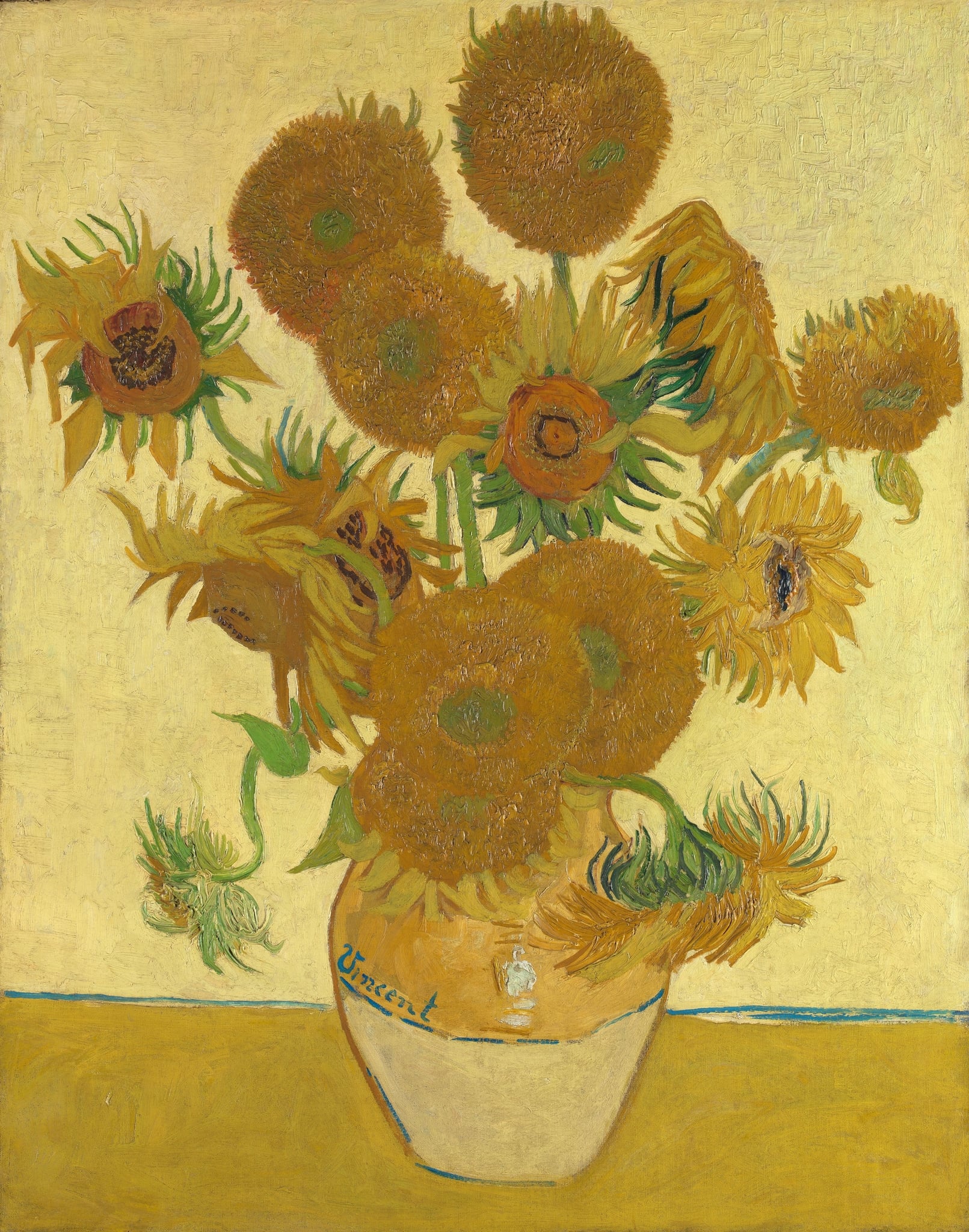
Vincent van Gogh’s Sunflowers (1888) is a <strong>yellow-on-yellow</strong> still life that stages a full <strong>cycle of life</strong> in fifteen blooms, from fresh buds to brittle seed heads. The thick impasto, green shocks of stem and bract, and the vase signed <strong>“Vincent”</strong> turn a humble bouquet into an emblem of endurance and fellowship <sup>[1]</sup><sup>[2]</sup>.

Garden with Courting Couples: Square Saint-Pierre by Vincent van Gogh

Garden with Courting Couples: Square Saint-Pierre

Vincent van Gogh (1887)

In Garden with Courting Couples: Square Saint-Pierre, Vincent van Gogh turns a small Montmartre park into a stage where <strong>spring</strong>, <strong>intimacy</strong>, and <strong>urban leisure</strong> converge. Short, shimmering strokes fuse pink chestnut blossoms, curving paths, and paired figures into one pulse of <strong>renewal</strong> and <strong>togetherness</strong> <sup>[1]</sup><sup>[2]</sup>.

In the Café: Agostina Segatori in Le Tambourin by Vincent van Gogh

In the Café: Agostina Segatori in Le Tambourin

Vincent van Gogh (1887 (Jan–Mar))

Van Gogh casts Agostina Segatori at a tiny, tambourine‑like café table, turning Le Tambourin into a <strong>stage of modern life</strong>. Cool greens and greys make the red <strong>flame‑plume hat</strong> and the foaming <strong>beer</strong> flare, while folded arms and a set‑aside <strong>parasol</strong> register private fatigue amid public display <sup>[1]</sup><sup>[2]</sup><sup>[3]</sup>.