View from Theo's Apartment

by Vincent van Gogh

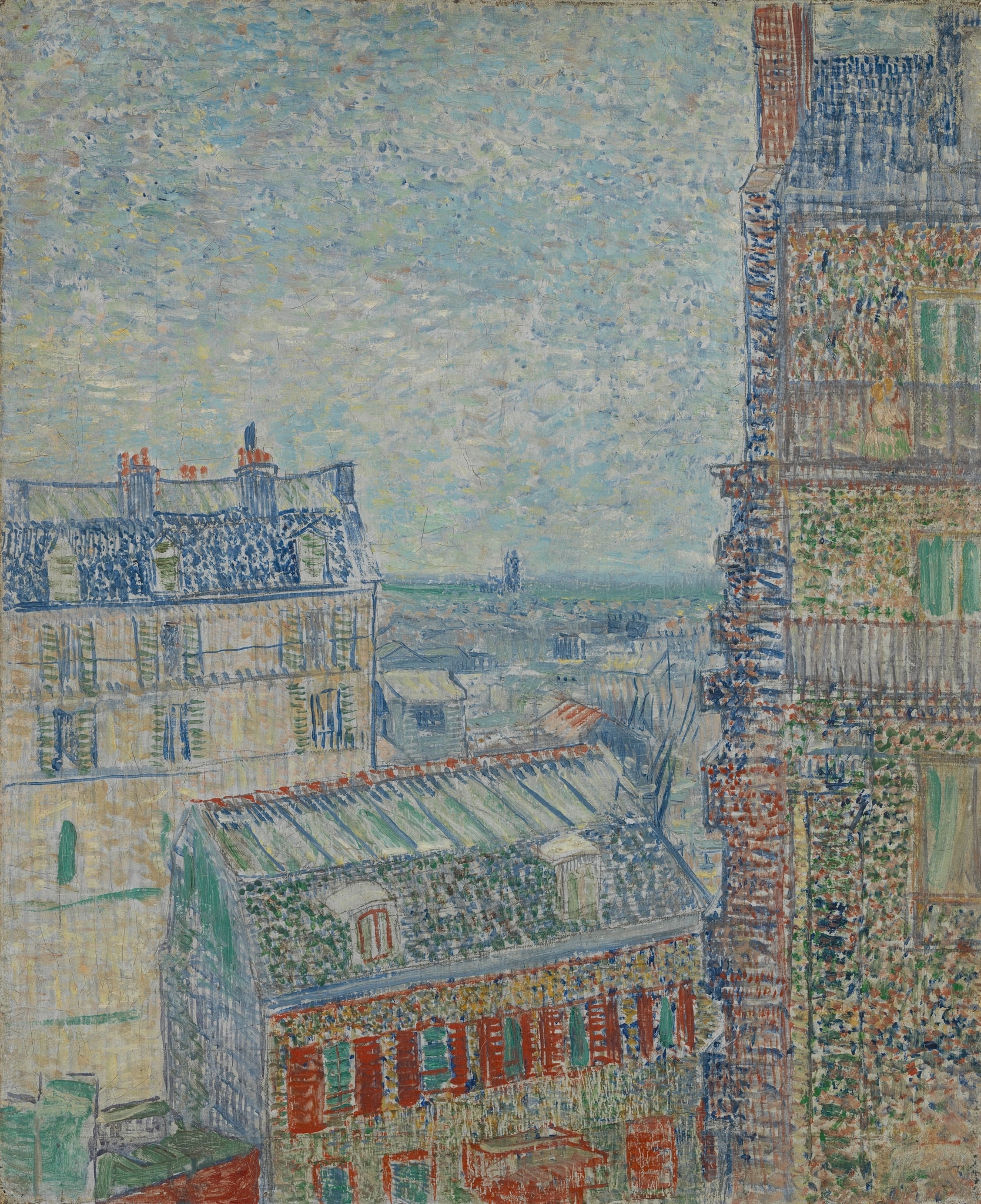
Van Gogh’s View from Theo’s Apartment compresses Paris into a close tapestry of roofs, windows, and chimneys, then releases the gaze into a pale, stippled sky. The painting fuses loose strokes with Pointillist touches, setting cool slate blues against warm brick reds to make the city surface quiver with urban energy [1][5]. On the far horizon, the vista opens toward Meudon and the Trocadéro, anchoring the scene in a real, breathable distance [2].
💰

Market Value

$45-75 million

How much is View from Theo's Apartment worth?

Study Print Studio

Create a personal study print

Build a companion study sheet around the part of this painting that speaks to you most. Choose a detail, shape an interpretation, and walk away with something personal and display-worthy.

Fast Facts

Year
1887
Medium
Oil on canvas
Dimensions
45.9 × 38.1 cm
Location
Van Gogh Museum, Amsterdam
See all Vincent van Gogh paintings in Amsterdam
View from Theo's Apartment by Vincent van Gogh (1887) featuring Stippled, expansive sky, Chimney pots and stacks, Repeating windows and shutters, Ivy‑covered brick façade

Click on any numbered symbol to learn more about its meaning

Meaning & Symbolism

From the fourth‑floor perch at 54 Rue Lepic, Van Gogh composes a city that presses in from the picture’s edges and yet breathes through the center. On the right, an ivy‑thick, brick façade crowds the margin, its balconies and green shutters stacked like vertebrae; opposite, steep zinc roofs with red chimney pots thrust up, their planes angled so they funnel sight toward the middle distance 1. Across the canvas, short, stippled touches in cool blues and greens weld the roofs into a single, pulsing surface, while warm reds in brickwork and shutters flicker against them, a deliberate chromatic opposition that animates the scene without resorting to strict Pointillist system 15. The windows repeat in tight vertical ranks, a grid of thresholds suggesting countless private lives compressed into the modern metropolis, as chimneys stand like quiet sentinels above them. The brushwork toggles between dotted, Pointillist passages in the sky and brisk, dragged strokes along the rooflines, making technique itself an index of the city’s double nature—mechanical regularity versus lived, improvisatory flux 15. Van Gogh structures this pressure and release with a firm scaffold. He had been using a perspective frame in Paris, and the painting’s receding diagonals—especially the run of roofs pulling from the lower left toward the center—signal that measured aid even as the surface bristles with painterly marks 27. That diagonal rhythm frees the gaze into a luminous, speckled sky—“a piece of sky above it that is almost as big as when one stands on the dune,” as Theo wrote—so the composition reads as a breath taken after urban compression 3. The vista is not generic: the Unravel research identifies the Montmartre Cemetery in the middle distance and, on the horizon, the hills of Meudon and the Palais du Trocadéro—facts that ground the painting’s metaphors in topography 2. The cemetery’s quiet band within a scene of domestic and industrial chimneys embeds a subdued memento mori inside the metabolism of the city, while the long horizon and high sky model the spatial escape Van Gogh himself sought in Paris, whose “air clears up the brain” even as it exhausted him 4. The ivy climbing the right‑hand wall complicates the geometry; its mottled greens infiltrate the brick, a soft, organic counter‑beat to Haussmann’s hard rectilinear order. Nature persists, but as a cling—tenacious, secondary—answering the thrum of the city with a whisper rather than a chorus. As a statement of artistic direction, the painting is decisive. Its hybrid facture—stippling laced with freer strokes—shows Van Gogh testing Neo‑Impressionist color juxtaposition without surrendering to its rigidity, a short‑lived method he would soon transform into the muscular handling of Arles 156. The canvas is small yet assertive: the near buildings are cropped at the frame, a modern cut that allies the view with contemporary rooftop images of Paris while insisting on Van Gogh’s own sensibility—more tactile, more emotionally charged 6. In that sense, the work performs its subject: modernity as contact and vibration. The roofs buzz with adjacent touches; the shutters toggle between closed privacy and open possibility; the skyline promises space. The meaning of View from Theo’s Apartment is this felt dialectic—an affectionate, restless inventory of urban life that searches for clarity in breadth and in color. And why View from Theo’s Apartment is important is that it captures, at a verifiable address and moment, the crucible in which Van Gogh’s palette brightened, his structure tightened, and his vision of modern space crystallized—just before he turned that energy loose on the South 1246.

Explore Deeper with AI

Ask questions about View from Theo's Apartment

Popular questions:

Powered by AI • Get instant insights about this artwork

💬 Ask questions about this artwork!

Interpretations

Technical Art History

Look at the picture as an experiment in controlled looseness. Van Gogh deploys a perspective frame to stage strong diagonals, yet overlays them with a hybrid facture that oscillates between stippling and brisk strokes—an intentional friction between measured depth and tactile surface 17. Conservation notes that he even reused the canvas, a choice visible in the paint build-up and consistent with his Paris-period pragmatism 8. Instead of adopting Seurat’s system, Van Gogh tests Pointillist adjacency where it serves optical vibration, then releases into freer handling along the rooflines—a procedural drama that becomes content 1511. The result is a city that both aligns and frays: geometry holds the field, brushwork unsettles it. Technique here is not neutral craft; it is a meaning-bearing structure that stages modernity’s push-pull between order and flux.

Source: Van Gogh Museum (object record; Unravel Van Gogh)

Topographic-Iconographic Reading

This view is not generic. Museum research pins the middle-distance Montmartre Cemetery and, on the horizon, Meudon and the Palais du Trocadéro—a factual spine for metaphors of mortality and escape 2. The cemetery’s dark band, threaded among chimneys, is a quiet memento mori inside domestic-industrial metabolism, tempering the city’s vitality with time’s limit 24. Above, Theo’s “piece of sky” dilates the scene, staging a breath after compression and echoing Vincent’s claim that Parisian air “clears up the brain34. With landmarks verified, the painting reads as a calibrated geography of feeling: density (foreground blocks), limit (cemetery), and horizon (Meudon/Trocadéro) as a gradient from enclosure to release.

Source: Unravel Van Gogh; Van Gogh Museum gallery text; Van Gogh’s Letters

Comparative Modernity

Framed against Paris’s rooftop genre, Van Gogh’s cut aligns with contemporaries like Caillebotte, yet tilts toward greater tactility and chromatic charge 19. The near facades are cropped sharply, a photographic modernity that asserts immediacy and partial vision—no boulevard spectacle, but the infrastructural city of chimneys, zinc, and grids 1. Where Caillebotte often cools surfaces into planar clarity, Van Gogh makes them vibrate with adjacent touches, stressing perceptual flux over Cartesian calm 91. This is modernity as contact: edges abut, colors spark, surfaces quiver. By adopting the rooftop vantage but intensifying facture and color, Van Gogh reframes a recognized urban motif as a laboratory for sensation, anticipating how the South would further radicalize his surface.

Source: Van Gogh Museum; Artprice (Caillebotte context)

Urban Sociology

The stacked facades and repeating window grid visualize social compression: countless private lives arranged by speculative housing into vertical ranks, privacy as architecture’s algorithm 4. Chimneys punctuate this order like metronomes of labor and domestic routine. Read with urban-cultural analyses of Van Gogh’s Paris, the painting registers ambivalence—an attraction to avant-garde color and city energy, coupled with a search for air and distance 10. The composition scripts that tension: pressure at the edges, release to the sky. Far from a neutral cityscape, it maps how modern life organizes bodies and views, offering a phenomenology of density in which looking becomes a negotiation between constraint and respite.

Source: Van Gogh Museum (gallery text); SAGE Journals (Atkinson)

Chromatic Experiment and Evolution

Color operates as urban physiology. Van Gogh stages cool roof planes in blues/greens against warm reds of brick and shutters, using adjacent contrasts to animate surfaces without submitting to Pointillism’s full algorithm 15. This strategic borrowing—stippling where optical buzz is needed, freer strokes where speed and touch matter—tracks his Paris pivot toward a brighter palette and sets the terms for Arles, where chroma and gesture will fuse more decisively 116. The city becomes a testbed: chromatic opposition as energy source, facture as register of tempo. Rather than mimetic neutrality, color here is argumentative—organizing pressure and release across the field and making perception itself the subject.

Source: Van Gogh Museum; Google Arts & Culture; Van Gogh Museum (Vincent’s Colours); DiMarco

Related Themes

About Vincent van Gogh

Vincent van Gogh (1853–1890) developed a radical, emotion‑driven use of color after moving from Paris to Arles in 1888, seeking southern light and an artists’ community. In Arles he created the Sunflowers series to decorate the Yellow House ahead of Gauguin’s visit. His late work fused impasto, high chroma, and symbolic motifs that shaped modern painting [2][5].
View all works by Vincent van Gogh

More by Vincent van Gogh
Café Terrace at Night by Vincent van Gogh

Café Terrace at Night

Vincent van Gogh (1888)

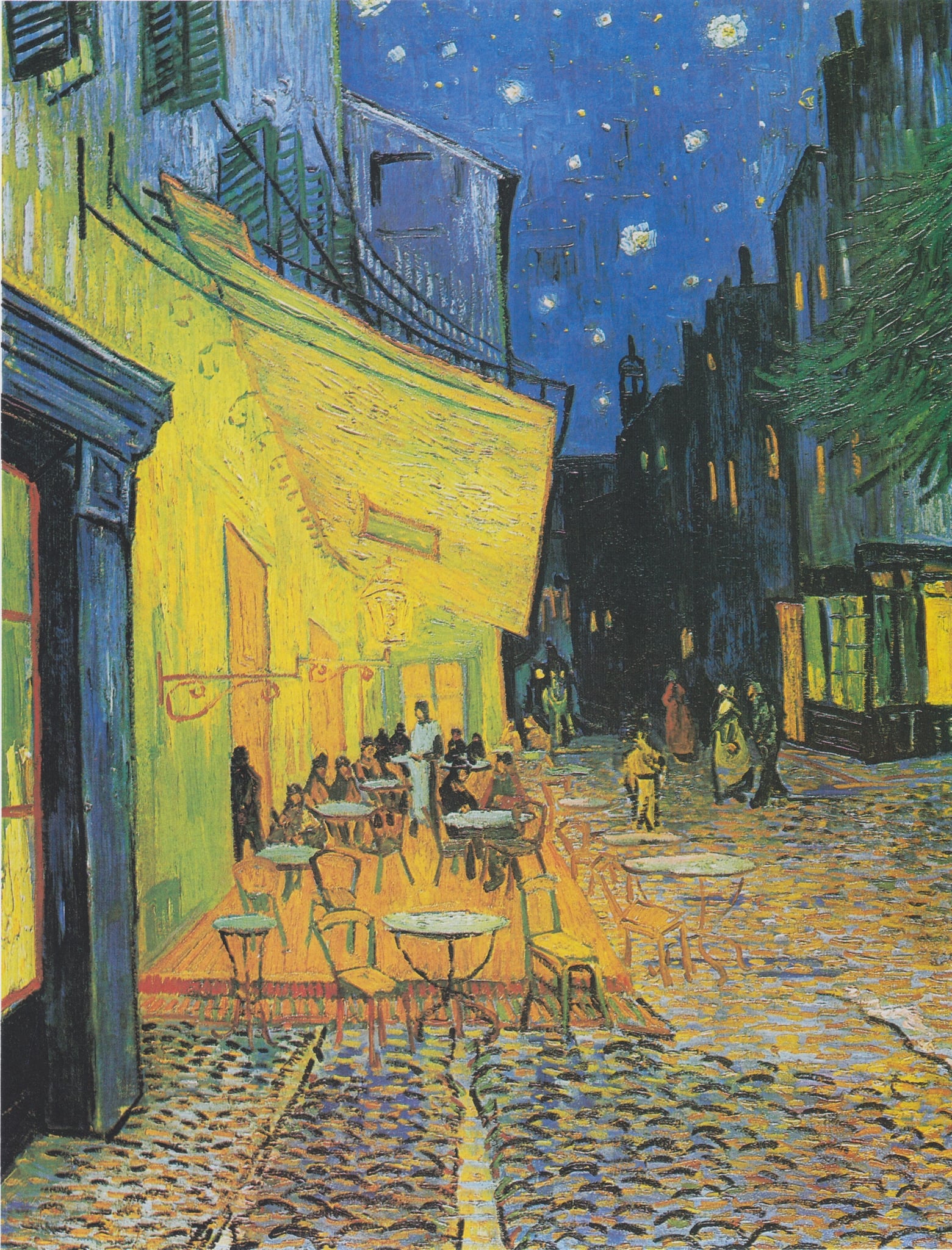
In Café Terrace at Night, Vincent van Gogh turns nocturne into <strong>luminous color</strong>: a gas‑lit terrace glows in yellows and oranges against a deep <strong>ultramarine sky</strong> pricked with stars. By building night “<strong>without black</strong>,” he stages a vivid encounter between human sociability and the vastness overhead <sup>[1]</sup><sup>[2]</sup>.
Red Cabbages and Onions by Vincent van Gogh

Red Cabbages and Onions

Vincent van Gogh (1887)

In Red Cabbages and Onions, Vincent van Gogh turns everyday produce into a drama of <strong>complementary color</strong> and <strong>restless brushwork</strong>. Hot red contours cinch violet cabbages and pale yellow bulbs against a cool, striated blue table, while a mustard‑yellow patch in the upper right tilts the space and sharpens the chromatic clash. The result asserts ordinary food as a locus of <strong>resilience</strong> and <strong>experimentation</strong> <sup>[1]</sup><sup>[2]</sup>.

Irises by Vincent van Gogh

Irises

Vincent van Gogh (1889)

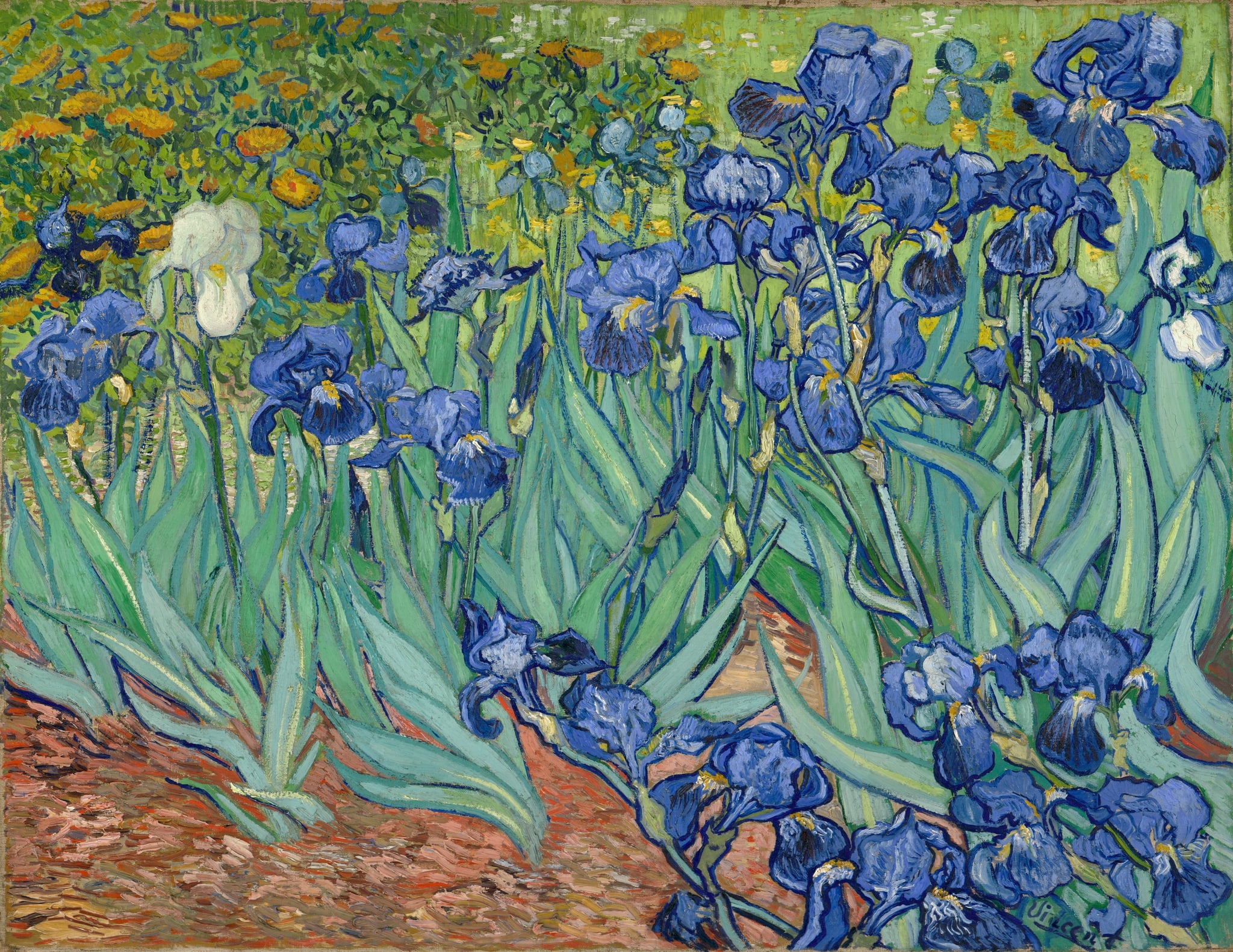
Painted in May 1889 at the Saint-Rémy asylum garden, Vincent van Gogh’s <strong>Irises</strong> turns close observation into an act of repair. Dark contours, a cropped, print-like vantage, and vibrating complements—violet/blue blossoms against <strong>yellow-green</strong> ground—stage a living frieze whose lone <strong>white iris</strong> punctuates the field with arresting clarity <sup>[1]</sup><sup>[2]</sup>.
Sunflowers by Vincent van Gogh

Sunflowers

Vincent van Gogh (1888)

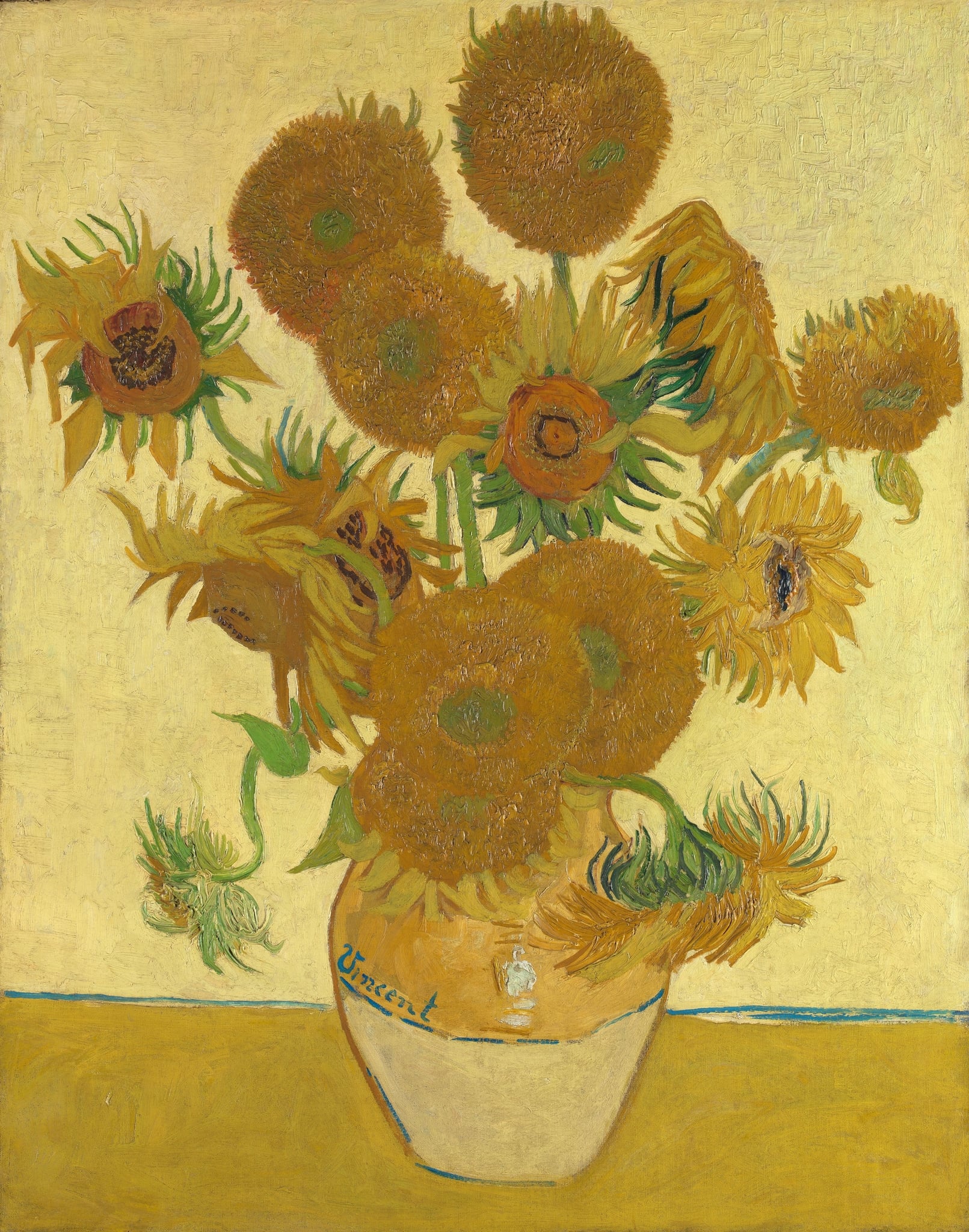
Vincent van Gogh’s Sunflowers (1888) is a <strong>yellow-on-yellow</strong> still life that stages a full <strong>cycle of life</strong> in fifteen blooms, from fresh buds to brittle seed heads. The thick impasto, green shocks of stem and bract, and the vase signed <strong>“Vincent”</strong> turn a humble bouquet into an emblem of endurance and fellowship <sup>[1]</sup><sup>[2]</sup>.

Garden with Courting Couples: Square Saint-Pierre by Vincent van Gogh

Garden with Courting Couples: Square Saint-Pierre

Vincent van Gogh (1887)

In Garden with Courting Couples: Square Saint-Pierre, Vincent van Gogh turns a small Montmartre park into a stage where <strong>spring</strong>, <strong>intimacy</strong>, and <strong>urban leisure</strong> converge. Short, shimmering strokes fuse pink chestnut blossoms, curving paths, and paired figures into one pulse of <strong>renewal</strong> and <strong>togetherness</strong> <sup>[1]</sup><sup>[2]</sup>.

In the Café: Agostina Segatori in Le Tambourin by Vincent van Gogh

In the Café: Agostina Segatori in Le Tambourin

Vincent van Gogh (1887 (Jan–Mar))

Van Gogh casts Agostina Segatori at a tiny, tambourine‑like café table, turning Le Tambourin into a <strong>stage of modern life</strong>. Cool greens and greys make the red <strong>flame‑plume hat</strong> and the foaming <strong>beer</strong> flare, while folded arms and a set‑aside <strong>parasol</strong> register private fatigue amid public display <sup>[1]</sup><sup>[2]</sup><sup>[3]</sup>.