How Much Is View from Theo's Apartment Worth?
Last updated: May 26, 2026
Quick Facts
- Insurance Value
- $95.0M (Analyst estimate based on comparable sales and standard museum uplift)
- Methodology
- comparable analysis
Hypothetical auction fair market value for Van Gogh’s View from Theo’s Apartment (Paris, 1887) is estimated at $45–75 million. This bracket aligns recent Paris‑period sales around $33m–$63m with the artist’s broader top-end pricing structure led by the $117.2m Arles record. Indicative insurance value: $95 million.
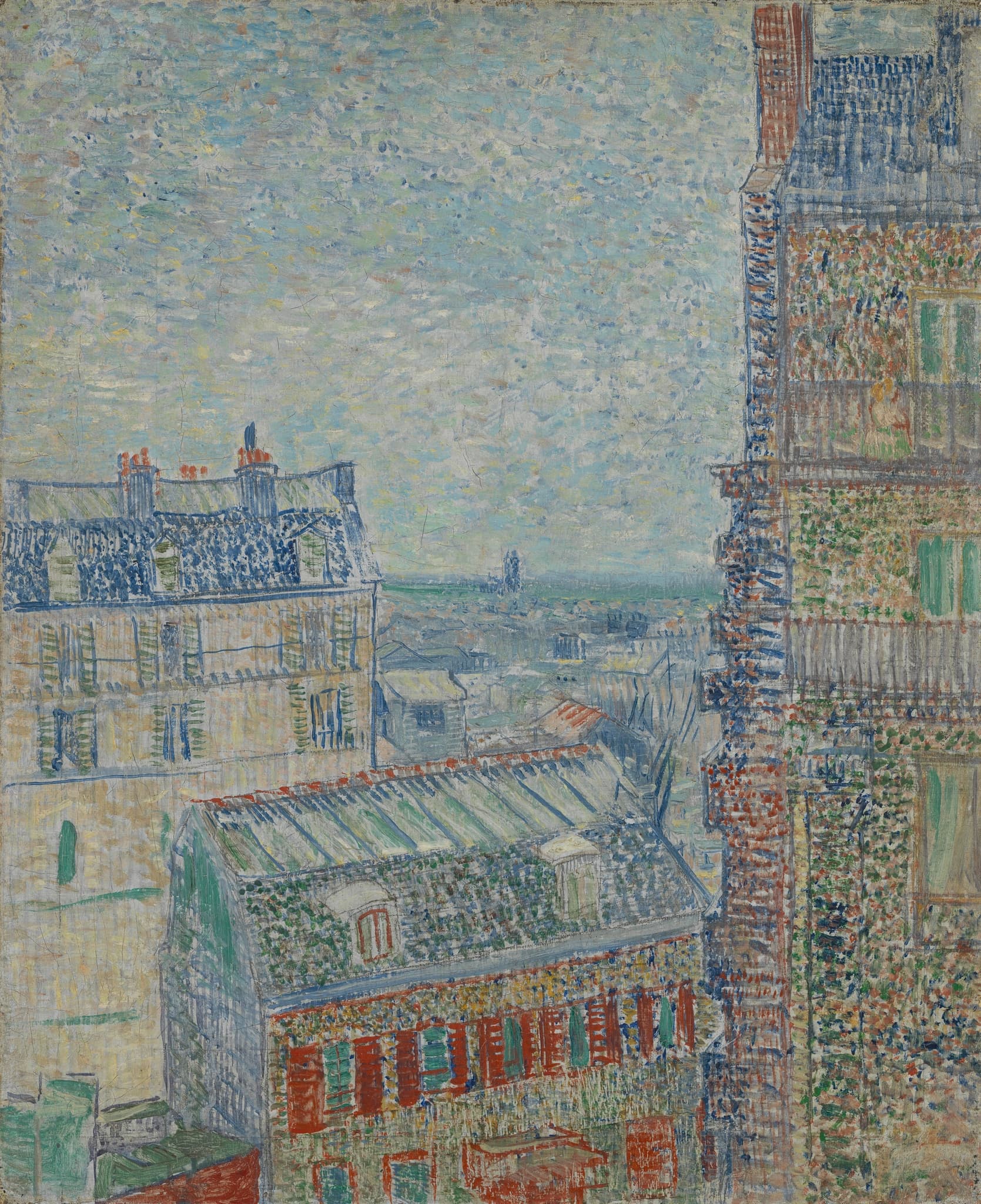
View from Theo's Apartment
Vincent van Gogh, 1887 • Oil on canvas
Read full analysis of View from Theo's Apartment →Valuation Analysis
Conclusion: View from Theo’s Apartment (Paris, 1887) would likely achieve $45–75 million at a major evening auction, with an indicative insurance/replacement value around $95 million. The estimate reflects the artist’s towering market status, the painting’s strong Paris‑period pedigree and unimpeachable family-to-Foundation provenance, balanced against the fact that collectors typically prize the Arles/Saint‑Rémy icons most highly.
Market anchors: The artist’s current record is $117.2 million for Orchard with Cypresses (1888, Arles), a benchmark that re-sets the ceiling for A+ Van Gogh oils from Provence [1]. Within the specific 1887 Paris segment, Romans parisiens (still life) realized $62.7 million in 2025, establishing a high-water mark for the year and period [2]. Meanwhile, closely related Paris‑period landscapes have clustered in the low‑to‑mid $30 millions recently: Coin de jardin avec papillons (1887) achieved $33.2 million in New York in 2024 [3], and Les canots amarrés (1887) made roughly $32.2 million in Hong Kong the same year amid softer regional bidding [4]. These data points frame the central tendency for strong but non‑iconic Paris oils in today’s market.
Positioning this work: The cityscape from the brothers’ rue Lepic apartment captures Van Gogh’s pivotal Paris moment—brighter palette, broken brushwork, and Neo‑Impressionist influence—yet it is not among the most commercially coveted Provence icons. That said, the appeal here is amplified by an exceptional provenance narrative: the picture descends from the family core holdings and is today in the Vincent van Gogh Foundation/Van Gogh Museum, Amsterdam, a lineage that collectors prize for certainty and cachet [5]. If hypothetically deaccessioned and presented with full institutional exhibition history, scholarly citations, and a clean, attractive condition report, it would command intense competition in a marquee sale.
Range rationale: The low end of $45 million sits above the recent $30–33 million Paris‑period landscape clears, recognizing the enhanced desirability of a signature Montmartre vantage and the near‑perfect provenance. The high end of $75 million acknowledges the demonstrated headroom for best‑in‑class 1887 works (Romans parisiens at $62.7 million) while remaining sensibly below the Provence masterpiece tier anchored by the $117.2 million record [1][2]. Sale choreography (global tour, top-tier scholarship, and a strong third‑party guarantee) would credibly pull this work toward the upper half of the bracket.
Insurance lens: Museums and lenders commonly set insured values above probable auction FMV to reflect scarcity, volatility, and replacement difficulty. An indicative $95 million insurance figure is consistent with current top‑end Van Gogh pricing dynamics and with institutional practice for works of this caliber and rarity [1][2][3].
Key Valuation Factors
Art Historical Significance
High ImpactPainted in 1887, the Paris year in which Van Gogh’s palette brightened and his facture absorbed Neo‑Impressionist ideas, this cityscape encapsulates a key transition from the darker Dutch period to the high‑chroma Arles/Saint‑Rémy masterpieces. The rue Lepic vantage directly links to Vincent’s intimate biography with Theo, reinforcing the picture’s scholarly resonance. While not an icon on the order of Sunflowers or The Bedroom, it is a textbook document of the artist’s Paris experiment and thus occupies a meaningful place in the oeuvre. That combination—recognized period importance and a specific, storied viewpoint—elevates the work above generic Paris subjects and supports a premium within the Paris‑period cohort.
Subject and Period Desirability
Medium ImpactCollectors consistently pay peak prices for late‑1888 to 1890 Provence subjects and signature portraits. Paris‑period works trade at a discount to those icons but remain highly liquid at the top end. Recent results for 1887 landscapes in New York and Hong Kong in the low‑to‑mid $30 millions establish a strong floor for quality examples. A well‑painted Montmartre cityscape with attractive color and assured brushwork holds broader appeal than garden corners or minor motifs, and it benefits from the recognizable narrative of the brothers’ apartment. This factor underpins the mid‑to‑upper‑tens bracket while acknowledging that the market still ranks the Paris cityscapes below the celebrated Arles/Saint‑Rémy canvases.
Provenance and Institutional Holding
High ImpactThe painting descends from the Van Gogh family and is held by the Vincent van Gogh Foundation/Van Gogh Museum, Amsterdam—a gold‑standard provenance. Such an unimpeachable chain is exceptionally rare in the market and reduces transactional friction around authenticity, title, and scholarship. Although institutional deaccession is highly unlikely, a hypothetical sale from such holdings would be presented with definitive literature, exhibition history, and technical documentation, maximizing bidder confidence. This factor also introduces scarcity value: core Foundation works almost never appear at auction, so the “freshness” and prestige of origin would materially lift competitive bidding relative to otherwise comparable Paris‑period landscapes.
Condition, Scale, and Presentation
Medium ImpactVan Gogh pricing is acutely sensitive to condition and size. A clean surface (stable impasto, no disfiguring retouches, sympathetic varnish), strong color preservation, and a compelling, display‑ready frame will move bidding decisively within the range. Larger, balanced compositions with a clear horizon and architectural rhythm tend to outperform small or sketch‑like formats. While a museum object generally benefits from high conservation standards, a recent condition report and high‑resolution imaging would be decisive sale tools. In practice, excellent condition and impactful scale would push this painting toward $65–75 million, whereas modest size or condition compromises would anchor bids nearer the low‑to‑mid $40 millions.
Sale History
View from Theo's Apartment has never been sold at public auction.
Vincent van Gogh's Market
Vincent van Gogh sits at the apex of the pre‑war canon with extremely limited supply and deep global demand. The standing auction record is $117.2 million for Orchard with Cypresses (Christie’s, 2022), underscoring the premium for A‑tier Arles works. Since then, buyers have remained selective but aggressive for blue‑chip material: in 2025, the Paris‑period still life Romans parisiens achieved $62.7 million, the high‑water mark for 1887 oils, while multiple Paris landscapes have recently transacted around $30–33 million. Museum ownership dominates the corpus, and when first‑rate examples surface, they galvanize marquee evening sales with multiple interested bidders and frequent third‑party guarantees. This combination—canonical status, rarity, and competition—supports sustained pricing in the tens to hundreds of millions.
Comparable Sales
Coin de jardin avec papillons
Vincent van Gogh
Same artist and 1887 Paris period; a Paris garden landscape from the transitional year. Strong, recent benchmark for non-iconic Paris-period landscapes.
$33.2M
2024, Christie's New York
~$34.2M adjusted
Les canots amarrés
Vincent van Gogh
Same artist and year (1887); Paris-period Seine/Asnières subject with bright palette and broken brushwork typical of the period. Useful geographic test of demand for Paris-period oils.
$32.2M
2024, Christie's Hong Kong
~$33.2M adjusted
Piles de romans parisiens et roses dans un verre (Romans parisiens)
Vincent van Gogh
Same artist and year (1887); though a still life, it set a record for a Paris-period Van Gogh—an upper-bound indicator for best-in-class 1887 works.
$62.7M
2025, Sotheby's New York
Jardin devant le Mas Debray
Vincent van Gogh
Same artist and 1887 Paris period; garden/landscape subject. A recent, reliable lower-to-mid benchmark for Paris-period oils without iconic subject matter.
$23.3M
2023, Sotheby's New York
~$24.7M adjusted
Orchard with Cypresses
Vincent van Gogh
Same artist; major 1888 Arles landscape (record price). Not period-identical but provides the category’s high-water mark for top-tier Van Gogh oils.
$117.2M
2022, Christie's New York
~$128.0M adjusted
Current Market Trends
At the top end, the Impressionist/Post‑Impressionist segment has shown renewed strength, with trophy works re‑energizing evening sales and collectors prioritizing proven names. Van Gogh remains a bellwether: after the 2022 record, recent results confirm robust demand for best‑in‑class paintings and disciplined pricing for secondary subjects. Paris‑period oils of quality have clustered in the low‑to‑mid $30 millions, while an outstanding 1887 still life has demonstrated capacity above $60 million. The market remains two‑speed—exceptional, fresh‑to‑market works can command aggressive bidding, whereas average material is estimate‑sensitive. Strong sale choreography, global touring, and third‑party guarantees are key levers for clearing the top of an estimate range.
Study print
Study this painting as a print
Pair the full artwork with a museum-style study sheet focused on one meaningful detail.
Sources
- Christie's Press Office: Paul G. Allen Collection sets Van Gogh record (Orchard with Cypresses, $117.18m)
- The Art Newspaper: Two Van Gogh records smashed—and a new high for the artist’s Paris‑period work (Nov 21, 2025)
- Christie’s: 20th Century Evening Sale totals $413.3m (includes Van Gogh, Coin de jardin avec papillons, $33.2m)
- South China Morning Post: Van Gogh sells for US$27.6m below estimate at Christie’s Hong Kong (Sept 26, 2024)
- Van Gogh Museum: Without family, no museum — the beginnings of the Van Gogh Museum