View of the Sea at Scheveningen

by Vincent van Gogh

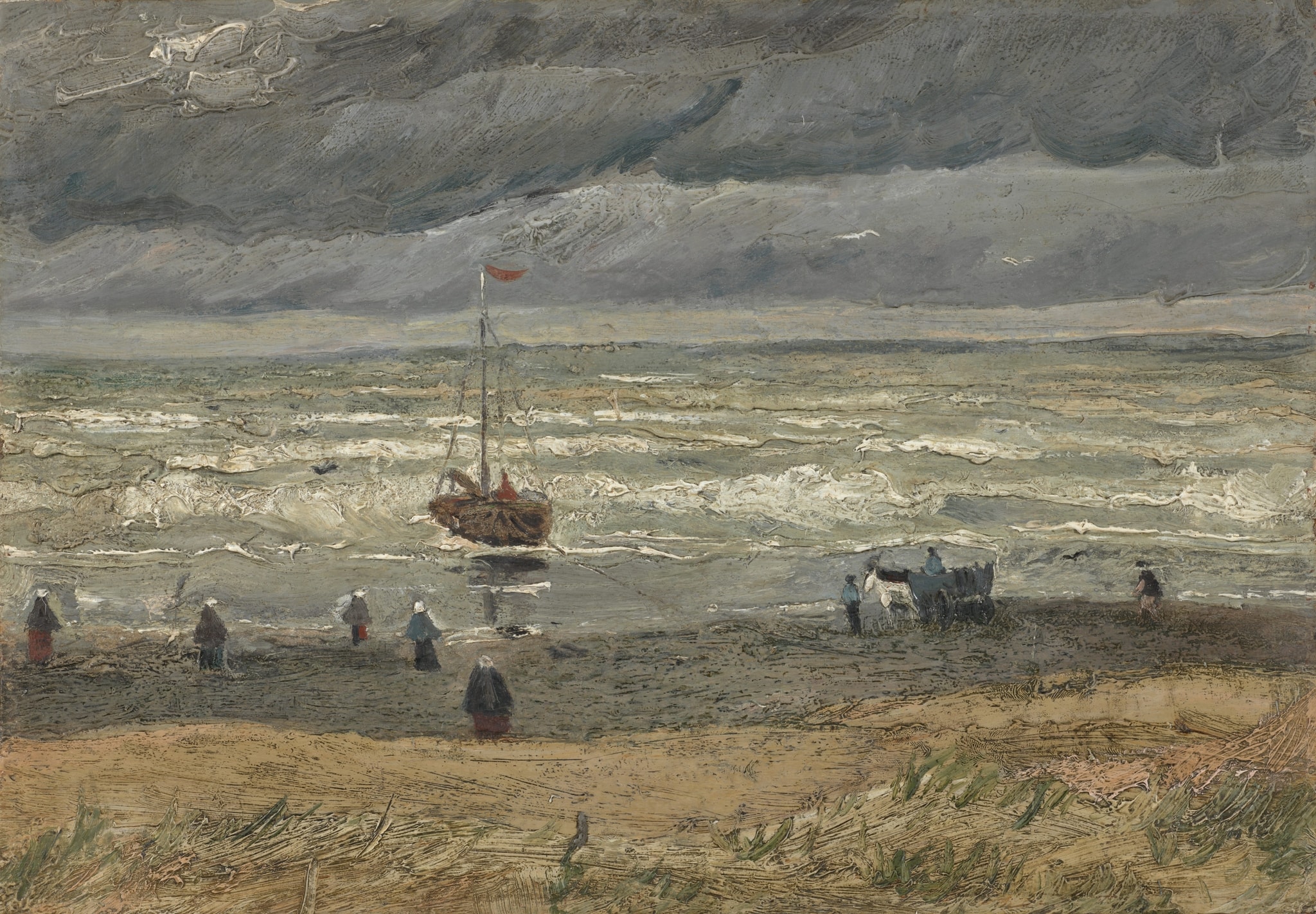
Under a storm-laden sky, Vincent van Gogh’s View of the Sea at Scheveningen pits tiny beach figures, a horse-and-cart, and a fishing boat with a red flag against the heaving North Sea. The quick, dense strokes and even grains of blown sand embedded in the paint make the weather itself the subject, fusing observation with immediacy [2][3].

Study Print Studio

Create a personal study print

Build a companion study sheet around the part of this painting that speaks to you most. Choose a detail, shape an interpretation, and walk away with something personal and display-worthy.

Fast Facts

Year
1882
Medium
Oil on paper, mounted on canvas
Dimensions
36.4 × 51.9 cm
Location
Van Gogh Museum, Amsterdam
See all Vincent van Gogh paintings in Amsterdam
View of the Sea at Scheveningen by Vincent van Gogh (1882) featuring Storm-laden sky, Turbulent North Sea (whitecaps and swells), Fishing boat (bomschuit), Red flag on the mast

Click on any numbered symbol to learn more about its meaning

Meaning & Symbolism

Van Gogh constructs the picture around three pressures: sea, sky, and shore. The sky arrives as stacked, slate bands, dragged wet‑into‑wet so the clouds feel heavy and close; breaks of pale horizon light barely restrain the dark massing above. Below, the sea is a field of low, parallel ridges—furrows of surf tipped with thick, off‑white impasto—so that each crest catches light and then collapses into the next. The shore is narrow and unstable: in the foreground the ocher dune is laced with wiry, scratched grasses; the wet strand beyond is streaked by receding water and footprints. This tripartite structure makes the sea’s advance continuous and the land’s hold provisional, a compositional argument about vulnerability and endurance 24. Against that force stand working people and their tools. Near the center-left, a bomschuit rides the swell, its red flag a live ember in the gray‑green field. At the right, men cluster around a horse and cart at the waterline; lines from the boat lead shoreward, anticipating the practiced routine Van Gogh described: a lookout signaling with flags, a horseman wading in to help kedging the anchor and hauling the vessel onto the open beach at Scheveningen—then without a harbor 5. Scattered figures—some likely fishwives with pale caps—dot the strand as dark notes. Their smallness is not diminishment but emphasis: the work’s moral center is the choreography of ordinary labor performed in extreme weather, a subject central to Van Gogh’s Hague period 16. The handling converts meteorology into handwriting. White foam is slashed on with a loaded brush; mid‑tones are dragged and scumbled; the dune grasses are incised, as if etched by grit. Under magnification, grains of beach sand remain embedded across the surface—evidence of the “nasty little storm” that, as Van Gogh wrote, forced him to scrape and repaint on the spot 34. Those particles are not accidents but meaning: material witnesses to plein‑air risk and to the artist’s insistence on being in the weather he paints. Even the seabirds, which flip from dark against foam to light against cloud, register Van Gogh’s early acuity for tonal contrast and transient effect 2. What emerges is not a sentimental marine view but a compact social‑natural drama. The sea’s rhythm is relentless; the sky presses down; and yet the boat holds its axis, the flag cuts a signal through the gray, and the team with the horse begins the shoreward pull. The painting states that human life at the coast is precarious but stubbornly organized—anchored by skill, routine, and community. In this, the picture aligns with the artist’s 1882 focus on workers and humble life, while already revealing the vigorous brushwork and tactile urgency that will become signatures of his mature art 26. As one of his first oil paintings, executed on paper later mounted to canvas, it shows Van Gogh testing how matter—paint, sand, wind—can carry meaning. View of the Sea at Scheveningen therefore stands at the threshold of his career as both document and declaration: the world’s weather and work made palpable in paint 13.

Explore Deeper with AI

Ask questions about View of the Sea at Scheveningen

Popular questions:

Powered by AI • Get instant insights about this artwork

💬 Ask questions about this artwork!

Interpretations

Material/Technical Lens: Weather as Medium

This early oil is literally salted with the beach: microscopic sand grains lodged in the impasto are remnants of the “nasty little storm” Van Gogh endured while painting, when he “had to scrape everything off twice.” The work’s unusual support—oil on paper mounted to canvas—and visibly reworked passages underscore a studio ethic formed in extremis: to let process and place co-author the image. Rather than a neutral carrier, the surface becomes a field where wind, grit, and viscosity register like data, turning conservation findings into interpretation. In this sense, the picture is a small manifesto of plein‑air risk: not only representing the storm but incorporating its residue, making materiality itself part of meaning 123.

Source: Van Gogh Museum (Unravel Van Gogh; Collection page); Van Gogh Letters

Social History: Rituals of Coastal Work

What looks like a flick of color (the red flag) and a minor group at the horse and cart are in fact nodes in a practiced labor system. Van Gogh’s letter details the lookout who waves a flag to signal incoming smacks, and the horseman who kedges the anchor ashore so the heavy bomschuit can be hauled onto an open beach with no harbor. On the strand, small figures—likely fishwives and crew—become rhythmic notations of coordination. The painting thus encodes a choreography of labor specific to Scheveningen’s fishery, aligning with Van Gogh’s 1882 focus on workers’ routines rather than leisure, and giving the scene the cadence of social realism anchored in direct observation 452.

Source: Van Gogh Letters; Van Gogh Museum (Gallery texts; Collection page)

Environmental Aesthetics: The Near-at-Hand Sublime

Instead of distant, Romantic spectacle, Van Gogh crafts a proximate sublime: low, slate bands of cloud and “furrows of ploughed land” in the waves squeeze horizon and foreground together. The effect is pressure, not panorama—the sea’s advance continuous and the land’s hold provisional. His marks operate meteorologically (directional drag, scumble, foam slashes) so that the painting behaves like weather: forces felt across a flat field. The result is awe scaled to labor—an elemental stage that threatens but does not overwhelm the practiced routine of work. This redefines the sublime as an everyday condition of the North Sea coast rather than a one‑off catastrophe 63.

Source: Van Gogh Museum (Unravel Van Gogh); Van Gogh Letters

Style Genealogy: Hague School to Van Gogh

Scheveningen ties Van Gogh to the Hague School—tonal palette, realist subject, Mesdag’s marine precedent—yet already declares his own vigorous brushwork. Where contemporaries prized atmospheric unity, Van Gogh lets facture protrude: foam laid on in thick, off‑white impasto, grasses incised, mid‑tones dragged and scumbled. Early critics read some Dutch works as “thick” or “clumsy,” but this friction becomes the engine of his mature style. The painting stands at a hinge: Mauve’s instruction in oils provides tonal discipline; Van Gogh adds a tactile urgency that will expand in Arles and Saintes‑Maries, while remaining anchored in truthful observation 786.

Source: Van Gogh Museum (Collection Catalogue, Vol. 1; Unravel Van Gogh); Britannica (Mauve)

Afterlife/Reception: Theft, Recovery, and Aura

The picture’s modern biography—stolen in 2002, hidden for fourteen years, and recovered near Naples in 2016—has reframed how audiences meet this small storm scene. The work’s absence generated a mediated memory (press images, case files), while its return prompted conservation review and renewed emphasis on its fragile paper support and embedded sand. Such episodes accrue an aura of survival that rhymes with the painting’s own theme of precarious endurance. Display narratives now regularly mention the heist and recovery, intertwining criminology with connoisseurship and making provenance part of interpretation for a work already about risk, contingency, and return 91011.

Source: Van Gogh Museum (Annual Reports); FBI; Smithsonian Magazine

Related Themes

About Vincent van Gogh

Vincent van Gogh (1853–1890) developed a radical, emotion‑driven use of color after moving from Paris to Arles in 1888, seeking southern light and an artists’ community. In Arles he created the Sunflowers series to decorate the Yellow House ahead of Gauguin’s visit. His late work fused impasto, high chroma, and symbolic motifs that shaped modern painting [2][5].
View all works by Vincent van Gogh

More by Vincent van Gogh
Café Terrace at Night by Vincent van Gogh

Café Terrace at Night

Vincent van Gogh (1888)

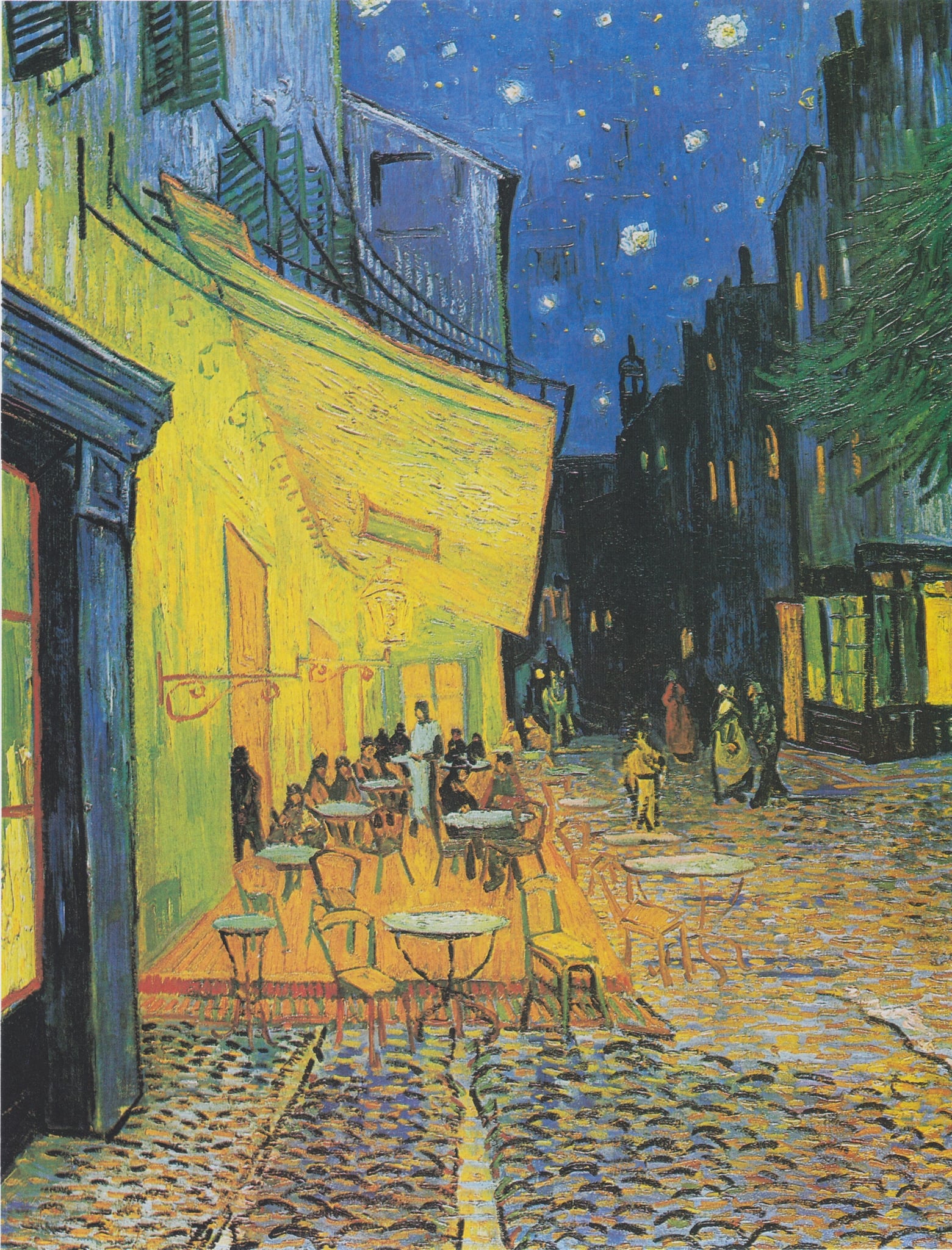
In Café Terrace at Night, Vincent van Gogh turns nocturne into <strong>luminous color</strong>: a gas‑lit terrace glows in yellows and oranges against a deep <strong>ultramarine sky</strong> pricked with stars. By building night “<strong>without black</strong>,” he stages a vivid encounter between human sociability and the vastness overhead <sup>[1]</sup><sup>[2]</sup>.
Irises by Vincent van Gogh

Irises

Vincent van Gogh (1889)

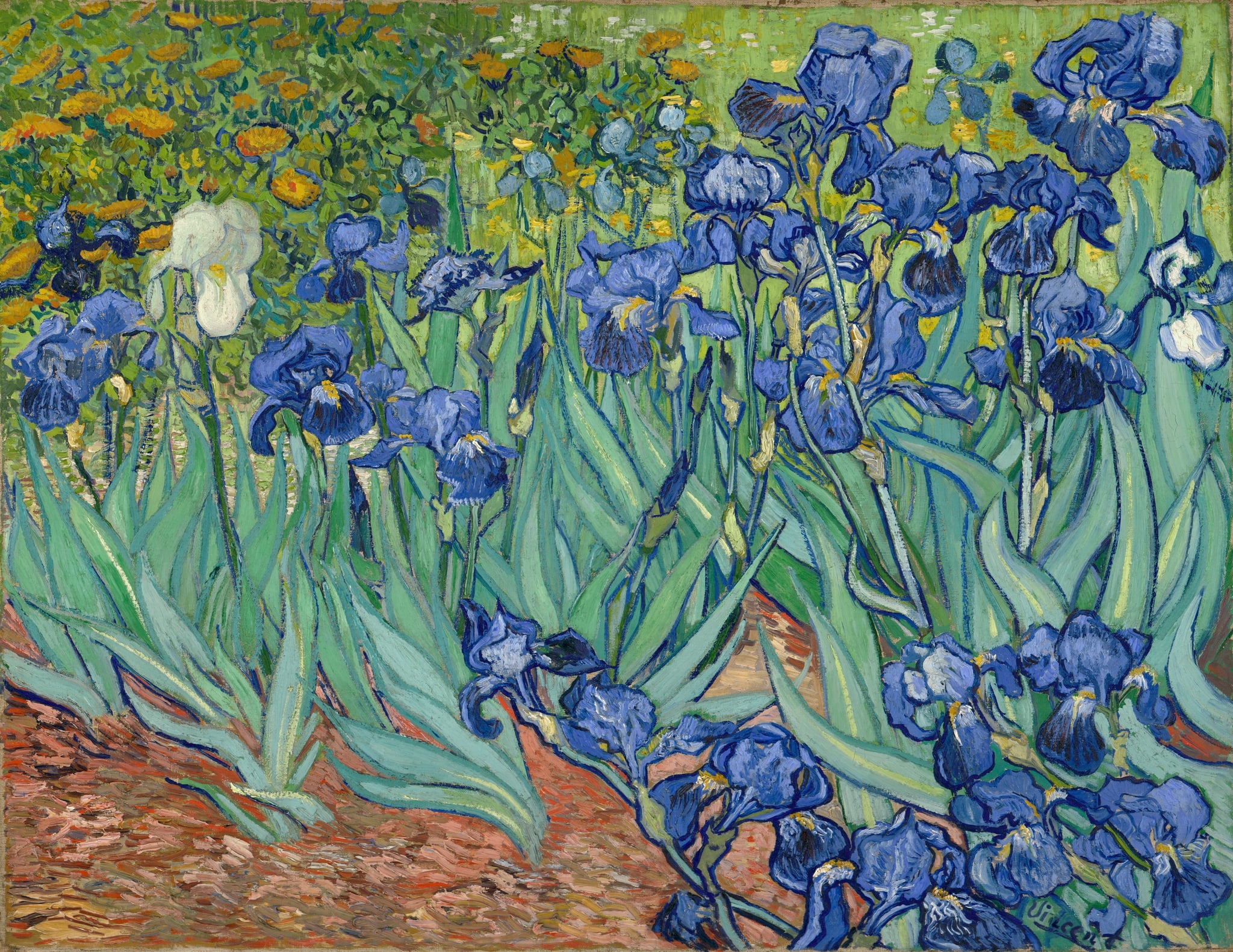
Painted in May 1889 at the Saint-Rémy asylum garden, Vincent van Gogh’s <strong>Irises</strong> turns close observation into an act of repair. Dark contours, a cropped, print-like vantage, and vibrating complements—violet/blue blossoms against <strong>yellow-green</strong> ground—stage a living frieze whose lone <strong>white iris</strong> punctuates the field with arresting clarity <sup>[1]</sup><sup>[2]</sup>.
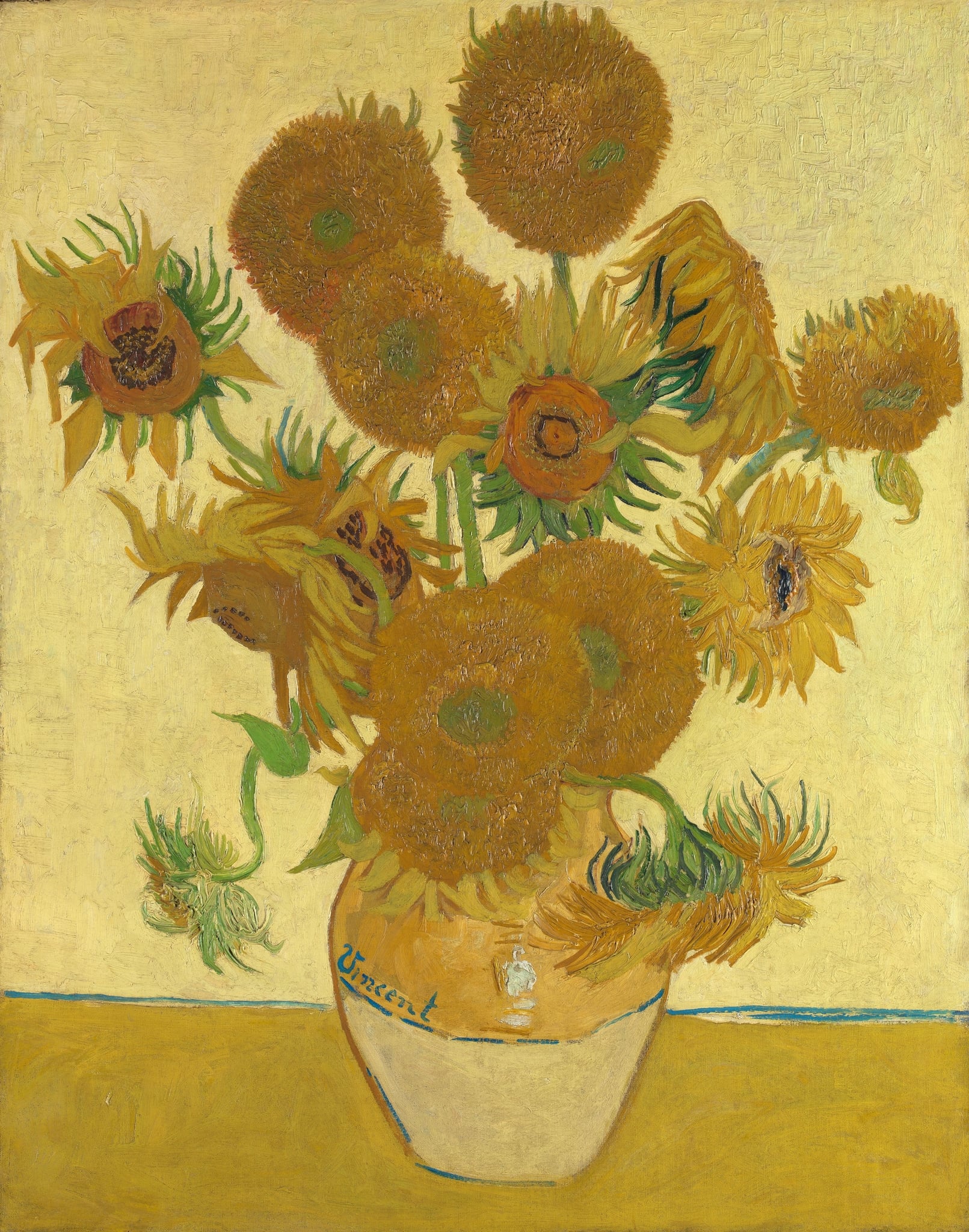
Sunflowers by Vincent van Gogh

Sunflowers

Vincent van Gogh (1888)

Vincent van Gogh’s Sunflowers (1888) is a <strong>yellow-on-yellow</strong> still life that stages a full <strong>cycle of life</strong> in fifteen blooms, from fresh buds to brittle seed heads. The thick impasto, green shocks of stem and bract, and the vase signed <strong>“Vincent”</strong> turn a humble bouquet into an emblem of endurance and fellowship <sup>[1]</sup><sup>[2]</sup>.

The Red Vineyard by Vincent van Gogh

The Red Vineyard

Vincent van Gogh (1888)

In The Red Vineyard, Vincent van Gogh forges a vision of <strong>autumn labor under a blazing sun</strong>, where harvesters flow diagonally through scarlet vines while a band of <strong>yellow light</strong> flares along a reflective roadway. The scene fuses <strong>exhaustion and ripeness</strong>, turning work into a rhythmic, almost liturgical procession <sup>[1]</sup><sup>[3]</sup>.

The Bedroom by Vincent van Gogh

The Bedroom

Vincent van Gogh (1889)

Vincent van Gogh’s The Bedroom turns a modest room into a psychological stage, using <strong>clashing color</strong> and <strong>tilted space</strong> to test whether color alone can evoke rest. The bright yellow bed, twin chairs, and green‑shuttered window press forward as the floor tilts and pictures cant, so that <strong>refuge and unease</strong> exist side by side <sup>[1]</sup><sup>[2]</sup>.

Self-Portrait with Bandaged Ear by Vincent van Gogh

Self-Portrait with Bandaged Ear

Vincent van Gogh (1889)

In Self-Portrait with Bandaged Ear (1889), Vincent van Gogh converts a recent crisis into an image of <strong>resolve</strong>. The frontal, slightly turned pose forces attention to the white bandage at the viewer’s right, while the fur cap, heavy coat, and the nearby <strong>Japanese print</strong> declare persistence and ideals that steady him in the wake of trauma <sup>[1]</sup><sup>[2]</sup>. The painting’s cool, wintry palette and insistent strokes make suffering legible yet disciplined, transforming pain into <strong>artistic purpose</strong> <sup>[2]</sup>.