The Langlois Bridge

by Vincent van Gogh

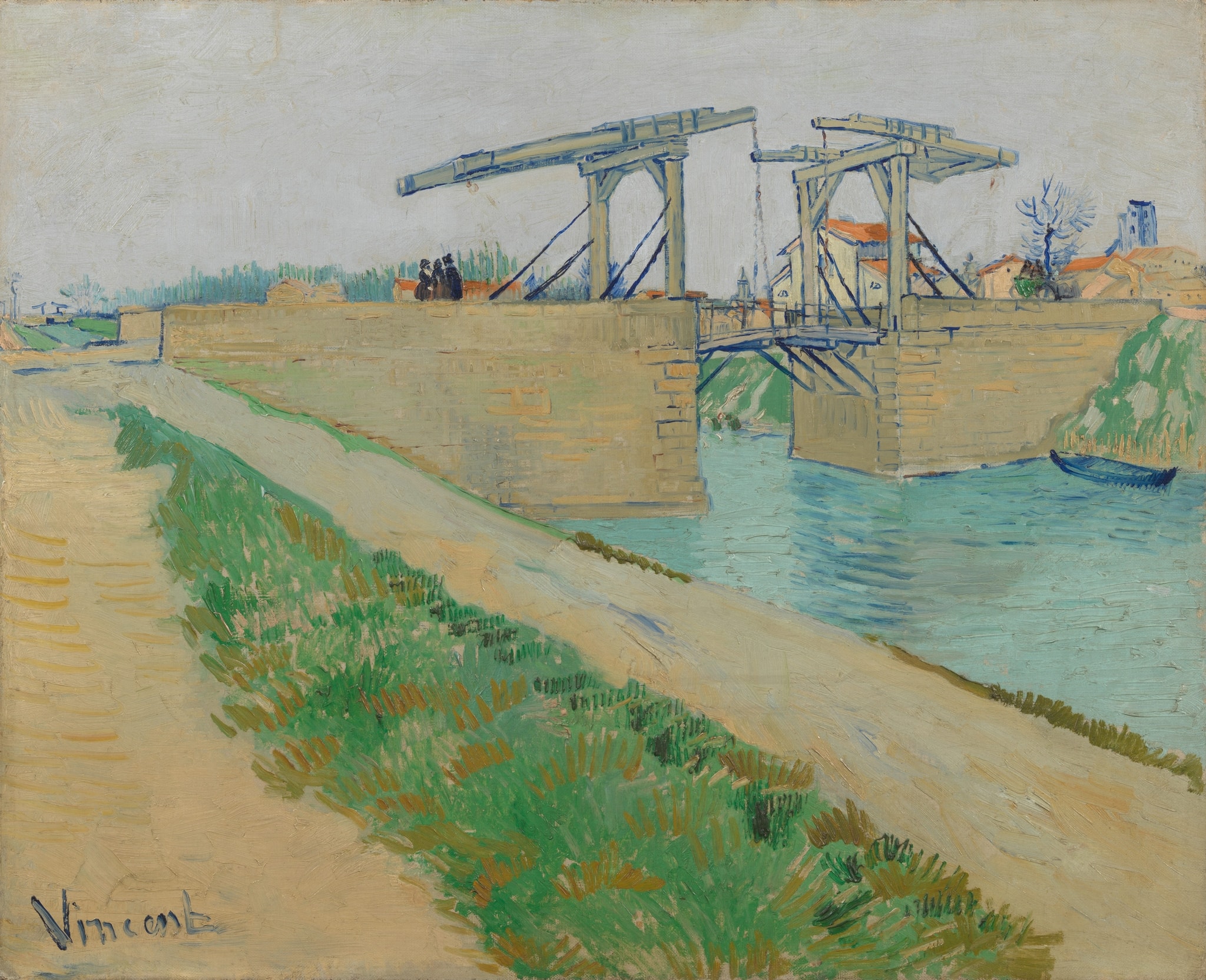
Van Gogh’s The Langlois Bridge turns a modest drawbridge into a symbol of connection and modern passage. With a sweeping towpath, firm blue contours, and turquoise water, the scene balances rural calm with engineered order [1][3].

Study Print Studio

Create a personal study print

Build a companion study sheet around the part of this painting that speaks to you most. Choose a detail, shape an interpretation, and walk away with something personal and display-worthy.

Fast Facts

Year
1888
Medium
Oil on canvas
Dimensions
59.6 × 73.6 cm
Location
Van Gogh Museum, Amsterdam
See all Vincent van Gogh paintings in Amsterdam
The Langlois Bridge by Vincent van Gogh (1888) featuring Firm blue contours, Drawbridge (lifting arms and chains), Diagonal towpath, Turquoise canal water

Click on any numbered symbol to learn more about its meaning

Meaning & Symbolism

Van Gogh organizes the picture around the diagonal towpath that cuts from the lower left to the stone pier, a calculated vector that disciplines the entire field. The twin wooden arms, chains, and masonry blocks of the drawbridge lock into a grid of horizontals and verticals, their edges inked in decisive blue lines that recall the cloisonné contours of Japanese woodblock prints—a method he openly pursued in Arles 15. The pale, nearly unmodulated sky and the broad, turquoise canal flatten depth, while the grassy banks pulse with short, rhythmic strokes that keep the surface alive without breaking the overall plan. Small, dark figures paused on the bridge and a moored boat at the right give human scale but remain subordinated to the architecture of lines. This hierarchy announces intention: modern infrastructure is not mere backdrop but the armature through which Van Gogh makes clarity visible. In his March 18 letter, he plotted “emerald” water and ochres and lilacs for the banks and shadows, proving that the color scheme was an expressive construction, not transcription 4. This engineered clarity sustains a layered symbolism. The bridge links the rural towpath to the tiled roofs and tower beyond; it also links Van Gogh’s present in Provence to the memory of Dutch drawbridges he had known, a biographical bridge underscored by Cologne’s curators and by his own use of a perspective frame to measure the motif precisely 3. The motif’s working life—traffic, laundry, towing—situates the painting at the seam of domestic labor and circulation, where modern movement intersects enduring routines 12. Yet nothing here feels hurried. The arms of the drawbridge lift like poised parentheses, holding a moment of suspension over the canal’s steady flow. The painting thus converts a passageway into a rite of passage, an emblem of transition from Paris to Arles, from Impressionist contingency to a program of ordered planes, complementary contrasts, and purposeful contours. That is why the scene reads as both calm and expectant: the world is in motion, but form prevails. Within Post‑Impressionism, The Langlois Bridge shows Van Gogh consolidating a language of structure plus sensation. He retains the quick touch in the grasses and water, but he rejects atmospheric blur in favor of legible design, serial study, and constructed perspective; technical examinations and letters confirm that deliberation 34. The result is neither nostalgia nor reportage but a lucid statement of modern pastoral: a working canal rendered with print‑like simplicity to achieve serenity, cheerfulness, and emotional resonance—the very qualities he associated with the “Japan of the South” 56. As such, the painting models how a humble, contemporary subject can carry large thematic weight: connection, transit, and the ordering of nature through human craft. Its influence lies in demonstrating that modern life’s infrastructure can anchor a profoundly expressive art, advancing the Post‑Impressionist aim to move beyond observation toward constructed meaning 7.

Explore Deeper with AI

Ask questions about The Langlois Bridge

Popular questions:

Powered by AI • Get instant insights about this artwork

💬 Ask questions about this artwork!

Interpretations

Formal-Technical: Measured Vision, Noted Sensation

The Langlois Bridge series is a case study in how Van Gogh engineered perception. Technical study at Cologne reveals pencil underdrawing and the use of a perspective frame, evidence that the scene’s clarity rests on measured scaffolding rather than spontaneity 3. In parallel, the March 18 letter to Bernard pre-plots “emerald” water and lilac shadows, confirming a designed palette before paint touched canvas 4. This conjunction—drafted structure plus premeditated chroma—produces the painting’s print‑like legibility while keeping sensation alive in the short, vibrating strokes of grass and water. The result is a hybrid rhetoric: the canal is seen through a constructed grid of vectors and planes, but it still shimmers with lived immediacy. Van Gogh converts Impressionist touch into a disciplined syntax that communicates movement, place, and purpose with uncommon exactitude 346.

Source: Wallraf‑Richartz‑Museum; Van Gogh Letters; The Met (Van Gogh in Arles)

Social History: Gendered Labor at the Water’s Edge

Museum records note that this canal was a working laundry site; in related versions, washerwomen appear explicitly, and even here their presence is implied by the banks and moorings 1. Van Gogh aligns domestic labor with infrastructural flow, placing gendered work at the literal hinge of circulation—the drawbridge—and giving it compositional dignity via the axial towpath and crisp contours. The wagon and towlines in sister canvases underscore a continuum of tasks (washing, hauling, crossing) that structure daily life in Arles 2. Rather than anecdote, these motifs function as social vectors: they indicate how time, bodies, and goods traverse the landscape. The painting thus stages a modern pastoral in which women’s work and transport logistics are inseparable from the canal’s ordered geometry and color orchestration 12.

Source: Van Gogh Museum (Amsterdam); Kröller‑Müller Museum

Japonisme as Program: Flatness, Contour, Cheerfulness

Van Gogh’s Arles campaign was self-consciously “Japanese”: he sought flat color fields, strong outlines, and decisive diagonals as vehicles for serenity and clarity—the “Japan of the South” 15. The bridge’s rectilinear arms read like ukiyo‑e cloisonné contours translated into architecture; the pale sky and broad canal simplify recession, prioritizing planar harmony over depth. Crucially, the program is emotive: the annotated palette (emeralds, ochres, lilacs) was designed to project cheerfulness rather than to mimic local color 45. In this light, Langlois Bridge is not influence as surface style but Japonisme as an ethical-aesthetic method—a way to order the world into legible, hopeful accord. The print-like clarity is not neutrality; it is Van Gogh’s cultivated stance against visual noise, tuned to the rhythms of a working landscape 145.

Source: Van Gogh Museum (Amsterdam); Van Gogh Letters; Van Gogh Museum – Van Gogh & Japan

Memory and Migration: A Bridge to the North

Cologne’s curators emphasize how the Arles drawbridge recalled the Dutch bascule bridges of Van Gogh’s youth, turning the motif into a biographical hinge between past and present 3. That echo aligns with his relocation from Paris to Arles weeks before painting the series: the bridge becomes a rite of passage, a figured crossing from Impressionist contingency toward a language of ordered planes and complementary contrasts. The perspective frame literalizes his desire to measure and stabilize a new life-world, while the steady canal invokes continuity beneath change 36. What might appear a neutral transit point thus functions as self-mapping: Van Gogh navigates memory, place, and method at once, binding Dutch recollection to Provençal light through a designed, portable grammar of line and color 36.

Source: Wallraf‑Richartz‑Museum; The Met (Van Gogh in Arles)

Environmental Technology: Ordering Water, Shaping Calm

The painting visualizes how infrastructure choreographs nature: piers, chains, and lifting arms span a canal whose surface is simplified into turquoise planes, signaling water made navigable and predictable 1. Yet Van Gogh resists triumphalist industrial rhetoric. Movement is controlled rather than accelerated—a wagon in a related version, moored boat, and paused figures imply paced transit, not speed 2. The short, rhythmic strokes along the banks keep organic life audible within the scheme, creating a negotiated truce between engineered clarity and natural pulse. This is a modern pastoral premised on environmental design: the bridge does not dominate the landscape; it articulates it into readable parts, modeling a humane modernity in which color harmony mirrors infrastructural balance 126.

Source: Van Gogh Museum (Amsterdam); Kröller‑Müller Museum; The Met (Van Gogh in Arles)

Related Themes

About Vincent van Gogh

Vincent van Gogh (1853–1890) developed a radical, emotion‑driven use of color after moving from Paris to Arles in 1888, seeking southern light and an artists’ community. In Arles he created the Sunflowers series to decorate the Yellow House ahead of Gauguin’s visit. His late work fused impasto, high chroma, and symbolic motifs that shaped modern painting [2][5].
View all works by Vincent van Gogh

More by Vincent van Gogh
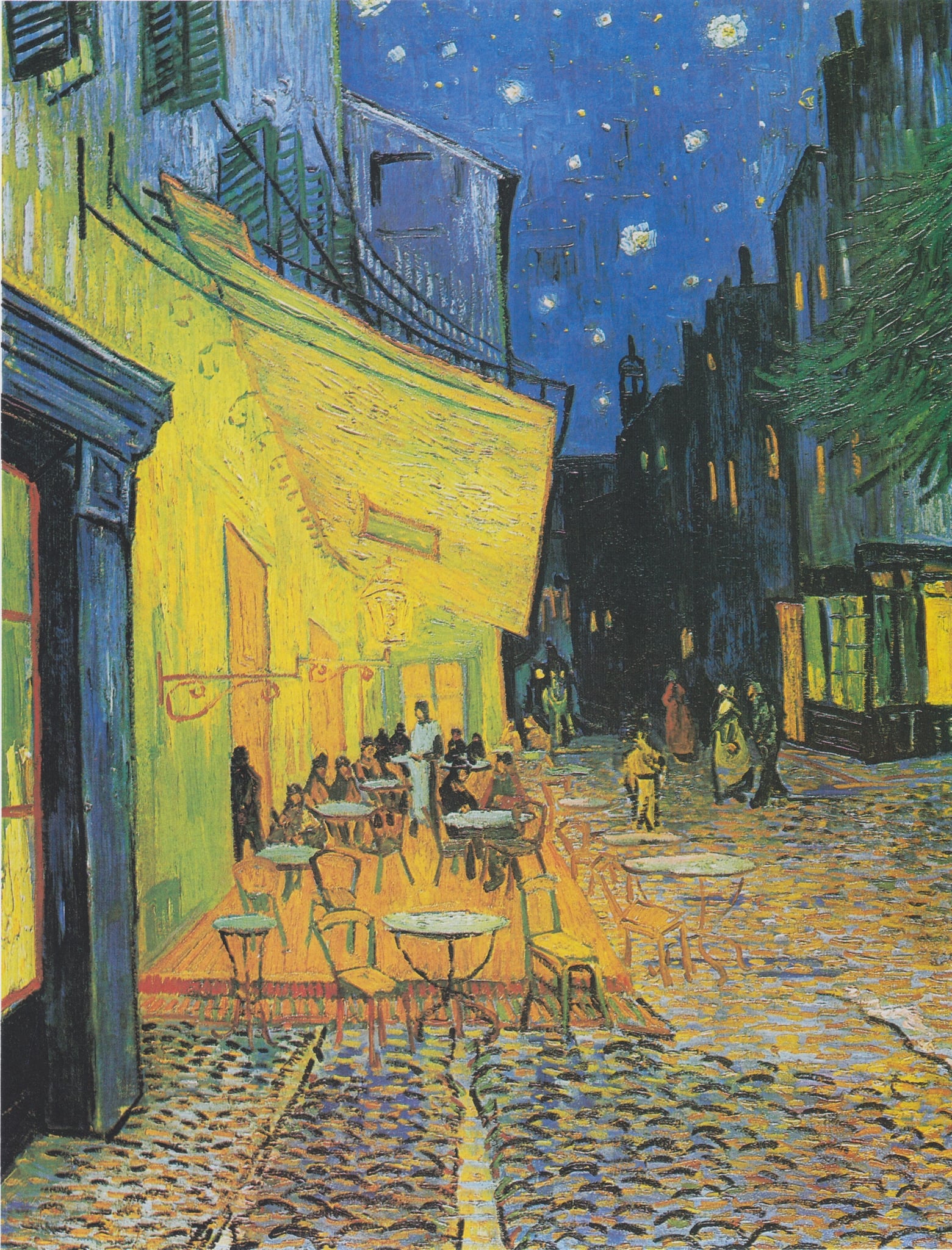
Café Terrace at Night by Vincent van Gogh

Café Terrace at Night

Vincent van Gogh (1888)

In Café Terrace at Night, Vincent van Gogh turns nocturne into <strong>luminous color</strong>: a gas‑lit terrace glows in yellows and oranges against a deep <strong>ultramarine sky</strong> pricked with stars. By building night “<strong>without black</strong>,” he stages a vivid encounter between human sociability and the vastness overhead <sup>[1]</sup><sup>[2]</sup>.
Red Cabbages and Onions by Vincent van Gogh

Red Cabbages and Onions

Vincent van Gogh (1887)

In Red Cabbages and Onions, Vincent van Gogh turns everyday produce into a drama of <strong>complementary color</strong> and <strong>restless brushwork</strong>. Hot red contours cinch violet cabbages and pale yellow bulbs against a cool, striated blue table, while a mustard‑yellow patch in the upper right tilts the space and sharpens the chromatic clash. The result asserts ordinary food as a locus of <strong>resilience</strong> and <strong>experimentation</strong> <sup>[1]</sup><sup>[2]</sup>.

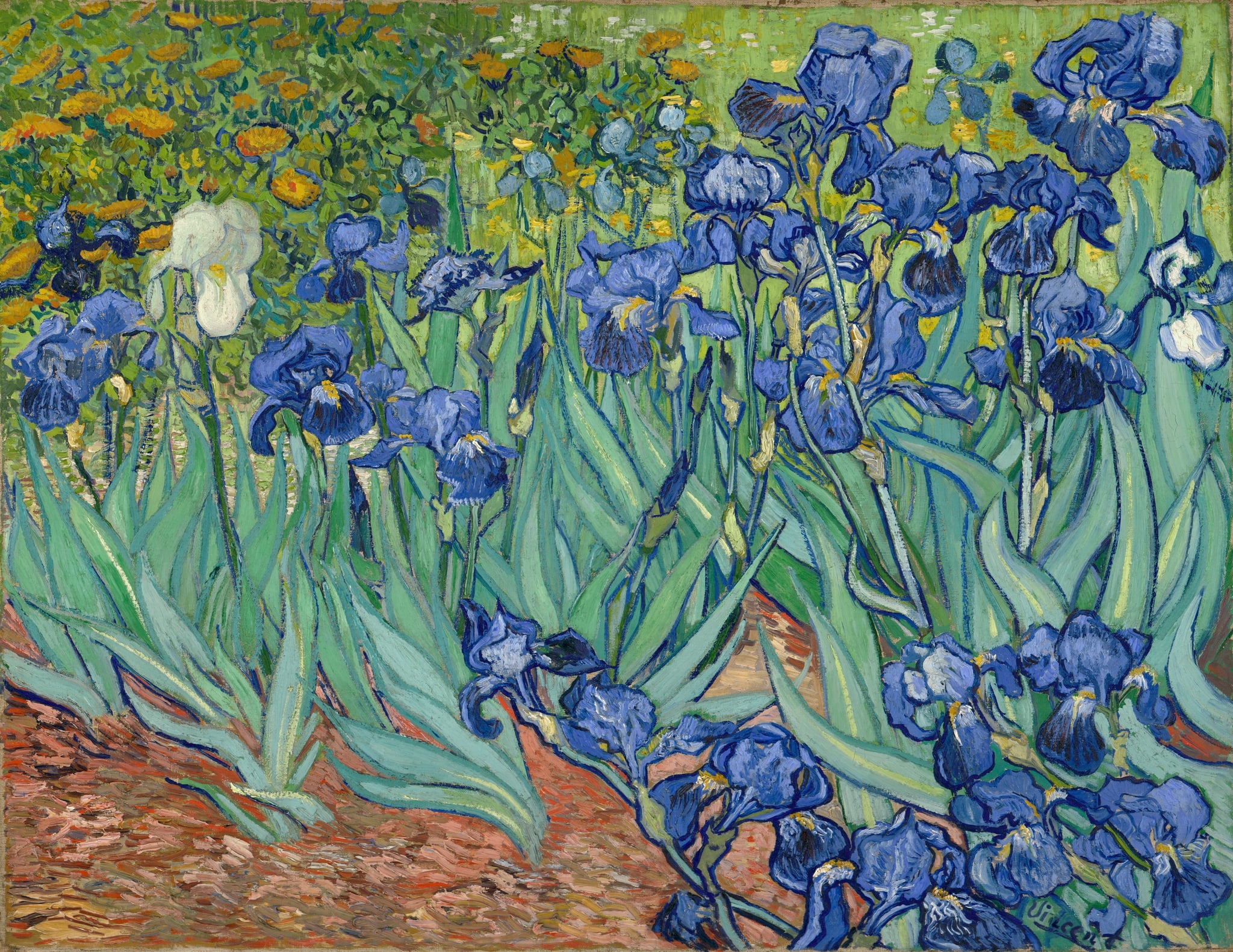
Irises by Vincent van Gogh

Irises

Vincent van Gogh (1889)

Painted in May 1889 at the Saint-Rémy asylum garden, Vincent van Gogh’s <strong>Irises</strong> turns close observation into an act of repair. Dark contours, a cropped, print-like vantage, and vibrating complements—violet/blue blossoms against <strong>yellow-green</strong> ground—stage a living frieze whose lone <strong>white iris</strong> punctuates the field with arresting clarity <sup>[1]</sup><sup>[2]</sup>.
Sunflowers by Vincent van Gogh

Sunflowers

Vincent van Gogh (1888)

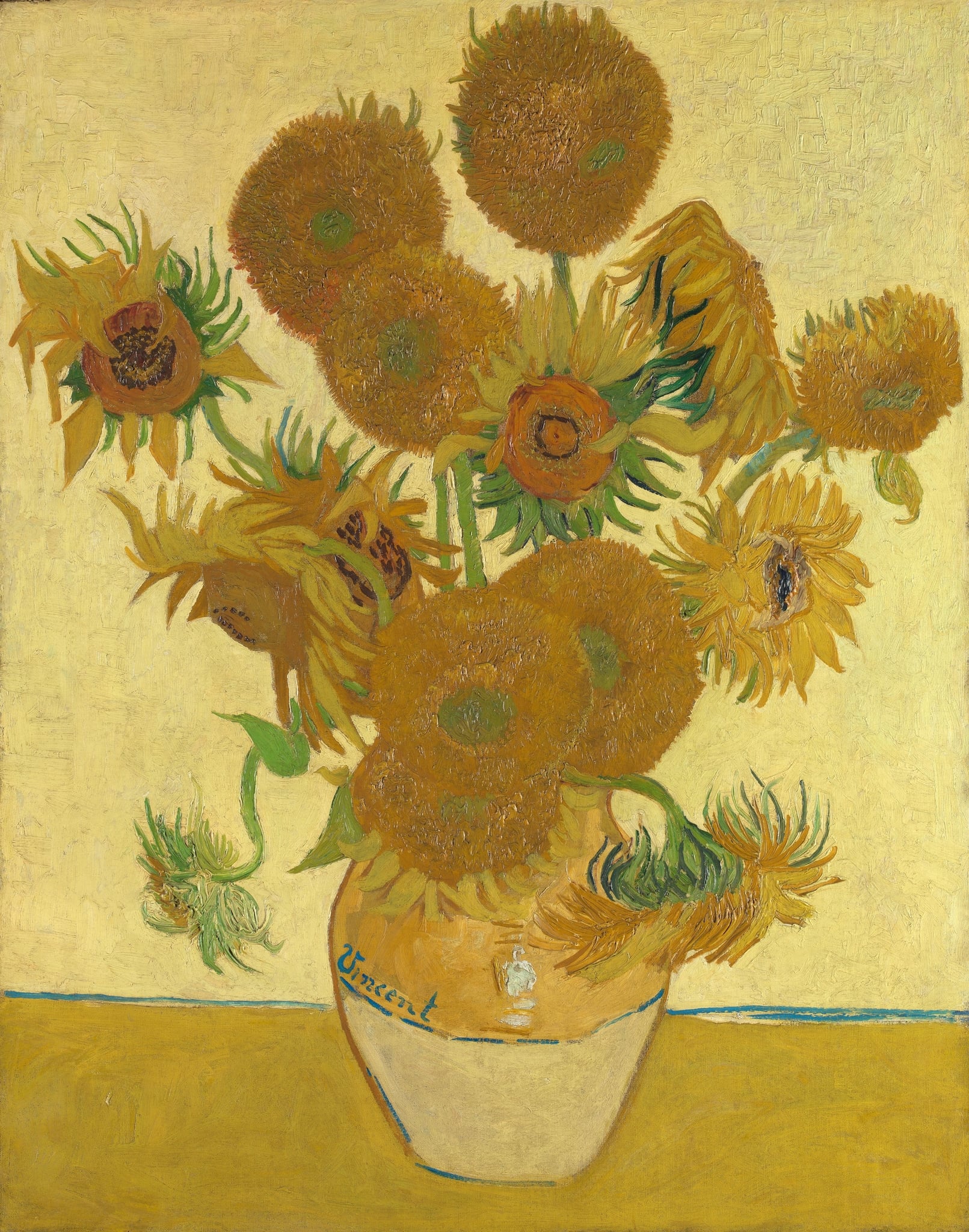
Vincent van Gogh’s Sunflowers (1888) is a <strong>yellow-on-yellow</strong> still life that stages a full <strong>cycle of life</strong> in fifteen blooms, from fresh buds to brittle seed heads. The thick impasto, green shocks of stem and bract, and the vase signed <strong>“Vincent”</strong> turn a humble bouquet into an emblem of endurance and fellowship <sup>[1]</sup><sup>[2]</sup>.

Garden with Courting Couples: Square Saint-Pierre by Vincent van Gogh

Garden with Courting Couples: Square Saint-Pierre

Vincent van Gogh (1887)

In Garden with Courting Couples: Square Saint-Pierre, Vincent van Gogh turns a small Montmartre park into a stage where <strong>spring</strong>, <strong>intimacy</strong>, and <strong>urban leisure</strong> converge. Short, shimmering strokes fuse pink chestnut blossoms, curving paths, and paired figures into one pulse of <strong>renewal</strong> and <strong>togetherness</strong> <sup>[1]</sup><sup>[2]</sup>.

In the Café: Agostina Segatori in Le Tambourin by Vincent van Gogh

In the Café: Agostina Segatori in Le Tambourin

Vincent van Gogh (1887 (Jan–Mar))

Van Gogh casts Agostina Segatori at a tiny, tambourine‑like café table, turning Le Tambourin into a <strong>stage of modern life</strong>. Cool greens and greys make the red <strong>flame‑plume hat</strong> and the foaming <strong>beer</strong> flare, while folded arms and a set‑aside <strong>parasol</strong> register private fatigue amid public display <sup>[1]</sup><sup>[2]</sup><sup>[3]</sup>.