How Much Is The Langlois Bridge Worth?
Last updated: May 27, 2026
Quick Facts
- Methodology
- comparable analysis
We estimate Vincent van Gogh’s The Langlois Bridge (1888, oil on canvas; Van Gogh Museum) at $160–220 million on a hypothetical fair‑market basis. The range reflects its prime Arles date, famous motif, museum‑grade quality, and deep global demand for A‑period Van Gogh, extrapolating above the artist’s $117.2m auction record for a comparable 1888 landscape.
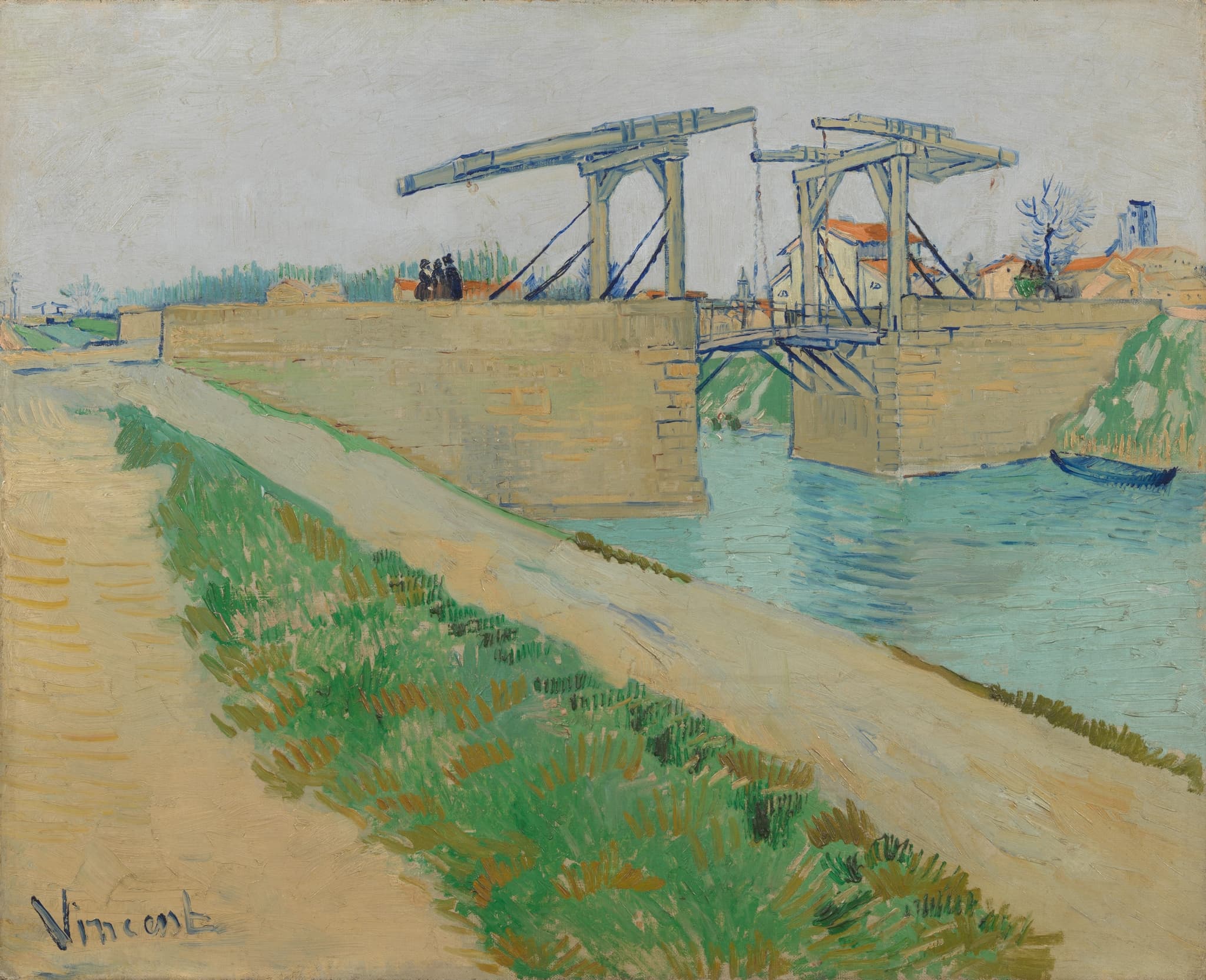
The Langlois Bridge
Vincent van Gogh, 1888 • Oil on canvas
Read full analysis of The Langlois Bridge →Valuation Analysis
Overview and subject. The Langlois Bridge at Arles is a celebrated 1888 motif executed during Van Gogh’s peak Arles period. The Van Gogh Museum’s oil (59.6 x 73.6 cm), held by the Vincent van Gogh Foundation, has never appeared at auction and carries unimpeachable, continuous provenance from the artist’s estate into the Museum/Foundation holdings [1]. The subject—an everyday drawbridge rendered through Van Gogh’s Japonisme‑inflected color and composition—is a touchstone of his Arles corpus and an image of broad public recognition.
Market benchmarks. Van Gogh’s current auction record stands at $117.2 million for the 1888 Arles landscape Orchard with Cypresses (Christie’s, 2022) [2]. Recent sales reaffirm depth across his late‑1880s market: a strong 1887 garden canvas made $33.2m in 2024 [4], and an 1888 work on paper achieved $29.4m in 2026 [5]. Even two decades earlier, a Langlois Bridge watercolor realized $8.30m (2003), signaling long‑standing demand for this precise motif [3]. Together, these data points define a robust price floor for prime Provence subjects and justify a premium for a top‑tier, famous‑motif 1888 oil with exemplary provenance.
Why $160–220 million. Our estimate places The Langlois Bridge meaningfully above the $117.2m benchmark due to (i) its subject’s higher recognition within the Arles canon, (ii) the extreme scarcity of A‑period oils of this stature in private hands (most are institutionally held), and (iii) trophy‑level cross‑category demand for late‑19th‑century masterpieces. The work’s size, composition, and art‑historical importance support competition at the low‑to‑mid nine figures if a museum‑grade example were (hypothetically) released. Notably, another Langlois Bridge oil entered the Kröller‑Müller collection via auction as early as 1912—an early indicator of the motif’s desirability [6].
Sale scenario assumptions. This valuation assumes: sound condition commensurate with major museum loans; clear title and standard warranties; New York or London evening‑sale exposure with full international marketing; and prevailing use of third‑party financial backing to catalyze bidding. Under such conditions, we judge $160–220m as fair‑market value today, with upside possible in a highly competitive setting. Replacement/insurance values could be set higher due to irreplaceability, but no public insurance figure exists for the Museum’s painting [1].
Conclusion. The Langlois Bridge is an upper‑tier Arles‑period Van Gogh of exceptional recognition and scholarship. Against the $117.2m 2022 record for a closely comparable 1888 landscape, and supported by fresh late‑1880s results in 2024–2026, a $160–220m range is well‑supported for a hypothetical sale of a museum‑grade example of this motif [2][3][4][5].
Key Valuation Factors
Art Historical Significance
High ImpactPainted in March 1888, The Langlois Bridge is a signature Arles motif that encapsulates Van Gogh’s embrace of vivid color, bold contour, and Japonisme‑inspired compositional clarity. The subject—a humble drawbridge outside Arles—allowed him to synthesize modern life with a serene, highly structured pictorial space. The motif recurs in multiple oils and works on paper, and the Van Gogh Museum canvas is extensively published and exhibited, making it one of the artist’s best‑known Provençal subjects. Its status within the oeuvre sits just below the handful of universal icons (Sunflowers, The Starry Night, The Bedroom) yet remains immediately recognizable to a broad audience. This combination of period, subject, and visibility materially elevates value and broadens the collector base.
Period and Subject Scarcity
High ImpactArles (1888–89) is the apex of Van Gogh’s market. Prime subjects from this period are tightly held by museums and foundations, creating structural scarcity. Famous‑motif Provence landscapes with strong color and composition appear extremely rarely at auction. When closely comparable A‑period oils have surfaced, they have set or approached artist records, as seen in the $117.2m Orchard with Cypresses (1888). A Langlois Bridge canvas of museum grade would benefit from this scarcity premium: it is a benchmark motif from the most sought‑after window of production, with almost no near‑substitutes available. Limited supply, combined with a deep global buyer pool for blue‑chip Modern masters, supports pricing in the low‑to‑mid nine figures in a marquee sale.
Condition, Scale, and Visual Impact
Medium ImpactAt approximately 59.6 x 73.6 cm, the picture sits in a highly commercial, wall‑friendly format for late‑19th‑century masterpieces. The composition offers a compelling balance of structure (the bridge’s geometry) and movement (water, figures, sky), translating powerfully in catalog and gallery contexts. Our estimate assumes sound, stable condition appropriate for a major museum loan picture; any material conservation issues (planarity, blanching, losses) would need to be reflected in an adjusted estimate. Conversely, pristine surface quality and an authoritative technical dossier could push demand higher. In today’s market, buyers pay for instant visual resonance at scale—this painting’s proportion and image strength contribute directly to competitive bidding.
Provenance and Institutional Standing
High ImpactThe Van Gogh Museum/Vincent van Gogh Foundation provenance is peerless and eliminates typical title or attribution risks. While an actual deaccession is highly improbable, the museum-grade pedigree would significantly bolster market confidence and global press visibility in any hypothetical sale. Deep literature and exhibition histories further strengthen the work’s standing. Collectors often assign a premium to masterpieces emerging from blue‑chip institutional contexts, especially when tied directly to the artist’s estate line. This level of provenance can amplify international participation, expand third‑party guarantee appetite, and compress due diligence timelines—factors that often translate into higher hammer prices at the top end of the Modern market.
Sale History
The Langlois Bridge has never been sold at public auction.
Vincent van Gogh's Market
Vincent van Gogh occupies a singular, blue‑chip position with a global, cross‑category collector base and exceptionally thin supply. His auction record is $117.2m for Orchard with Cypresses (Christie’s New York, 2022), anchoring nine‑figure demand for prime Arles landscapes. Recent salerooms confirm depth: high‑quality Paris and Provence works have achieved $23–33m in 2023–2024, with a standout 2025 Paris‑period canvas at $62.7m and an 1888 work on paper at $29.4m in 2026—underscoring willingness to pay for period and subject even off‑canvas. Most A‑period paintings reside in institutions, magnifying competition when exceptional canvases appear. Guarantees and third‑party backing frequently support marquee offerings, while expanding Asian participation has further broadened the bidding pool.
Comparable Sales
Orchard with Cypresses
Vincent van Gogh
Same artist; same Arles year (1888); prime oil landscape with a highly recognized Provence motif; benchmark top-of-market result.
$117.2M
2022, Christie's New York
~$130.2M adjusted
Laboureur dans un champ (Ploughman in the Field)
Vincent van Gogh
Same artist; late-1880s Provence-period oil of major quality and market visibility; calibrates nine‑figure demand for A‑period canvases.
$81.3M
2017, Christie's New York
~$107.7M adjusted
Champs près des Alpilles
Vincent van Gogh
Same artist; late‑1880s Provence landscape oil; strong but non‑iconic subject helps bracket pricing below top Arles icons.
$51.9M
2022, Christie's New York
~$57.7M adjusted
Coin de jardin avec papillons
Vincent van Gogh
Same artist; near‑period (1887) oil of high quality; shows current depth around $30m+ for non‑iconic pre‑Arles subjects.
$33.2M
2024, Christie's New York
~$33.9M adjusted
La moisson en Provence
Vincent van Gogh
Same artist; same 1888 Provence year; work on paper (not oil) but underscores intense demand for A‑period motifs even off‑canvas.
$29.4M
2026, Sotheby's New York
~$28.7M adjusted
Le pont de Langlois à Arles (watercolor/gouache)
Vincent van Gogh
Same artist and exact motif (Langlois Bridge); medium is work on paper from 1888; provides direct subject‑specific demand context.
$8.3M
2003, Christie's New York
~$14.7M adjusted
Current Market Trends
The Modern/Post‑Impressionist segment has remained a relative safe haven amid mixed macro conditions. After a softer 2024, late‑2025 and spring‑2026 marquee sales showed renewed confidence in blue‑chip trophies, with Modern masters (Klimt, Van Gogh, Picasso) leading season totals. Supply is selective but met by strong demand, particularly for works with peak‑period dating, famous motifs, and unassailable provenance. Price discovery is increasingly global—New York, London, and Hong Kong now all serve as viable platforms for headline results—while third‑party guarantees help de‑risk consignments. In this two‑speed market, best‑in‑class 19th‑century masterpieces continue to command intense, competitive bidding and can set or challenge artist records when the right works surface.
Study print
Study this painting as a print
Pair the full artwork with a museum-style study sheet focused on one meaningful detail.
Sources
- Van Gogh Museum: The Langlois Bridge (S0027V1962)
- The Art Newspaper: Van Gogh record at $117.2m for Orchard with Cypresses (2022)
- Christie’s Press (2003): Impressionist & Modern Art Evening Sale highlights
- Christie’s Press (2024): 20th Century Evening Sale results
- The Art Newspaper (2026): Sotheby’s Modern Evening Sale results
- Van Gogh Museum Articles: An Offer You Can Refuse (Kröller‑Müller 1912 acquisition of a Langlois Bridge)