Still Life with Bible

by Vincent van Gogh

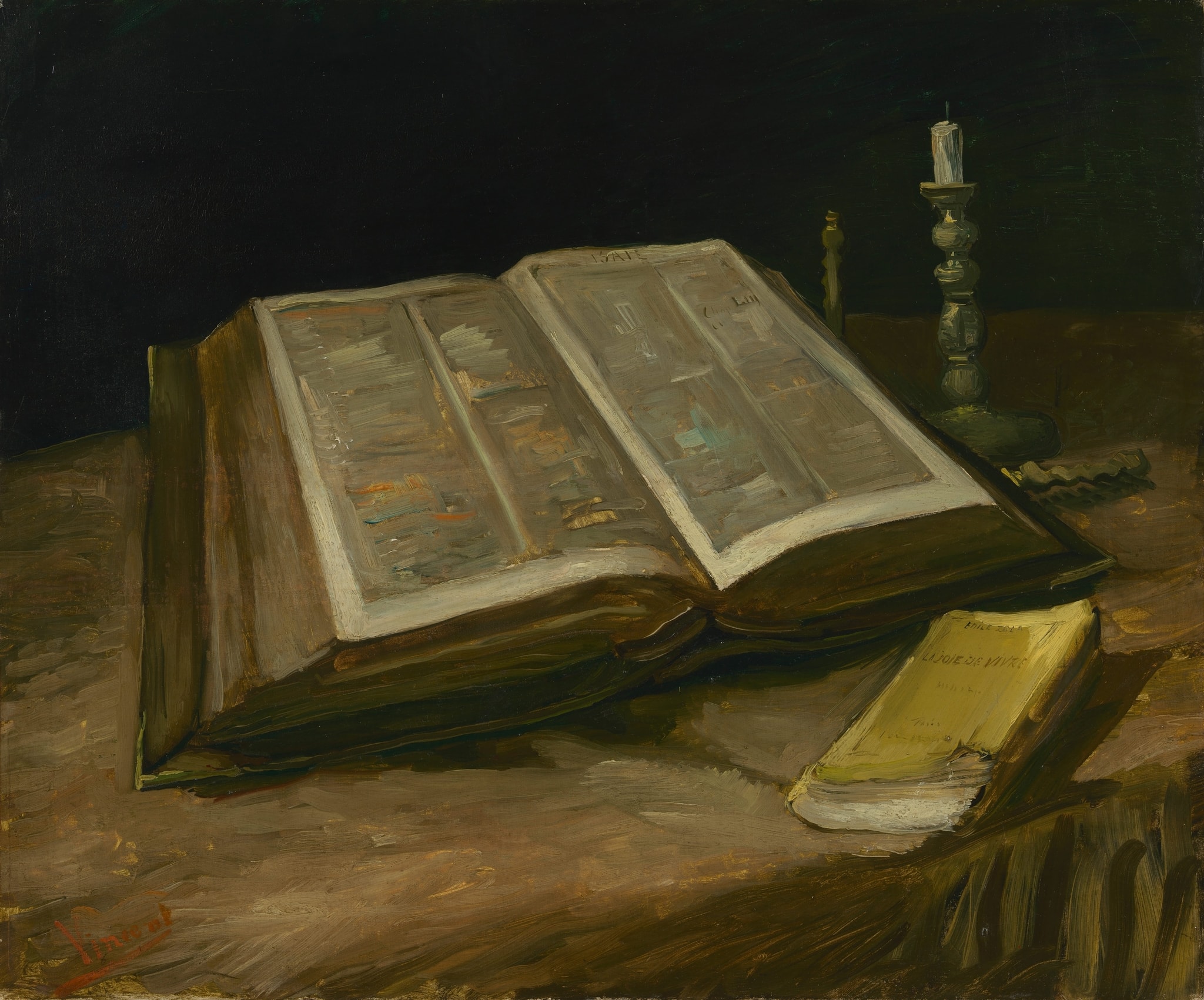
Vincent van Gogh’s Still Life with Bible (1885) stages a stark encounter between a monumental family Bible, a snuffed candle, and Zola’s yellow‑covered La joie de vivre. The painting’s heavy, earthen brushwork and diagonal sweep forge a tense dialogue between inherited faith and modern experience [1][2].

Study Print Studio

Create a personal study print

Build a companion study sheet around the part of this painting that speaks to you most. Choose a detail, shape an interpretation, and walk away with something personal and display-worthy.

Fast Facts

Year
1885
Medium
Oil on canvas
Dimensions
65.7 × 78.5 cm
Location
Van Gogh Museum, Amsterdam
See all Vincent van Gogh paintings in Amsterdam
Still Life with Bible by Vincent van Gogh (1885) featuring Yellow paperback (Zola’s La joie de vivre), Open family Bible, Extinguished candle, Brass candlestick

Click on any numbered symbol to learn more about its meaning

Meaning & Symbolism

Van Gogh anchors the composition with a huge, timeworn Bible opened like a stone slab, its broken white pages catching a low, ochre light against a dense black field. The brass candlestick beside it bears a blunt, unlit wick; there is no visible flame to illuminate the text. At the Bible’s lower edge, an inexpensive yellow paperback—identified with Zola’s La joie de vivre—leans forward, its acid color puncturing the brown‑green ground. The eye is driven along a firm diagonal—from the Scripture’s weight, past the dead candle, toward Zola’s splayed, modern cover—so that the very act of looking reenacts a move from sacred inheritance to lived, contemporary life 14. In an October 1885 letter, van Gogh described the picture’s “black background” and “touch of citron yellow,” confirming that color contrast and darkness were not incidental but integral to the work’s argument 2. Scholars further note that the open page likely points to Isaiah 53, the “Suffering Servant,” intensifying the theme of redemptive pain and consolation without spectacle—the candle is dark, but the text remains legible, enduring, and grave 3. Formally, van Gogh makes meaning through matter. Thick, sculptural strokes build the Bible’s spine and pages into an almost geologic mass, granting paternal faith the dignity of weight and duration; by contrast, the paperback’s lighter facture and frayed edges suggest immediacy, affordability, and circulation—ideas travel now in cheap paper rather than in monumental tomes 14. The snuffed candle acts as a vanitas sign: it is a sign of death and the end of a former illumination—biographically resonant after his father’s passing in March 1885—yet the Scripture remains open, insisting that moral seriousness survives even as old certainties dim 48. This is not a simple repudiation. The painting’s tension is dialectical: the Bible’s mass and the novel’s acid yellow coexist, their meanings refracted by the surrounding dark that van Gogh defended in his letters as purposeful, not merely gloomy 2. In this sense, the canvas renews the Dutch still‑life tradition by converting objects into a personal credo: suffering read in Isaiah becomes a shared human condition; the modern novel becomes a competing, even complementary, source of ethical insight 13. Therefore, the work’s narrative is not of victory but of conversation. The diagonal thrust binds past and present in a single movement; the candle’s silence calls for inward light; the pages’ off‑white planes act as quiet beacons amid blackness. Painted at the end of van Gogh’s dark Nuenen period, on the cusp of his departure for Antwerp and then Paris, Still Life with Bible consolidates his earthy palette and moral gravity while foreshadowing the sharper tonal contrasts and modern subjects to come 5. Its lasting claim is clear: meaning is found where grief, tradition, and modern life meet—and painting, through color and touch, can stage that meeting with uncompromising clarity 13.

Explore Deeper with AI

Ask questions about Still Life with Bible

Popular questions:

Powered by AI • Get instant insights about this artwork

💬 Ask questions about this artwork!

Interpretations

Historical Context: Dark Palette to Modern Edge

Painted in late 1885 at the end of Van Gogh’s Nuenen period, Still Life with Bible consolidates his earthy tonalism just as he pivots toward Antwerp and Paris. The work functions as a capstone to his dark palette—aesthetic kin to The Potato Eaters—while forecasting the bolder contrasts and modern subjects he would soon pursue. Crucially, he defends the black ground and the sharp citron yellow accent in a contemporary letter, making color a matter of principle rather than mere mood. The juxtaposition of paternal Scripture and Zola’s yellowback is historically pointed: it mirrors a Europe where religious authority met the expanding domain of naturalist literature and mass print. This canvas thus reads as a pre‑Parisian manifesto: darkness retained for moral weight, punctured by modern, circulating ideas 125.

Source: Van Gogh Museum; Van Gogh Letters; Britannica

Theological Reading: Isaiah 53 without Spectacle

Scholars identify the open page as Isaiah 53, the “Suffering Servant,” which recasts illumination as inward rather than optical. The unlit candle pointedly withholds visible light; instead, legible text supplies meaning. In theological terms, Van Gogh pictures a kenosis—glory through abasement—aligning with Protestant emphases on Scripture’s sufficiency. The painting’s silence becomes its homily: grief and redemptive consolation are read, not shown in miracle or halo. By letting a modern novel share the stage, Van Gogh intimates that contemporary literature can refract, not erase, biblical consolation. The result is an anti‑spectacular theology of seeing: the eye learns to read suffering as a site of grace, guided by text and memory rather than flame 13.

Source: MDPI Religions; Van Gogh Museum

Print Culture and the Ethics of the Yellowback

The acid yellow paperback—Zola’s La joie de vivre—operates as a democratizing counter‑object to the monumental family Bible. Its cheap paper, portability, and circulation signal how ethics and knowledge now travel through mass print. Rather than staging a simple anti‑clerical jab, Van Gogh proposes a double canon: Scripture for enduring gravity, Zola for contemporary experience. In late‑19th‑century visual culture, such yellowbacks were both vilified and ubiquitous; here, their color becomes a modern signal flare against the brown‑green ground. The diagonal that carries the gaze from sacred tome to modern cover dramatizes a lived pivot toward reading as practice—an ethics in circulation. Van Gogh’s letter confirms this chromatic argument: the “touch of citron yellow” is not garnish but thesis 12.

Source: Van Gogh Museum; Van Gogh Letters

Form and Matter: How Touch Writes a Credo

The painting’s meaning is built through facture. Heavy, tectonic strokes turn the Bible into a geologic mass, a proxy for duration and paternal authority; by contrast, the splayed yellowback’s lighter handling suggests immediacy and wear. The diagonal vector and the legible page stage a play between the written word and the “painted word,” aligning old still‑life rhetoric with modern textuality. This is less mimesis than material argument: pigment thickness stands for tradition’s weight; thin, frayed edges for ideas on the move. Critics note how the work updates the vanitas genre while preserving its gravity, a renewal of Dutch still‑life through personal symbolism and modern typographic presence. The black surround is not gloom but structure—a field that makes these semantic touches register as claims 26.

Source: The Independent (Great Works); Van Gogh Letters

Elegy without Renunciation: A Psycho‑Biographical Lens

Composed months after the death of Van Gogh’s minister father, the canvas reads as an elegy that neither repudiates faith nor surrenders to it. The extinguished wick marks an ended life and an old light gone out, yet the Bible remains open—continuity without presence. Setting Zola beside Scripture stages a son’s search for moral seriousness beyond institutional bounds, a modern “bible” of lived ethics. Medical‑humanities scholars underscore this double valence: mourning inflects but does not foreclose meaning; grief becomes the ground where two texts can speak. The painting’s stillness is clinical in its restraint—no tears, no figures—only objects charged as psychological stand‑ins, insisting that consolation is a reading practice as much as a creed 14.

Source: JAMA Psychiatry (Humanities); Van Gogh Museum

Related Themes

About Vincent van Gogh

Vincent van Gogh (1853–1890) developed a radical, emotion‑driven use of color after moving from Paris to Arles in 1888, seeking southern light and an artists’ community. In Arles he created the Sunflowers series to decorate the Yellow House ahead of Gauguin’s visit. His late work fused impasto, high chroma, and symbolic motifs that shaped modern painting [2][5].
View all works by Vincent van Gogh

More by Vincent van Gogh
Café Terrace at Night by Vincent van Gogh

Café Terrace at Night

Vincent van Gogh (1888)

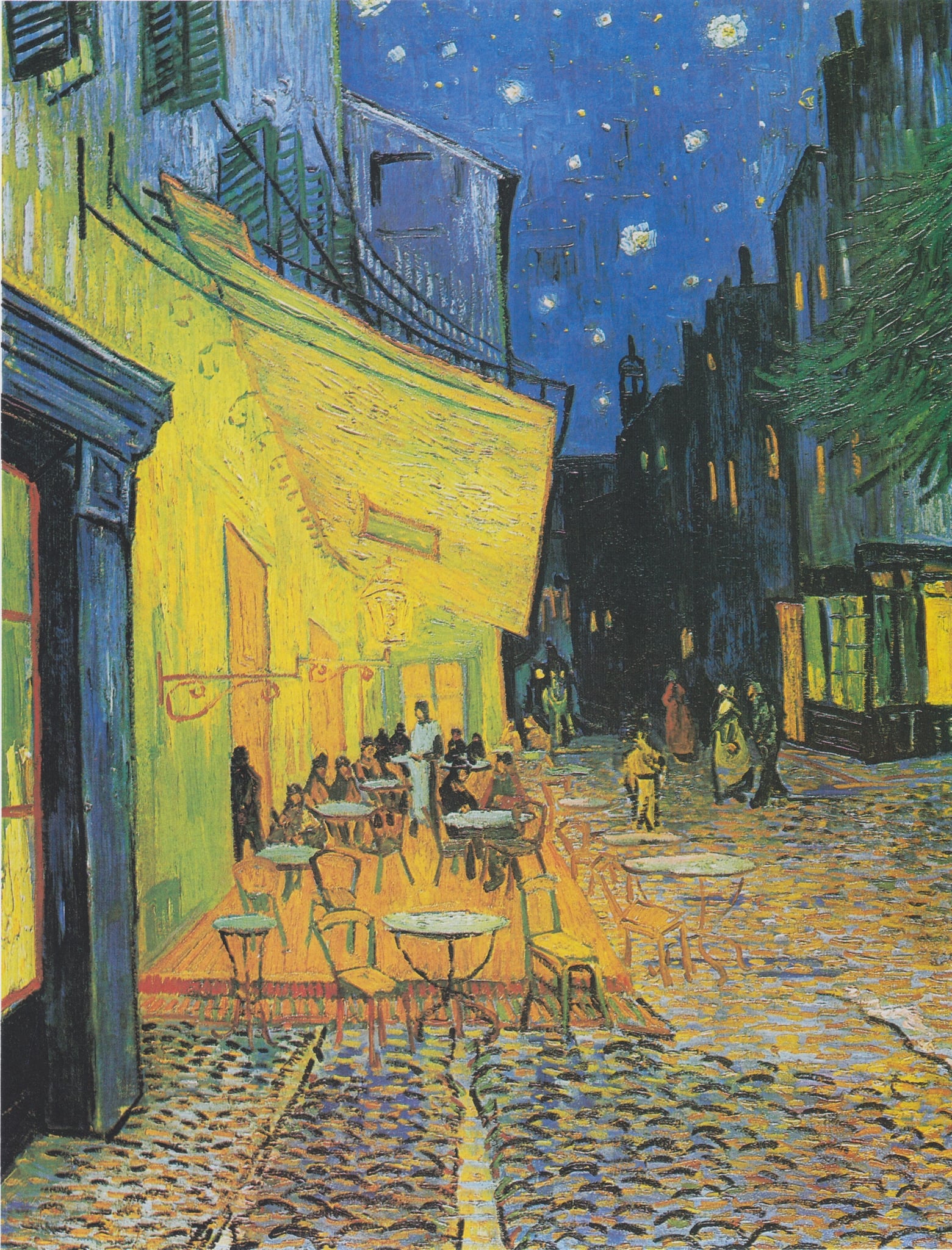
In Café Terrace at Night, Vincent van Gogh turns nocturne into <strong>luminous color</strong>: a gas‑lit terrace glows in yellows and oranges against a deep <strong>ultramarine sky</strong> pricked with stars. By building night “<strong>without black</strong>,” he stages a vivid encounter between human sociability and the vastness overhead <sup>[1]</sup><sup>[2]</sup>.
Irises by Vincent van Gogh

Irises

Vincent van Gogh (1889)

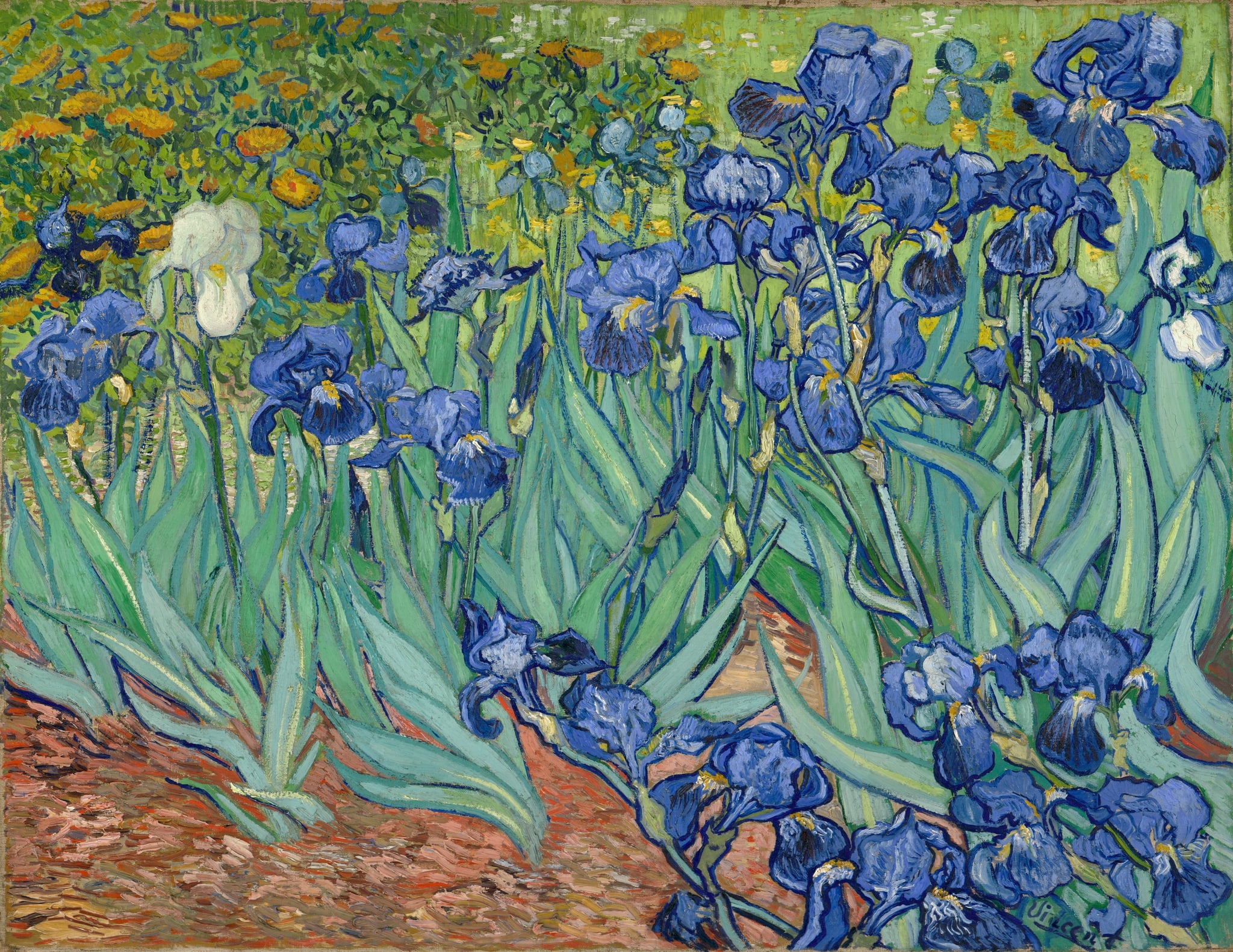
Painted in May 1889 at the Saint-Rémy asylum garden, Vincent van Gogh’s <strong>Irises</strong> turns close observation into an act of repair. Dark contours, a cropped, print-like vantage, and vibrating complements—violet/blue blossoms against <strong>yellow-green</strong> ground—stage a living frieze whose lone <strong>white iris</strong> punctuates the field with arresting clarity <sup>[1]</sup><sup>[2]</sup>.
Sunflowers by Vincent van Gogh

Sunflowers

Vincent van Gogh (1888)

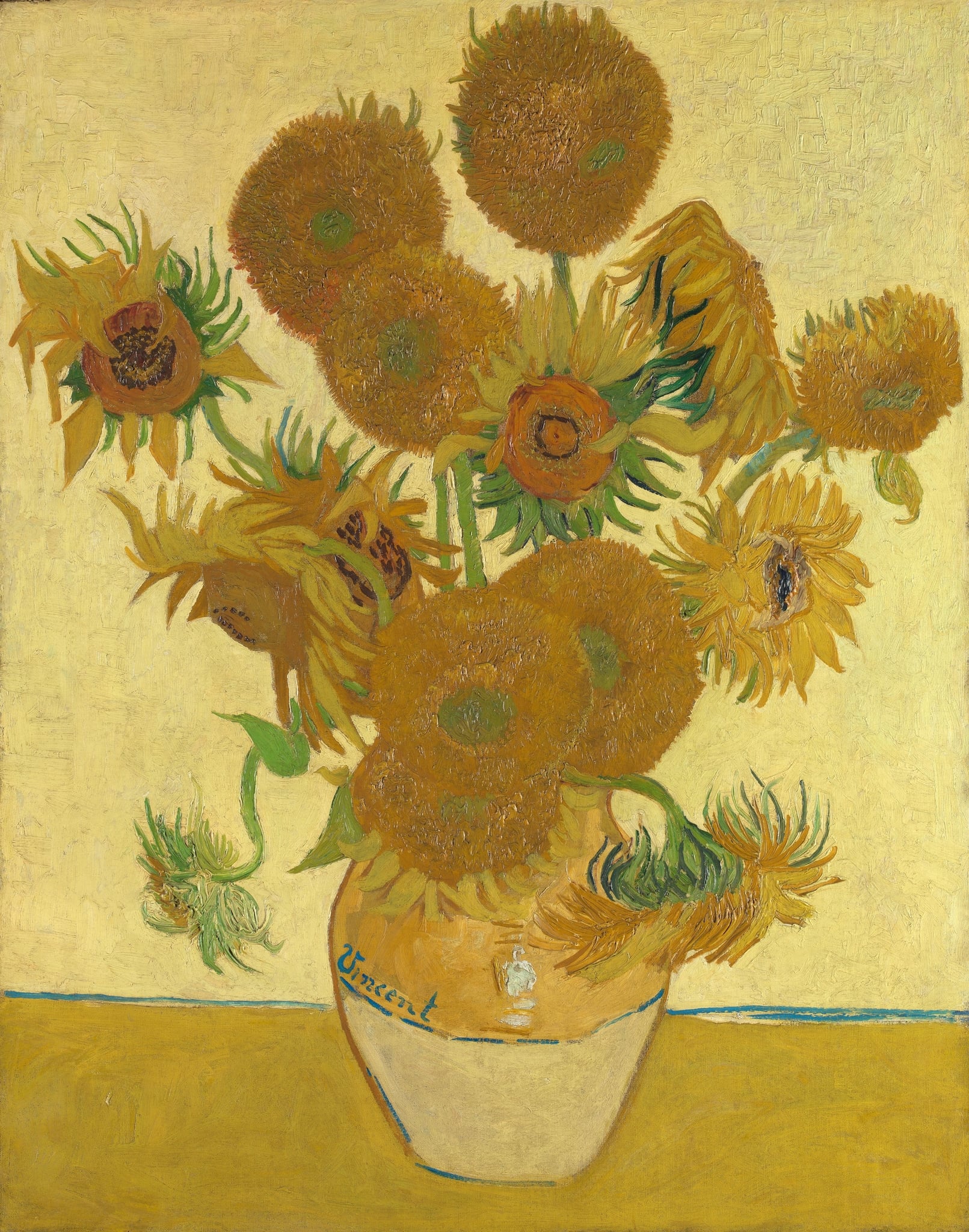
Vincent van Gogh’s Sunflowers (1888) is a <strong>yellow-on-yellow</strong> still life that stages a full <strong>cycle of life</strong> in fifteen blooms, from fresh buds to brittle seed heads. The thick impasto, green shocks of stem and bract, and the vase signed <strong>“Vincent”</strong> turn a humble bouquet into an emblem of endurance and fellowship <sup>[1]</sup><sup>[2]</sup>.

The Red Vineyard by Vincent van Gogh

The Red Vineyard

Vincent van Gogh (1888)

In The Red Vineyard, Vincent van Gogh forges a vision of <strong>autumn labor under a blazing sun</strong>, where harvesters flow diagonally through scarlet vines while a band of <strong>yellow light</strong> flares along a reflective roadway. The scene fuses <strong>exhaustion and ripeness</strong>, turning work into a rhythmic, almost liturgical procession <sup>[1]</sup><sup>[3]</sup>.

The Bedroom by Vincent van Gogh

The Bedroom

Vincent van Gogh (1889)

Vincent van Gogh’s The Bedroom turns a modest room into a psychological stage, using <strong>clashing color</strong> and <strong>tilted space</strong> to test whether color alone can evoke rest. The bright yellow bed, twin chairs, and green‑shuttered window press forward as the floor tilts and pictures cant, so that <strong>refuge and unease</strong> exist side by side <sup>[1]</sup><sup>[2]</sup>.

Self-Portrait with Bandaged Ear by Vincent van Gogh

Self-Portrait with Bandaged Ear

Vincent van Gogh (1889)

In Self-Portrait with Bandaged Ear (1889), Vincent van Gogh converts a recent crisis into an image of <strong>resolve</strong>. The frontal, slightly turned pose forces attention to the white bandage at the viewer’s right, while the fur cap, heavy coat, and the nearby <strong>Japanese print</strong> declare persistence and ideals that steady him in the wake of trauma <sup>[1]</sup><sup>[2]</sup>. The painting’s cool, wintry palette and insistent strokes make suffering legible yet disciplined, transforming pain into <strong>artistic purpose</strong> <sup>[2]</sup>.