How Much Is The Zouave Worth?
Last updated: May 27, 2026
Quick Facts
- Methodology
- comparable analysis
Hypothetical fair‑market value for Vincent van Gogh’s The Zouave (Half‑figure), 1888: $110–160 million. The work is a prime Arles‑period portrait—one of the most coveted segments of van Gogh’s oeuvre—supported by late‑1880s auction benchmarks led by the $117.18m 2022 record for Orchard with Cypresses.
Valuation Analysis
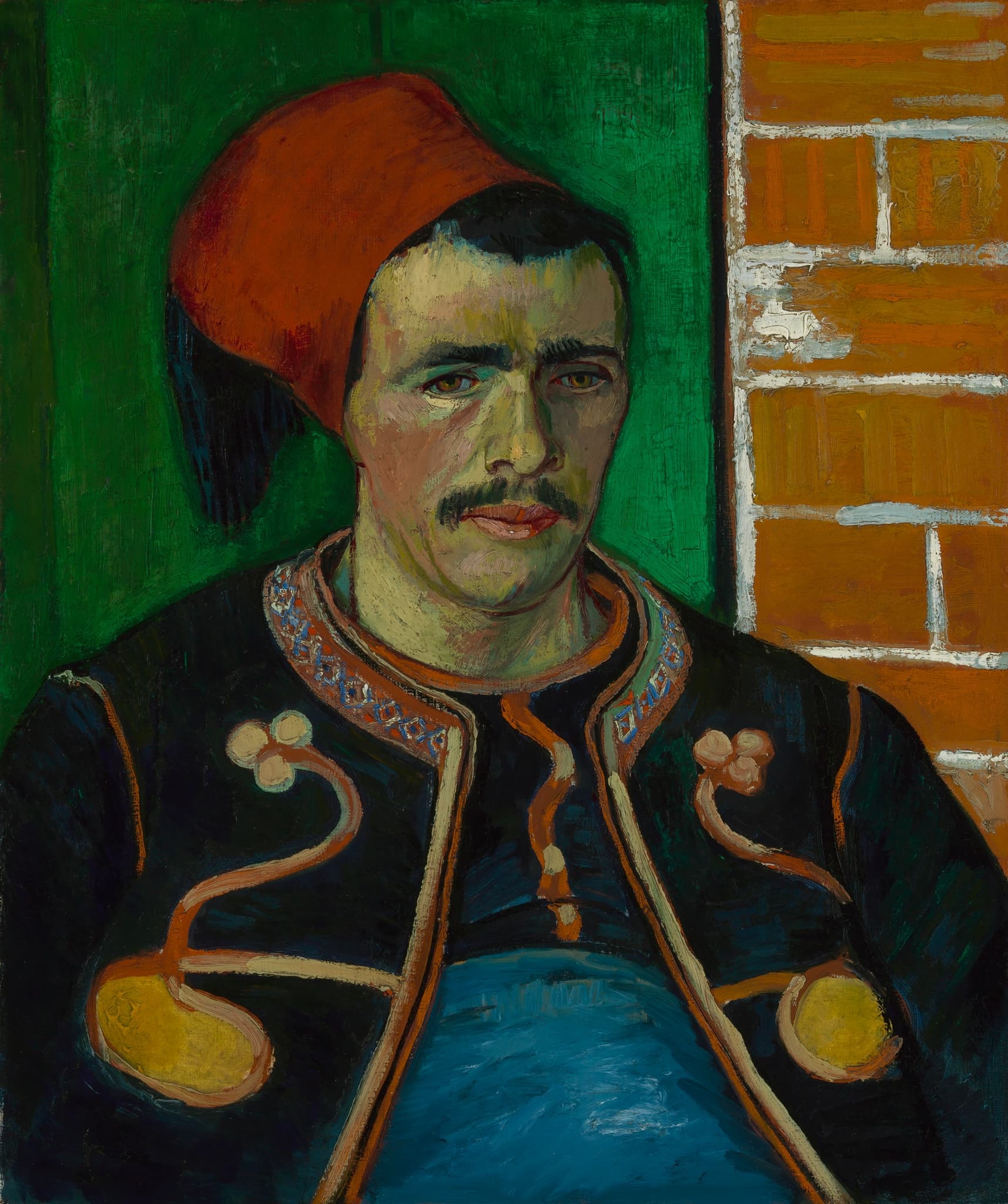
Conclusion. We estimate Vincent van Gogh’s The Zouave (Half‑figure), 1888, at a hypothetical fair‑market value of $110–160 million if it were ever offered without institutional constraints. This range reflects the work’s status as a prime Arles‑period portrait—one of the most highly prized categories in van Gogh’s market—tempered by the fact that it is not among the artist’s very few universally iconic images (e.g., Sunflowers, Dr. Gachet). The subject is a forceful half‑length depiction of a French Zouave soldier (Paul‑Eugène Milliet), painted in Arles in 1888, the single most in‑demand phase of the artist’s career [5].
Comparable market anchors. Late‑1880s van Goghs have recently realized among the strongest prices in all of Modern art. The artist’s standing auction record is $117.18 million for Orchard with Cypresses (1888; Christie’s, 2022) [1]. Other closely timed works underscore depth in this price band: Laboureur dans un champ (1889) brought $81.31 million in 2017 [2], and L’Allée des Alyscamps (1888) achieved $66.33 million in 2015 [3]. Against these anchors, a museum‑grade Arles portrait of an identifiable sitter justifies a level north of $100 million, with upside toward the mid‑nine figures given scarcity, subject impact, and competition.
Positioning of The Zouave within the oeuvre. The Zouave portraits form a recognized Arles series and exemplify van Gogh’s color‑driven, high‑key portraiture from summer 1888. The half‑figure format and chromatic intensity place the work above “strong but secondary” landscapes from the period and closer to the upper tier of van Gogh’s portrait production, albeit below the absolute icons that would be expected to clear the artist’s record decisively. On quality, date, format, and subject, The Zouave sits in the significant/upper‑tier bracket of Arles portraits [5].
Provenance and marketability. The painting is owned by the Vincent van Gogh Foundation and housed at the Van Gogh Museum, Amsterdam. Works within this core group descended from the family and were transferred to the Foundation in 1962; they are not traded in the modern market [4]. Our estimate models a hypothetical free‑market sale (e.g., deaccession permitted, export authorized) and assumes mainstream sale mechanics (global marketing, third‑party guarantee, and full competition).
Key sensitivities. The upper end of the range presumes excellent condition and surface integrity, a comprehensive exhibition and literature history, and robust global bidding. Conversely, material condition issues, restrictions on movement, or constrained sale strategies could pressure the result toward the lower bound. Within today’s trophy‑led but supply‑constrained landscape for canonical Modern masters, a fresh‑to‑market, prime‑period van Gogh portrait of this caliber would be positioned to challenge the $100m threshold and, with aggressive competition, push well into the mid‑nine figures [1][2][3].
Key Valuation Factors
Art Historical Significance
High ImpactPainted in Arles in 1888, The Zouave (Half‑figure) belongs to the apex year of van Gogh’s career and within a distinct portrait series depicting a French Zouave soldier, Paul‑Eugène Milliet. This is the period when van Gogh crystallized his saturated palette, expressive brushwork, and psychologically charged portraiture. The work’s half‑length format, focused likeness, and chromatic intensity align it with the artist’s most studied and exhibited themes from Arles. While not on the singular icon tier of Sunflowers or Dr. Gachet, the painting is squarely in the significant/upper‑tier of his portrait production—a category that commands a premium due to its centrality to the narrative of Post‑Impressionism and van Gogh’s pursuit of a “modern portrait.”
Period and Subject Desirability
High ImpactCollector preference strongly favors van Gogh’s Arles (1888) and Saint‑Rémy (1889–90) works, with Arles portraits among the scarcest and most hotly contested sub‑categories. The Zouave combines an instantly legible, high‑impact subject with the sought‑after half‑length format and bold color contrasts emblematic of Arles. This places the work above many late‑1880s landscapes in perceived importance. Although the image lacks the near‑universal recognition of a few top icons, it retains several market catalysts—prime date, portrait genre, and vivid palette—that materially elevate demand. In a competitive sale, those factors typically move van Gogh portraits into nine‑figure territory, ahead of comparably dated but less emblematic compositions.
Market Benchmarks and Scarcity
High ImpactRecent results anchor a robust pricing corridor for late‑1880s van Goghs. The 2022 record of $117.18m for the 1888 Orchard with Cypresses sets a contemporary ceiling; other proximate works—Laboureur dans un champ (1889) at $81.31m and L’Allée des Alyscamps (1888) at $66.33m—demonstrate durable depth. Against this backdrop, a fresh, museum‑grade Arles portrait would be expected to clear $100m and, with competition, test the mid‑nine figures. Crucially, supply of top‑period portraits is vanishingly thin; many are locked in institutions. That scarcity amplifies competitive tension when an opportunity arises, justifying an upper range that can approach, and in strong conditions exceed, the artist’s recent high watermark.
Provenance, Condition, and Scale
Medium ImpactThe painting’s museum‑level provenance—Vincent van Gogh Foundation, displayed at the Van Gogh Museum—confers unimpeachable authenticity and scholarly pedigree. While this boosts desirability, it also implies deaccession and export hurdles; our range assumes a hypothetical unrestricted sale. Condition and surface quality are critical value drivers for van Gogh’s impasto‑rich portraits; pristine state would support the high end, while structural or color instability (e.g., reds) could compress pricing. The canvas size (c. 65 × 54 cm) is a classic, collector‑preferred format that balances presence with domestic displayability. Overall, this factor is medium: it can materially shift the result within the range but is unlikely to redefine the category‑level pricing anchors.
Sale History
The Zouave has never been sold at public auction.
Vincent van Gogh's Market
Vincent van Gogh is among the two or three most valuable and liquid names in Western art. Demand is deep, global, and trophy‑led, with supply acutely constrained—especially for prime Arles and Saint‑Rémy paintings. The auction record stands at $117.18 million for Orchard with Cypresses (1888), set in 2022, with other late‑1880s works frequently achieving $60–80+ million in strong seasons. Portraits from 1888–90 are especially coveted, and the best examples are widely expected to command nine‑figure sums if freed from institutional collections. The combination of canonical status, cross‑category appeal to Modern and global collectors, and rarity underpins sustained price resilience, even as broader market conditions cycle.
Comparable Sales
Orchard with Cypresses
Vincent van Gogh
Same artist and year (1888, Arles). Prime-period canvas with market-leading result; strong anchor for top-tier late-1880s works though not a portrait.
$117.2M
2022, Christie's New York
~$128.1M adjusted
Self-Portrait Without Beard
Vincent van Gogh
Late 1880s portrait by van Gogh; iconic bust-format and among the artist’s most coveted portrait categories—very close in genre/significance to a half-figure Arles portrait.
$71.5M
1998, Christie's New York
~$140.4M adjusted
L'Arlésienne (Madame Ginoux)
Vincent van Gogh
Portrait of an Arles sitter (half-length), a canonical van Gogh portrait type closely aligned with The Zouave in period and format.
$40.3M
2006, Christie's New York
~$64.0M adjusted
Laboureur dans un champ (Ploughman in the Field)
Vincent van Gogh
Prime late-1880s Provence work with a figure; top-tier demand indicator for works immediately adjacent to the Arles portrait period.
$81.3M
2017, Christie's New York
~$106.1M adjusted
L'Allée des Alyscamps
Vincent van Gogh
Arles, 1888. Highly desirable prime-period canvas with figures; close in date and location to The Zouave and useful for pricing the broader Arles premium.
$66.3M
2015, Sotheby's New York
~$89.5M adjusted
Portrait of Dr. Gachet
Vincent van Gogh
Iconic late portrait (1890). Though older as a sale, it is the benchmark for the market’s appetite for van Gogh’s most important portraits.
$82.5M
1990, Christie's New York
~$202.0M adjusted
Current Market Trends
The top end of the Modern and Impressionist segment remains trophy‑driven and supply‑constrained. When blue‑chip, museum‑caliber works appear—particularly by canonical names such as van Gogh—auction houses can marshal global bidding, guarantees, and private underbids to support robust results. While broader volatility has pushed some consignors toward private channels, headline works continue to clear at strong prices, with depth concentrated around historically validated artists and prime periods. In this environment, a fresh, high‑impact Arles portrait by van Gogh would likely see vigorous cross‑border competition, with price formation shaped by pre‑sale placement, third‑party guarantees, and condition‑driven confidence.
Study print
Study this painting as a print
Pair the full artwork with a museum-style study sheet focused on one meaningful detail.
Sources
- The Art Newspaper: A van Gogh record—Orchard with Cypresses soars to $117m at Paul Allen auction (2022)
- Christie’s: Laboureur dans un champ by Vincent van Gogh (sale result and analysis, 2017)
- Sotheby’s: Vincent van Gogh, L’Allée des Alyscamps — price realized $66.33m (2015)
- Van Gogh Museum: Without family, no museum — the beginnings of the Van Gogh Museum (on the Vincent van Gogh Foundation, 1962 transfer)
- Wikipedia: The Zouave (Van Gogh) — identification of the Arles portrait series and sitter