Spirit of the Dead Watching

by Paul Gauguin

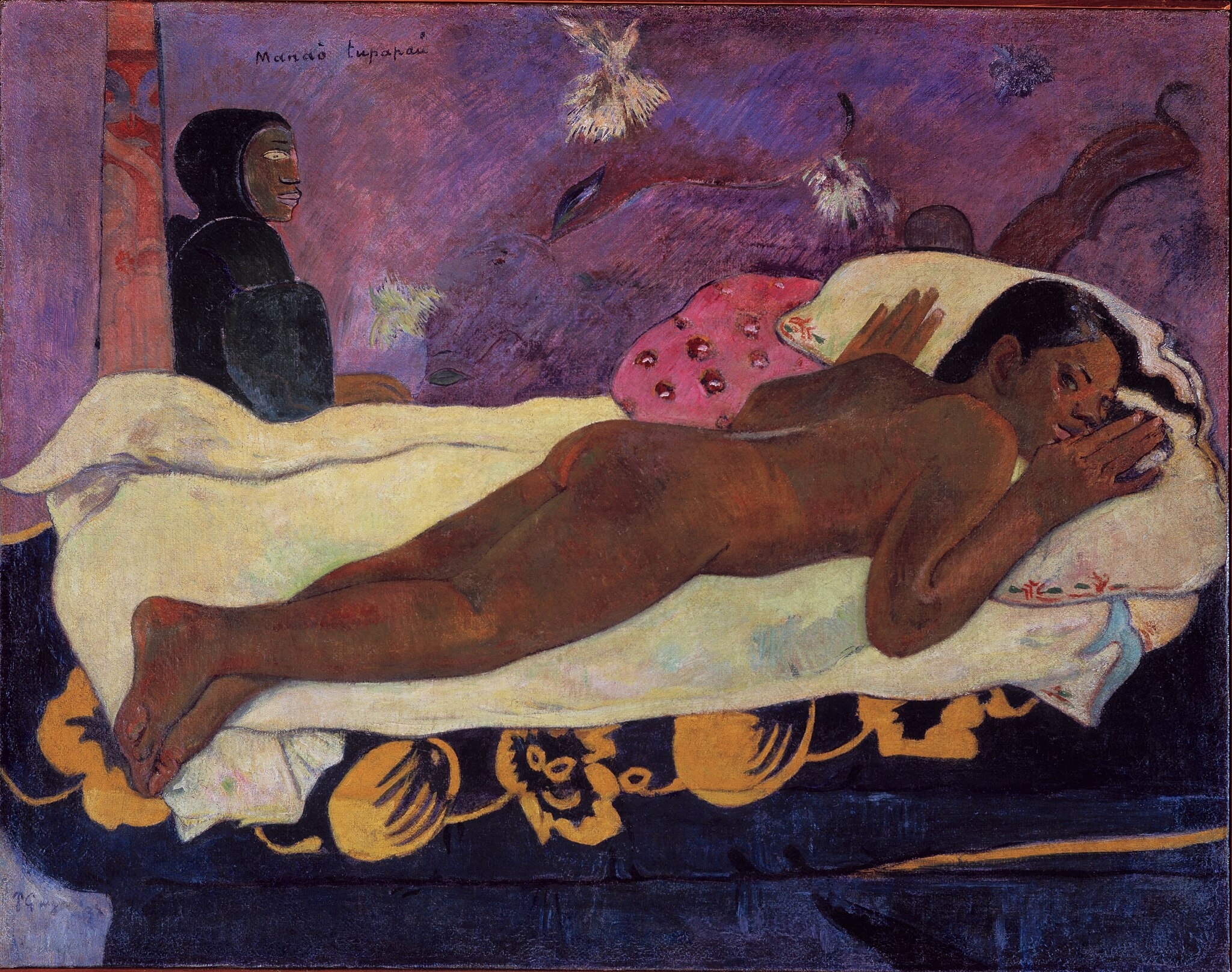
Spirit of the Dead Watching stages a nocturnal confrontation between a rigid, prone nude and a dark, hooded presence at the bed’s edge, fusing desire with dread. Flat patterns, cloisonné outlines, and violet-black fields convert the room into a symbolic plane where a Tahitian tupapaú may be either guardian or threat. The work crystallizes Gauguin’s Synthetist aim to make color and contour carry mythic psychology rather than mere description [1][2].

Study Print Studio

Create a personal study print

Build a companion study sheet around the part of this painting that speaks to you most. Choose a detail, shape an interpretation, and walk away with something personal and display-worthy.

Fast Facts

Year
1892
Medium
Oil on jute mounted on canvas
Dimensions
73.02 × 92.39 cm (support)
Location
Buffalo AKG Art Museum, Buffalo, NY
Spirit of the Dead Watching by Paul Gauguin (1892) featuring Tupapa'u (spirit watcher), Recumbent nude, Phosphorescent ‘spirit lights’, Tahitian inscription “Manao tupapa’u”

Click on any numbered symbol to learn more about its meaning

Meaning & Symbolism

Spirit of the Dead Watching binds erotic display to mortal fear by staging a back-turned nude pressed into white bedding while a dark, hooded figure sits upright at the mattress edge. The woman’s eyes are cast over her shoulder toward the left, neither meeting ours nor settling on a stable threat; her tense hands splay against a pillow embroidered with tiny flowers. Around her, feathered white shapes flicker across a violet wall, and the blanket’s gold-on-black arabesques spill like cut-paper shadows. Gauguin systematizes this dread through Synthetist means: flat planes, thick contours, and non-naturalistic violets and indigos compress the room into a shallow tapestry where meaning, not modeling, dominates 2. The Tahitian inscription at upper left and the seated, shrouded watcher name the scene as Manao tupapaú—the spirit of the dead keeping watch—while the artist’s later text explains the floating phosphorescences as signs of spirit presence and even imagines the specter as a "little old woman" 1. The picture therefore suspends two certainties: either the girl fears the dark and conjures a presence, or the presence is real and she senses it. In the hinged space between those readings, the painting generates its voltage. That voltage is ethical as much as formal. Read against the colonial situation that made the scene possible, the bed becomes a stage for power, and the watchfulness accrues a second referent: the European artist’s gaze. Feminist and postcolonial critics argue that the terror on the model’s face can register not only a supernatural dread but the threat of a real watcher in the room, shifting the specter’s identity toward the artist’s own authority 34. This doubling is underscored by the picture’s structure of looking: the girl averts her eyes, the specter looks past her, and we, invited as witnesses, complete the circuit of surveillance. The painting thus weaponizes ambiguity. Its violet field presses forward like night itself; decorative motifs—the pink dotted bolster, the gold vegetal border—deny depth and trap the figure in a zone where patterns perform as signs. Within that shallow stage, light and dark are principles, not optics: the cool purple-black world encroaches, while the bed’s chalky whites create a fragile sanctuary that cannot hold. Gauguin insisted that color and contour carry feeling and idea; here, indigo and amethyst become the grammar of fear, while warm siennas and ochers hold the body in life 2. The painting’s later circulation in prints for Noa Noa, and his own myth-making prose around Tahitian belief, amplified this program, repositioning the image as both testimony and theater of the so-called "primitive" imaginary 567. Formally, the work dialogues with European precedents while estranging them. The recumbent nude, modeled without academic depth, recalls Manet and Degas yet overturns their studio daylight with a nocturne of mythic anxiety. Where Olympia installs a knowing stare, this figure presents a fearful backward glance; where the maid once brought flowers, a dark watcher now sits and keeps the scene in suspense. That inversion clarifies Gauguin’s wager: to convert a modern European genre into a vessel for symbolic narrative drawn from Polynesian belief—but also to expose how such conversion consumes and recodes its subjects within a colonial fantasy. The meaning of Spirit of the Dead Watching, then, is not a single folklore illustration but a charged ambivalence: a painting that makes terror and tenderness, myth and domination, coexist on the same narrow bed. Why Spirit of the Dead Watching is important is precisely this double legacy: it advances modernism’s symbolic language even as it compels viewers to confront the conditions—gendered, racialized, imperial—that the language served 1234.

Explore Deeper with AI

Ask questions about Spirit of the Dead Watching

Popular questions:

Powered by AI • Get instant insights about this artwork

💬 Ask questions about this artwork!

Interpretations

Postcolonial/Feminist Lens: Surveillance as the True Specter

The painting’s “structure of looking” installs a regime of surveillance: the girl averts her gaze, the hooded watcher sits at the edge, and we complete the circuit. Feminist and postcolonial critics argue that the terror can be read as fear of a real watcher—Gauguin himself—rather than (or in addition to) a tupapa’u, shifting the specter toward colonial, masculinist authority. This reading reframes the nocturne not as ethnography but as a technology of viewing that eroticizes and disciplines a racialized body. The bed’s shallow stage, patterned like a theatrical apron, literalizes that apparatus: intimacy becomes spectacle; privacy, display. In this account, the image’s power is ethical and political before it is mystical, making the painting a manifesto of the imperial gaze masked as myth 34.

Source: Griselda Pollock; Nancy Mowll Mathews (summarized via university sources)

Synthetism as a Grammar of Fear

Gauguin replaces modeling with Synthetist signs: cloisonné contours, compressed planes, and non‑naturalistic violets/indigos. In this system, color is not atmosphere but concept—indigo articulates night as encroaching force; chalky whites clinch a provisional sanctuary of the bed; ochers hold the body in life. The “feathery” wall marks and dark watcher are not spatial cues so much as tokens in a symbolic syntax where meaning overtakes mimesis. This is Post‑Impressionism veering to Symbolism: a calculated anti‑illusionism that makes dread legible as a flat tapestry of signs. The result is affect engineered by design, a modernist wager that form itself can carry metaphysics—here, the metaphysics of fear 12.

Source: Buffalo AKG Art Museum; Encyclopaedia Britannica (Gauguin overview)

Counter‑Olympia: Rewriting the Recumbent Nude

Scholars often read the picture as a Tahitian counter‑Olympia. Where Manet’s courtesan confronts viewers with a knowing stare, Gauguin’s model glances back in alarm; where a maid once presented flowers, a cloaked figure now incubates threat. The pivot from daylight studio to violet nocturne retools a canonical European genre to traffic in mythic anxiety. This inversion is not neutral quotation: it manufactures difference—racial, sexual, colonial—by recoding a familiar format through an exoticizing lens. The painting thus claims modernist originality via appropriative revision, turning the Salon nude into a stage for symbolic narrative that is simultaneously an instrument of othering 4.

Source: Art History II (Lumen/LibreTexts) summarizing standard scholarship on Olympia comparisons

Myth‑Making and Print Afterlives

The image did not end at the canvas. Back in France, Gauguin issued zincographs, lithographs, and woodcuts of the motif for L’Estampe originale and the Noa Noa project, broadcasting the composition as a portable myth of Tahiti. The serial printmaking abstracts the scene further—flattening, reducing, and repeating signs (the watcher, phosphorescences, floral bedding)—to stabilize a legible icon of the “primitive” imaginary for European audiences. This dissemination shows authorship as iteration: a workshop of variants that entrenches a narrative Gauguin was simultaneously scripting in prose. The afterlives prove how modernism’s forms and markets could naturalize invented ethnography as aesthetic truth 5678.

Source: The Met; MoMA; British Museum; National Gallery of Art (Gauguin: Maker of Myth)

Ambiguous Ontology: Presence or Projection?

Gauguin’s own text names the wall lights as “phosphorescent” spirit signs and even imagines the ghost as a “little old woman,” yet the painting withholds confirmation: does the girl conjure a fear of darkness, or does she sense an actual presence? This double ontology is the engine of the work’s charge. The Tahitian inscription frames a local spirit belief, but the Synthetist language repositions it within European symbolism, making ambiguity the content. That undecidability—vision vs. hallucination, myth vs. psychology—keeps viewers oscillating between empathy and voyeurism, between sacred dread and staged theatrics 19.

Source: Buffalo AKG Art Museum; Gauguin, Noa Noa (translated excerpts)

Related Themes

About Paul Gauguin

Paul Gauguin (1848–1903) left a finance career to pursue avant‑garde painting, seeking alternatives to European modernity first in Brittany and then in Polynesia. His Tahitian works synthesize bold color, flat contour, and symbolic imagery, shaping the course of Post‑Impressionism and modernist primitivism [3][1].
View all works by Paul Gauguin

More by Paul Gauguin