The Yellow Christ

by Paul Gauguin

Paul Gauguin’s The Yellow Christ (1889) fuses sacred narrative with everyday Brittany, rendering a lemon‑yellow Christ in a rural autumn landscape. Through Synthetist color and Cloisonnist contours, the work declares spiritual meaning over naturalism, placing devotion among kneeling Breton women beneath a banded, hope‑tinged sky [1][3].

Study Print Studio

Create a personal study print

Build a companion study sheet around the part of this painting that speaks to you most. Choose a detail, shape an interpretation, and walk away with something personal and display-worthy.

Fast Facts

Year
1889
Medium
Oil on canvas
Dimensions
92.07 × 73.34 cm
Location
Buffalo AKG Art Museum, Buffalo, New York
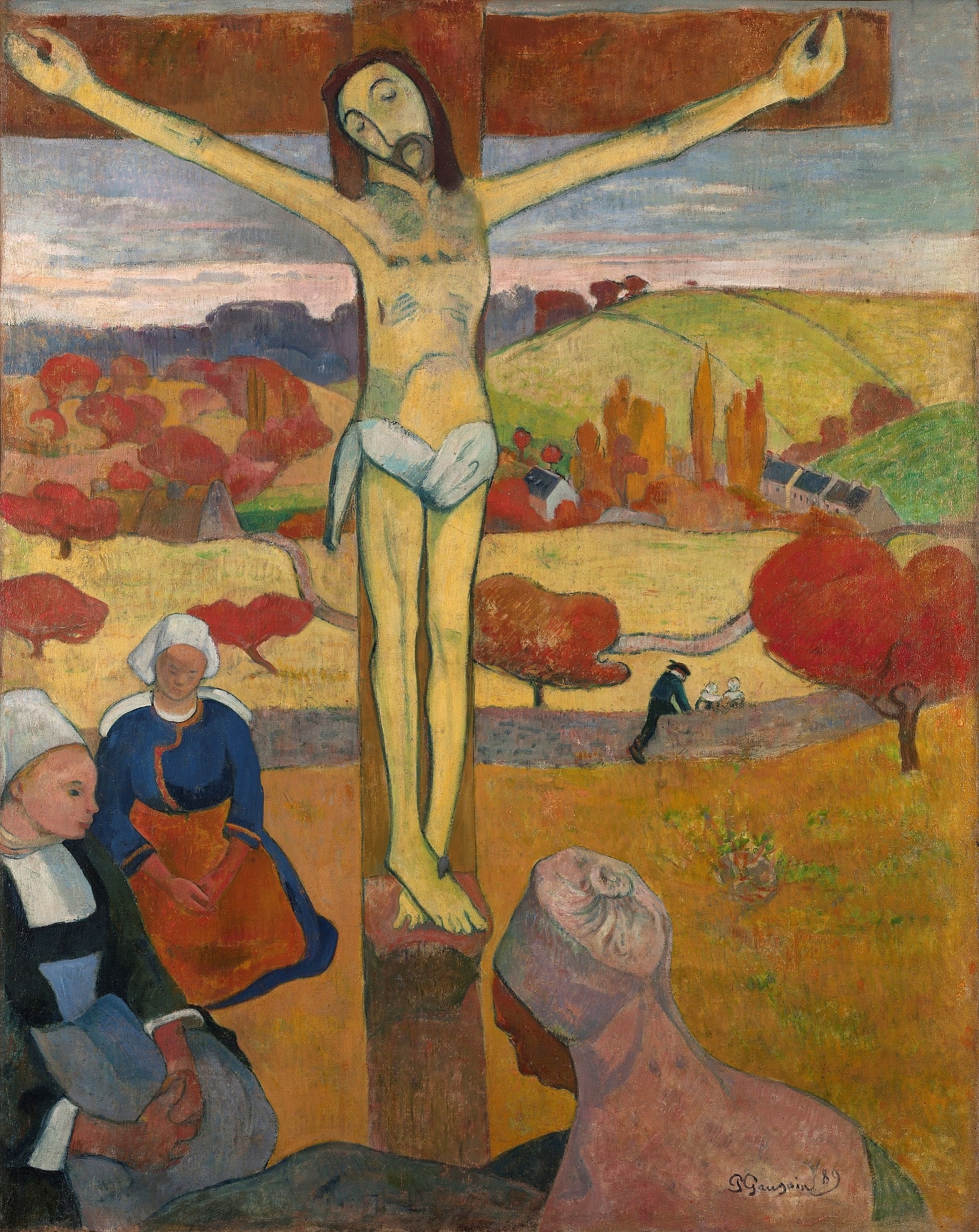
The Yellow Christ by Paul Gauguin (1889) featuring Yellow body of Christ, Breton calvary (wooden cross), Kneeling Breton women with white coifs, Autumn landscape (ochers, reds, and orange trees)

Click on any numbered symbol to learn more about its meaning

Meaning & Symbolism

Gauguin stages the Crucifixion not in Jerusalem but in a Breton autumn, replacing documentary verisimilitude with spiritual equivalence. The elongated, lemon‑yellow body—outlined like enamel work—hangs on a rough wooden cross that reads less as archaeology than as a familiar Breton calvary, the kind found along village roads. Christ’s masklike face, rigid torso, and simplified hands refuse anatomical persuasion to assert an inner truth: suffering held in serene stillness. The surrounding field blazes with ochers and reds, while the distant hill cools to yellow‑green beneath a sky banded in mauve, gray, and blue; the chromatic arc moves from heat to cool, staging a passage from death to promise. At the lower left, women in traditional white coifs kneel in prayer; their blocky silhouettes and flat garments—navy, orange, and black—anchor the sacred drama in the Angelus rhythm of the day, signaling communal piety rather than individual spectacle 1. The result is a deliberate time‑collapse: biblical sacrifice coincides with the harvest cycle, inviting viewers to find transcendence within ordinary labor and devotion. Formally, the picture is a manifesto for Synthetism and a paradigmatic instance of Cloisonnism. Dark contours corral broad, unmodeled color zones so that shape and hue function as ideas rather than illusions. Yellow, in particular, bears meaning: it simultaneously suggests divine light and the pallor of a body drained of blood, turning Christ into an emblem that radiates and withers at once. This symbolic palette, forged in Gauguin’s Brittany years alongside Émile Bernard, rejects Impressionist optics in favor of a deliberate synthesis of memory, observed motif, and inner vision 23. The specific model—the polychrome crucifix of the Trémalo Chapel near Pont‑Aven—confirms how Gauguin translates a local devotional object into modern myth: the painted folk sculpture becomes a universal sign when lifted into the living landscape 1. That move also seeds Gauguin’s self‑mythologizing. Within a year he would pose with this very image in his studio, aligning the suffering redeemer with the misunderstood modern artist, and extending the painting’s theology into an artistic credo 4. In short, why The Yellow Christ is important is that it consecrates an anti‑naturalist modernism: by binding sacred story to Breton earth through bold line and symbolic color, Gauguin shows how modern art can make the eternal immediate, the cosmic legible in the everyday.

Explore Deeper with AI

Ask questions about The Yellow Christ

Popular questions:

Powered by AI • Get instant insights about this artwork

💬 Ask questions about this artwork!

Interpretations

Ritual Time: Angelus and the Workday

At the lower left, the Breton women at the Angelus anchor the drama in communal ritual, not individual rapture. Their blocky silhouettes and flat garments function like timekeepers of rural labor—punctuating the day at dawn, noon, and dusk—so that devotion is experienced as tempo as much as belief. The crucifix, suspended within an autumn blaze, synchronizes with agrarian cutting and gathering; death and promise are literally on the clock of work. Gauguin thereby reframes the Passion as a rhythm one can inhabit, where piety and toil co-constitute meaning and the sacred is encountered in the measured tasks of the field 1.

Source: Buffalo AKG Art Museum

Site-Translation and Folk Devotion

The Yellow Christ is less a relocation than a site-translation: a Breton roadside calvary becomes a living, sacramental presence in the fields. Gauguin models Christ on the polychrome crucifix of the Trémalo Chapel and then releases that devotional object into the open air, where it converses with harvest hues and village prayer. This move fuses artifact and environment, converting a localized folk image into a universal sign without relinquishing its vernacular charge. The result is a theology of place: Brittany’s Catholic rituals and woodcarving traditions are not quaint backdrops but the very medium of modern myth-making. In this register, the painting reads as ethnography transfigured—an act of cultural attention that becomes Symbolist revelation 127.

Source: Buffalo AKG Art Museum; National Gallery of Art

Chromatic Theology: Yellow as Double Valence

Gauguin’s yellow is ambivalent: at once aureole and cadaveric pallor. The acid lemon of Christ’s flesh radiates an inner, metaphysical light while signaling blood-drain and death, an equivocation that turns color into doctrine. Symbolist praxis is explicit here: hue does not imitate sunlight; it articulates belief. By corralling planes with dark contours, Gauguin sharpens yellow’s semantic edge so that it oscillates between glory and withering, eternity and decay. This is not a mood wash but a propositional color—an argument in paint that rejects Impressionist optics in favor of Synthetist meaning, where chroma and line are carriers of thought as much as sight 14.

Source: Buffalo AKG Art Museum; Britannica

Artist as Martyr: Self-Myth Afterlife

Within a year, Gauguin stages a picture-within-a-picture—Self‑Portrait with the Yellow Christ—placing the 1889 canvas behind his head to align the suffering redeemer with the misunderstood modern artist. This is not mere quotation; it is a transfer of iconographic charge from devotion to authorship. The Yellow Christ thus becomes a portable credo, migrating from landscape to studio to assert that artistic vocation entails sacrifice, isolation, and prophetic vision. Institutional readings emphasize how Brittany incubated this self-mythic posture, amplified across works like Christ in the Garden of Olives (1889). The painting’s theology, in short, doubles as a modernist ethics of making—an identity forged under the sign of martyrdom 23.

Source: Musée d’Orsay; National Gallery of Art

Cloisonné Logic and Anti-Naturalist Space

Formally, the canvas operates like stained glass or enamel: dark lines partition flat fields, creating a cloisonné logic where contours behave as theological armatures. This Cloisonnist architecture suppresses recession and modeling, replacing perspectival persuasion with declarative silhouettes—figures as ideas. Under the broader banner of Synthetism, memory and inner vision synthesize with motif; the cross reads as sign, the women as glyphs, the landscape as banded schema. Such design-forward construction repudiates Impressionist empiricism and resets painting as a symbolic system—a medium where composition and chroma articulate metaphysical content with liturgical clarity 456.

Source: Britannica; The Metropolitan Museum of Art; Cloisonnism overview

Related Themes

About Paul Gauguin

Paul Gauguin (1848–1903) left a finance career to pursue avant‑garde painting, seeking alternatives to European modernity first in Brittany and then in Polynesia. His Tahitian works synthesize bold color, flat contour, and symbolic imagery, shaping the course of Post‑Impressionism and modernist primitivism [3][1].
View all works by Paul Gauguin

More by Paul Gauguin

Vision After the Sermon by Paul Gauguin

Vision After the Sermon

Paul Gauguin (1888)

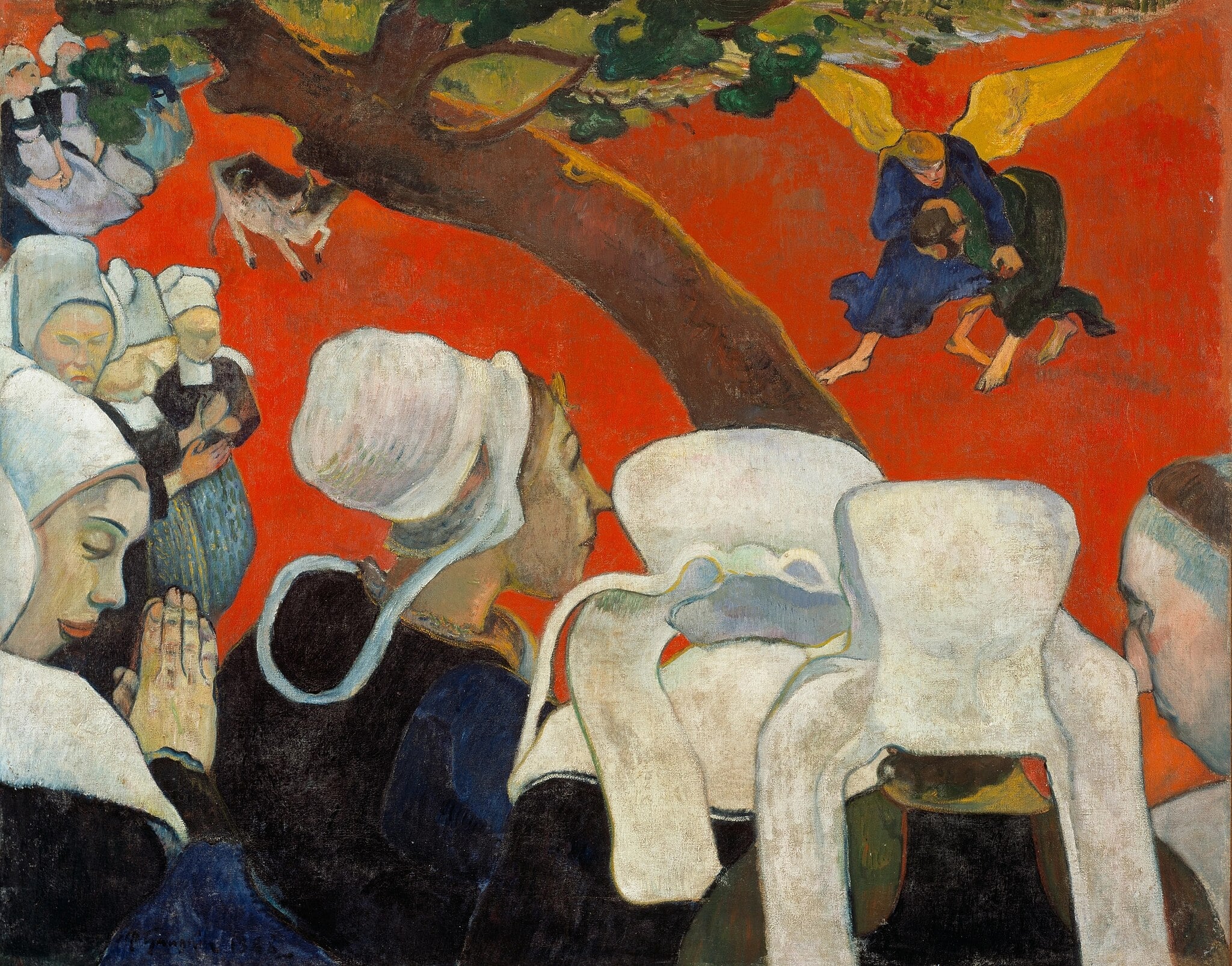
Paul Gauguin’s Vision After the Sermon (1888) stages a divide between lived ritual and <strong>collective vision</strong>: Breton women pray in the foreground while, across a diagonal tree, Jacob wrestles an angel on a <strong>flat red field</strong>. With <strong>bold contours</strong> and <strong>non‑naturalistic color</strong>, Gauguin turns faith into pictorial form, making inner experience the painting’s true subject <sup>[1]</sup><sup>[2]</sup>.

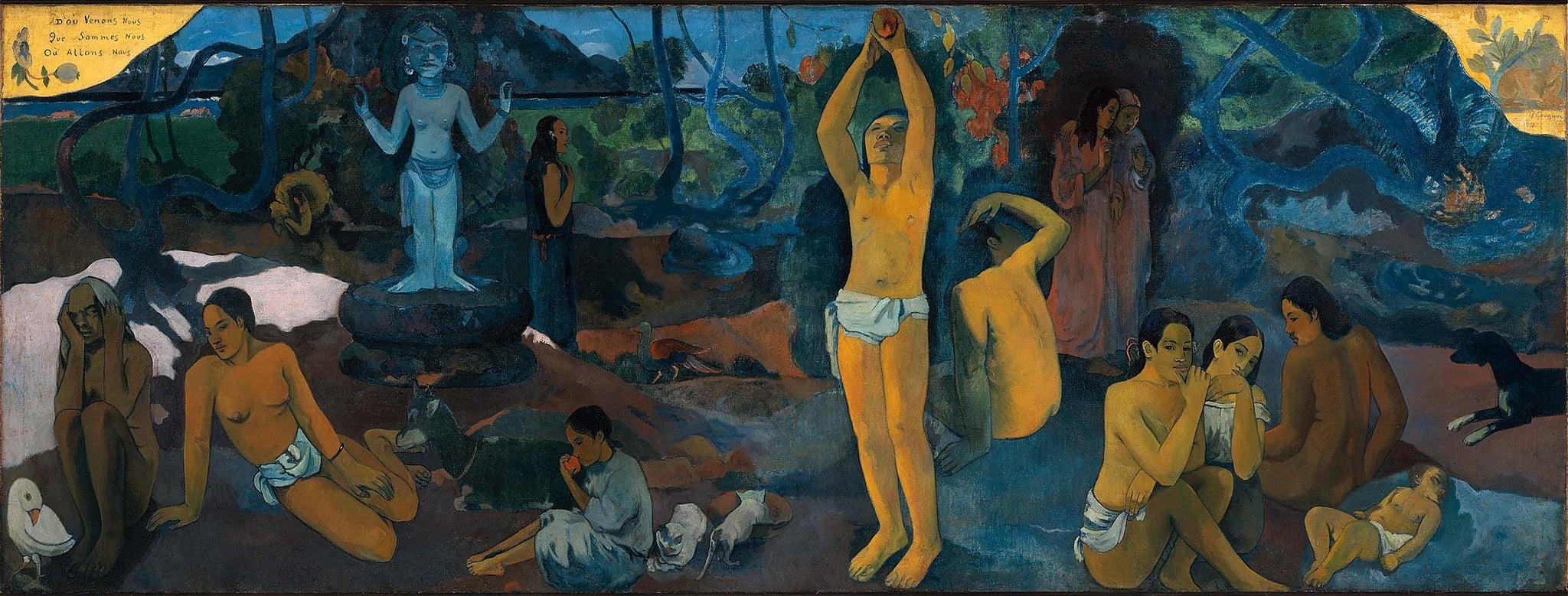
Where Do We Come From? What Are We? Where Are We Going? by Paul Gauguin

Where Do We Come From? What Are We? Where Are We Going?

Paul Gauguin (1897–1898)

A panoramic frieze staged in a Tahitian grove, Paul Gauguin’s Where Do We Come From? What Are We? Where Are We Going? unfolds right-to-left as a cycle of life, from an infant at the far right to an aged woman at the far left. Amid saturated blues and ochres, a central figure reaches for fruit and a pale-blue idol stands motionless, creating a theatre of <strong>origin, desire, and destiny</strong> that never resolves into a single answer.
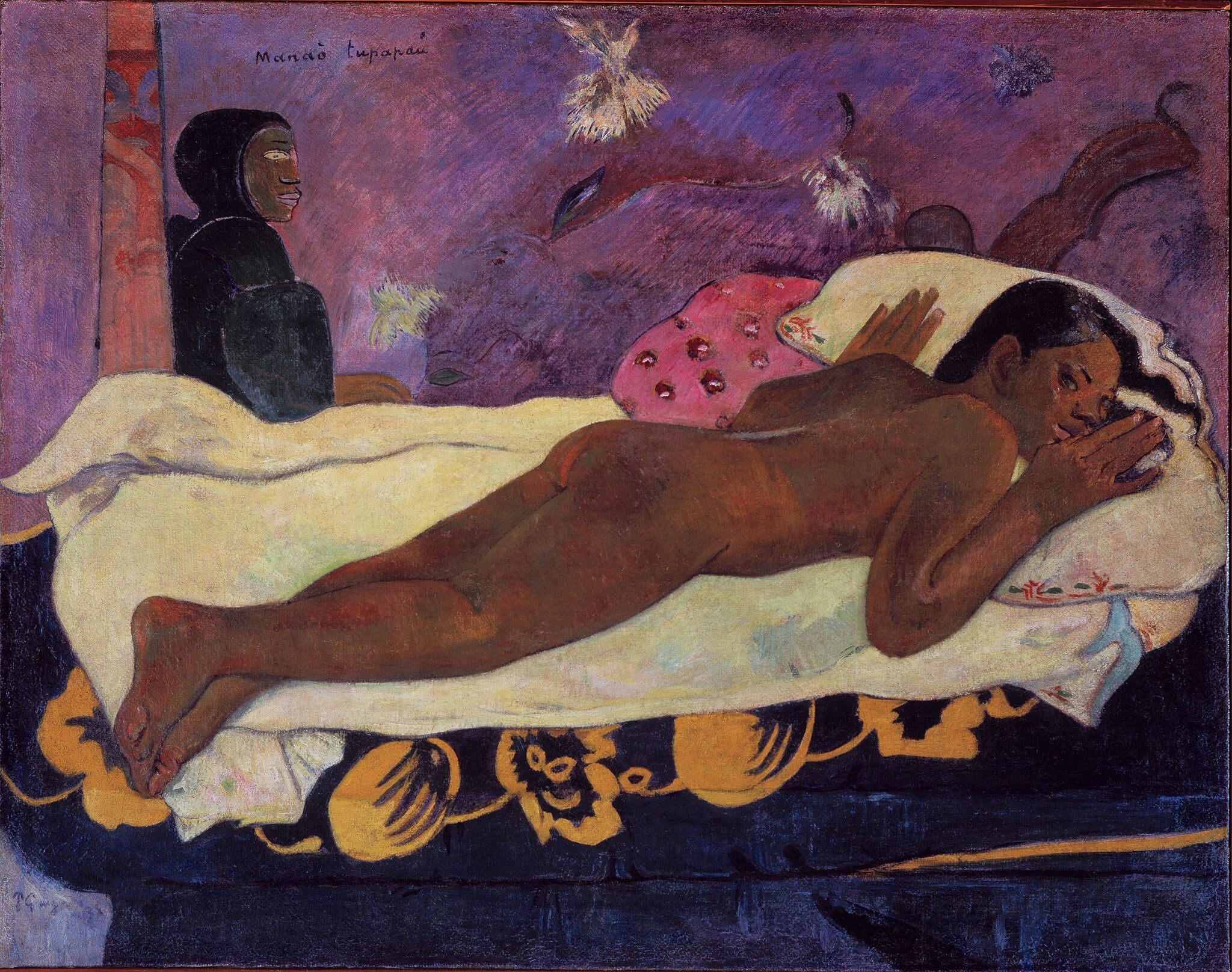
Spirit of the Dead Watching by Paul Gauguin

Spirit of the Dead Watching

Paul Gauguin (1892)

Spirit of the Dead Watching stages a nocturnal confrontation between a rigid, prone nude and a dark, hooded presence at the bed’s edge, fusing <strong>desire</strong> with <strong>dread</strong>. Flat patterns, cloisonné outlines, and violet-black fields convert the room into a symbolic plane where a Tahitian <strong>tupapaú</strong> may be either guardian or threat. The work crystallizes Gauguin’s Synthetist aim to make color and contour carry <strong>mythic psychology</strong> rather than mere description <sup>[1]</sup><sup>[2]</sup>.