Where Do We Come From? What Are We? Where Are We Going?
by Paul Gauguin
A panoramic frieze staged in a Tahitian grove, Paul Gauguin’s Where Do We Come From? What Are We? Where Are We Going? unfolds right-to-left as a cycle of life, from an infant at the far right to an aged woman at the far left. Amid saturated blues and ochres, a central figure reaches for fruit and a pale-blue idol stands motionless, creating a theatre of origin, desire, and destiny that never resolves into a single answer.
Study Print Studio
Create a personal study print
Build a companion study sheet around the part of this painting that speaks to you most. Choose a detail, shape an interpretation, and walk away with something personal and display-worthy.
Fast Facts
- Year
- 1897–1898
- Medium
- Oil on canvas
- Dimensions
- 139.1 × 374.6 cm
- Location
- Museum of Fine Arts, Boston
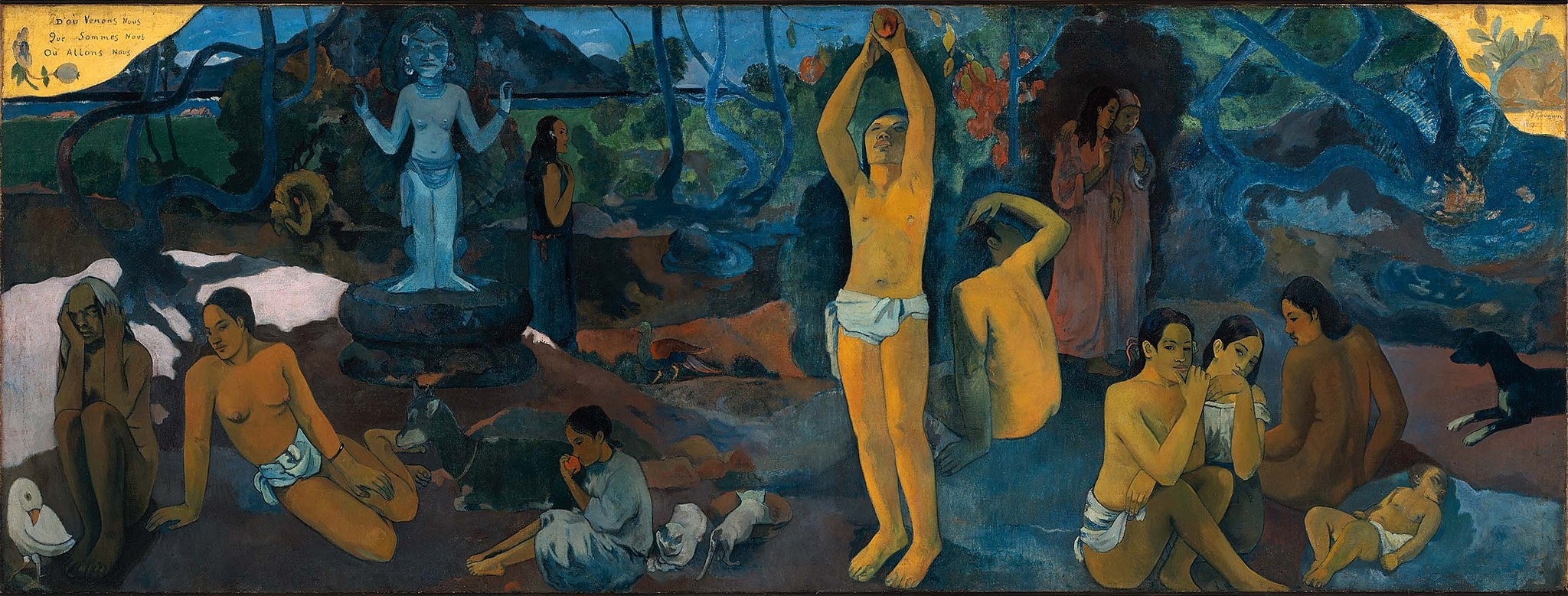
Click on any numbered symbol to learn more about its meaning
Meaning & Symbolism
Read from right to left, the canvas choreographs human time across a continuous Tahitian landscape. At the extreme right, a sleeping infant lies on a blue cloth, ringed by seated women who lean inward; they embody arrival and communal attention. Moving leftward, two youths sit in introspective poses—one twisting away, one hand to head—announcing self-consciousness and the burden of thought. At center, under branching, serpent-like trunks, a luminous figure raises both arms to pluck fruit; this vertical, aureole-lit body forms the composition’s hinge, an emblem of choice, appetite, and knowledge that many have linked to an Edenic moment recast in Polynesia 1. Near him, a pale-blue idol with raised arms stands atop a stone base—an otherworldly axis that, in Gauguin’s words, “indicates the Beyond,” asserting that life’s stages unfold under a still, inscrutable order 1. Punctuating the leftward drift, an aged woman crouches with hands to her head beside a small white bird; Gauguin glossed the bird as the “futility of words,” a terse epitaph for language at the threshold of death 1. In the upper corners, patches of chrome yellow and the painted French inscription integrate text and image, turning the support itself into a sacred, timeworn surface that poses the title’s questions as if inscribed on a golden wall 1.
Gauguin’s stylization makes this sequence feel inevitable and dreamlike. Figures float on simplified grounds; proportions shift intentionally; dark contours lock forms into decorative rhythms. The cobalt shadowing of the grove, the ember-like oranges of hanging fruit, and the sinuous trees that stitch sky to earth dissolve natural space into a symbolic field where action reads as allegory rather than incident 1. Animals—cats clustered near the child, a black dog alert at right, a goat by the fruit-eater—bind human stages to nature’s implacable cycles; they are companions, witnesses, and memento-like markers of time passing. The idol’s unwavering frontality counterbalances the central picker’s striving reach, keeping the narrative suspended between embodied desire and a still metaphysical absolute. Gauguin insisted on the right-to-left reading, mapping birth to death along the frieze; that directive anchors interpretation even as details resist closure 14. If the fruit-picker signals the moment we become what we are—choosing, desiring, knowing—the old woman and mute white bird assert the limit of explanation. Words fail, yet the image, with its golden corners and hieratic calm, claims a different kind of knowing: a painted manifesto of Symbolism’s belief that color, contour, and motif can intimate truths that discourse cannot 14.
Context deepens this meaning. Painted in Tahiti at a moment of illness and crisis, the work is Gauguin’s deliberately monumental summa, executed at speed and shipped to Paris as the capstone of his Polynesian project 13. It channels European longings for origins into an invented Tahitian Eden, revealing both the modernist stake in primitivist myth and the ethical ambiguities of turning a colonized elsewhere into a stage for universal philosophy 2. That tension—between private symbol and public claim, between decorative surface and existential depth—explains the painting’s enduring power. Where Do We Come From? What Are We? Where Are We Going? refuses to answer its questions, but by arranging infant, youth, fruit, idol, and elder under a canopy of blue shadow and gold-lit sky, it makes the questions unforgettable—and visually inexhaustible 134.
Explore Deeper with AI
Ask questions about Where Do We Come From? What Are We? Where Are We Going?
Popular questions:
Powered by AI • Get instant insights about this artwork
💬 Ask questions about this artwork!
Interpretations
Colonial Primitivism and the Ethics of Universals
Gauguin frames existential questions within an invented Tahitian Eden, a move that both powers and compromises the painting’s claim to universality. By staging origins and ends in Polynesia, he activates a colonial primitivist fantasy—an imagined elsewhere that promises access to beginnings while erasing contemporaneous Tahitian modernities under French rule. The idyll’s authority derives from its distance: decorative flattening and hieratic calm masquerade as timeless truth, yet they also aestheticize imperial asymmetries. Museums and scholars now read this summa as a modernist achievement bound to colonial appropriation, where the picture’s very capacity to symbolize “humanity” rests on transforming an occupied culture into a philosophical backdrop 125.
Source: The Met (Heilbrunn Timeline); Smarthistory; Musée d’Orsay
Materiality as Theology (Medium Reflexivity)
The chrome‑yellow corners and painted inscription convert the canvas into a quasi‑icon, a surface that looks aged, gilded, and liturgical. This is medium reflexivity: Gauguin stages painting as sacred object—part fresco, part tapestry—so that the support itself utters doctrine. The coarse support (often described as sackcloth) and mural scale intensify the effect of a wall‑bound relic, while the French text sutures word and image into a single catechism. Rather than mimetic description, facture becomes meaning: the rough weave, planar color, and decorative contour proclaim Symbolism’s creed that painting can intimate truths beyond discourse—theology through texture and chroma 13.
Source: Smarthistory; Museum of Fine Arts, Boston (object record)
Ambiguous Bodies, Open Identities
The central fruit‑picker’s androgynous modeling and frontal lift of the arms have prompted readings that the figure may reference a Polynesian third‑gender role (mahu). If so, the painting’s middle “hinge” complicates the life‑arc with a nonbinary inflection, unsettling European binaries at the very point where appetite, choice, and knowledge converge. Even without consensus, this lens sharpens how the work negotiates embodiment: the question What Are We? is not only metaphysical but corporeal, cultural, and gendered. Gauguin’s silence on identity keeps the register symbolic, while the potential mahu reading inserts local specificity back into a universalizing allegory 16.
Source: John Richardson; Smarthistory
Genealogy of Form: From Puvis to Symbolism
The painting’s frieze‑like procession, simplified grounds, anti‑illusionistic color, and hieratic stillness place it within a lineage from Puvis de Chavannes to late‑19th‑century Symbolism. Gauguin recasts Puvis’s decorative allegory as existential cosmology: a right‑to‑left cycle secured by a static idol and a vertical, aureole‑lit picker. Color functions synecdochically—cobalt shadows and embered oranges read as mood‑keys rather than natural light—while deliberate disproportion arrests narrative into emblem. By subordinating naturalistic space to rhythmic contour, Gauguin turns sequence into rite, making the grove a stage for metaphysical time. The result is not anecdote but a programmatic, “painted manifesto” of symbolist poetics 1.
Source: Smarthistory (Noelle Paulson)
Testament, Crisis, and Self‑Mythology
Gauguin cast the work as a final testament, claiming to have painted it rapidly and to have attempted suicide immediately after completion. Scholars caution that such accounts are part of his strategic self‑mythologizing. Still, illness, debt, and isolation in Tahiti inflect the picture’s tonal gravity: the elder’s mute despair, the white bird’s “futility of words,” and the idol’s impassive frontality mirror a psyche negotiating limit and meaning. Read psychologically, the painting externalizes crisis into ritual order—private breakdown stabilized by public‑scale allegory—while the shipped canvas’s delayed market success underscores the distance between avant‑garde self‑fashioning and contemporary reception 14.
Source: Smarthistory; Britannica
Related Themes
About Paul Gauguin
Paul Gauguin (1848–1903) left a finance career to pursue avant‑garde painting, seeking alternatives to European modernity first in Brittany and then in Polynesia. His Tahitian works synthesize bold color, flat contour, and symbolic imagery, shaping the course of Post‑Impressionism and modernist primitivism [3][1].
View all works by Paul Gauguin →