The Execution of Emperor Maximilian

by Édouard Manet

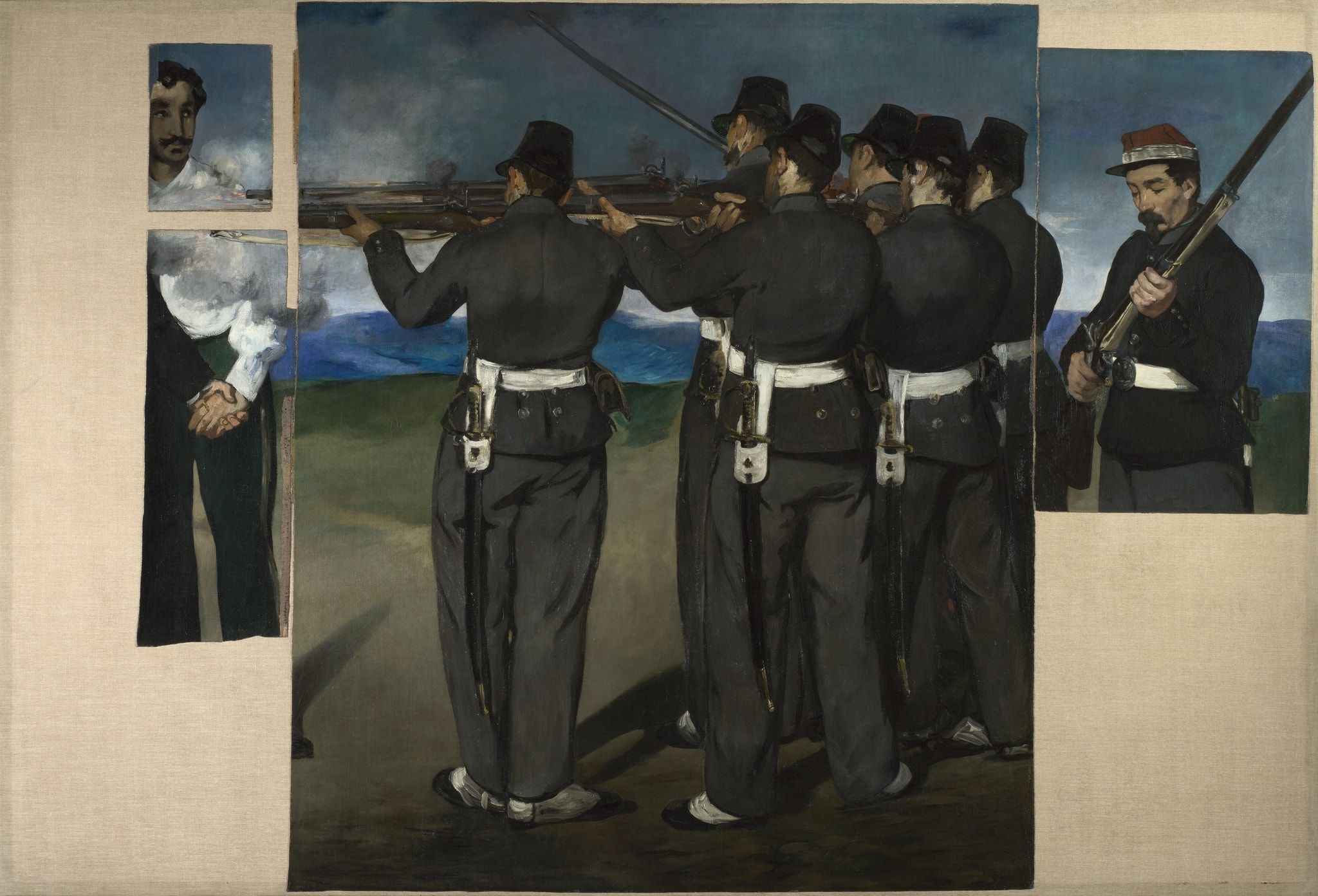
Manet’s The Execution of Emperor Maximilian confronts state violence with a cool, reportorial style. The wall of gray-uniformed riflemen, the fragmented canvas, and the dispassionate loader at right turn the killing into impersonal machinery that implicates the viewer [1][2].

Fast Facts

Year
1867–1868
Medium
Oil on canvas
Dimensions
193 × 284 cm
Location
National Gallery, London
The Execution of Emperor Maximilian by Édouard Manet (1867–1868) featuring Wall of riflemen (backs turned), Horizontal rifles aligned with the horizon, Loader preparing the coup de grâce, Fragmented canvas and exposed linen

Click on any numbered symbol to learn more about its meaning

Meaning & Symbolism

We stand with the firing squad. Their backs—six gray coats with white belts and cartridge pouches—form a rhythmic barricade that blocks access to the victims. The rifles stretch in a strict horizontal, their barrels eerily level with the horizon so that the landscape and the volley share a single line of force. Puffs of smoke seep between bodies, a quiet record of an action already underway. At the extreme left, the condemned are broken into parts: a head and a pair of clasped hands, as if the execution has begun by cutting them out of the picture itself. On the right, a noncommissioned officer coolly loads his weapon, preparing the coup de grâce, the routinized “finishing” act that reduces killing to procedure 2. Manet’s flat light and cool palette suppress heroics; the anonymity of the shooters and their French-looking kit sharpen the accusation that imperial policy—not just Mexican soldiers—engineered this death 26. Form and politics lock together. The canvas is literally pieced: raw margins and recomposed fragments are legible as scars, materializing how the image—and the event—were cut, censored, and reassembled in public discourse 12. Manet pursued multiple versions and a lithograph that the state suppressed; the shifting details across versions track the flow of photographs and press reports into the studio, making the painting read like a dossier compiled under pressure 245. In this London version, the compositional compression is ruthless: the victims are displaced to the edge, the squad fills the center, and the distant blue hills remain serenely indifferent. The result is not melodrama but administrative death—violence carried out by faceless functionaries, its horror amplified by understatement 23. Manet’s dialogue with Goya’s Third of May 1808 is unmistakable, yet he refuses Goya’s theatrics. Where Goya humanizes the condemned with a frontal martyr, Manet denies us faces; where Goya dramatizes light, Manet uses reportorial coolness that mirrors photography’s claim to truth while exposing its detachment 23. The viewer’s station—shoulder-to-shoulder with the squad—implicates us as witnesses and potential accomplices. The painting therefore acts as a double indictment: of Napoleon III’s failed Mexican adventure, signaled by the French-style uniforms, and of modern spectatorship that consumes atrocity as a composed image 26. In the Mannheim finale Manet even dates his signature to the day of the execution, insisting on the historical charge of the scene; the series as a whole becomes an ethics of looking, a modern history painting that measures how images can both register and occlude state violence 52.

Explore Deeper with AI

Ask questions about The Execution of Emperor Maximilian

Popular questions:

Powered by AI • Get instant insights about this artwork

💬 Ask questions about this artwork!

Interpretations

Material Politics (Medium as Evidence)

The London canvas carries its politics in its body: cut into fragments after Manet’s death and later reassembled by Degas, the painting’s raw seams and mismatched joins read like a dossier reconstructed from censored files. This is more than conservation history; it is a material allegory of suppression and retrieval, mirroring how the execution entered public knowledge in partial, contested forms. When the National Gallery mounted the fragments together in 1992, the scarred surface doubled as an archive of the image’s reception, turning the work into a case study in how modern states and markets manage traumatic visibility. Form becomes forensic—the picture testifies to what was cut from view and what could be pieced back for judgment 12.

Source: National Gallery, London

Uniform Semiotics and Imperial Culpability

Manet’s most subversive choice is sartorial: the soldiers’ French-looking uniforms recode a Mexican execution as a French deed. Critics quickly grasped the implication—Zola quipped that it is “France executing Maximilian”—and the state’s suppression of the lithograph confirms the stakes of this reading. Costume here is political grammar: belts, pouches, and forage caps operate as signifiers tying the volley to Napoleon III’s failed Mexican adventure. By shifting attire across versions as reports filtered into Paris, Manet calibrated blame and legibility for a public attuned to uniforms as news. The result is a historiographic painting that assigns agency through dress, indicting empire not by allegory but by equipment 1457.

Source: Juliet Wilson-Bareau; Art Institute of Chicago; The Met; napoleon.org

Seriality, News, and the Image-Economy of 1867–69

Across three large oils, a small sketch, and a censored lithograph, Manet works like a newsroom editor, updating facts as photographs and press items arrive. This serial method makes each version a timestamp of what was knowable—and printable—within the Second Empire’s media regime. The final Mannheim canvas adds a dated signature (19 June 1867), collapsing painting time into event time to insist on historicity rather than timeless tragedy. Meanwhile, the lithograph’s delayed publication (posthumous, 1884) demonstrates how reproducible media were policed more aggressively than unique paintings. Manet thus stages a critique of the period’s information flows: images circulate, mutate, and are throttled, while art strives to register the event despite the chokehold of censorship 1356.

Source: National Gallery, London; Kunsthalle Mannheim; The Met; Wilson-Bareau (1992)

After Goya: Modernizing History Painting

Manet’s dialogue with Goya is neither homage nor parody; it is a programmatic revision. Where Goya’s martyr faces the viewer, incandescent under a moral spotlight, Manet denies frontal pathos and floods the scene with flat, cool light. The effect is to exchange moral theater for procedural vision aligned with photography’s claim to truth. In later states, the wall of onlookers converts martyrdom into spectacle, shifting the painting’s ethical center from the victims to the mechanisms of viewing and recording. This is history painting recalibrated for a press-saturated public: less an epic of heroes than an analysis of how state violence becomes an image we consume 14.

Source: Art Institute of Chicago; National Gallery, London

Bureaucracy of Killing: The Coup de Grâce

At the right margin, a noncommissioned officer calmly loads his weapon for the coup de grâce—a detail pulled from reportage that anchors the picture in execution protocol rather than battle. The rifles’ strict horizontal, level with the horizon, turns the volley into a ruler-straight procedure; the act is not personal vengeance but administration. Manet’s understatement—pale tonality, anonymized faces—makes violence legible as paperwork enacted by bodies. By isolating this finishing shot as a separate task, the painting anatomizes modern killing into steps and roles, implicating systems over individuals and anticipating later critiques of bureaucratic violence as routinized, impersonal labor 1.

Source: National Gallery, London (In-depth essay)

Related Themes

About Édouard Manet

Édouard Manet (1832–1883) bridged Realism and Impressionism, turning modern urban life into a chief subject of painting. In his final years, declining health led him to intimate formats and studio-staged scenes that still pulse with immediacy, culminating in late masterpieces like A Bar at the Folies-Bergère [4].
View all works by Édouard Manet

More by Édouard Manet

Woman Reading by Édouard Manet

Woman Reading

Édouard Manet (1880–82)

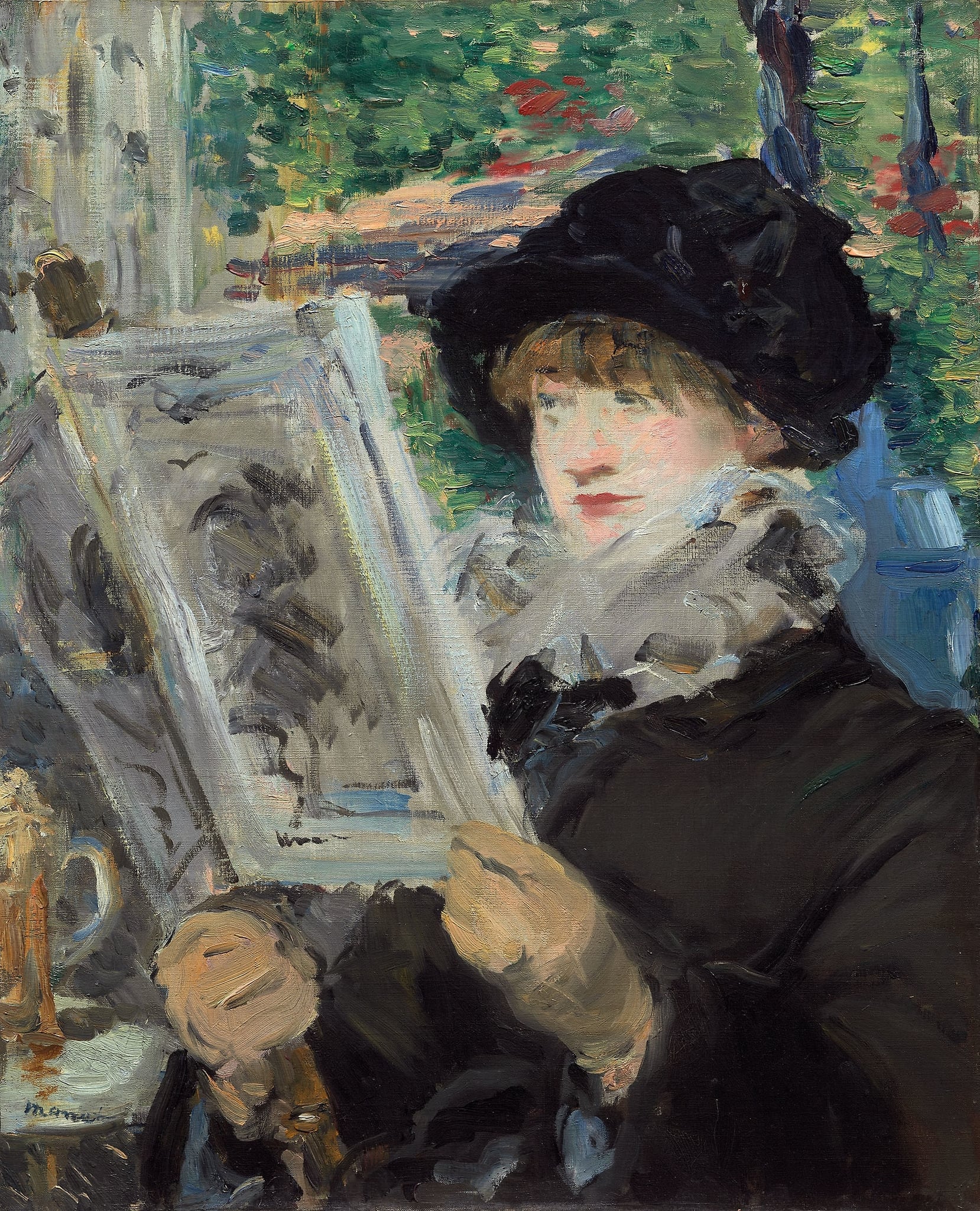
Manet’s Woman Reading distills a fleeting act into an emblem of <strong>modern self-possession</strong>: a bundled figure raises a journal-on-a-stick, her luminous profile set against a brisk mosaic of greens and reds. With quick, loaded strokes and a deliberately cropped <strong>beer glass</strong> and paper, Manet turns perception itself into subject—asserting the drama of a private mind within a public café world <sup>[1]</sup><sup>[2]</sup>.
Jeanne (Spring) by Édouard Manet

Jeanne (Spring)

Édouard Manet (1881)

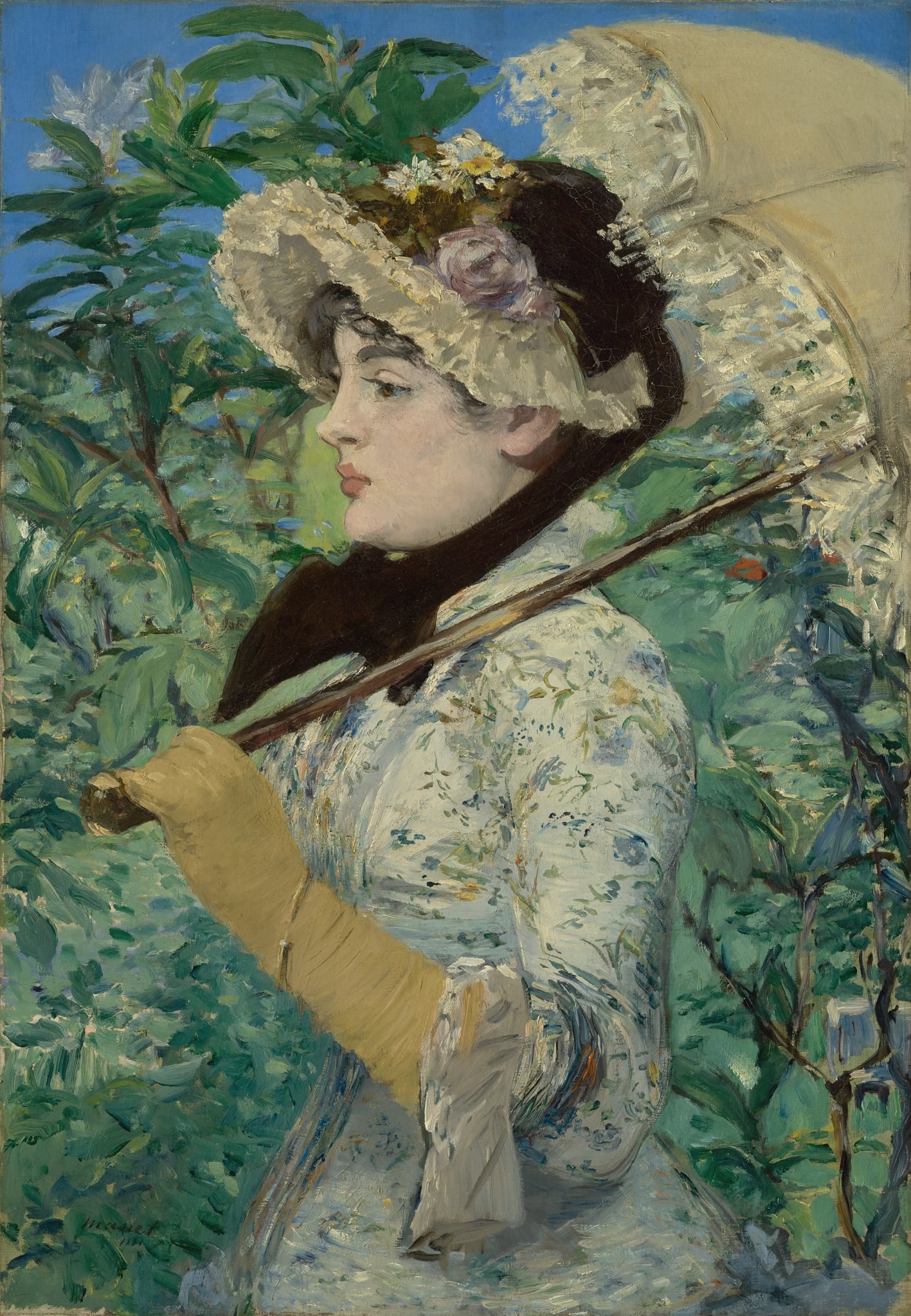
Édouard Manet’s Jeanne (Spring) fuses a time-honored allegory with <strong>modern Parisian fashion</strong>: a crisp profile beneath a cream parasol, set against <strong>luminous, leafy greens</strong>. Manet turns couture—hat, glove, parasol—into the language of <strong>renewal and youth</strong>, making spring feel both perennial and up-to-the-minute <sup>[1]</sup><sup>[2]</sup>.

On the Beach by Édouard Manet

On the Beach

Édouard Manet (1873)

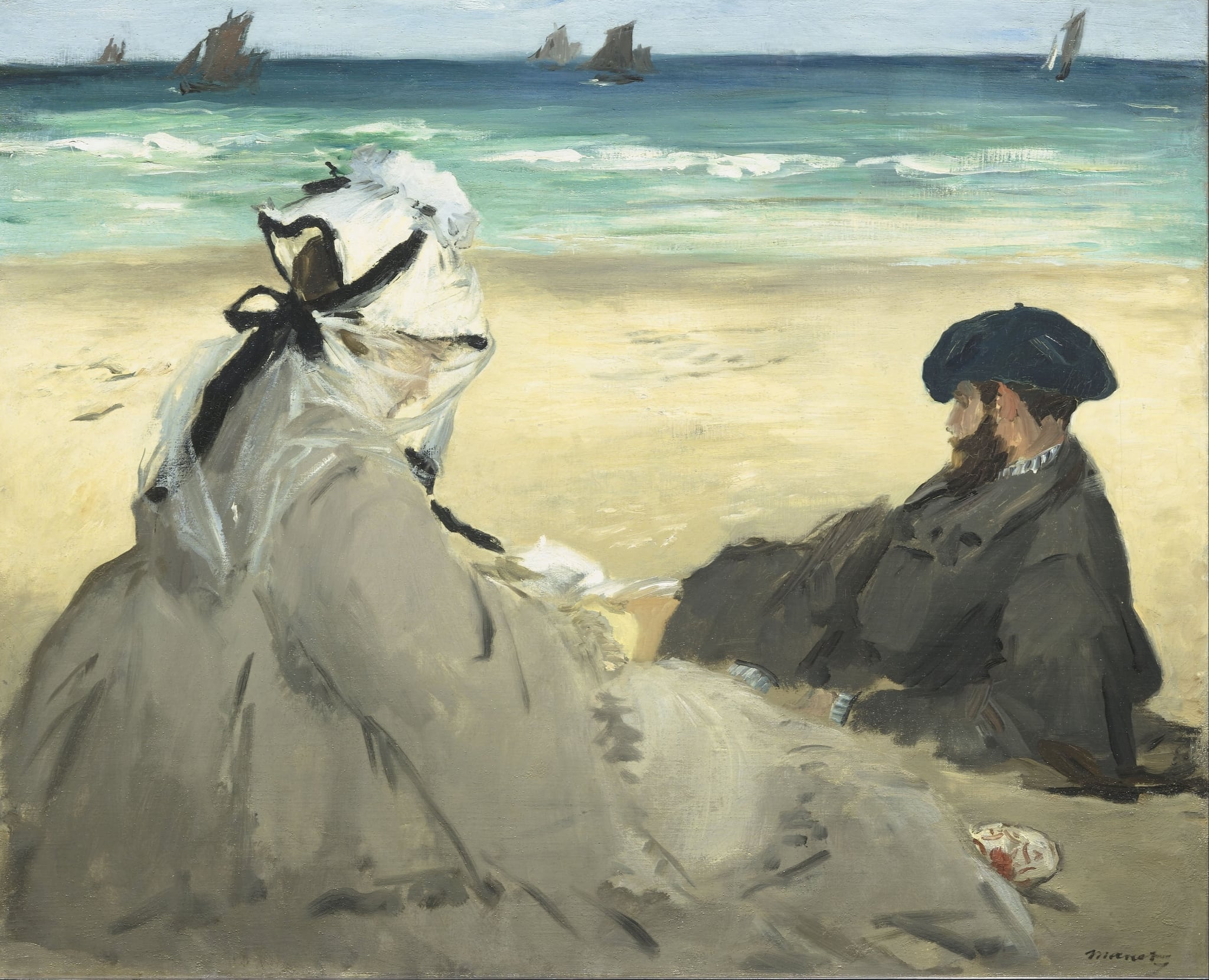
On the Beach captures a paused interval of modern leisure: two fashionably dressed figures sit on pale sand before a <strong>banded, high-horizon sea</strong>. Manet’s <strong>economical brushwork</strong>, restricted greys and blacks, and radical cropping stage a scene of absorption and wind‑tossed motion that feels both intimate and detached <sup>[1]</sup>.
Plum Brandy by Édouard Manet

Plum Brandy

Édouard Manet (ca. 1877)

Manet’s Plum Brandy crystallizes a modern pause—an urban <strong>interval of suspended action</strong>—through the idle tilt of a woman’s head, an <strong>unlit cigarette</strong>, and a glass cradling a <strong>plum in amber liquor</strong>. The boxed-in space—marble table, red banquette, and decorative grille—turns a café moment into a stage for <strong>solitude within public life</strong> <sup>[1]</sup><sup>[2]</sup>.

The Fifer by Édouard Manet

The Fifer

Édouard Manet (1866)

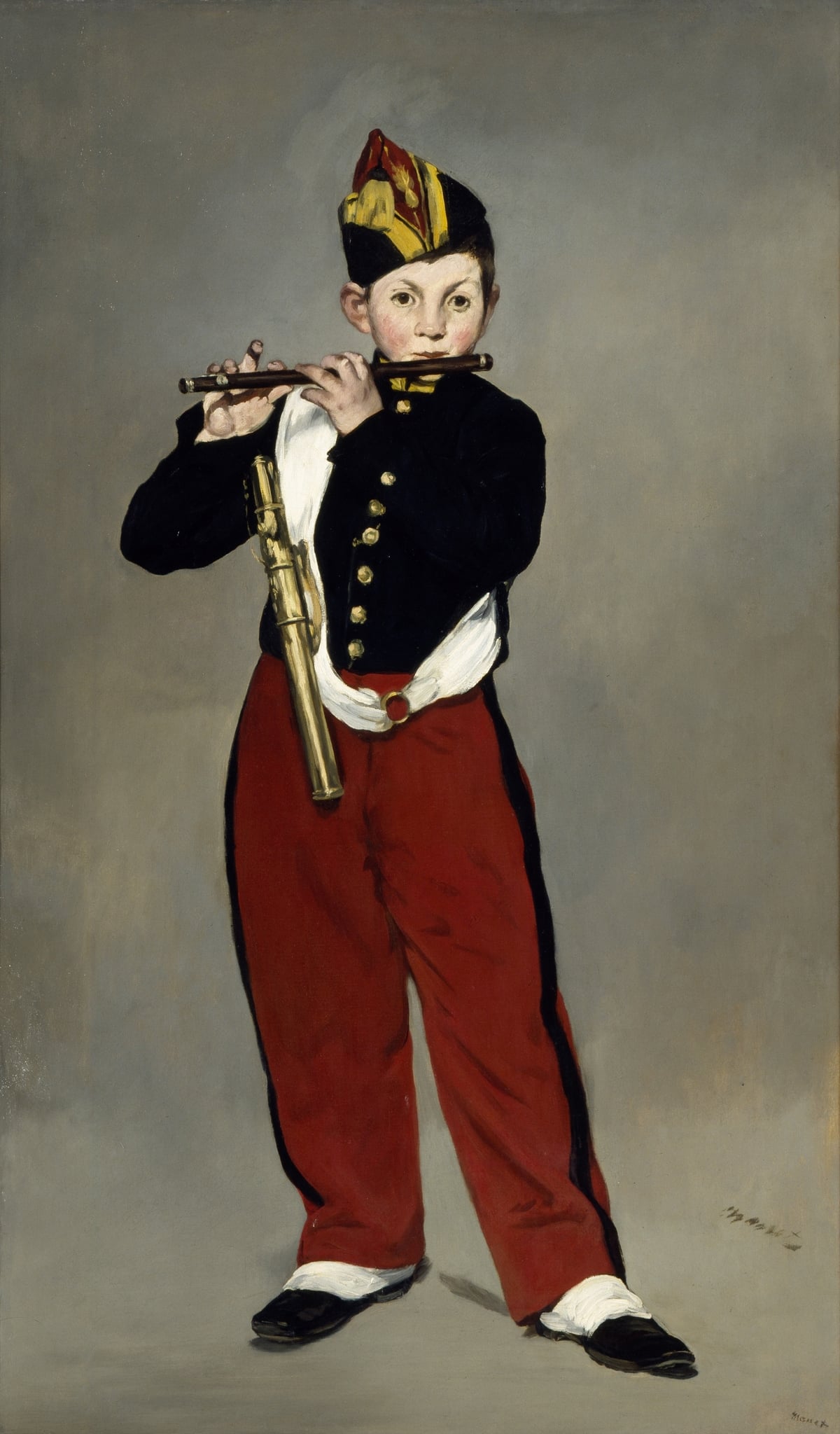
In The Fifer, <strong>Édouard Manet</strong> monumentalizes an anonymous military child by isolating him against a flat, gray field, converting everyday modern life into a subject of high pictorial dignity. The crisp <strong>silhouette</strong>, blocks of <strong>unmodulated color</strong> (black tunic, red trousers, white gaiters), and glints on the brass case make sound and discipline palpable without narrative scaffolding <sup>[1]</sup>. Drawing on <strong>Velázquez’s single-figure-in-air</strong> formula yet inflected by japonisme’s flatness, Manet forges a new modern image that the Salon rejected in 1866 <sup>[1]</sup><sup>[2]</sup><sup>[3]</sup>.
Music in the Tuileries by Édouard Manet

Music in the Tuileries

Édouard Manet (1862)

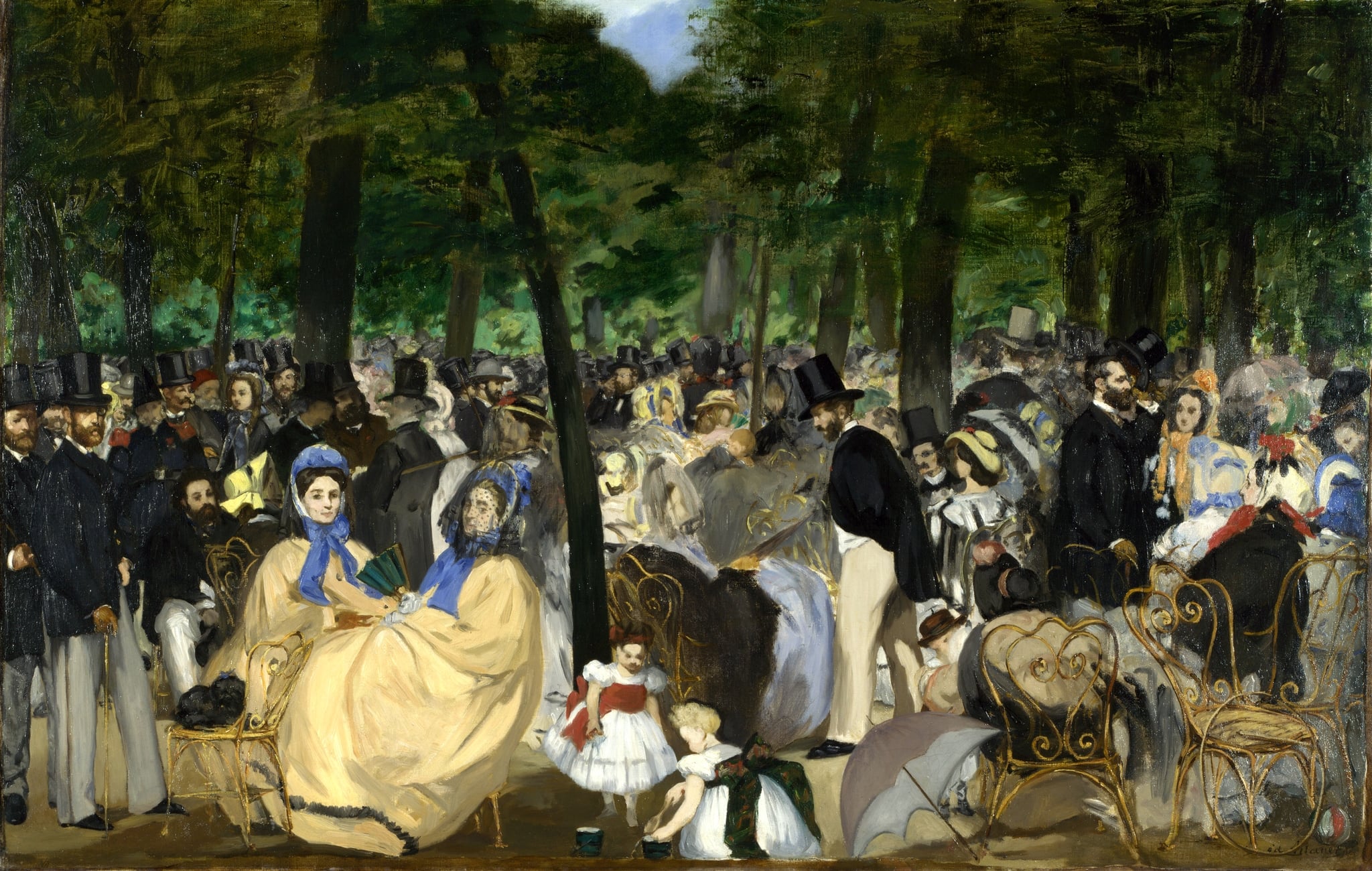
Édouard Manet’s Music in the Tuileries turns a Sunday concert into a manifesto of <strong>modern life</strong>: a frieze of top hats, crinolines, and iron chairs flickering beneath <strong>toxic green</strong> foliage. Instead of a hero or center, the painting disperses attention across a restless crowd, making <strong>looking itself</strong> the drama of the scene <sup>[1]</sup><sup>[2]</sup>.