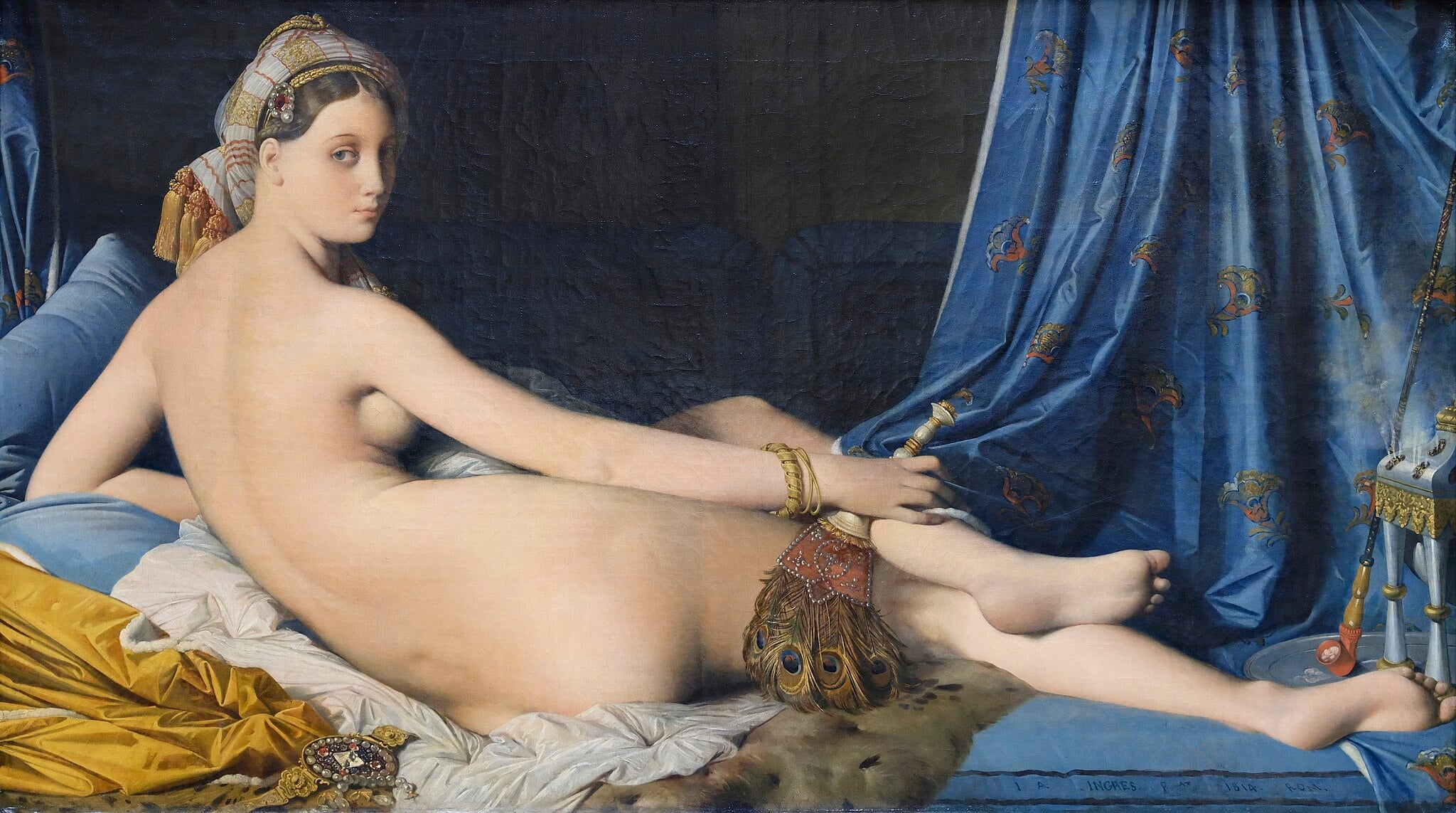
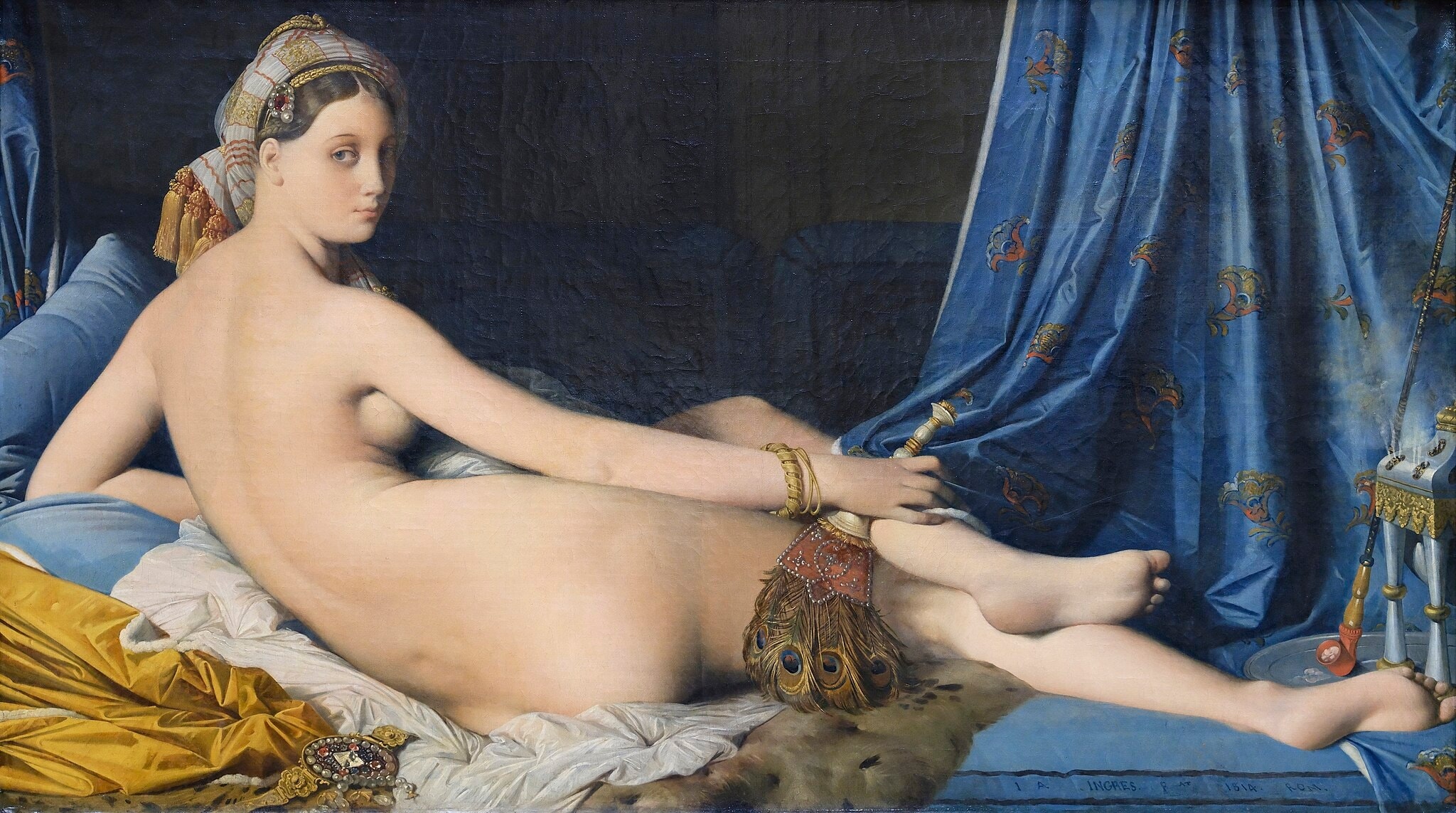
Grande Odalisque
In Jean-Auguste-Dominique Ingres’s Grande Odalisque (1814), a nude woman reclines against cool satin and a deep blue, patterned curtain, her spine drawn into an elegant, impossible arc. With a jeweled turban, bracelets, and a peacock-feather fan, she turns to meet the viewer’s look, poised yet distant. The image fuses Neoclassical idealization with Orientalist fantasy, privileging line and artifice over realism [1][2].
Study Print Studio
Create a personal study print
Build a companion study sheet around the part of this painting that speaks to you most. Choose a detail, shape an interpretation, and walk away with something personal and display-worthy.
Fast Facts
- Year
- 1814
- Medium
- Oil on canvas
- Dimensions
- 91 x 162 cm
- Location
- Musée du Louvre, Paris
Click on any numbered symbol to learn more about its meaning
Meaning & Symbolism
Ingres organizes the body as a continuous, serpentine line sweeping from the small head through the astonishingly lengthened spine to the tapering legs. The porcelain chill of her skin against the saturated blue curtain and mustard sash intensifies the artifice: flesh becomes polished surface. Contemporary viewers sensed the disjunction—critics mocked her as boneless, and later analysis estimated a lengthening equivalent to several vertebrae, underscoring deliberate deformation as program rather than error 23. The result is a diagram of desire built by line: the eye glides along the elongated back, loops at the hip, then tracks the arm to the peacock fan and the delicately crossed feet. This choreography replaces bodily weight and breath with pictorial rhythm. Even the head—small, masklike, recalling Renaissance prototypes—signals Ingres’s classicizing ideal over lived anatomy, aligning the odalisque with a timeless canon rather than a particular woman 26.
Yet the painting’s power also lies in how it binds formal idealization to Orientalist staging. The jeweled turban, the brocaded, flowered blue drapery, and the lavish fabrics construct a privatized interior of abundance; the peacock‑feather fan literalizes display and vanity; at the right edge, a smoking apparatus and brazier-like stand (often read as hookah and incense) complete the tableau of perfumed leisure 12. These props do not document the Ottoman harem so much as they fabricate a consumable fantasy for French spectators in the years after empire, channeling appetites for distant, feminized luxury 27. The woman’s backward glance is pivotal: she is presented to the gaze, but her expression—cool, faintly withholding—keeps her opaque. That controlled aloofness, intensified by the chilling tonalities and the careful isolation of her body against the dark field, complicates simple erotic availability. She embodies desire while remaining untouchable, a paradox that has fueled both the painting’s magnetism and its critique.
Patronage and reception fold further complexity into the image. Commissioned by Caroline Murat as a pendant to a lost reclining nude, the work entered the Salon of 1819 to derision for its distortions before becoming canonical as a manifesto of linear idealism 124. The fact of a female royal patron complicates a straightforward story of male artist and passive object, even as the picture continues to exemplify the male gaze and its colonial fantasies in modern scholarship 78. Today, Grande Odalisque anchors debates about how beauty is made—and whom it is made for. Ingres’s meticulous draftsmanship and anti‑anatomical choices show how style can author desire; the Orientalist decor reveals how aesthetics can naturalize power. Together they explain why Grande Odalisque is important: it is at once a pinnacle of Neoclassical line and a touchstone for interrogating gendered and imperial looking in Western art 1278.
Explore Deeper with AI
Ask questions about Grande Odalisque
Popular questions:
Powered by AI • Get instant insights about this artwork
💬 Ask questions about this artwork!
Interpretations
Formal Analysis: Orientalist Stagecraft as Material Semiotics
Rather than ethnography, the décor acts as sign-system. The peacock-feather fan, jeweled turban, and saturated draperies translate the odalisque into a legible code of luxury and enclosure. In museum records, the fan and blue curtain are confirmed, while the pipe/incense at right—often cited—remain less securely cataloged, underscoring how “the Orient” is built from selectively named props 12. This mise-en-scène turns space into a commodity of looking: a privatized alcove that promises access while maintaining distance. The textiles’ chromatic intensity and the fan’s iridescence work like stage lighting against the porcelain chill of skin, amplifying contrast to heighten allure. Ingres’s décor therefore operates as a technology of fantasy, not reportage—an apparatus that stabilizes desire and difference within a controlled pictorial theater 12.
Source: Musée du Louvre; The Metropolitan Museum of Art
Patronage & Spectatorship: A Queen’s Commission and the Gaze
Commissioned by Caroline Murat, the painting’s origin troubles a simple tale of male producer/female object. A woman—royal and politically situated—sought this image as a pendant to La Dormeuse de Naples, suggesting elite female spectatorship within Napoleonic networks 1. Feminist scholarship reads this as an inflection, not an exoneration: the work still activates the male gaze, yet its initial addressee included a powerful woman whose agency shaped format, scale, and luxury coding 6. This complicates reception at the Salon of 1819, where critics decried “boneless” distortion: what scandalized male publics may have aligned with a patron’s preference for idealizing line and courtly opulence. The commission thus reveals how taste, politics, and gendered looking intersect in the picture’s making and early life 16.
Source: Musée du Louvre; MOED (Museum of Equality and Difference)
Anatomical Program: Quantifying Idealization
Contemporary jibes about “extra vertebrae” have been medically parsed: a quantitative study estimates elongation equivalent to nearly five lumbar vertebrae, affirming deformation as method rather than ineptitude 3. Ingres subordinates anatomy to an unbroken, serpentine line, shrinking the head, attenuating limbs, and smoothing musculature to achieve a continuous arabesque 2. Studies for the painting show iterative recalibration of contour and proportion, indicating deliberation rather than afterthought 9. Read this way, the odalisque becomes a theorem of line: the body is redesigned to carry rhythm across canvas, turning bones into design vectors. The scandal of 1819 thus indexes a clash of pictorial regimes—empirical anatomy versus ideal beauty—that Ingres pursued with polemical clarity 239.
Source: BMJ (quantitative analysis); The Metropolitan Museum of Art; Musée du Louvre (studies)
Iconographic Genealogy: Raphaelized Head, Neoclassical Creed
The masklike, small head echoes Raphaelesque models circulating in prints and academic study, aligning the odalisque with a timeless canon rather than a named sitter 4. Ingres’s creed—line as the sovereign vehicle of beauty—derives from French Neoclassicism, where contour and purity of profile trump optical naturalism 7. By grafting a Renaissance ideal to an “Oriental” nude, he produces a hybrid: a body coded as exotic yet governed by Western classicism’s measure. This genealogical splice clarifies why the face reads iconic, even hieratic; it’s an ideal template attached to a body re-engineered for arabesque flow. The result is less portraiture than type-formation, a canonical face presiding over a designed anatomy 47.
Source: RISD Museum; Encyclopaedia Britannica
Circulation & Canon Formation: Prints, Publics, and the Odalisque Type
Reproductive prints in the 1820s disseminated the odalisque’s silhouette and décor, standardizing a visual type across European publics 5. This circulation amplified the work’s polemics—its linear ideal and Orientalist coding—beyond the Salon, turning the image into a portable pedagogy of desire and difference. As the motif multiplied, it helped anchor Ingres’s reputation and trained viewers to read the elongated back as style, not mistake 2. Print culture thus operated as the picture’s afterlife, fixing its arabesque as canonical and naturalizing its fantasy interior as the default harem stage. The economy of copies did not merely reflect fame; it produced it, suturing market, museum, and academy around the odalisque’s designed body 25.
Source: The British Museum; The Metropolitan Museum of Art
Seen in Comparisons
Related Themes
About Jean-Auguste-Dominique Ingres
Jean-Auguste-Dominique Ingres (1780–1867) was the foremost French Neoclassicist, a champion of linear draftsmanship and ideal form, and later director of the French Academy in Rome. His pursuit of purity of contour and cool finish shaped both his history paintings and portraits, while provoking early criticism for deliberate anatomical liberties [6].
View all works by Jean-Auguste-Dominique Ingres →