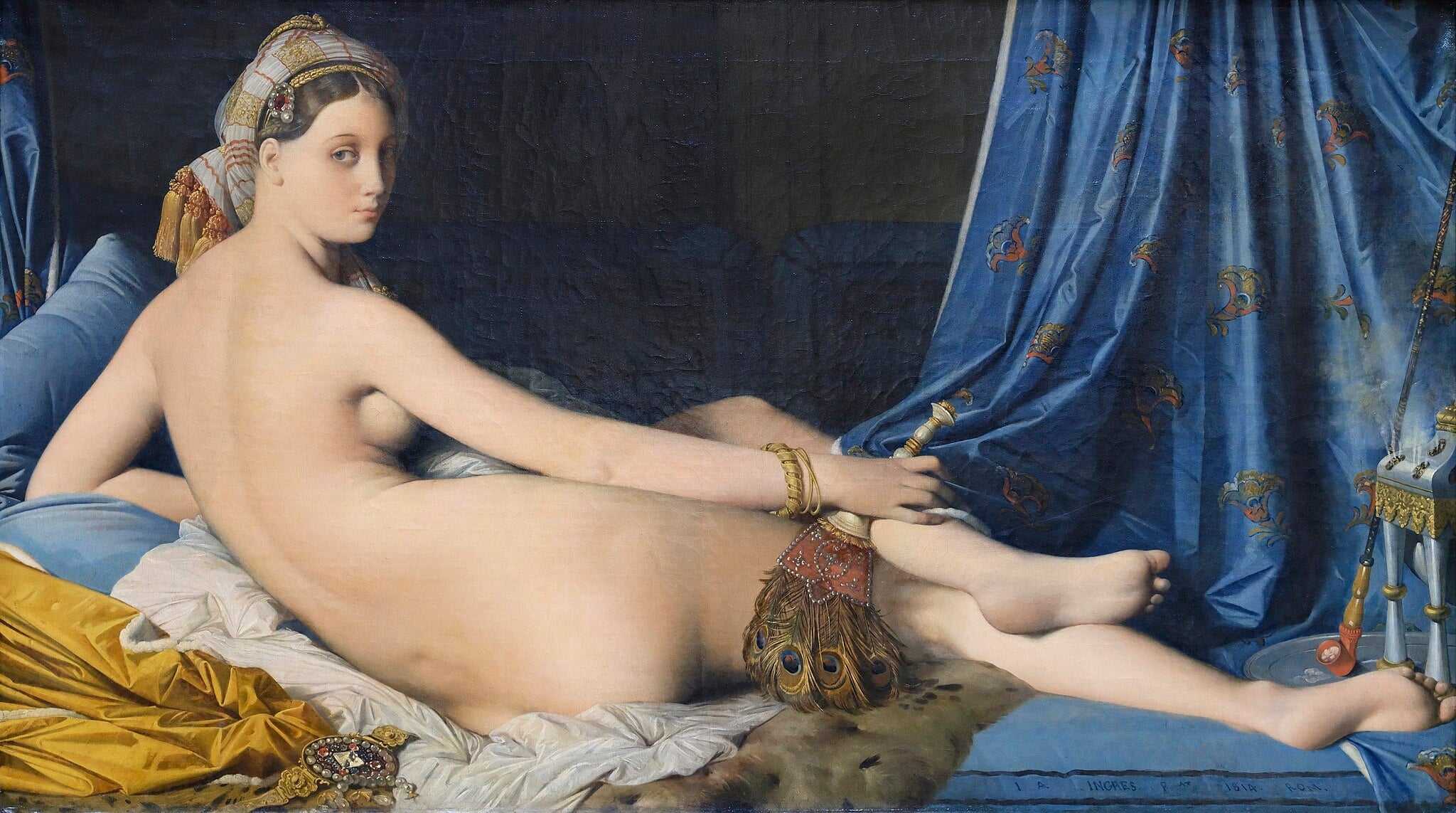
Ingres organizes The Great Odalisque around the sovereignty of line: the body reads first as a continuous, serpentine silhouette that arcs from the jeweled turban through the impossibly elongated back to the cool, tapering legs. The proportions refuse naturalism—the small, mask-like head, the sharply rotated left shoulder, the boneless hips—so that anatomy yields to an
arabesque of contours, a priority Ingres explicitly cultivated and the Louvre underscores in its discussion of the work
2. The model’s backward glance is composed rather than intimate; it acknowledges our gaze without conceding emotion, reinforcing the painting’s aura of
control. Around this
idealized figure, Ingres arrays a stage set of luxury: the embroidered blue curtain the odalisque grasps in her right hand, the peacock-feather fan resting near her thigh, the fur and gold textiles, and the hookah and incense burner that exhale thin smoke at the edge of the bed. Each item is a sign of an imagined harem,
a Western picture of the "Orient" that encodes sensuality, indolence, and opulence—signals that locate desire in a space safely marked as other
147. By placing the nude within this curated inventory of exotic things, the painting
makes erotic looking appear both cultivated and distant, a matter of taste as much as temptation.
This fusion of classicism and erotic reverie explains the painting’s turbulence at the Salon of 1819, where critics mocked the figure’s liberties—famously claiming she had “too many vertebrae”—even as they recognized Ingres’s technical finish
3. Later analysis has shown the deformation to be deliberate and extensive, with medical humanities scholars arguing that the spine’s elongation separates head and pelvis as a kind of symbolic distancing—mind from body, thought from sex
5. That reading aligns with what the eye already registers: the odalisque is less a person than a polished construction, a cool surface engineered for viewing. Ingres’s Raphaelesque devotion to contour and the immaculate, reflective skin amplify that idealization, securing his position as the leading French Neoclassicist even as this canvas courts Romantic subject matter
6. The image’s legacy confirms its stakes. As Orientalism entered critical focus, scholars highlighted how such interiors translate geopolitical power into visual fantasy, packaging female bodies for European consumption under the alibi of culture and taste
4. And when
the Guerrilla Girls later donned Ingres’s odalisque with a gorilla mask to indict gender inequities in museums, they made explicit what the picture had long performed:
the politics of who looks, who is looked at, and how institutional display consecrates desire
8. In short, The Great Odalisque endures not because it depicts a nude but because it converts the nude into a system—of line, luxury, and distance—through which beauty, fantasy, and authority are made to coincide
124.