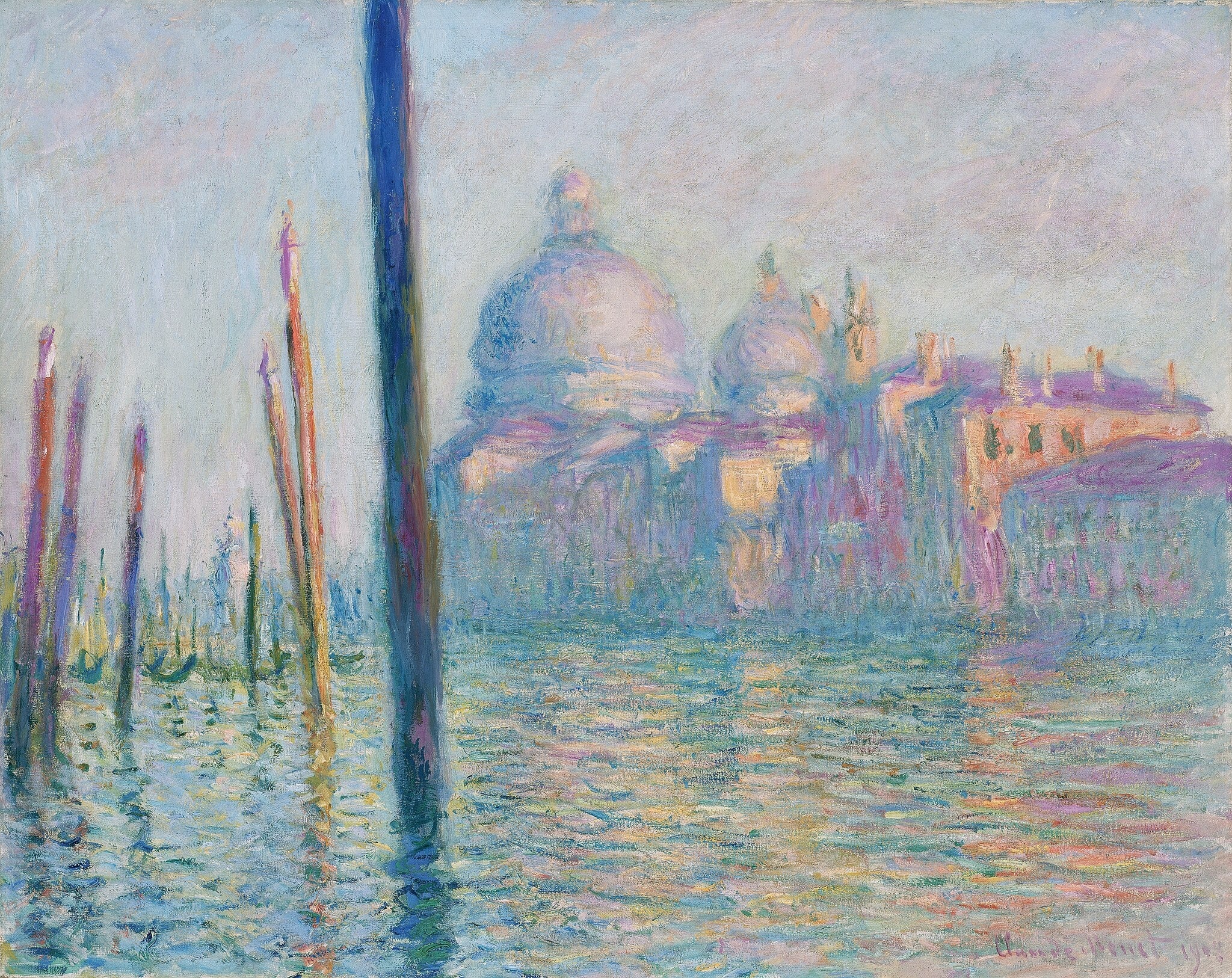
The Doge's Palace

by Claude Monet

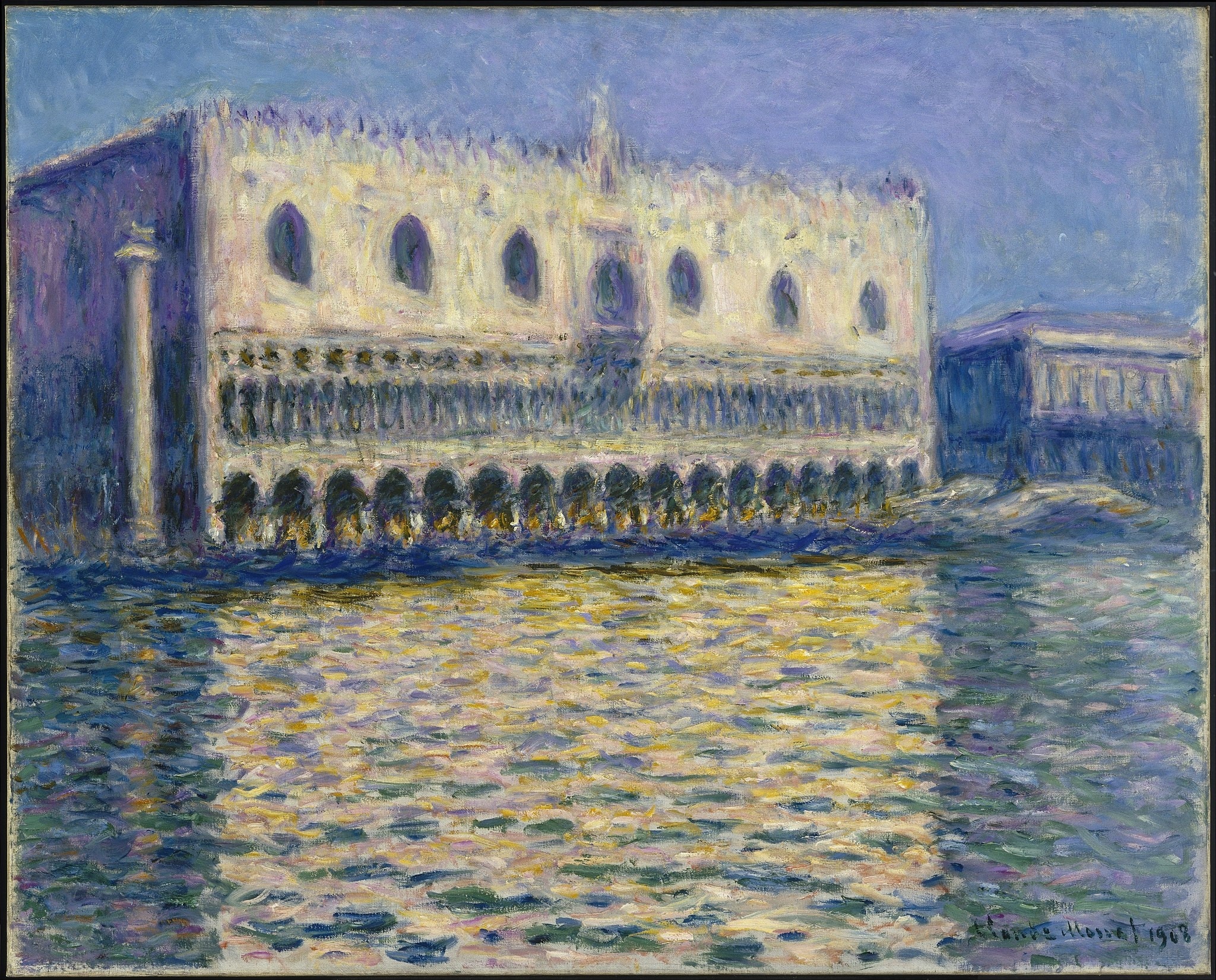
Monet’s The Doge’s Palace translates Venice’s emblem of authority into an atmospheric drama of lilac, cream, and ultramarine. Architecture becomes a screen for light, as the ogival windows and double arcades blur into vibrating strokes mirrored by the lagoon’s second architecture—its reflection [1][4].
💰

Market Value

$40–60 million

How much is The Doge's Palace worth?

Fast Facts

Year
1908
Medium
Oil on canvas
Dimensions
81.3 x 99.1 cm
Location
Brooklyn Museum, New York
The Doge's Palace by Claude Monet (1908)

Click on any numbered symbol to learn more about its meaning

Meaning & Symbolism

Monet stages a confrontation between the palace’s Gothic grammar and the lagoon’s motion. The painting’s frontal, near‑gondola viewpoint crowds the façade into the frame so that its lower arcade reads as a dark, scrolling band, while the row of pointed windows above becomes a run of shadowed ovals pressed into a pale, opalescent wall. Edges are deliberately unstable: the left corner column is brushed in cool violets that bleed into the façade, and the crenellations dissolve into sky. Across the basin, broad, broken strokes in the water—gold, lilac, and ultramarine—echo the façade’s tones, establishing reflection as a second architecture that both underwrites and undermines the first. Here, line yields to rhythm, and mass yields to color, enacting Monet’s late conviction that the palace was “an excuse for painting the atmosphere1. The result is not a topographical document but a perceptual assertion: authority survives only as a vibration held between stone and light. This choice carries historical and cultural stakes. The Doge’s Palace once housed a republic famed for brokerage between West and East; its Venetian Gothic skin, with patterns resonant with Mamluk design, already encodes hybridity 1. Monet intensifies that hybridity by allowing the façade’s polychromy to be completed by the lagoon’s shimmer, binding architecture to environment so tightly that site becomes sight. The cool spectrum that unites sky and water forms what Monet elsewhere called an “envelope,” the atmospheric field within which motifs live and change 2. In The Doge’s Palace, the envelope is sovereign: notice how the violet shadows nesting in the ogival windows recur as violet scallops on the water, and how the bright, lemon flecks near the building’s base flare again as bars of gold skating across the surface. The palace seems to breathe with the canal; civic stone becomes weather, and history becomes a present-tense sensation of color. That is the meaning of The Doge’s Palace: permanence staged as flux, sovereignty reimagined as light. Why The Doge’s Palace is important is twofold. First, it crystallizes Monet’s late method of beginning motifs on site in strict daylight intervals and completing them from memory in the studio, so that the final image is a distilled time‑experience rather than a momentary snapshot 23. The painting shown here, with its unified lilac‑blue key and restrained detail, bears the stamp of that distillation: it is less about discrete stones than about the feel of a cool, sun‑pierced morning where gold skims a violet sea. Second, it advances a modern idea of monumentality. By letting reflection “author” the palace as much as masonry does, Monet proposes that meaning in architecture emerges relationally—from air, water, light, and viewer—rather than from sheer mass. The Doge’s Palace thus converses with his Rouen and London projects but goes further: the lagoon furnishes a living mirror that doubles and liquefies power, making Venice theatrical and spectral at once 34. In this painting, grandeur is not carved; it is reconstituted into color and rhythm, a modern politics of seeing in which history persists only as a radiant haze shared by sky, façade, and sea 124.

Explore Deeper with AI

Ask questions about The Doge's Palace

Popular questions:

Powered by AI • Get instant insights about this artwork

💬 Ask questions about this artwork!

Interpretations

Historical Context

In autumn 1908 Monet worked Venice with a strict timetable, beginning canvases on site across fixed daylight intervals and finishing them in Giverny—turning each painting into a condensed time‑structure rather than a punctual view. Letters attest he left with “only sketches, beginnings,” planning to resolve them later, a practice culminating in the acclaimed 1912 Bernheim‑Jeune show. This workflow helps explain the Brooklyn Doge’s Palace’s unified lilac‑blue key and pared masonry: it compresses many instants into one atmospheric total, privileging duration over instantaneity. The result is a visual equivalent of recollection—Venice as a retained sensation, not a report. The Met’s record corroborates the heavy studio reworking of the Venetian canvases, clarifying why edges feel mediated, even remembered, rather than transcribed on the spot 23.

Source: Art Institute of Chicago; The Metropolitan Museum of Art

Intercultural/Political Reading

The Doge’s Palace was the emblem of a republic that mediated trade routes linking Europe to the eastern Mediterranean. Its Venetian Gothic ornament, with motifs resonant with Mamluk design, already broadcasts hybridity. Monet intensifies that message by letting chromatic reflections from the lagoon complete the façade’s polychromy—an optical metaphor for brokerage in which environment co‑authors identity. This is not Orientalist display but a relational politics of form: civic power is shown as permeable, negotiated between stone and water. By fusing façade and basin into one palette, Monet reframes imperial Venice as an ecology of interdependence rather than a monolithic monument, recoding authority as something sustained by circulation—of light, goods, and cultural signs 1.

Source: Brooklyn Museum

Formal Analysis (Reflection as Structure)

Monet converts reflection from a decorative effect into an architectural principle. The compressed, frontal framing flattens the façade into patterned zones while the basin’s broken strokes replay and recompose those zones below, yielding a duplex construction—stone above, water‑architecture below. Compared with Rouen and London, Venice adds a literal mirror that co‑produces form, so that composition becomes a rhythm between strata rather than a façade plus foreground. Curators note a dreamlike, near‑Symbolist inflection in these late Venetian works: iridescent transitions blur contour into chromatic atmosphere, allowing color to bear mass. The palace is thus built twice—once in masonry, once in liquidity—aligning Monet with modern abstraction’s interest in structure without outline 34.

Source: The Metropolitan Museum of Art; Museum Barberini

Medium Reflexivity / Phenomenology

Monet’s oft‑quoted claim that the palace was “an excuse for painting the atmosphere” signals a medium‑aware turn: paint becomes a device for staging perception itself. His “envelope” approach fuses motif and ambient conditions so thoroughly that the work behaves like a phenomenological experiment—what does authority feel like when grasped through light? The violet scallops nesting in ogival shadows and rippling across the water enact a feedback loop between seeing and world, where the viewer’s gaze completes the motif. Rather than mimesis, the painting offers a calibrated field of optical events that invites embodied attention—an early modernist argument that meaning arises in the encounter between medium, environment, and spectator 12.

Source: Brooklyn Museum; Art Institute of Chicago

Reception and Debate

Contemporary critics in 1912 (e.g., Mirbeau) praised Venice’s reflections for giving “body” to both wall and water—an apotheosis of atmospherics that confirmed Monet’s late mastery. A century later, dissenting voices argue some Venetian canvases feel coolly optical, lacking Turner’s affective undertow. That split neatly tracks the paintings’ method: heavy studio recomposition after on‑site starts can read either as distilled vision or as attenuated immediacy. The Doge’s Palace thus sits at the crux of a modern debate—are these works records of sensation or inventions of memory? The question remains productive: it reframes Impressionism not as snapshot but as construction, pressing viewers to test how much feeling a calibrated color‑system can carry 25.

Source: Art Institute of Chicago; The Art Newspaper

Monumentality Reframed

Here “grandeur” is not carved; it is reconstituted in color and rhythm. By allowing reflection to co‑author the edifice, Monet proposes a relational monumentality grounded in air, water, and vantage. The Met emphasizes how Venice’s “unique light” catalyzed this unification of sky, stone, and basin; the outcome is a sovereign image whose power depends on circulation—of light across surfaces, of gaze across strata. This soft politics of seeing undoes the palace’s rhetorical weight without denying it; authority persists as a calibrated glow, not a mass. In that sense, The Doge’s Palace becomes a prototype for modern urban icons understood less as objects than as luminous fields shared by environment and viewer 13.

Source: The Metropolitan Museum of Art; Brooklyn Museum

Related Themes

About Claude Monet

Claude Monet (1840–1926) led Impressionism’s pursuit of open-air painting and optical immediacy, especially during his Argenteuil years focused on modern leisure and light. He later developed serial studies of changing conditions, culminating in the Water Lilies cycle [2].
View all works by Claude Monet

More by Claude Monet

La Japonaise (Camille Monet in Japanese Costume) by Claude Monet

La Japonaise (Camille Monet in Japanese Costume)

Claude Monet (1876)

Claude Monet’s La Japonaise (Camille Monet in Japanese Costume) (1876) stages a witty confrontation between <strong>Parisian modernity</strong> and the fashion for <strong>Japonisme</strong>. A fair-skinned model in a blazing red uchikake preens before a wall tiled with uchiwa fans, lifting a <strong>tricolor</strong> hand fan that asserts Frenchness amid the imported decor. The painting turns costume, props, and gaze into a performance about <strong>desire, display, and identity</strong> <sup>[1]</sup><sup>[2]</sup>.

Boating by Claude Monet

Boating

Claude Monet (1887)

Monet’s Boating crystallizes modern leisure as a drama of perception, setting a slim skiff and two pale dresses against a field of dark, mobile water. Bold cropping, a thrusting oar, and the complementary flash of hull and foliage convert a quiet outing into an experiment in <strong>modern vision</strong> and the <strong>materiality of water</strong> <sup>[1]</sup><sup>[2]</sup>.

The Thames below Westminster by Claude Monet

The Thames below Westminster

Claude Monet (about 1871)

Claude Monet’s The Thames below Westminster turns London into <strong>light-made architecture</strong>, where Parliament’s mass dissolves into mist and the river shivers with <strong>industrial motion</strong>. Tugboats, a timber jetty with workers, and the rebuilt Westminster Bridge assert a modern city whose power is felt through atmosphere more than outline <sup>[1]</sup>.

Haystacks Series by Claude Monet | Light, Time & Atmosphere by Claude Monet

Haystacks Series by Claude Monet | Light, Time & Atmosphere

Claude Monet

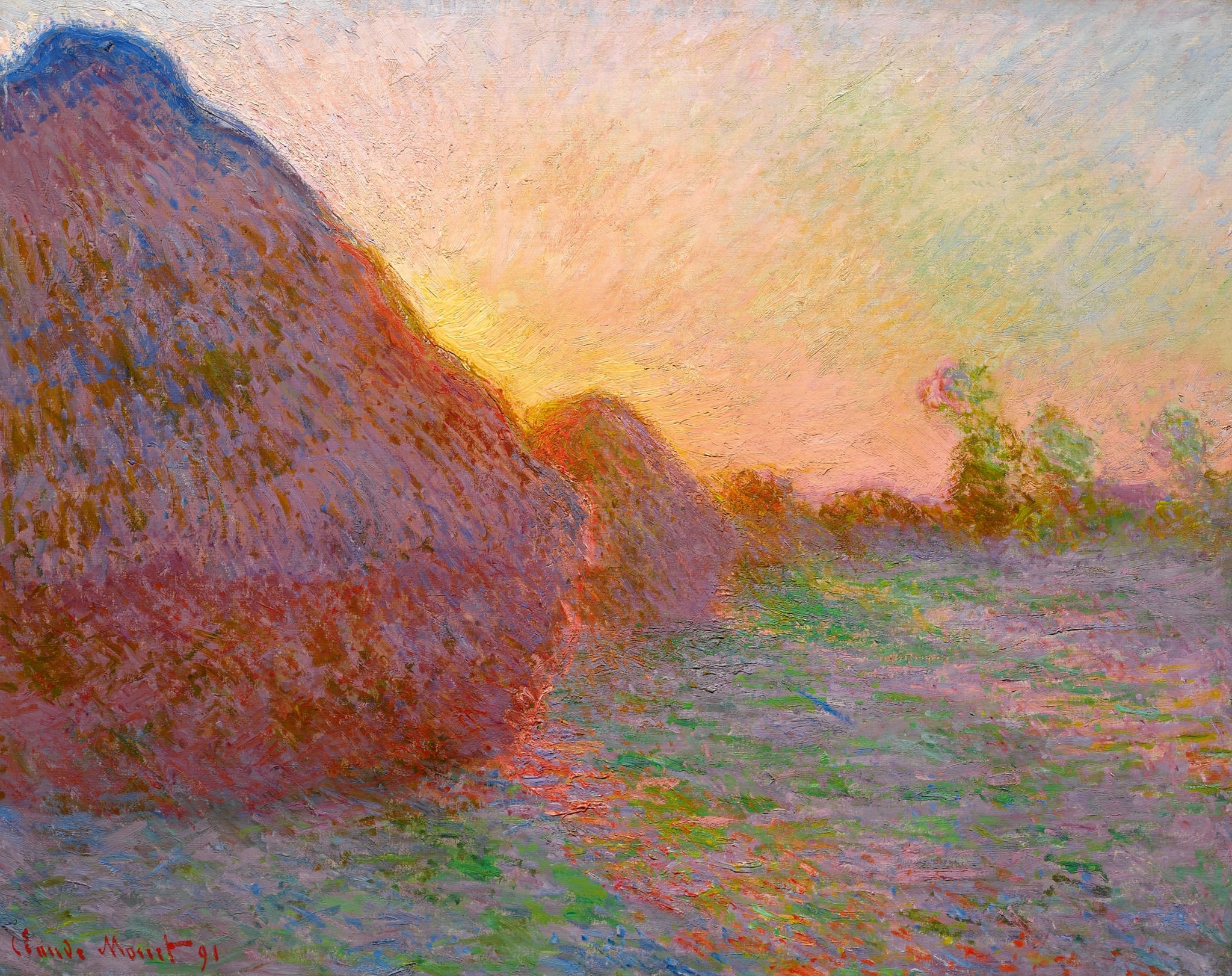
Claude Monet’s <strong>Haystacks Series</strong> transforms a routine rural subject into an inquiry into <strong>light, time, and perception</strong>. In this sunset view, the stacks swell at the left while the sun burns through the gap, making the field shimmer with <strong>apricot, lilac, and blue</strong> vibrations.
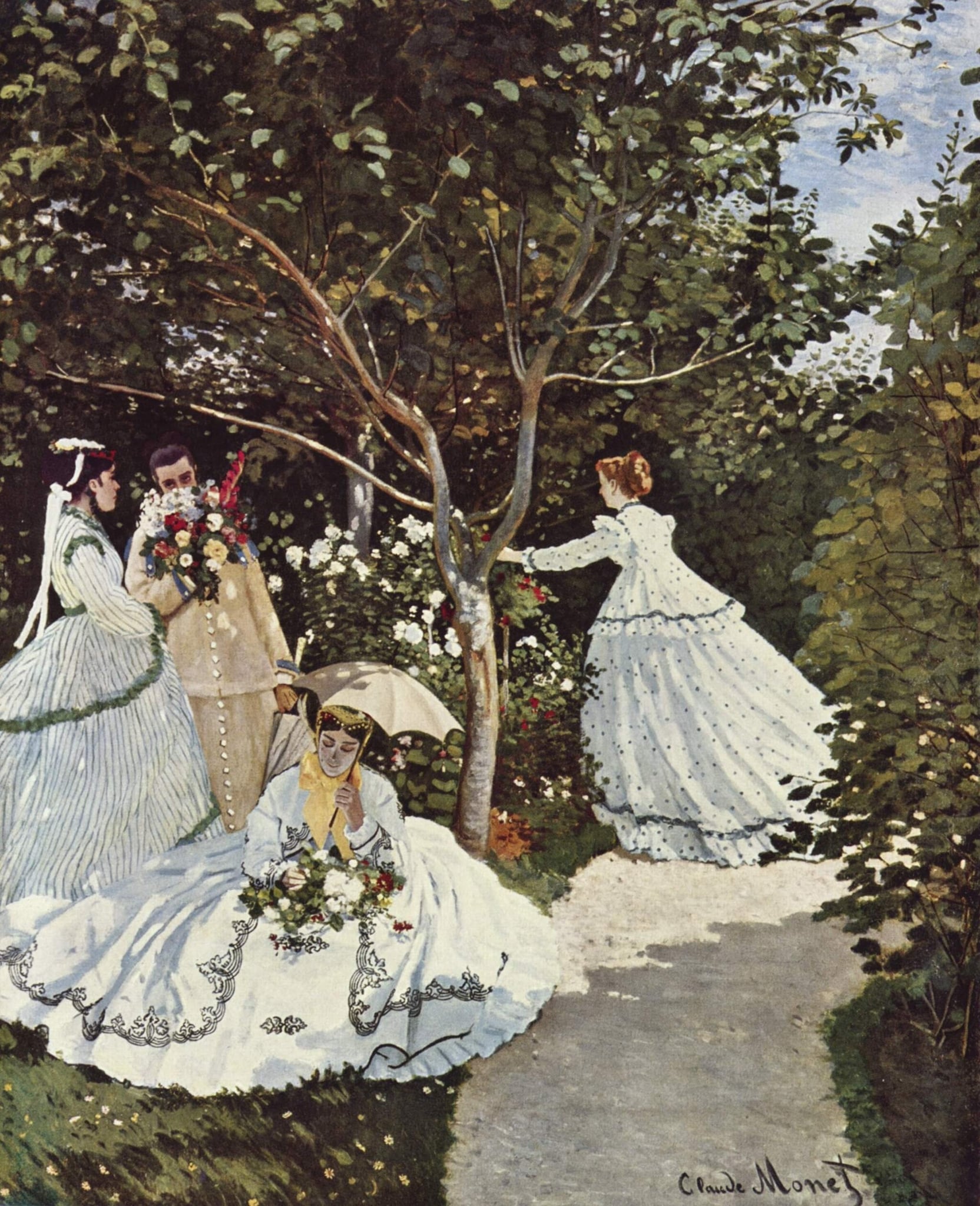
Women in the Garden by Claude Monet

Women in the Garden

Claude Monet (1866–1867)

Claude Monet’s Women in the Garden choreographs four figures in a sunlit bower to test how <strong>white dresses</strong> register <strong>dappled light</strong> and shadow. The path, parasol, and clipped flowers frame a modern ritual of leisure while turning fashion into an instrument of <strong>perception</strong>. The scene reads less as portraiture than as a manifesto for painting the <strong>momentary</strong> outdoors <sup>[1]</sup><sup>[3]</sup>.
Impression, Sunrise by Claude Monet

Impression, Sunrise

Claude Monet (1872)

In Impression, Sunrise, Claude Monet turns Le Havre’s fog-bound harbor into an experiment in <strong>immediacy</strong> and <strong>modernity</strong>. Cool blue-greens dissolve cranes, masts, and smoke, while a small skiff cuts the water beneath a blazing, <strong>equiluminant</strong> orange sun whose vertical reflection stitches the scene together <sup>[1]</sup><sup>[3]</sup>. The effect is a poised dawn where industry meets nature, a quiet <strong>awakening</strong> rendered through light rather than line.