Monet vs Turner
Both artists turn stone into weather and make light the protagonist. Monet measures change by holding a motif steady across hours and seasons; Turner concentrates weather, fire, and speed into a single, climactic episode. Reading them together clarifies two modern models of vision: perception calibrated over time versus perception shocked by an event.
Comparison frame: How do Monet’s serial “envelopes” and Turner’s singular “events” change what painting asks the eye to do?
Quick Comparison
| Topic | Claude Monet | J. M. W. Turner |
|---|---|---|
| Core premise | Calibrate perception across a fixed motif (the enveloppe). | Stage a sublime episode where forces collide (storm, fire, speed). |
| Temporality | Serial, comparative time; ensembles carry meaning. | Instantaneous, dramatic time; a decisive moment. |
| Composition engine | Fixed vantage; even spread; armatures (bridges, poles) steady the field. | Diagonals, vortexes, radiant centers; perspective as drama. |
| Role of architecture | Scaffold for atmosphere; silhouettes register light and haze. | Participant in spectacle; bent by rain, steam, fire, and glare. |
| Water’s function | Second architecture: reflections structure the image. | Conduit of energy and glare; stage for motion and hazard. |
| Modernity | Polluted London light measured across series. | Railway and steam allegorized as a new sublime. |
| Material/brushwork | Small chromatic shifts unify the field; low contour. | Scumble, glaze, impasto to ignite centers and cut contrasts. |
| Titles/exhibition logic | Series exhibited as calibrated sets (Haystacks, London, Venice). | Single emblematic canvases with poetic/allegorical cues. |
Shared Ground
Monet and Turner both make light and atmosphere the subject. Buildings, bridges, and shorelines are retained less for their details than for what they enable optically: silhouettes, reflections, halos, and veils. In London and Venice especially, water becomes a second architecture—horizontal bands of reflection that organize the picture as decisively as any façade. This is why Westminster and the Doge’s Palace can feel like screens receiving weather rather than monuments resisting it.
Each pushes representation toward abstraction by compressing depth and letting color intervals carry structure. Monet’s late ponds and London fogs knit sky and river into nearly all-over fields; Turner’s sunrises and late Venetian light dissolve masonry into radiant haze. Both also fold modernity into atmosphere. Turner turns the railway into a moving weather system where rain, steam, and velocity fuse; Monet treats industrial haze as a measurable condition that tints and equalizes sky, stone, and water. Serial or iterative looking is common ground too: Monet’s series formalize it—multiple canvases of the same motif, developed together—while Turner’s returns to Venice refine a luminous grammar across years. In short, for both artists, the “air between things” is the main event. Architecture and boats steady the eye, but meaning migrates to conditions: how light, moisture, and particulate air construct what we see, and how quickly that construction can change.
Decisive Difference
The decisive difference is how each artist conceives time. Monet measures perception. He fixes a vantage and motif—haystacks, Rouen, Waterloo Bridge, Parliament—and builds meaning through calibrated differences of hour, season, and weather. He often started on site, then finished canvases together in the studio so the set would cohere; the ensemble becomes the unit of truth. Compositionally this yields a stable armature (bridge spans, silhouettes, poles) within a unified atmospheric shell, where small chromatic shifts read as time unfolding. Painting, for Monet, is sustained attention made visible.
Turner intensifies perception. He composes singular episodes—storm, fire, speed—where light, weather, and technology collide at once. Perspective diagonals, vortexing brushwork, and radiant centers create a stage on which forces act. His titles and poetic frames steer readings beyond topography, and his Royal Academy training in perspective underwrites the kinetic thrust of works like Rain, Steam and Speed. Structures are pulled into vectors of rain, steam, fire, and glare; allegory condenses the instant into meaning. Painting, for Turner, is a theatre of forces compressed into a felt event. In short: Monet calibrates the envelope; Turner detonates the moment. The difference changes what the viewer must do—compare and measure across a series with Monet, withstand and interpret a climax with Turner.
Paired Works
Westminster: atmosphere versus event
Focus question: How does each turn state power into weather—and to what end?
Houses of Parliament vs The Burning of the Houses of Lords and Commons
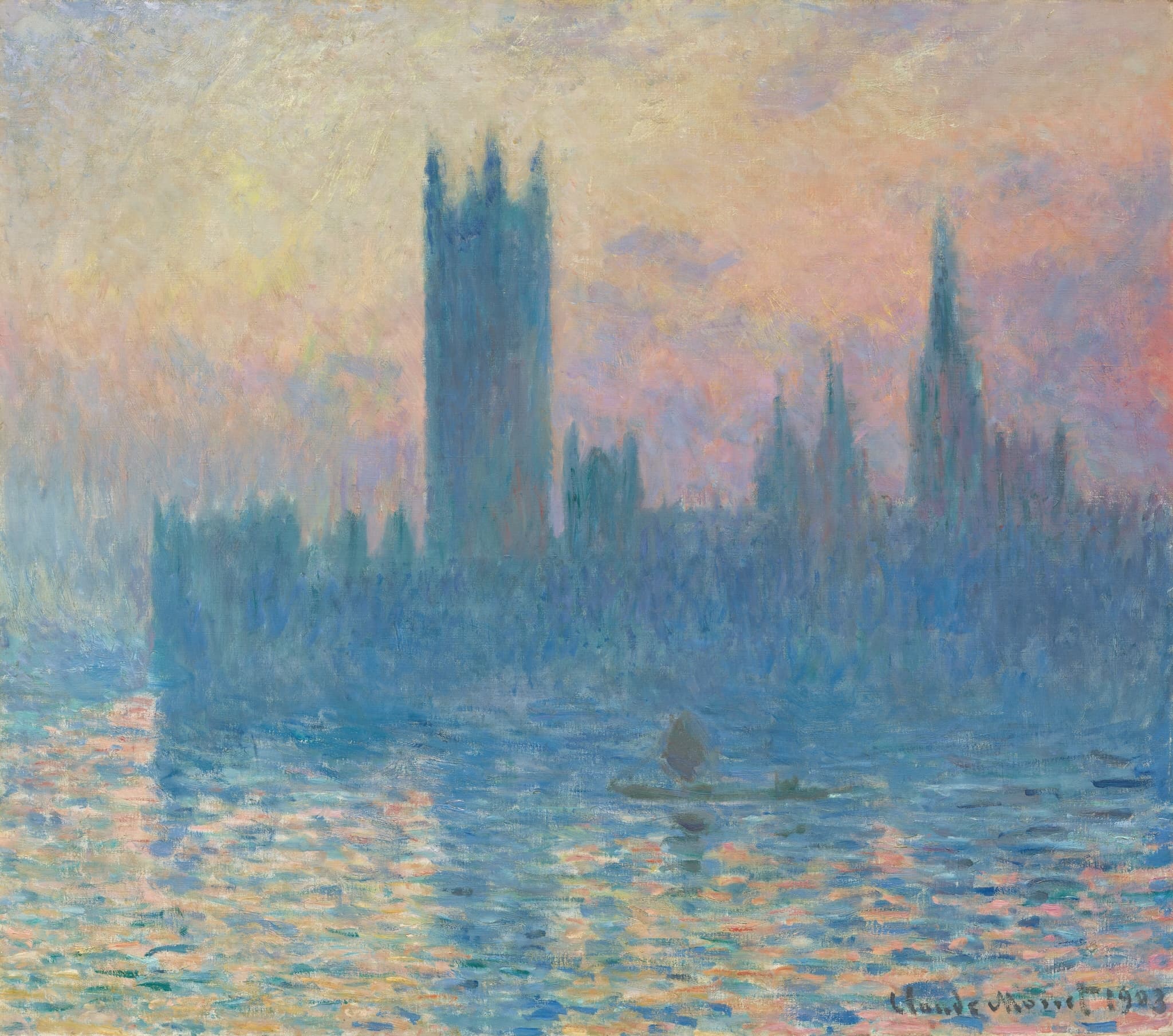
Monet’s Houses of Parliament reduces Westminster to a cool silhouette keyed to a single chromatic weather: peach and mauve light flooding sky and Thames until stone, air, and water share one system. A tiny skiff quietly scales the scene. The painting belongs to a series: same motif, shifted hours. Meaning accrues comparatively—how the façade darkens or lightens against fog; how the river mirrors the sky in rectangular tremors. Power is pictured as a condition the eye must measure through time.
Turner’s Burning of the Houses of Lords and Commons is a one-shot drama. The same architecture flares into moral spectacle—smoke coils, crowds line the opposite bank, reflections ignite the Thames. Composition drives toward crisis; forms whip into the glare. Where Monet’s Parliament is stabilized by repetition, Turner’s is transformed by catastrophe. Both make “state power as weather,” but Monet calibrates its atmosphere; Turner allegorizes its fate. The comparison clarifies two ethics of looking: monitor change patiently versus witness an event and weigh its charge.
Industrial modernity in weather
Focus question: When industry meets weather, what kind of time does each painter ask us to see?
Waterloo Bridge, Veiled Sun vs Rain, Steam and Speed
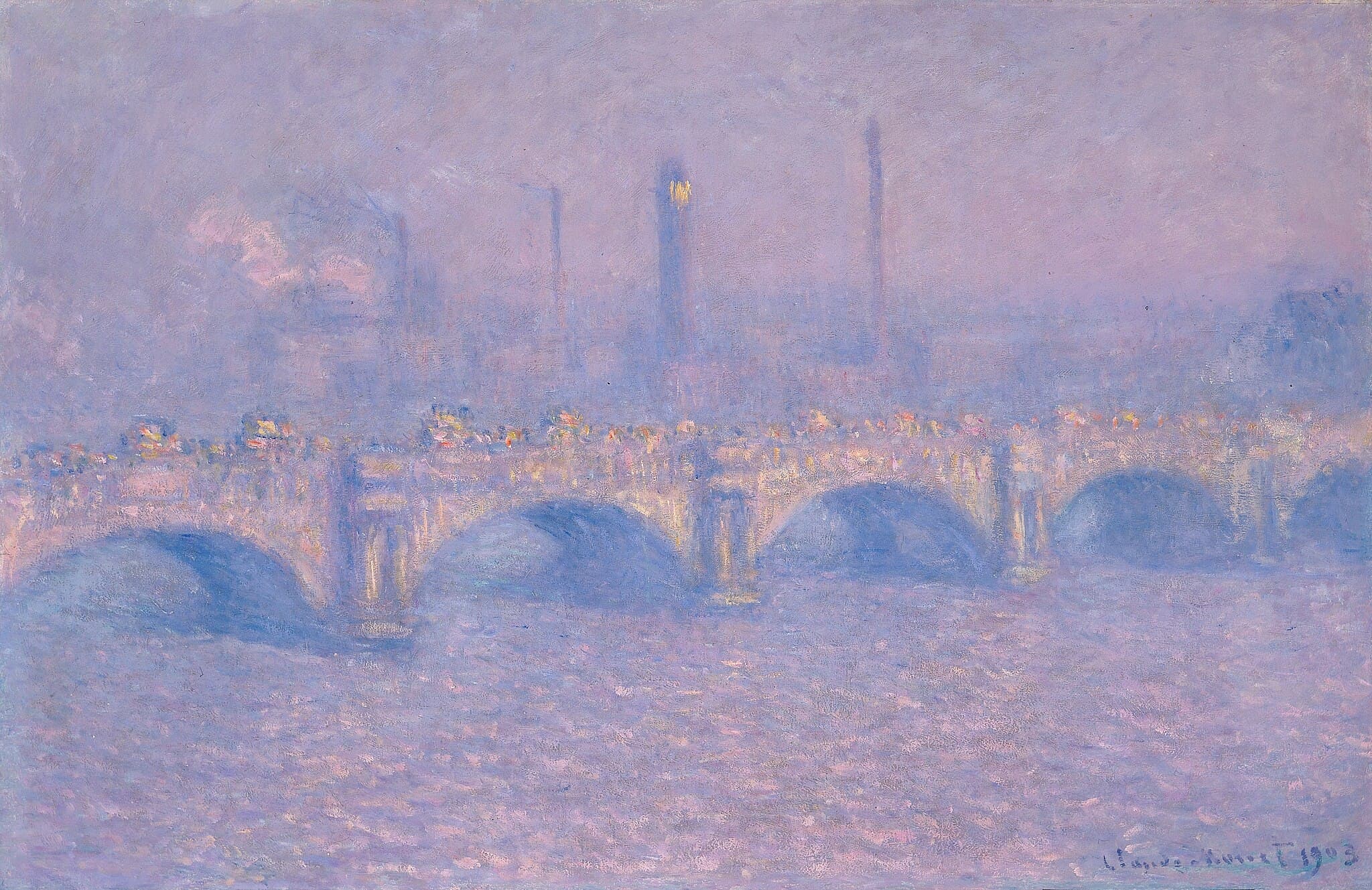
Monet’s Waterloo Bridge, Veiled Sun anchors London’s haze to a measured cadence of arches, a pricked sun, and lavender air that levels masonry, water, and sky. Industrial stacks register as soft uprights; lamps and carriages flicker as color incidents. Time is slow and comparable—the bridge as constant, the atmosphere as variable—one panel among many that together read the city’s particulate light.
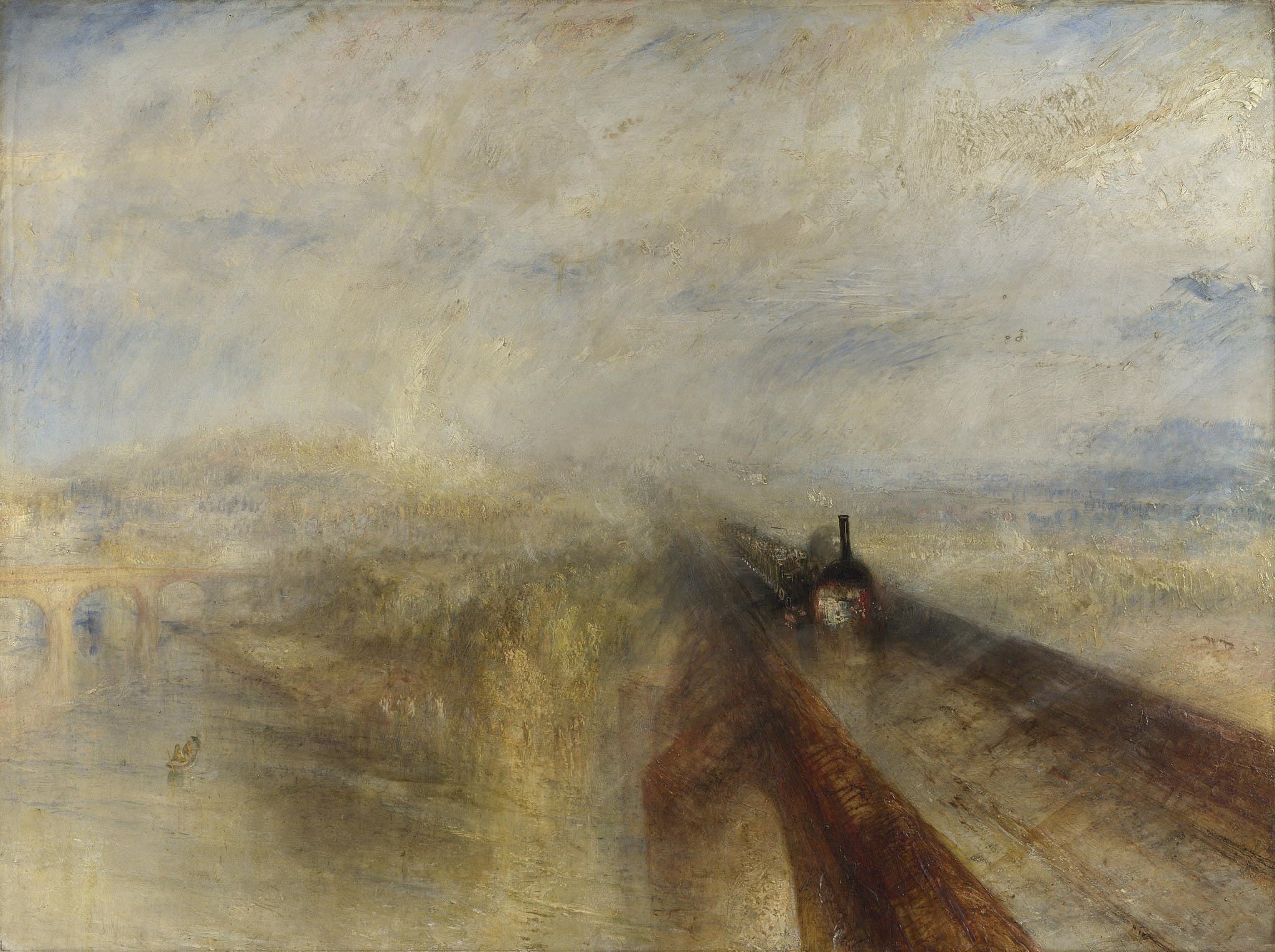
Turner’s Rain, Steam and Speed compresses modernity into a kinetic diagonal: Brunel’s bridge rushes at us, the locomotive blasts through rain, and the world smears into a field of energy. Counter-motifs—a boat below, a ploughman in the distance, the tiny hare—stage what speed overtakes. Time is climactic: a single, irreversible instant. Monet turns industry into an optical veil; Turner turns it into a force that reorders perception. Both fuse weather and technology, but Monet invites comparison across hours, while Turner demands you feel the instant’s shock.
Venice made of light
Focus question: What changes when Venice is a serial calibration versus a poetic arrival?
The Doge's Palace vs Approach to Venice
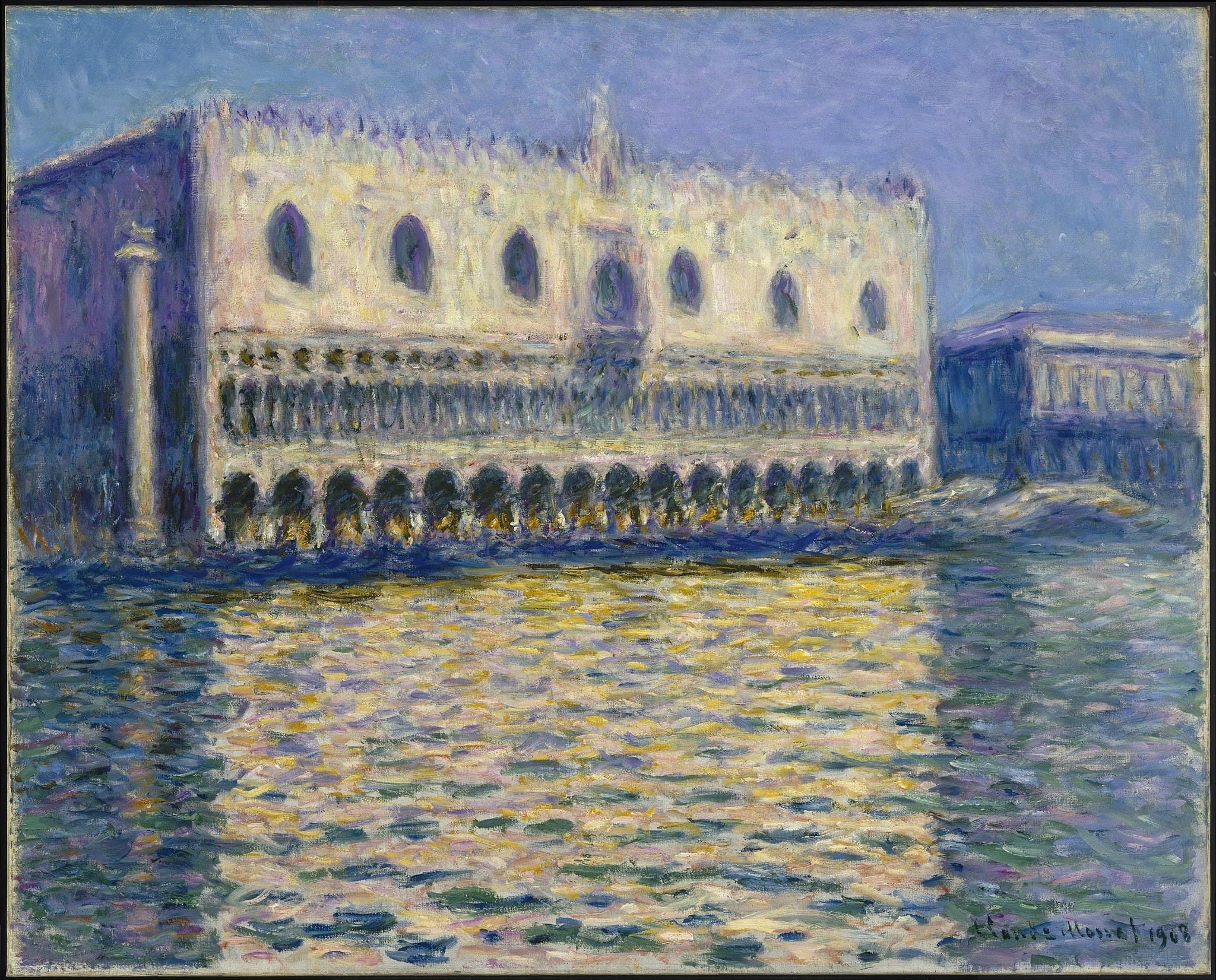
In The Doge’s Palace, Monet frontalizes the façade and lets reflection author structure: lilac walls, dark ovals of windows, and a lagoon that repeats their tones as a second architecture. Edges soften; authority shimmers. The picture belongs to a 1908 group—hours and weather orchestrated so the ensemble, not any single canvas, defines Venice as a calibrated atmosphere.
Turner’s Approach to Venice is a choreographed entrance. The vantage is elevated and mobile; boats, haze, and a radiant expanse stage the city as a luminous apparition. The mood is poetic, even Byronic, and the title signals arrival as theme. Monet’s Venice is measured from fixed landings and calibrated across versions; Turner’s Venice is an orchestrated epiphany. Both dissolve stone into light, but one treats the city as a test-bed for time, the other as a scene set for revelation.
Near‑abstraction from opposite premises
Focus question: How do they approach dissolution: by construction or by radiance?
The Water Lily Pond vs Norham Castle, Sunrise
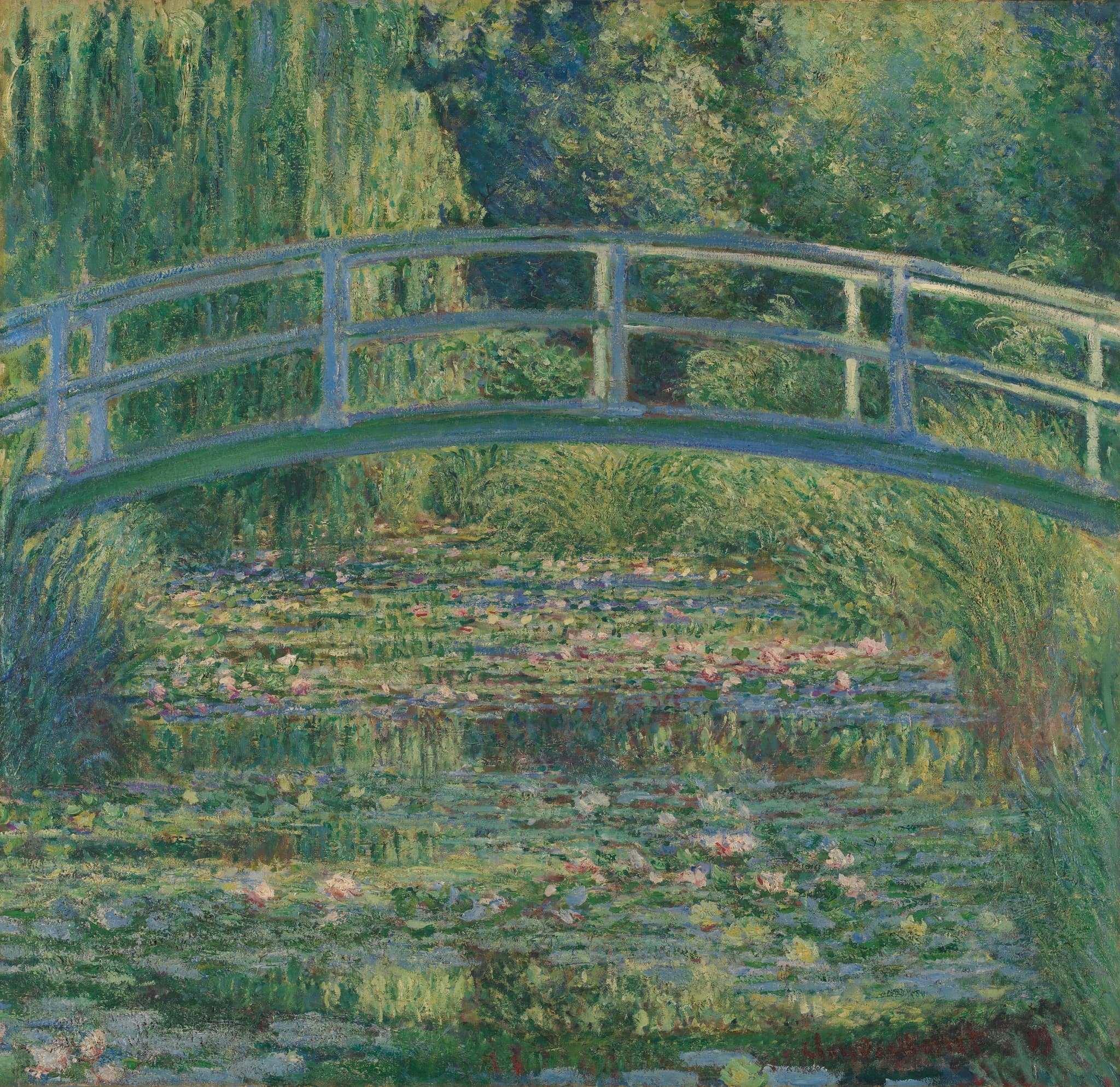
Monet’s The Water Lily Pond withholds the sky and turns a designed garden into a laboratory. The Japanese bridge is a calm armature; lilies punctuate a skin of reflections. Space compresses into a surface of intervals, built stroke by stroke. Abstraction approaches by construction—optical chords arranged around a fixed motif studied over months and years.
Turner’s Norham Castle, Sunrise dissolves the motif into radiant haze. The castle is a memory within light; color blooms outward from a luminous core until edges fade. Abstraction arrives by radiance—form given over to atmosphere. Monet’s dissolution is disciplined by a scaffold he engineered; Turner’s is yielded to a dawn that un-makes contour. Both bring painting to the threshold of the non-descriptive, but they get there by opposite routes: measured structure versus engulfing light.
Why This Comparison Matters
Seeing Monet beside Turner clarifies two durable options for modern painting and for looking. Monet shows how meaning can live in calibrated difference: hold a motif steady and let small chromatic shifts carry time, weather, and even pollution. Turner shows how a single arrangement of forces can concentrate significance: speed, fire, or glare turning landscape into a felt event. Both make atmosphere accountable—one by measuring it, the other by dramatizing it.
Those options still shape how images work. Serial photography, data visualizations, and climate graphics descend from Monet’s comparative logic; cinema’s set‑pieces and headline images inherit Turner’s theatre of forces. For viewers, the comparison is practical: some pictures ask you to compare and revisit; others ask you to submit to a moment. Understanding which mode you’re in—envelope or event—makes the art, and the world it renders, easier to read.
Related Links
Sources
- National Gallery, London: Claude Monet, The Water-Lily Pond
- National Gallery, London: J. M. W. Turner, Rain, Steam and Speed
- National Gallery, London: J. M. W. Turner, The Fighting Temeraire
- National Gallery of Art, Washington: Monet, The Houses of Parliament, Sunset
- The Met: Monet in London (vantage points and series method)
- Cleveland Museum of Art: Turner, The Burning of the Houses of Lords and Commons
- National Gallery of Art: Turner, Approach to Venice
- PNAS (2023): Atmospheric pollution and the optics of Turner and Monet
- Proceedings of the Royal Society A (2006): Solar geometry and Monet’s London series
- University of Vienna DoME: Monet’s Venice exhibition (Bernheim‑Jeune, 1912)
- Art Institute of Chicago: Haystacks (series and 1891 hanging)