Waterloo Bridge, Veiled Sun

by Claude Monet

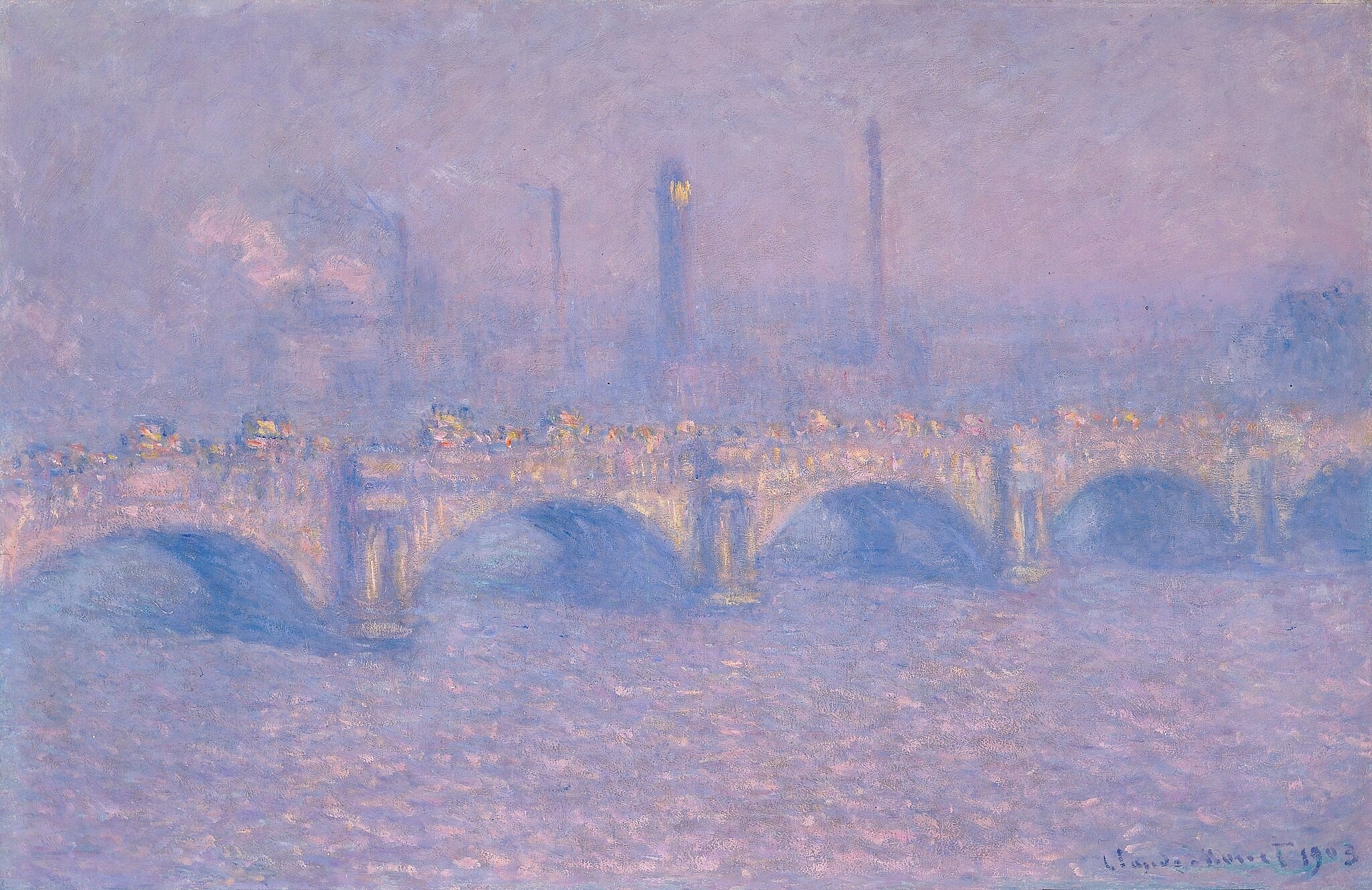
Claude Monet’s Waterloo Bridge, Veiled Sun renders London as a field of vibrating color where atmosphere overtakes architecture. The bridge’s cool violet arches and the tiny veiled sun—a gold pin of light above the parapet—stage a dialogue between urban modernity and shifting light.

Fast Facts

Year
1903
Medium
Oil on canvas
Dimensions
64.8 x 99.7 cm
Location
Memorial Art Gallery, University of Rochester, Rochester, NY
See all Claude Monet paintings in New York
Waterloo Bridge, Veiled Sun by Claude Monet (1903) featuring Waterloo Bridge arches, Veiled Sun, Industrial Smokestacks, Fog/Haze (Atmosphere)

Click on any numbered symbol to learn more about its meaning

Meaning & Symbolism

Monet constructs Waterloo Bridge, Veiled Sun as a meditation on perception in a mechanized city. The bridge’s masonry spans form a steady cadence of five pale arches, but their solidity yields to a lavender atmosphere that pulls water, sky, and stone into one vibrating surface. Along the parapet, pricks of orange-yellow—carriages and lamps reduced to light-events—flicker against cool violets, while a minute golden flare of the sun glows through the haze just above a thick vertical stack, asserting time’s presence without resorting to narrative detail. These choices declare that the artwork’s subject is not the bridge as an object, but the effect of filtered sunlight crossing a polluted Thames morning, a thesis Monet pursued from his Savoy vantage and refined back in Giverny as part of a rigorously conceived ensemble of “effects” 26. The brushwork—short, overlapping touches that knit rippling water to air—enacts a perceptual truth: in London, distance collapses under fog, and the eye measures duration in color shifts rather than in outlines 23. The painting also asserts a modern symbolism. The bridge stands for connection and endurance, a man-made constant that makes metropolitan life possible; yet the atmosphere that dignifies it is inseparable from industry. Stacks rise as soft verticals in the middle distance, their emissions veiling the sun while energizing the city’s economy—an ambiguity Monet seizes without polemic. His oft-quoted preference for London’s fog acknowledges the beauty of diffusion, but contemporary research underscores that this haze was heavily coal-laden; the “veil” thus encodes a measurable environmental condition that complicates the canvas’s lyricism 457. In this register, the tiny sun becomes an emblem of fragility—present, potent, and yet subdued by modern production—while the water’s lavender sheen suggests how atmosphere re-colors every surface it touches. Such readings align with museum accounts that frame the Thames series as artworks where atmosphere is the protagonist and urban life appears only as flickers at the edge of legibility 23. Why Waterloo Bridge, Veiled Sun is important, finally, is methodological as much as iconographic. Monet refused to release these canvases until the series cohered as a calibrated set, each version capturing a distinct temporal effect while advancing a unified argument about seeing in time 2. This picture demonstrates that argument with rare economy: the bridge’s measured rhythm versus the city’s shifting, industrially inflected light. By relocating meaning from objects to conditions—light, weather, particulate air—Monet articulates a decisive turn in modern art. He shows that to represent the modern city truthfully is to paint its atmosphere, and to accept that urban permanence is always contingent on the fleeting moods of color and air 123.

Explore Deeper with AI

Ask questions about Waterloo Bridge, Veiled Sun

Popular questions:

Powered by AI • Get instant insights about this artwork

💬 Ask questions about this artwork!

Interpretations

Technical/Material Analysis

MAG’s conservation-led project shows how Monet engineered the image’s vibration: thin scumbles of violet and lilac knit sky to river, while denser, short touches anchor the bridge’s arches. Under magnification, the parapet’s orange-yellow “flickers” sit as high-chroma accents atop cooler strata, a strategy that lets traffic-lights read at distance without becoming narrative detail. Evidence of reworking from Giverny—additions, toning, and subtle glazes—supports the thesis that the London views were built as calibrated “effects,” not plein-air snapshots. The imaging confirms how Monet tuned atmospheric coherence by adjusting relationships between neighboring strokes rather than by contour, allowing particulate haze to be materialized as layered paint interactions rather than depicted smoke trails 1.

Source: Memorial Art Gallery (University of Rochester)

Seriality and Completion Ethics

The painting gains force when seen as one tile in Monet’s serial matrix. From the Savoy, he staged multiple canvases at once, each keyed to a distinct temporal effect—sun visibility, fog density, chromatic temperature—and refused to release any picture until the ensemble “read” correctly. This method redefines subject matter: the “same” bridge becomes a platform to test color constancy, interval, and duration. Veiled Sun’s economy—steady arches versus mutable haze—performs Monet’s ethics of completion, where meaning is not singular but distributed across iterations. The work thus functions as a node in a comparative system that replaces anecdote with time-indexed perception, making process and curation intrinsic to content 2.

Source: Art Institute of Chicago

Ecocritical/Scientific Reading

Recent studies correlate the period’s London “fog” with elevated coal pollution, suggesting the canvas encodes a measurable atmospheric condition. The veiled sun and heightened yellow-orange scattering are consistent with aerosols that redden and mute solar light; the city’s hazy tonal unity becomes both an aesthetic veil and an index of industrial emissions. While Monet praised London’s fog, the term “smog” emerged only later, clarifying a modern afterimage: beauty entangled with toxicity. Veiled Sun thus permits a double reading—lyric diffusion and environmental degradation—in which the sun’s reduced intensity signals the costs of metropolitan growth without didacticism. Monet’s empiricism of perception inadvertently becomes an archive of air 45.

Source: Washington Post (reporting on peer‑reviewed study); Courtauld Institute (Learning Resource)

Genealogy: Turner, Whistler, and Monet’s London

Monet’s Thames joins a lineage of atmospheric modernity: Turner’s dissolving riverine light and Whistler’s nocturnes. Yet Monet’s contribution is daylight smog transmuted into serial effects. Where Whistler tends toward tonal harmony and nocturnal poetics, Monet operationalizes optical variables—humidity, sun angle, particulate density—across canvases to map shifting chroma. His oft-cited relish for London’s fog aligns with a self-conscious embrace of diffusion as a modern optic, but in Veiled Sun he pointedly admits smokestacks into the field, suturing Whistlerian elegy to industrial fact. The result is not homage but a late‑Impressionist system for perceiving a mechanized city’s air 57.

Source: Courtauld Institute; National Gallery, London

Urban Phenomenology of Time

Curatorial readings emphasize that in these Thames pictures, duration is legible as color drift rather than contour. Veiled Sun intensifies this by compressing depth: bridge, water, and sky meet on a near‑planar surface where the eye tracks minute transitions—lavender to lilac, cool gray to citron flare—as temporal markers. The traffic becomes pulses along the parapet, a phenomenology of urban motion measured in chromatic beats instead of forms. In this register, London is not a set of landmarks but a lived interval, a morning whose passing is inscribed in optical modulation. The painting models how a modern city is perceived when distance collapses under haze and time is seen in color 23.

Source: Art Institute of Chicago; National Gallery of Canada

Infrastructure and Political Economy

The bridge’s measured cadence signifies metropolitan infrastructure—the substrate of exchange—while the softly asserted stacks mark the engines of industrial capital. Yet labor remains spectral: workers, carriages, and boats are reduced to light-events, visualizing how modern economies can render the human invisible within systems. Veiled Sun’s beauty thus encodes political economy: connection and throughput are stable; the atmosphere that dignifies them is the byproduct of the same combustion that powers the city. Rather than polemic, Monet stages an ambivalence—endurance versus atmospheric cost—inviting viewers to read London as a network where utility, profit, and environmental externalities fuse into one chromatic field 16.

Source: Carnegie Museum of Art; Memorial Art Gallery (University of Rochester)

Related Themes

About Claude Monet

Claude Monet (1840–1926) led Impressionism’s pursuit of open-air painting and optical immediacy, especially during his Argenteuil years focused on modern leisure and light. He later developed serial studies of changing conditions, culminating in the Water Lilies cycle [2].
View all works by Claude Monet

More by Claude Monet

Boating by Claude Monet

Boating

Claude Monet (1887)

Monet’s Boating crystallizes modern leisure as a drama of perception, setting a slim skiff and two pale dresses against a field of dark, mobile water. Bold cropping, a thrusting oar, and the complementary flash of hull and foliage convert a quiet outing into an experiment in <strong>modern vision</strong> and the <strong>materiality of water</strong> <sup>[1]</sup><sup>[2]</sup>.

The Thames below Westminster by Claude Monet

The Thames below Westminster

Claude Monet (about 1871)

Claude Monet’s The Thames below Westminster turns London into <strong>light-made architecture</strong>, where Parliament’s mass dissolves into mist and the river shivers with <strong>industrial motion</strong>. Tugboats, a timber jetty with workers, and the rebuilt Westminster Bridge assert a modern city whose power is felt through atmosphere more than outline <sup>[1]</sup>.

Haystacks Series by Claude Monet | Light, Time & Atmosphere by Claude Monet

Haystacks Series by Claude Monet | Light, Time & Atmosphere

Claude Monet

Claude Monet’s <strong>Haystacks Series</strong> transforms a routine rural subject into an inquiry into <strong>light, time, and perception</strong>. In this sunset view, the stacks swell at the left while the sun burns through the gap, making the field shimmer with <strong>apricot, lilac, and blue</strong> vibrations.
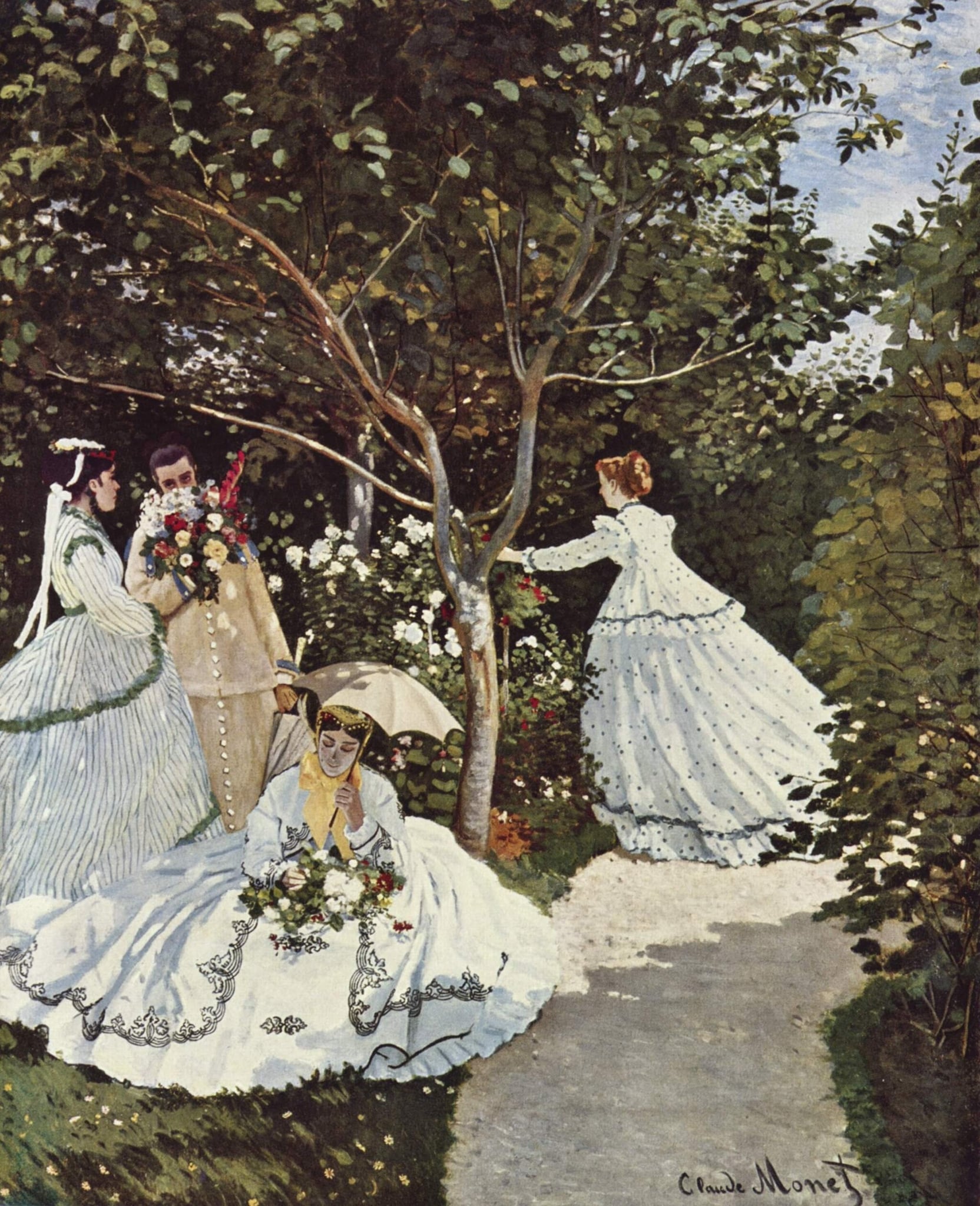
Women in the Garden by Claude Monet

Women in the Garden

Claude Monet (1866–1867)

Claude Monet’s Women in the Garden choreographs four figures in a sunlit bower to test how <strong>white dresses</strong> register <strong>dappled light</strong> and shadow. The path, parasol, and clipped flowers frame a modern ritual of leisure while turning fashion into an instrument of <strong>perception</strong>. The scene reads less as portraiture than as a manifesto for painting the <strong>momentary</strong> outdoors <sup>[1]</sup><sup>[3]</sup>.
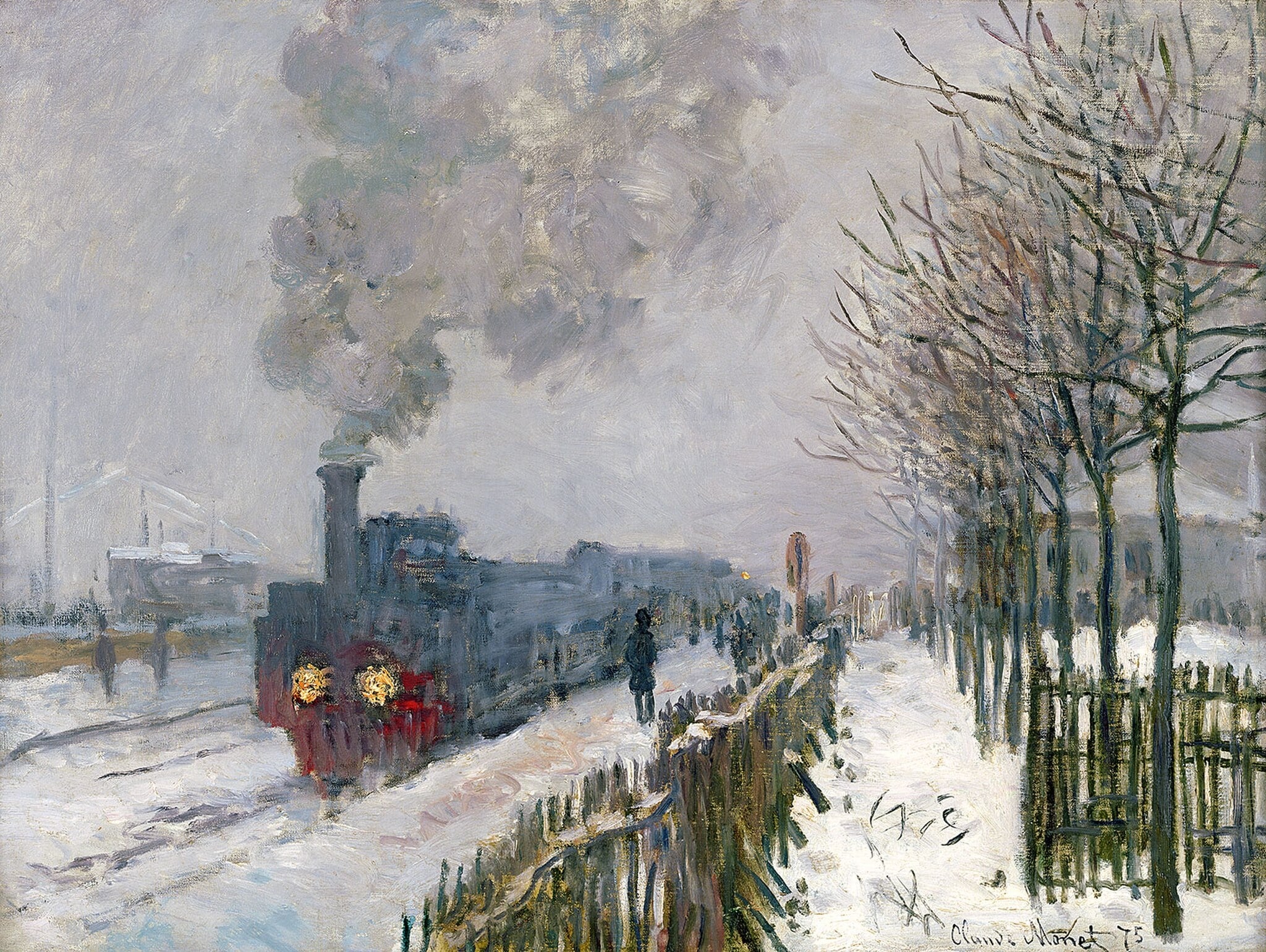
The Train in the Snow (The Locomotive) by Claude Monet

The Train in the Snow (The Locomotive)

Claude Monet (1875)

Claude Monet’s The Train in the Snow (The Locomotive) (1875) turns a suburban winter platform into a study of <strong>modernity absorbed by atmosphere</strong>. The engine’s twin yellow headlights and a smear of red push through a world of greys and violets as steam fuses with the low sky, while the right-hand fence and bare trees drill depth and cadence into the scene <sup>[1]</sup><sup>[4]</sup>. Monet fixes not an object but a <strong>moment of perception</strong>, where industry seems to dematerialize into weather <sup>[1]</sup><sup>[2]</sup>.
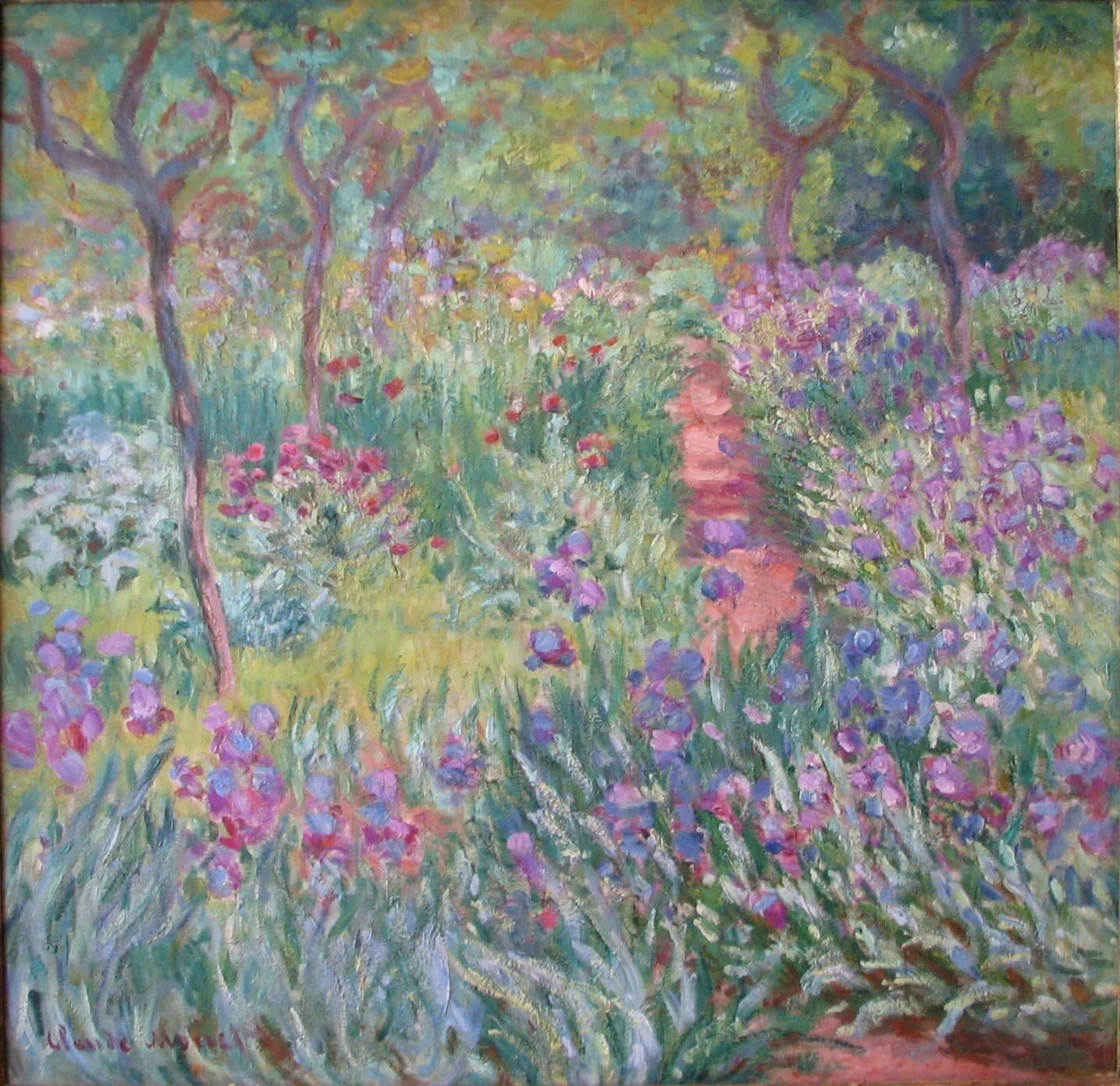
The Artist's Garden at Giverny by Claude Monet

The Artist's Garden at Giverny

Claude Monet (1900)

In The Artist's Garden at Giverny, Claude Monet turns his cultivated Clos Normand into a field of living color, where bands of violet <strong>irises</strong> surge toward a narrow, rose‑colored path. Broken, flickering strokes let greens, purples, and pinks mix optically so that light seems to tremble across the scene, while lilac‑toned tree trunks rhythmically guide the gaze inward <sup>[1]</sup><sup>[3]</sup>.