Monet vs Renoir: Light as Climate, Life as Contact
Both men helped launch Impressionism and made modern life their stage. Their shared problem is how vision records the present. Monet turns a fixed motif into an index of air and time; Renoir turns bodies and manners into an index of intimacy. Read them together to see how painting can measure conditions—or conduct.
Comparison frame: How do Monet and Renoir teach us to see: as an environment of changing light or as a choreography of human closeness?
Quick Comparison
| Topic | Claude Monet | Pierre-Auguste Renoir |
|---|---|---|
| Core aim | Make changing light and air the subject | Make human closeness and etiquette the subject |
| Engine of repetition | Serial cycles from a fixed vantage (Haystacks, Rouen, London, Venice) | Repeated figure types and pendants (Dance pair, Young Girls at the Piano versions) |
| Light’s job | Unifying enveloppe that tints every form | Luminous skin for touch, mood, and decorum |
| Architecture’s role | Armature to stabilize optical change | Civic stage or elegant backdrop for social action |
| Water’s role | Reflective field where form dissolves into time | Pastoral or social setting for bodies |
| Human figure | Often subordinated to atmosphere | Primary carrier of feeling and conduct |
| Working method | On‑site starts; ensemble calibrated in studio | Figure‑first composition; post‑Italy firmer contour |
| Exhibition tactic | Hang series as comparative optics | Life‑size portraits, dance pendants; state‑backed piano variants |
Shared Ground
Monet and Renoir meet on common ground: modern life and the act of seeing. Both helped inaugurate the independent Impressionist exhibitions in 1874, trading academic stories for scenes of cafés, dance gardens, and city promenades. Their early side‑by‑side experiments at La Grenouillère in 1869 set a template—open‑air facture, reflections that edit reality, and crowds treated as moving light. For each, light is not mere illumination but the structure that makes forms, feelings, and social relations legible.
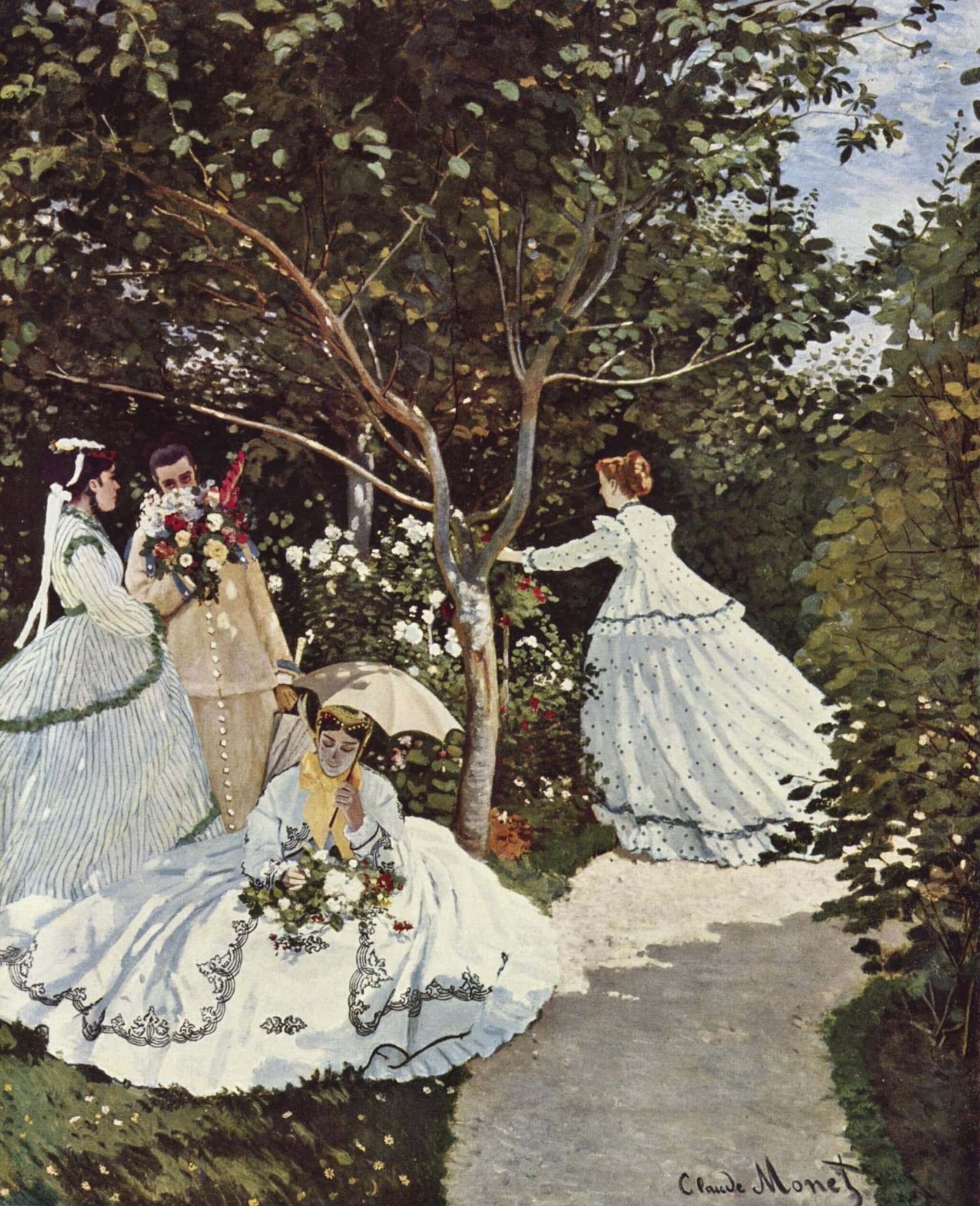
They also share a habit of repetition to think. Monet returns to a single motif across hours and weathers—Haystacks, Rouen Cathedral, London bridges, the Venetian waterfront—so differences of time become the argument. Renoir repeats in another key: paired Dances (1883) that test place and decorum, and multiple studio versions of Young Girls at the Piano (1892) that refine an ideal of domestic culture. Both use scale ambitiously—Monet’s outdoor Women in the Garden proposes plein‑air monumentality; Renoir revives the life‑size, full‑length portrait for suburban dance and ballroom scenes.
This shared project keeps biography in the wings and puts vision at center stage. Whether a garden bower or an opera box, the scene is a laboratory for perception: color intervals carry structure; reflections and shadows do narrative work; and modern accessories—parasols, gloves, café tables—double as optical instruments. The link is strong: each artist anchors Impressionism’s wager that truth can be shown as a present‑tense experience on the surface of paint.
Decisive Difference
Monet treats painting as an ecology of light and time. He fixes a vantage, lets conditions compose the image, and organizes entire ensembles around the enveloppe—the ambient key that tints everything. Architecture and vegetation become armatures for optical states: Rouen’s façade as a register of hours; London’s Parliament as silhouette inside smog; Venice’s palaces stabilized by their own reflections. At Giverny he even authors the motif—diverting water, planting lilies, building a bridge—so he can study how weather and season write the world. His on‑site starts and studio calibrations teach us to read hour, humidity, and air as the real subject.
Renoir treats painting as the choreography of human closeness. Outdoors or in, his central problems are bodies, touch, and manners rendered with luminous color. After Italy (1881–82) he strengthens contour and modeling, seeking classical poise for modern intimacy: the Dance pendants calibrate etiquette across settings; The Large Bathers monumentalizes sociable, idealized touch; the repeated Young Girls at the Piano turns practice into a state‑endorsed ideal. Repetition here refines types and conduct, not meteorology. The lesson is clear: painting can show how companionship looks and feels—through hands, fabrics, posture, and the codes that govern them.
In a sentence: Monet turns vision into an index of changing air; Renoir turns vision into an index of changing relations.
Paired Works
Garden light, two agendas
Focus question: When sunlight hits fabric and faces outdoors, what matters more—the behavior of light or the behavior of people?
Women in the Garden vs Dance in the Country
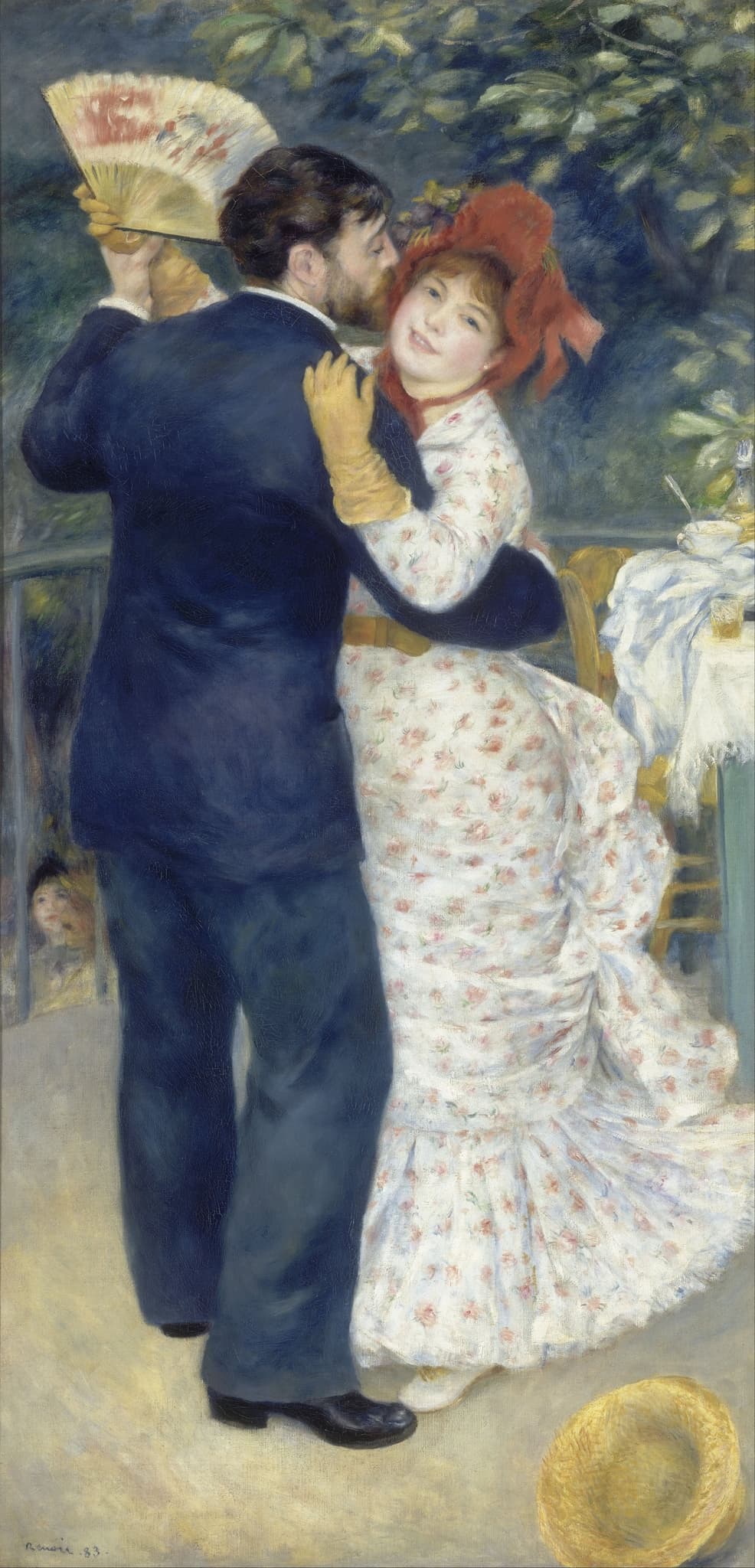
Monet’s garden scene is an outdoor laboratory: white dresses are instruments that catch dapples, parasols meter shade, and foliage reads across fabric as green and blue stains. Narrative recedes; perception is the action. He even worked the large canvas in situ, letting hour and weather set terms of finish. Renoir’s terrace dance, by contrast, is a social machine. Gloves, fan, and a table abandoned mid‑drink script public flirtation; the tossed boater and close embrace tighten the choreography of a couple becoming a couple. Light remains lively, but it serves conduct: the rose‑sprigged dress rhymes with leaves to naturalize intimacy, while the man’s darker suit stabilizes the swirl. Side by side, the priorities separate. Monet subordinates anecdote to the behavior of light on surfaces. Renoir subordinates setting to the behavior of people within shared rules. Both look modern; only one treats the garden primarily as climate rather than as a ballroom with birdsong.
Water and the human figure
Focus question: Is water an optical laboratory or a pastoral rite?
The Water Lily Pond vs The Large Bathers
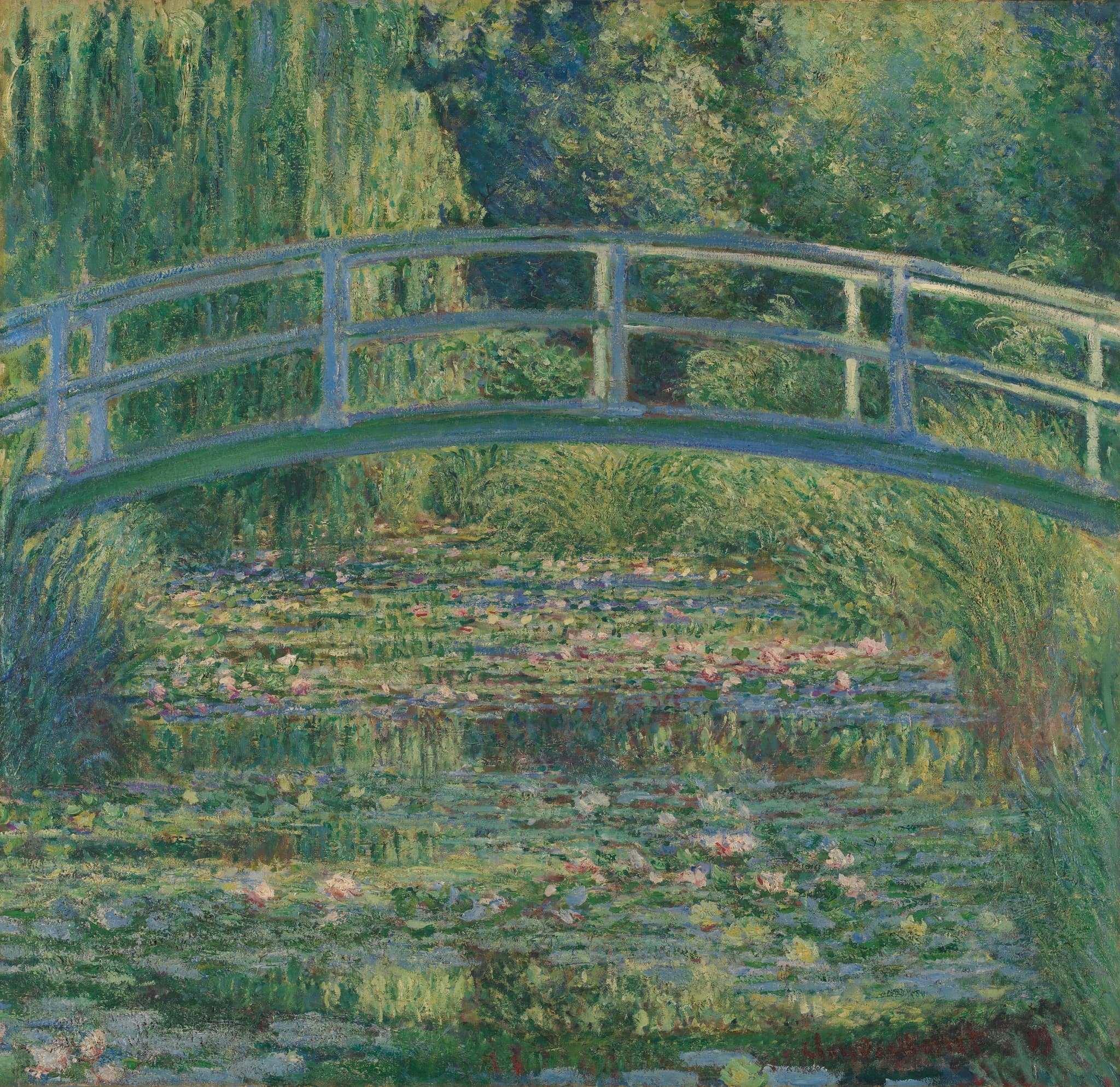
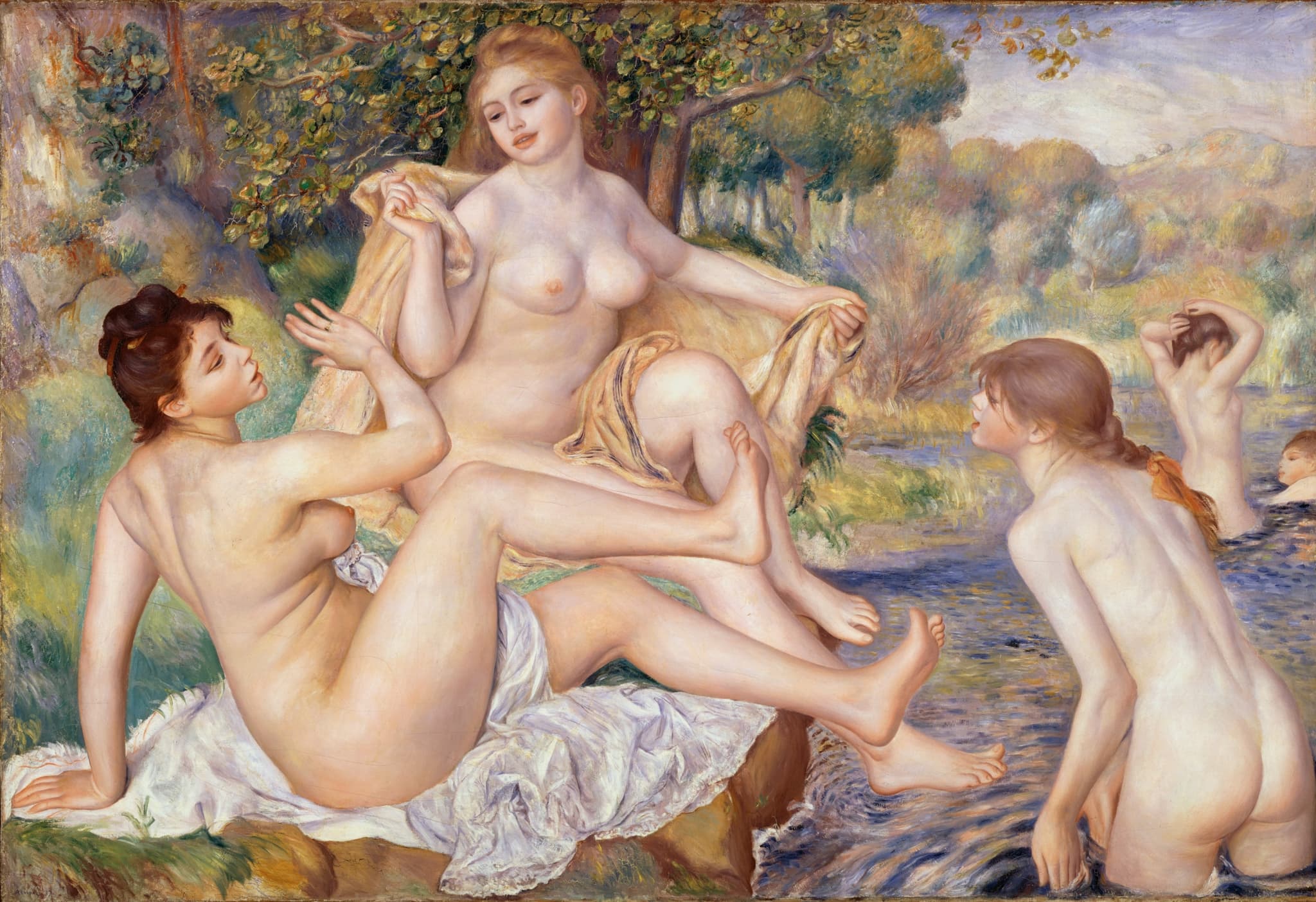
Monet’s pond with its small bridge withholds horizon and sky, forcing the eye to read a surface where reflection rivals object. Lilies become buoys in a field of time; the bridge is a quiet armature for changing greens and violets. The water is not pastime but medium—light’s editor—designed by the artist so conditions can be observed and compared. Renoir’s grove stages a different claim. Monumental nudes, clarified by firm contours and classical rhythms, anchor the scene; the brook touches and joins them, a rite of companionship and renewal. Brushwork shimmers in foliage, but bodies resist dissolution. Where Monet nears a subjectless perception—water thinking—Renoir asserts idealized, sculptural presence. The pairing reveals what each believes painting should secure: for Monet, the truth of appearances as they change; for Renoir, the truth of touch, grace, and measured desire.
Venice: monument under light
Focus question: What is a building for—stabilizing optical change or staging civic life?
The Doge's Palace vs The Piazza San Marco, Venice
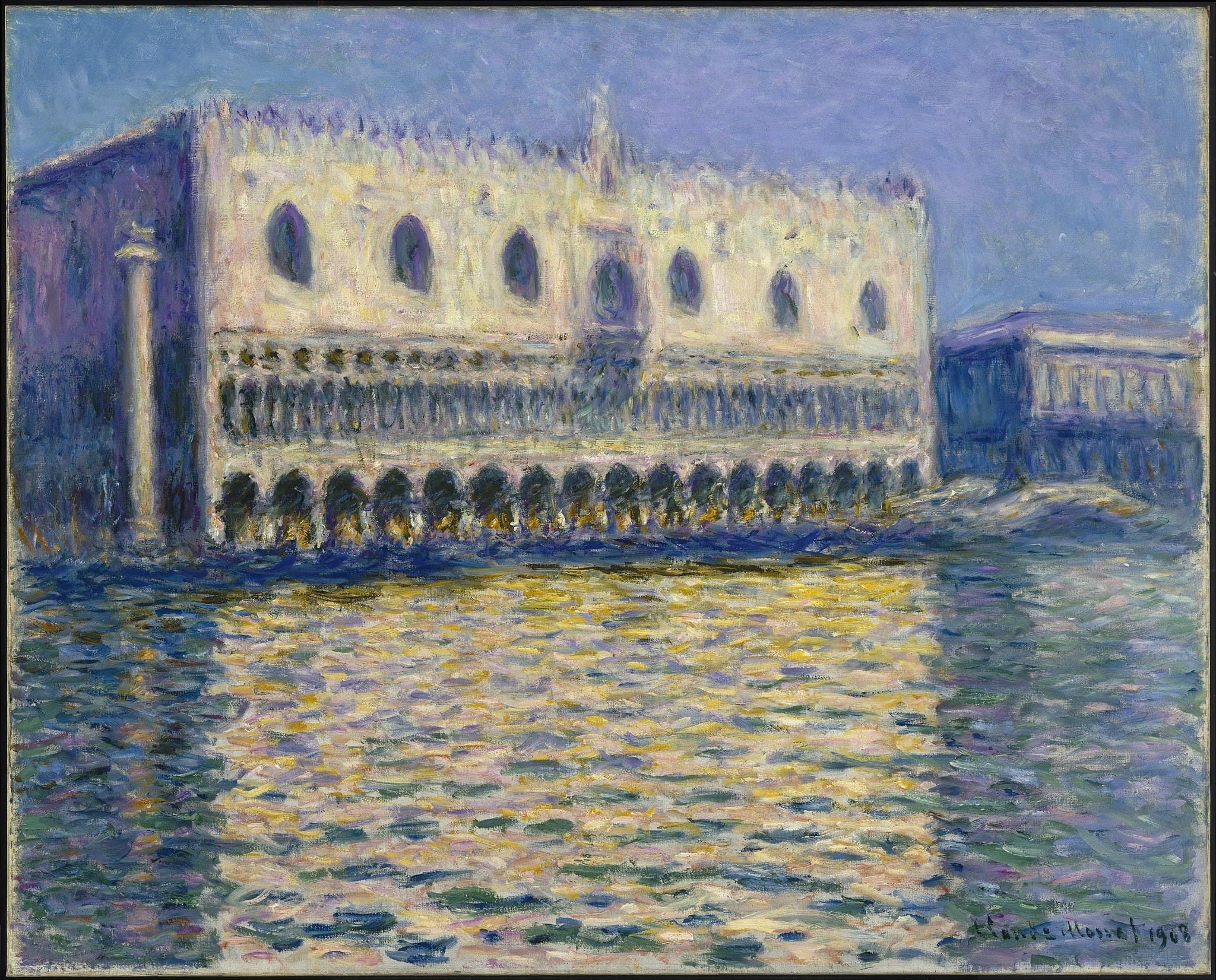
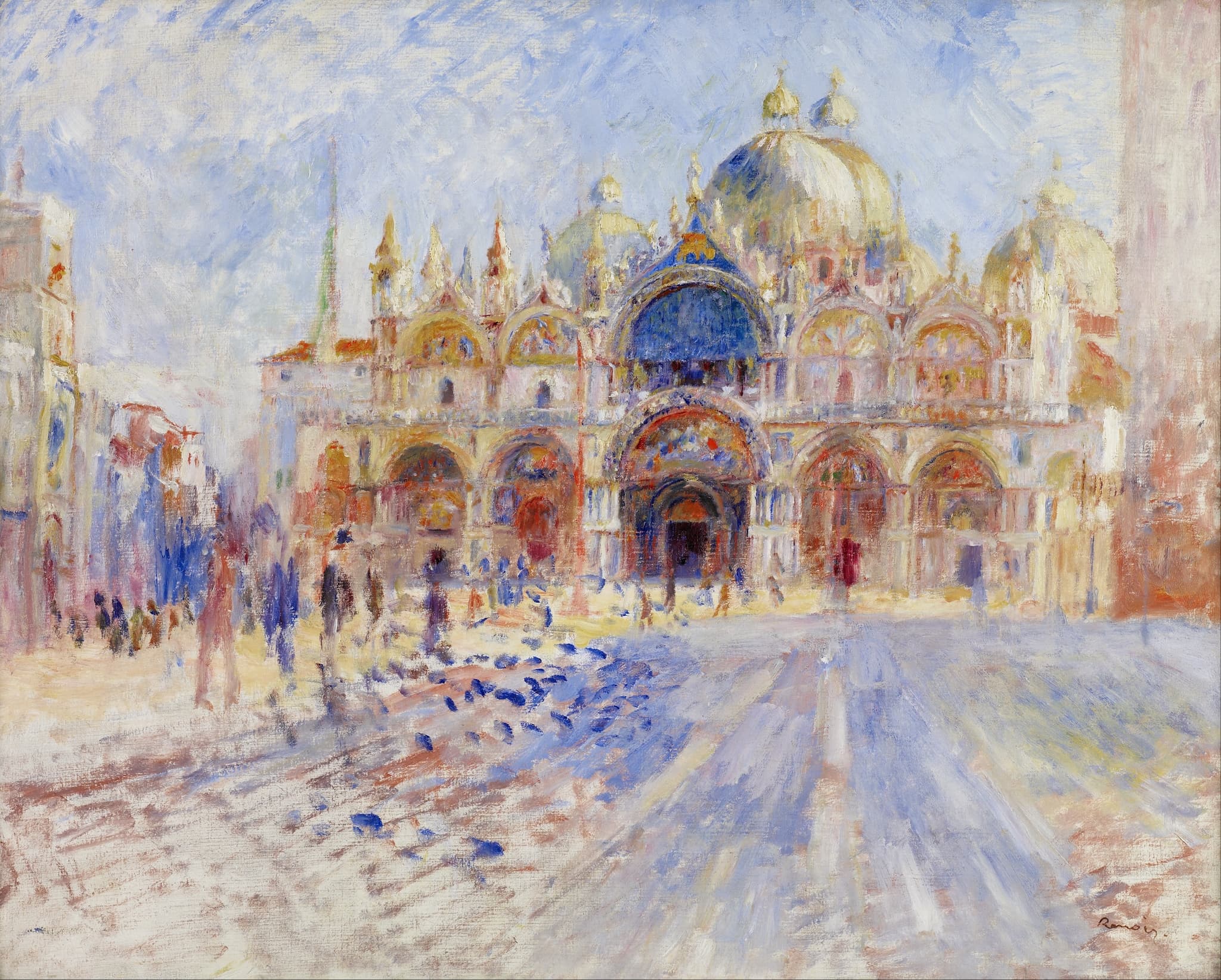
Monet crowds the palace frontally and lets the lagoon build a second architecture in reflection. Ogival windows dissolve into pulses of violet; water carries the façade’s tones forward, proving that atmosphere is sovereign. The building is a pretext, a steady grid against which the day can shift. Renoir’s St. Mark’s treats monument and crowd as one bright sensation: domes, mosaics, pigeons, and passersby fuse into broken color; diagonal shadows sweep the square like stage lighting. The basilica reads less as armature than as a civic beacon around which urban life gathers. Monet serializes the view for hours and keys; Renoir captures an encounter—public space vibrating at once. One turns stone into weather; the other makes grandeur a shared, social brightness.
Institutions and spectatorship
Focus question: How does modern power appear—as filtered light or as social optics?
Houses of Parliament vs The Loge
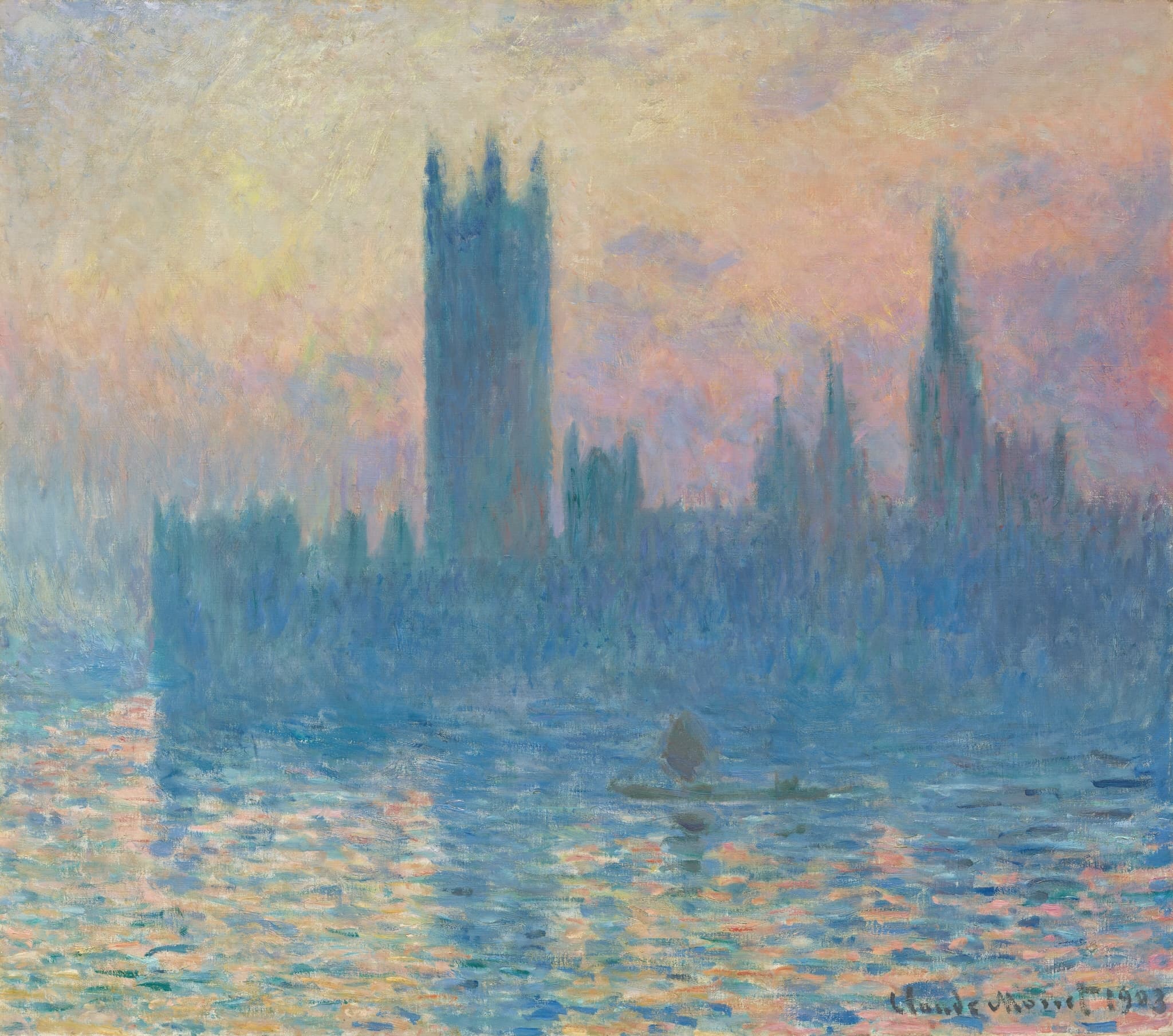
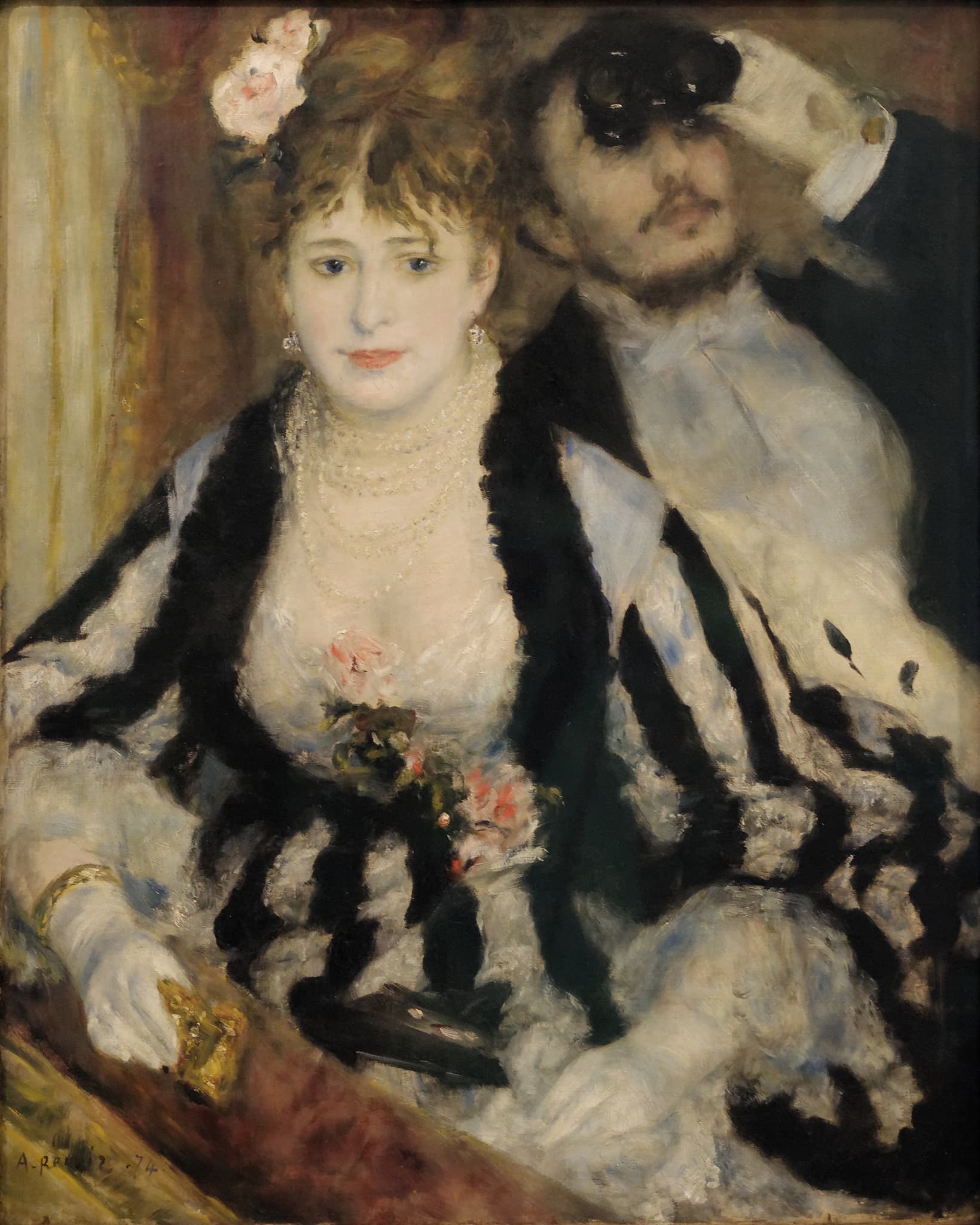
Monet reduces Westminster to a darkened silhouette inside haze; sun and smoke set the terms, not masonry. Serial canvases align to compare effects, so a seat of state becomes a sequence of atmospheres—power read through air. Renoir’s theatre box reverses the premise. A frame‑within‑a‑frame shows looking itself as the engine of urban modernity: a woman meets our gaze while her companion scans the house. Pearls, gloves, roses, and gaslight are instruments of visibility; decorum scripts desire. Together, the works clarify the axis of this comparison. For Monet, institutions are seen truly when folded into weather and time. For Renoir, modern life is seen truly when we map who looks, who is looked at, and how style and space choreograph that exchange.
Why This Comparison Matters
Setting Monet against Renoir clarifies two durable models for modern painting. One treats the world as conditions—hour, weather, particulate air—made legible by a stable motif and a calibrated series. The other treats the world as conduct—touch, etiquette, companionship—made legible by bodies, fabrics, and the stages where people meet. That split reframes Impressionism beyond the shorthand of “light and color.” It explains why Monet steers landscape toward abstraction and environmental attention, and why Renoir preserves a human scale where grace, intimacy, and social codes remain central.
For viewers, the payoff is practical. Monet trains the eye to read climate: to notice how reflections author a city, how fog equalizes stone and water, how a garden can be built to study time. Renoir trains the eye to read company: how gloves license touch, how a dance varies with place, how a piano lesson rehearses harmony and class. Together they widen what painting can tell us—about air and about us.
Related Links
Sources
- National Gallery of Art: 1874—The Birth of Impressionism
- Britannica: The Impressionist exhibitions
- The Met: Auguste Renoir (1841–1919)
- Musée d’Orsay: Women in the Garden
- Musée d’Orsay: Dance in the Country
- Art Institute of Chicago: Monet’s serial practice (Haystacks, 1891)
- National Gallery, London: Monet & Architecture
- National Gallery of Art: The Houses of Parliament, Sunset
- PNAS 2023: Atmospheric pollution and the optics of Impressionist skies
- Minneapolis Institute of Art: The Piazza San Marco, Venice
- The Courtauld: La Loge (The Theatre Box)
- NGA: Monet’s Japanese Footbridge (Giverny context)
- Art Institute of Chicago: Monet in Venice (1908–1912)
- AAE Portal (Herbert): Impressionism, Art, Leisure and Parisian Society