The Piazza San Marco, Venice

by Pierre-Auguste Renoir

Renoir’s The Piazza San Marco, Venice redefines St. Mark’s Basilica as atmosphere rather than architecture, fusing domes, mosaics, and crowd into vibrating color. Blue‑violet shadows sweep the square while pigeons and passersby resolve into daubs of light, declaring modern vision as the true subject [1][3].

Fast Facts

Year
1881
Medium
Oil on canvas
Dimensions
65.41 × 81.28 cm
Location
Minneapolis Institute of Art, Minneapolis
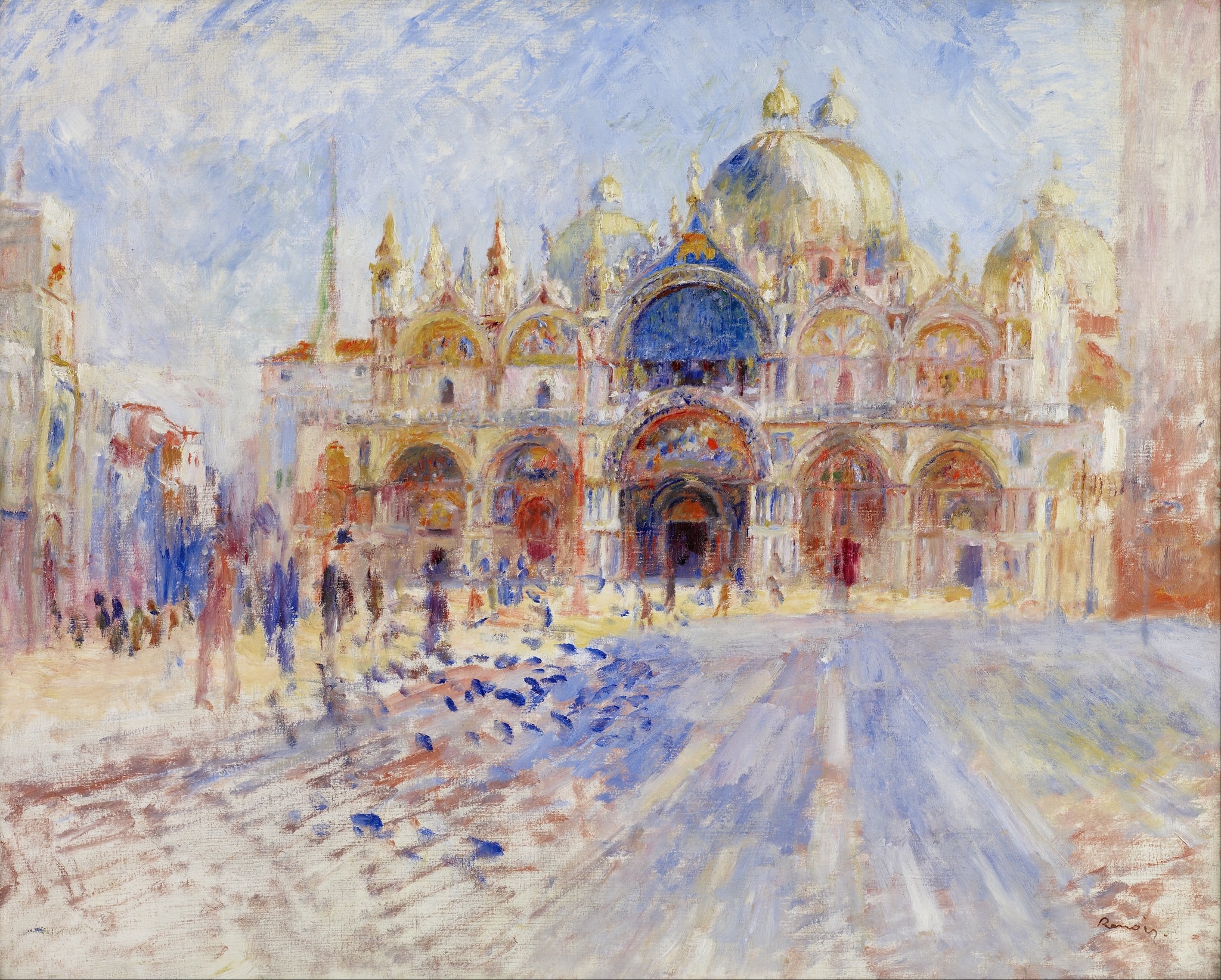
The Piazza San Marco, Venice by Pierre-Auguste Renoir (1881) featuring Five gilded domes of St. Mark’s, Gilded mosaics and blue lunette, Diagonal blue‑violet shadows on the paving, Flock of pigeons

Click on any numbered symbol to learn more about its meaning

Meaning & Symbolism

Renoir stages St. Mark’s not as a fixed façade but as an optical event. The five domes swell like pale shells, their forms broken by strokes of ultramarine, rose, and gold; the arches and lunette mosaics glint as quick flecks rather than legible pictures. Across the pavement, diagonal bands of blue‑violet shade run from lower right to center, knitting sky and stone into a single atmospheric field. Figures drift as semi‑transparent silhouettes—no faces, only pulses of navy and umber—so that the square reads as a civic stage rather than a roster of individuals. A scatter of pigeons, rendered as dark commas, punctuates the brightest zone of the square and calibrates scale without yielding narrative. The brushwork remains brisk and “sketch‑like,” consistent with the Minneapolis curators’ observation that Renoir left passages in a state of plein‑air immediacy, using unmixed color to let light do the modeling 1. In short, light is the form; architecture is what happens to light when it touches marble, gold ground, and crowd. This strategy directly counters the veduta tradition that had taught viewers to expect crisp edges and enumerated details in Venetian scenes. Contemporary critics, encountering Renoir’s Venetian canvases soon after this trip, called them “ferocious daubs,” precisely because façades here melt into sensation 3. The painting’s diagonally cast shadows perform more than description: they tether the Byzantine monument to the lagoon’s atmosphere, suggesting that Venice is stone held together by water and air. By refusing portrait-like exactitude in the people—just as he refuses iconographic legibility in the basilica’s mosaics—Renoir subsumes history and devotion within the modern tempo of seeing. The luminous, broken surface echoes the basilica’s famous gilded skin while denying its narrative panels; the result is a secular metaphor of sacred shimmer, a translation of divine radiance into optical vibration rather than theology 16. The choice is deliberate and timely. In 1881 Renoir was traveling—Algeria in spring, Italy in autumn—and in Venice he painted the canonical sites he later listed (Grand Canal, Doge’s Palace, Piazza San Marco), but he filtered them through Impressionism’s wager on perception 24. Shown around the time of his substantial return to the group exhibition in 1882, works like this intensified debates over whether rapid facture could bear public, even monumental subjects 23. That is why The Piazza San Marco, Venice is important: it claims a premier European civic‑religious space for modern vision, proving that speed, contingency, and shared urban life can sustain grandeur. The indistinct crowd affirms a democratic spectatorship—the square belongs to everyone who steps into its light. The pigeons’ erratic pattern, the sky’s streaked strokes, and the domes’ pearly halos together articulate a thesis about Venice as a perpetually becoming city. Rather than commemorating what St. Mark’s is, the painting asserts what Venice does: it glitters, drifts, and gathers people. In that assertion, Renoir turns a postcard view into a proposition about seeing itself, aligning his late‑1870s/early‑1880s practice—plein air, high‑key color, unblended touches—with a cosmopolitan stage where commerce, history, and devotion fuse in a single sun‑struck moment 123.

Explore Deeper with AI

Ask questions about The Piazza San Marco, Venice

Popular questions:

Powered by AI • Get instant insights about this artwork

💬 Ask questions about this artwork!

Interpretations

Formal Analysis: Veduta Undone

Rather than transcribing St. Mark’s as a legible façade, Renoir atomizes form into chromatic incidents—ultramarine, rose, and gold that refuse linear description. This counters the veduta’s empirical promise and aligns with Impressionism’s wager that the viewer’s eye reconstructs the scene from “daubs.” Contemporary critics read the Venice series as “ferocious daubs,” a charge that acknowledges how the basilica melts into sensation and how the square’s diagonals of blue‑violet shadow function as compositional vectors, not mere cast shade 12. The canvas thus stages a tension between civic monumentality and pictorial contingency: edges fray, mosaics flicker, and figures resolve as tonal accents. In Renoir’s hands, mimesis gives way to optical equivalence—light organizes the whole and architecture becomes what light does.

Source: MFA Boston; Minneapolis Institute of Art

Symbolic Reading: Secularized Splendor

St. Mark’s gold‑ground mosaics historically perform divine radiance, a Byzantine theology of light that envelops worshippers. Renoir quotes that radiance without its narratives: the lunette mosaics glint as non‑iconographic flickers, and the domes bloom as pearly haloes built from strokes, not saints. This is a secular translation—"divine radiance" recast as optical vibration—where shimmer survives but doctrine recedes 16. The painting thereby reframes sacred spectacle as a modern, public luminosity shared by tourists, pigeons, and passersby alike. By withholding iconographic detail, Renoir preserves the sensation of sanctity (glow, reflection, gilt) while relocating its meaning to perception itself—the light that binds the square’s bodies and stones supersedes the basilica’s stories.

Source: Minneapolis Institute of Art; St. Mark’s Basilica (mosaics)

Urban Sociology: Democratic Spectatorship

The crowd appears as anonymous silhouettes, a choreography of navy and umber that suppresses rank, trade, and portraiture. This anonymity—augmented by the pigeons’ dark commas that punctuate the pavement—articulates the piazza as common ground, a civic optic co‑authored by any body entering the light 1. In modernist terms, the work advances a public of viewers who finish the image, aligning with Impressionism’s participatory seeing and its scandalous “unfinishedness” noted by period critics 24. The pigeons, iconic to San Marco’s stage, normalize the square’s everyday spectacle and calibrate scale without narrative, reinforcing leisure as a shared, egalitarian temporality within a monumental setting 7. Renoir’s piazza thus performs urban modernity as collective looking rather than ceremonial hierarchy.

Source: Frick Collection; MFA Boston; Associazione Piazza San Marco

Environmental Optics: Venice as Climate

Diagonal bands of blue‑violet shade tether basilica to lagoon air, making atmosphere the true armature of the scene. Renoir’s plein‑air immediacy and unmixed color render Venice as a meteorological medium in which stone, water, and bodies interpenetrate 1. Light does the modeling, yes—but those shadows also inscribe the sun’s arc, humidity, and reflective glare unique to a marble square beside tidal canals. The basilica’s pearly domes read like weather phenomena, swelling not by contour but by value shifts and reflected color. In this ecological lens, the painting claims that Venice persists as an equilibrium of elements—“stone held together by water and air”—so that monumentality is literally sustained by climate, and vision is a mode of environmental registration.

Source: Minneapolis Institute of Art

Historical Context: Tourism, Speed, and Public Scale

Renoir reached Venice in late 1881 amid a broader itinerary (Algeria in spring; Italy in autumn), ticking off canonical sites he later listed—Grand Canal, Doge’s Palace, Piazza San Marco—like a modern tourist with an easel 35. Shown around his substantial return to the 1882 Impressionist Exhibition, these Venetian canvases tested whether Impressionism’s rapid facture could carry premier civic subjects 3. The controversy they stirred—accused as “outrageous… ferocious daubs”—marks a collision between souvenir expectation (postcard precision) and experiential immediacy 2. By converting a postcard view into a proposition about seeing, Renoir leverages cosmopolitan visibility and Durand‑Ruel’s market platform to argue that speed, contingency, and crowd life are not antithetical to grandeur but its modern condition.

Source: Frick Collection; MFA Boston; Ambroise Vollard (via Christie’s)

Related Themes

About Pierre-Auguste Renoir

Pierre-Auguste Renoir (1841–1919) emerged from craft training into the avant-garde circle around Monet, Sisley, and Bazille, helping to found Impressionism. In the mid‑1870s he focused on outdoor scenes of modern leisure in and around Montmartre, using dappled light and high-chroma color to capture transient sensations [1][2][5].
View all works by Pierre-Auguste Renoir

More by Pierre-Auguste Renoir
In the Garden by Pierre-Auguste Renoir

In the Garden

Pierre-Auguste Renoir (1885)

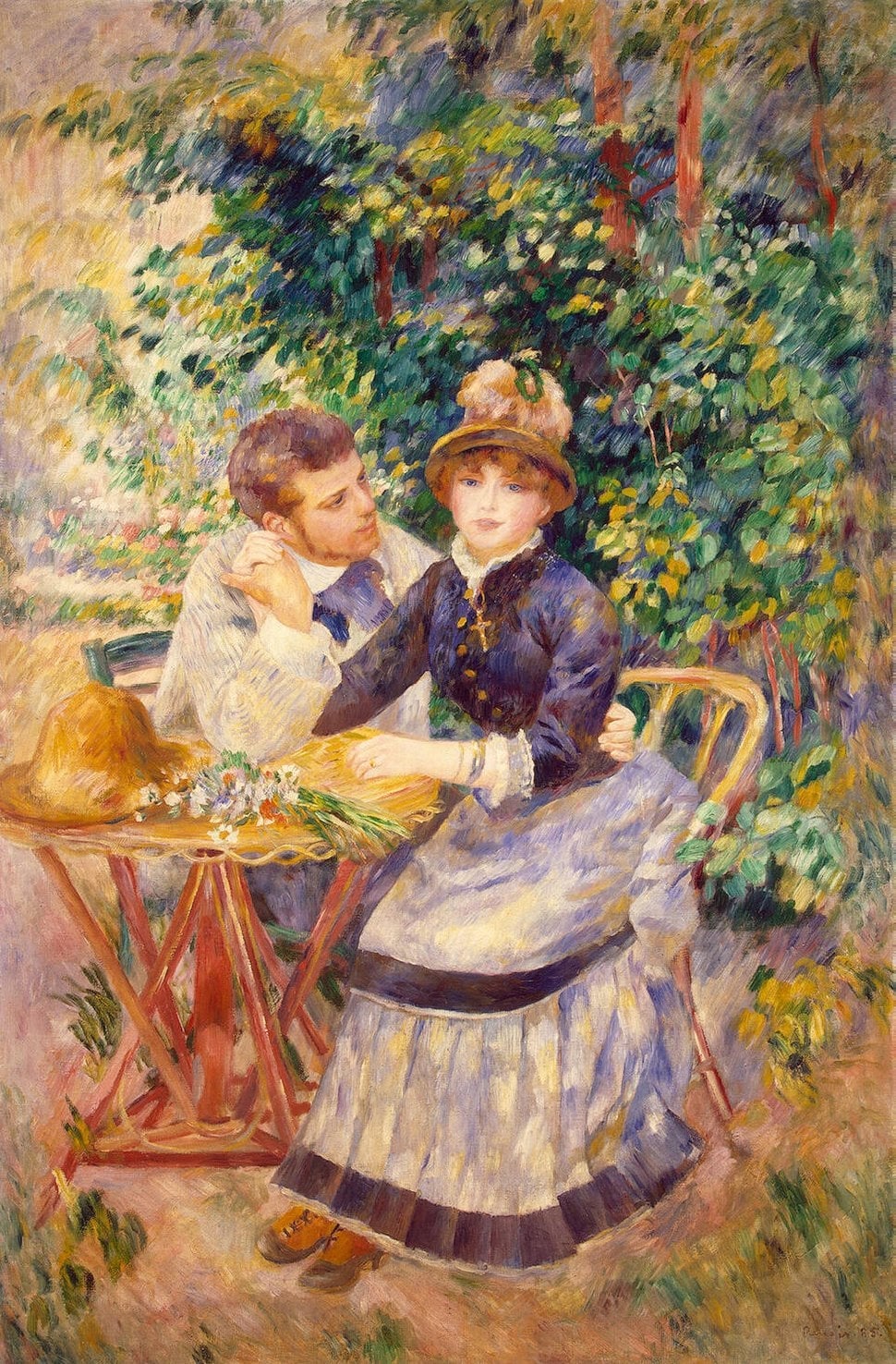
In the Garden presents a charged pause in modern leisure: a young couple at a café table under a living arbor of leaves. Their lightly clasped hands and the bouquet on the tabletop signal courtship, while her calm, front-facing gaze checks his lean. Renoir’s flickering brushwork fuses figures and foliage, rendering love as a <strong>transitory, luminous sensation</strong> <sup>[1]</sup><sup>[3]</sup>.
Young Girls at the Piano by Pierre-Auguste Renoir

Young Girls at the Piano

Pierre-Auguste Renoir (1892)

Renoir’s Young Girls at the Piano turns a quiet lesson into a scene of <strong>attunement</strong> and <strong>bourgeois grace</strong>. Two adolescents—one seated at the keys, the other leaning to guide the score—embody harmony between discipline and delight, rendered in Renoir’s late, <strong>luminous</strong> touch <sup>[1]</sup><sup>[2]</sup>.

Pont Neuf Paris by Pierre-Auguste Renoir

Pont Neuf Paris

Pierre-Auguste Renoir (1872)

In Pont Neuf Paris, Pierre-Auguste Renoir turns the oldest bridge in Paris into a stage where <strong>light</strong> and <strong>movement</strong> bind a city back together. From a high perch, he orchestrates crowds, carriages, gas lamps, the rippling Seine, and a fluttering <strong>tricolor</strong> so that everyday bustle reads as civic grace <sup>[1]</sup>.

The Large Bathers by Pierre-Auguste Renoir

The Large Bathers

Pierre-Auguste Renoir (1884–1887)

Pierre-Auguste Renoir’s The Large Bathers unites modern bodies with a pastoral grove to stage an <strong>Arcadian ideal</strong>. Three monumental nudes form interlocking curves and triangles while two background figures splash and groom, fusing <strong>sensual warmth</strong> with <strong>classical order</strong> <sup>[1]</sup><sup>[2]</sup>.

After the Luncheon by Pierre-Auguste Renoir

After the Luncheon

Pierre-Auguste Renoir (1879)

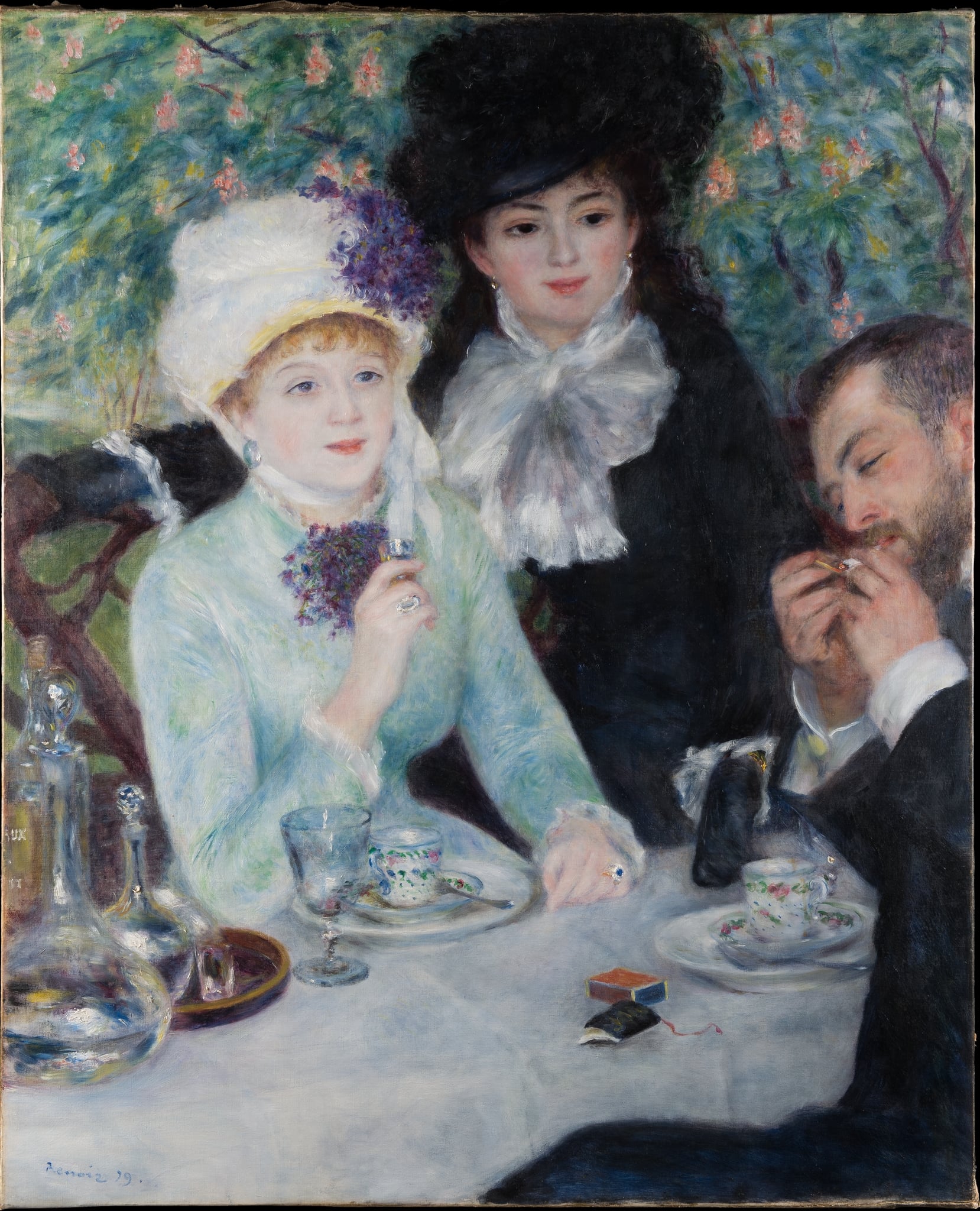
After the Luncheon crystallizes a <strong>suspended instant</strong> of Parisian leisure: coffee finished, glasses dappled with light, and a cigarette just being lit. Renoir’s <strong>shimmering brushwork</strong> and the trellised spring foliage turn the scene into a tapestry of conviviality where time briefly pauses.
The Loge by Pierre-Auguste Renoir

The Loge

Pierre-Auguste Renoir (1874)

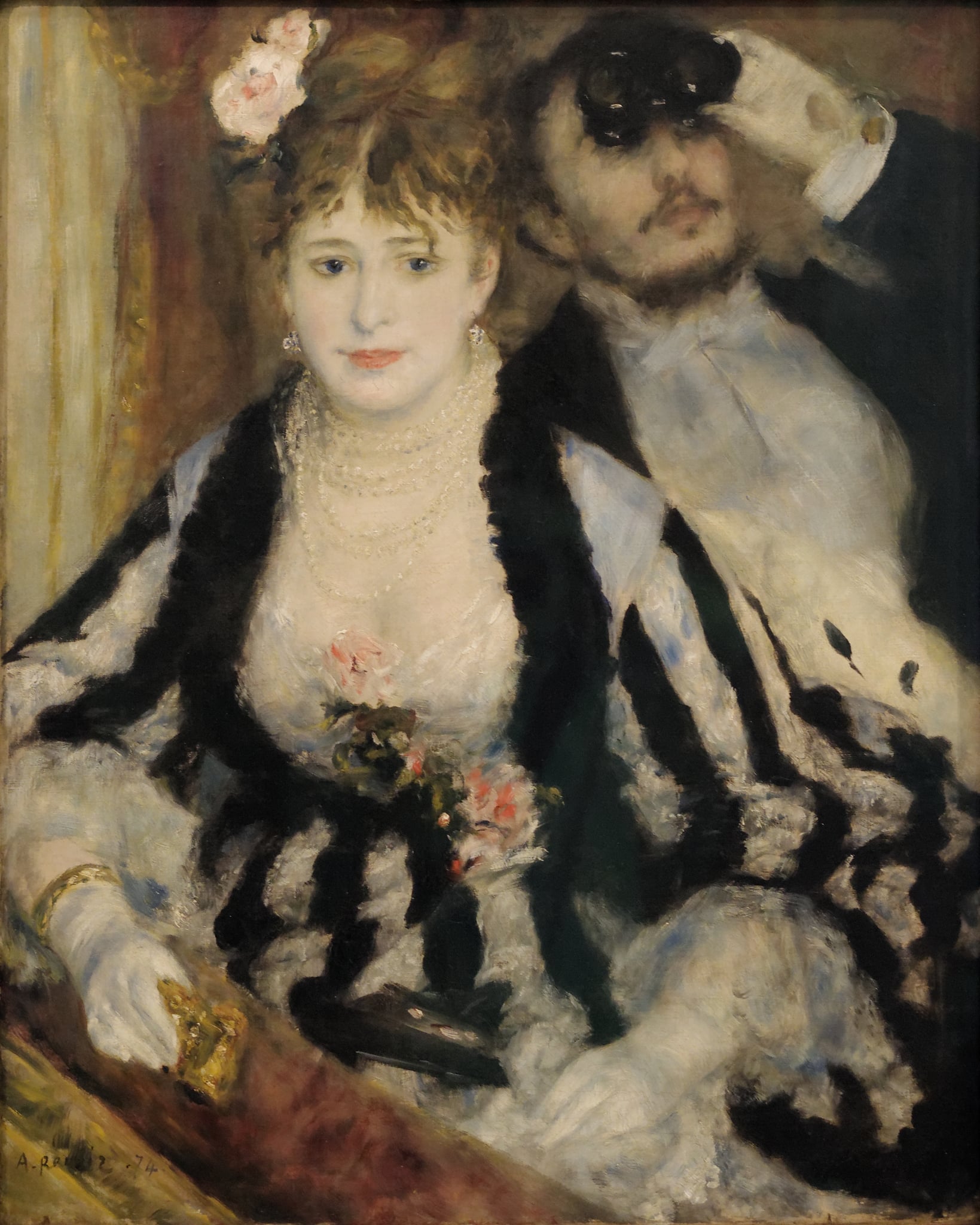
Renoir’s The Loge (1874) turns an opera box into a <strong>stage of looking</strong>, where a woman meets our gaze while her companion scans the crowd through binoculars. The painting’s <strong>frame-within-a-frame</strong> and glittering fashion make modern Parisian leisure both alluring and self-conscious, turning spectators into spectacles <sup>[1]</sup><sup>[2]</sup>.