Ancient Greece and Egypt

by Gustav Klimt

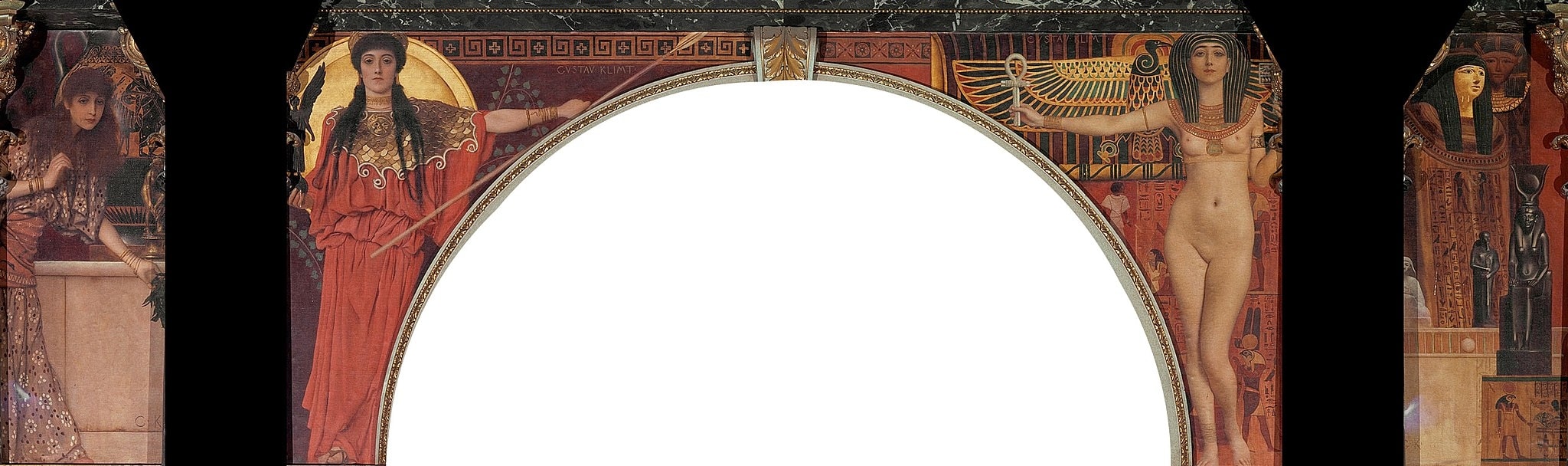
Gustav Klimt’s staircase pair Ancient Greece and Egypt stages two female allegories flanking an empty arch: a robed, animated Athena to the left and a frontal, nude Egyptian goddess aligned with Nekhbet’s vulture to the right. Klimt fuses collection-based citations with ornamental gold, red, and black to declare a canon in which Western art passes through Greece’s humanist clarity and Egypt’s sacral permanence [1][2][3].
💰

Market Value

$18-30 million

How much is Ancient Greece and Egypt worth?

Study Print Studio

Create a personal study print

Build a companion study sheet around the part of this painting that speaks to you most. Choose a detail, shape an interpretation, and walk away with something personal and display-worthy.

Fast Facts

Year
1891
Medium
Oil on canvas
Dimensions
c. 230 × 230 cm (spandrels; approx.)
Location
Kunsthistorisches Museum, Vienna (Grand Staircase)
See all Gustav Klimt paintings in Vienna
Ancient Greece and Egypt by Gustav Klimt (1891) featuring Empty ceremonial arch/portal, Ankh, Vulture of Nekhbet (outspread wings), Nemes headdress with uraeus

Click on any numbered symbol to learn more about its meaning

Meaning & Symbolism

Klimt composes a ceremonial gateway: the empty arch is not mere architecture but a metaphorical passage between foundational traditions. At left, Athena advances in a vermilion peplos, haloed and bordered by the Greek key; an olive sprig rises behind her. Her arm extends outward, a performative welcome that casts Greece as the source of dramatic action, rhetoric, and civic intelligence. At right, the Egyptian counterpart fixes the viewer with a hieratic stare; she stands nude beneath a striped nemes, her chest crossed by a jeweled pectoral with uraei and a spread vulture of Nekhbet, while she raises the ankh of life. The surrounding field compresses shrines, hieroglyphic panels, and funerary statuary; deities such as Horus and Thoth appear, and stacked coffins and ushabti containers construct a miniature survey of Egyptian art. Klimt deliberately violates pharaonic decorum—adult nudity and sensuality—to turn Egypt into a modern symbol of immutable rite and erotic power 12. Across this divide, Klimt argues that Western art is founded on a dialectic: Greece’s human-centered dynamism and Egypt’s sacral, unchanging order. The chromatic and graphic grammar—enamel-like reds, blacks, and golds; strict profiles and frontality; surfaces that read as pattern more than depth—translates academic history into a decorative, proto‑Symbolist language. This is not antiquarian description; it is programmatic ideology. Installed high over the KHM’s grand staircase, the pair literalizes the visitor’s ascent into the museum’s canon: to enter the collections is to pass between these mothers of form. Klimt satisfies the commission’s demand to cite the imperial holdings—on the Greek side, collection types like the bell‑krater and the “Sandal‑Removing Venus” are integrated nearby; on the Egyptian side, object clusters span Old to New Kingdoms—yet the citations are subordinated to an allegorical schema that asserts continuity through opposition 124. The importance of Ancient Greece and Egypt also lies in its position within Klimt’s career. Executed by the “Künstler‑Compagnie” as oil on canvas panels mounted in situ, the staircase cycle marks the apex of Ringstraße historicism even as its planar ornament and eroticized allegory prefigure the Vienna Secession. The frontal goddesses, the conflation of jewelry and architecture, and the gold-suffused surfaces anticipate the later, fully Symbolist Klimt. By feminizing both origins, he casts cultural tradition as generative and seductive—a body of the past that commands devotion while inviting passage into modernity 35.

Explore Deeper with AI

Ask questions about Ancient Greece and Egypt

Popular questions:

Powered by AI • Get instant insights about this artwork

💬 Ask questions about this artwork!

Interpretations

Power & Politics: Empire Staged as Canon

Installed above a ceremonial staircase, the dyad functions as imperial theater: the Habsburg museum choreographs entrance through Greece and Egypt, turning collection categories into political cosmology. Klimt fulfills the brief to cite objects, but he fuses them into an allegorical threshold that ratifies the museum’s role as canon-maker. The result is a soft imperial ideology: empire appears not as conquest but as stewardship of universal origins. The flanking goddesses dignify the ascent, while intercolumniation “still lifes” of vases and coffins read like trophies recoded as pedagogy. This is historicism as statecraft, where architectural placement (high, axial, processional) amplifies authority and naturalizes hierarchy within a grand narrative of Western art 14.

Source: Kunsthistorisches Museum (KHM)

Gender & Sexuality: The Erotic Contract of Origins

Klimt’s Egyptian persona, nude and frontal, violates pharaonic decorum (adult nudity) to fuse ritual with desire; Athena’s vermilion peplos acts as a chromatic foil that heightens sensual charge. This is an early instance of Klimt’s modern female allegory—a seductive interface where the past becomes accessible through erotic charisma. The jeweled pectoral (uraei, Nekhbet vulture) and nemes operate as adorned armor, translating political-religious sovereignty into allure. Such staging anticipates Secessionist strategies in which ornament, gold, and frontal gaze index power through sexual magnetism, making cultural transmission feel visceral rather than didactic. Klimt thus recasts origin not as a text to read but as a body to face, binding knowledge to looking and looking to desire 23.

Source: Kunsthistorisches Museum (KHM); Klimt Foundation

Formal Analysis: From Archaeology to Ornament

The ensemble’s enamel-like reds, blacks, and golds; strict frontality; and graphic compression convert archaeological citation into planar ornament. Relief-like profiles and emblazoned emblems (Greek key, uraei) flatten depth, privileging decorative syntax over illusionism—an early step toward Secession surface logic. While intercolumniation groups function as typological displays (bell‑krater; “Sandal‑Removing Venus”), Klimt subordinates empiricism to a symbolic grid, making objects read as signs in a larger schema. This dual register—archaeological reference within a decorative field—signals the hinge from Ringstraße historicism to proto‑Symbolism, where meaning accrues via pattern, mirror symmetries, and axial address rather than narrative naturalism 13.

Source: Klimt Foundation; Kunsthistorisches Museum (KHM)

Iconography & Sources: Naming Nekhbet

Against popular attributions to Isis or Ma’at, museum-linked research identifies the Egyptian persona with Nekhbet, indexed by the spread vulture and uraei on the pectoral. Klimt’s source-basis in 19th‑century compilations (e.g., Prisse d’Avennes; Boulaq albums) yields a curated toolkit of hieratic emblems repurposed for modern allegory. This is not antiquarian exactitude: by grafting a sacred protective goddess onto a sexualized adult nude, Klimt produces a paradox—ritual purity refracted through fin‑de‑siècle sensuality. The hybrid signals how historicist décor appropriates scholarship to build contemporary myth, compressing Old/Middle/New Kingdom citations into a single, legible icon that reads instantly as “Egypt” while advancing a distinctly modern affect 23.

Source: Kunsthistorisches Museum (KHM); Klimt Foundation

Medium & Site: The Architectural Image

Though often called murals, these are oil on canvas panels engineered for a soaring architectural frame. Their elevated, spandrel format enforces frontality and emblematic clarity, favoring silhouettes and gilded contour over atmospheric depth. In this Gesamtkunstwerk, painting behaves architecturally: jewelry becomes cornice, pectorals act like tympana, and patterned fields read as cladding. The medium’s portability aided workshop production while the site’s processional axis staged the works as a rite of passage into the museum’s taxonomy of art. Such site-specific decorum—didactic yet ornamental—marks the apex of Ringstraße historicism and anticipates Secession’s synthesis of medium, ornament, and space 453.

Source: Kunsthistorisches Museum (KHM); Bridgeman Images; Klimt Foundation

Related Themes

About Gustav Klimt

Gustav Klimt (1862–1918), co-founder of the Vienna Secession, pivoted from controversial public commissions to a decorative-symbolist language in his Golden Period. Drawing on Byzantine mosaics and modern design, he fused opulent surfaces with psychological intensity. By 1908–09, he transformed scandal into canon, and The Kiss became Vienna’s emblem of modern love.
View all works by Gustav Klimt

More by Gustav Klimt

Portrait of Adele Bloch-Bauer I by Gustav Klimt

Portrait of Adele Bloch-Bauer I

Gustav Klimt (1907)

Gustav Klimt’s Portrait of Adele Bloch-Bauer I stages its sitter as a <strong>secular icon</strong>—a living presence suspended in a field of gold that converts space into <strong>pattern and power</strong>. The naturalistic face and hands emerge from a reliquary-like cascade of eyes, triangles, and tesserae, turning light, ornament, and status into the painting’s true subjects <sup>[1]</sup><sup>[2]</sup>.

Sunflower by Gustav Klimt

Sunflower

Gustav Klimt (1907/1908)

Gustav Klimt’s Sunflower turns a single bloom into a <strong>monumental, figure-like presence</strong>. A tapering stack of broad, drooping leaves rises from a <strong>mosaic-like carpet of round blossoms</strong>, crowned by a gold-flecked disc that glows against a cool, stippled field. The work fuses <strong>portrait, icon, and landscape</strong> into one emblem of vitality and quiet sanctity <sup>[1]</sup><sup>[2]</sup>.

Cottage Garden with Sunflowers by Gustav Klimt

Cottage Garden with Sunflowers

Gustav Klimt (1906–1907 (signed 1907))

Cottage Garden with Sunflowers is a square, horizonless field of blooms where a vertical column of <strong>sunflowers</strong> anchors an all-over weave of color and pattern. Klimt fuses <strong>ornament and nature</strong>, turning a humble Litzlberg cottage plot into a radiant matrix of cyclical life and renewal <sup>[1]</sup><sup>[4]</sup><sup>[5]</sup>.

The Kiss by Gustav Klimt

The Kiss

Gustav Klimt (1908 (completed 1909))

The Kiss stages human love as a <strong>sacred union</strong>, fusing two figures into a single, gold-clad form against a timeless field. Klimt opposes <strong>masculine geometry</strong> (black-and-white rectangles) to <strong>feminine organic rhythm</strong> (spirals, circles, flowers), then resolves them in radiant harmony <sup>[1]</sup><sup>[2]</sup>.
The Tree of Life by Gustav Klimt

The Tree of Life

Gustav Klimt (1910–1911 (design; mosaic installed 1911))

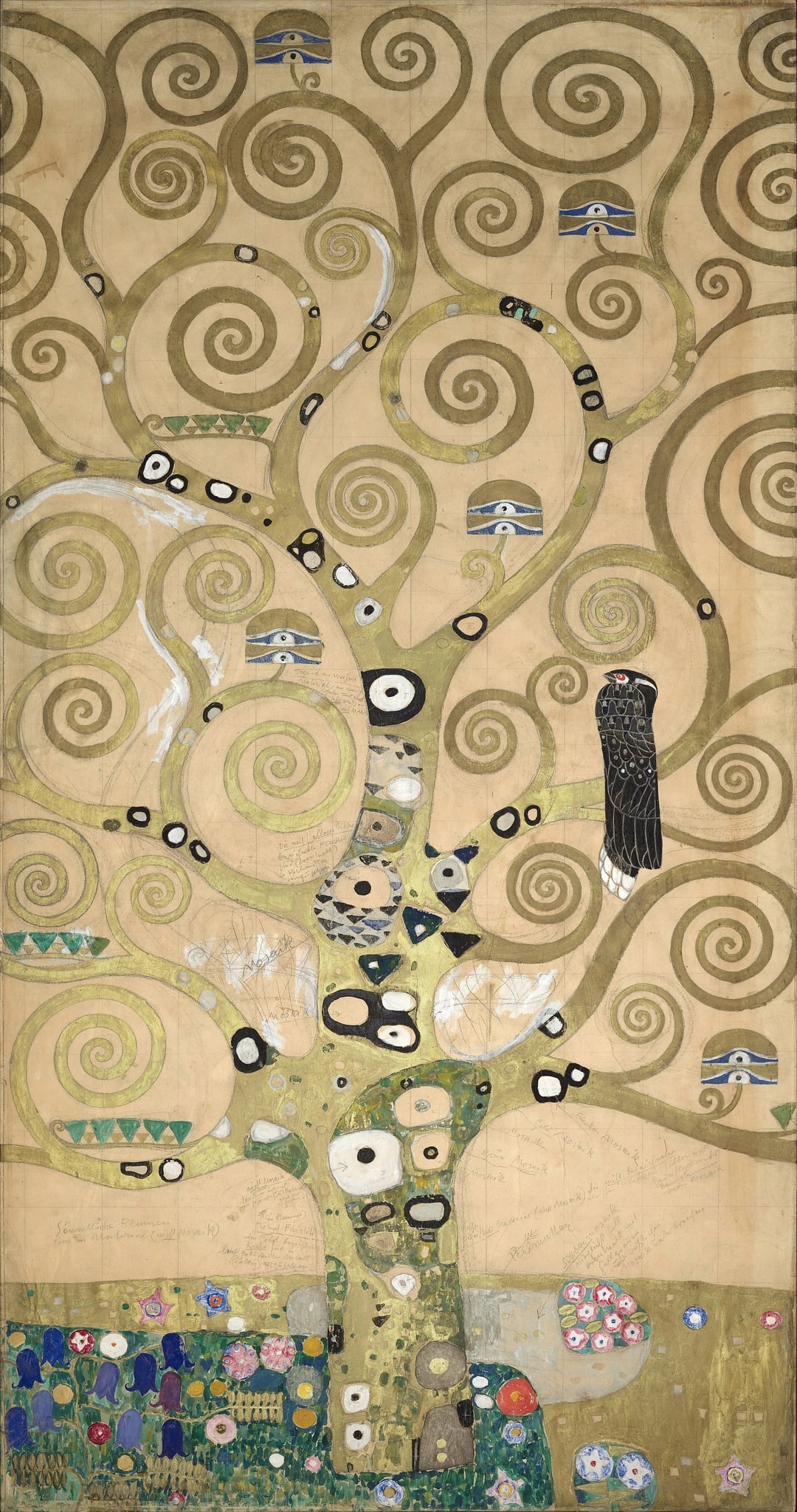
Gustav Klimt’s The Tree of Life crystallizes a <strong>cosmological axis</strong> in a gilded ornamental language: a rooted trunk erupts into <strong>endless spirals</strong>, embedded with <strong>eye-like rosettes</strong> and shadowed by a black, red‑eyed bird. Designed as part of the Stoclet dining‑room frieze, it fuses <strong>symbolism and luxury materials</strong> to link earthly abundance with timeless transcendence <sup>[1]</sup><sup>[2]</sup>.
The Kiss (Lovers) by Gustav Klimt

The Kiss (Lovers)

Gustav Klimt (1907–1908 (Belvedere lists 1908/09))

The Kiss (Lovers) crystallizes Klimt’s <strong>Golden Period</strong> ideal: erotic union staged as a sacred vision. Two bodies fuse beneath a single golden mantle, poised on a flowered ledge at the brink of the unknown, where <strong>pattern becomes symbol</strong> and intimacy becomes icon.