Rosebush (Part 6)

by Gustav Klimt

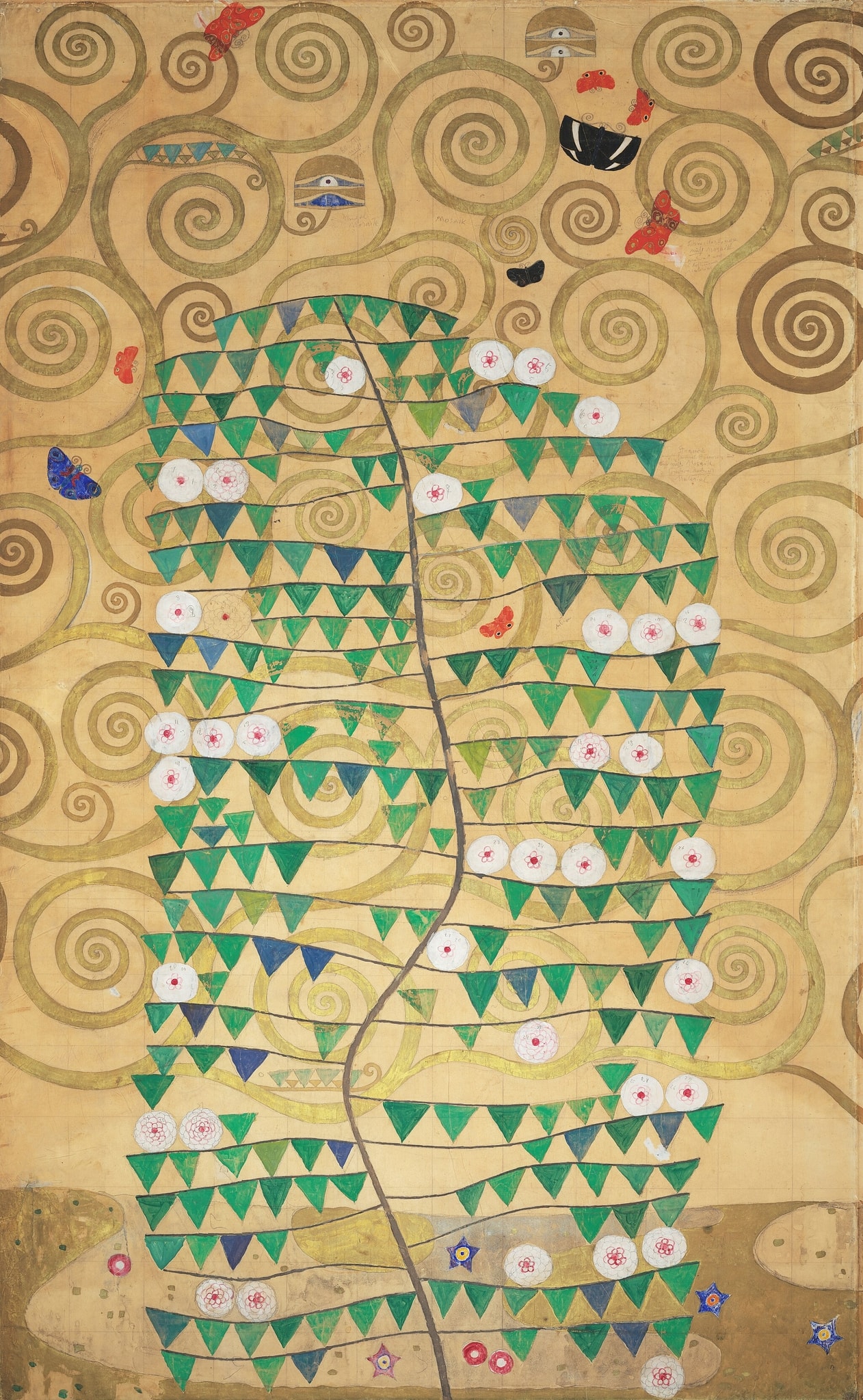
In Rosebush (Part 6), a single, wavering stem climbs through a field of gold spirals while regimented green-and-blue triangular leaves and pale, jewel-like blossoms punctuate its path. Around it, vivid butterflies and star-flowers animate the surface. Klimt fuses nature and ornament into a precious, cyclical emblem of growth, metamorphosis, and renewal.

Study Print Studio

Create a personal study print

Build a companion study sheet around the part of this painting that speaks to you most. Choose a detail, shape an interpretation, and walk away with something personal and display-worthy.

Fast Facts

Year
1910/11
Medium
Gold and silver leaf, graphite, and mixed media on ruled wrapping paper (full-scale working drawing/cartoon for mosaic)
Dimensions
approx. 194.5 × 120.3 cm
Location
MAK – Museum of Applied Arts, Vienna
See all Gustav Klimt paintings in Vienna
Rosebush (Part 6) by Gustav Klimt (1910/11) featuring Sinuous central stem, Gold spirals, Triangular leaf bands, White disk blossoms with red centers

Click on any numbered symbol to learn more about its meaning

Meaning & Symbolism

Rosebush (Part 6) converts a humble shrub into a hieratic sign of life’s persistence. The single, sinuous stem slices vertically through bands of small green and blue triangles, whose strict alignment contrasts with the stem’s free meander—an image of organic impulse contained by rhythmic order. White blossoms, rendered as flat disks with tiny red centers, repeat like inlaid medallions along the bush, making renewal appear not as a singular event but as a patterned recurrence. Behind and around the plant, gold spirals spool outward across the entire field, transforming background into principle and time into ornament: the world itself pulses in scrolls that suggest wind, growth rings, and the infinite unwinding of duration 13. The result is not a naturalistic vignette but a declarative emblem—nature articulated as lawful abundance, where geometry and life coincide. Klimt stages metamorphosis at the picture’s edges: butterflies of black, vermilion, and ultramarine dart through the spiral air. Their presence, and Klimt’s instruction that they be executed "not [in] mosaic—other material," sharpen a key contrast the cartoon is designed to produce in situ—gleaming stone for the structural plant, more delicate, changeable media for the creatures that signify transience 1. This material dramaturgy elevates the rosebush’s steady cycle against the butterflies’ brief flare, binding endurance and ephemerality within one decorative field. Within the Stoclet Frieze’s overarching Tree of Life program—an image of cosmic interconnection and cyclical renewal—the rosebush reads as a focused variation: a vertical counter-motif that domesticates the tree’s branching spirals into garden form while keeping its metaphysical pulse 5. The blossoms’ serial repetition and the leaf-bands’ quasi-processional order echo the frieze’s ritual character, which scholars have linked to both Byzantine mosaic precedent—gold grounds, jewel color, planar shimmer—and an Egyptianizing severity of profile and pattern that turns growth into rite 34. Why Rosebush (Part 6) is important is inseparable from how it was meant to be made. As a full-scale working drawing with gold and silver leaf on ruled paper, complete with notations dividing what should become mosaic from what should not, it is both image and instruction—Klimt’s choreography for a total environment realized by specialized workshops 1. In this sense, the panel embodies the Secessionist ideal that art and craft are one: the rosebush’s meaning depends on the shimmer, hardness, and tactility of the final room, where each spiral, blossom, and wing would catch and release light like a living surface. The cartoon’s fusion of natural emblem, abstract system, and material prescription exemplifies the frieze’s celebrated "modern Byzantinism": an art that makes luxury itself—gold, tesserae, enamel-like color—the vehicle of symbolic thought 3. Rosebush (Part 6) thus stands as a compact credo of Klimt’s Vienna 1900 project: to render life’s cycles—growth, metamorphosis, renewal—as radiant order, so that decoration becomes destiny and ornament, a philosophy of time.

Explore Deeper with AI

Ask questions about Rosebush (Part 6)

Popular questions:

Powered by AI • Get instant insights about this artwork

💬 Ask questions about this artwork!

Interpretations

Medium Reflexivity: A Tactile Grammar of Time

Klimt writes the artwork’s meaning into its fabrication. His notes—“butterflies… not [in] mosaic—other material”—stage a hierarchy of surfaces: the rosebush’s structural elements demand the hard, light-catching logic of tesserae, while ephemeral creatures require softer, changeable media. This is not mere technique; it is a temporal code. Mosaic’s mineral permanence reads as duration, while non-mosaic accents flicker like lived time. The cartoon thus functions as both score and script, prescribing how light will articulate endurance versus transience in the final room. Material difference becomes semantic difference—a classic Secessionist fusion of art and craft where the “how” of making becomes the “what” of meaning 1.

Source: MAK – Museum of Applied Arts, Vienna

Optics of Luxury: Modern Byzantinism as Time Machine

The panel’s gold field is not background but an optical engine. Klimt’s “modern Byzantinism” translates Ravenna’s sacred shimmer into a secular technology of light: a planar, reflective surface that animates the room with micro-shifts as diners move and candles flare. The spiral-laden gold does what narrative cannot—it temporalizes ornament, turning pattern into a durational experience. In this reading, the rosebush’s cycles unfold within a radiant continuum where seeing is modulated by glint, glare, and afterimage. Luxury materials are not decadence; they are instruments for thinking time and presence through vision, an emphatically modern use of ancient means 3.

Source: MoMA, Vienna 1900: Art, Architecture & Design

Egyptianizing Rite: Order, Profile, and Procession

Warlick’s Egyptianizing lens clarifies the panel’s ritual demeanor: disciplined leaf-bands echo processional order, the planar blossoms recall inlaid ornament, and the vertical stem operates like an axial standard. Such “severity of profile and pattern” converts growth into rite, aligning the rosebush with a ceremonial ecology rather than a picturesque garden. This grammar resonates with Klimt’s broader borrowings—stylized flora/fauna, hieratic stillness, and symbolic economy—that reframe natural forms as components of a timeless cultic decorum. The result is less botany than liturgy: a vegetal ritual performed across gold ground, where repetition reads as incantation rather than description 4.

Source: M. E. Warlick, The Art Bulletin

Cyclic Endurance vs. Winged Instant: A Memento-Mori Dialectic

The panel binds endurance and ephemerality within one decorative system. The rosebush’s serial blooms visualize recurrence; butterflies flash at the margins as avatars of brief life. Klimt’s medium instructions heighten this dialectic—stone-like mosaic for the enduring plant, more delicate media for transient wings—so ontology is felt as texture. Framed by the Stoclet “Tree of Life,” the ensemble reads as a compact memento-mori lesson that neither mourns nor moralizes: death is not outside the design but inside the rhythm. Ornament becomes philosophy, where duration and vanishing are co-authors of the same gleam 15.

Source: MAK – Museum of Applied Arts, Vienna; Web Gallery of Art (context)

From Nature to Emblem: Anti-Mimetic Botany

“Not a naturalistic vignette but a declarative emblem”: Klimt abstracts growth into geometry. Disks stand for blossoms, leaf-bands march in alignment, and the sinuous stem negotiates with triangular fields—a negotiation between organic impulse and rule-bound order. In the Secessionist spirit, mimesis yields to system; description yields to structure. The rosebush does not show us a plant so much as it teaches how nature can be legible as law—measured, serial, and integrable into architectural rhythm. This anti-mimetic botany aligns with Klimt’s modern Byzantine program, where flatness, pattern, and reflective ground eclipse depth and modeling as the vehicles of thought 3.

Source: MoMA, Vienna 1900: Art, Architecture & Design

Choreographing a Gesamtkunstwerk: Division of Labor as Meaning

As a full-scale working drawing, the panel is a relay between authorial design and specialized execution by the Wiener Werkstätte and mosaic workshops. Klimt’s annotations distribute tasks across media and hands, scripting how each motif should exist in space and light. This is labor made visible: authorship becomes coordination, and content emerges from the calibrated interplay of disciplines—draftsman, gilder, mosaicist. In Stoclet’s dining room, the rosebush is inseparable from this collaborative machine, exemplifying the Secessionist axiom that art and craft co-produce meaning, with material expertise functioning as an interpretive act, not mere service 1.

Source: MAK – Museum of Applied Arts, Vienna

Related Themes

About Gustav Klimt

Gustav Klimt (1862–1918), co-founder of the Vienna Secession, pivoted from controversial public commissions to a decorative-symbolist language in his Golden Period. Drawing on Byzantine mosaics and modern design, he fused opulent surfaces with psychological intensity. By 1908–09, he transformed scandal into canon, and The Kiss became Vienna’s emblem of modern love.
View all works by Gustav Klimt

More by Gustav Klimt

Sunflower by Gustav Klimt

Sunflower

Gustav Klimt (1907/1908)

Gustav Klimt’s Sunflower turns a single bloom into a <strong>monumental, figure-like presence</strong>. A tapering stack of broad, drooping leaves rises from a <strong>mosaic-like carpet of round blossoms</strong>, crowned by a gold-flecked disc that glows against a cool, stippled field. The work fuses <strong>portrait, icon, and landscape</strong> into one emblem of vitality and quiet sanctity <sup>[1]</sup><sup>[2]</sup>.

Cottage Garden with Sunflowers by Gustav Klimt

Cottage Garden with Sunflowers

Gustav Klimt (1906–1907 (signed 1907))

Cottage Garden with Sunflowers is a square, horizonless field of blooms where a vertical column of <strong>sunflowers</strong> anchors an all-over weave of color and pattern. Klimt fuses <strong>ornament and nature</strong>, turning a humble Litzlberg cottage plot into a radiant matrix of cyclical life and renewal <sup>[1]</sup><sup>[4]</sup><sup>[5]</sup>.

The Kiss by Gustav Klimt

The Kiss

Gustav Klimt (1908 (completed 1909))

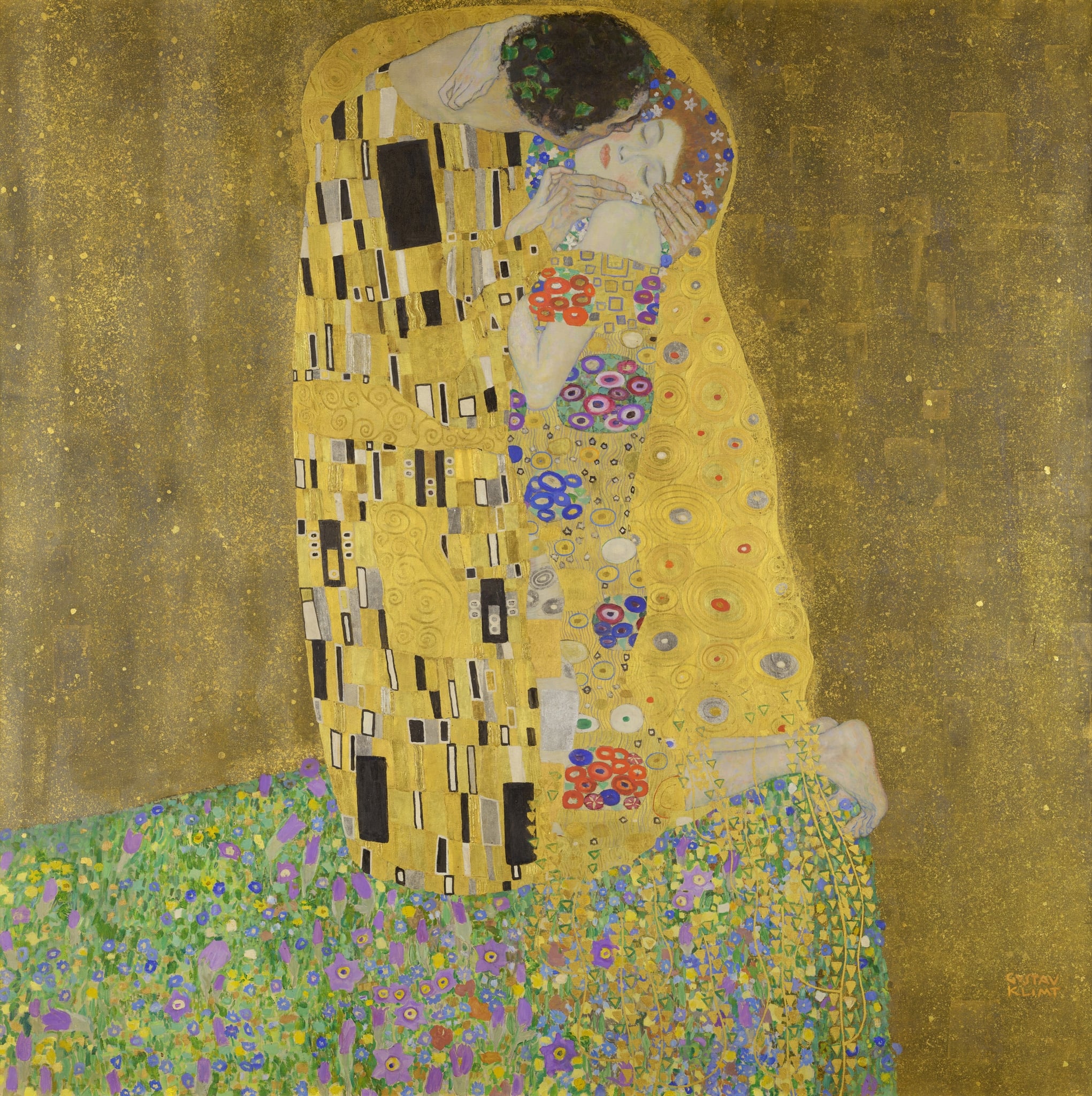
The Kiss stages human love as a <strong>sacred union</strong>, fusing two figures into a single, gold-clad form against a timeless field. Klimt opposes <strong>masculine geometry</strong> (black-and-white rectangles) to <strong>feminine organic rhythm</strong> (spirals, circles, flowers), then resolves them in radiant harmony <sup>[1]</sup><sup>[2]</sup>.
Tree of Life (Part 4) by Gustav Klimt

Tree of Life (Part 4)

Gustav Klimt (1910–1911)

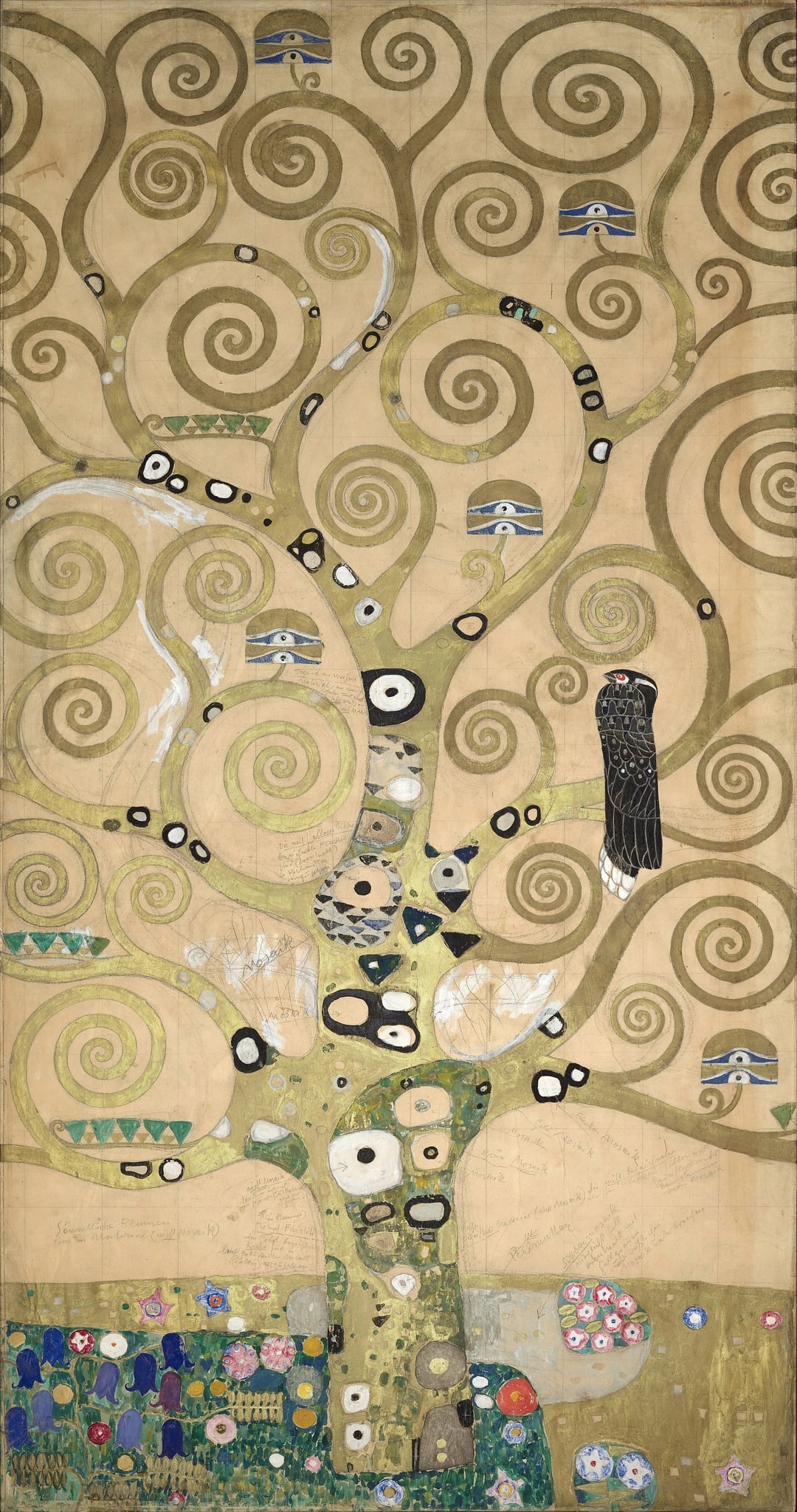
Tree of Life (Part 4) stages a gilded axis where <strong>spiraling branches</strong>, <strong>amuletic eyes</strong>, and a <strong>black raptor</strong> compress growth, vigilance, and mortality into a single ornamental system. The mosaic-like bark and jewel-bright flower carpet root the image in fecund earth while the volutes coil upward toward the abstract and the eternal <sup>[1]</sup><sup>[6]</sup>.

Knight (Part 9) by Gustav Klimt

Knight (Part 9)

Gustav Klimt (1910–1911)

Klimt’s Knight (Part 9) turns chivalry into a <strong>geometric icon</strong>: a vertical standard of stacked bars and checks flanked by <strong>ranks of circles and triangles</strong> that read as shields and studs. Set on a <strong>golden ground</strong> and crowned and undergirded by ornamental zones, it proclaims vigilance and ethical guardianship between the frieze’s figural scenes. <sup>[1]</sup>

The Tree of Life by Gustav Klimt

The Tree of Life

Gustav Klimt (1910–1911 (design; mosaic installed 1911))

Gustav Klimt’s The Tree of Life crystallizes a <strong>cosmological axis</strong> in a gilded ornamental language: a rooted trunk erupts into <strong>endless spirals</strong>, embedded with <strong>eye-like rosettes</strong> and shadowed by a black, red‑eyed bird. Designed as part of the Stoclet dining‑room frieze, it fuses <strong>symbolism and luxury materials</strong> to link earthly abundance with timeless transcendence <sup>[1]</sup><sup>[2]</sup>.