Cottage Garden with Sunflowers

by Gustav Klimt

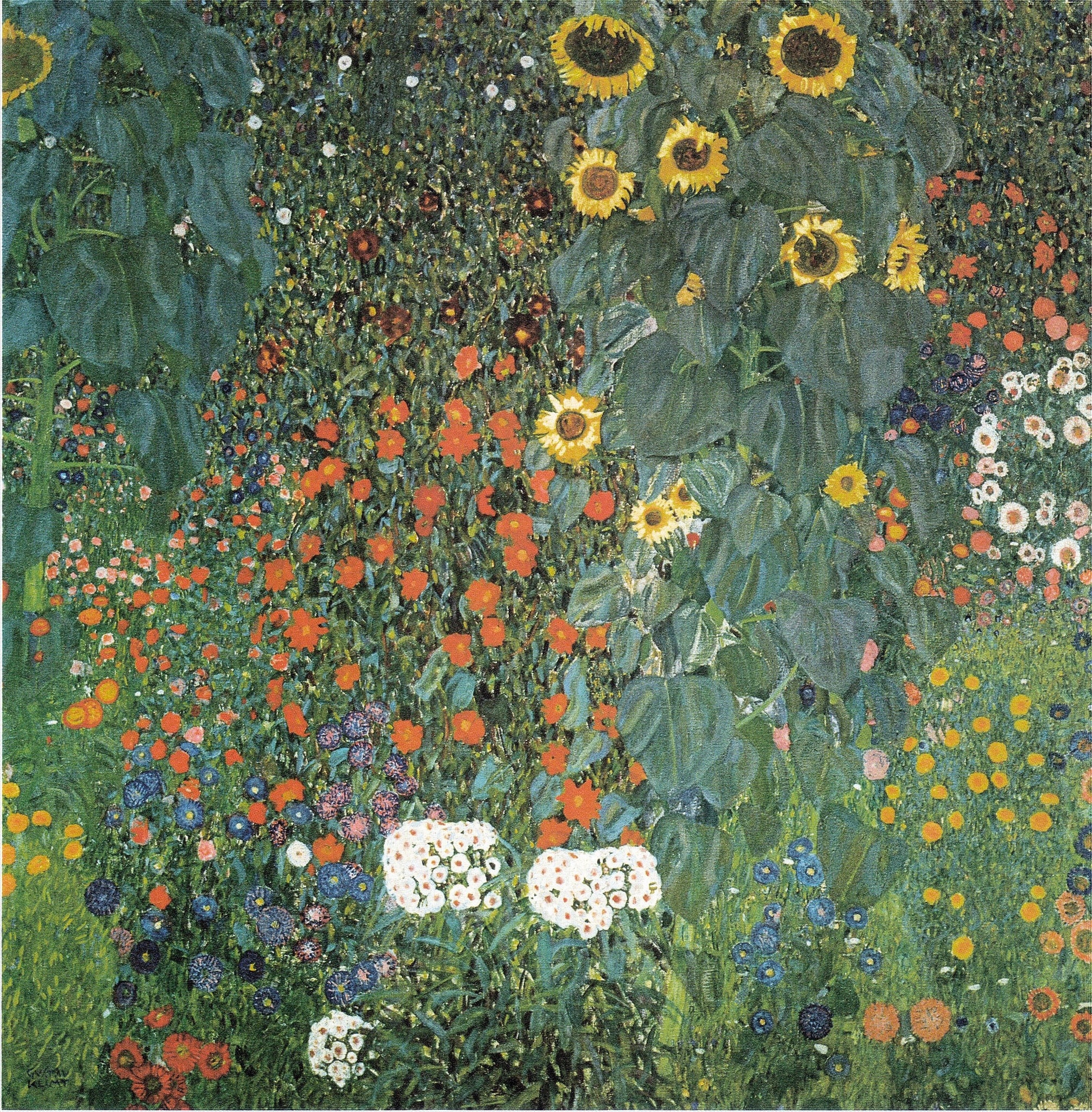
Cottage Garden with Sunflowers is a square, horizonless field of blooms where a vertical column of sunflowers anchors an all-over weave of color and pattern. Klimt fuses ornament and nature, turning a humble Litzlberg cottage plot into a radiant matrix of cyclical life and renewal [1][4][5].

Fast Facts

Year
1906–1907 (signed 1907)
Medium
Oil on canvas
Dimensions
110 × 110 cm
Location
Österreichische Galerie Belvedere, Vienna
See all Gustav Klimt paintings in Vienna
Cottage Garden with Sunflowers by Gustav Klimt (1906–1907 (signed 1907)) featuring Sunflower column (solar axis), Red poppy swaths, White daisies, Violet/blue asters

Click on any numbered symbol to learn more about its meaning

Meaning & Symbolism

Klimt builds the composition as an all-over field that abolishes horizon and sky, compelling the eye to read the surface like a woven ground. The central-right column of sunflowers functions as a solar axis, a compositional spine whose circular disks punctuate the green with golden beats; against this vertical, clusters of red-orange poppies, white daisies, and violet asters aggregate into rhythmic swaths. The square format intensifies that tapestry effect: forms are distributed edge to edge, with no perspectival escape, so that every petal, dot, and leaf participates in a continuous decorative order 23. The visual evidence is decisive—the sunflower stalks rise like sentinels, while smaller blossoms tessellate the bottom half into modular bands—demonstrating Klimt’s strategy of turning the flux of summertime growth into a stable ornamental system. As Frank Whitford observed of these landscapes, they “unfurl like tapestries,” arresting the fleeting and rendering nature as an immutable paradise 3. This decorative logic is not a retreat from meaning but its vehicle. By selecting a cottage plot in Litzlberg am Attersee—the “Brauhausgarten,” a working garden rather than an aristocratic park—Klimt elevates the ordinary into a symbol of cyclical fecundity and domestic sanctuary 5. Belvedere educators identify sunflowers with dahlias, marigolds, asters, and phlox here, signaling not botanical cataloguing alone but a curated palette of forms that can repeat, rhyme, and knit the surface into pattern 4. The dense stippling of greens behind the sunflower column compresses depth and turns foliage into a granular field; across the lower register, round blossoms read as units in a visual grammar, echoing the circular motifs of Klimt’s golden-period portraits. In this way, the picture asserts a Secessionist truth: ornament is not applied; it is discovered in nature and revealed through art. The result is a harmonization of art and life—Jugendstil’s core aspiration—where the decorative becomes a metaphysics of growth 2. Symbolically, the sunflower column anchors the painting as a vertical “life-line,” a radiant conduit of energy rising through the profusion below. Its disks face outward like small suns, stabilizing a world otherwise teeming with lateral scatter; the eye returns to them as to a pulse. Around that axis, the profuse cottage flora embodies repetition within variety—“multiplicity in simplicity,” in Johannes Dobai’s phrase—suggesting seasonal return rather than heroic singularity 3. The square’s equilibrium and the horizon’s erasure suspend time, supporting Belvedere’s reading of Klimt’s gardens as spaces where flowers “never wither,” an eternal blooming achieved through pattern 4. The meaning of Cottage Garden with Sunflowers, then, is the assertion that life’s sensuous abundance can be held—momentarily but convincingly—inside an ornamental order without being diminished. This is why Cottage Garden with Sunflowers is important within Klimt’s oeuvre and Viennese Modernism: it translates the gilded, iconic stillness of his portraits into the democratic subject of a farm garden, making modern decorative art a vehicle for contemplating nature’s renewing force 124.

Explore Deeper with AI

Ask questions about Cottage Garden with Sunflowers

Popular questions:

Powered by AI • Get instant insights about this artwork

💬 Ask questions about this artwork!

Interpretations

Formal Analysis

Klimt’s square, horizonless format compresses depth so the eye navigates a continuous textile-like field. The vertical sunflower column sets a measured rhythm of circular accents against lateral swaths of smaller blooms, creating a counterpoint of axis vs. spread. This is not mere scenic description but a calculated orchestration of modules—disks, dots, and leaf-shingles—into a near-mosaic. Frank Whitford’s observation that Klimt’s landscapes “unfurl like tapestries” captures how the painting treats foliage as pattern units rather than perspectival markers. The result echoes the decorative logics of Klimt’s golden portraits—flattened planes, iterated motifs—recast in vegetal terms, so that the garden is perceived as a woven surface rather than a recessive vista 34.

Source: Frank Whitford (via Christies); Neue Galerie/Prestel, Klimt Landscapes

Social History (Everyday Ornament)

By picturing the Litzlberg “Brauhausgarten,” a working cottage plot rather than an aristocratic park, Klimt advances a quiet social claim: the ordinary domestic garden merits the same ornamental exaltation as elite subjects. This aligns with Vienna Secession ambitions to dissolve hierarchies between fine and applied arts and to integrate design with everyday life. The composition’s all-over field and square format turn maintenance, sowing, and cyclical growth—daily routines of non-elite life—into high aesthetic order. In short, the canvas democratizes beauty: it translates a local, cared-for plot into a universal decorative system, demonstrating how modern art can dignify middling spaces through pattern and form 25.

Source: Belvedere Museum (Brauhausgarten product note); Belvedere exhibition pressbook

Symbolic Reading (Solar Axis)

The sunflower column acts as a solar conduit—a vertical “life-line” whose circular heads stabilize the painting’s lateral profusion. This axis recalls Klimt’s fascination with emblematic disks in his golden-period works; here they are naturalized as blooms whose faces radiate energy. The anthropomorphic tendency in Klimt’s related Sunflower (1907/08) shades this column with a totemic presence, like sentinels mediating light to the garden below. Around it, asters, phlox, and marigolds proliferate as serial units, staging multiplicity within order and turning seasonal abundance into symbolic permanence—what Belvedere readings call a world where flowers “never wither.” The axis binds growth to patterned eternity, fusing vitality with design 13.

Source: Belvedere educator’s guide; Christies (Dobai/Whitford synthesis)

Phenomenology of Viewing

The painting engineers a distinctive viewing behavior: without a horizon, the eye cannot escape but must scan—hovering between near detail (stipples, petals) and an emergent, quilt-like totality. The square format suspends directional bias, promoting a meditative, centripetal attention in which perception oscillates from part to pattern. Such sustained looking mirrors Secessionist ideals of immersive ornament, where contemplation fuses with sensation. The work thus operates phenomenologically: it teaches the viewer to experience nature as an equilibrium of repeats, not as a window onto depth. Neue Galerie scholarship stresses how Klimt’s landscapes solicit prolonged, absorptive spectatorship—a modern decorative sublime achieved by serial variation across a compressed field 43.

Source: Neue Galerie/Prestel, Klimt Landscapes; Frank Whitford (via Christies)

Biographical Context (Attersee Working Retreat)

Painted during Klimt’s Attersee summers, the canvas reflects a rhythm of seasonal retreat that shaped his turn to square formats and close-cropped, horizonless views. Away from Vienna’s heat and cultural politics, Klimt developed landscapes “for his own pleasure,” refining a grammar of vegetal modules under rural time. The domestic garden—linked to Emilie Flöge’s circle and local sites—offered both respite and laboratory: a setting where observation could be distilled into decorative law. Belvedere’s press materials and Klimt-Foundation studies underscore how these summers catalyzed his mature landscape language, yoking leisure, intimacy of place, and systematic experimentation in color, motif, and format 56.

Source: Belvedere exhibition pressbook; Klimt-Foundation (Attersee summers)

Erotic Ecology (Panerotic Life-Force)

Critics have described Klimt’s landscapes as suffused with a panerotic vitality: repetitions of leaves and blooms pulse like living tissue, sublimating erotic charge from his portraits into vegetal pattern. In Cottage Garden with Sunflowers, the rhythmic alternation of circular blossoms and stippled greens reads as biomorphic cadence—growth as desire, desire as growth. This sensual undercurrent is not pictorial excess; it is the engine of the painting’s order, where fecundity is disciplined into ornament. The garden becomes a diagram of life-force domesticated, its abundance rendered stable without losing tactile immediacy—an equilibrium that 1900s viewers recognized as Klimt’s signature reconciliation of sensuality and structure 3.

Source: Christies catalog essay (summarizing period criticism via Nebehay and Dobai)

Related Themes

About Gustav Klimt

Gustav Klimt (1862–1918), co-founder of the Vienna Secession, pivoted from controversial public commissions to a decorative-symbolist language in his Golden Period. Drawing on Byzantine mosaics and modern design, he fused opulent surfaces with psychological intensity. By 1908–09, he transformed scandal into canon, and The Kiss became Vienna’s emblem of modern love.
View all works by Gustav Klimt

More by Gustav Klimt

Portrait of Adele Bloch-Bauer I by Gustav Klimt

Portrait of Adele Bloch-Bauer I

Gustav Klimt (1907)

Gustav Klimt’s Portrait of Adele Bloch-Bauer I stages its sitter as a <strong>secular icon</strong>—a living presence suspended in a field of gold that converts space into <strong>pattern and power</strong>. The naturalistic face and hands emerge from a reliquary-like cascade of eyes, triangles, and tesserae, turning light, ornament, and status into the painting’s true subjects <sup>[1]</sup><sup>[2]</sup>.

Sunflower by Gustav Klimt

Sunflower

Gustav Klimt (1907/1908)

Gustav Klimt’s Sunflower turns a single bloom into a <strong>monumental, figure-like presence</strong>. A tapering stack of broad, drooping leaves rises from a <strong>mosaic-like carpet of round blossoms</strong>, crowned by a gold-flecked disc that glows against a cool, stippled field. The work fuses <strong>portrait, icon, and landscape</strong> into one emblem of vitality and quiet sanctity <sup>[1]</sup><sup>[2]</sup>.

The Kiss by Gustav Klimt

The Kiss

Gustav Klimt (1908 (completed 1909))

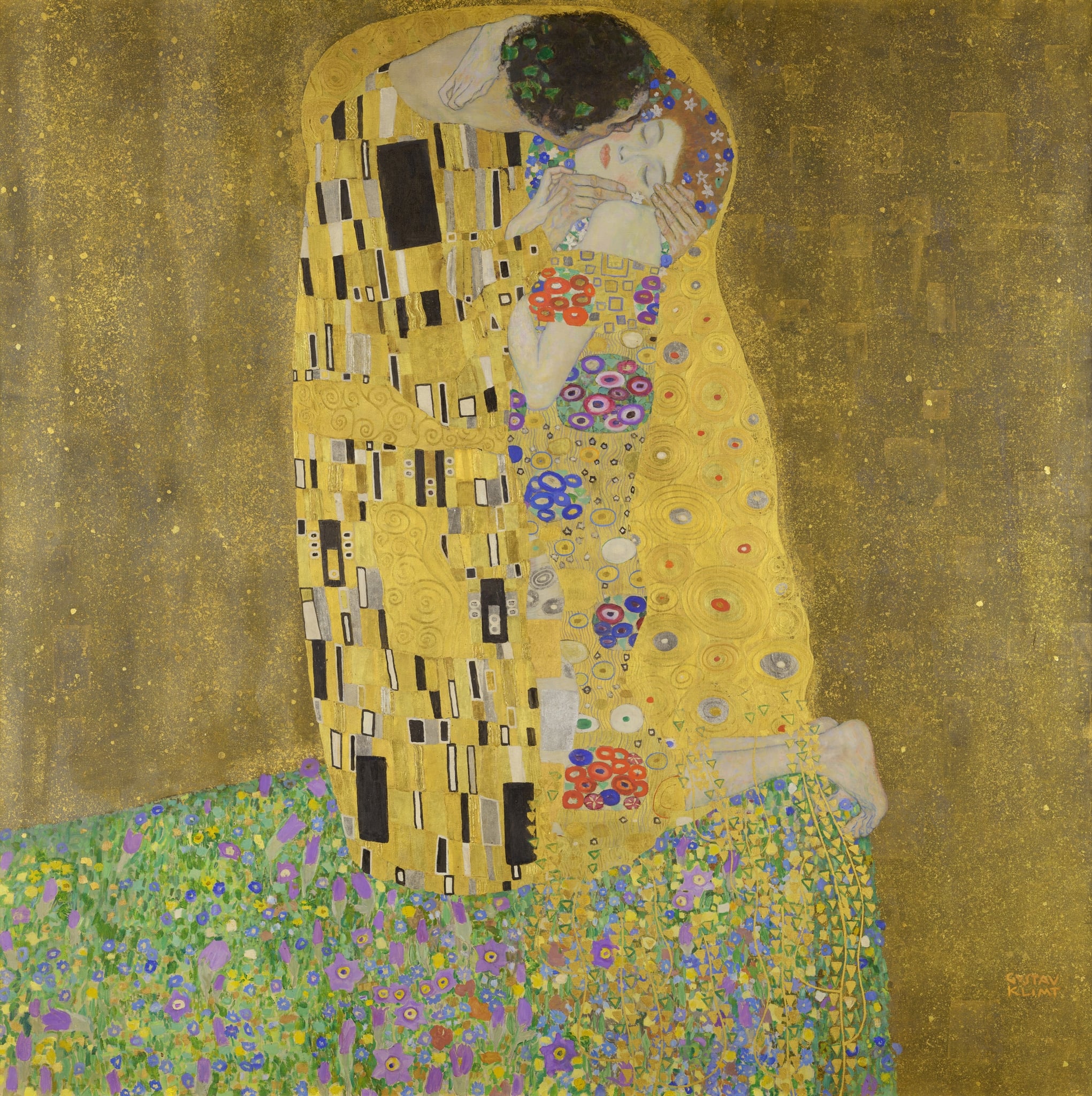
The Kiss stages human love as a <strong>sacred union</strong>, fusing two figures into a single, gold-clad form against a timeless field. Klimt opposes <strong>masculine geometry</strong> (black-and-white rectangles) to <strong>feminine organic rhythm</strong> (spirals, circles, flowers), then resolves them in radiant harmony <sup>[1]</sup><sup>[2]</sup>.
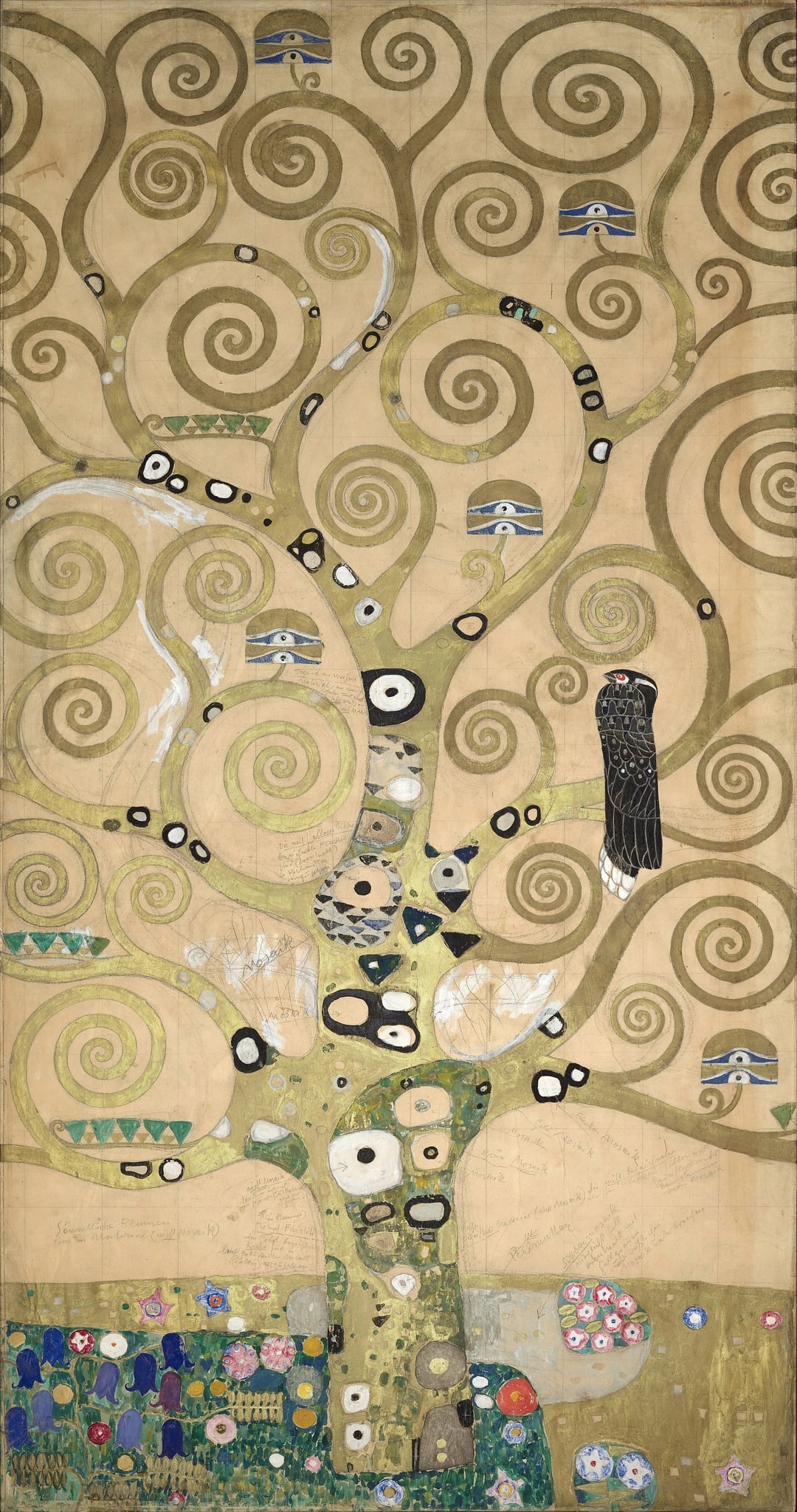
The Tree of Life by Gustav Klimt

The Tree of Life

Gustav Klimt (1910–1911 (design; mosaic installed 1911))

Gustav Klimt’s The Tree of Life crystallizes a <strong>cosmological axis</strong> in a gilded ornamental language: a rooted trunk erupts into <strong>endless spirals</strong>, embedded with <strong>eye-like rosettes</strong> and shadowed by a black, red‑eyed bird. Designed as part of the Stoclet dining‑room frieze, it fuses <strong>symbolism and luxury materials</strong> to link earthly abundance with timeless transcendence <sup>[1]</sup><sup>[2]</sup>.
The Kiss (Lovers) by Gustav Klimt

The Kiss (Lovers)

Gustav Klimt (1907–1908 (Belvedere lists 1908/09))

The Kiss (Lovers) crystallizes Klimt’s <strong>Golden Period</strong> ideal: erotic union staged as a sacred vision. Two bodies fuse beneath a single golden mantle, poised on a flowered ledge at the brink of the unknown, where <strong>pattern becomes symbol</strong> and intimacy becomes icon.

Flowering Poppies by Gustav Klimt

Flowering Poppies

Gustav Klimt (1907)

Gustav Klimt’s <strong>Flowering Poppies</strong> (1907) turns a meadow into a shimmering, all-over field where botany becomes <strong>ornament</strong>. A square canvas packed with red poppies, daisies, and fruiting trees compresses depth and invites a drifting gaze rather than linear recession <sup>[1]</sup><sup>[2]</sup>. The result is a sensuous, immersive vision that fuses observed nature with <strong>decorative abstraction</strong> <sup>[2]</sup>.