Sunflower

by Gustav Klimt

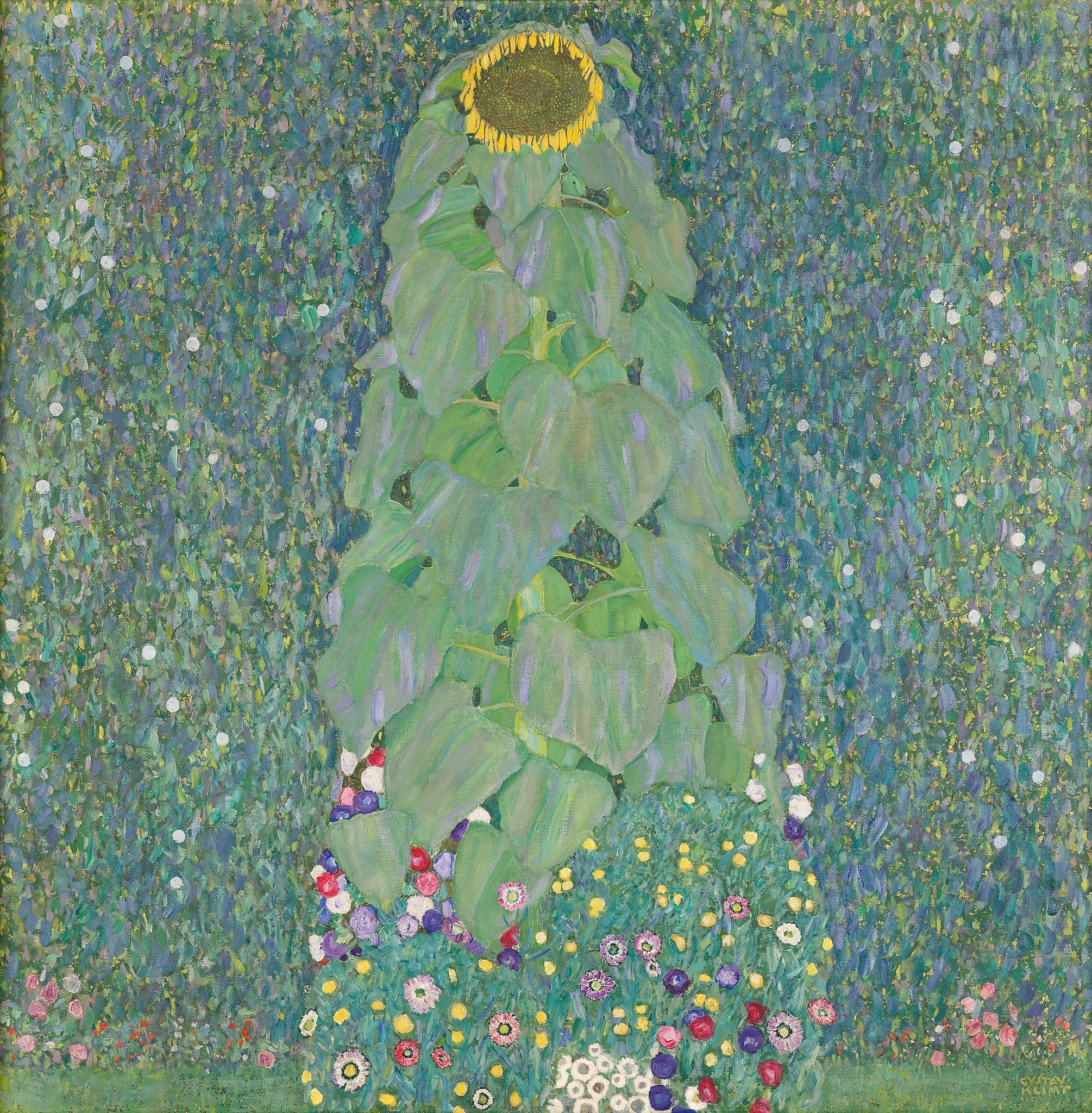
Gustav Klimt’s Sunflower turns a single bloom into a monumental, figure-like presence. A tapering stack of broad, drooping leaves rises from a mosaic-like carpet of round blossoms, crowned by a gold-flecked disc that glows against a cool, stippled field. The work fuses portrait, icon, and landscape into one emblem of vitality and quiet sanctity [1][2].
💰

Market Value

$15-75 million

How much is Sunflower worth?

Fast Facts

Year
1907/1908
Medium
Oil and gold leaf on canvas
Dimensions
110 × 110 cm
Location
Upper Belvedere (Österreichische Galerie Belvedere), Vienna
See all Gustav Klimt paintings in Vienna
Sunflower by Gustav Klimt (1907/1908) featuring Gold-flecked sunflower head (nimbus/solar disc), Tapering mantle of drooping leaves, Central vertical column/stem, Mosaic carpet of round meadow blossoms

Click on any numbered symbol to learn more about its meaning

Meaning & Symbolism

Klimt casts the sunflower as a solitary sovereign. Centered within the square, its leaves stack like articulated scales, forming a tapering column that reads as a cloaked body; the slightly tilted head, edged with yellow petals, assumes the role of a nimbus above a patterned ground. The surrounding hedge dissolves into a dense all-over of blue-green strokes and dots, so the figure seems to both emerge from and radiate into its environment. This compositional fusion asserts a symbolic identity: the plant is at once an individual and a shrine, a living presence absorbing light and re-emitting it as ornament. The gold-flecked disc at the top—subtly scintillating within the painted center—anchors the work in Klimt’s Golden Period vocabulary, where precious surfaces bestow iconic charge on secular subjects 23. In this setting, the sunflower’s upward thrust toward the light signals resilient growth; its solitude, set against the flicker of the seasons in the stippled field, proposes endurance amid flux 12. Klimt intensifies this icon-making through anthropomorphic cues. The drooping leaves broaden and overlap like a protective mantle, echoing the silhouette of a cloaked figure; this Marian “mantle” analogy has long framed readings of the work as a nature-born Madonna of Mercy, shielding the bright, beadlike meadow blossoms gathered at its base 1. Contemporary reception already sensed a personified presence—Ludwig Hevesi’s “verliebte Fee,” a “fairy in love,” names the flower as a feeling subject rather than a botanical specimen 1. Some scholars further see a veiled portrait of Emilie Flöge: the cascading leaves resemble a reform dress, and the slightly cocked head suggests a poised sitter—an artful rapprochement between portrait and landscape that Klimt pursued at the height of 1907/08 2. While this identification remains interpretive, the painting undeniably treats the plant as a subject, not a motif. The square format and carpet of round, candy-bright flowers compress depth into pattern, aligning Sunflower with Klimt’s Attersee landscapes, where nature becomes a woven field of color and rhythm 12. In this tapestry, the sunflower’s central axis supplies the human measure: a vertical, breathing column that turns the meadow into a stage for presence. Sunflower also articulates a modern spiritualism grounded in material means. Klimt’s meticulous stippling, the calibrated chromatic cool of the hedge, and the restrained, luminous metal at the head produce a quiet hieratic effect without narrative props. The painting functions as a votive for renewal and fecundity: the meadow’s circles pulse like seeds or cells, while the column’s ascent suggests aspiration tempered by gravity in the drooping leaves. This synthesis clarifies why Sunflower is important within the Vienna Secession: it demonstrates how ornament can carry meaning, uniting symbol and sensation. In 1908, at the moment Klimt consolidated his golden idiom for the Kunstschau, such a work declared that modern painting could reconcile intimate observation with monumental form, turning a single garden plant into a timeless emblem of life’s self-contained vitality 24.

Explore Deeper with AI

Ask questions about Sunflower

Popular questions:

Powered by AI • Get instant insights about this artwork

💬 Ask questions about this artwork!

Interpretations

Material Poetics (Gold in a Landscape)

Klimt’s decision to lace a botanical subject with gold leaf reframes the status of landscape: the sunflower’s seeded disc subtly scintillates, importing the liturgical aura of his Golden Period into a non-figural motif. Rather than a full gold ground, he deploys “countless gold dots” as a dispersed halo, letting metallic highlights puncture the cool, stippled hedge and activate a slow, devotional shimmer. This calibrated sparseness matters: it keeps the image rooted in observed nature while granting it iconic charge. Technical campaigns at the Belvedere (IRR 10500) underscore ongoing attention to Klimt’s layered facture, even as findings remain primarily conservational. Here, material choices are not garnish but meaning-bearing—a test-case for Secessionist belief that ornament can hold metaphysical weight without narrative scaffolding 23.

Source: Belvedere Museum; Klimt-Database (Klimt Foundation)

Fashion, Gender, and the Veiled Portrait

The overlapping, tapering leaves read like a reform dress, aligning Sunflower with Vienna’s dress-reform culture and with Klimt’s photographs of Emilie Flöge in flowing garments. Scholars have proposed a “hidden portrait” of Flöge: the cocked “head,” cloaked “body,” and vertical poise echo a studio sitter while remaining avowedly vegetal. Klimt thus fuses genres—portrait and landscape—at the height of 1907/08, translating feminine presence into botanical silhouette. This strategy dodges the psychic charge and social risk of overt portraiture while preserving intimacy and charisma. The result exemplifies the Secession’s porous borders between fine art, fashion, and design, and expands “likeness” to include analogical form and sensorial equivalence rather than facial depiction 12.

Source: Belvedere Museum; Klimt-Database (Klimt Foundation)

Secular Devotion and the Schutzmantel Schema

Sunflower builds a votive dynamic without saints. The leaf-mantle’s protective arc recalls the medieval Schutzmantelmadonna (Madonna of Mercy), but Klimt replaces doctrinal content with sensory ritual: stipple, cool chroma, and calibrated gilding. The plant becomes a shrine to fecundity and renewal, its central axis functioning like a reliquary housing seasonal life. This is not parody but translation—the sacred redistributed into matter and light. Such an approach typifies Klimt’s symbolist modernism: a hieratic effect achieved through surface orchestration rather than iconographic narration, aligning private spiritualism with the Secession’s decorative philosophy 12.

Source: Belvedere Museum; Klimt-Database (Klimt Foundation)

All-Overness and the Modern Picture Plane

The square format and dense, stippled hedge create an all-over field that compresses depth into oscillating pattern, a signature of Klimt’s Attersee practice. Against this textile-like continuum, the sunflower’s vertical column supplies a “human measure,” stabilizing the eye while letting lateral rhythms weave around it. The image thus negotiates mimesis and abstraction: natural forms are observed yet subsumed into a decorative order that privileges surface continuity. This solution aligns Klimt with broader modernist tendencies toward flatness while preserving motif legibility, demonstrating how Secessionist painting could reconcile optical pleasure, structural rigor, and symbolic surplus in a single, self-contained field 1.

Source: Belvedere Museum

Reception and Personification

Contemporary critic Ludwig Hevesi called the bloom a “verliebte Fee”—a “fairy in love”—registering how viewers immediately read personhood into Klimt’s plant. That phrase captures the work’s psychological gambit: it invites empathy through anthropomorphic cues while withholding the face, letting projection do the rest. The sunflower becomes a “feeling subject,” poised between object and persona. This reception history clarifies why solitude here reads as dignity rather than lack, and why the painting sustains allegorical resonance without narrative. In Klimt’s hands, personification is less literary trope than perceptual strategy, coaxing the viewer to complete the subject through affective inference 15.

Source: Belvedere Museum; Ludwig Hevesi via Belvedere/Google Arts & Culture

Kunstschau 1908 and the Secessionist Manifesto

Positioned at the moment of the Kunstschau 1908, Sunflower operates like a manifesto in miniature: it argues that ornament and modern spirituality are compatible, and that landscape can carry iconic force. The Klimt-Database situates the work within the artist’s Golden Period program completed by June 1, 1908, alongside landscapes that found eager buyers during the show’s first week. In this milieu, Sunflower’s synthesis—material preciousness, all-over field, anthropomorphic focus—models the Secession’s credo that art should unite design, nature, and inner life. The painting thus served both as a contemplative object and as a proof-of-concept for Vienna’s modern decorative ideal 24.

Source: Klimt-Database (Klimt Foundation); Britannica

Related Themes

About Gustav Klimt

Gustav Klimt (1862–1918), co-founder of the Vienna Secession, pivoted from controversial public commissions to a decorative-symbolist language in his Golden Period. Drawing on Byzantine mosaics and modern design, he fused opulent surfaces with psychological intensity. By 1908–09, he transformed scandal into canon, and The Kiss became Vienna’s emblem of modern love.
View all works by Gustav Klimt

More by Gustav Klimt

Portrait of Adele Bloch-Bauer I by Gustav Klimt

Portrait of Adele Bloch-Bauer I

Gustav Klimt (1907)

Gustav Klimt’s Portrait of Adele Bloch-Bauer I stages its sitter as a <strong>secular icon</strong>—a living presence suspended in a field of gold that converts space into <strong>pattern and power</strong>. The naturalistic face and hands emerge from a reliquary-like cascade of eyes, triangles, and tesserae, turning light, ornament, and status into the painting’s true subjects <sup>[1]</sup><sup>[2]</sup>.

Cottage Garden with Sunflowers by Gustav Klimt

Cottage Garden with Sunflowers

Gustav Klimt (1906–1907 (signed 1907))

Cottage Garden with Sunflowers is a square, horizonless field of blooms where a vertical column of <strong>sunflowers</strong> anchors an all-over weave of color and pattern. Klimt fuses <strong>ornament and nature</strong>, turning a humble Litzlberg cottage plot into a radiant matrix of cyclical life and renewal <sup>[1]</sup><sup>[4]</sup><sup>[5]</sup>.

The Kiss by Gustav Klimt

The Kiss

Gustav Klimt (1908 (completed 1909))

The Kiss stages human love as a <strong>sacred union</strong>, fusing two figures into a single, gold-clad form against a timeless field. Klimt opposes <strong>masculine geometry</strong> (black-and-white rectangles) to <strong>feminine organic rhythm</strong> (spirals, circles, flowers), then resolves them in radiant harmony <sup>[1]</sup><sup>[2]</sup>.
The Tree of Life by Gustav Klimt

The Tree of Life

Gustav Klimt (1910–1911 (design; mosaic installed 1911))

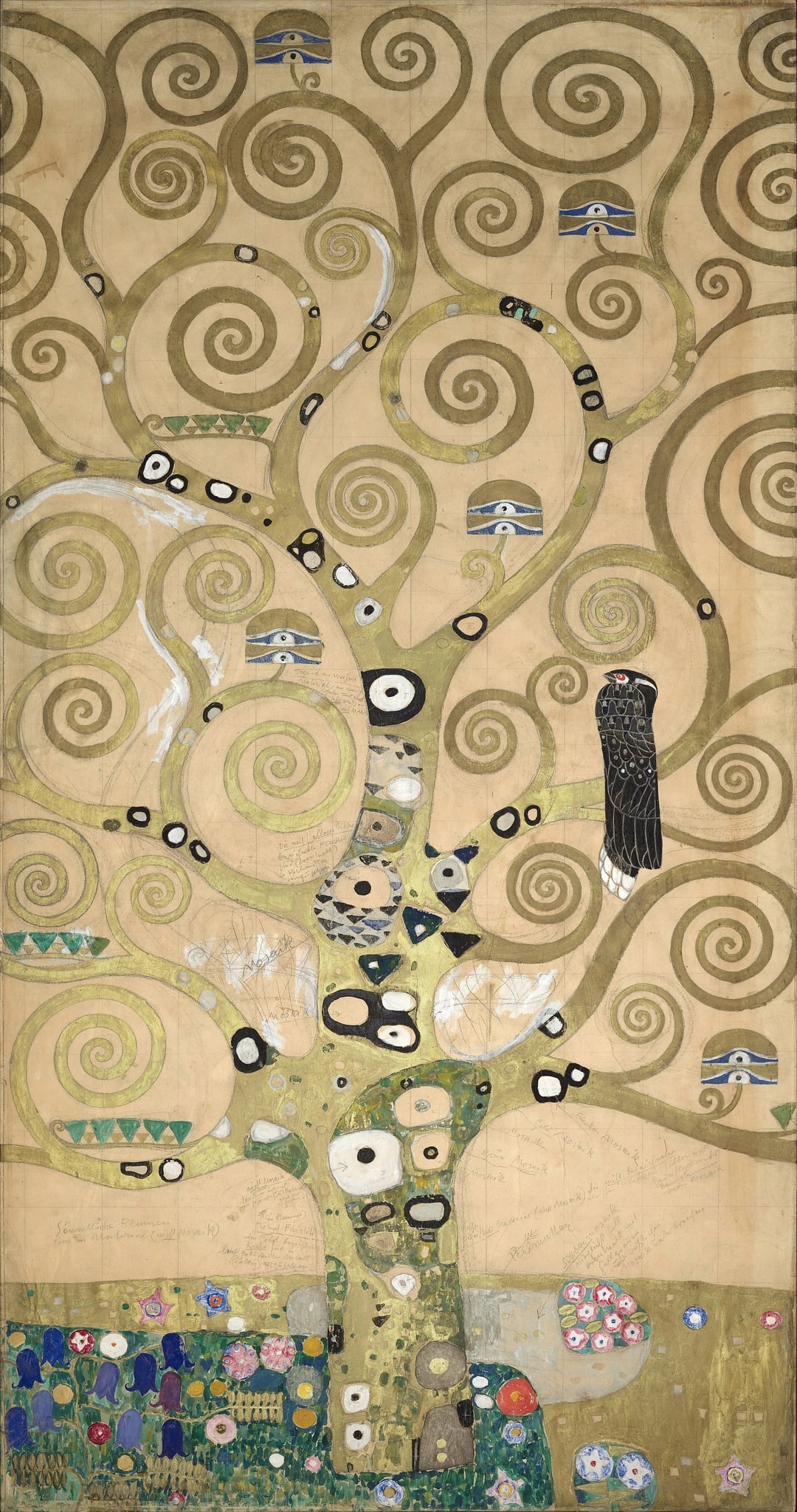
Gustav Klimt’s The Tree of Life crystallizes a <strong>cosmological axis</strong> in a gilded ornamental language: a rooted trunk erupts into <strong>endless spirals</strong>, embedded with <strong>eye-like rosettes</strong> and shadowed by a black, red‑eyed bird. Designed as part of the Stoclet dining‑room frieze, it fuses <strong>symbolism and luxury materials</strong> to link earthly abundance with timeless transcendence <sup>[1]</sup><sup>[2]</sup>.
The Kiss (Lovers) by Gustav Klimt

The Kiss (Lovers)

Gustav Klimt (1907–1908 (Belvedere lists 1908/09))

The Kiss (Lovers) crystallizes Klimt’s <strong>Golden Period</strong> ideal: erotic union staged as a sacred vision. Two bodies fuse beneath a single golden mantle, poised on a flowered ledge at the brink of the unknown, where <strong>pattern becomes symbol</strong> and intimacy becomes icon.

Flowering Poppies by Gustav Klimt

Flowering Poppies

Gustav Klimt (1907)

Gustav Klimt’s <strong>Flowering Poppies</strong> (1907) turns a meadow into a shimmering, all-over field where botany becomes <strong>ornament</strong>. A square canvas packed with red poppies, daisies, and fruiting trees compresses depth and invites a drifting gaze rather than linear recession <sup>[1]</sup><sup>[2]</sup>. The result is a sensuous, immersive vision that fuses observed nature with <strong>decorative abstraction</strong> <sup>[2]</sup>.