Gustav Klimt Paintings in Vienna — Where to See Them
Vienna is the most complete place to see Gustav Klimt in context: approximately 44 paintings are on permanent display across seven museums in the city where he lived, worked, and launched the Secession. You can cover them efficiently at the Belvedere Museum (15, including The Kiss), Leopold Museum (12), MAK – Museum of Applied Arts (9), Kunsthistorisches Museum (4), Wien Museum (3), the Secession Building (1), and the Theatermuseum (0). What’s distinctive here is the sweep from early allegories to gold-period icons and late landscapes, presented in institutions tied to his patrons, collaborators, and the movement he helped found.
At a Glance
- Museums
- Belvedere Museum, Leopold Museum, Wien Museum, Secession, Kunsthistorisches Museum Wien, MAK – Museum of Applied Arts, Theatermuseum
- Highlight
- Don’t miss The Kiss at Belvedere Palace.
- Best For
- Art lovers seeking Klimt masterpieces and Vienna Secession history.
Belvedere Museum (Österreichische Galerie Belvedere)
This is the core public collection for Klimt: it holds The Kiss and other emblematic Golden Period works that show his synthesis of Byzantine shimmer, Viennese modernism, and erotic psychology. Seeing multiple major canvases together lets you trace his move from historicism to the decorative-symbolist language that defined Vienna 1900.
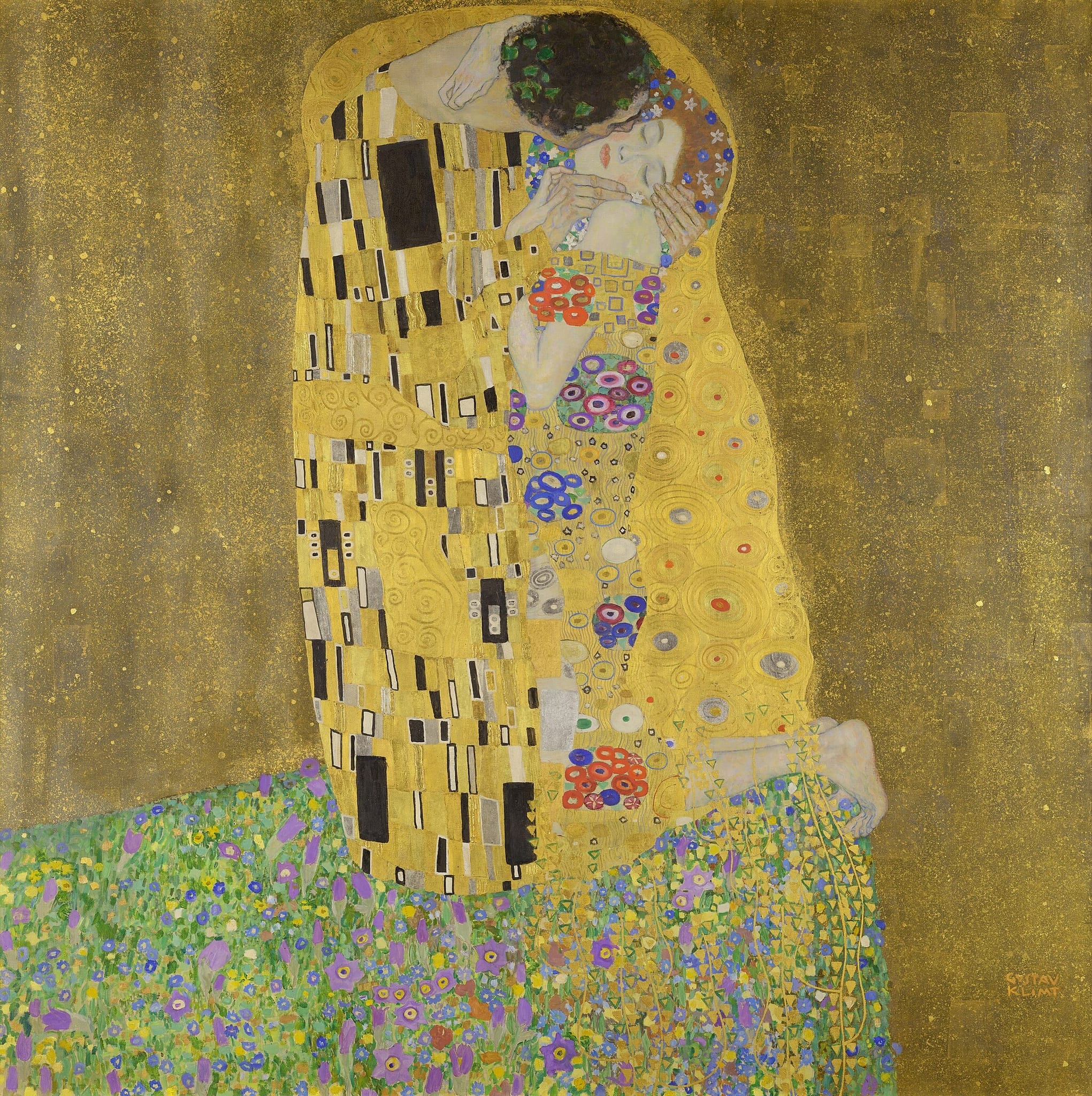
The Kiss (Lovers)
1908–1909
A couple kneels on a flowered verge, their bodies enveloped in a shimmering, gold-patterned mantle that fuses them into a single form. It’s a summa of Klimt’s Golden Period—sensual yet iconic—where love becomes a radiant emblem. Look for the contrast between geometric motifs around the man and softer, circular patterns around the woman, and the way the gold ground dissolves the scene into timelessness.
Must-see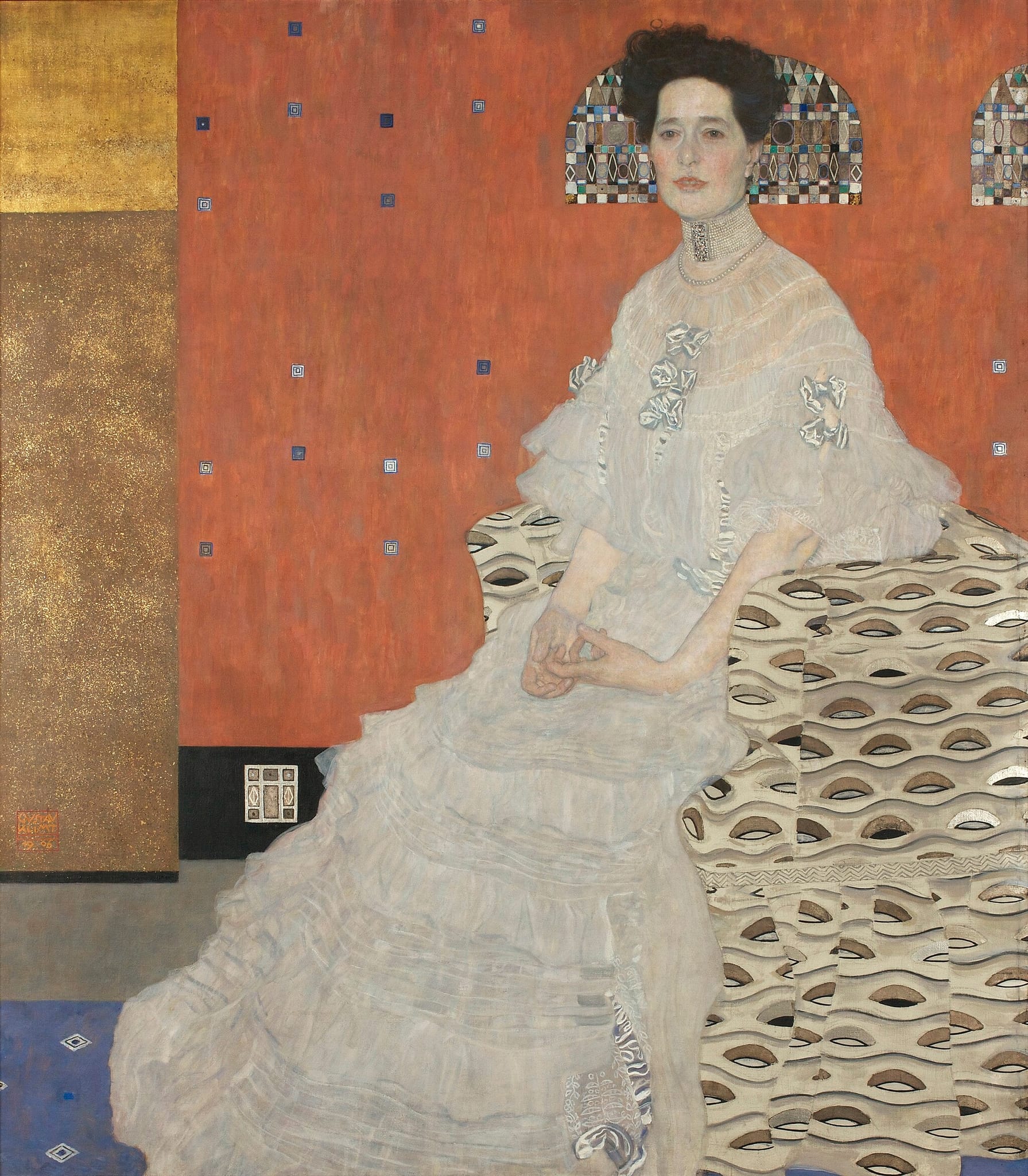
Fritza Riedler
1906
The sitter sits upright in a high-backed chair, framed by a halo-like decorative field that flattens space and heightens her presence. Klimt modernizes portraiture by merging psychological intensity with ornamental abstraction. Watch for the crisp geometry of the chair and cushion against the delicate oval of her face and the patterned backdrop.
Must-see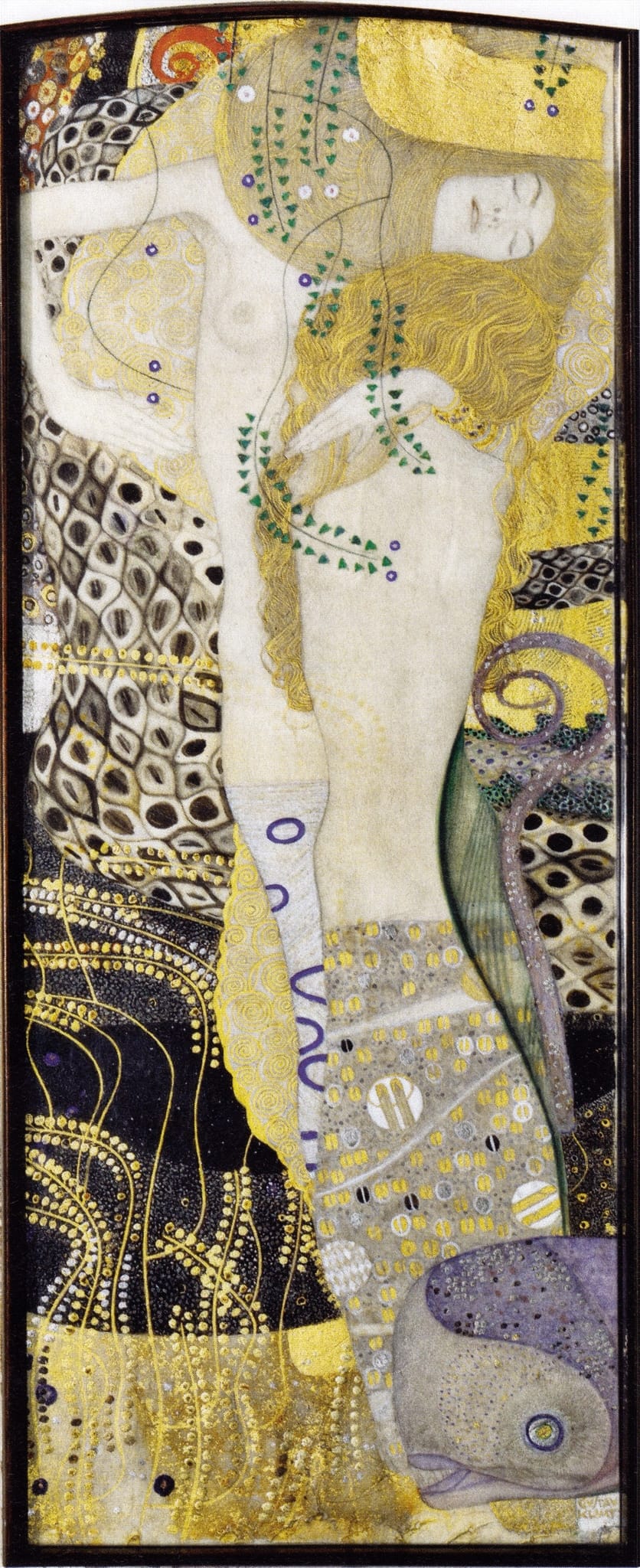
Girlfriends (Water Serpents I)
1904 (minor additions 1907)
Intertwined female figures drift in an aquatic reverie, their opalescent skin and flowing hair surrounded by jeweled, serpentine patterns. The work celebrates sensuality and a dreamlike, underwater sisterhood. Look for sinuous contours, iridescent accents, and the way decorative motifs ripple like water across the surface.
Must-see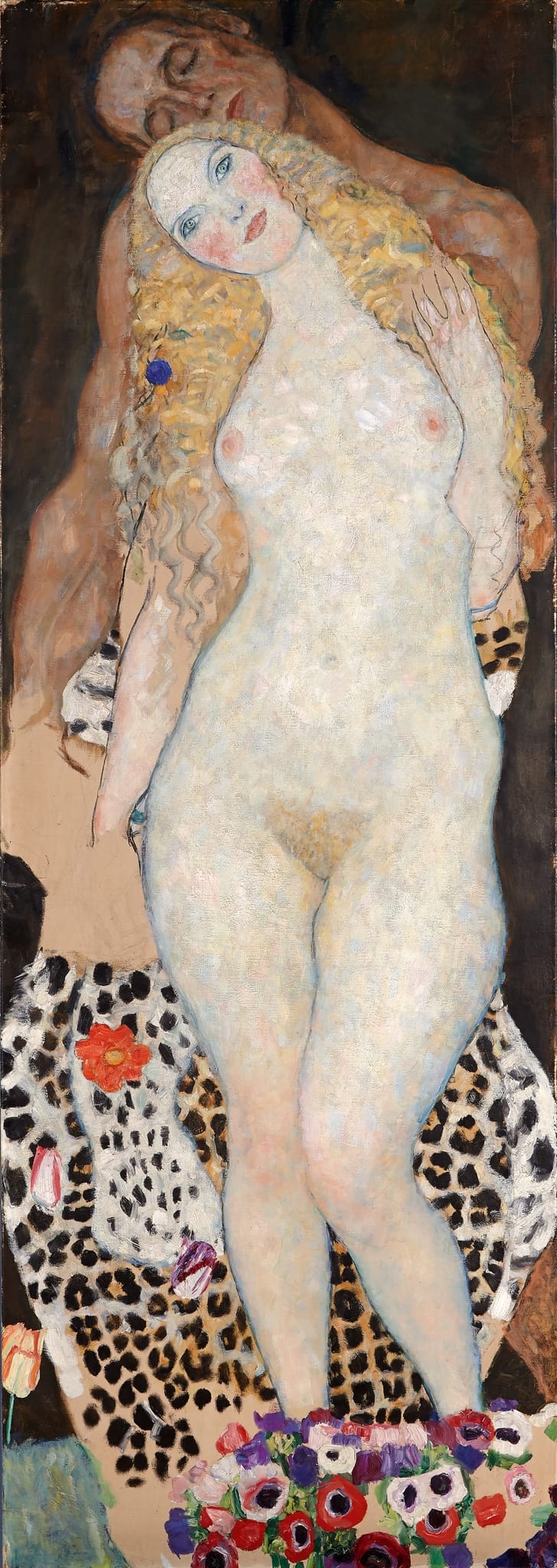
Adam and Eve
1916–1918
Klimt reimagines the first couple as a tender, intimate pairing—Eve luminous at the front, Adam emerging in shadow behind. It’s a late synthesis of naturalistic modeling and decorative atmosphere. Notice the soft transitions of flesh, the enveloping darkness flecked with color, and the quiet, contemplative mood rather than drama.
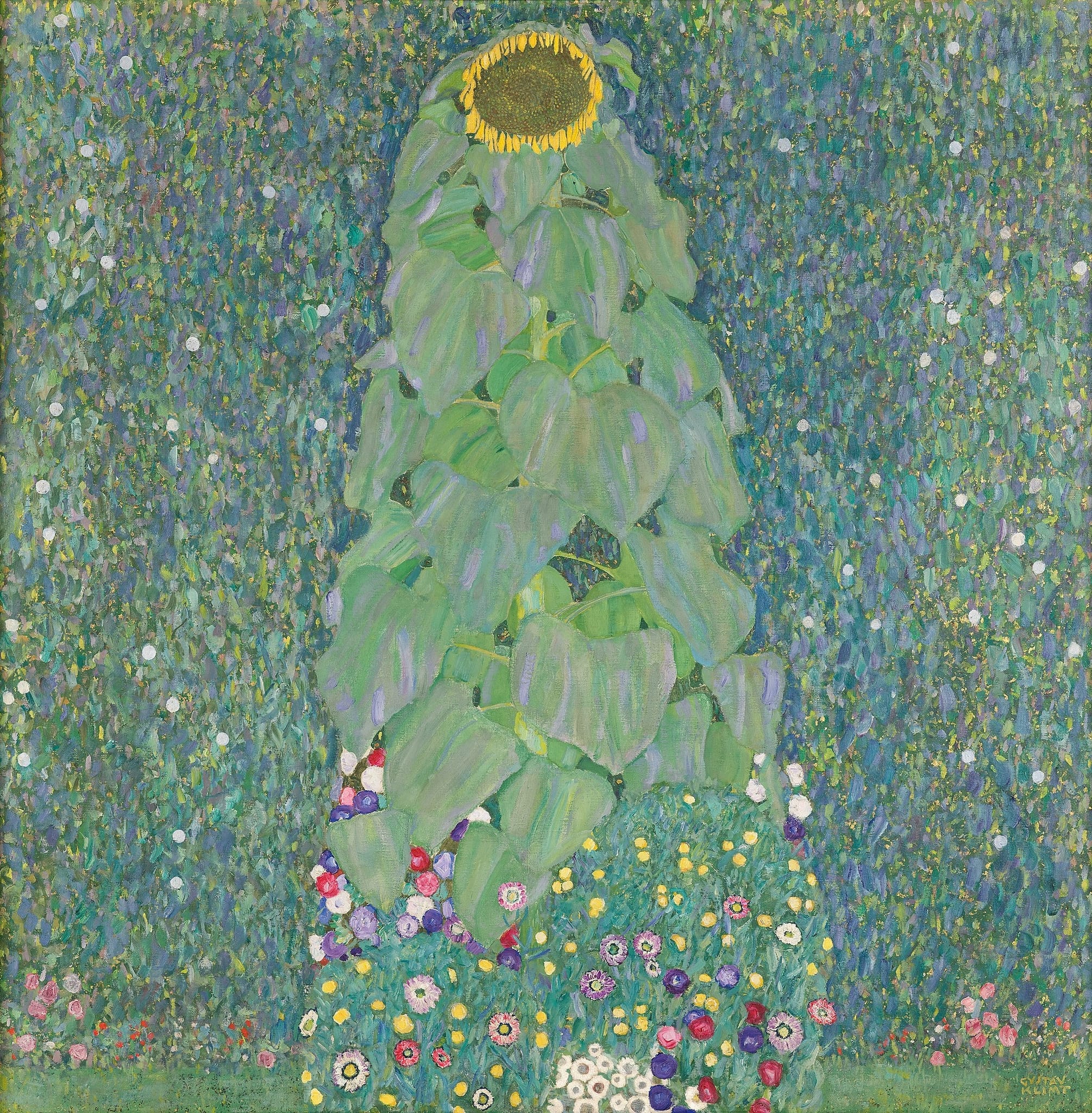
Sunflower
1907–1908
A single towering sunflower stands like a portrait subject, set against a velvety ground. Klimt elevates a humble bloom into an icon, fusing nature with ornament. Look closely at the mosaic-like dabs of paint and the halo effect that grants the plant near-human presence.
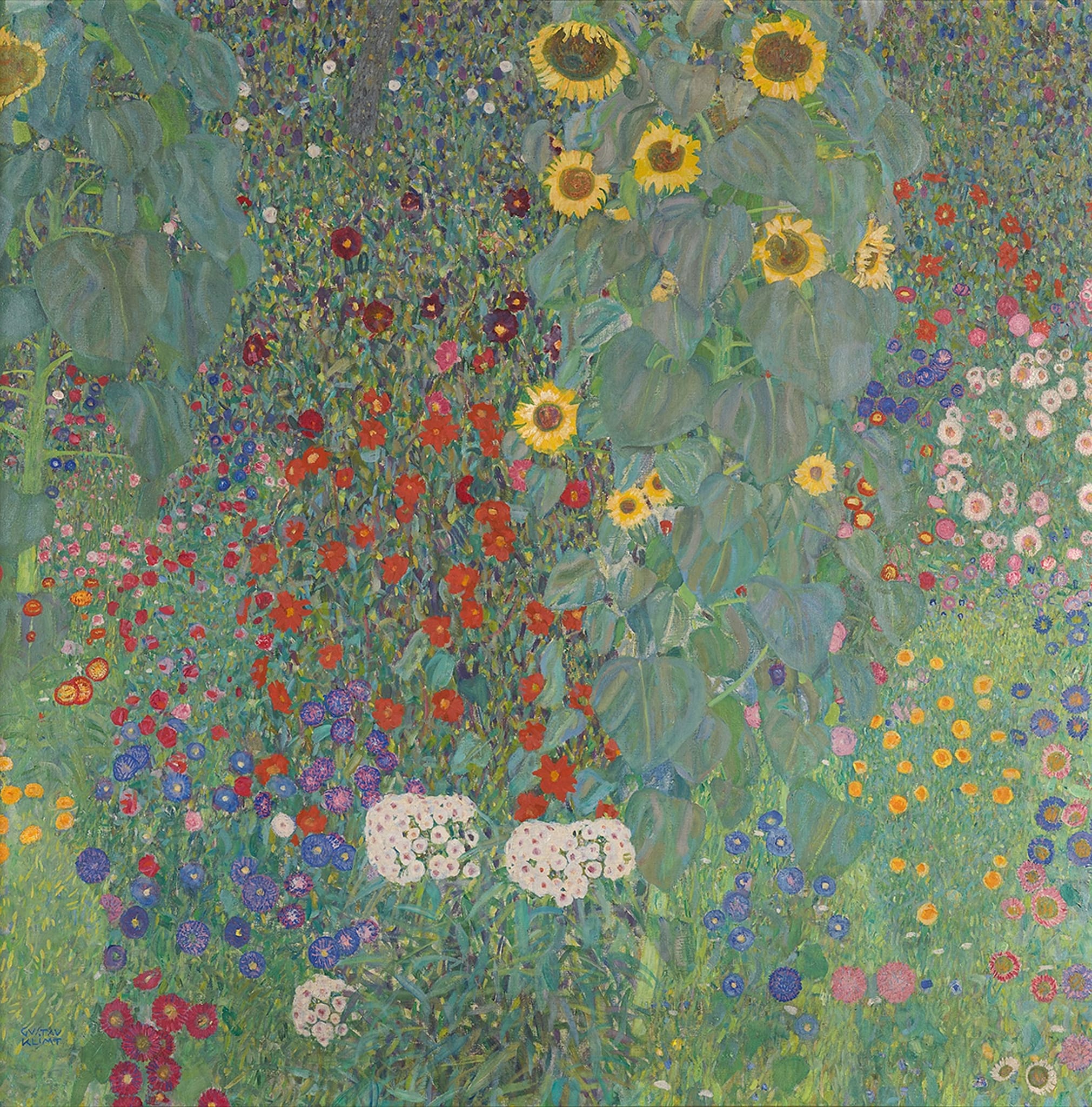
Cottage Garden with Sunflowers
1906
A dense wall of blossoms presses forward, turning a garden into an all-over tapestry of color and pattern. The scene flattens into decoration while still pulsing with botanical life. Watch for the vertical punctuations of sunflowers and the way tiny strokes knit the surface into a patterned fabric.
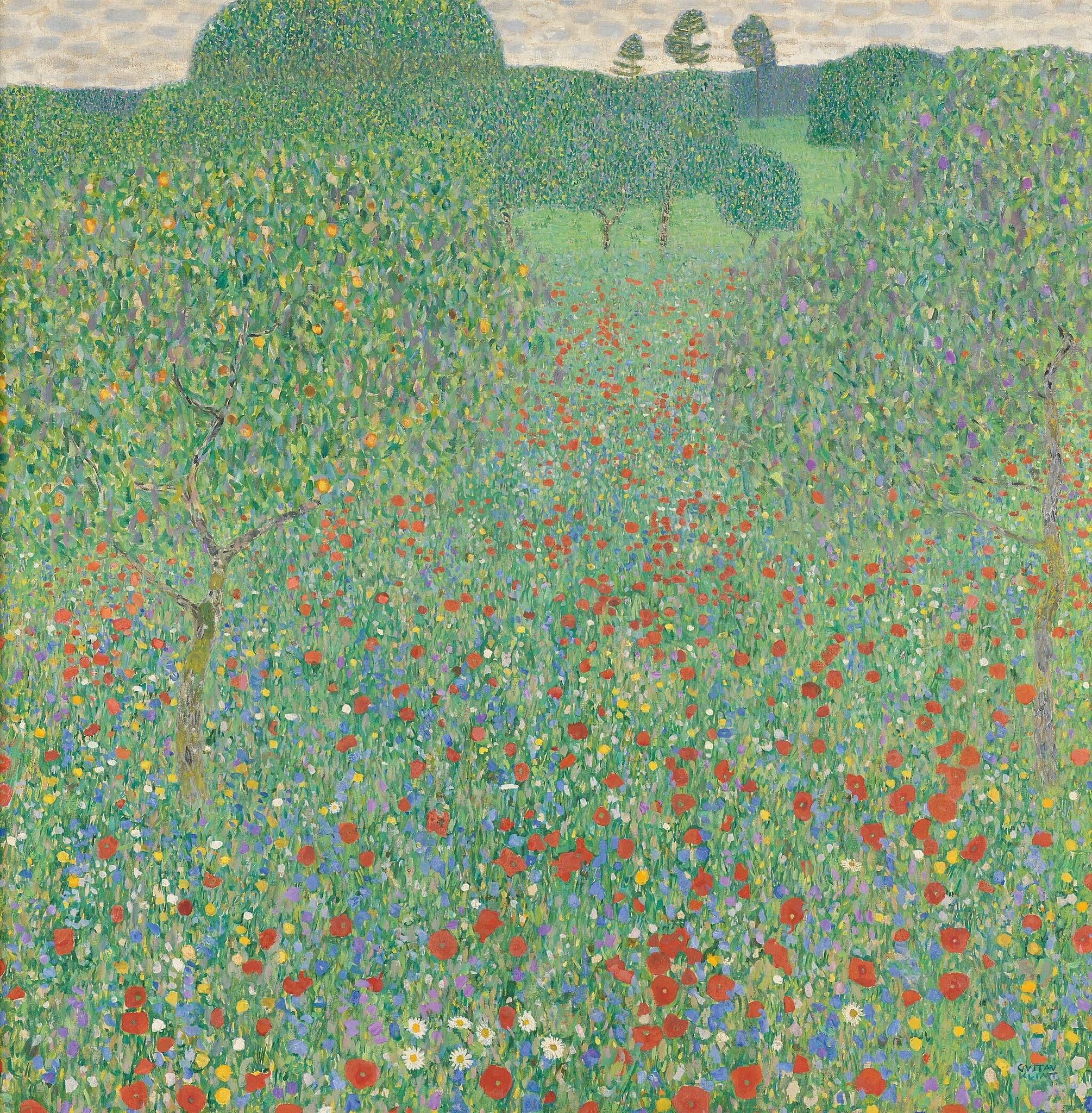
Flowering Poppies
1907
A carpet of red poppies vibrates against greens and blues, nearly collapsing depth into fields of color. Klimt uses the subject to push toward near-abstraction through repetition and rhythm. Notice how the scarlet blooms float on a shimmering ground, creating a hypnotic, optical buzz.
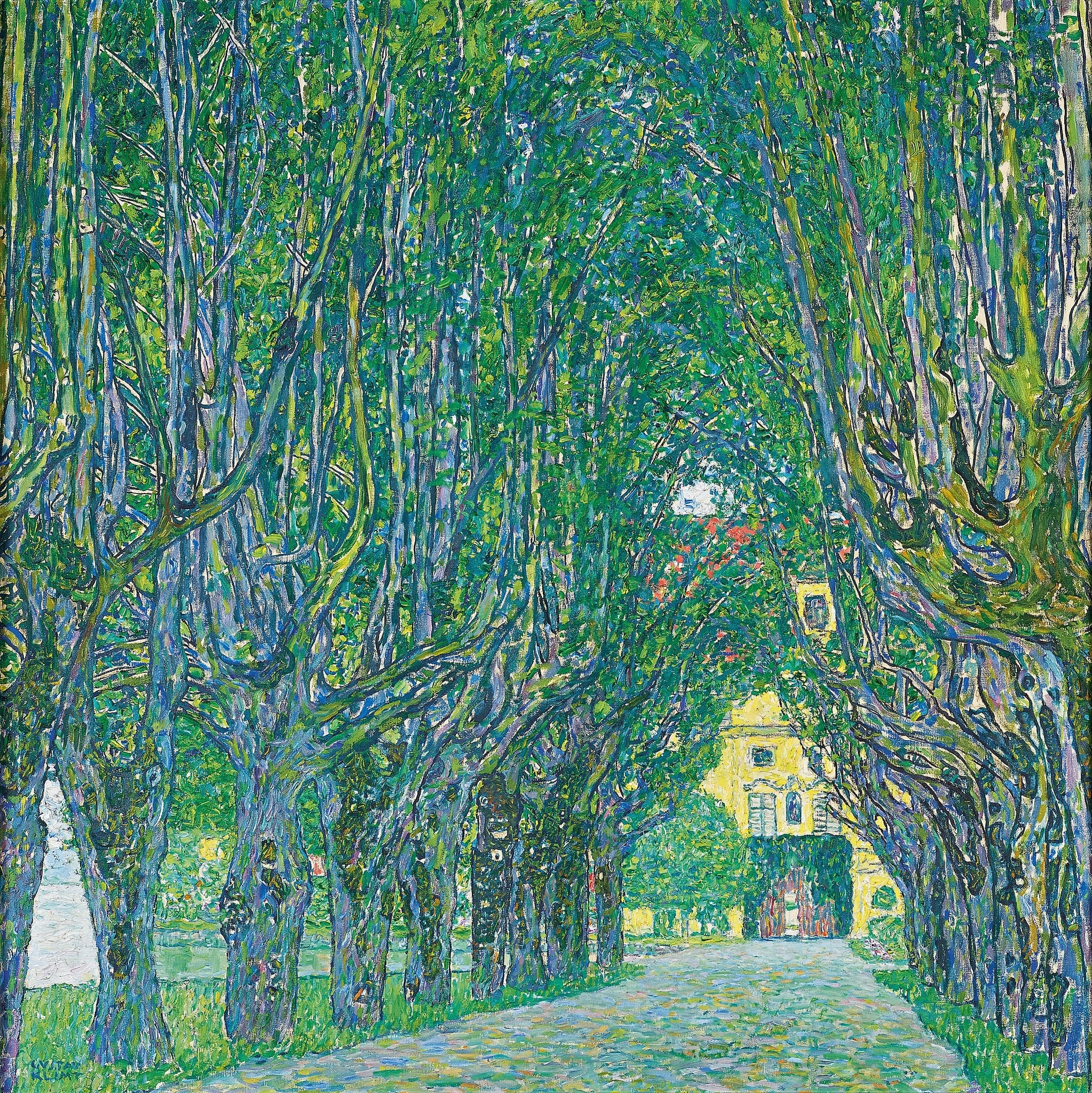
Avenue in Schloss Kammer Park
1912
A tree-lined path forms a cool tunnel of trunks and dappled leaves leading the eye into distance. Klimt turns landscape into pattern without losing the sensation of air and shade. Look for the rhythmic verticals of the trees and the flicker of light that quilts the lane.
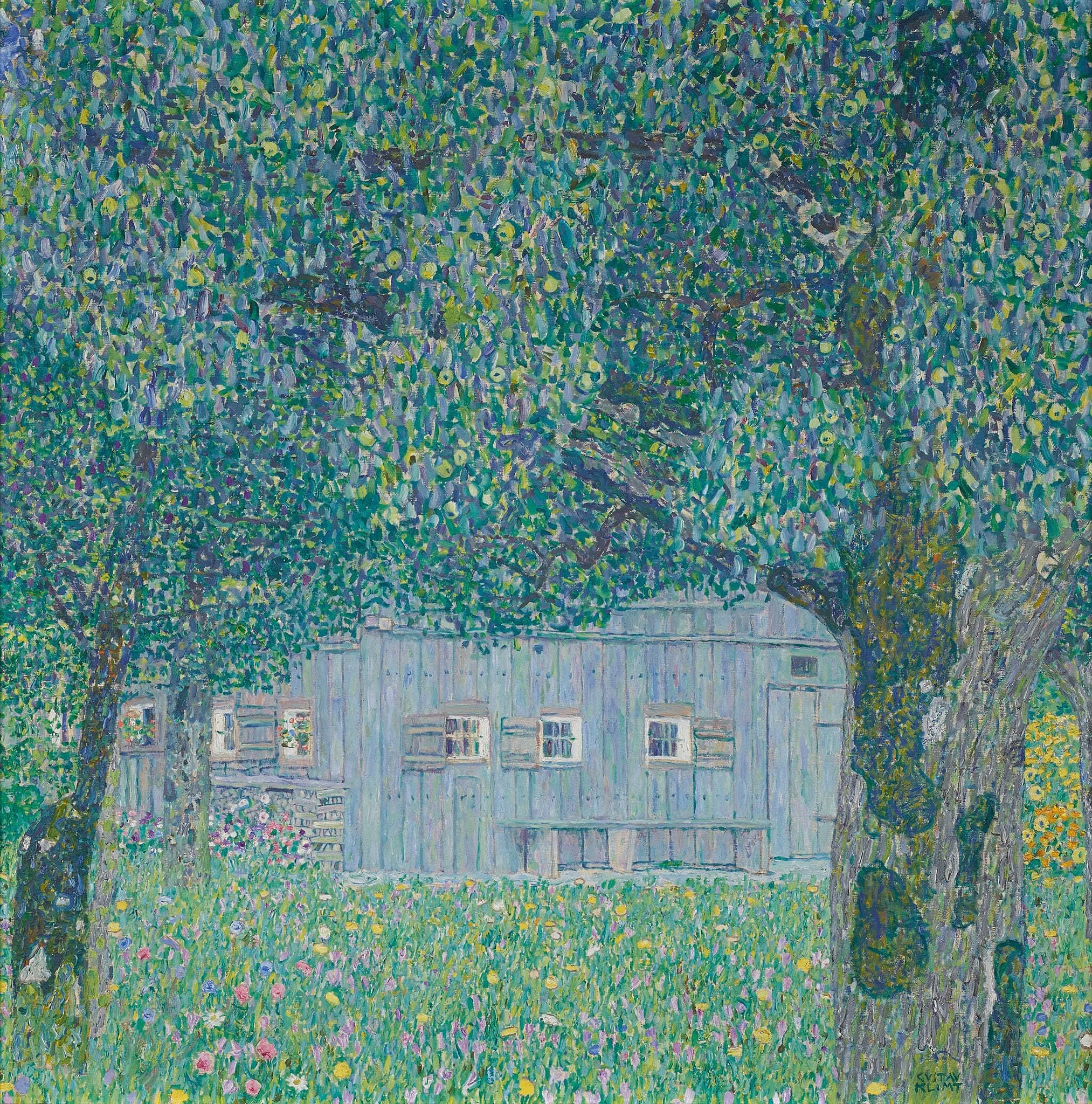
Farmhouse in Buchberg (Upper Austrian Farmhouse)
1911
A cropped farmhouse nestles within dense foliage, rendered in tightly packed strokes that verge on ornamental mosaic. The everyday rural motif becomes an exploration of texture and pattern. Watch for the square, frontal composition and the patchwork greenery that almost swallows the architecture.
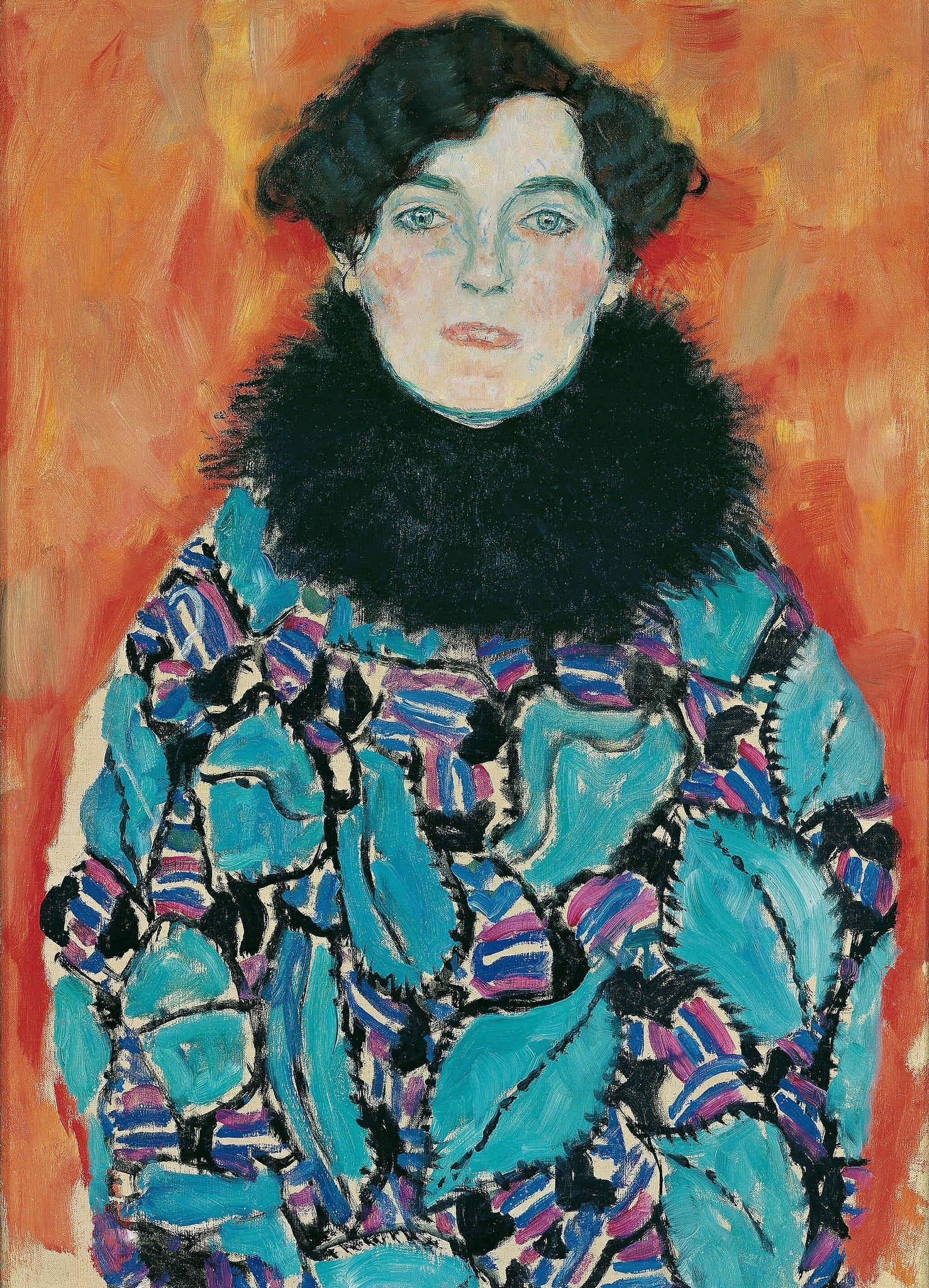
Johanna Staude
1917–1918
An arresting gaze meets the viewer as the sitter wears a bold, patterned blouse, while parts of the canvas remain unresolved. The portrait’s modernity lies in its frank psychology and ornamental bravura. Look for the contrast between the incisive face and the sketch-like passages that reveal the painting’s making.
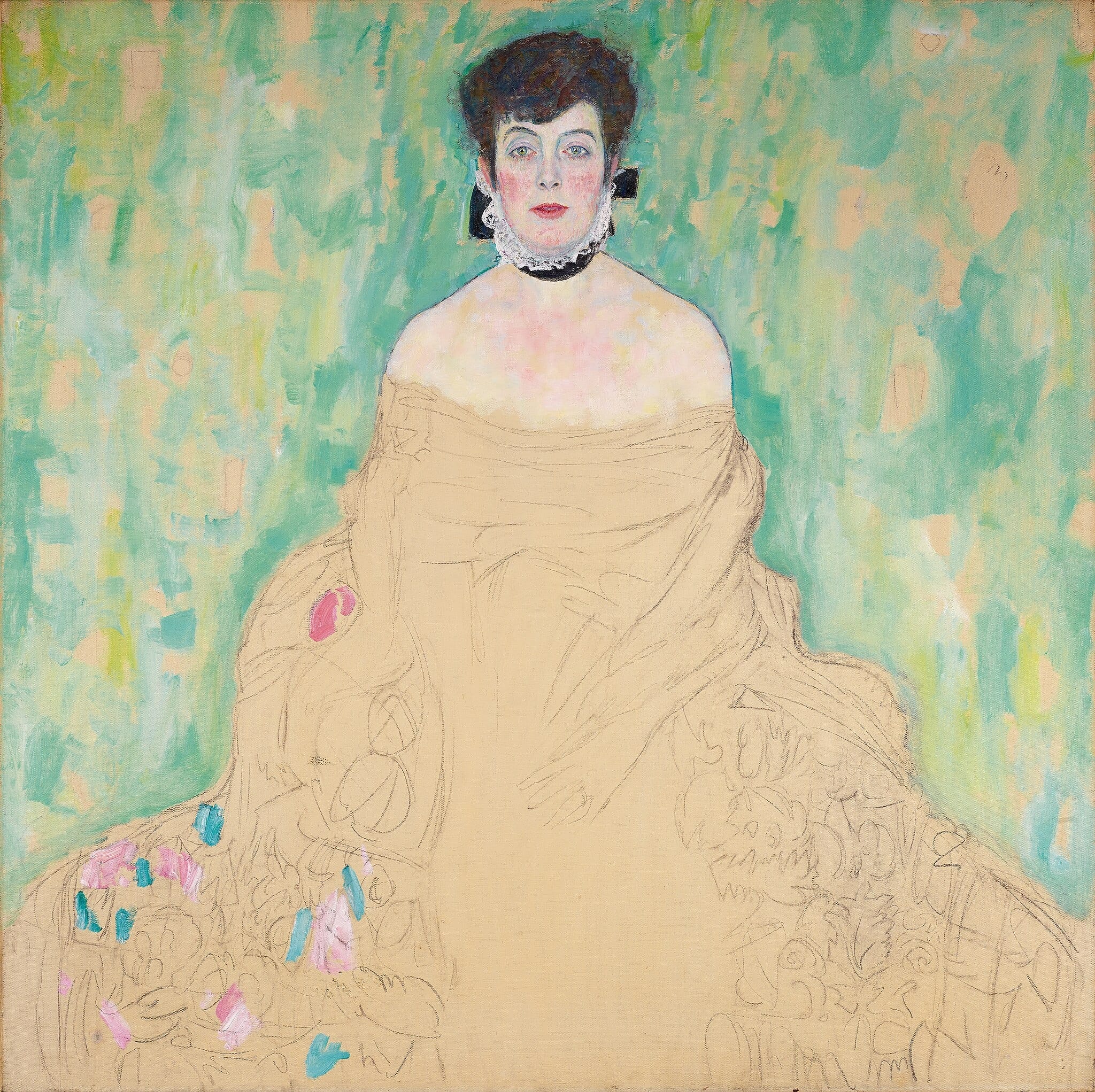
Amalie Zuckerkandl
1917–1918
An unfinished portrait shows a poised sitter emerging from a lightly worked ground, the likeness vivid even as details remain open. Its significance lies in the immediacy of Klimt’s late style and the poignancy of an image left incomplete. Look for the confidently modeled face against sketchier passages that expose the process.
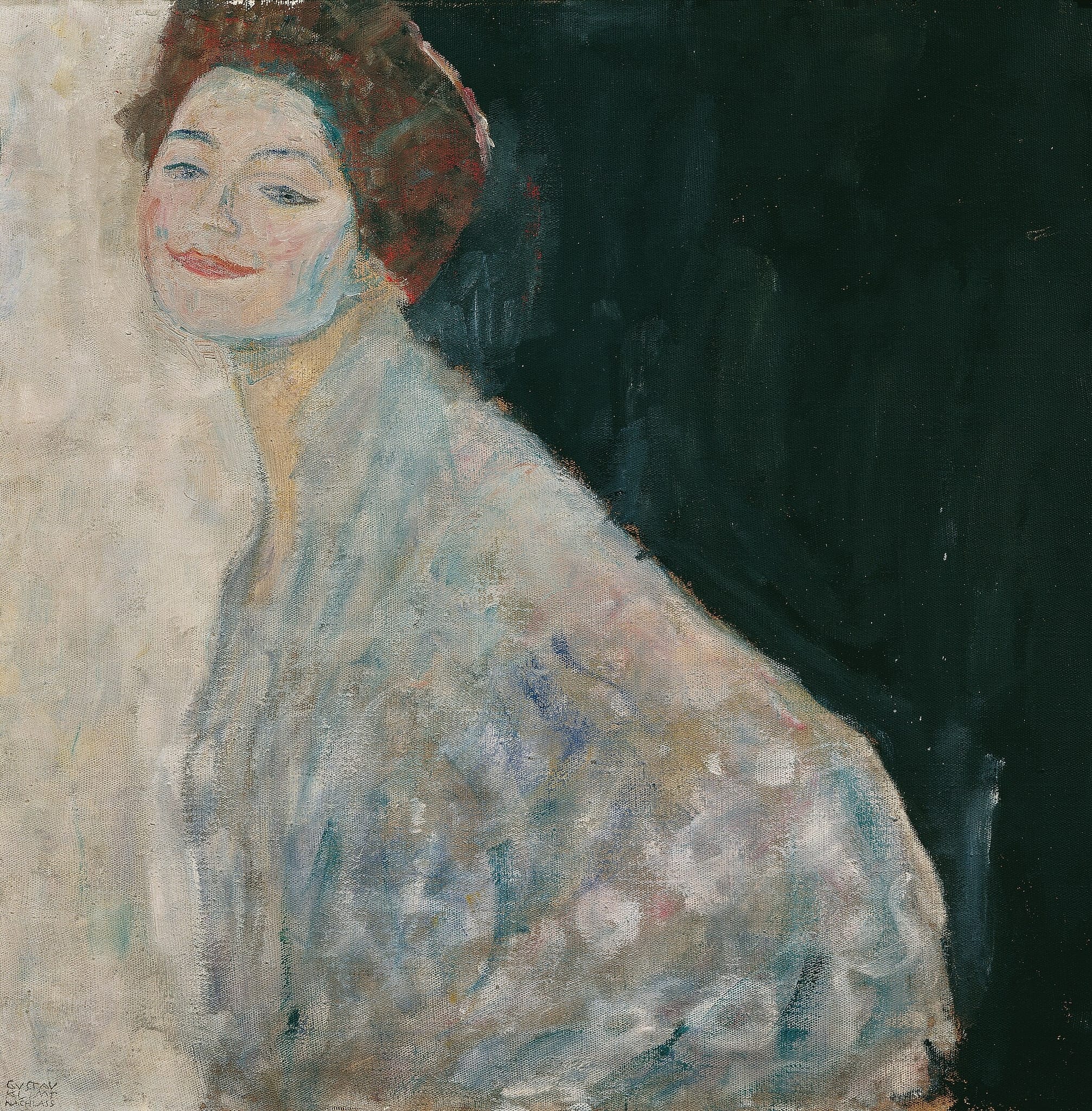
Lady in White
1917–1918
A figure swathed in pale garments hovers between presence and apparition, her form softened by veils of cool color. The painting epitomizes Klimt’s late ethereality and elegant restraint. Watch for the subtle blues and grays within the whites, and the way contours dissolve into atmosphere.
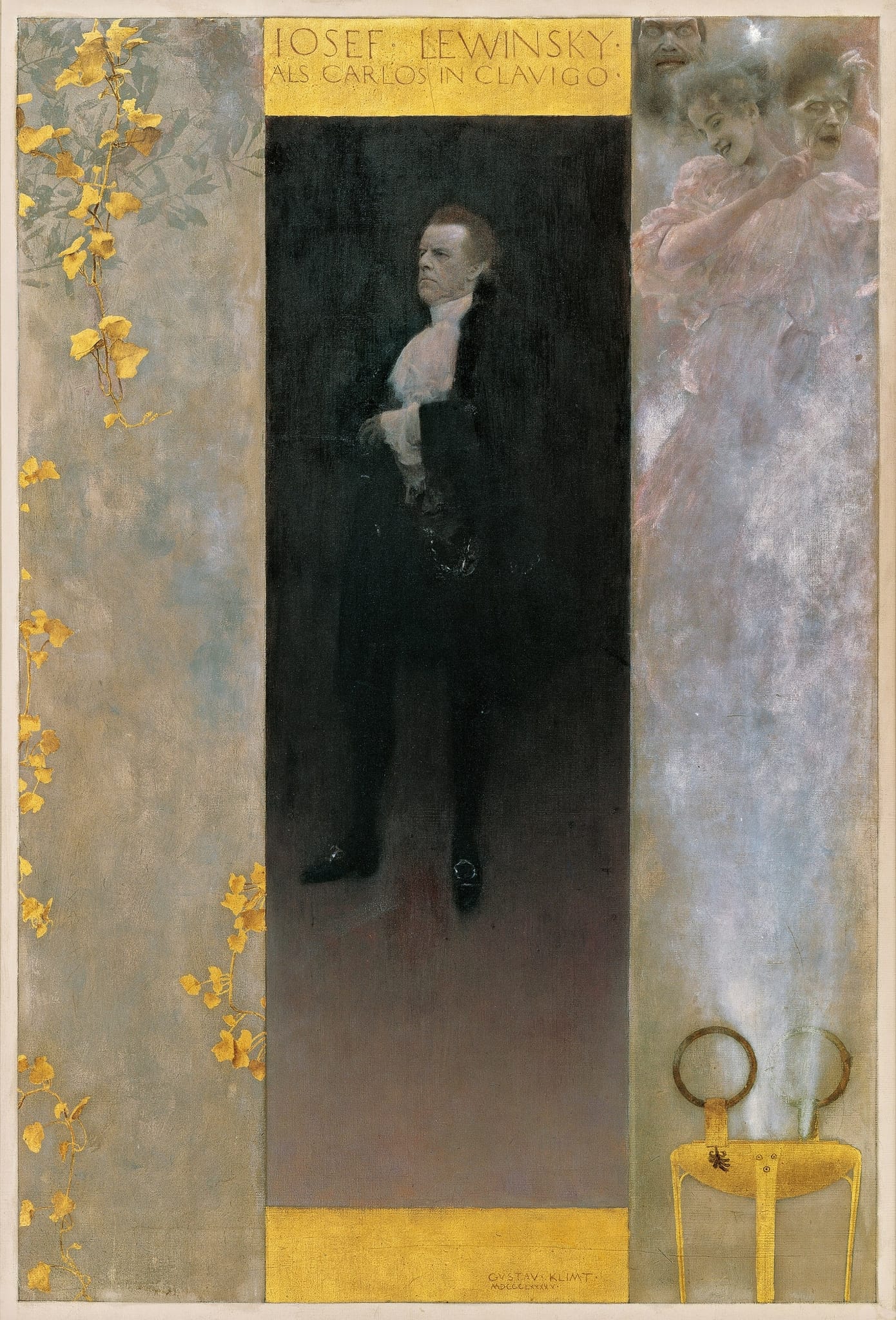
Josef Lewinsky as Carlos in Clavigo
1895
An actor is captured in character, his costume and bearing conveying theatrical intensity. Klimt fuses stagecraft with fine art portraiture, dignifying performance as subject. Look for the dramatic profile, controlled lighting, and crisp detailing of fabric and gesture.
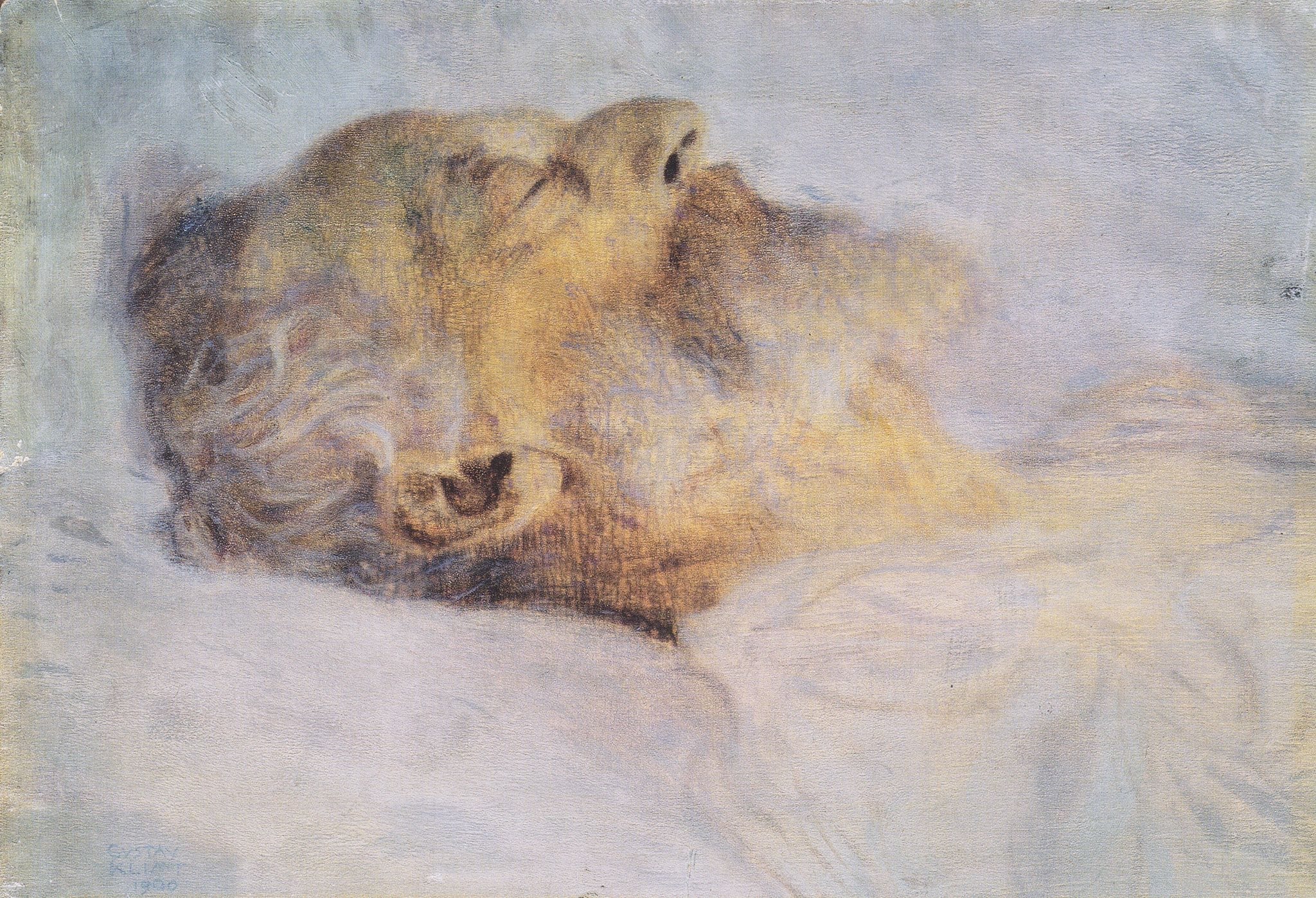
Old Man on His Deathbed
1900
A frail figure lies in quiet repose, rendered with a tenderness that turns mortality into meditation. The work reveals Klimt’s sensitivity beyond opulence, attentive to human vulnerability. Notice the muted palette, the careful modeling of the face and hands, and the hush that seems to permeate the scene.
Leopold Museum
Leopold places Klimt in the charged triangle with Schiele and Kokoschka, so you feel how his late figuration and themes of love and mortality ripple through younger Viennese artists. Landmark canvases like Death and Life reveal his dialogue with fin‑de‑siècle anxieties beyond the glitter of the Golden Phase.
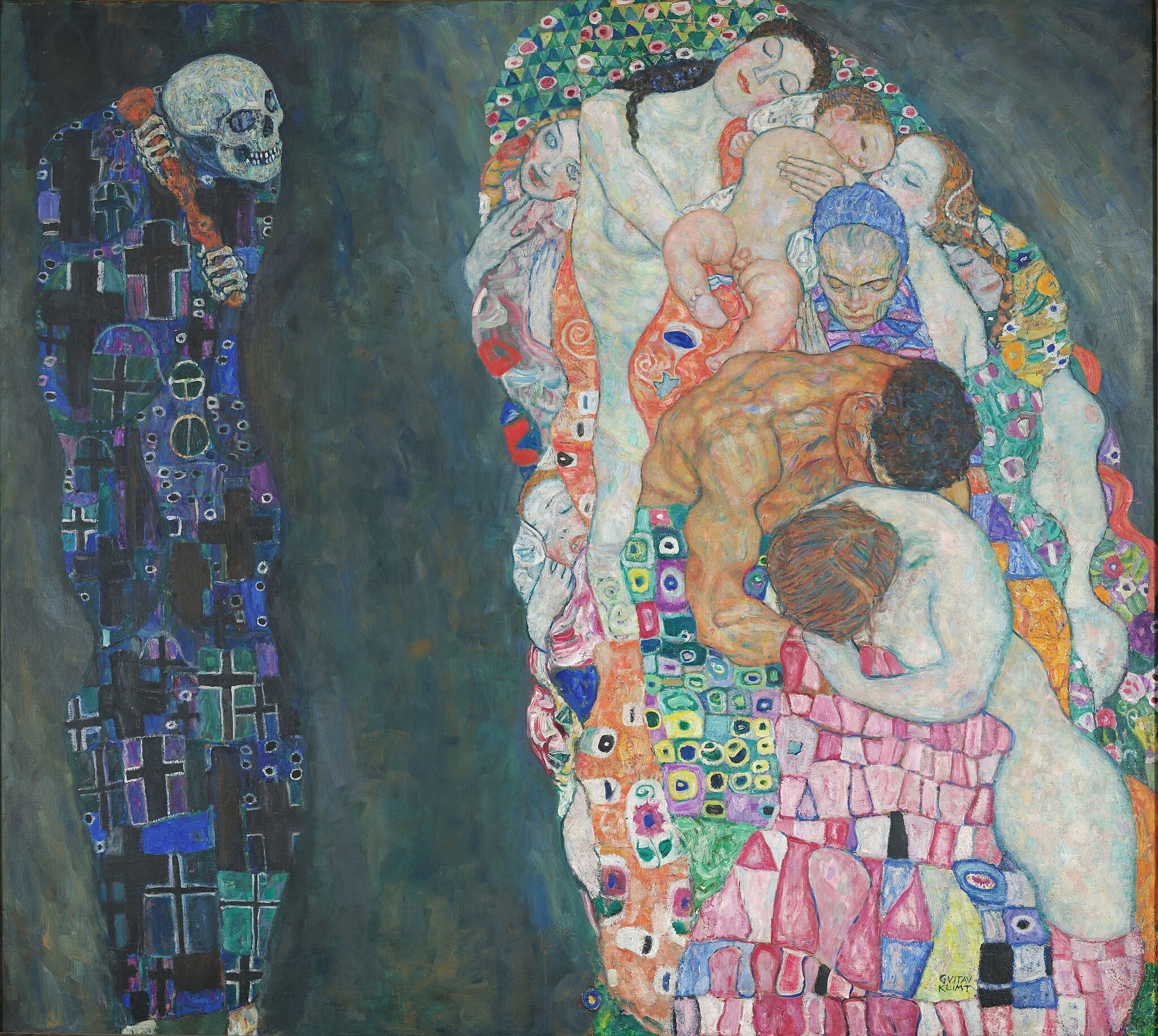
Death and Life
1910
Klimt stages a confrontation between a cross-cloaked skeleton and a clustered oval of figures—lovers, a mother and child, and an old woman—embodying the human life cycle. One of his largest surviving allegories, it was repeatedly reworked and prizewinning, revealing his ongoing meditation on mortality. Look for the tense gap between the grinning Death and the dreamlike, patterned figures who refuse to see him. ([onlinecollection.leopoldmuseum.org](https://onlinecollection.leopoldmuseum.org/en/object/629-death-and-life/))
Must-see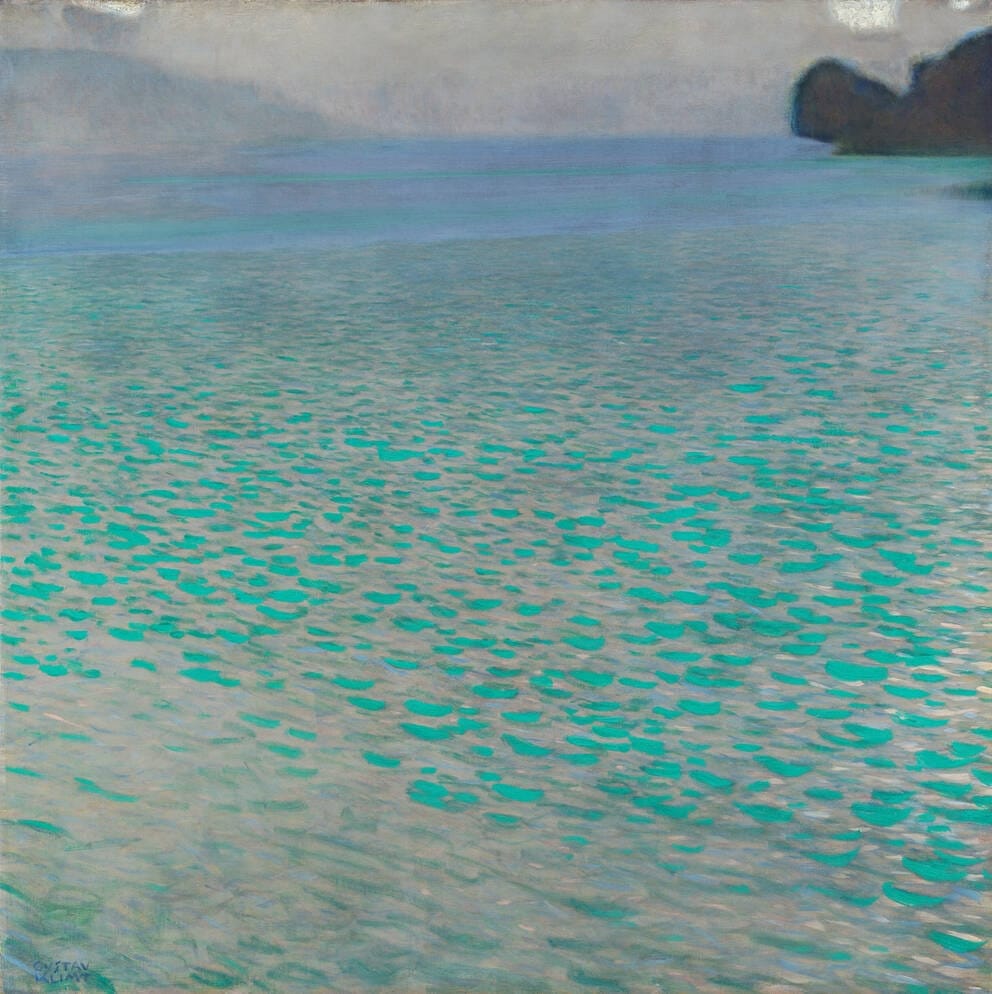
On Lake Attersee
1900
This nearly square canvas shows little but rippling turquoise water, with a sliver of Litzlberg’s shoreline peeking in at the upper right. Celebrated by contemporaries for its radical composition, it pushes Klimt’s landscape painting toward abstraction. Watch how the short, interlocking strokes and shifting greens and grays flatten depth into a vibrating surface. ([onlinecollection.leopoldmuseum.org](https://onlinecollection.leopoldmuseum.org/en/object/4328-on-lake-attersee/))
Must-see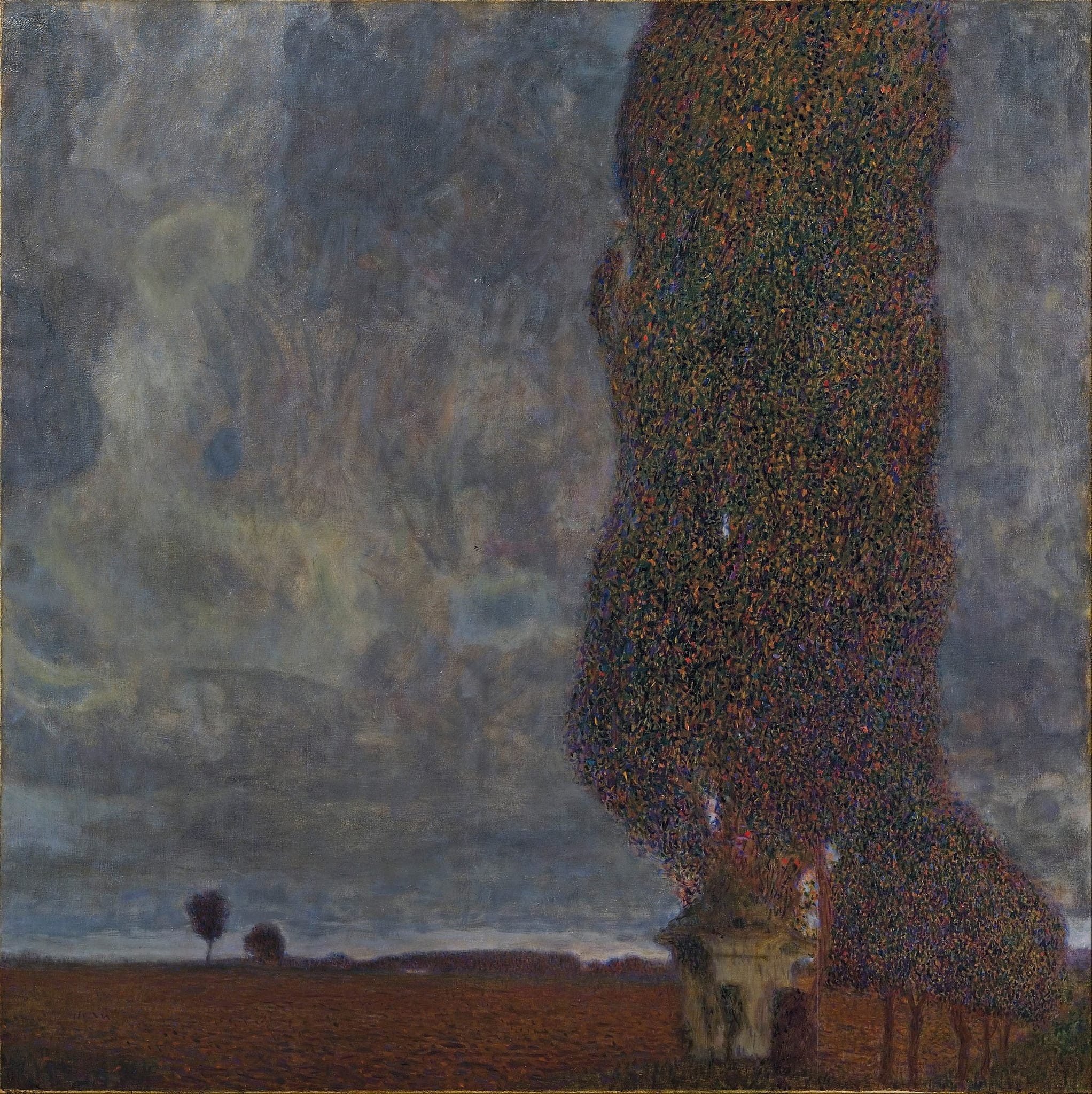
The Large Poplar II (Gathering Storm)
1902
A towering poplar near the Seehof Chapel rises before a low horizon under churned storm clouds, its leaves rendered as a shimmer of dotted color. The painting exemplifies Klimt’s Attersee summers and his ornamental, near-pointillist approach to nature. Notice the chapel anchoring the composition’s cross of horizontals and verticals and the ‘trout-spot’ foliage. ([onlinecollection.leopoldmuseum.org](https://onlinecollection.leopoldmuseum.org/en/object/2149-the-large-poplar-ii-gathering-storm/))
Must-see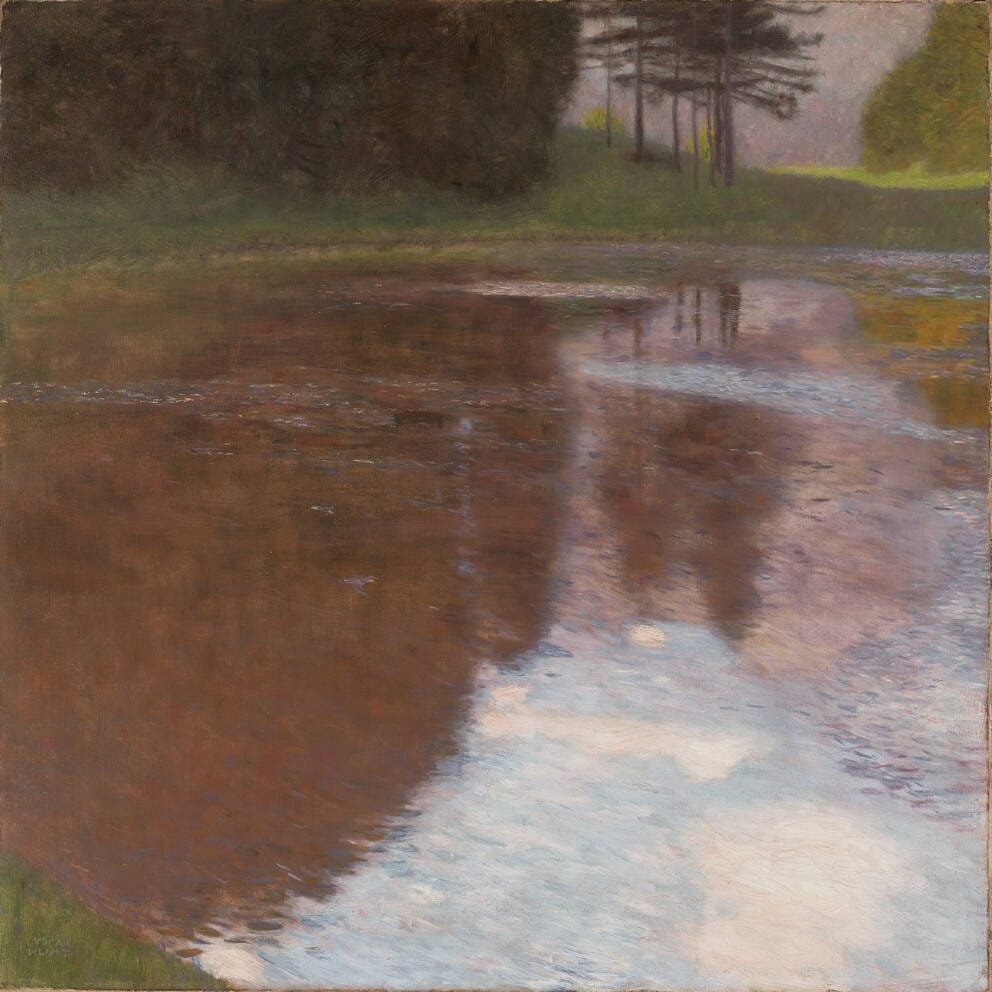
A Morning by the Pond
1899
Klimt’s first square-format landscape captures a calm shoreline he painted during a 1899 summer sojourn with the Flöge family. It marks a key turn toward delicate, pastel-inflected color harmonies that shaped his palette after 1900. Look for the bluish‑pink light flickering across the water and the gentle green edge of the wood. ([onlinecollection.leopoldmuseum.org](https://onlinecollection.leopoldmuseum.org/en/object/2148-a-morning-by-the-pond/))
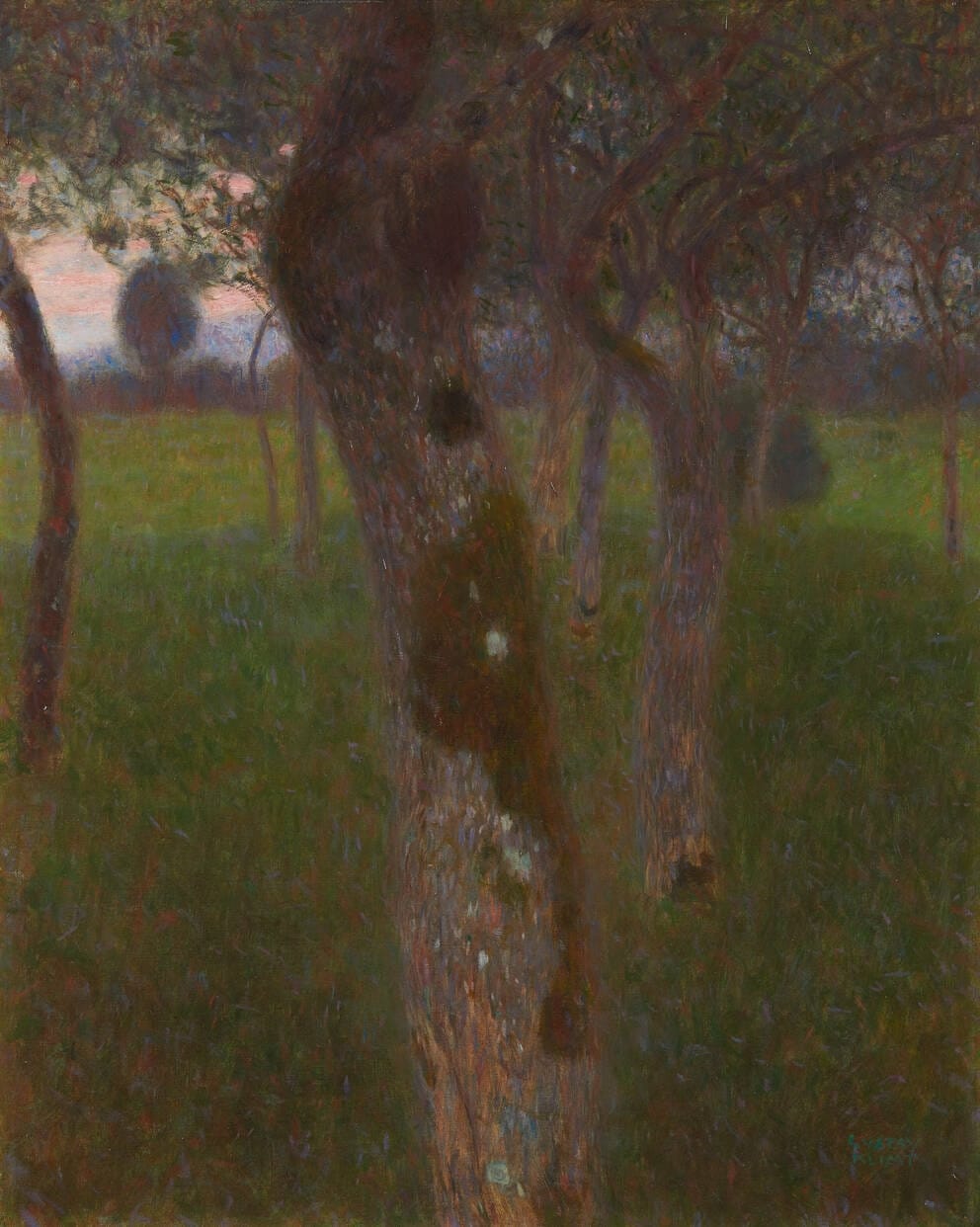
Orchard in the Evening
1898
Painted in 1898 and praised at the 7th Secession Exhibition, this intimate orchard scene sets a high horizon behind a central tree trunk. Its clear, almost architectural structure and dusky mood show Klimt refining his landscape language. Watch how the vertical trunk organizes the view and how evening tones gather under the leaves. ([onlinecollection.leopoldmuseum.org](https://onlinecollection.leopoldmuseum.org/en/object/33818-orchard-in-the-evening/))
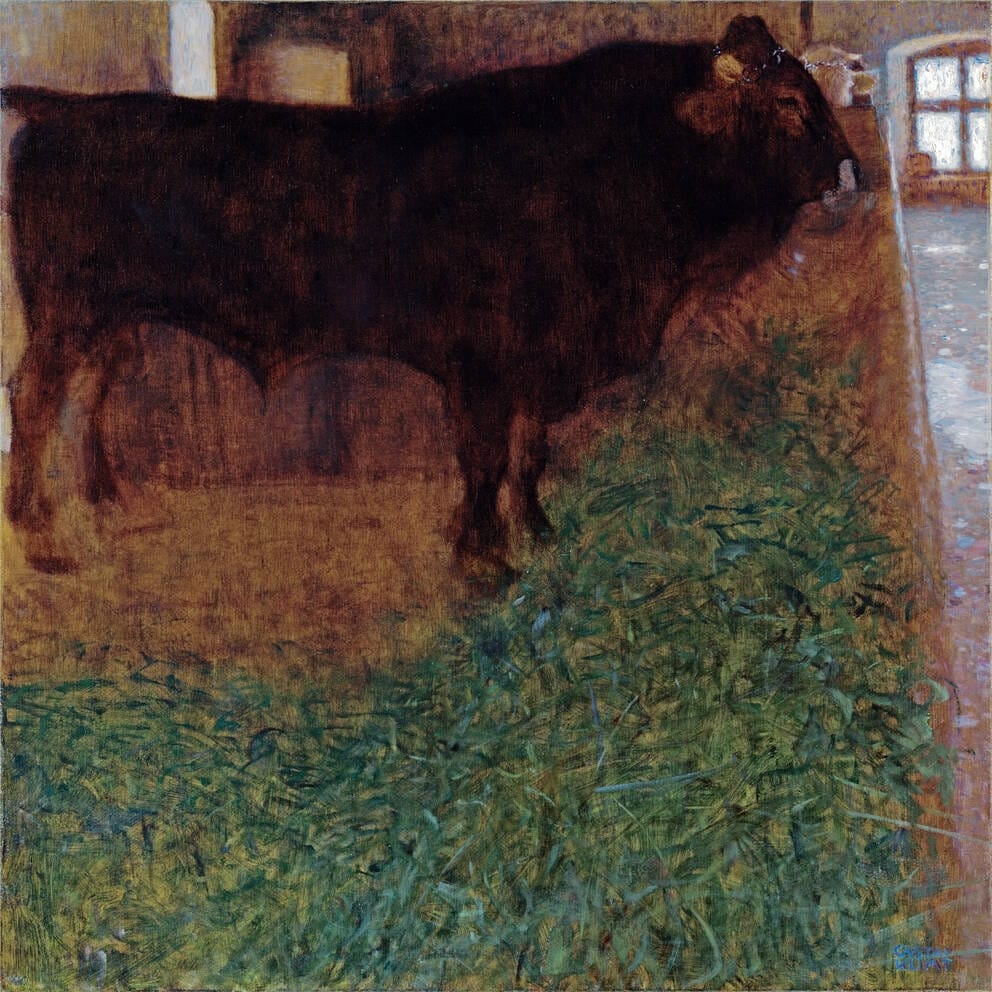
The Black Bull
1900
An enormous bull—reportedly named Martin—fills the stable interior from Klimt’s first Litzlberg stay, its mass modeled in clay‑toned paint. A rare animal subject for Klimt, the work trades ornament for atmosphere. Notice the single small window that pierces the dusk and the way light skims the animal’s hide. ([onlinecollection.leopoldmuseum.org](https://onlinecollection.leopoldmuseum.org/en/object/5780-the-black-bull/))
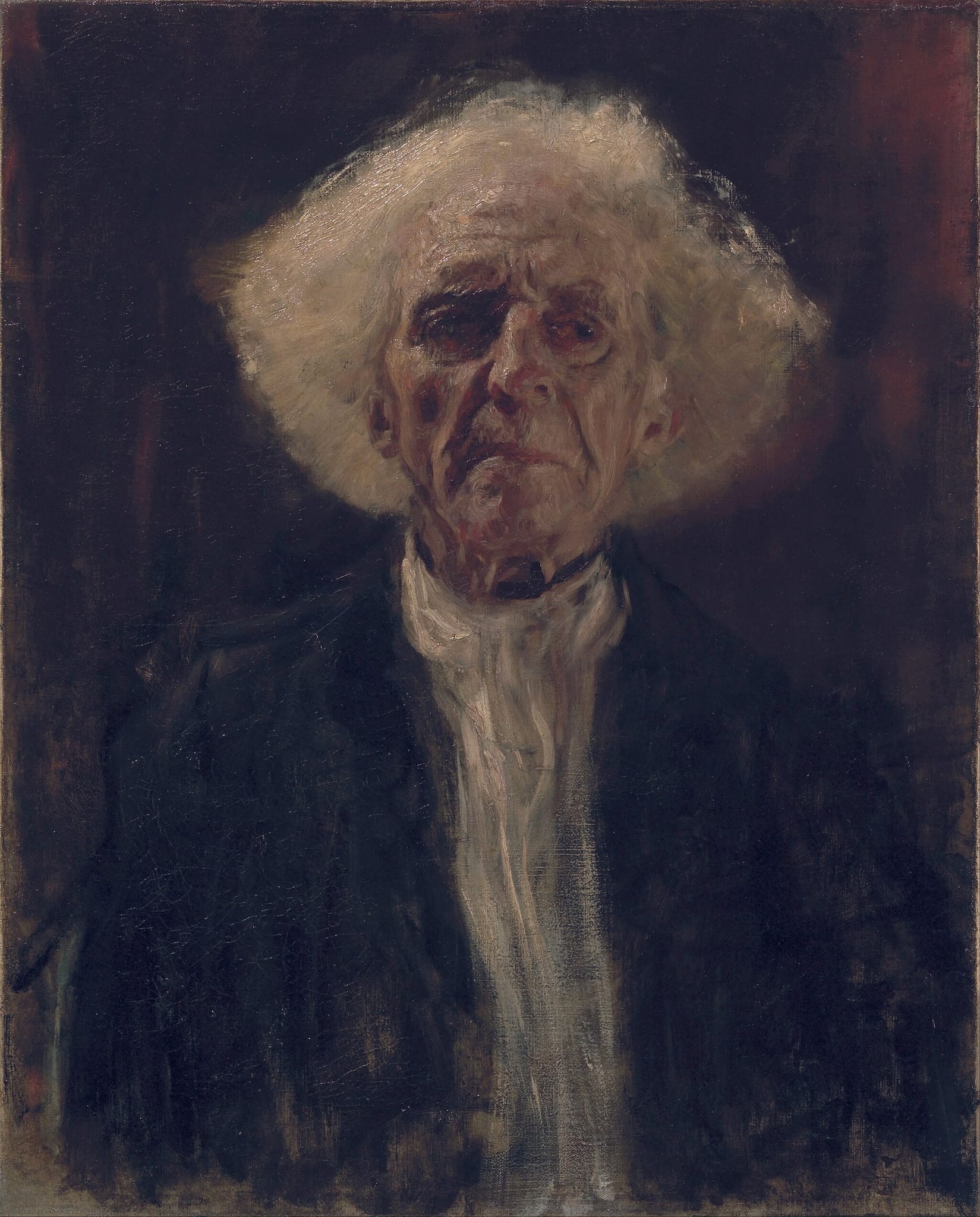
The Blind Man
1896
This bust of an elderly sitter explores stark contrasts of light and dark rather than genteel likeness. Exhibited at the 1st Secession in 1898 and reproduced in Ver Sacrum, it likely functioned as a portrait study rather than a commission. Look for the concentrated illumination on the face and the somber, dusky surround. ([onlinecollection.leopoldmuseum.org](https://onlinecollection.leopoldmuseum.org/en/object/4324-the-blind-man/))
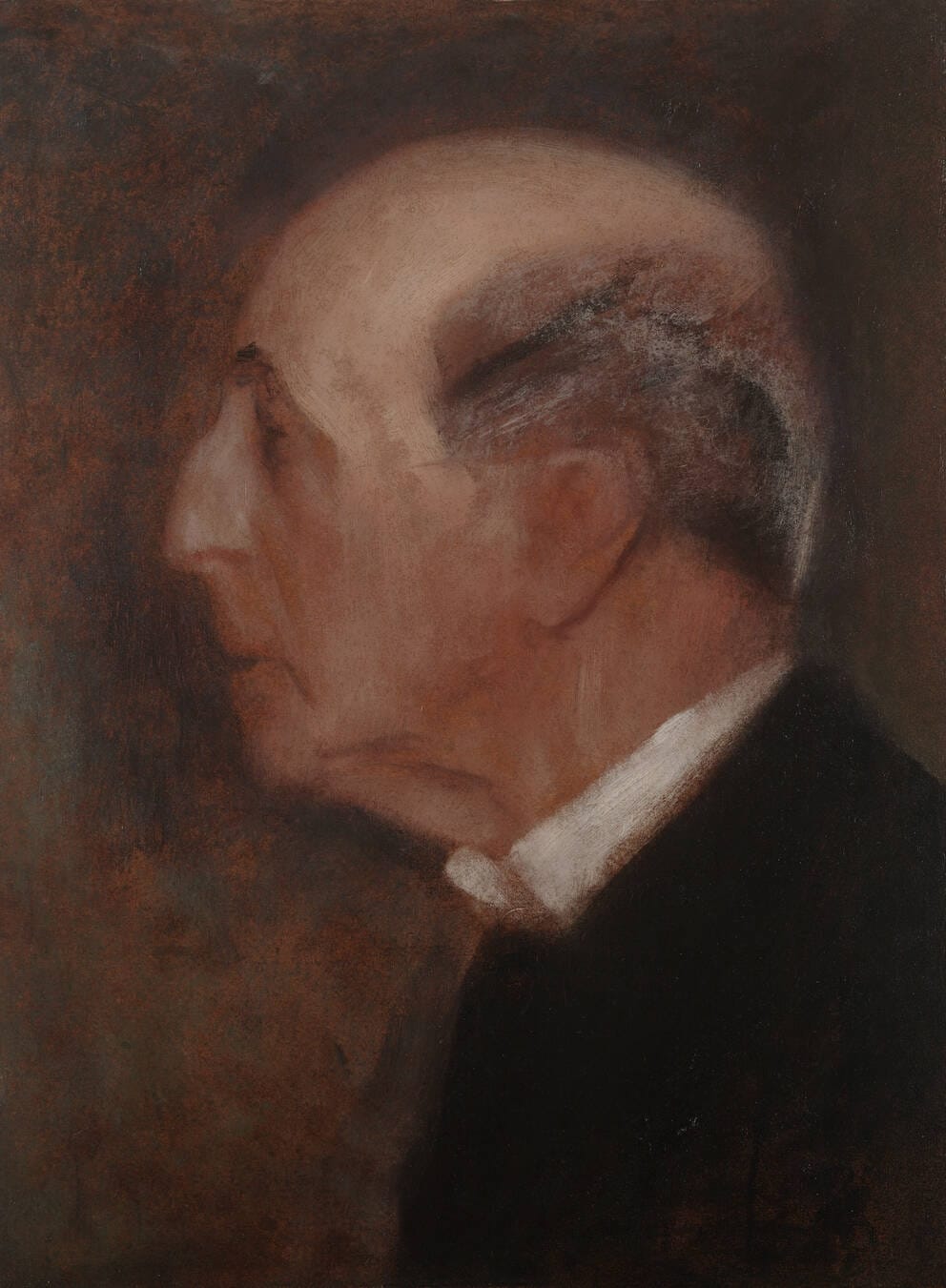
Portrait of an Old Man in Profile (Count Traun?)
1896
Despite the traditional title, the sitter’s identity is unproven; Klimt kept the painting until his death, suggesting a self-initiated character study. With thin paint and strict profile, he sharpens attention on nose, brow, and jaw. Focus on the crisp contour of the head and the economy of modeling used to define age and temperament. ([onlinecollection.leopoldmuseum.org](https://onlinecollection.leopoldmuseum.org/en/object/4325-portrait-of-an-old-man-in-profile-count-traun/))
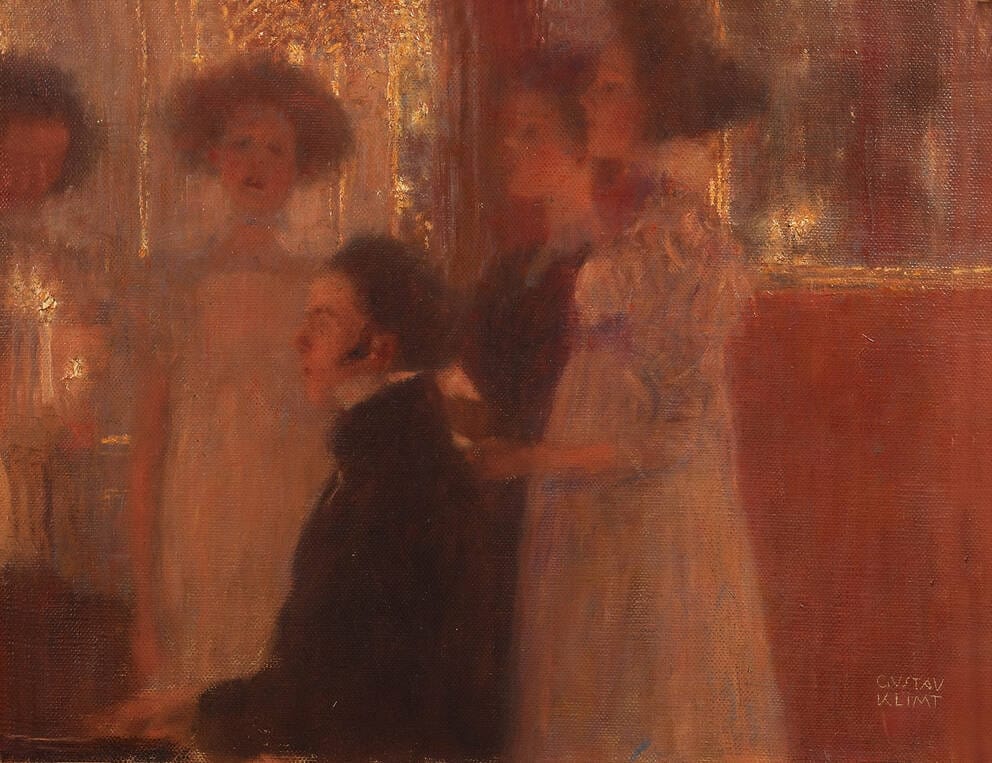
Schubert at the Piano. Design for the music room by Nikolaus Dumba
1896
Commissioned in the 1890s for Baron Nikolaus Dumba’s palace, this painted study predates a finalized version destroyed in 1945. It is pivotal in Klimt’s trajectory, bridging his realist beginnings and a more Impressionist handling. Look for the intimate salon atmosphere and the softening brushwork around the pianist and listeners. ([onlinecollection.leopoldmuseum.org](https://onlinecollection.leopoldmuseum.org/en/object/33817-schubert-at-the-piano-design-for-the-music-room-by-nikolaus-dumba/))
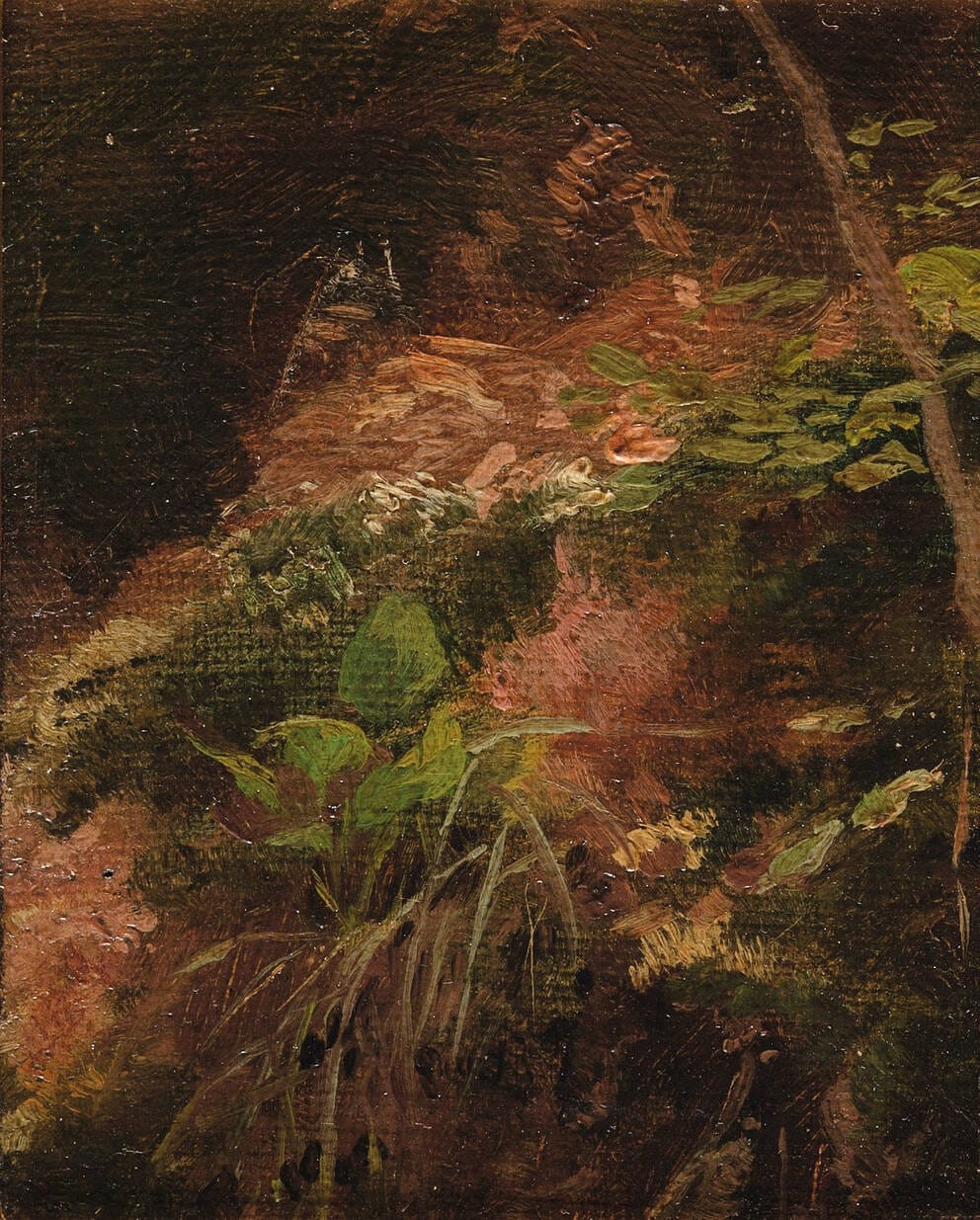
Forest Floor
1881
A tiny early oil sketch from 1881/82, this is among Klimt’s first attempts at landscape, observed in the academic manner. Even at 10 × 8 cm, it balances light and shadow across moss, twigs, and leaf litter with baroque-like chiaroscuro. Examine the diagonal slope and the lively, open brushstrokes in browns and greens. ([onlinecollection.leopoldmuseum.org](https://onlinecollection.leopoldmuseum.org/en/object/31087-forest-floor/))
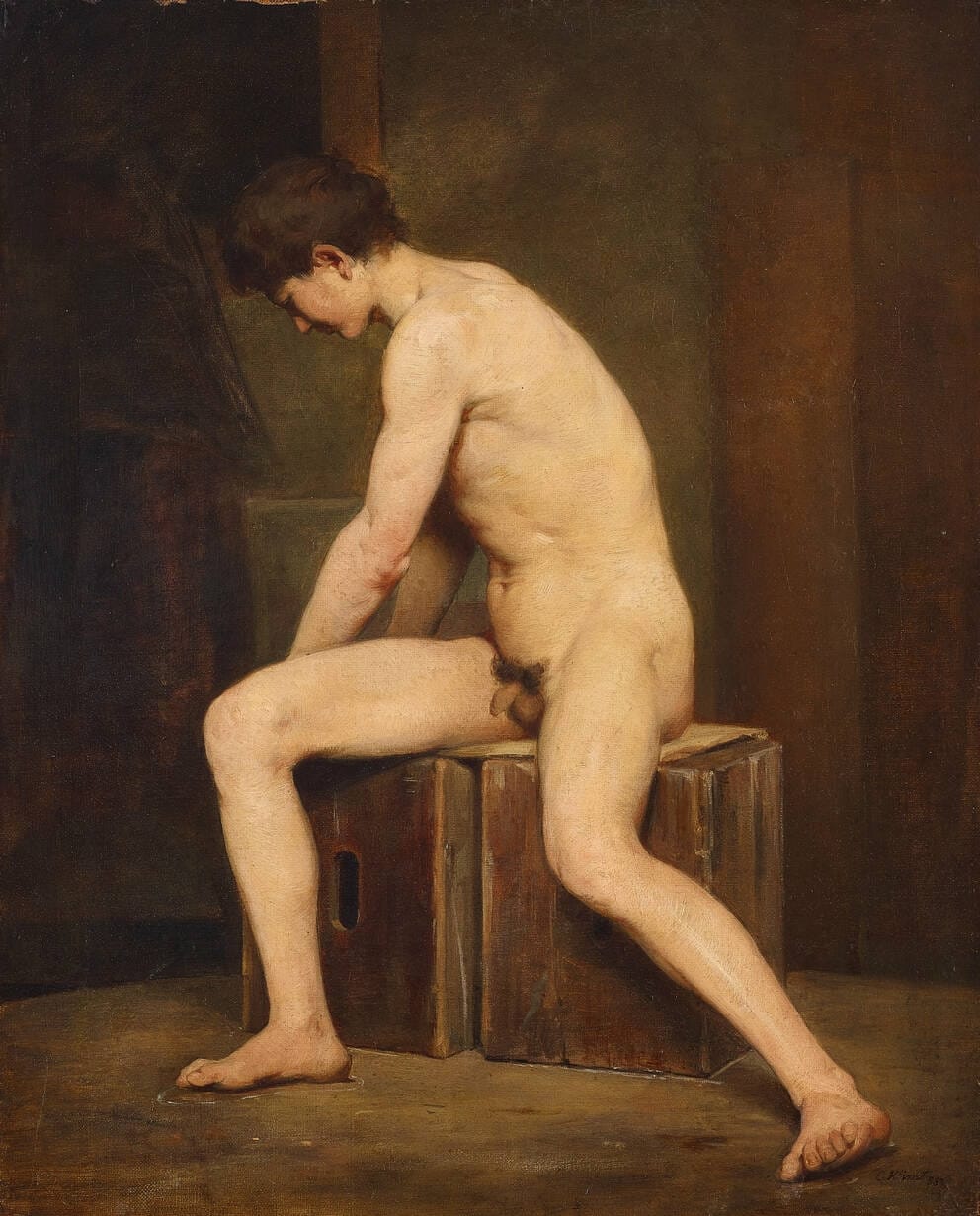
Sitting Nude Man Turned to the Left
1883
An academy study from 1883, this male nude is one of four similar early figure exercises Klimt undertook as a student. Dated by the artist, it anchors the chronology of his formative years just as he founded the Künstler‑Compagnie. Note the frank, study-hall pose and careful anatomical modeling over a plain ground. ([onlinecollection.leopoldmuseum.org](https://onlinecollection.leopoldmuseum.org/en/object/29429-sitting-nude-man-turned-to-the-left/))
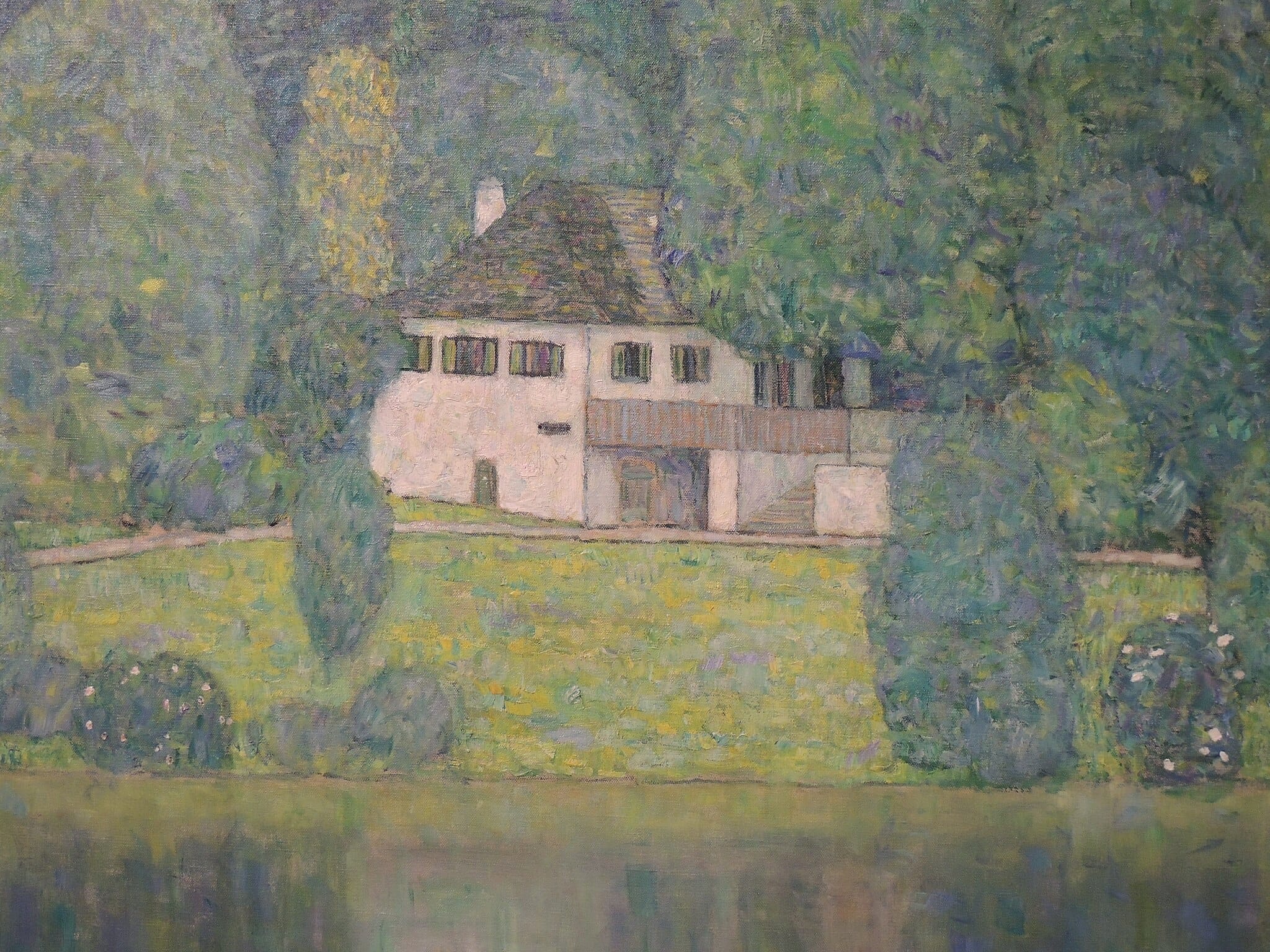
Litzlbergkeller
1915
A close-up of the lakeside restaurant ‘Litzlberger Keller,’ likely viewed from a boat, compresses architecture and water into a postcard-like crop. Commissioned by Otto Primavesi, it probably drew on Klimt’s mailed ‘correspondence cards’ or photographs and, true to his landscapes, excludes people. Watch the taut framing and the play of reflections that turn the structure into pattern. ([onlinecollection.leopoldmuseum.org](https://onlinecollection.leopoldmuseum.org/en/object/18249-litzlbergkeller/?utm_source=openai))
Wien Museum (Vienna Museum)
This museum anchors Klimt in the story of Vienna itself—early paintings, portraits like Emilie Flöge, and ephemera sketch the city networks (design, fashion, salons) that nurtured him. It’s the place to see how everyday Vienna 1900 fed into the icon that Belvedere presents.
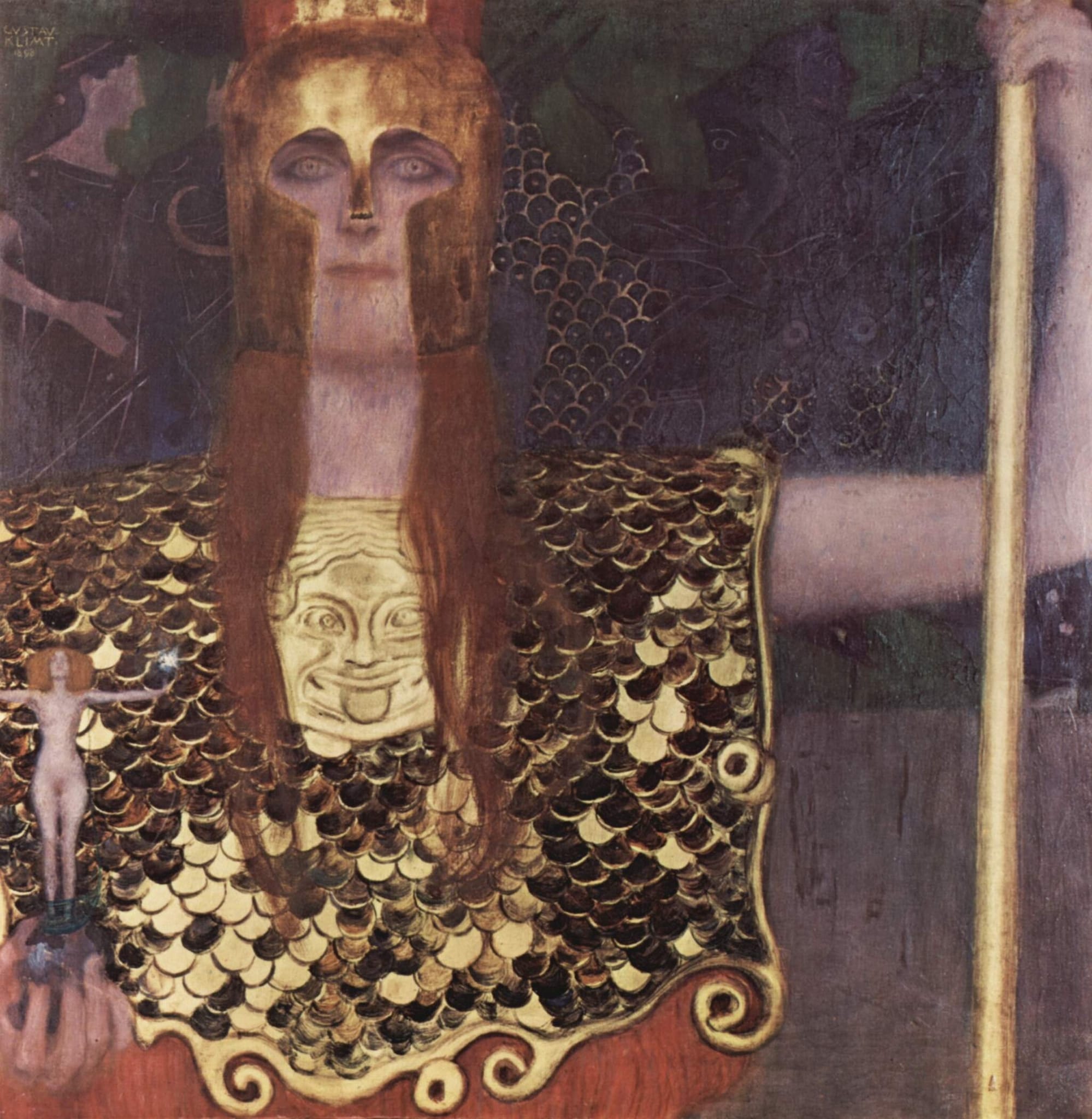
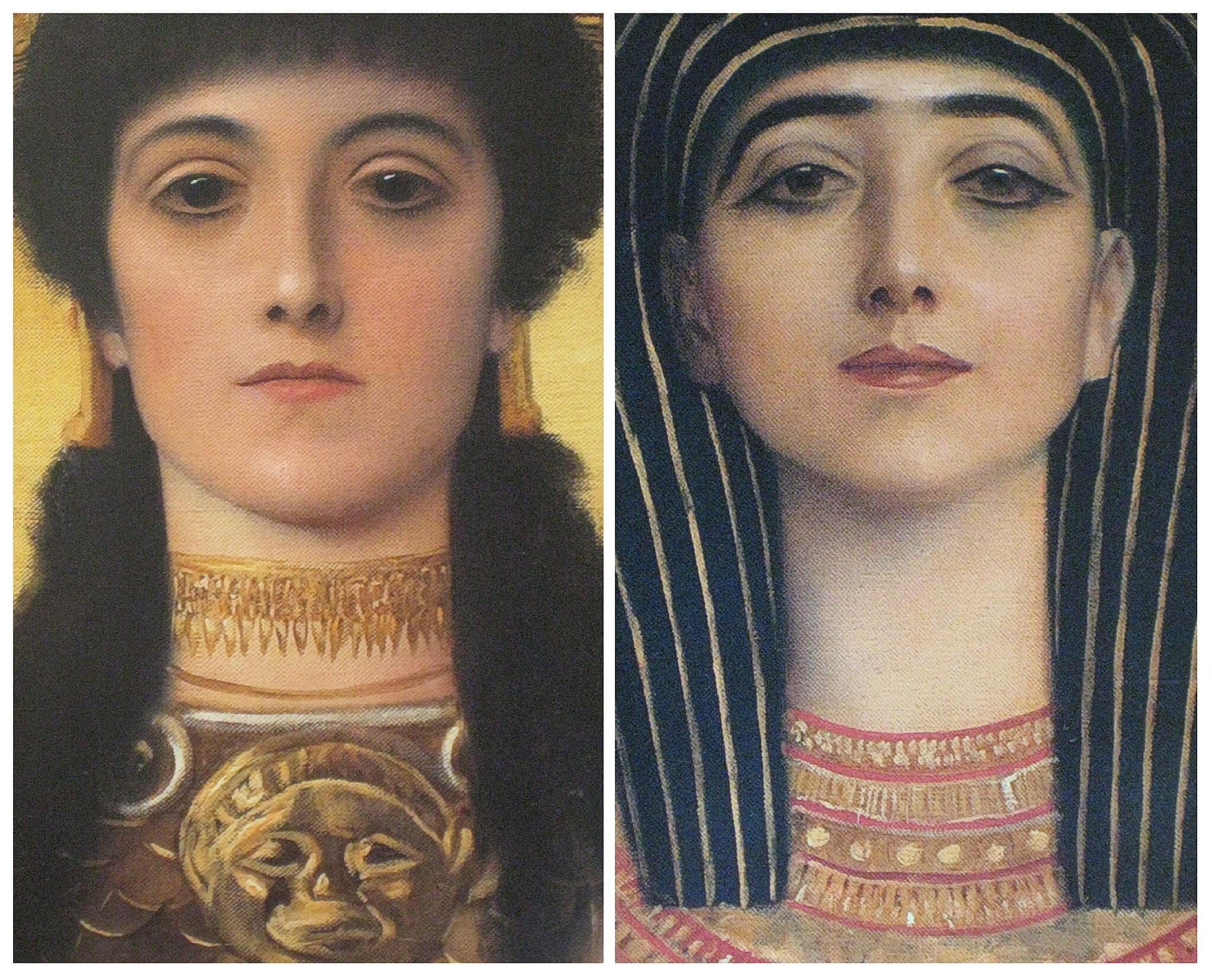
Pallas Athena
1898
Klimt presents the war-and-wisdom goddess as a commanding modern icon in gleaming armor, set against a flat, ornamental gold ground. Painted at the moment he helped found the Vienna Secession, it signals his break from academic naturalism toward symbolism and decorative abstraction. Look for the penetrating gaze, the gorgoneion on her breastplate, and the crisp, mosaic-like surface that declares a new aesthetic.
Must-see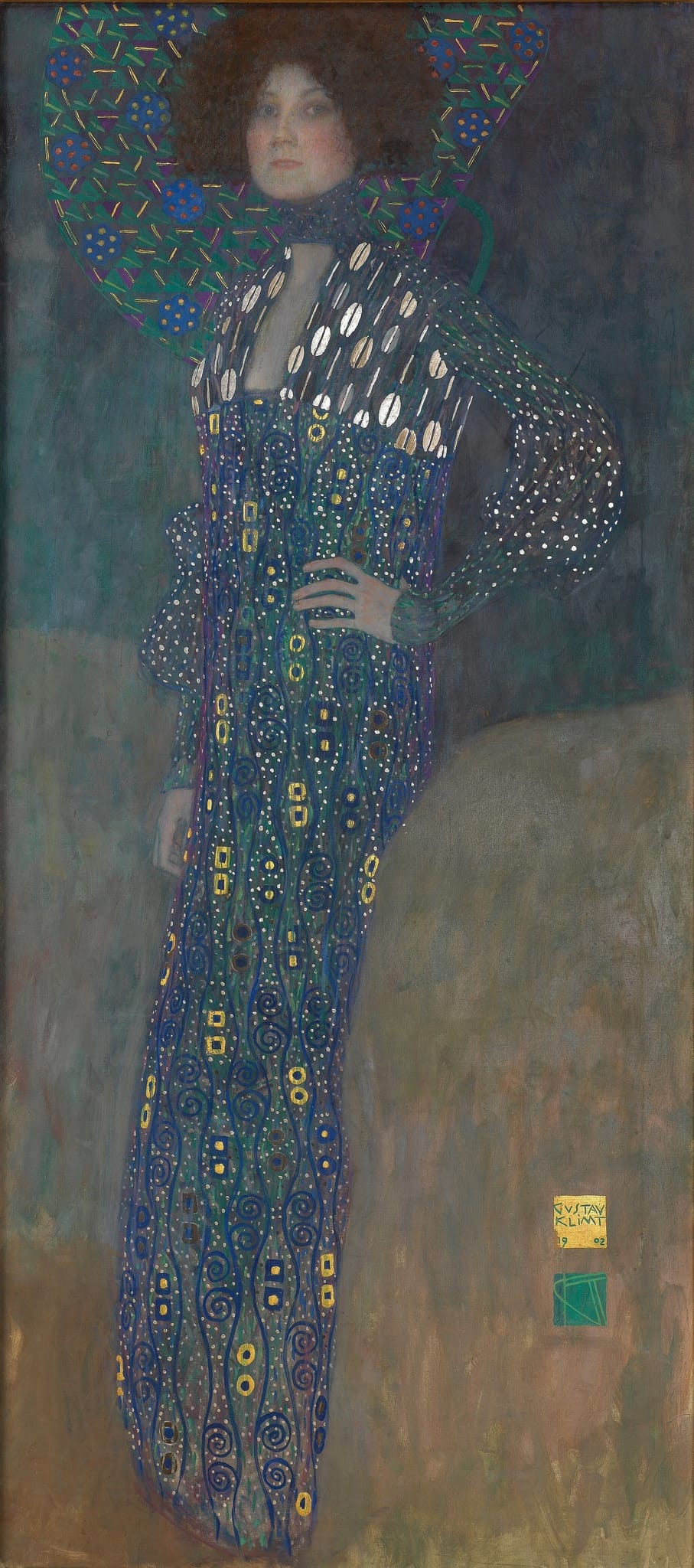
Emilie Flöge
1902
This full-length portrait depicts Klimt’s close companion and famed Viennese fashion designer in a flowing, patterned dress, enveloped by a shimmering field of ornament. It celebrates the modern, self-possessed woman and the fusion of fine art with avant‑garde textile design. Look for the richly patterned fabric, the elongated silhouette, and how figure and background interlace into a nearly abstract decorative whole.
Must-see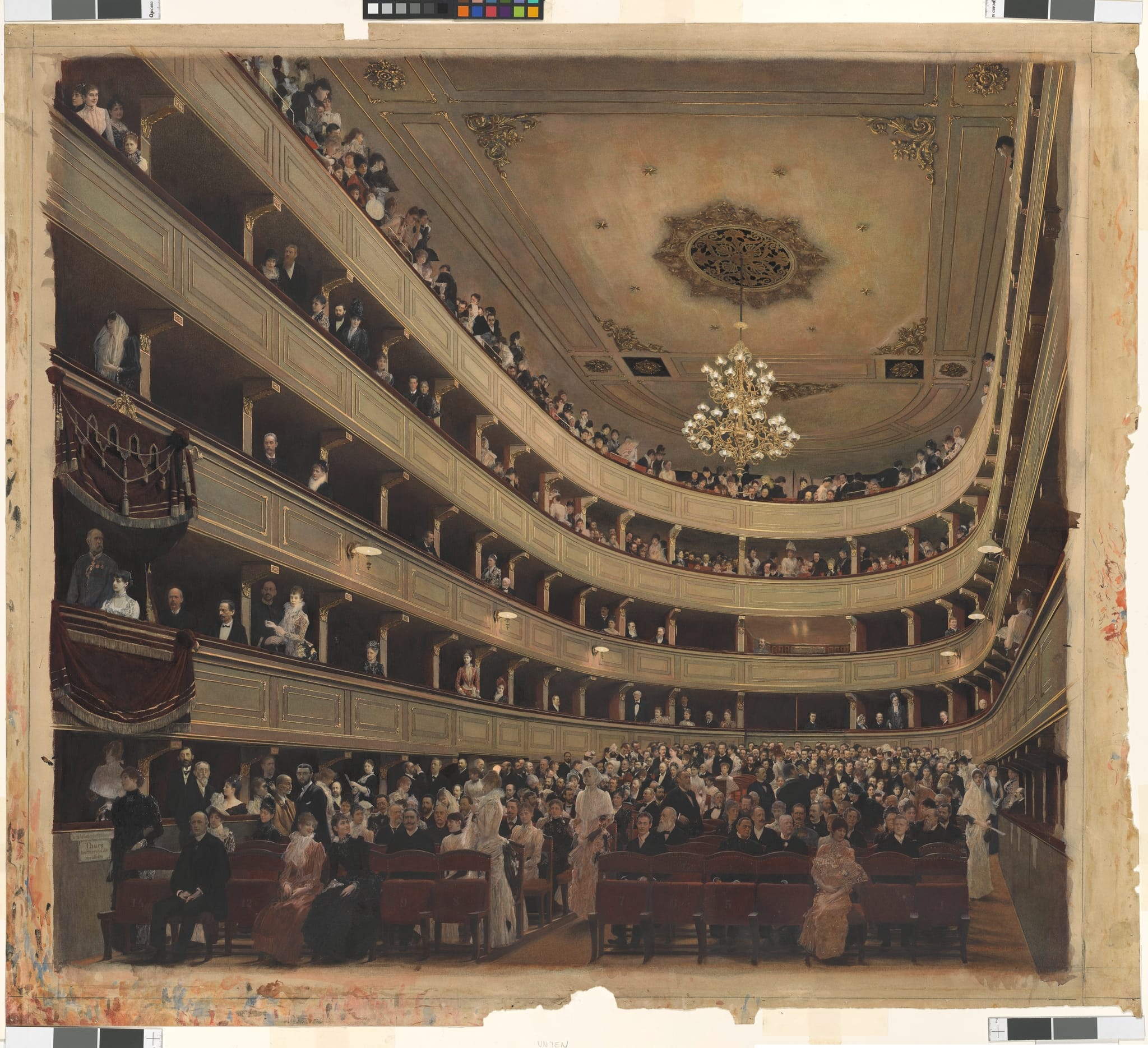
Auditorium of the Old Burgtheater
1888
Klimt records the packed interior of Vienna’s former Burgtheater just before it disappeared from the cityscape, capturing the tiers of boxes and a sea of distinct faces. The painting is both a tour‑de‑force of observation and an irreplaceable document of a lost architectural space and its audience. Look for the meticulous, portrait-like heads throughout the crowd and the precise rendering of the theater’s balconies and ornament.
Secession (Vienna Secession Building)
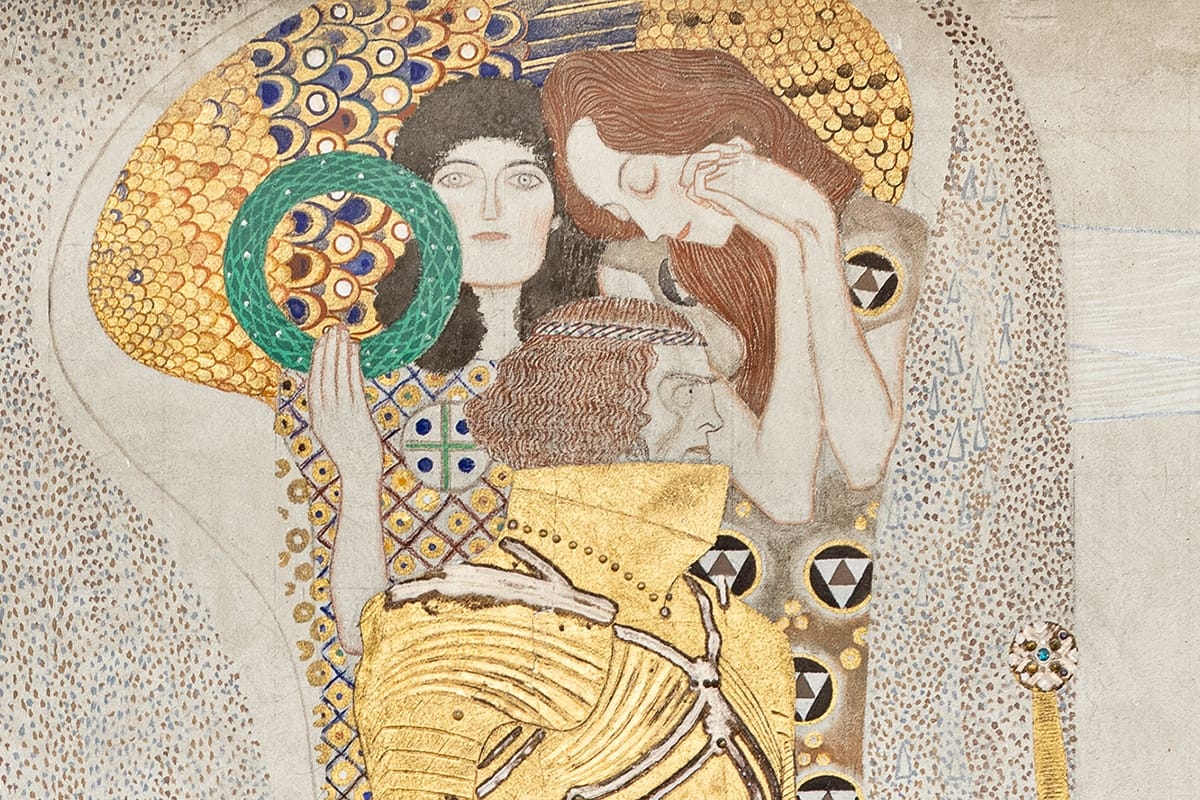
Home to Klimt’s monumental Beethoven Frieze, the Secession is the living manifesto of the movement he co‑founded to break from academic art. Experiencing the frieze in situ—surrounding you at architectural scale—clarifies his ambition to fuse painting, music, and architecture into a total work of art.
Kunsthistorisches Museum Wien (Museum of Art History)
Klimt, with his brother and Franz Matsch, painted the allegorical spandrels along the grand staircase here—his breakthrough public commission. These high‑set panels show his early mastery of ornament and female allegory before the full Golden Period bloom.
Ancient Greece and Egypt
1891
Klimt pairs Pallas Athena with a Tanagra maiden on the Greek side and a nude Isis before hieroglyphs and ritual objects on the Egyptian side; look for Athena’s tiny Nike, gorgoneion cuirass and tondo-like shield versus Isis holding the ankh beneath a spread-winged vulture. The work signals Klimt’s break from strict historicism through the sensuous, provocative rendering of Isis in a public setting. Spot the canopic chest, ushabtis, and the Aphrodite statuette of the ‘sandal-loosening’ type in the intercolumniations. ([khm.at](https://www.khm.at/objektdb/detail/1311302/?utm_source=openai))
Must-see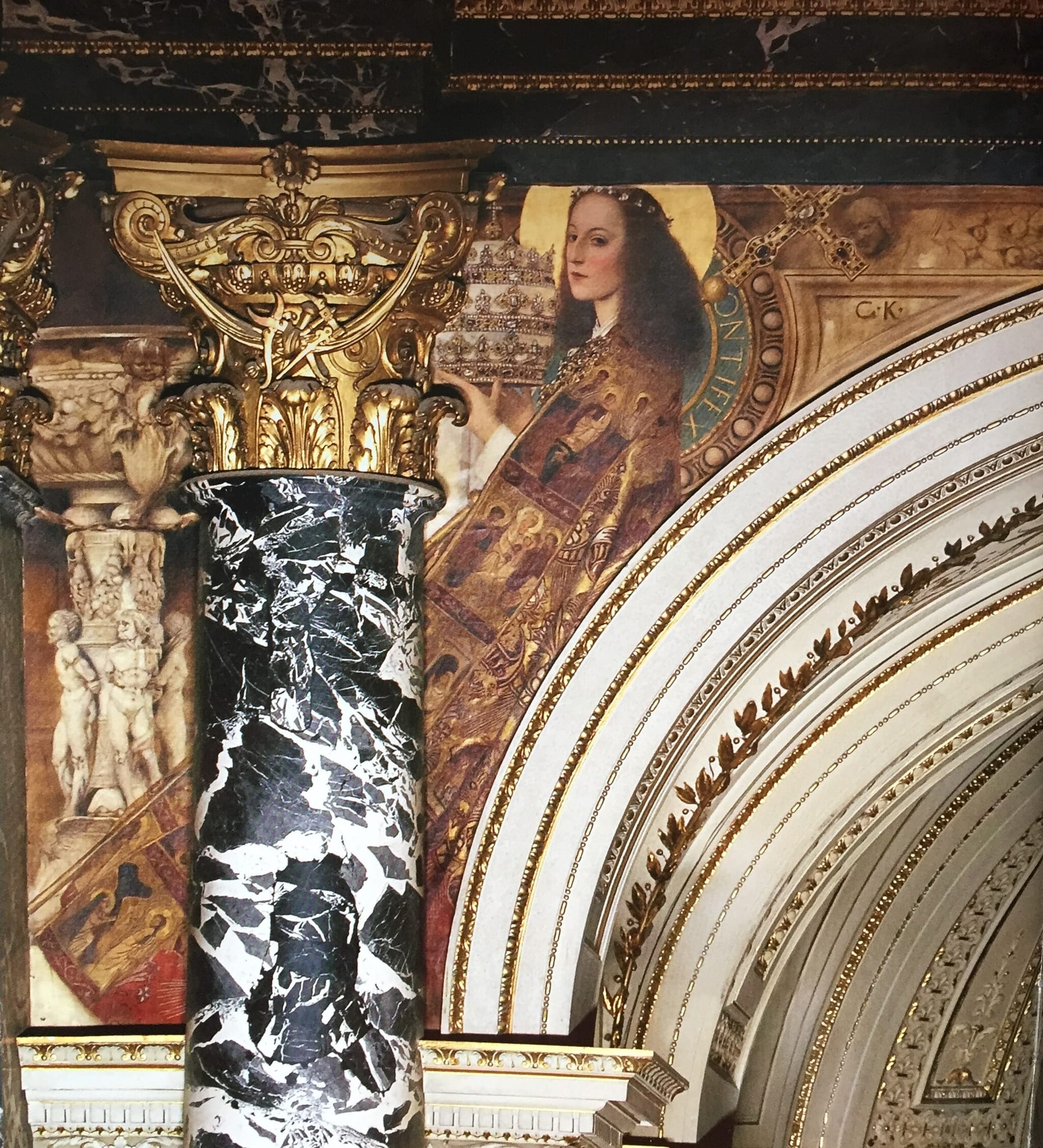
Roman and Venetian Quattrocento
1891
Allegorical figures embody Renaissance Rome and Venice: Ecclesia, representing the papacy, presents the tiara beside a baptismal font, while a Doge in brocaded robes appears with the winged Lion of Saint Mark. Klimt contrasts these rival centers with Renaissance-style symmetry and a gold-ochre palette, hinting at his emerging modern decorative language. Look for the Siena-inspired font, the Bellini-derived likeness of Doge Leonardo Loredan, and the Latin “PAX TIBI MARCE EVANGELISTA MEUS.” ([khm.at](https://www.khm.at/kunstwerke/roemisches-und-venezianisches-quattrocento-1311301?utm_source=openai))
Must-see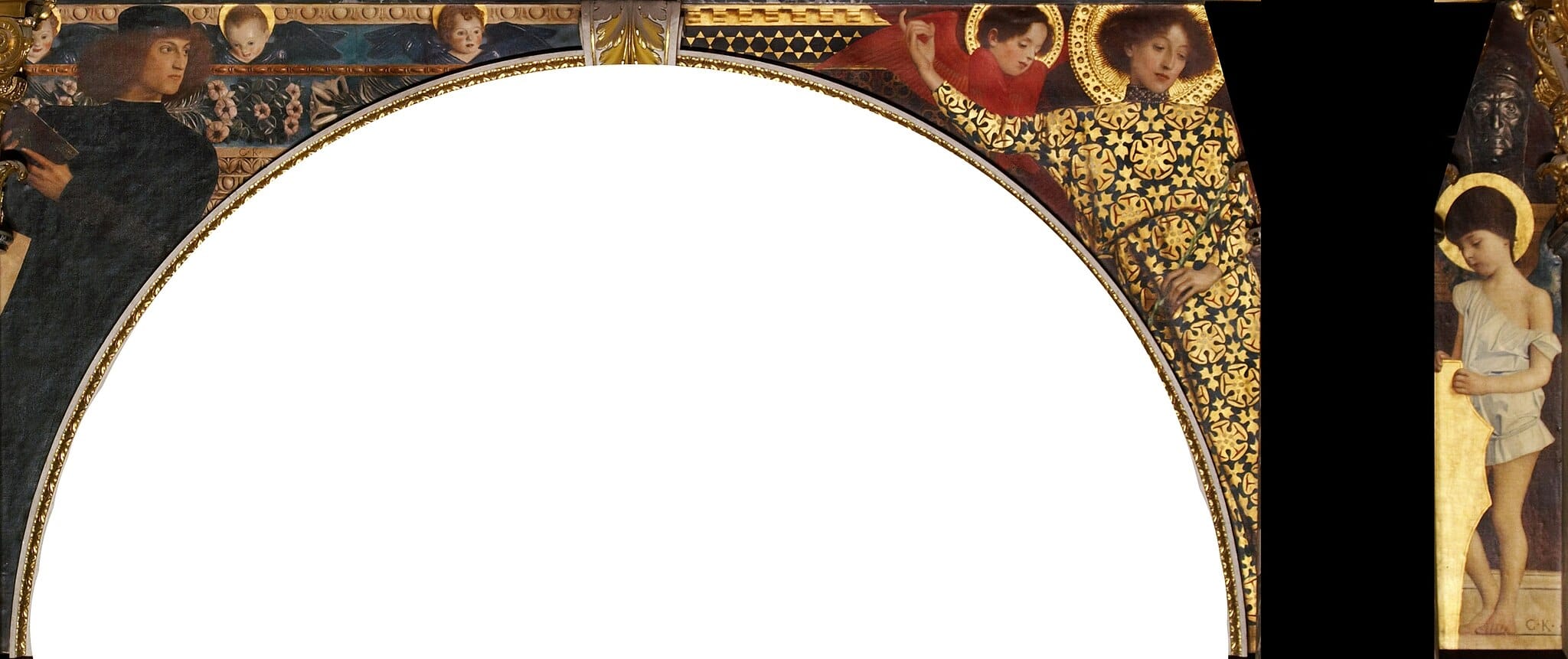
Old Italian Art
1891
A black-clad youth with an open book faces a richly patterned, haloed woman holding a lily, while a cherub hovers and, nearby, a bust of Dante and an angel suggest a dialogue with the Divine Comedy. The panel is significant for foreshadowing Klimt’s later hallmark separation of ornamental surface and modeled flesh seen in works like Judith and The Kiss. Look for the Dante bust, the Medici-associated horse-head shield motif, and the luxuriant floral fabric that flattens the figure into decorative pattern. ([de.wikipedia.org](https://de.wikipedia.org/wiki/Altitalienische_Kunst_%28Klimt%29))
MAK – Museum of Applied Arts
MAK holds Klimt’s full‑scale cartoons and studies for the Stoclet Frieze, revealing his design process for one of the era’s greatest Gesamtkunstwerk interiors. You see how his painting language was engineered to live with furniture, textiles, and architecture—core to understanding Vienna Secession ideals.
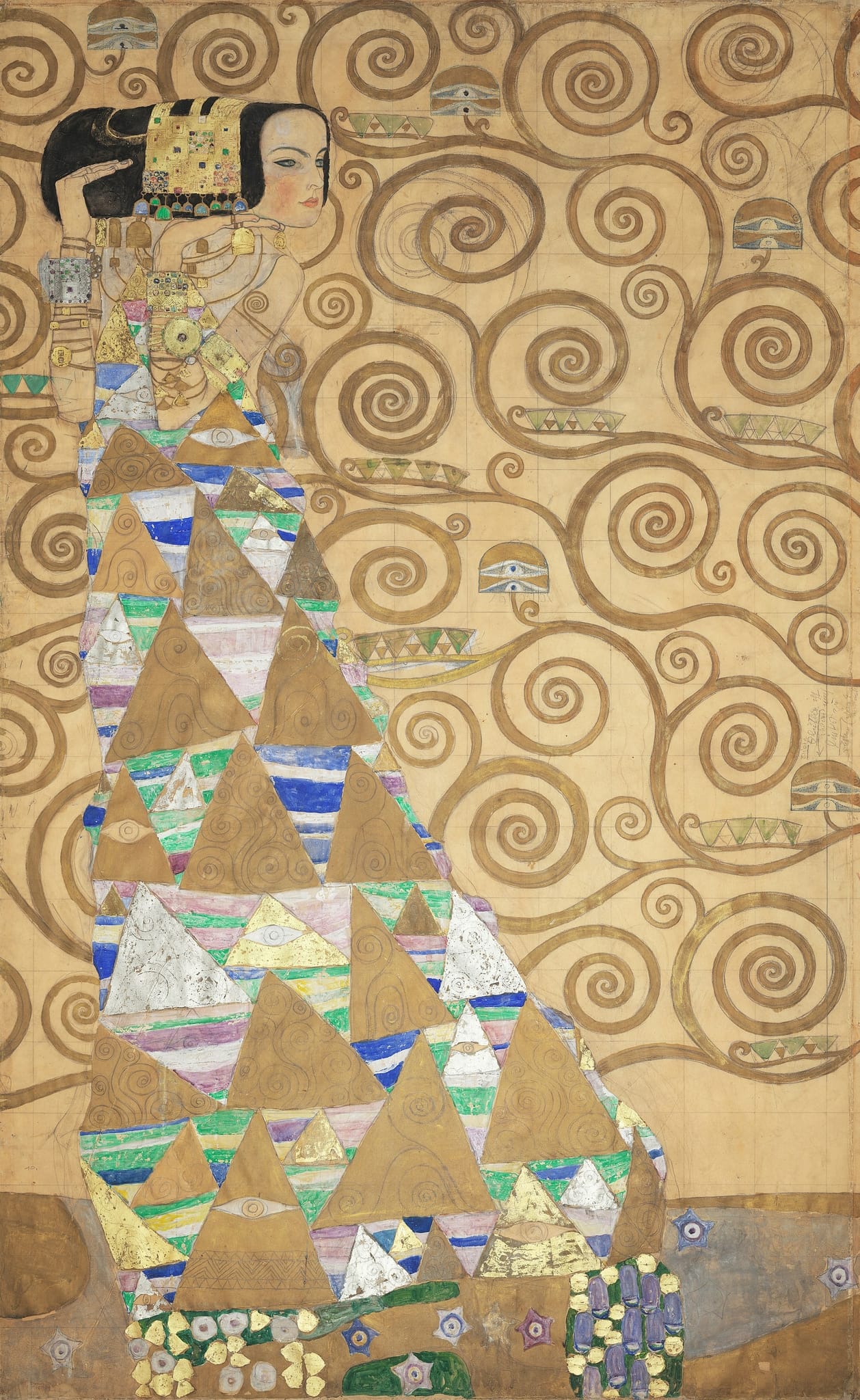
Expectation (Dancer)
1911
A profile dancer with Egyptian-inspired posture stands before a field of spirals, her triangular, mosaic-like robe echoing the frieze’s geometric rhythm. As a full‑scale cartoon for the Stoclet House mosaic, it shows Klimt fusing modern dance influences with ancient motifs; look for the frontal torso with sideways head, the stylized headdress, and notes intended for Wiener Werkstätte artisans. ([artsandculture.google.com](https://artsandculture.google.com/asset/nine-cartoons-for-the-execution-of-a-frieze-for-the-dining-room-of-stoclet-house-in-brussels-part-2-expectation-dancer-gustav-klimt/HgFr3a3RDqM_jQ?hl=en&utm_source=openai))
Must-see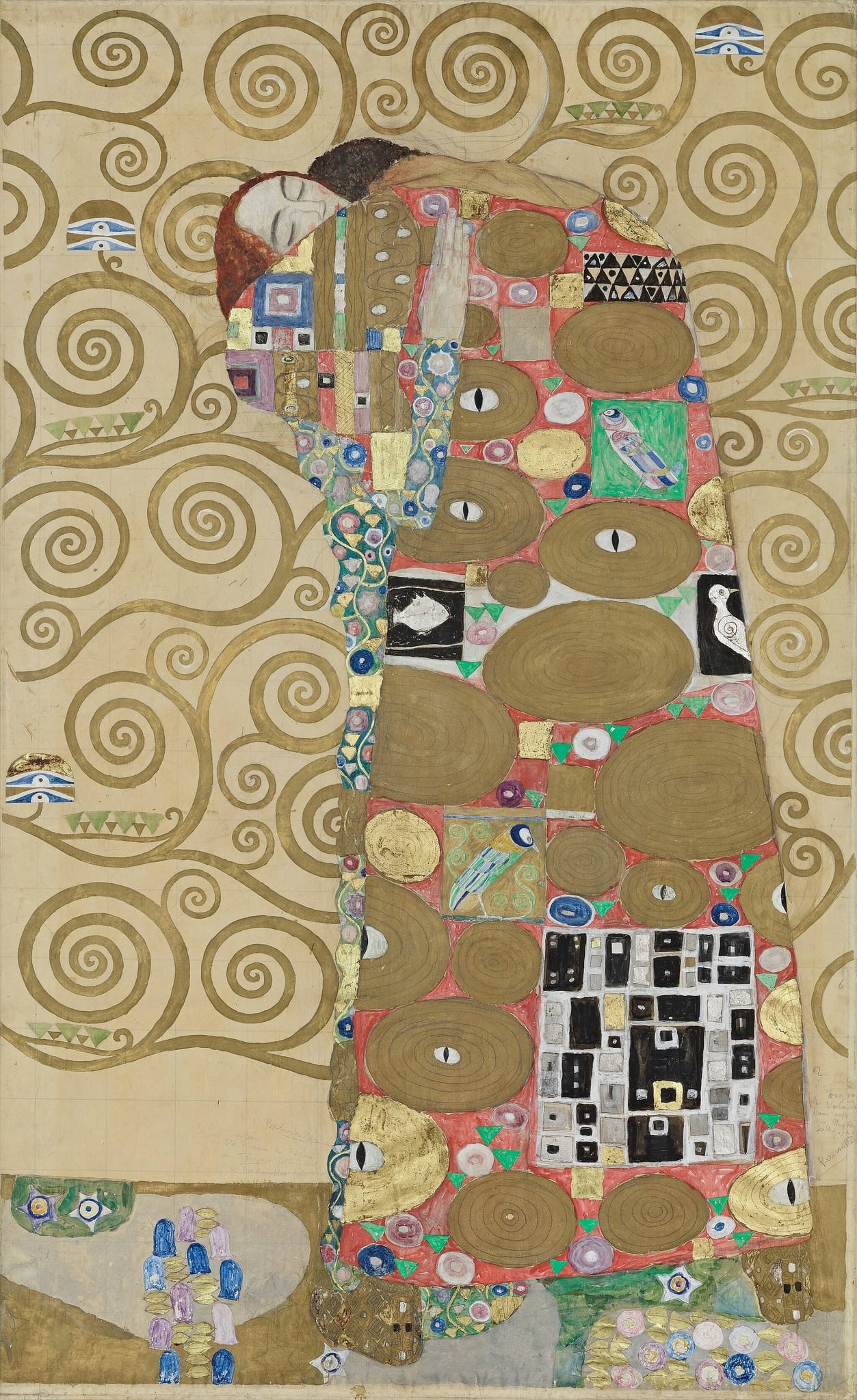
Fulfillment
1911
An embracing couple completes the frieze’s narrative, their patterned garments interlocking like tesserae and contrasting with the angularity of Expectation. Significance lies in its role as the culminating panel of Klimt’s Stoclet project during his Golden period; look for the lush circular motifs and the life‑size working‑drawing details that guided the final mosaic. ([artsandculture.google.com](https://artsandculture.google.com/theme/a-history-of-mosaics%C2%A0/CAKiKfBMxsR5KQ?utm_source=openai))
Must-see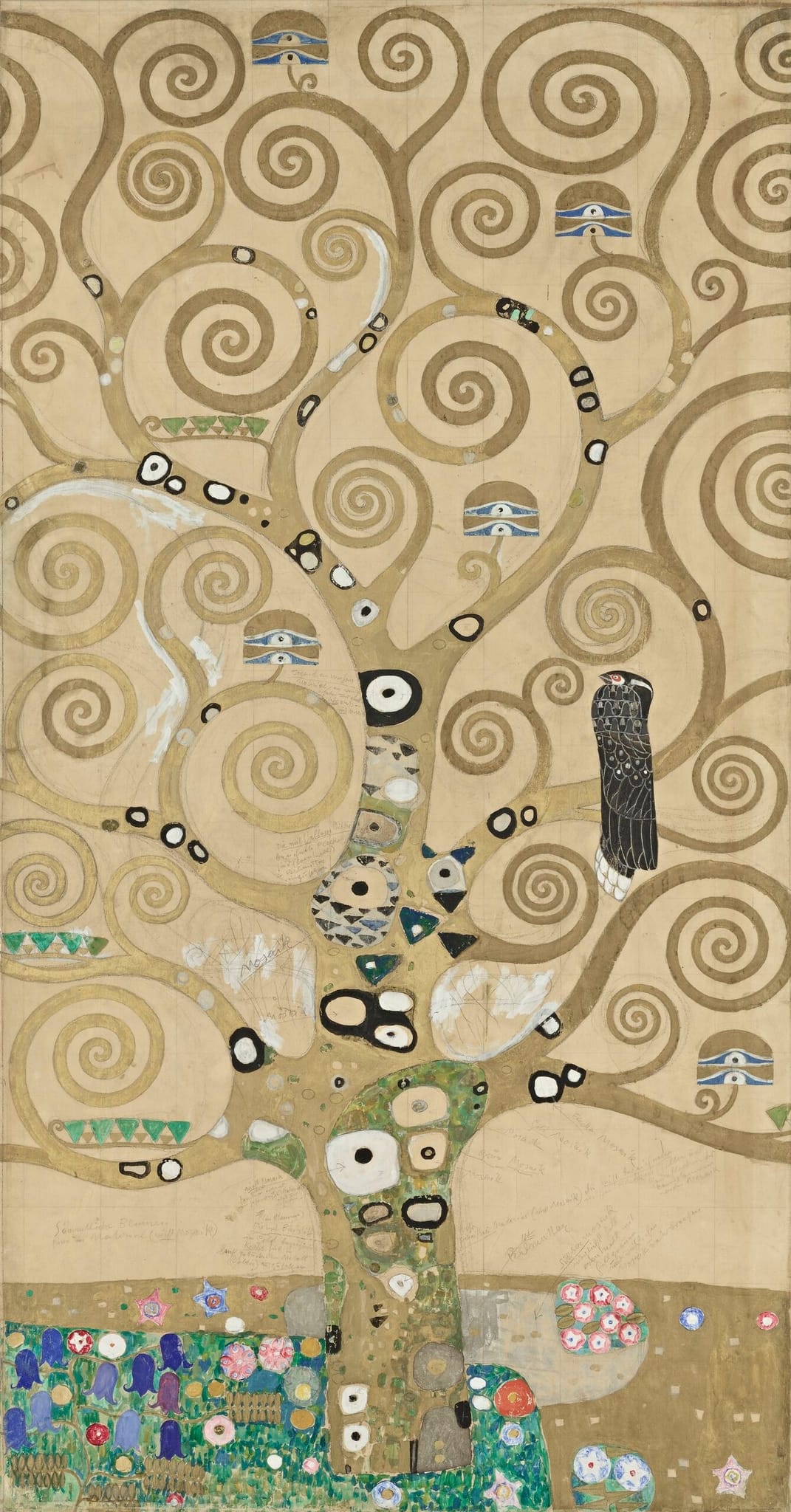
Tree of Life (Part 4)
The central Tree of Life unfurls in opulent, volute spirals, studded with Horus eyes, falcons, and stylized blossoms. This cartoon anchors the ensemble and was mirrored across the dining room; look for Klimt’s Byzantine‑inspired stylization and his handwritten production notes on the sheet. ([artsandculture.google.com](https://artsandculture.google.com/asset/nine-cartoons-for-the-execution-of-a-frieze-for-the-dining-room-of-stoclet-house-in-brussels-part-4-part-of-the-tree-of-life/IwE6G8n5wsoEjg?utm_source=openai))
Must-see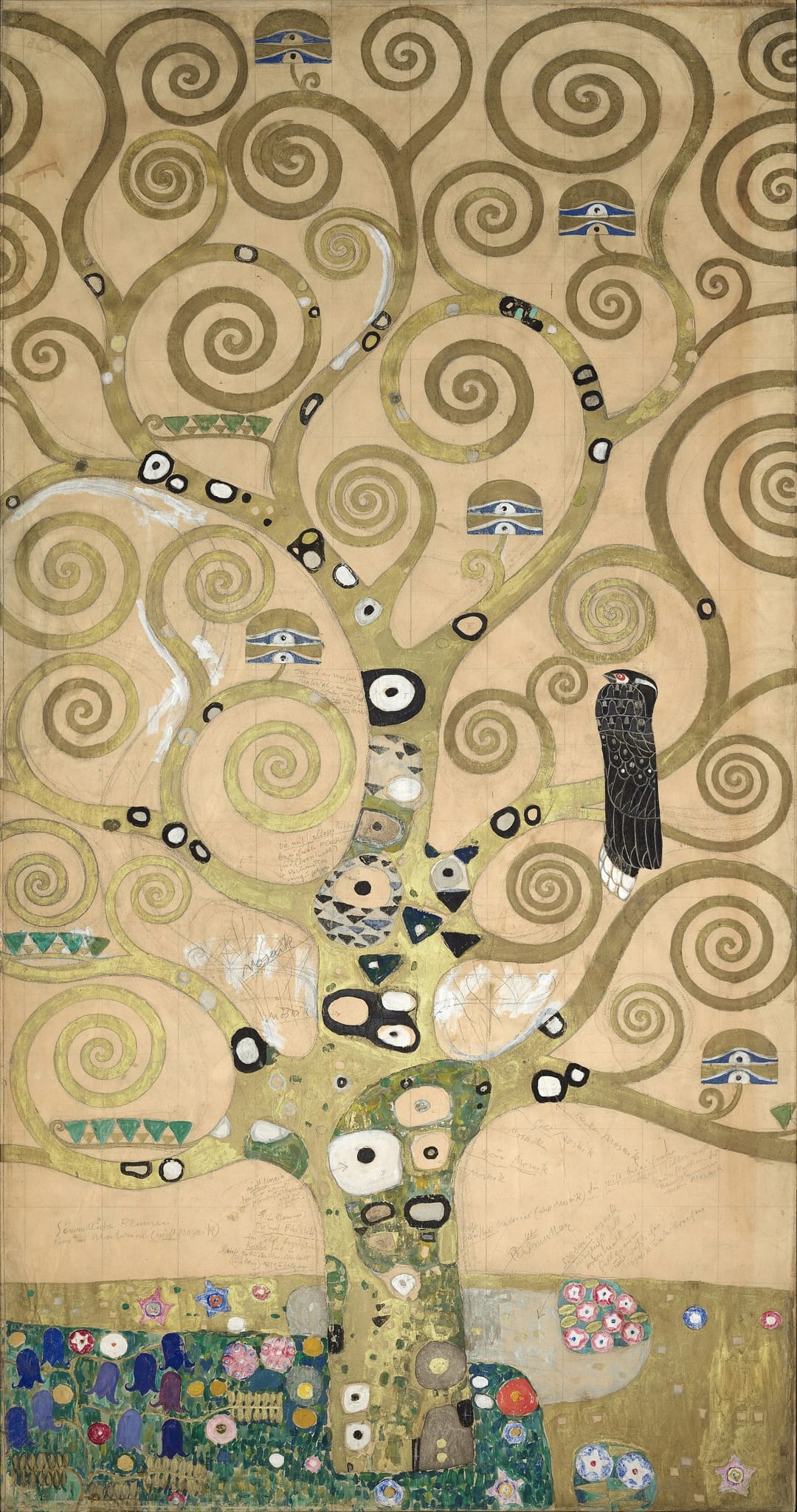
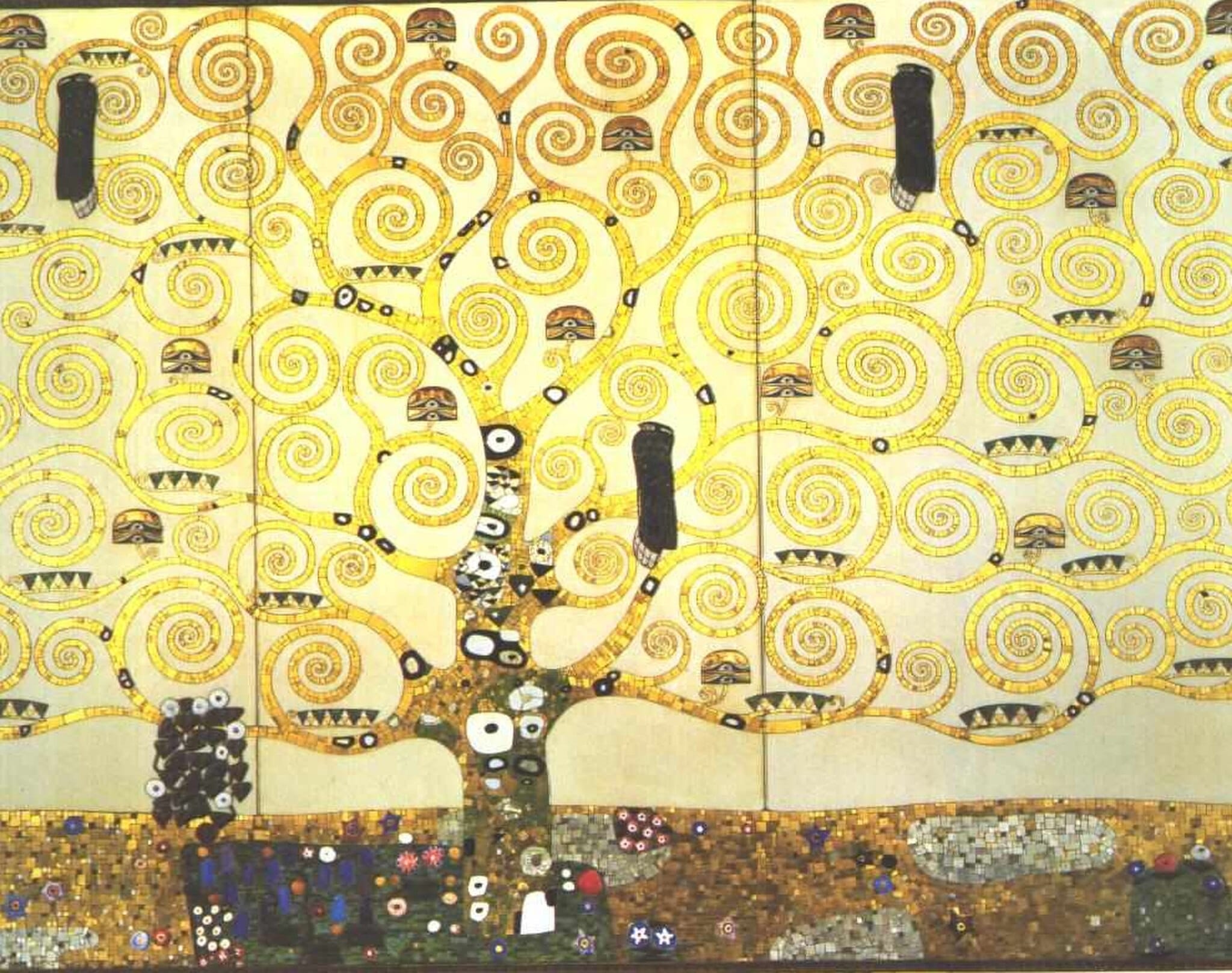
Part of the Tree of Life (Part 1)
A segment of the long wall where the Tree’s swirling branches weave through a meadow of abstract flowers. It helps establish the frieze’s continuous ornamental field; look for tightly coiling spirals, avian details, and the blend of Egyptian and Byzantine references. ([wga.hu](https://www.wga.hu/html_m/k/klimt/2/42stoclet.html?utm_source=openai))
Part of the Tree of Life (Part 3)
Another passage of the sprawling Tree of Life, this sheet refines the balance between branching volutes and carpet‑like ground. Its significance is in mapping the rhythm and spacing for the final mosaic; watch for recurring eyes, blossoms, and Klimt’s precise alignment of spiral geometry. ([pivada.com](https://www.pivada.com/en/gustav-klimt-sketch-for-stoclet-frieze-part-3-the-tree-of-life-1910-1911?utm_source=openai))
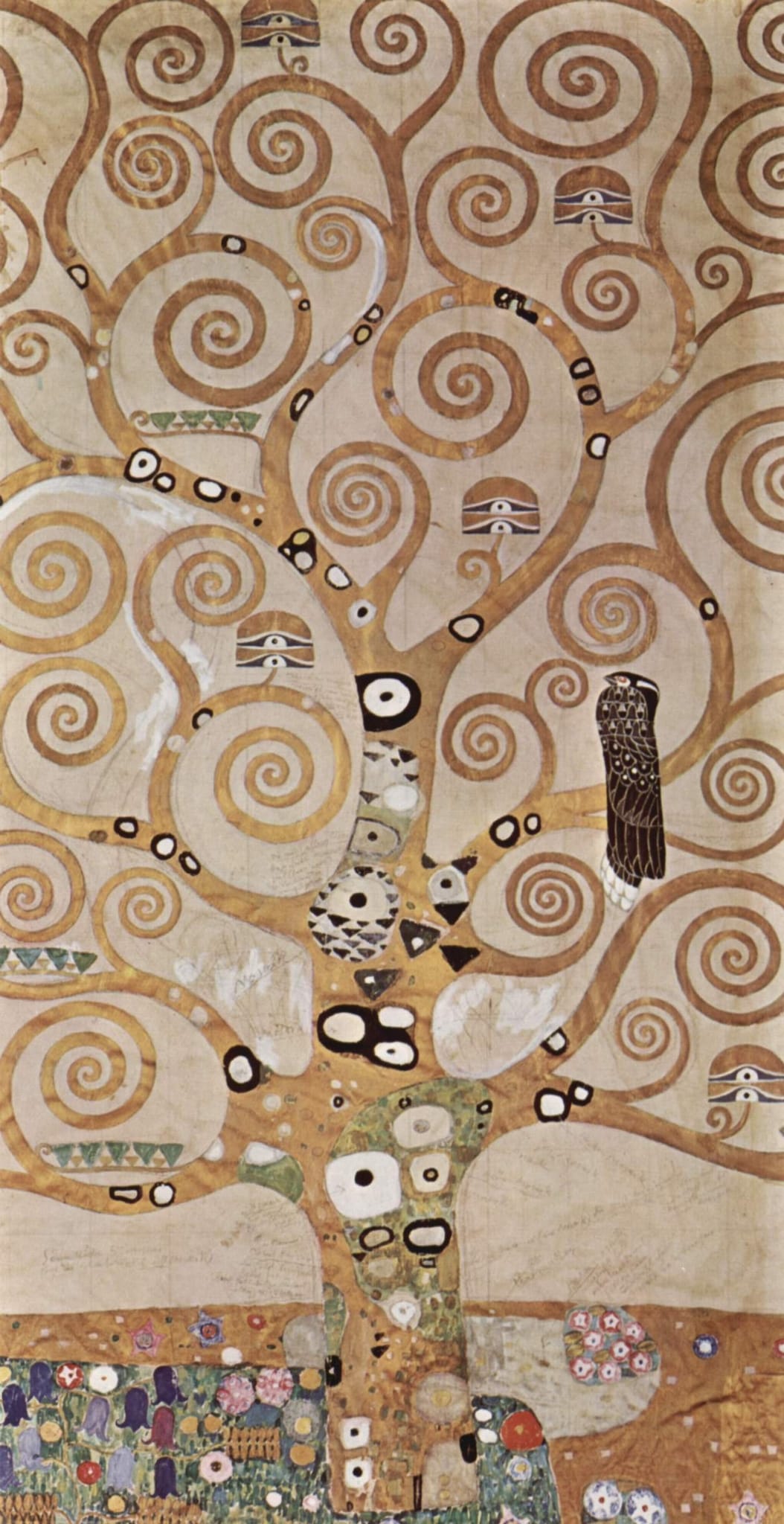
Part of the Tree of Life (Part 5)
Here the Tree’s arabesques thicken and open, guiding the eye across the wall and toward the figural panels. Look for Horus eyes and falcons tucked among the gold‑toned spirals—motifs likely inspired by the Stoclets’ collection and specified by Klimt in his working drawings. ([artsandculture.google.com](https://artsandculture.google.com/exhibit/gustav-klimt-y-el-palais-stoclet-mak-austrian-museum-of-applied-arts/FgIitDQVcrnvKg?hl=es-419&utm_source=openai))
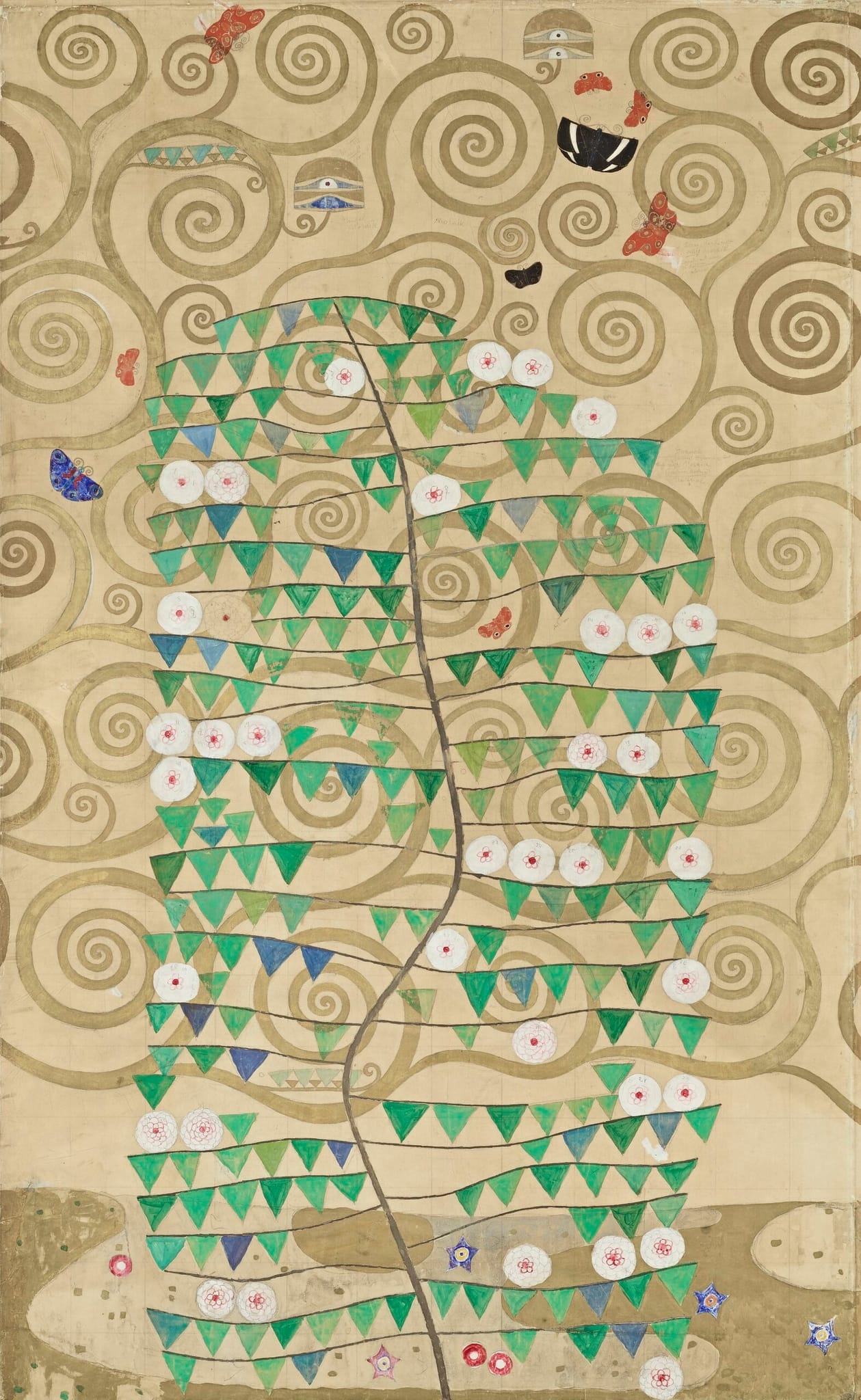
Rosebush (Part 6)
A dense rosebush punctuates the frieze’s lower register, a natural counterpoint to the Tree’s abstract spirals. It signals Klimt’s sensitivity to ornamental ‘breathing spaces’ within the continuum; notice the clustered blooms and notations that directed material choices like enamel and gold. ([artsandculture.google.com](https://artsandculture.google.com/exhibit/gustav-klimt-au-palais-stoclet-mak-austrian-museum-of-applied-arts/FgIitDQVcrnvKg?hl=fr&utm_source=openai))
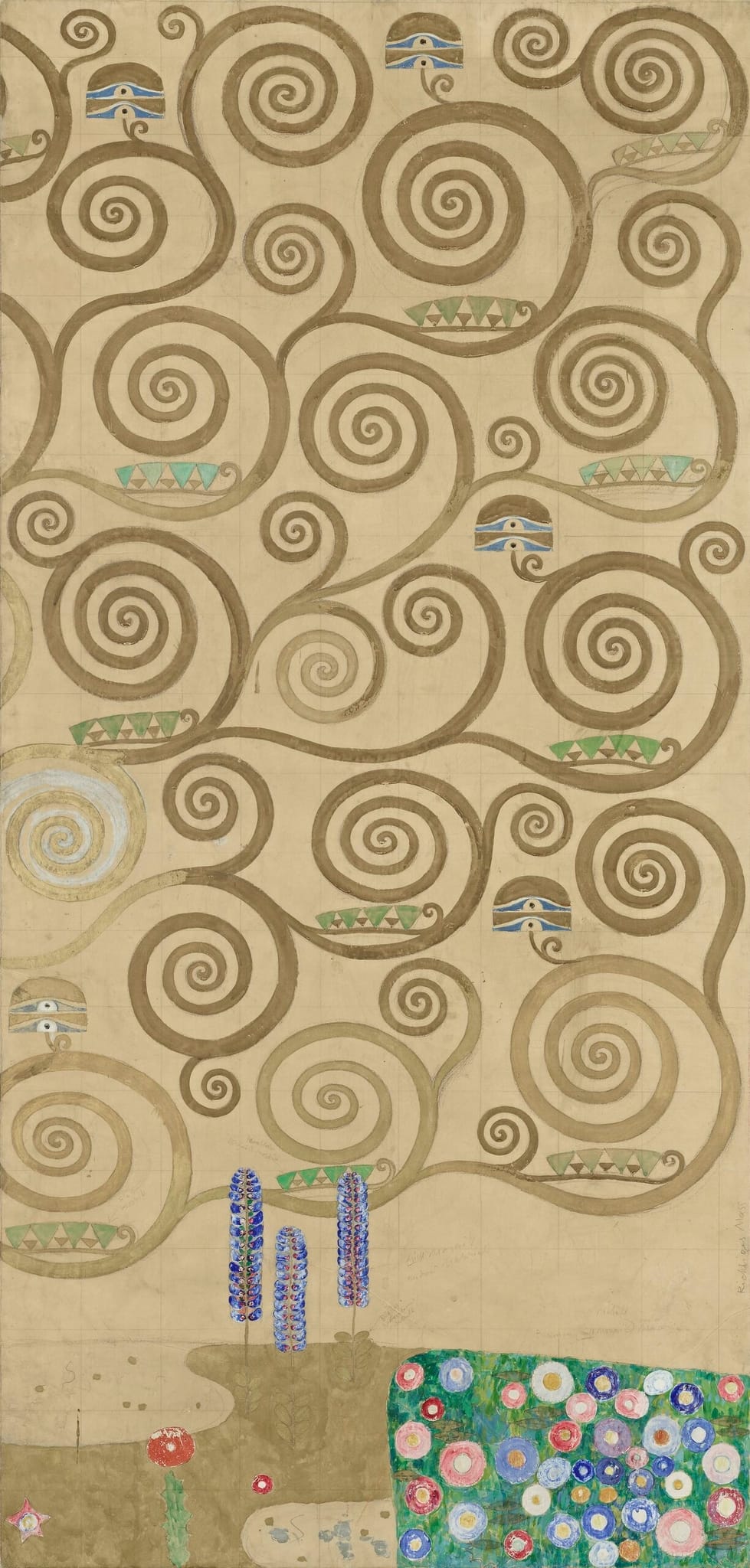
Part of the Tree of Life (Part 7)
This late segment modulates the spiral canopy above an abstracted flower meadow, preparing the visual cadence near the room’s corner. Watch for the disciplined repeat of curves and blossoms and how Klimt’s drawn cues translate into shimmering mosaic texture. ([artsandculture.google.com](https://artsandculture.google.com/exhibit/gustav-klimt-au-palais-stoclet-mak-austrian-museum-of-applied-arts/FgIitDQVcrnvKg?hl=fr&utm_source=openai))
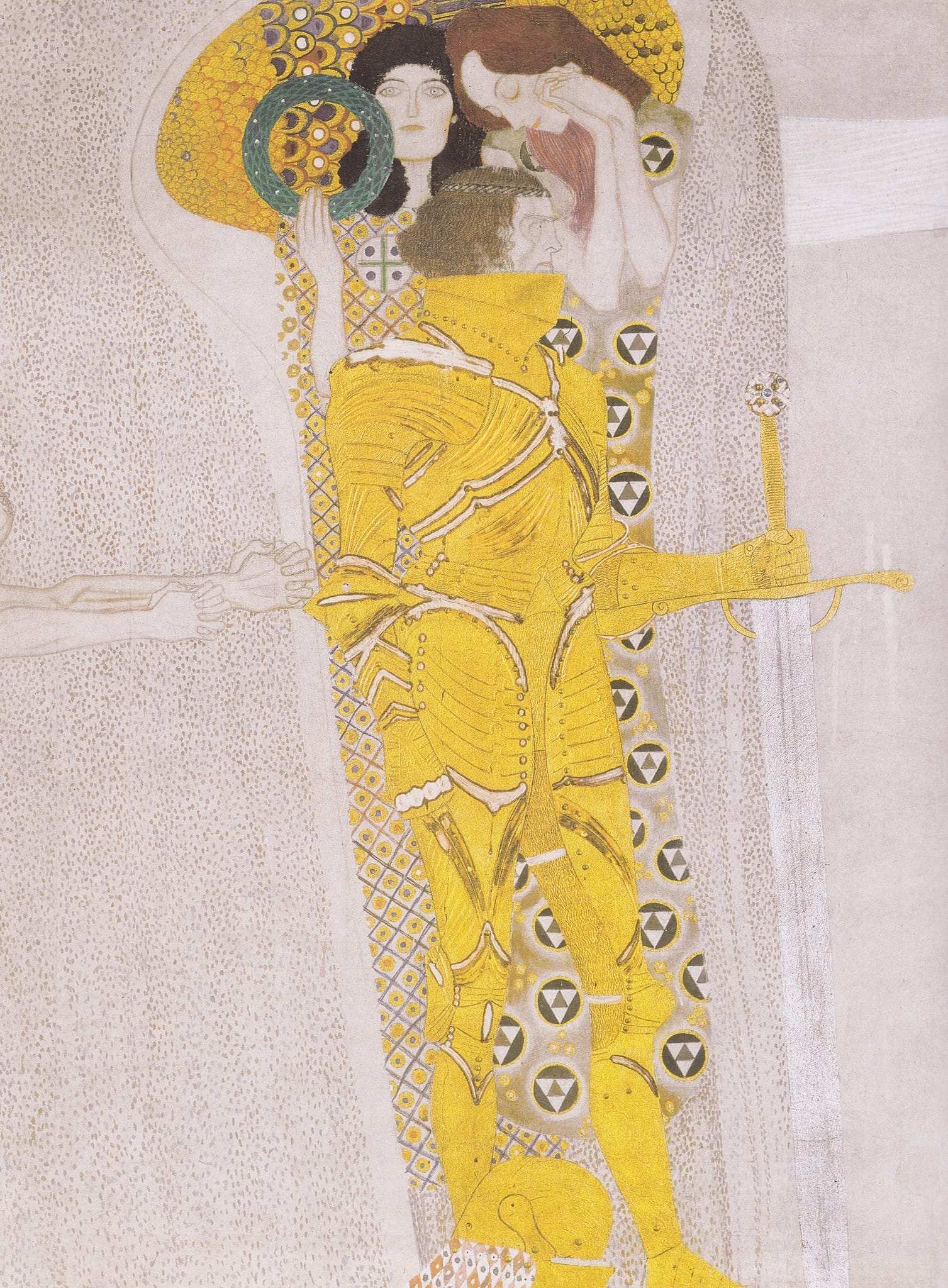
Knight (Part 9)
1911
An abstracted armored guardian presides over the narrow wall, built almost entirely from squares, triangles, and circles. Unique within Klimt’s oeuvre, it acts as a sentinel between Expectation and Fulfillment; look for the gridded cloak, shield forms, and the composition’s near‑mathematical order. ([artsandculture.google.com](https://artsandculture.google.com/asset/nine-cartoons-for-the-execution-of-a-frieze-for-the-dining-room-of-stoclet-house-in-brussels-part-9-knight-gustav-klimt/mQH-rRyI3WP4mg?utm_source=openai))
Theatermuseum (Palais Lobkowitz)
Even without paintings, this museum illuminates Klimt’s early career with theater commissions alongside his brother and Matsch, including studies tied to the Burgtheater. It frames how stagecraft, allegory, and public decoration shaped his later ornamental language.