Beethoven Frieze

by Gustav Klimt

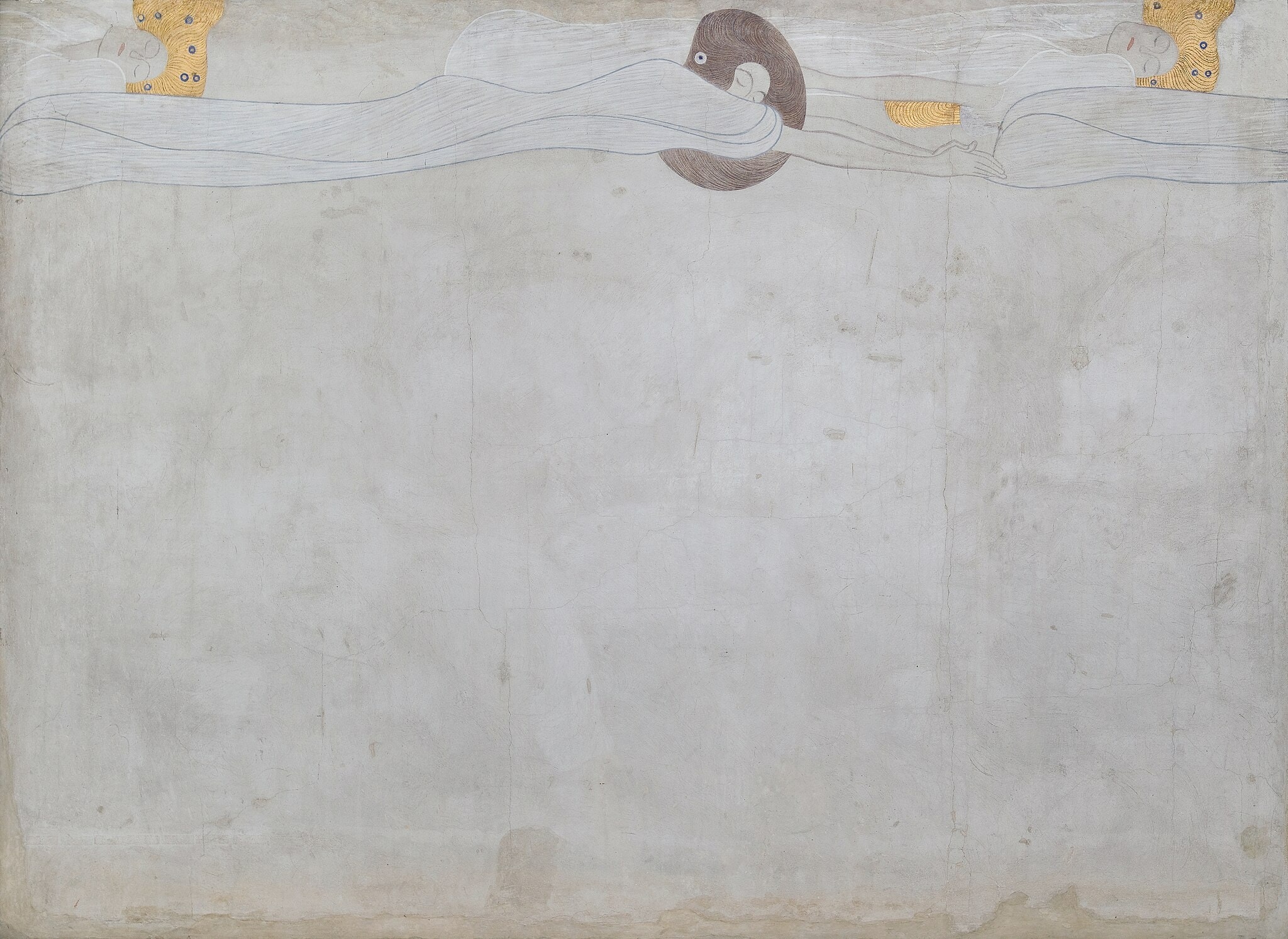
Gustav Klimt’s Beethoven Frieze visualizes Beethoven’s Ninth as a quest from suffering to joy, using weightless, ribbon-like bodies and gold-gleaming ornament to translate sound into sight. In the panel shown, floating genii drift horizontally while islands of gold studded with eye-like jewels punctuate a vast, chalky void, suspending time like a long musical rest. The work fuses line, flatness, and precious materials to promise transcendence through art [1][3].
💰

Market Value

$300-500 million

How much is Beethoven Frieze worth?

Study Print Studio

Create a personal study print

Build a companion study sheet around the part of this painting that speaks to you most. Choose a detail, shape an interpretation, and walk away with something personal and display-worthy.

Fast Facts

Year
1901–1902
Medium
Charcoal, graphite, colored chalks/pastel, casein paint; gilt stucco with applied gold and silver, mother-of-pearl, glass, mirror, brass, and other inlays on mortar over reed matting
Dimensions
approx. 215 × 3414 cm overall
Location
Secession Building (permanent display), Vienna; owned by the Republic of Austria (Belvedere), on permanent loan to the Secession
See all Gustav Klimt paintings in Vienna
Beethoven Frieze by Gustav Klimt (1901–1902) featuring Floating genii (elongated figures), Ribbon-like current, Gold islands with eye-like jewels, Masklike, inward-turned faces

Click on any numbered symbol to learn more about its meaning

Meaning & Symbolism

Klimt opens the cycle with a current of elongated, hovering figures—the genii of impulse—who skim the upper register like a held musical line. Their bodies are articulated by hair-fine, calligraphic contours; faces turn inward, masklike, resisting individual identity. Between them, small fields of gilded relief, speckled with jewel-like “eyes,” flare against the chalk-gray ground. The entire lower expanse remains deliberately empty, a stage of expectancy rather than action. This compositional gambit—image as suspended sound—declares that affect, not event, is the true subject. By withholding weight and gravity, Klimt renders the figures as ideals in transit, carriers of desire that will soon congeal into the frieze’s moral quest: Suffering Humanity pleading, the Knight setting forth, and the ordeal by Hostile Forces, before arriving at the Choir and embrace 1. The panel thus functions like an anacrusis, a breath before the downbeat of the drama. Formally, Klimt forges meaning through two-dimensionality and ornament. The linear, fluttering bodies refuse modeling; the wall remains a plane rather than an illusionistic depth. Into this plane he sets literal matter—gold and silver, relief stucco, mother-of-pearl, buttons, mirror and glass—so that radiance is not depicted but physically present 34. The tiny “eyes” embedded in the gold islands act as sentient ornaments: watchful, protective, and slightly uncanny. They convert decoration into symbol, suggesting that beauty in the Secessionist sense is ethical force. The cool tonality of casein and chalk contrasts with the hot shimmer of metal, staging a dialectic of the earthly and the transfigured. What reads here as silence—the broad gray field—is not absence but a rest in the score, a deliberate pause that amplifies the coming crescendo of temptation and rescue. Klimt’s surface becomes time: the viewer moves laterally as one listens forward. Iconographically, this opening aligns with the Wagnerian reading of the Ninth: from longing to fulfillment through art 1. The upward drift of the genii intimates aspiration; their closed eyes and detached mouths insist that the first movement of the soul is inward, prior to action. As the cycle proceeds, the serene current will be shattered by Typhon’s monstrous mass and the angular knot of afflictions—Lasciviousness, Madness, Death—before the work resolves in the angelic choir and the embracing couple, Klimt’s secular gloss on “This kiss to the whole world” 1. Read against Vienna 1900’s search for a surrogate religion, the panel’s hush announces the Secession’s creed: art redeems—not by preaching narrative morals, but by orchestrating sight, material, and rhythm into communal feeling 14. In this sense, the frieze is less an illustration of Beethoven than a translation of musical structure: line equals melody, ornament equals timbre, gold equals the sacral overtone. The image before us is the first sustained note of that translation—held, luminous, and ethically charged.

Explore Deeper with AI

Ask questions about Beethoven Frieze

Popular questions:

Powered by AI • Get instant insights about this artwork

💬 Ask questions about this artwork!

Interpretations

Historical Context: Gesamtkunstwerk and Surrogate Religion

Installed for the Secession’s 1902 Beethoven Exhibition—an orchestrated Gesamtkunstwerk—the frieze funneled visitors toward Max Klinger’s idol-like Beethoven, ritualizing spectatorship as communal rite 1. Read with Schorske’s thesis on Vienna 1900, Klimt’s procession from suffering to choral embrace enacts a surrogate religion: art fuses architecture, sculpture, and painting to promise social cohesion when traditional faiths falter 5. The finale’s embrace alongside the angelic choir translates Schiller’s Ode into a civic sacrament, while the exhibition’s layout choreographed a pilgrimage from entrance to apotheosis. This is not mere illustration of music but a cultural program that sacralizes aesthetic experience, aligning beauty with ethical renewal in a newly designed temple of art 15.

Source: Vienna Secession; Carl E. Schorske (via Cornell eCommons)

Formal/Material Analysis: Ornament as Ethical Force

Klimt’s medium is not illusion but presence: casein over mortar, relief stucco, and inlays of mother‑of‑pearl, glass, mirror, and metal convert radiance into literal surface energy 23. The jeweled ‘eyes’ function as sentient ornament, part protective amulet, part uncanny witness, folding symbol into décor. Conservation records confirm a complex, additive technique—buttons, nails, and glass shards—so the wall gleams like a reliquary rather than a window into space 4. In this register, ornament becomes ethics: the precious materials dignify human longing and counter the specter of affliction with tangible luminosity. Klimt thus revalues the decorative as a moral vector, proposing that beauty’s material fact can redeem—an argument embedded in the very physics of the frieze’s surface 234.

Source: FAMSF Digital Stories; MoMA Catalogue; IIC Conservation Bulletin

Modernist/Psychological Reading: Weightlessness and the Split Body

The opening’s drifting genii and the later floating, masklike heads mark a modernist uncoupling of mind and body, what scholars identify as a new aesthetics of buoyancy circa 1900 1. Emmelyn Butterfield‑Rosen situates Klimt at a pivot where decentered, levitating visages signal a psyche unmoored from classical corporeal gravitas—an image of inwardness compatible with symbolist anti-naturalism and psychoanalytic Vienna 1. The lateral glide of forms against a flat ground rejects muscular action; desire moves as a sustained line, not a posed anatomy. In this psychological key, Klimt’s bodies think more than they act, suspending weight to visualize interior states—yearning, dread, exaltation—as planar rhythms that the viewer ‘reads’ temporally while walking the frieze.

Source: Emmelyn Butterfield‑Rosen (via Vienna Secession)

Mythic/Tragic Lens: Hostile Forces and the Monstrous Feminine

At the center, Typhon and the Gorgons compact Greek myth into a tragic tableau of fate, seduction, and terror. This aligns with fin‑de‑siècle engagements with Nietzschean tragedy, where Apollonian order falters before Dionysian excess 6. Klimt’s Gorgons—ornamented yet lethal—figure the period’s ‘monstrous feminine’: beauty as peril, desire as entrapment. The angular personifications (Lasciviousness, Intemperance, Death) press the Knight into a trial of seeing—to behold beauty without capitulating to it 1. Ornament thereby plays double agent: it dazzles and threatens. The passage to the Choir reframes tragedy’s abyss through aesthetic transfiguration, proposing not denial of the monstrous but its sublimation in collective song and embrace 61.

Source: The Art Bulletin (TandF); Vienna Secession

Reception and Display: Scandal, Ephemerality, Survival

Contemporary critics attacked the ‘hostile forces’ as obscene or pathological, registering the friction between Klimt’s erotic-symbolist idiom and bourgeois decorum 1. Crucially, the frieze was conceived as temporary wall art, to be removed after the show; its survival—cut into sections, sold, expropriated, restored, and finally reinstalled—casts the work as a modern relic 1. This trajectory sharpens its thesis: an artwork about redemption that itself required rescue—technical, institutional, and ideological. The Secession’s 1986 permanent installation reframed a scandalous ephemera as canon, proving how exhibition design, conservation labor, and museal authority shape meaning across time, turning a provisional manifesto into a civic monument 1.

Source: Vienna Secession

Related Themes

About Gustav Klimt

Gustav Klimt (1862–1918), co-founder of the Vienna Secession, pivoted from controversial public commissions to a decorative-symbolist language in his Golden Period. Drawing on Byzantine mosaics and modern design, he fused opulent surfaces with psychological intensity. By 1908–09, he transformed scandal into canon, and The Kiss became Vienna’s emblem of modern love.
View all works by Gustav Klimt

More by Gustav Klimt

Portrait of Adele Bloch-Bauer I by Gustav Klimt

Portrait of Adele Bloch-Bauer I

Gustav Klimt (1907)

Gustav Klimt’s Portrait of Adele Bloch-Bauer I stages its sitter as a <strong>secular icon</strong>—a living presence suspended in a field of gold that converts space into <strong>pattern and power</strong>. The naturalistic face and hands emerge from a reliquary-like cascade of eyes, triangles, and tesserae, turning light, ornament, and status into the painting’s true subjects <sup>[1]</sup><sup>[2]</sup>.

Sunflower by Gustav Klimt

Sunflower

Gustav Klimt (1907/1908)

Gustav Klimt’s Sunflower turns a single bloom into a <strong>monumental, figure-like presence</strong>. A tapering stack of broad, drooping leaves rises from a <strong>mosaic-like carpet of round blossoms</strong>, crowned by a gold-flecked disc that glows against a cool, stippled field. The work fuses <strong>portrait, icon, and landscape</strong> into one emblem of vitality and quiet sanctity <sup>[1]</sup><sup>[2]</sup>.

Cottage Garden with Sunflowers by Gustav Klimt

Cottage Garden with Sunflowers

Gustav Klimt (1906–1907 (signed 1907))

Cottage Garden with Sunflowers is a square, horizonless field of blooms where a vertical column of <strong>sunflowers</strong> anchors an all-over weave of color and pattern. Klimt fuses <strong>ornament and nature</strong>, turning a humble Litzlberg cottage plot into a radiant matrix of cyclical life and renewal <sup>[1]</sup><sup>[4]</sup><sup>[5]</sup>.

The Kiss by Gustav Klimt

The Kiss

Gustav Klimt (1908 (completed 1909))

The Kiss stages human love as a <strong>sacred union</strong>, fusing two figures into a single, gold-clad form against a timeless field. Klimt opposes <strong>masculine geometry</strong> (black-and-white rectangles) to <strong>feminine organic rhythm</strong> (spirals, circles, flowers), then resolves them in radiant harmony <sup>[1]</sup><sup>[2]</sup>.
The Tree of Life by Gustav Klimt

The Tree of Life

Gustav Klimt (1910–1911 (design; mosaic installed 1911))

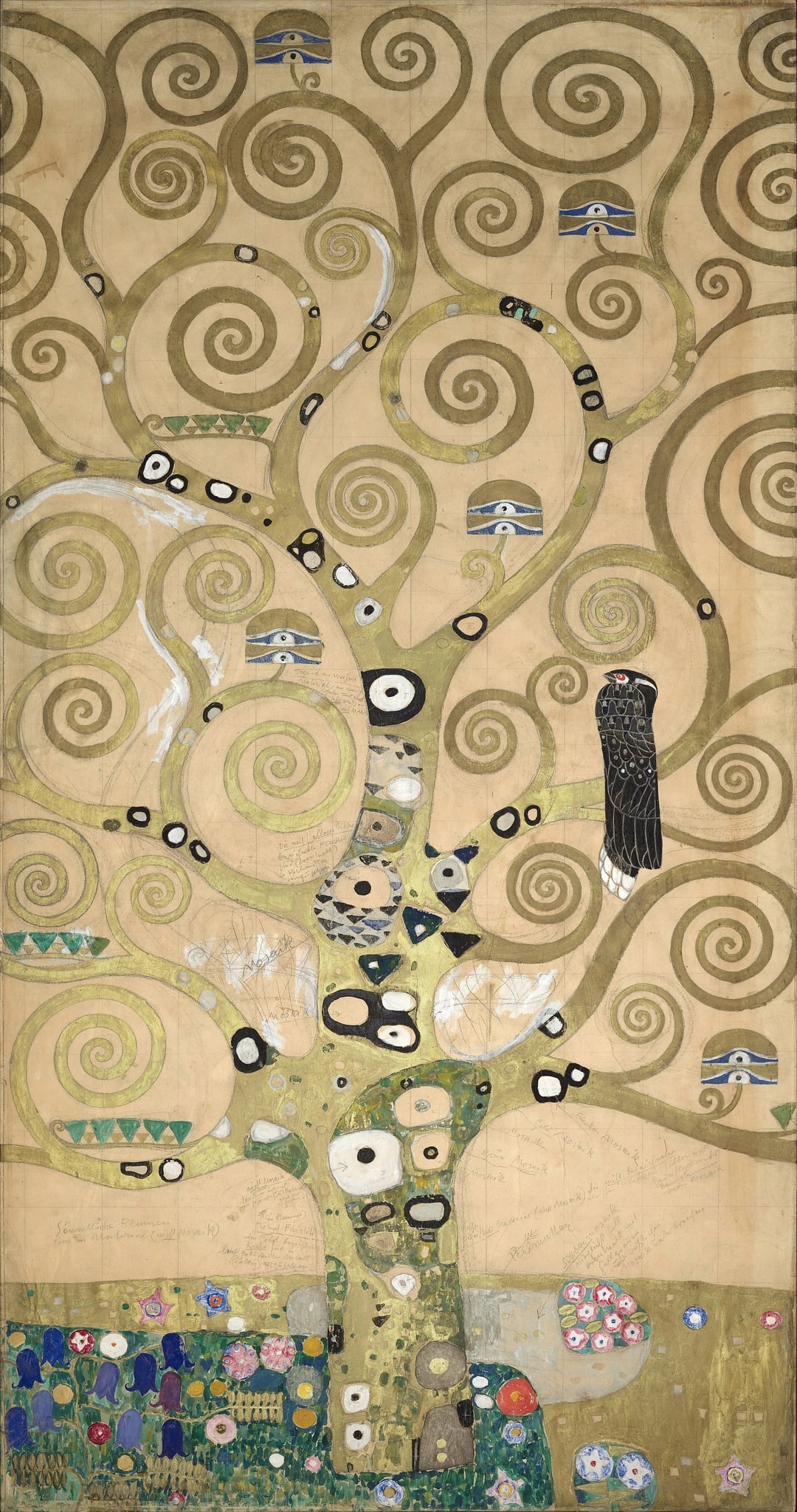
Gustav Klimt’s The Tree of Life crystallizes a <strong>cosmological axis</strong> in a gilded ornamental language: a rooted trunk erupts into <strong>endless spirals</strong>, embedded with <strong>eye-like rosettes</strong> and shadowed by a black, red‑eyed bird. Designed as part of the Stoclet dining‑room frieze, it fuses <strong>symbolism and luxury materials</strong> to link earthly abundance with timeless transcendence <sup>[1]</sup><sup>[2]</sup>.
The Kiss (Lovers) by Gustav Klimt

The Kiss (Lovers)

Gustav Klimt (1907–1908 (Belvedere lists 1908/09))

The Kiss (Lovers) crystallizes Klimt’s <strong>Golden Period</strong> ideal: erotic union staged as a sacred vision. Two bodies fuse beneath a single golden mantle, poised on a flowered ledge at the brink of the unknown, where <strong>pattern becomes symbol</strong> and intimacy becomes icon.