How Much Is Beethoven Frieze Worth?
Last updated: April 14, 2026
Quick Facts
- Last Sale
- $650K (1972, Republic of Austria (state acquisition from Erich Lederer))
- Methodology
- extrapolation
Open‑market equivalent valuation for Gustav Klimt’s Beethoven Frieze: $300–500 million. This reflects its apex art‑historical importance, singular scale, and Klimt’s newly established $200m+ price ceiling, offset by format, conservation, and marketability constraints.
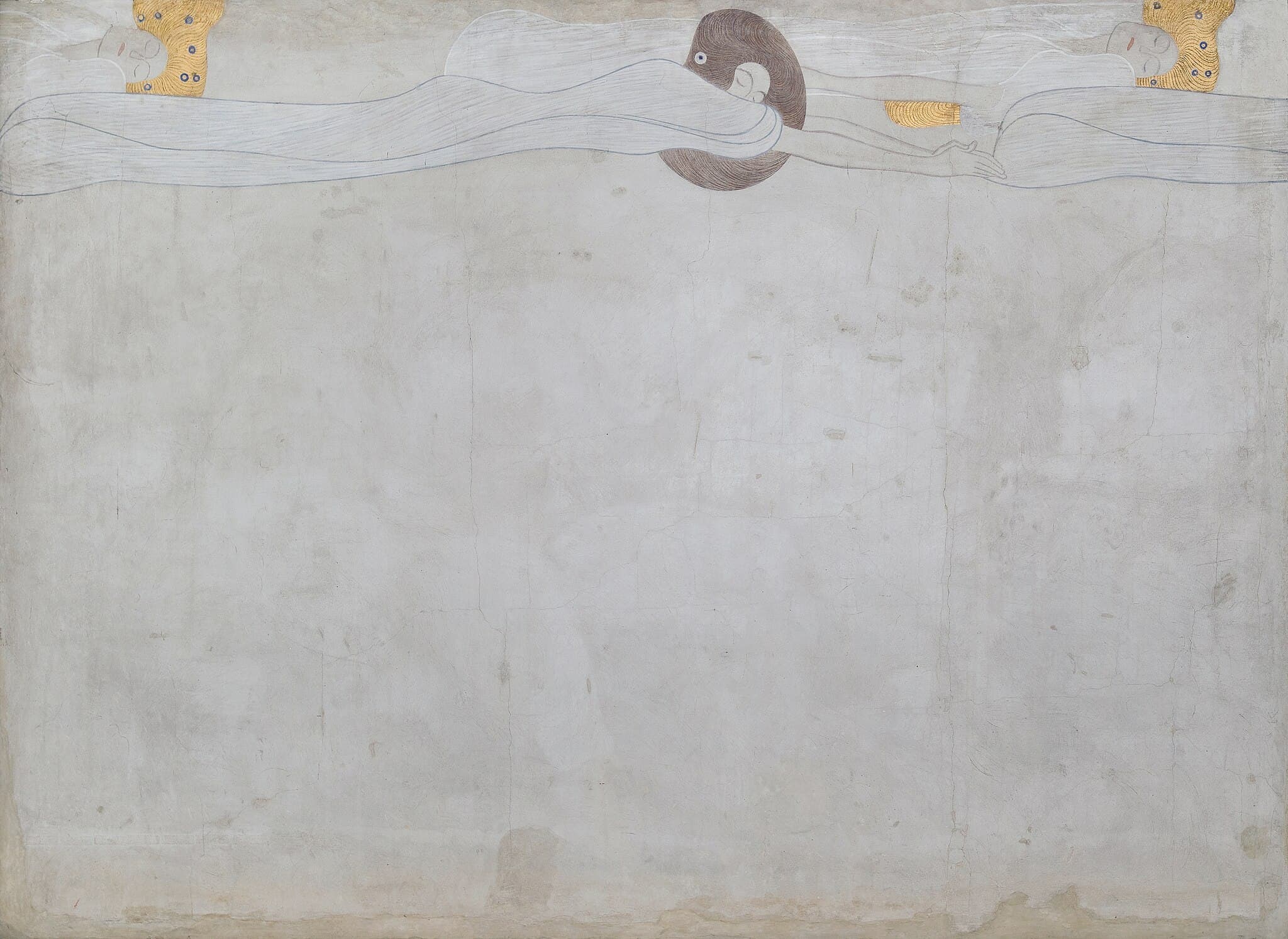
Beethoven Frieze
Gustav Klimt, 1901–1902 • Charcoal, graphite, colored chalks/pastel, casein paint; gilt stucco with applied gold and silver, mother-of-pearl, glass, mirror, brass, and other inlays on mortar over reed matting
Read full analysis of Beethoven Frieze →Valuation Analysis
Conclusion: We estimate an open‑market equivalent for Gustav Klimt’s Beethoven Frieze at $300–500 million. This range reflects the work’s singular, canonical status within the artist’s oeuvre and the Vienna Secession, extrapolated from record Klimt auction prices now exceeding $200 million and sustained nine‑figure demand for top examples, balanced against the frieze’s format, logistics, and real‑world inalienability under Austrian public ownership [1][2][3][4][5].
Why the work commands a premium: Created for the Secession’s landmark 1902 Beethoven exhibition, the frieze is a foundational statement of the movement’s ideals—an immersive, mural‑scale synthesis of painting, relief, and gilded decoration that sits at the summit of Klimt’s achievements alongside The Kiss and the golden‑period portraits [1]. As a complete, monumental cycle with unrivaled cultural resonance, it stands above virtually all easel‑painting comparables in art‑historical weight.
Market anchors and extrapolation: Klimt’s market has reset decisively at the top end. In 2025, a museum‑caliber portrait achieved $236.4 million at Sotheby’s, establishing a new record and a robust price ceiling for the artist [3]. That result built on multiple nine‑figure sales: Lady with a Fan at $108.4 million in 2023 and Birch Forest at $104.6 million in 2022, while the private‑market benchmark for Wasserschlangen II is widely reported around $183.8 million [4][5][6]. Against this comp set, the Beethoven Frieze’s art‑historical primacy justifies an extrapolation above the $236.4 million auction peak, even as its mural format tempers unlimited upside.
Constraints and logistics: The frieze’s mixed media, scale, and site‑specific conception entail complex conservation, de‑installation, transport, and re‑installation risk. Those factors would narrow the buyer universe and increase total cost of ownership. In practice, the work is state‑owned, legally protected, and permanently installed at the Secession; a real transaction is highly implausible under Austria’s heritage regime [1][2]. Our figure therefore represents a hypothetical “open‑market equivalent” or insurance‑planning proxy rather than a prediction of a realizable sale price under current law.
Synthesis: Taking Klimt’s recalibrated top auction price, the breadth of nine‑figure demand across portraits and landscapes, and the frieze’s unique, apex significance, we set a primary band of $300–500 million. The lower bound acknowledges format and logistics; the upper bound recognizes comparable trophy pricing dynamics for singular, globally recognized masterpieces. If constrained to remain in Austria with strict conditions, an institutional transaction could clear meaningfully lower, but the open‑market equivalent for this canonical work remains firmly in the $300–500 million range [2][3][4][5].
Key Valuation Factors
Art Historical Significance
High ImpactAmong Klimt’s most important works, the Beethoven Frieze is a keystone of the Vienna Secession and a total work of art conceptually bound to the 1902 Beethoven exhibition. Its synthesis of painting, relief, and gilded decoration, and its programmatic narrative tied to Beethoven’s Ninth Symphony, make it a touchstone for both Klimt’s oeuvre and turn‑of‑the‑century modernism. In scholarly and public terms, it stands alongside The Kiss and the golden‑period portraits as a defining statement. This apex significance supports a valuation premium over even outstanding easel works, as the frieze embodies the movement’s ideals at a scale and ambition unmatched elsewhere in Klimt’s production.
Market Comparables and Demand
High ImpactKlimt’s top auction price rose to $236.4m in 2025, while other nine‑figure results (Lady with a Fan at $108.4m; Birch Forest at $104.6m) and a widely reported private sale of Wasserschlangen II around $183.8m confirm deep, global demand for apex material. The buyer pool includes major museums, private foundations, and UHNW collectors across Europe, the Americas, and Asia. Against this backdrop, the Beethoven Frieze—superior in art‑historical stature to nearly all traded Klimts—warrants extrapolation above the $236.4m ceiling. The valuation range brackets today’s demonstrated price tolerance for Klimt trophies while recognizing format‑related discounting.
Rarity, Scale, and Visibility
High ImpactComplete, mural‑scale Klimt ensembles are virtually unobtainable. The Beethoven Frieze is unique in its survival, integrity, and permanent public presentation in a dedicated gallery. Its visibility and educational value amplify institutional interest and reputational utility for potential custodians or sponsors. The scarcity of directly comparable masterpieces—and the impossibility of assembling an equivalent from the market—creates a scarcity premium. High‑impact, globally recognizable works typically command disproportionate pricing power because they function as cultural flagships for collections, brands, or nations. That dynamic supports the upper end of the range despite practical display challenges.
Legal/Marketability & Logistics Constraints
Medium ImpactThe work is owned by the Republic of Austria, protected by heritage law, and on permanent display at the Secession—conditions that render a conventional sale and export effectively impossible. Even in a hypothetical transaction, casein paint, relief elements, and gilded surfaces require stringent handling, bespoke crating, and environmental controls, elevating cost and risk. These constraints narrow the buyer universe and would normally compress price. Our estimate is therefore framed as an open‑market equivalent or insurance‑planning proxy. In a domestically constrained or non‑export scenario, a lower transaction band would be expected relative to the $300–500m figure.
Sale History
Republic of Austria (state acquisition from Erich Lederer)
Private treaty purchase; contract and budgeting steps concluded in 1972 for ATS 15,000,000 (≈US$650,000). Inventory completed in 1973. Date approximate per ministerial approvals.
Gustav Klimt's Market
Gustav Klimt is a top‑tier, highly liquid blue‑chip artist. His market has been re‑priced upward by recent headline results, including a $236.4m auction record in 2025 for a golden‑period portrait, and multiple nine‑figure sales in 2023–2022 (Lady with a Fan at $108.4m; Birch Forest at $104.6m). Private‑market intelligence around $180m+ for Wasserschlangen II further evidences depth of demand at the ultra‑trophy level. Appetite spans portraits and prime landscapes, with global participation from U.S., European, and Asian collectors. Supply remains thin and provenance scrutiny is intense, but when museum‑caliber works appear, competition is fierce and pricing resilient—placing apex Klimts among the most sought‑after works of early modernism.
Comparable Sales
Portrait of Elisabeth Lederer
Gustav Klimt
Record-setting, museum-caliber Klimt portrait that currently defines the market ceiling for the artist; establishes trophy-level demand for apex works.
$236.4M
2025, Sotheby's New York
Dame mit Fächer (Lady with a Fan)
Gustav Klimt
Blue-chip late portrait with widespread institutional exhibition history; Europe auction record at the time, demonstrating global depth for Klimt masterpieces.
$108.4M
2023, Sotheby's London
~$116.0M adjusted
Birch Forest
Gustav Klimt
Major early-1900s landscape from just after the Beethoven Frieze period, validating nine-figure appetite for Klimt’s museum-grade works beyond portraits.
$104.6M
2022, Christie's New York
~$116.1M adjusted
Blumenwiese (Blooming Meadow)
Gustav Klimt
Top-tier landscape confirming strong demand for non-portrait Klimts near the artist’s peak years; relevant for gauging value beyond figure subjects.
$86.0M
2025, Sotheby's New York
Waldabhang bei Unterach am Attersee (Forest Slope in Unterach on the Attersee)
Gustav Klimt
High-value landscape demonstrating breadth of buyer demand across Klimt sub-genres; anchors the lower end of recent top results.
$68.3M
2025, Sotheby's New York
Insel im Attersee
Gustav Klimt
Painted circa 1901–02, directly contemporaneous with the Beethoven Frieze; evidences market strength for Klimt works precisely from this period.
$53.2M
2023, Sotheby's New York
~$56.9M adjusted
Current Market Trends
At the very top of the Modern category, demand has polarized toward rare, museum‑quality masterpieces with impeccable provenance. After a softer 2024, 2025 auctions rebounded at the high end, resetting artist ceilings and validating deep global bidding for fresh, trophy‑level lots. Klimt sits at the forefront of this trend, with nine‑figure results across portraits and landscapes underscoring breadth of demand beyond a single sub‑genre. Heightened diligence around WWII‑era provenance can slow deal flow, but when works clear vetting, competition is intense. In this context, an apex, canonical Klimt like the Beethoven Frieze would command a substantial premium on a hypothetical open market.
Study print
Study this painting as a print
Pair the full artwork with a museum-style study sheet focused on one meaningful detail.
Sources
- Vienna Secession – Beethoven Frieze (official)
- Austrian Restitution Advisory Board – Recommendation (Beethoven Frieze)
- The Art Newspaper – Klimt record at Sotheby’s New York (Nov 2025)
- The Art Newspaper – Lady with a Fan sets Europe auction record (2023)
- The Art Newspaper – Paul G. Allen sale results incl. Klimt (2022)
- The Art Newspaper – Rybolovlev suit citing Klimt private price (2018)