How Much Is Part of the Tree of Life (Part 1) Worth?
Last updated: May 5, 2026
Quick Facts
- Methodology
- comparable analysis
We estimate Gustav Klimt’s Part of the Tree of Life (Part 1) at $6–12 million. This full-scale, gold- and silver-embellished cartoon for the Stoclet Frieze is a museum-grade document of Klimt’s golden period, rarer and more coveted than typical drawings yet priced below autonomous oils.
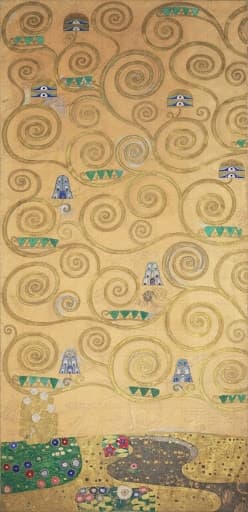
Part of the Tree of Life (Part 1)
Gustav Klimt, 1910–1911 • Cartoon: chalk, pencil, gouache, bronze, silver, gold, platinum on transparent and draft paper
Read full analysis of Part of the Tree of Life (Part 1) →Valuation Analysis
Estimate: $6–12 million. This valuation reflects a comparable-analysis approach that anchors to recent apex results for Gustav Klimt while calibrating to the distinct, lower price band for even the most important works on paper relative to autonomous oils. Part of the Tree of Life (Part 1) is a large, elaborately worked full-scale cartoon for the Stoclet Frieze, executed with metallic media and extensive detailing—an exceptional object within Klimt’s oeuvre and central to the iconography of his golden period [1].
Art-historical importance. The Stoclet Frieze (Expectation / Tree of Life / Fulfillment) is among Klimt’s most celebrated achievements and a cornerstone of Vienna 1900’s Gesamtkunstwerk ideal. The MAK’s nine cartoons document Klimt’s final design transfer to mosaic at 1:1 scale, complete with grids, notations, and precious-metal application—offering unparalleled insight into the artist’s working method. Within Klimt’s design and decorative practice, these cartoons are key primary documents, far rarer than pencil figure studies and on par, in scholarly weight, with major preparatory material for his best-known commissions [1].
Market context and calibration. Klimt’s market has surged at the top end: Portrait of Elisabeth Lederer achieved $236.4 million (with fees) in November 2025, resetting the artist’s record and the Modern-art auction benchmark [2]. This followed earlier, marquee results such as Lady with a Fan at ~$108.4 million in 2023 [3] and a run of high-value landscapes (e.g., Blumenwiese at ~$86 million; Waldabhang at ~$68.3 million in 2025) that demonstrate deep global demand for Klimt’s ornamental, flattened pictorial language [2][4]. These painting prices establish an upper ceiling for Klimt’s decorative idiom; a finished, monumental cartoon—while far more significant than a typical drawing—sits in a distinct, lower tier than autonomous oils.
Pricing translation for category. Monumental, colored, and metal-embellished Klimt works on paper are exceedingly scarce. Typical graphite studies may trade in the mid-to-high five figures up to low/mid seven figures; highly worked sheets with color or gold can reach into the low millions. A full-scale Stoclet cartoon is markedly rarer and more covetable than standard studies, justifying a step-change upward into the mid-seven to low-eight figures. The $6–12 million range situates this sheet at the peak of Klimt’s works-on-paper category, still at a prudent fraction of related oil-based benchmarks.
Key constraints and sensitivities. The medium (large joined papers with gold/silver) is fragile, and condition can materially affect price. As a MAK museum holding, any hypothetical market transfer would also need to consider Austrian cultural property controls, which can limit exportability and compress results versus an unrestricted international sale. Conversely, pristine condition, clear transferability, and a marquee sale context could move the result toward the top of the range.
Conclusion. Balancing extraordinary art-historical significance, rarity, and medium-specific constraints, a current fair-market estimate of $6–12 million is well supported. This positions the cartoon as a blue-chip, institutional-caliber work on paper aligned with heightened demand for Klimt’s golden-period masterpieces, while respecting category boundaries below the artist’s oil-on-canvas peak.
Key Valuation Factors
Art Historical Significance
High ImpactThis sheet is a full-scale working cartoon for the Stoclet Frieze—one of the defining achievements of Klimt’s golden period and a landmark of Vienna 1900 design. As part of the MAK’s nine-part group, it evidences Klimt’s final design language, complete with grids, annotations, and precious-metal application. The Tree of Life motif ranks among Klimt’s most iconic images, and these cartoons are cornerstone documents for understanding his Gesamtkunstwerk collaboration at the Stoclet Palace. Within the artist’s oeuvre, the cartoons rise far above typical figure studies: they are major, museum-grade works that connect directly to a canonical commission and showcase Klimt’s decorative vocabulary at 1:1 scale.
Medium and Category Positioning
Medium ImpactDespite extraordinary importance, the work is a cartoon/preparatory design rather than an autonomous oil painting. Market conventions price even the most significant works on paper—however large and elaborately finished—at a fraction of the artist’s oil paintings. Klimt’s apex prices are led by portraits and major landscapes on canvas; the cartoons, though richly worked with gold and silver and far superior to standard graphite studies, still sit in the works-on-paper tier. The estimate calibrates this gap: it positions the cartoon at the very top of Klimt’s works-on-paper spectrum, while recognizing a consistent discount versus fully realized oils that command eight- and nine-figure results.
Rarity, Scale, and Visual Impact
High ImpactLarge, colored, and metal-embellished Klimt works on paper are exceptionally scarce. At roughly life-size for the frieze, the cartoon’s format offers an immersive, decorative surface comparable in presence to Klimt’s canvases. The combination of scale, gold/silver application, and direct linkage to a canonical commission sets this far apart from the broader pool of drawings that typically enter the market. This rarity underpins the upper bound of the estimate: among works on paper, few objects can rival a Stoclet cartoon’s scholarly and visual gravitas, enabling credible low-eight-figure outcomes under strong sale conditions.
Marketability and Practical Constraints
Medium ImpactAs a MAK collection object, any hypothetical transfer would likely face institutional policy and cultural property/export considerations in Austria. Such constraints, along with the fragility of large joined papers with metallic media, can narrow the buyer pool and weigh on price realization versus an unrestricted, privately held counterpart. Conversely, if offered with clear title, export permissions, and supported by a high-visibility exhibition and scholarship, the work’s desirability to leading collectors and institutions could drive results to the upper end of the range. The estimate reflects this balance between demand and real-world transaction frictions.
Sale History
Part of the Tree of Life (Part 1) has never been sold at public auction.
Gustav Klimt's Market
Gustav Klimt is a top-tier, blue-chip artist with exceptionally strong global demand and extremely limited supply. His auction record stands at $236.4 million (with fees) for Portrait of Elisabeth Lederer (Sotheby’s New York, Nov 2025), the most valuable Modern artwork ever sold at auction. Other landmark results include Lady with a Fan at ~$108.4 million (Sotheby’s London, 2023) and trophy landscapes such as Blumenwiese at ~$86 million and Waldabhang at ~$68.3 million (Sotheby’s New York, 2025). This apex pricing reflects intense competition for Klimt’s golden-period imagery and patterned surfaces. Works on paper, while occupying a different tier, benefit from this halo, with highly worked, colored sheets capable of achieving seven figures and, in rare, monumental cases, low eight figures.
Comparable Sales
Blumenwiese (Blooming Meadow)
Gustav Klimt
Same artist; golden-period, highly ornamental surface akin to the Stoclet vocabulary. Strongest recent non-portrait benchmark for Klimt’s decorative idiom (upper-bound context; different medium: oil vs. cartoon on paper).
$86.0M
2025, Sotheby's New York
Waldabhang bei Unterach am Attersee (Forest Slope in Unterach on the Attersee)
Gustav Klimt
Same artist and late period; confirms deep demand for non-portrait Klimts with decorative, flattened patterning. Used as market ceiling reference despite medium difference (oil vs. cartoon).
$68.3M
2025, Sotheby's New York
Lady with a Fan (Dame mit Fächer)
Gustav Klimt
Same artist; late-style tour de force that set a European auction record. Demonstrates apex appetite for Klimt’s golden/ornamental language (upper-bound anchor; oil painting, portrait subject).
$108.4M
2023, Sotheby's London
~$114.9M adjusted
Insel im Attersee (Island in the Attersee)
Gustav Klimt
Same artist; early golden-period landscape with dense, decorative surface—closest market analogue among recent sales for non-figurative, ornamental Klimt (still oil vs. cartoon).
$53.2M
2023, Sotheby's New York
~$56.4M adjusted
Birch Forest
Gustav Klimt
Same artist; golden-period, fully patterned nature subject showing Klimt’s ornamental vocabulary at grand scale. Useful as a ceiling for decorative Klimt demand (oil vs. cartoon).
$104.6M
2022, Christie's New York
~$115.0M adjusted
Current Market Trends
The Modern category has exhibited a two-speed dynamic: broader selectivity since 2024 alongside powerful outperformance for fresh-to-market, museum-quality masterpieces. Klimt has been a clear beneficiary—his 2025 record-setting portrait and strong landscape prices reaffirm a deep collector base across the US, Europe, and Asia. Guarantees and third-party backing continue to enable marquee consignments. Within this climate, best-in-class, institutionally important works on paper can achieve exceptional results, though they remain priced below autonomous oils. For top Klimt material, demand remains robust; category-specific constraints—condition, scale, and any export restrictions—are the main variables governing final price realization.
Study print
Study this painting as a print
Pair the full artwork with a museum-style study sheet focused on one meaningful detail.