How Much Is Part of the Tree of Life (Part 3) Worth?
Last updated: May 5, 2026
Quick Facts
- Methodology
- comparable analysis
Hypothetical fair‑market value for Gustav Klimt’s full‑scale Stoclet Frieze cartoon, Part of the Tree of Life (Part 3), is estimated at $15–30 million. The range reflects the work’s canonical Golden‑Period importance, monumental mixed‑media execution, and extreme rarity, balanced against the medium (paper), conservation/installation complexity, and the absence of direct public sale comparables.
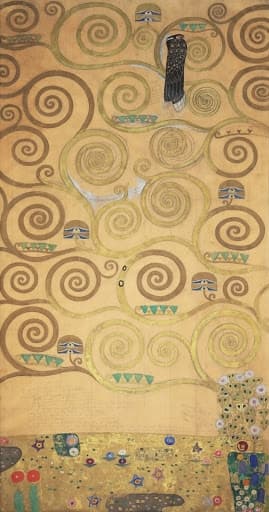
Part of the Tree of Life (Part 3)
Gustav Klimt, 1910–1911 • Chalk, pencil, gouache, bronze, silver, gold, platinum on transparent and draft paper (full‑scale cartoon)
Read full analysis of Part of the Tree of Life (Part 3) →Valuation Analysis
Estimate: $15–30 million (hypothetical fair‑market value for a legally transferable, well‑conserved work offered via a marquee platform). This full‑scale cartoon for the Stoclet Frieze’s Tree of Life (MAK, Vienna; c. 200 × 102 cm; chalk, pencil, gouache with bronze, silver, gold, and platinum on transparent paper) is a singular work that directly underpins one of Klimt’s most celebrated Golden‑Period ensembles [1].
Methodology and anchors: With no public sale history for the Stoclet cartoons, the estimate is derived by triangulating from recent marquee Klimt oils and then applying a disciplined medium/marketability discount. Klimt’s top end has re‑rated sharply: Portrait of Elisabeth Lederer achieved $236.4m in 2025 [2]; Lady with a Fan brought ~$108.7m in 2023 [3]; Birch Forest realized ~$104.6m in 2022 [4]. These nine‑figure benchmarks affirm deep, global demand for museum‑grade Klimts, setting the ceiling from which a unique but paper‑based masterpiece is calibrated.
Why this cartoon commands an exceptional premium among works on paper: Unlike typical drawings, the Stoclet cartoons are monumental, highly resolved, and richly worked with metallic media, conceived at full scale for a canonical decorative cycle. The Tree of Life motif is among Klimt’s most recognizable images, and this cartoon is central to that iconography. As such, it sits far above the artist’s standard works on paper (usually five to low‑six figures) and within the rarefied cohort of Modern works on paper capable of mid‑eight‑figure pricing when art‑historical weight, scale, and finish converge [1][6].
Discounts and constraints: Two factors temper valuation relative to oils. First, medium: works on paper—especially with metallic pigments on transparent support—carry conservation, light‑exposure, glazing, and handling complexities that institutions and private collectors price in. Second, marketability: the cartoon is museum‑held (MAK) and likely subject to Austrian cultural‑property/export controls, limiting real‑world auction testing. The $15–30m range therefore represents an informed, transferable‑scenario estimate; in practice, institutional status can cap liquidity even when demand is strong [1][5].
Positioning within the range: The upper half of the range ($22–30m) is justified by pristine condition, comprehensive documentation and exhibition history, and competitive institutional and private interest; the lower half ($15–22m) would reflect conservation sensitivities, complex installation requirements, or restrictive sale conditions. Net, the estimate places this cartoon among the highest‑valued unique works on paper by any Fin‑de‑Siècle artist, consistent with Klimt’s tier‑one market standing and the Stoclet project’s canonical status [2][3][4].
Key Valuation Factors
Art Historical Significance
High ImpactThis cartoon is integral to Klimt’s Stoclet Frieze—one of the definitive achievements of his Golden Period and a touchstone of Vienna 1900 design. As a full‑scale, highly resolved working model for the Tree of Life, it is both a key document of process and a visually autonomous object. The Tree of Life is among Klimt’s most recognizable motifs, linking the work to a broad audience beyond specialists. Because the Stoclet project synthesizes painting, ornament, and architecture at the highest level, objects directly tied to it command exceptional scholarly and institutional interest, elevating value far above typical drawings and placing the cartoon at the apex of Klimt works on paper.
Rarity and Uniqueness
High ImpactFull‑scale Stoclet cartoons are unique, monumental objects that virtually never appear on the market. The MAK in Vienna holds the known set, and there is no public auction precedent for these sheets. This scarcity exerts strong upward pressure on price: collectors cannot substitute a smaller study or later print to obtain a comparable visual and historical outcome. Among Klimt works on paper, the combination of scale (c. 200 × 102 cm), elaborate mixed media (including metallic pigments), and direct connection to a canonical commission is effectively unmatched. Rarity at this level not only widens potential bidder pools (private and institutional) but also supports a mid‑eight‑figure valuation despite the paper support.
Medium and Conservation Risk
Medium ImpactWhile the metallics and scale make the work visually powerful, they also introduce conservation and display complexities: sensitivity to light and humidity, potential tarnish or migration of metallic media, and the need for specialized mounting and glazing. Collectors and museums price in these long‑term stewardship costs and risks, which typically compress valuations relative to oils. However, because this cartoon is a singular, high‑finish object tied to a masterpiece cycle, the medium discount is moderated compared with ordinary drawings. A current, detailed condition report and display‑standard framing would be crucial levers for achieving the upper end of the range and broadening institutional competition.
Market Evidence and Comparables
Medium ImpactKlimt’s market has re‑rated to the top echelon, with a $236.4m record in 2025 and multiple nine‑figure results in 2022–2023 for major oils. Those prices set the ceiling against which a disciplined medium discount is applied for this cartoon. Although Klimt drawings typically transact far lower, exceptional Modern works on paper have achieved eight figures when scale, finish, and importance are present. Given the absence of direct auction comparables for Stoclet cartoons, triangulation from Klimt oils and rare, high‑end works on paper supports a low‑to‑mid eight‑figure indication, consistent with $15–30m for a legally transferable example.
Legal/Marketability Constraints
High ImpactThe work is museum‑held (MAK, Vienna) and may be subject to Austrian cultural‑property protections and export controls. Such constraints limit the probability of an open‑market sale and can suppress competitive tension compared with a freely consignable, internationally shippable painting. Our valuation explicitly frames a hypothetical, transferable scenario via a marquee sale platform. Should deaccession be impossible or export licenses unobtainable, the realizable value in any private arrangement could be materially lower. Conversely, clear deaccession authority, impeccable documentation, and international transport permission would unlock broader bidder participation and support the top end of the estimate.
Sale History
Part of the Tree of Life (Part 3) has never been sold at public auction.
Gustav Klimt's Market
Gustav Klimt is a blue‑chip, trophy‑level artist with deep global demand across the U.S., Europe, and Asia. The artist’s auction record stands at $236.4 million (Portrait of Elisabeth Lederer, Sotheby’s New York, 2025), capping a run of nine‑figure results that includes Lady with a Fan (~$108.7m, London, 2023) and Birch Forest (~$104.6m, New York, 2022). Select late landscapes have sold between roughly $50–90m, and supply at this level is extremely scarce. Provenance clarity and institutional‑caliber presentation are decisive drivers of pricing, while unresolved restitution issues can derail transactions. Against this backdrop, masterworks and canonical subjects command intense competition and premium pricing.
Comparable Sales
Portrait of Elisabeth Lederer
Gustav Klimt
Same artist; late masterpiece benchmark that set Klimt’s auction record in 2025. Anchors current trophy-level demand for Klimt’s Golden/late period against which a full-scale Stoclet cartoon would be discounted by medium.
$236.4M
2025, Sotheby's New York
Blumenwiese (Blooming Meadow)
Gustav Klimt
Same artist; decorative, all-over composition from a closely related period. Serves as a fresh, high-profile benchmark illustrating eight-figure demand for major Klimts; useful to bracket a discount for a monumental work on paper.
$86.0M
2025, Sotheby's New York
Waldabhang bei Unterach am Attersee (Forest Slope in Unterach on the Attersee)
Gustav Klimt
Same artist and era; another marquee Klimt landscape sold the same night as the record portrait, reinforcing current pricing for top-tier Klimts and providing a ceiling reference versus a preparatory cartoon.
$68.3M
2025, Sotheby's New York
Dame mit Fächer (Lady with a Fan)
Gustav Klimt
Same artist; late icon and 2023 Europe auction record. Demonstrates global depth for Klimt at the top end, helpful for calibrating the magnitude of the medium discount for a full-scale cartoon.
$108.4M
2023, Sotheby's London
~$114.9M adjusted
Insel im Attersee (Island in the Attersee)
Gustav Klimt
Same artist; major Klimt landscape achieving an eight-figure result in 2023. Useful as a mid-range anchor among recent top Klimt oils, against which a unique but paper-based Stoclet cartoon is likely valued at a fraction.
$53.2M
2023, Sotheby's New York
~$56.4M adjusted
Birch Forest (1903)
Gustav Klimt
Same artist; Golden Period landscape and major decorative composition that set a then-record in 2022. Serves as a high-end reference point for Klimt’s market strength when triangulating a discount for a monumental work on paper.
$104.6M
2022, Christie's New York
~$115.0M adjusted
Current Market Trends
At the pinnacle of the Modern market, liquidity is concentrated in museum‑grade works with ironclad provenance, and Klimt is a prime beneficiary of this selectivity. While 2024 saw softer volumes, late‑2025 marquee sales reasserted top‑end strength, with Klimt among the headline performers. For works on paper, demand is highly selective: most drawings trade modestly, but exceptional, large‑scale, fully realized sheets tied to canonical projects can achieve mid‑eight figures. Conservation and installation complexity are priced in, but scarcity and art‑historical importance can more than offset the medium discount. Restitution clarity remains a gating factor for peak pricing in the Vienna 1900 category.
Study print
Study this painting as a print
Pair the full artwork with a museum-style study sheet focused on one meaningful detail.
Sources
- Google Arts & Culture / MAK object record (MAL 226-3)
- Sotheby’s press release (Nov 18, 2025): Leonard A. Lauder Collection results
- CBS News: Klimt’s Lady with a Fan sets European auction record (2023)
- The Art Newspaper: Paul Allen sale; Klimt’s Birch Forest at $104.6m (2022)
- AP News: Klimt sale at im Kinsky and provenance scrutiny (2024)
- Christie’s: November 2023 Marquee Week results (incl. eight-figure works on paper highlights)