Gustav Klimt
Biography
Themes in Their Work
Where to See Gustav Klimt's Paintings
Explore Gustav Klimt's works on display in museums around the world.
Featured in Essays
Compare Gustav Klimt
Most Expensive Gustav Klimt Paintings
Explore ranked valuations of Gustav Klimt's most valuable works →
Featured Artworks
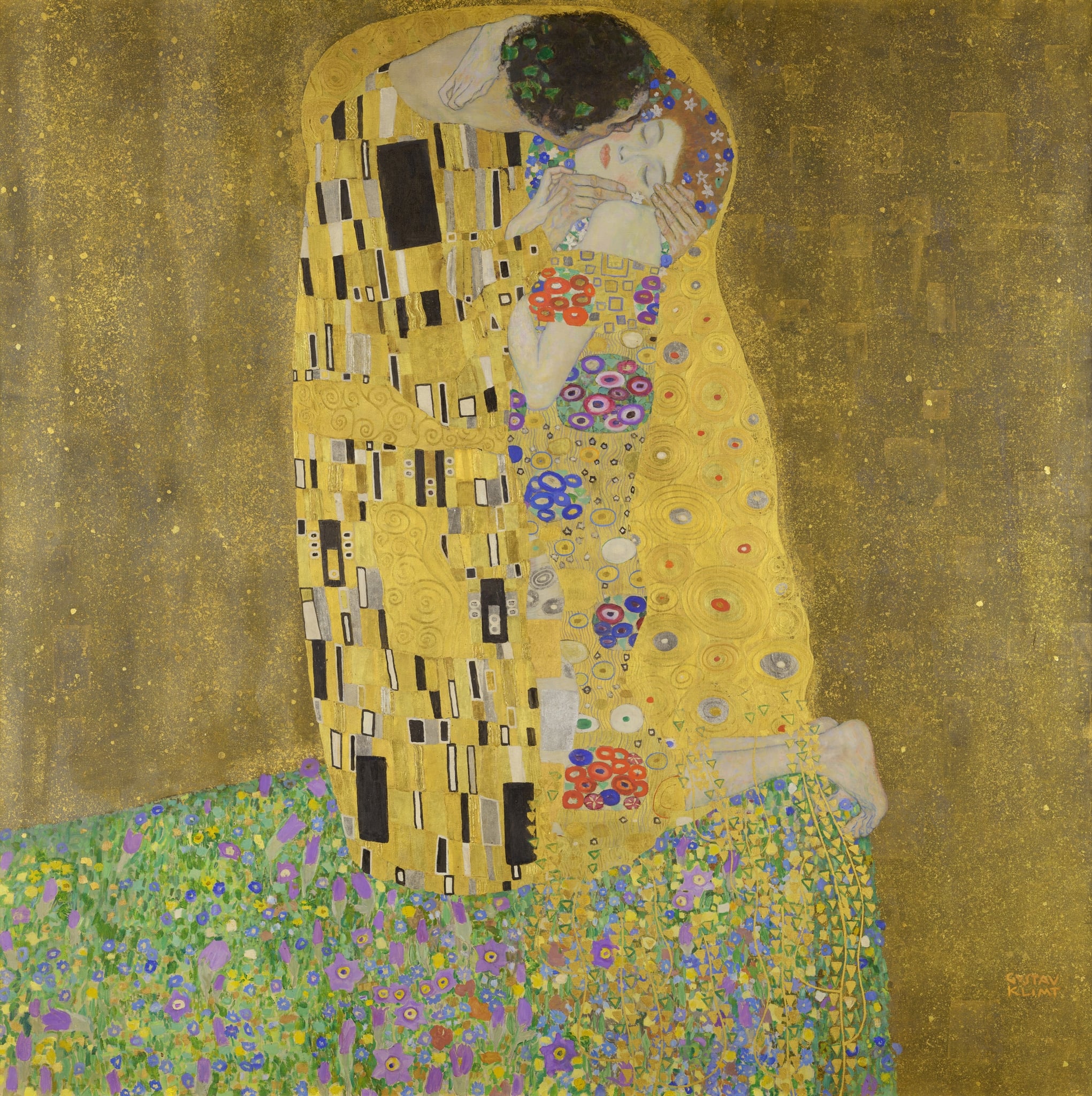
The Kiss
Gustav Klimt (1908 (completed 1909))
The Kiss stages human love as a <strong>sacred union</strong>, fusing two figures into a single, gold-clad form against a timeless field. Klimt opposes <strong>masculine geometry</strong> (black-and-white rectangles) to <strong>feminine organic rhythm</strong> (spirals, circles, flowers), then resolves them in radiant harmony <sup>[1]</sup><sup>[2]</sup>.
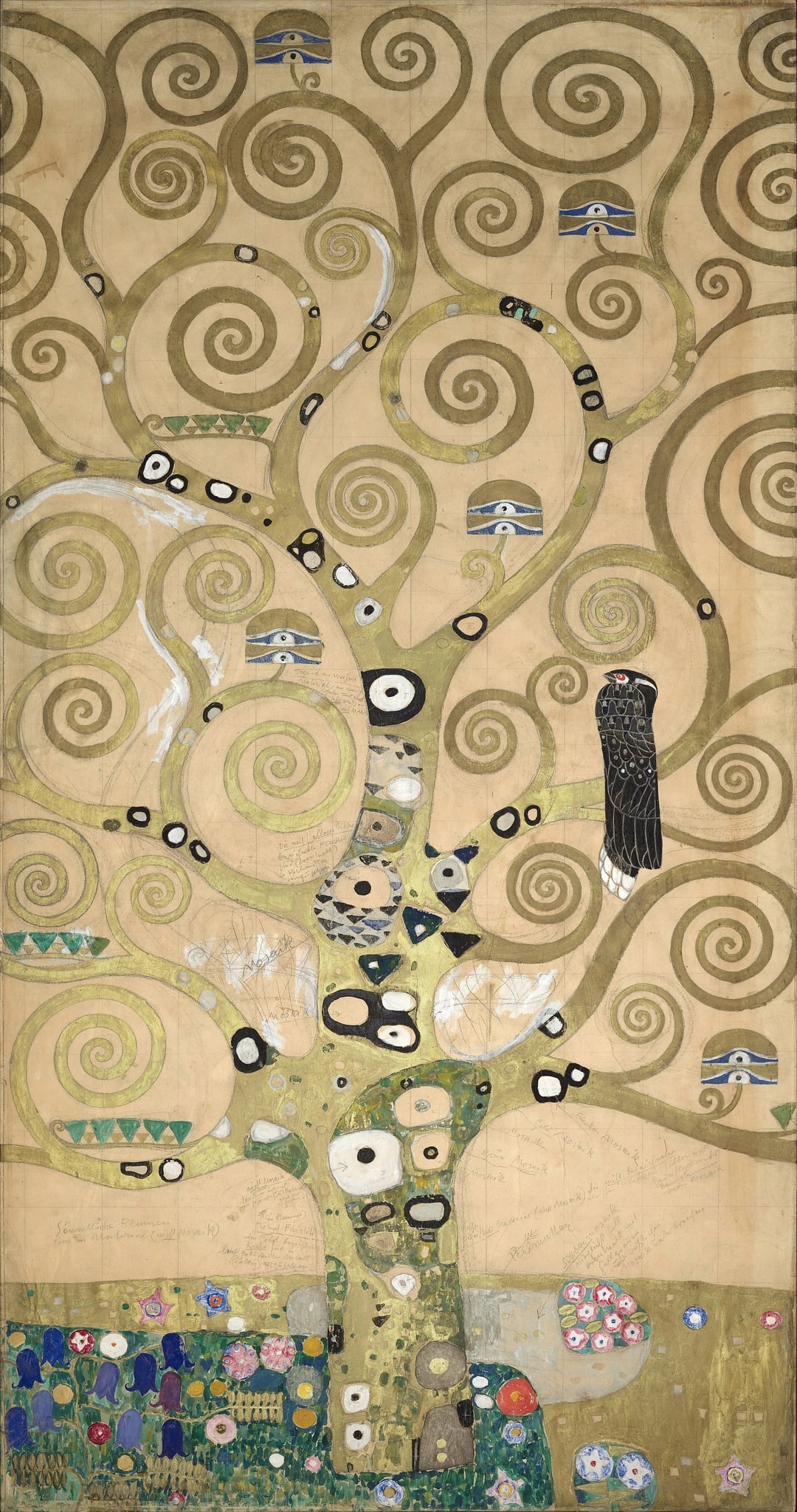
The Tree of Life
Gustav Klimt (1910–1911 (design; mosaic installed 1911))
Gustav Klimt’s The Tree of Life crystallizes a <strong>cosmological axis</strong> in a gilded ornamental language: a rooted trunk erupts into <strong>endless spirals</strong>, embedded with <strong>eye-like rosettes</strong> and shadowed by a black, red‑eyed bird. Designed as part of the Stoclet dining‑room frieze, it fuses <strong>symbolism and luxury materials</strong> to link earthly abundance with timeless transcendence <sup>[1]</sup><sup>[2]</sup>.
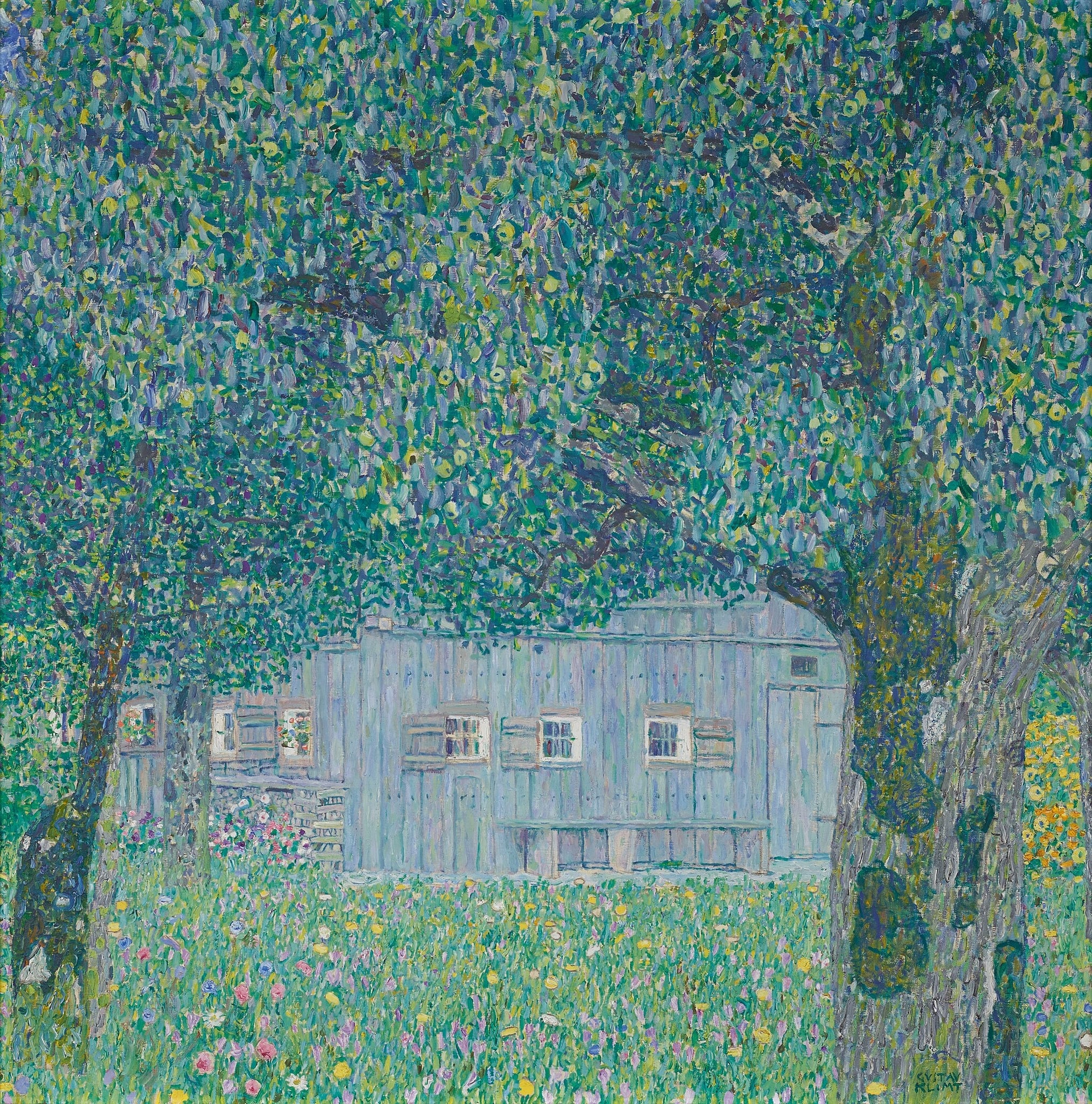
Farmhouse in Buchberg (Upper Austrian Farmhouse)
Gustav Klimt (1911)
Gustav Klimt’s Farmhouse in Buchberg (Upper Austrian Farmhouse) renders a rural dwelling almost absorbed by an orchard, its cool façade held in balance against a vibrating canopy of leaves and a jewel-like meadow. Through a square format and <strong>selective pointillism</strong>, Klimt fuses house, trees, and flowers into a contemplative, patterned field that privileges <strong>stillness</strong> over incident <sup>[1]</sup><sup>[6]</sup>. The work turns everyday architecture into an emblem of <strong>refuge within fecund nature</strong>.
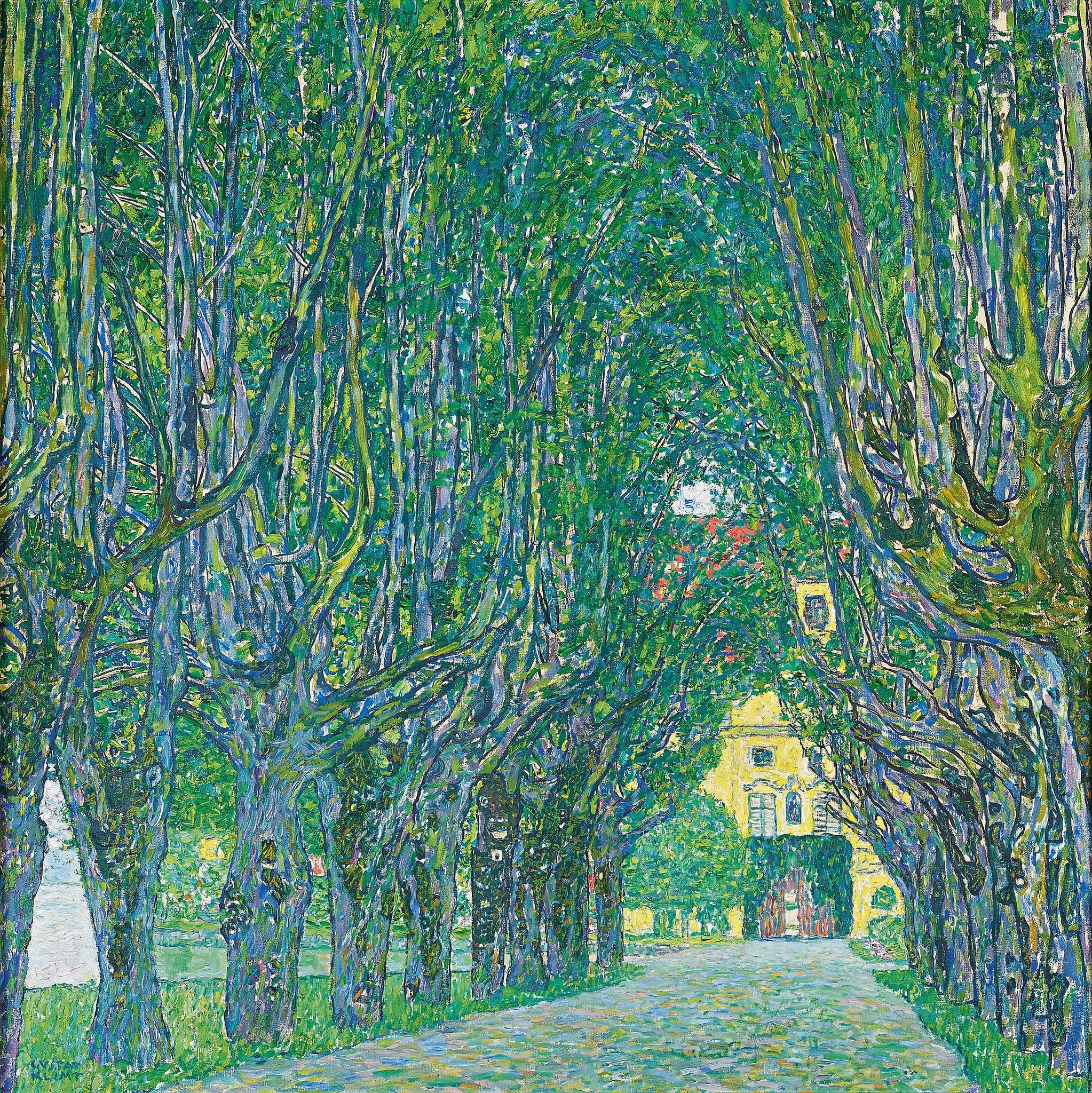
Avenue in Schloss Kammer Park
Gustav Klimt (1912)
Gustav Klimt’s Avenue in Schloss Kammer Park stages a ceremonial approach beneath a vaulted <strong>tunnel of linden trees</strong>, their pollarded limbs clasping to form a green nave. A cobbled axis pulls the eye toward a sunlit <strong>ocher façade and arched doorway</strong>, while Klimt’s tessellated strokes make foliage, bark, and shadow flicker between <strong>pattern and depth</strong> <sup>[1]</sup><sup>[5]</sup><sup>[6]</sup>.
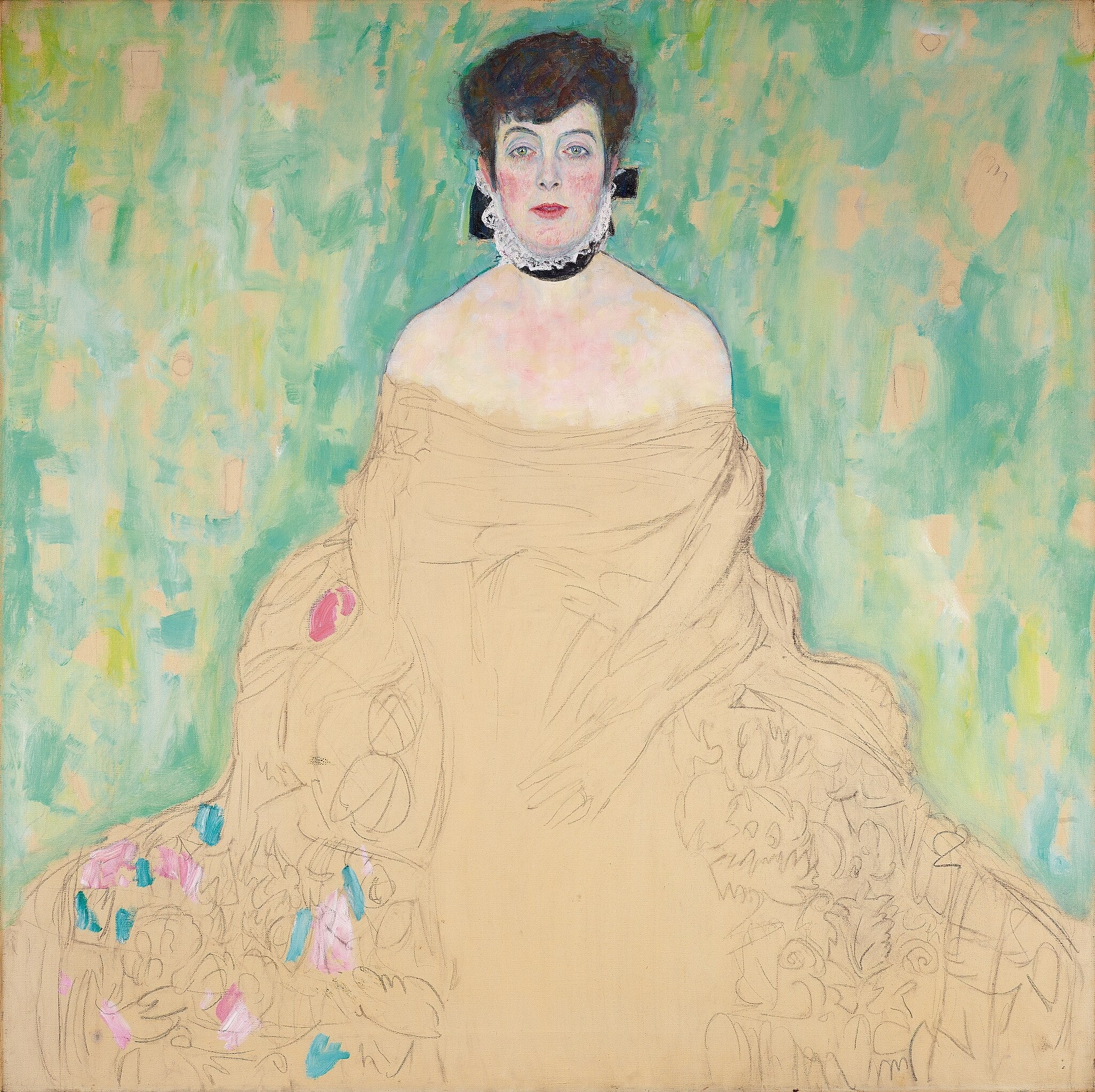
Amalie Zuckerkandl
Gustav Klimt (1917–1918)
Gustav Klimt’s Amalie Zuckerkandl is an <strong>unfinished</strong> late portrait in which a fully realized head and shoulders float above a gown left as <strong>skeletal graphite and washes</strong>. Set against a mottled, cool <strong>green ground</strong>, her flushed face, direct gaze, black <strong>choker</strong> and crisp lace collar stage a drama of poise, sensuality, and restraint <sup>[1]</sup><sup>[6]</sup>. The painting’s incompletion becomes the work’s meaning: a vivid selfhood <strong>emerging</strong> while ornament remains <strong>in potential</strong>.
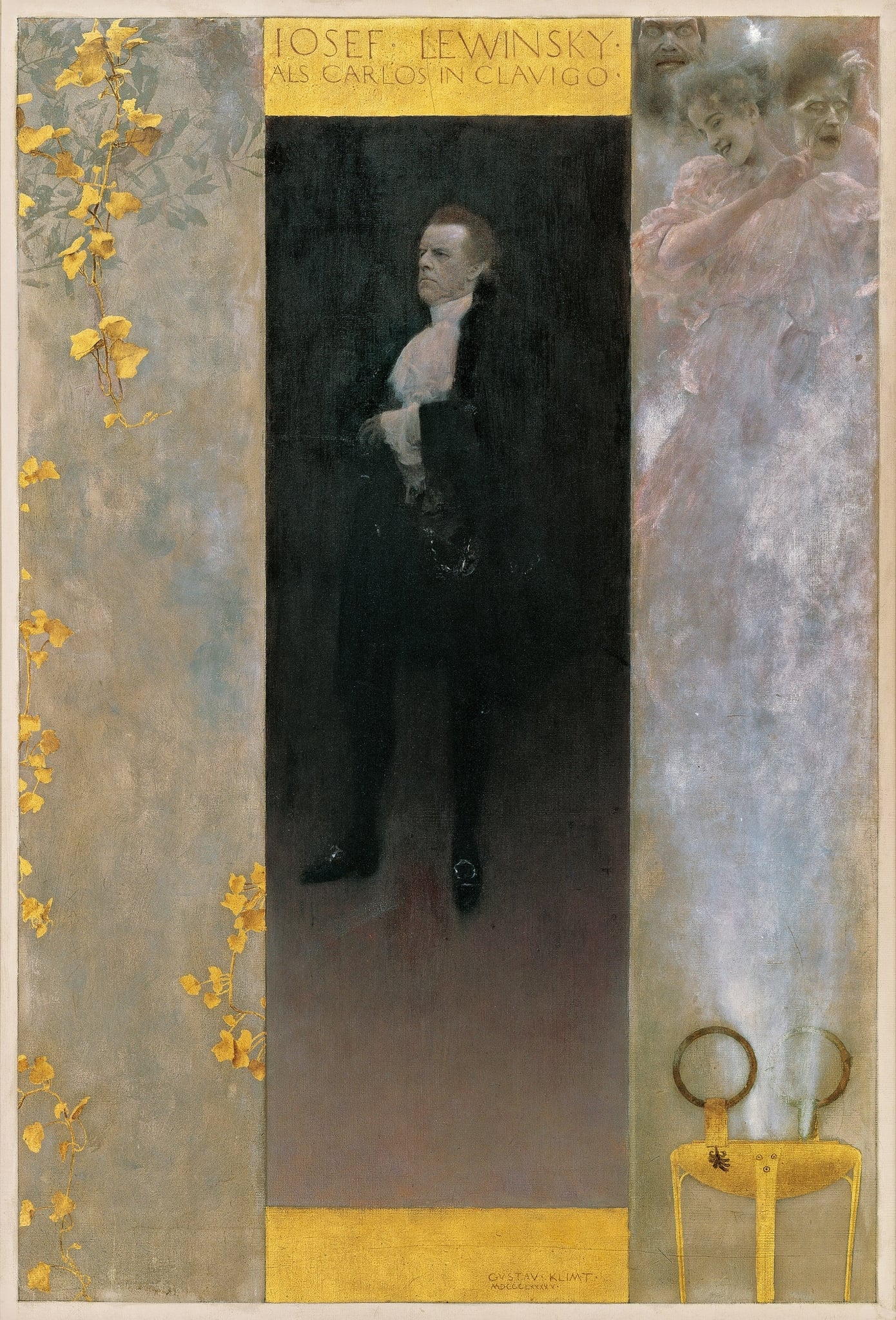
Josef Lewinsky as Carlos in Clavigo
Gustav Klimt (1895)
A stark, triptych-like design turns the actor’s upright silhouette into a test of <strong>will</strong> against a surrounding chorus of <strong>masks</strong>, <strong>laurel/ivy</strong>, and a smoking <strong>antique tripod</strong>. Klimt fuses <strong>portrait</strong> and <strong>allegory</strong> to stage the psychic weather of Goethe’s drama while previewing his turn toward <strong>Symbolism</strong> and ornamental modernity <sup>[1]</sup><sup>[2]</sup>.
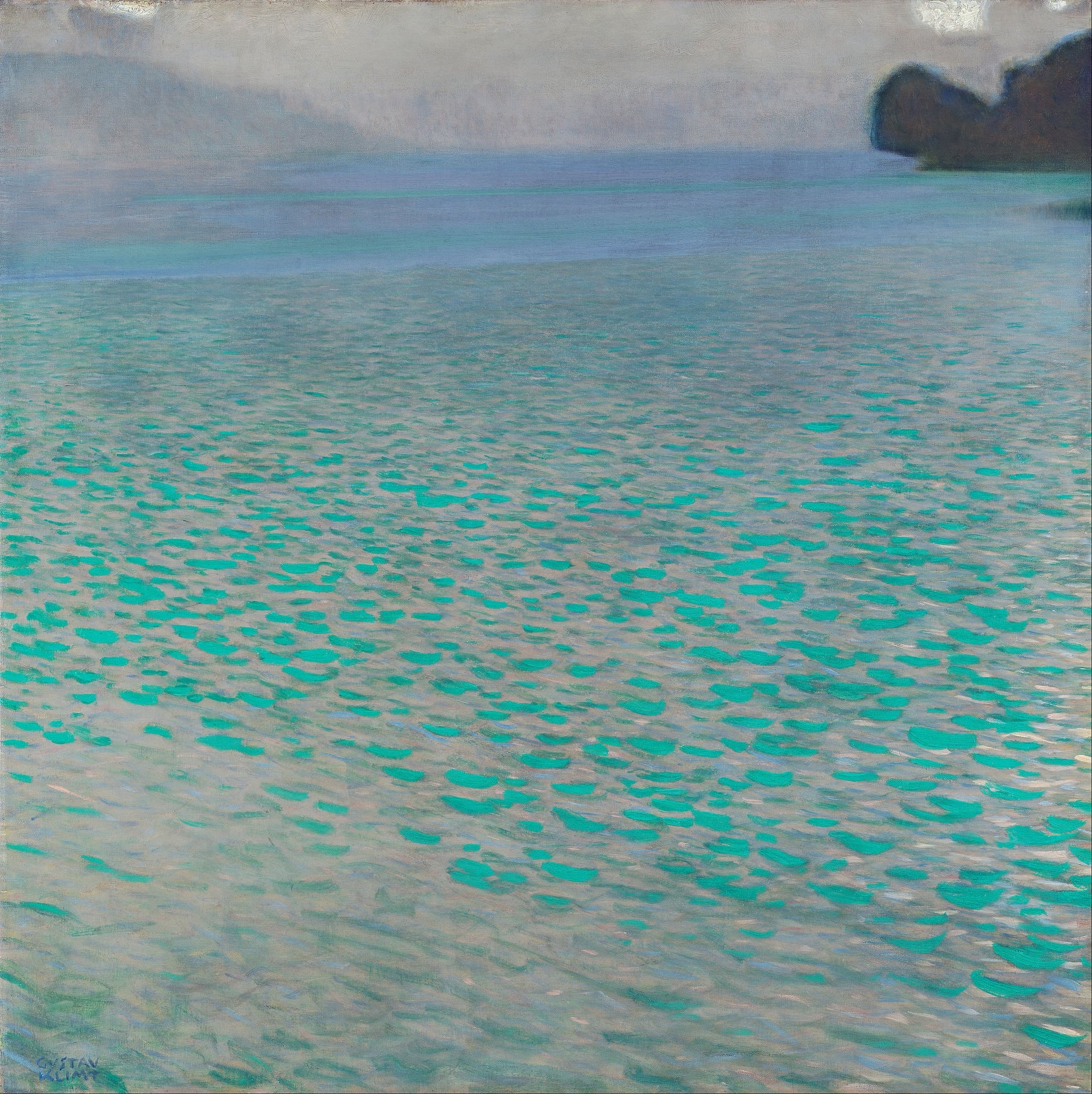
On Lake Attersee
Gustav Klimt (1900)
Gustav Klimt’s On Lake Attersee (1900) turns a summer lake into a <strong>woven field of light</strong>. A square canvas nearly filled with water, it stages a quiet duel between <strong>surface pattern</strong> and <strong>atmospheric depth</strong>, letting a tiny dark headland at the upper right anchor an otherwise hypnotic expanse <sup>[1]</sup><sup>[2]</sup>.
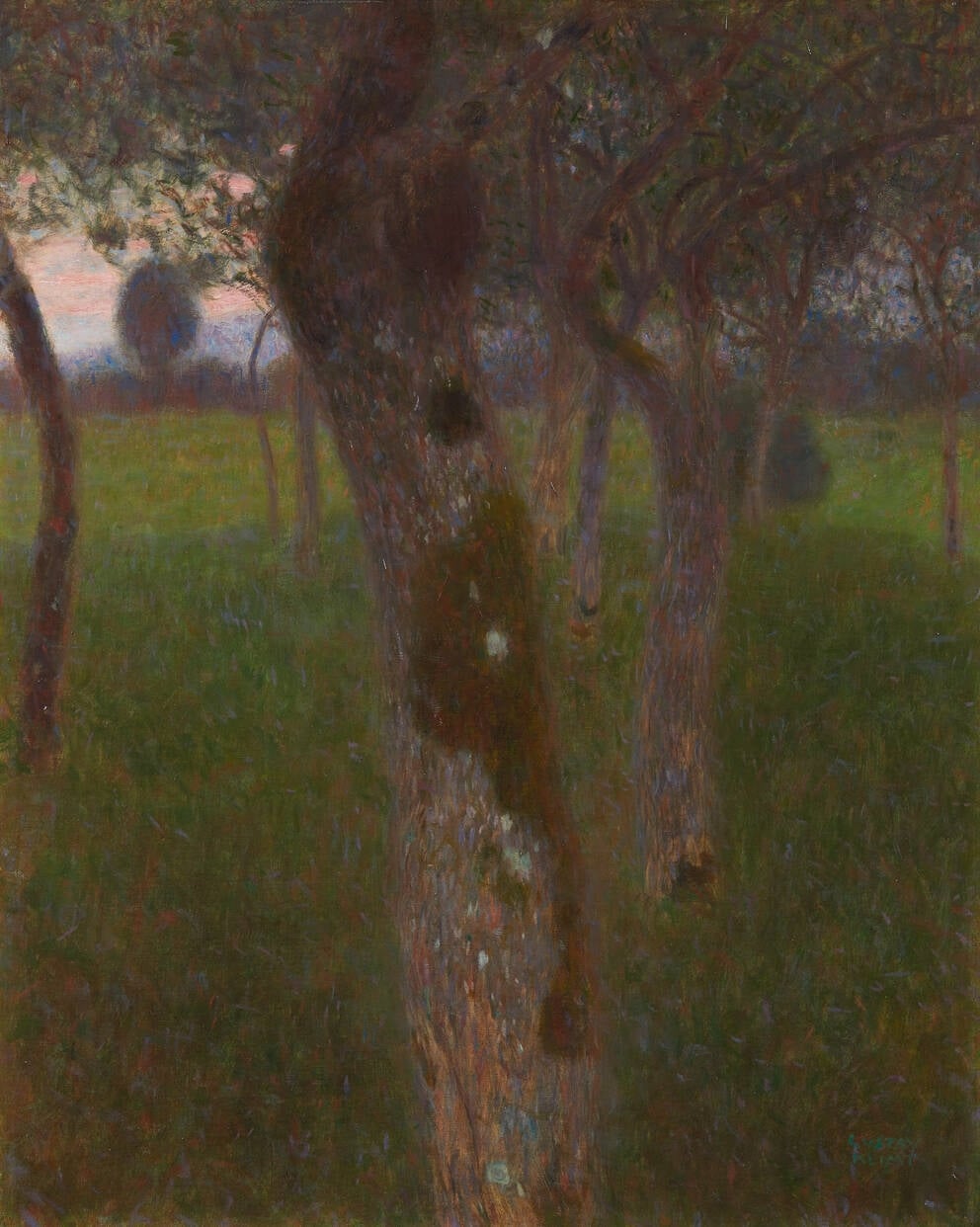
Orchard in the Evening
Gustav Klimt (1898)
Gustav Klimt’s Orchard in the Evening compresses a grove of fruit trees into a shallow, <strong>planar</strong> field where trunks press forward and dusk thins the color. A pale <strong>twilight</strong> band at the high horizon seals the space, turning observed nature into a contemplative, <strong>ornamental</strong> enclosure <sup>[1]</sup><sup>[2]</sup>.
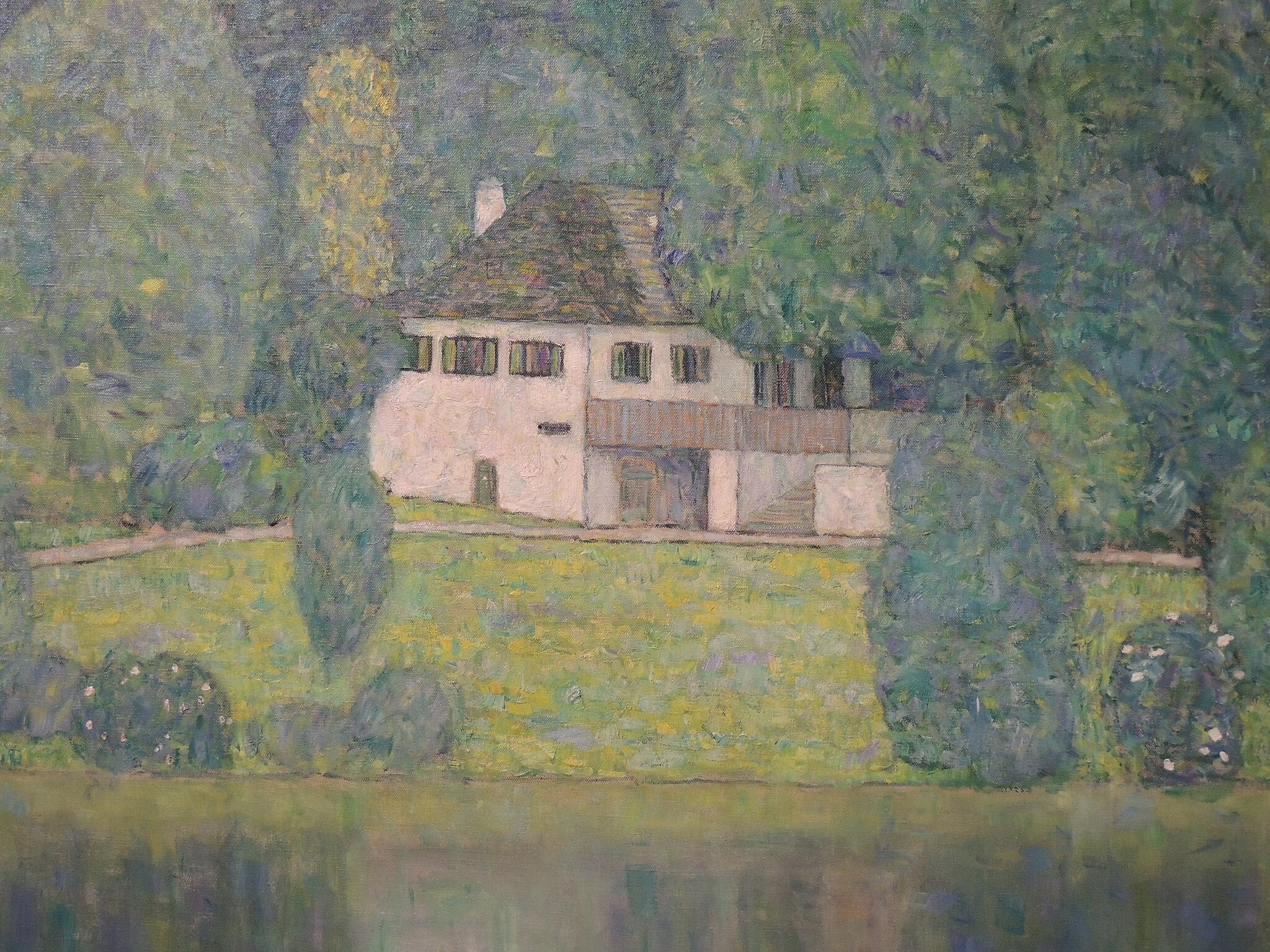
Litzlbergkeller
Gustav Klimt (1915–1916)
Litzlbergkeller distills a lakeside inn into a square, shimmering field where the house’s pale rectangle and window rhythm quietly answer the vertical screen of trees and the calm band of water below. Klimt fuses geometry and foliage into a <strong>decorative, contemplative refuge</strong>, converting observation into patterned memory <sup>[1]</sup><sup>[2]</sup>.
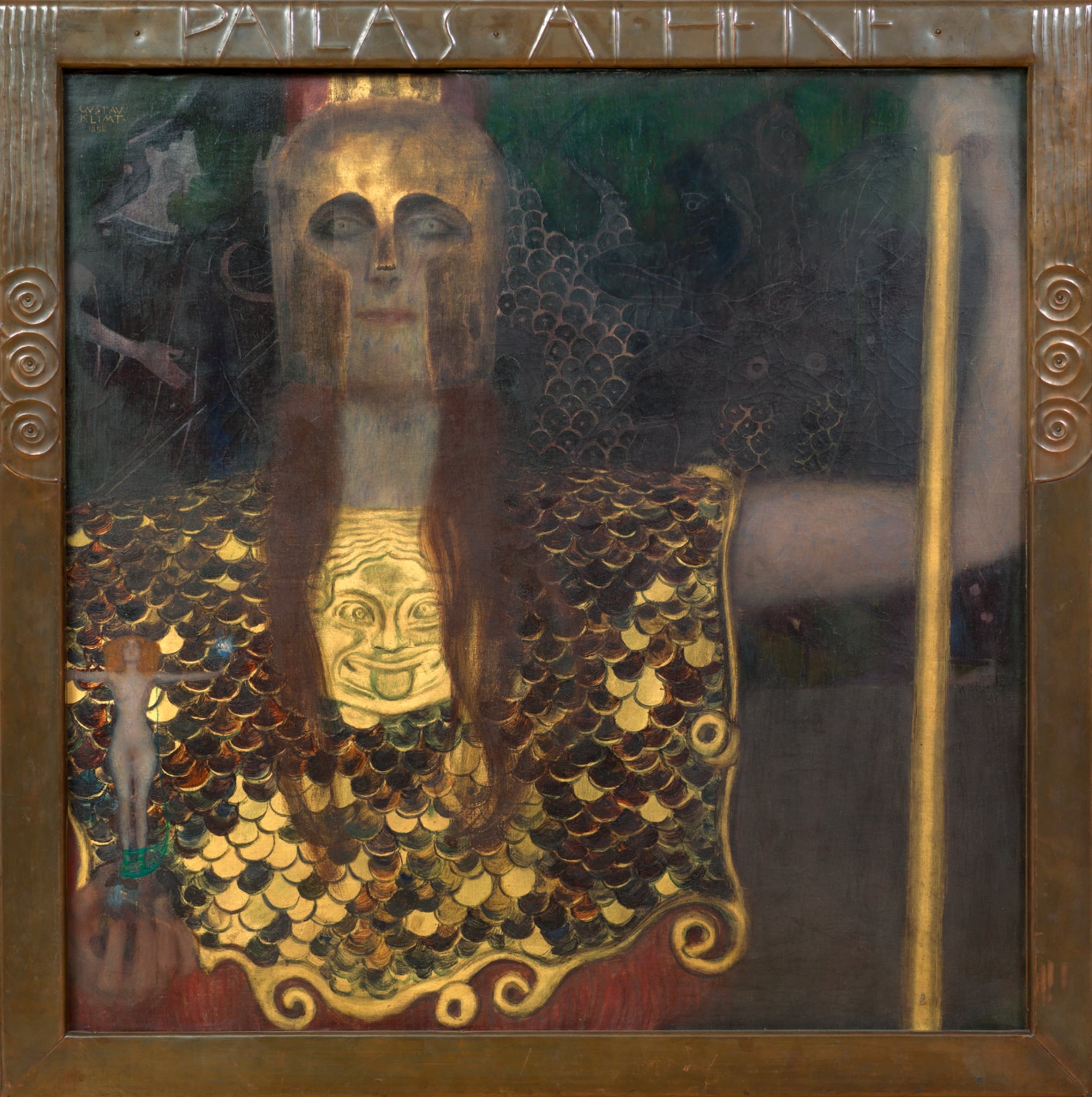
Pallas Athena
Gustav Klimt (1898)
Pallas Athena confronts the viewer as a <strong>frontal icon of power</strong>: helmeted, impassive, and armored in <strong>gleaming scale aegis</strong> crowned by a <strong>gorgoneion</strong>. Klimt fuses archaic authority with modern ornament to proclaim <strong>Vienna Secession</strong> ideals—reason, strategy, and artistic truth held in a single, implacable image <sup>[1]</sup><sup>[2]</sup>.
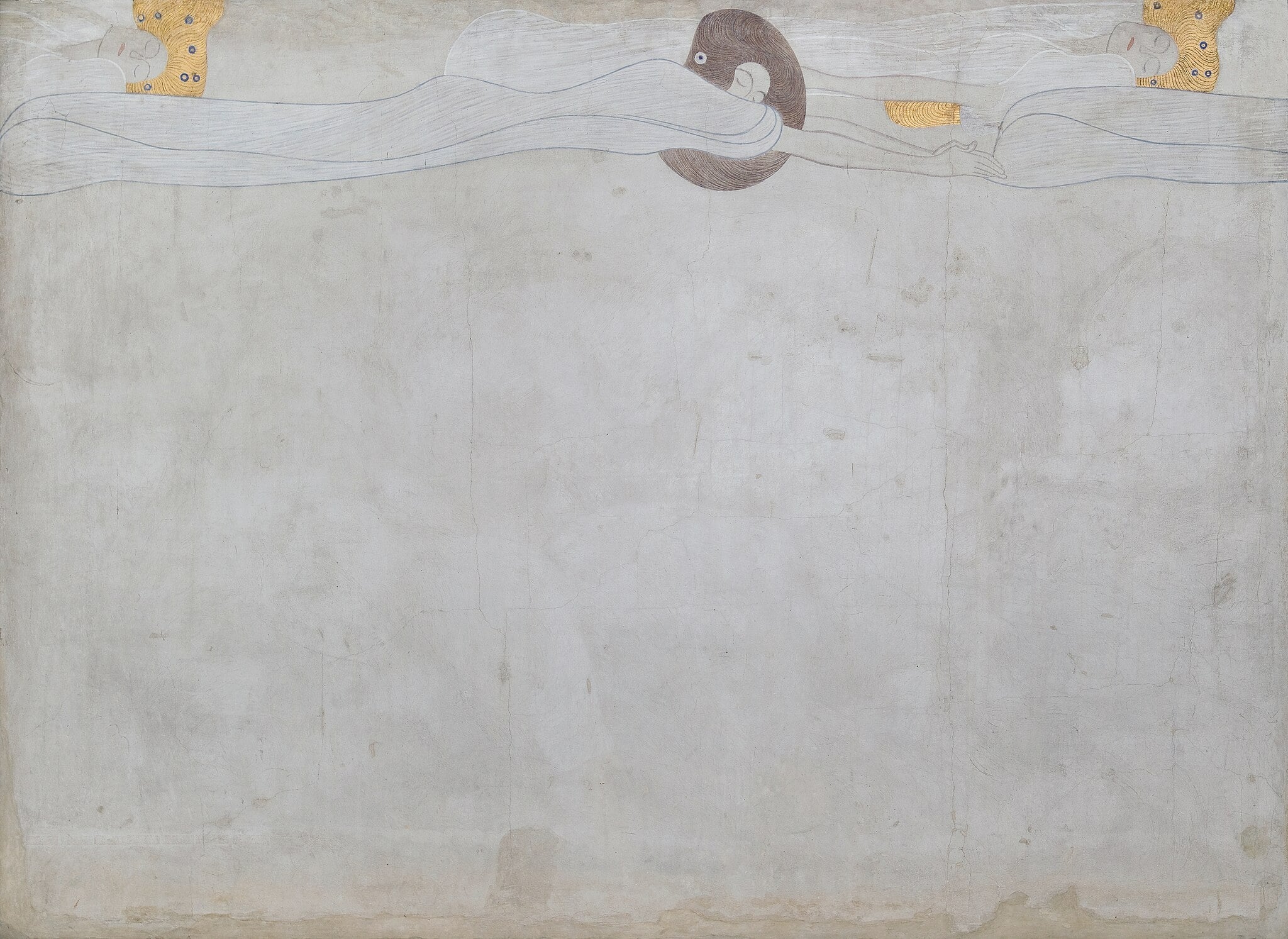
Beethoven Frieze
Gustav Klimt (1901–1902)
Gustav Klimt’s Beethoven Frieze visualizes Beethoven’s Ninth as a <strong>quest from suffering to joy</strong>, using weightless, ribbon-like bodies and <strong>gold-gleaming ornament</strong> to translate sound into sight. In the panel shown, floating genii drift horizontally while <strong>islands of gold studded with eye-like jewels</strong> punctuate a vast, chalky void, suspending time like a long musical rest. The work fuses <strong>line, flatness, and precious materials</strong> to promise transcendence through art <sup>[1]</sup><sup>[3]</sup>.
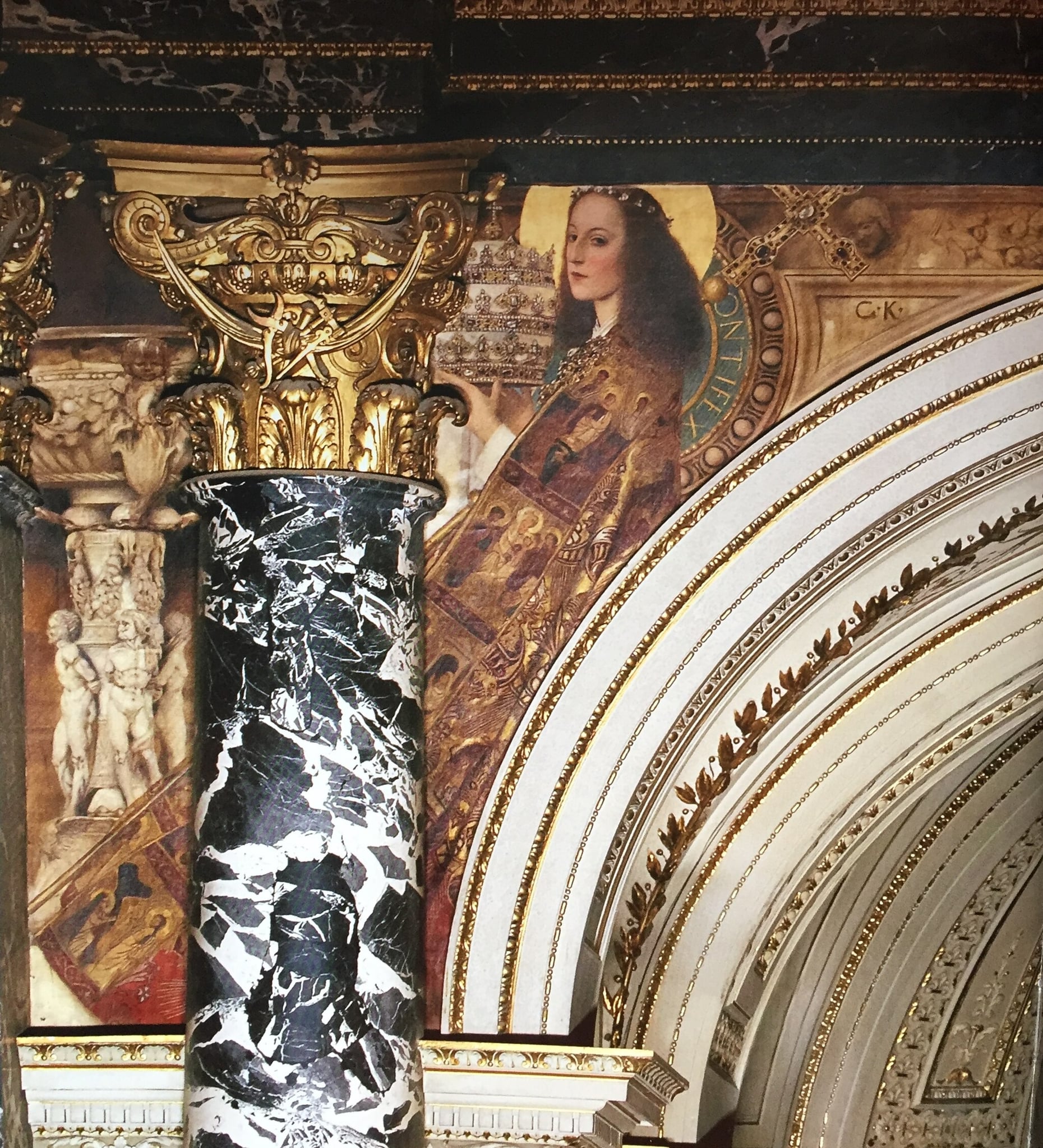
Roman and Venetian Quattrocento
Gustav Klimt (1891)
Gustav Klimt’s Roman and Venetian Quattrocento crowns the Kunsthistorisches Museum’s staircase with a didactic panorama of the Italian fifteenth century, balancing <strong>papal Rome</strong> and <strong>civic Venice</strong>. In the spandrel shown, a saintly female personification in <strong>pontifical vestments</strong> presents the <strong>papal tiara</strong> before a field of classicizing reliefs and Latin script, framed by real marble and gilded capitals. The ensemble fuses architecture and allegory, previewing Klimt’s later <strong>ornamental gold</strong> idiom while teaching viewers to read art through symbols <sup>[1]</sup><sup>[2]</sup>.
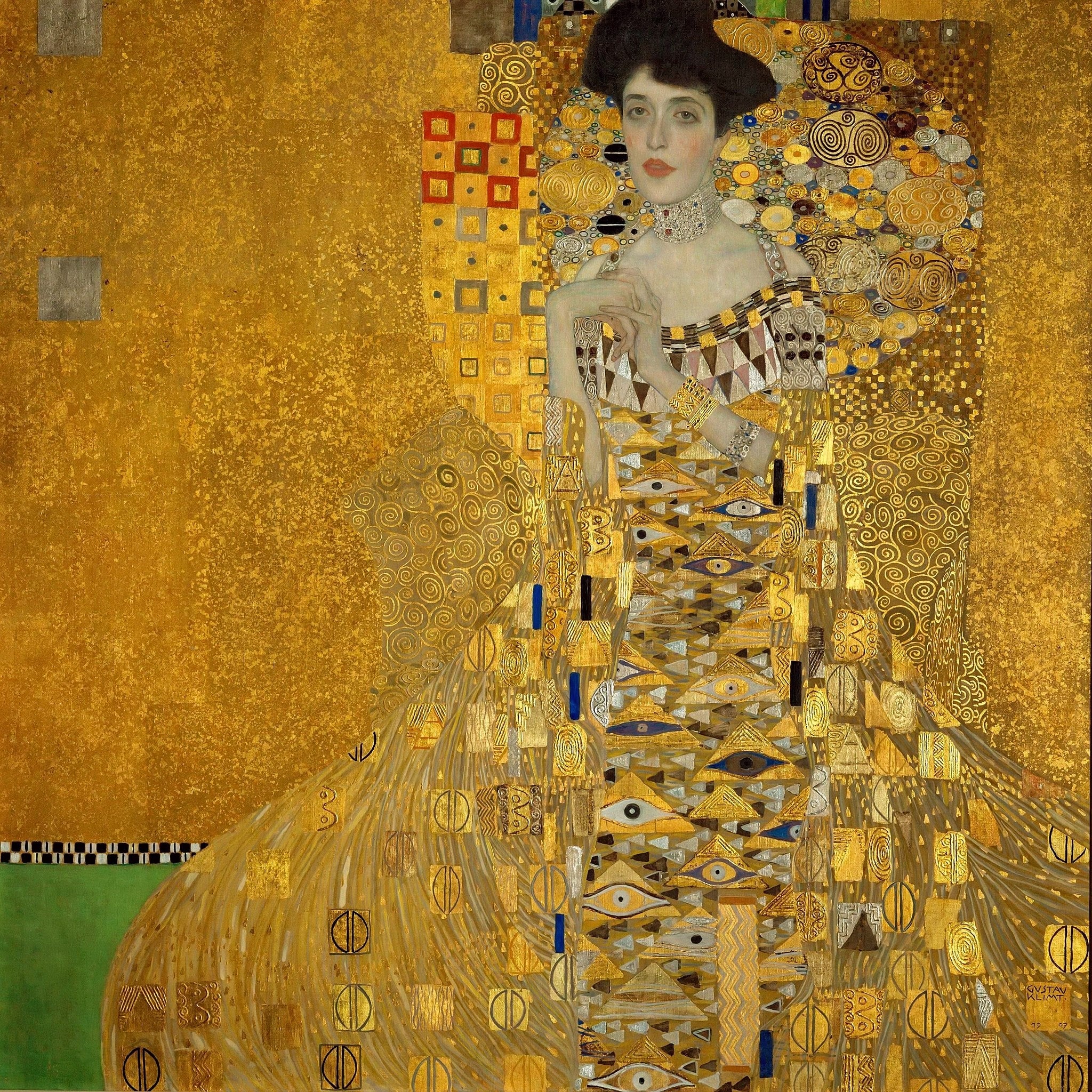
Portrait of Adele Bloch-Bauer I
Gustav Klimt (1907)
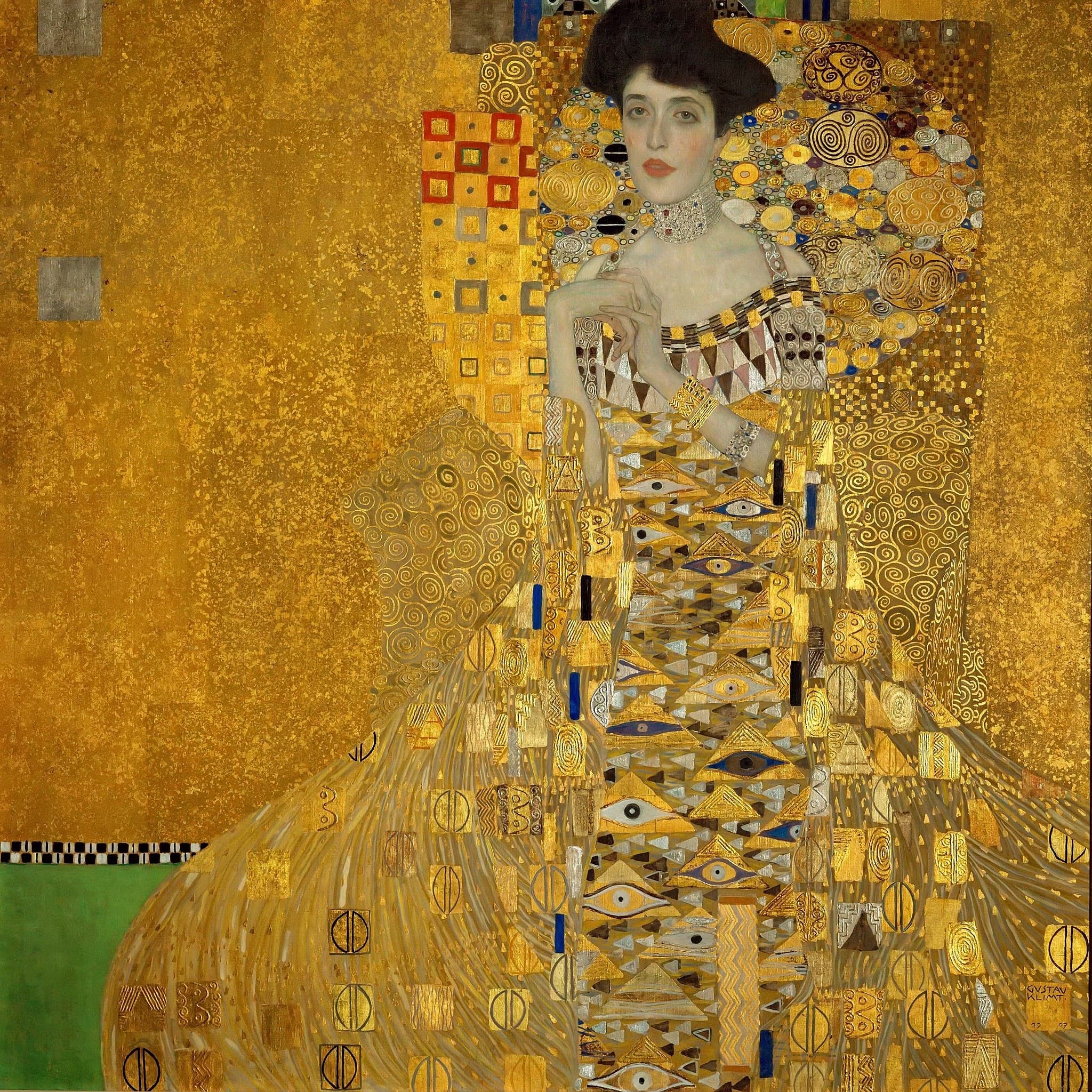
Gustav Klimt’s Portrait of Adele Bloch-Bauer I stages its sitter as a <strong>secular icon</strong>—a living presence suspended in a field of gold that converts space into <strong>pattern and power</strong>. The naturalistic face and hands emerge from a reliquary-like cascade of eyes, triangles, and tesserae, turning light, ornament, and status into the painting’s true subjects <sup>[1]</sup><sup>[2]</sup>.
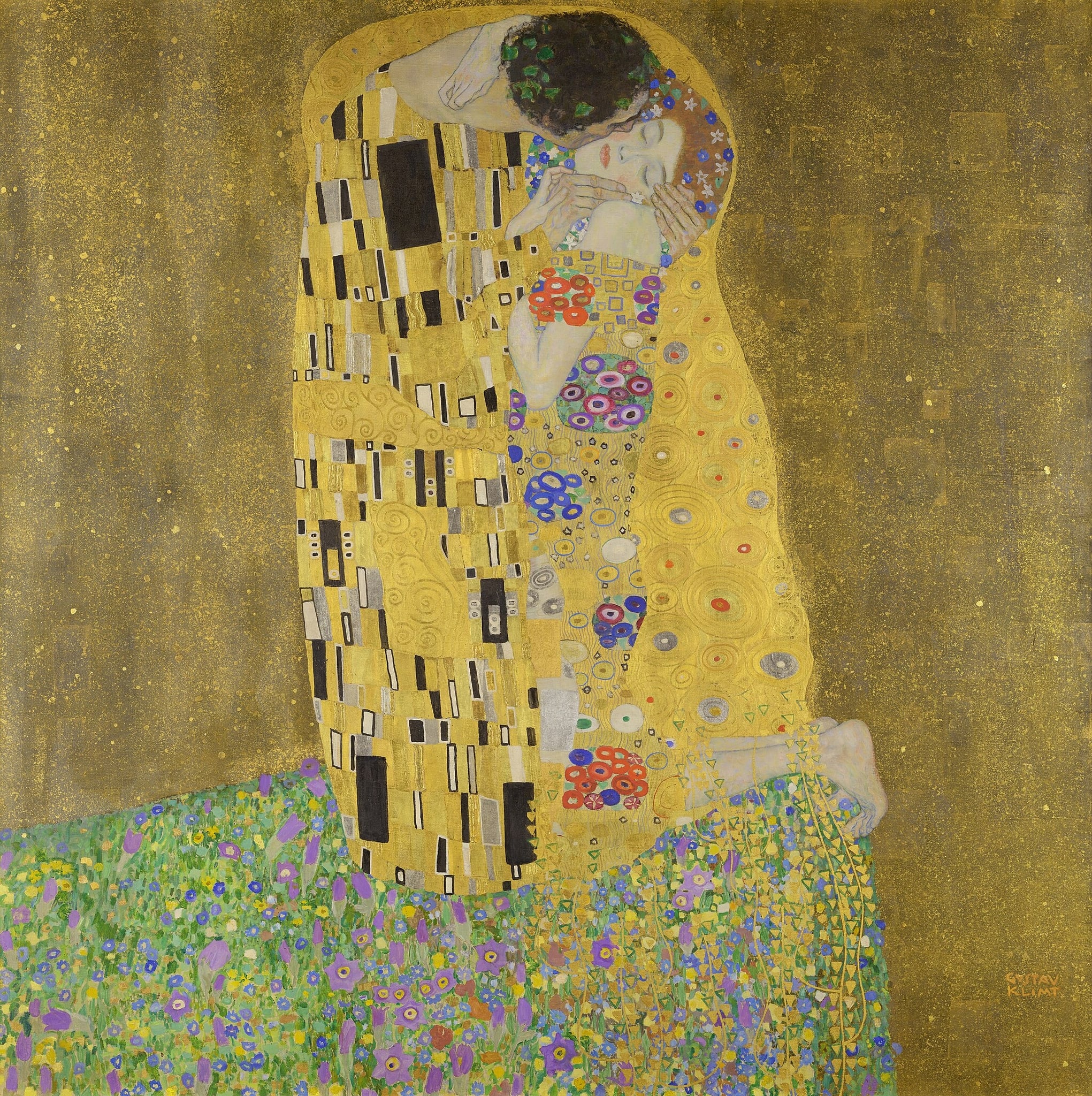
The Kiss (Lovers)
Gustav Klimt (1907–1908 (Belvedere lists 1908/09))
The Kiss (Lovers) crystallizes Klimt’s <strong>Golden Period</strong> ideal: erotic union staged as a sacred vision. Two bodies fuse beneath a single golden mantle, poised on a flowered ledge at the brink of the unknown, where <strong>pattern becomes symbol</strong> and intimacy becomes icon.
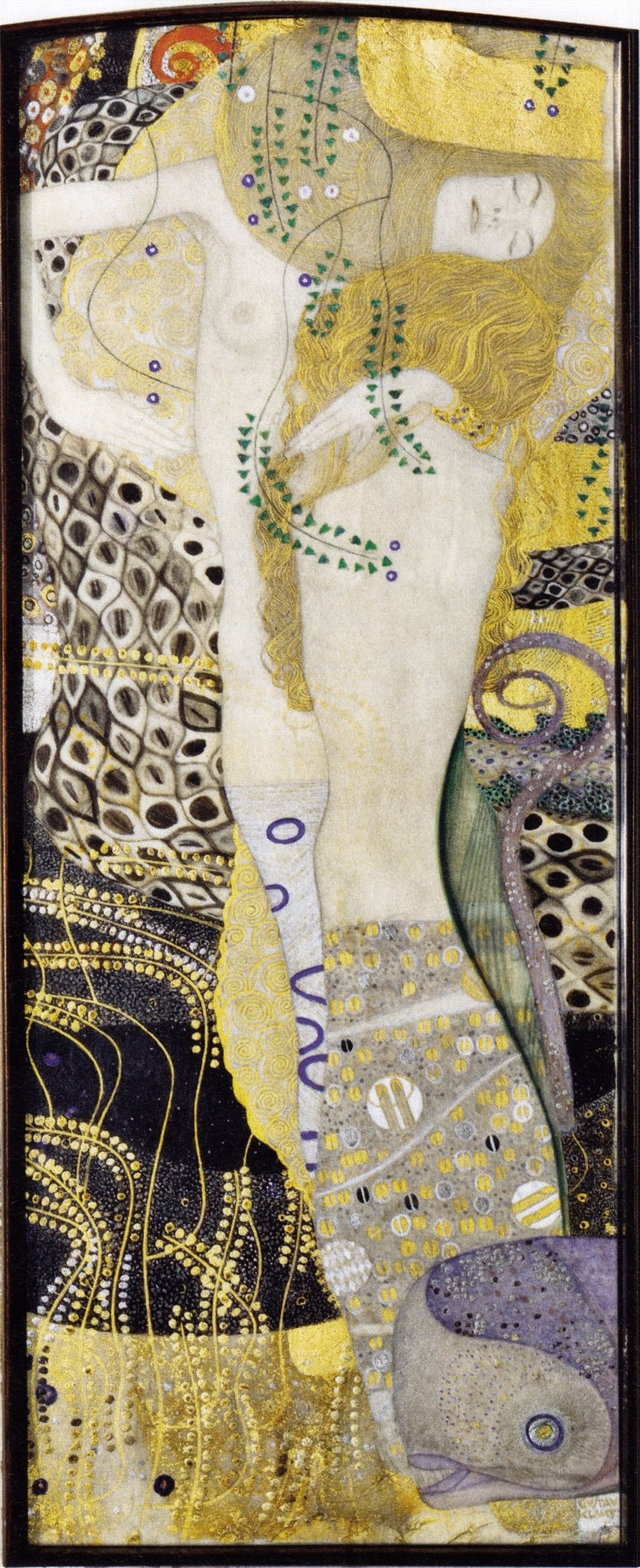
Girlfriends (Water Serpents I)
Gustav Klimt (1904; last revisions by 1907)
Gustav Klimt’s Girlfriends (Water Serpents I) stages two elongated nudes drifting in a jeweled, underwater field where bodies and ornament fuse into a single, <strong>luminous</strong> surface. Closed eyes, interlaced arms, and hair that streams like <strong>currents</strong> seal the scene in intimate secrecy, while metallic scales, eye-shaped ovals, and a watchful fish charge the water with <strong>erotic</strong> and <strong>mythic</strong> tension <sup>[1]</sup><sup>[2]</sup><sup>[3]</sup>.
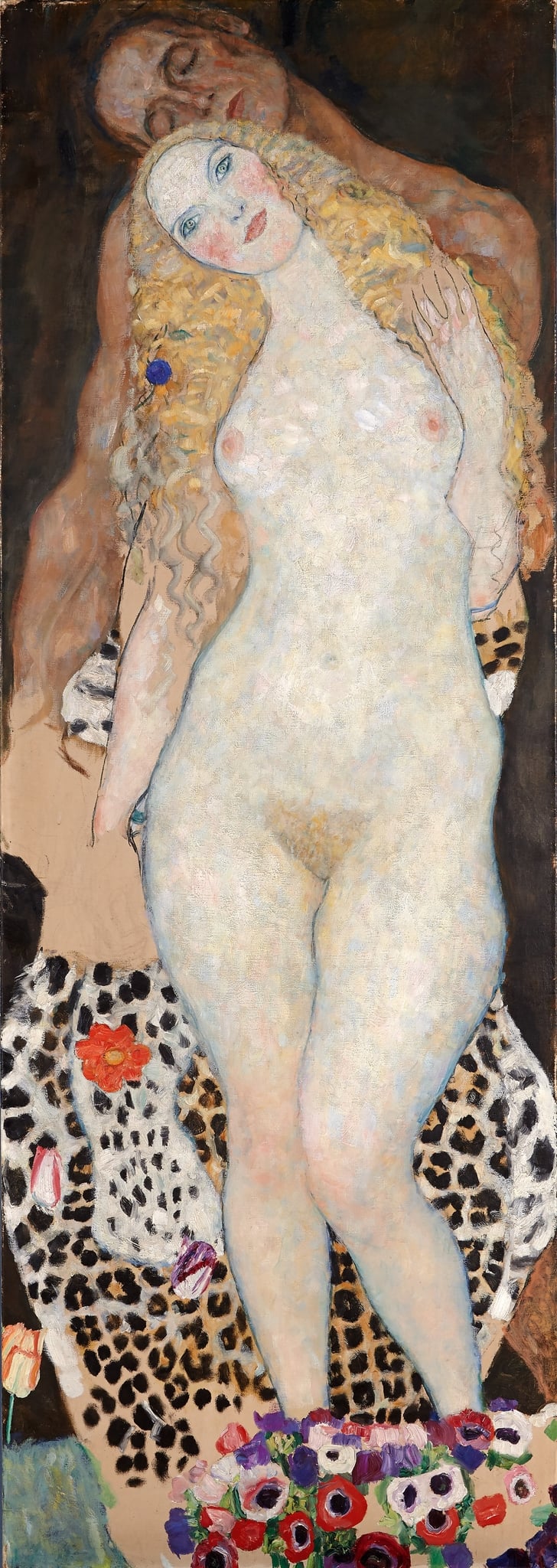
Adam and Eve
Gustav Klimt (1916–1918 (unfinished))
Gustav Klimt’s Adam and Eve recasts the biblical pair as a <strong>sensual, timeless allegory</strong> rather than a didactic tale. Eve’s <strong>luminous, opalescent body</strong> and direct gaze dominate, while Adam recedes in shadow, enfolding her amid a <strong>leopard pelt</strong> and a <strong>carpet of anemones</strong> that signal erotic vitality and fertility <sup>[2]</sup><sup>[3]</sup>.
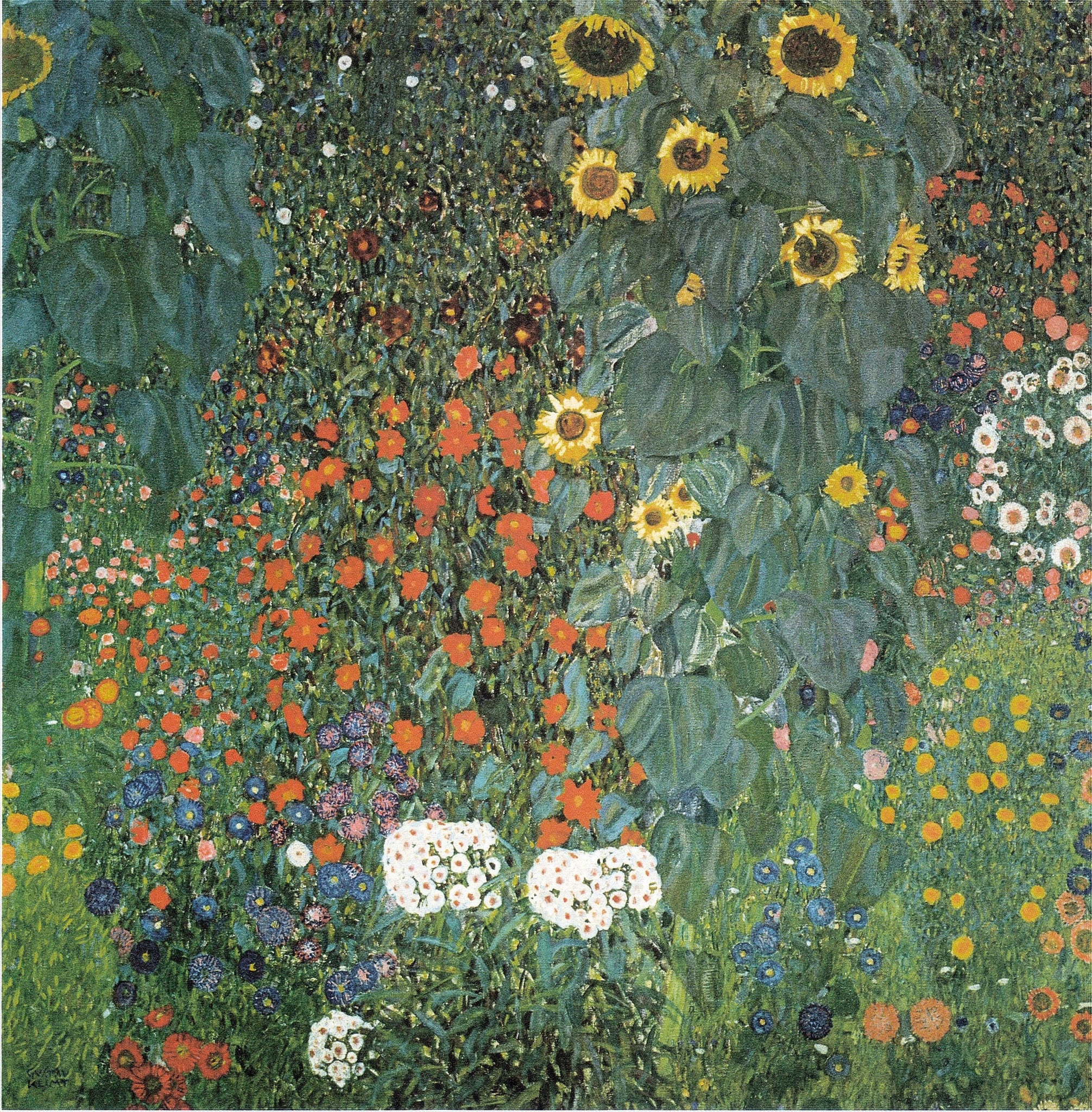
Cottage Garden with Sunflowers
Gustav Klimt (1906–1907 (signed 1907))
Cottage Garden with Sunflowers is a square, horizonless field of blooms where a vertical column of <strong>sunflowers</strong> anchors an all-over weave of color and pattern. Klimt fuses <strong>ornament and nature</strong>, turning a humble Litzlberg cottage plot into a radiant matrix of cyclical life and renewal <sup>[1]</sup><sup>[4]</sup><sup>[5]</sup>.
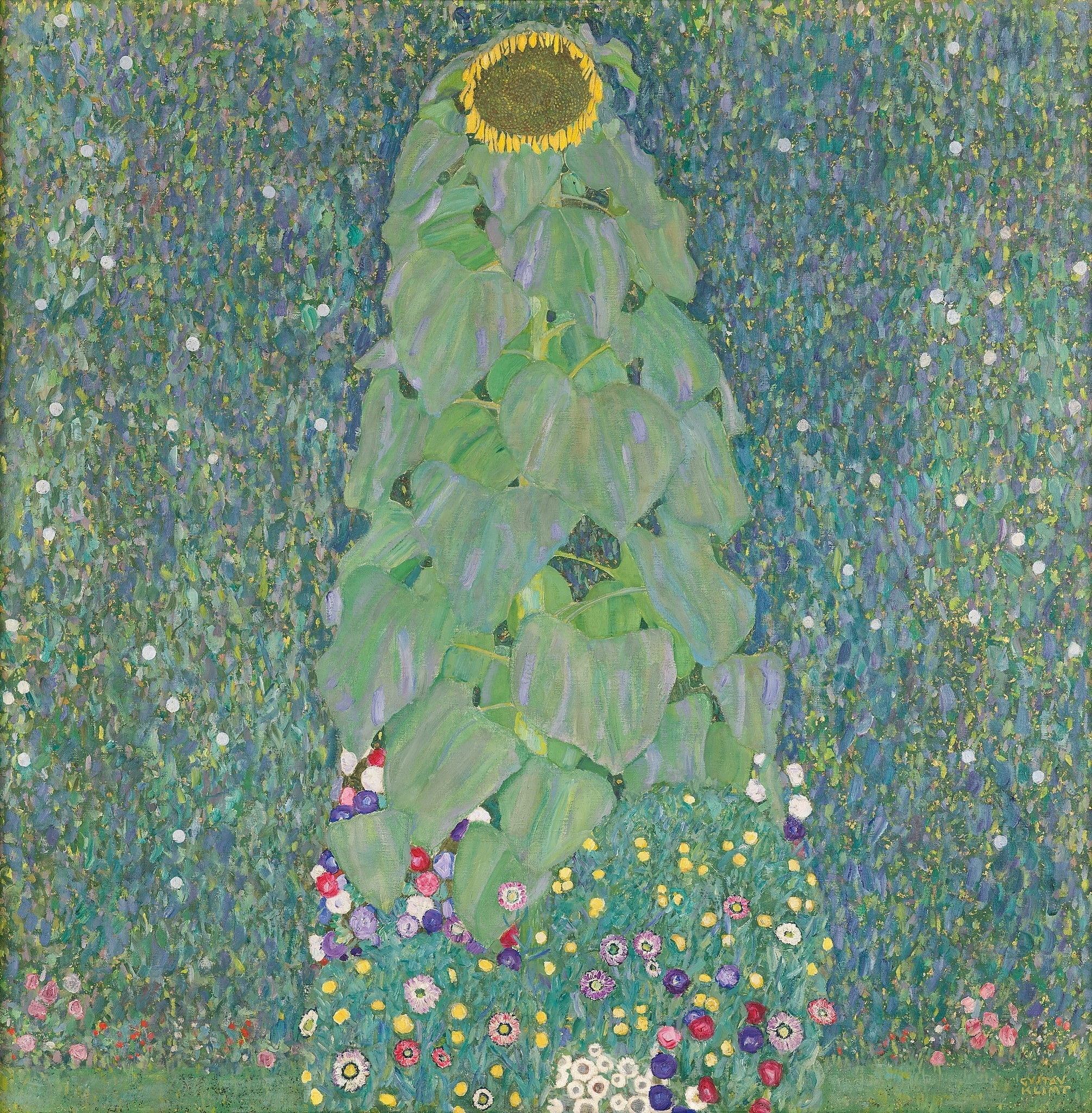
Sunflower
Gustav Klimt (1907/1908)
Gustav Klimt’s Sunflower turns a single bloom into a <strong>monumental, figure-like presence</strong>. A tapering stack of broad, drooping leaves rises from a <strong>mosaic-like carpet of round blossoms</strong>, crowned by a gold-flecked disc that glows against a cool, stippled field. The work fuses <strong>portrait, icon, and landscape</strong> into one emblem of vitality and quiet sanctity <sup>[1]</sup><sup>[2]</sup>.
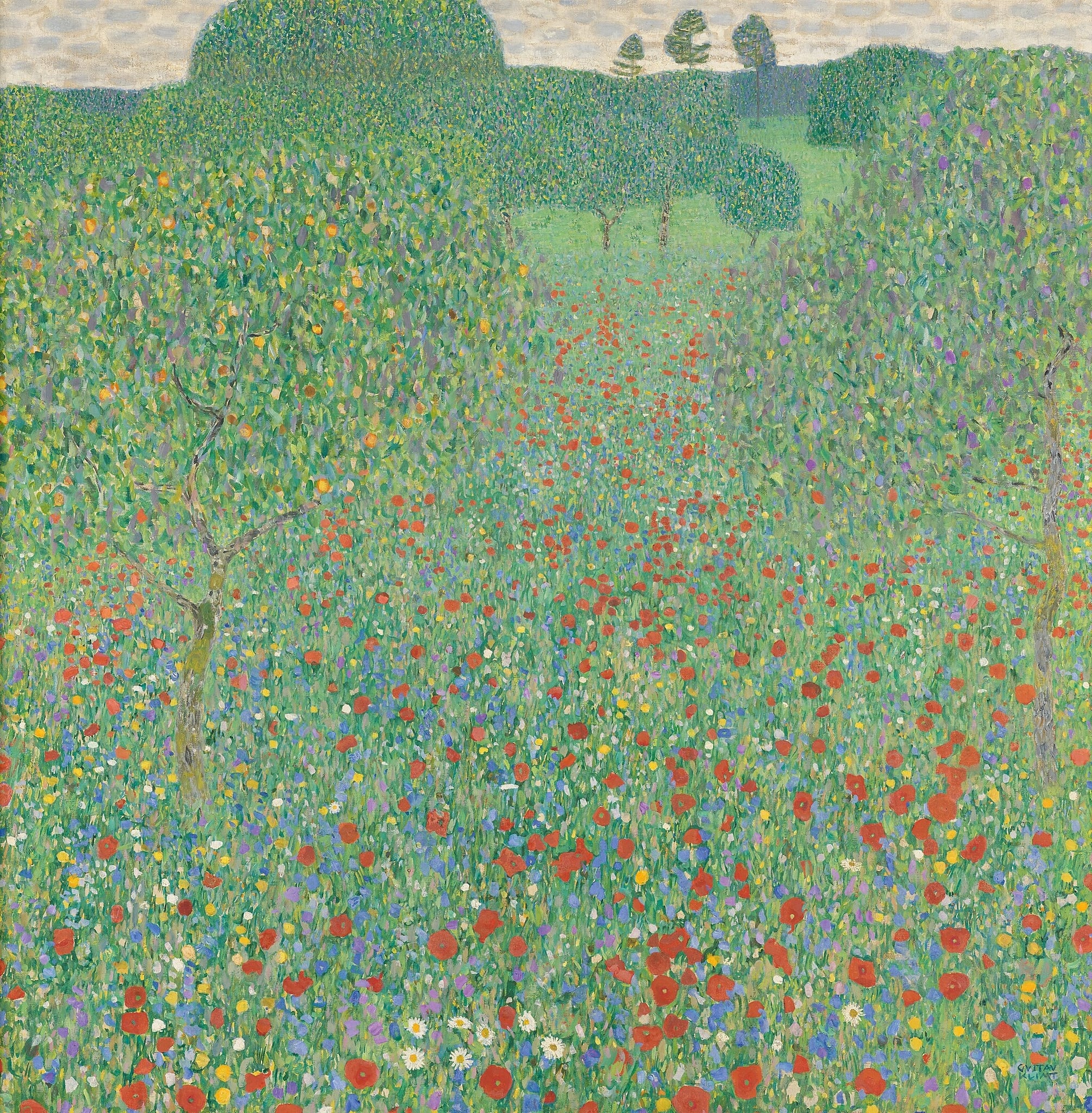
Flowering Poppies
Gustav Klimt (1907)
Gustav Klimt’s <strong>Flowering Poppies</strong> (1907) turns a meadow into a shimmering, all-over field where botany becomes <strong>ornament</strong>. A square canvas packed with red poppies, daisies, and fruiting trees compresses depth and invites a drifting gaze rather than linear recession <sup>[1]</sup><sup>[2]</sup>. The result is a sensuous, immersive vision that fuses observed nature with <strong>decorative abstraction</strong> <sup>[2]</sup>.
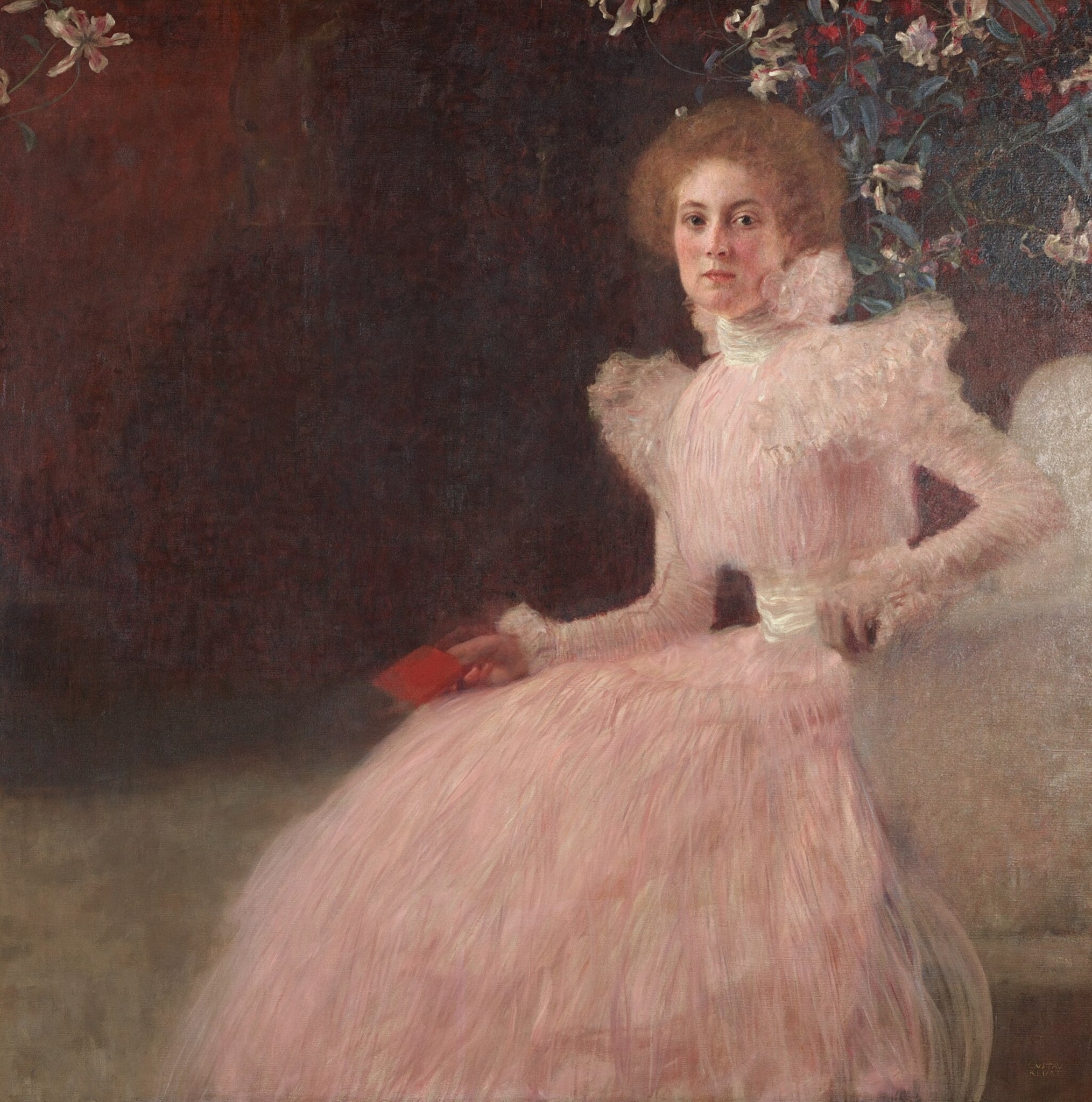
Sonja Knips
Gustav Klimt (1897/1898)
In Sonja Knips, Gustav Klimt stages a poised young woman as a modern self—held taut between <strong>lucid presence</strong> and <strong>ornamental dissolution</strong>. The square canvas, the feathery pink dress, the climbing white lilies, and the single <strong>red sketchbook</strong> in her hand crystallize an identity that is reflective, intelligent, and self‑aware within a decorous world <sup>[1]</sup><sup>[2]</sup><sup>[4]</sup>.
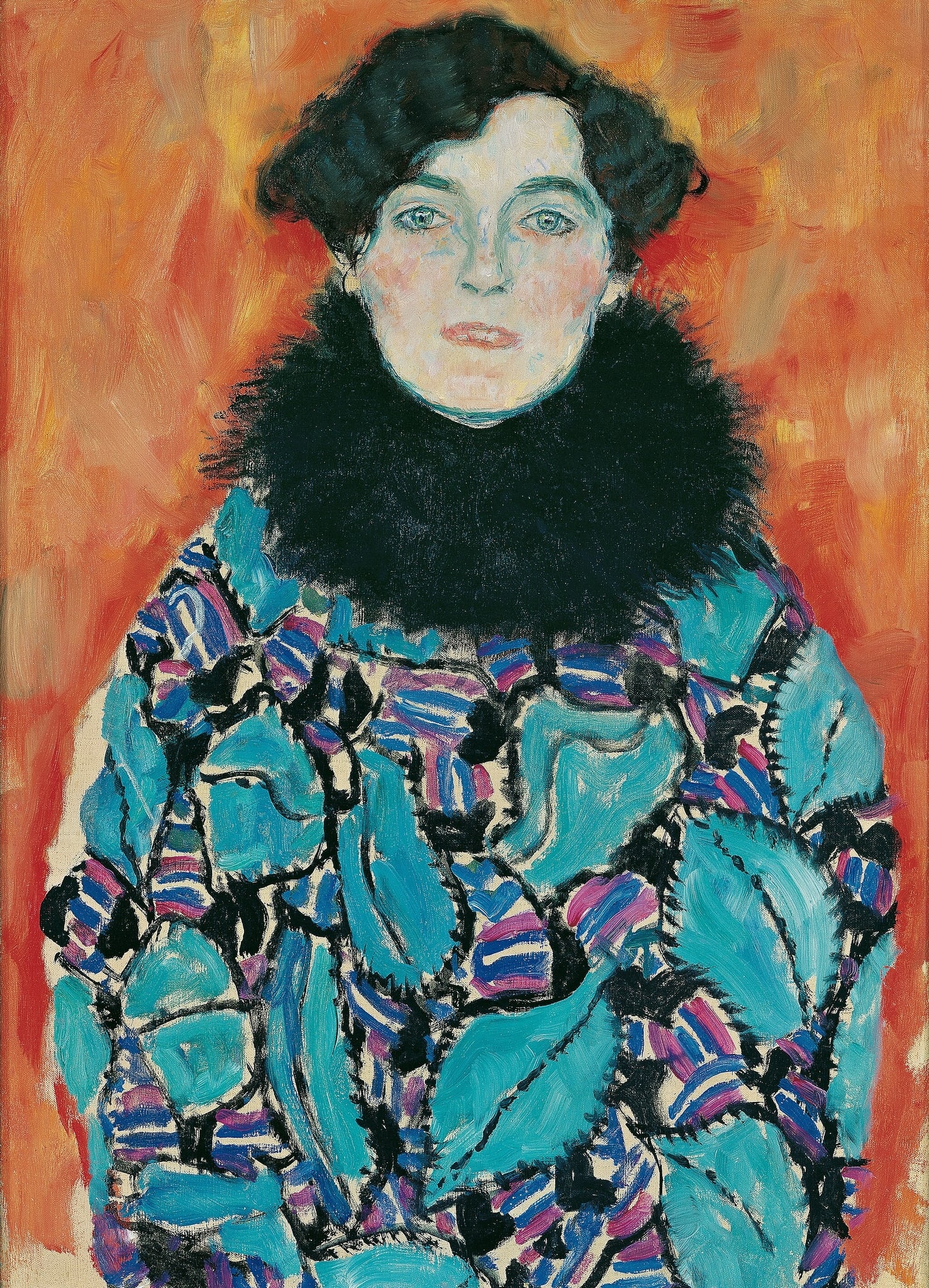
Johanna Staude
Gustav Klimt (1917/1918)
<strong>Johanna Staude</strong> distills Klimt’s late style into a charged encounter between a cool, impassive face and a blazing orange field. The sitter’s head is isolated by a <strong>black feather collar</strong>, while a <strong>Wiener Werkstätte</strong> blouse in turquoise leaves and violet stripes surges forward as a near-abstract surface <sup>[1]</sup><sup>[2]</sup>. Painted in 1917/1918 and left <strong>unfinished</strong> at the mouth, it becomes a poised emblem of modern identity in Vienna on the eve of Klimt’s death <sup>[1]</sup><sup>[2]</sup><sup>[5]</sup>.
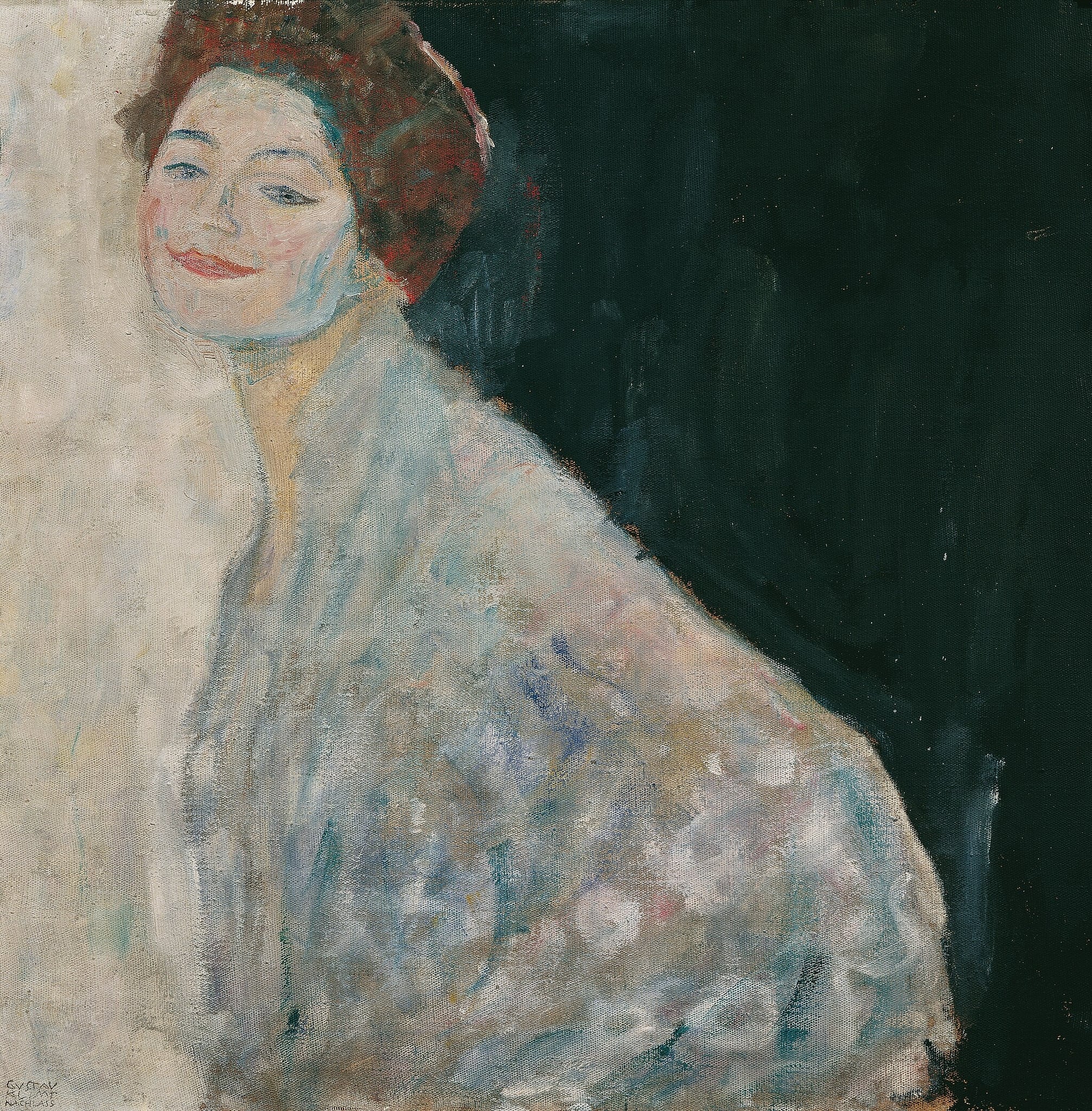
Lady in White
Gustav Klimt (1917–1918)
Lady in White crystallizes Klimt’s late style as a <strong>liminal apparition</strong>: a woman who seems to form out of paint where a pale field meets a dark one. Her kimono‑like robe dissolves into <strong>iridescent whites</strong> touched by blues and violets, while a tilted, <strong>mask‑like smile</strong> hovers between intimacy and anonymity <sup>[1]</sup><sup>[2]</sup><sup>[3]</sup>. The result is less a likeness than a <strong>luminous state of being</strong> suspended on a threshold.
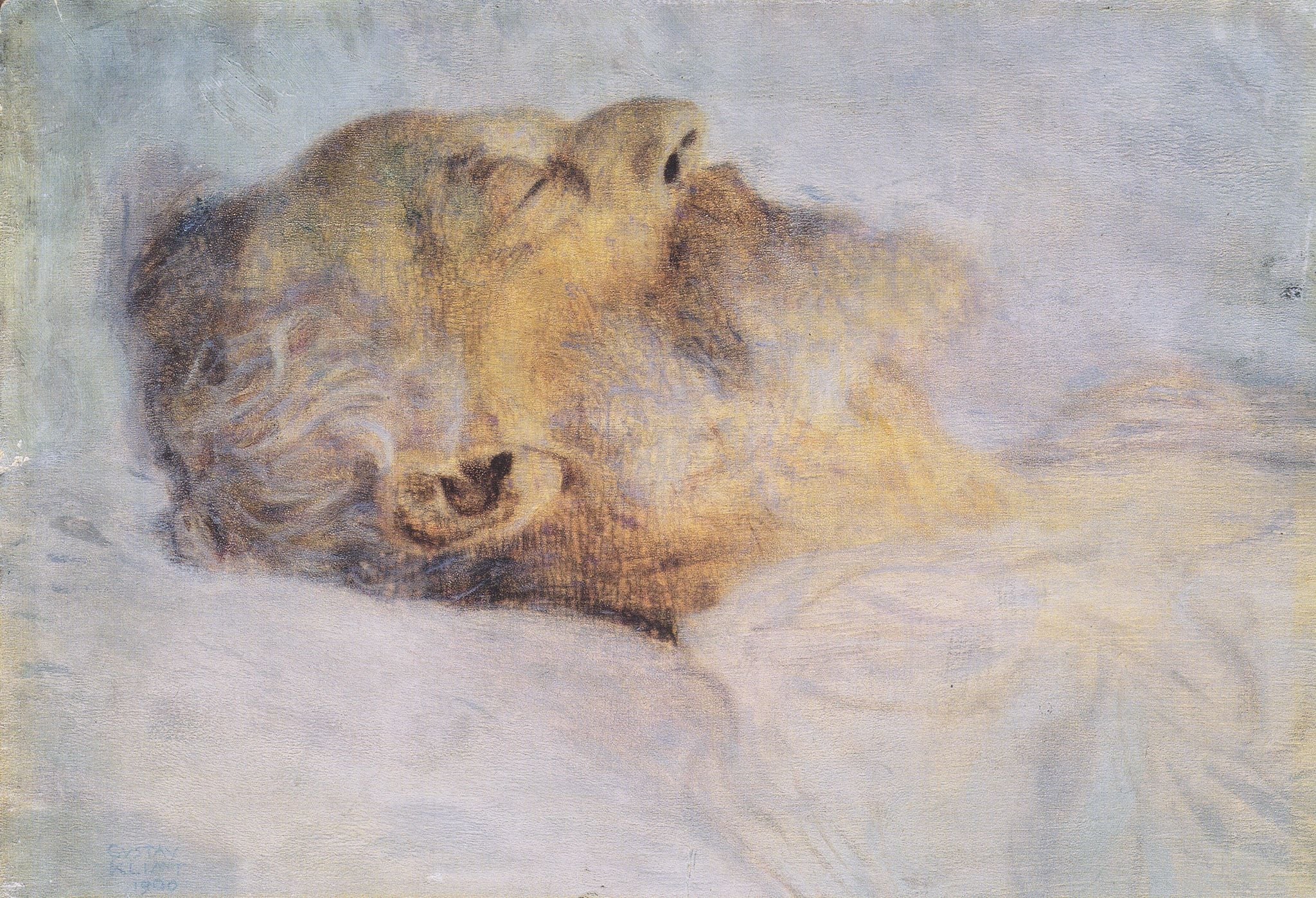
Old Man on His Deathbed
Gustav Klimt (1900 (cataloged; c. 1899–1900, inscription likely by another hand))
Gustav Klimt’s Old Man on His Deathbed is a concentrated vigil at life’s threshold, rendered in <strong>vaporous blues and ochers</strong> that let head, pillow, and air bleed into one another. The profile turned toward light, with <strong>closed eyes and a slightly parted mouth</strong>, transforms observation into a modern <strong>memento mori</strong> <sup>[1]</sup><sup>[2]</sup>.
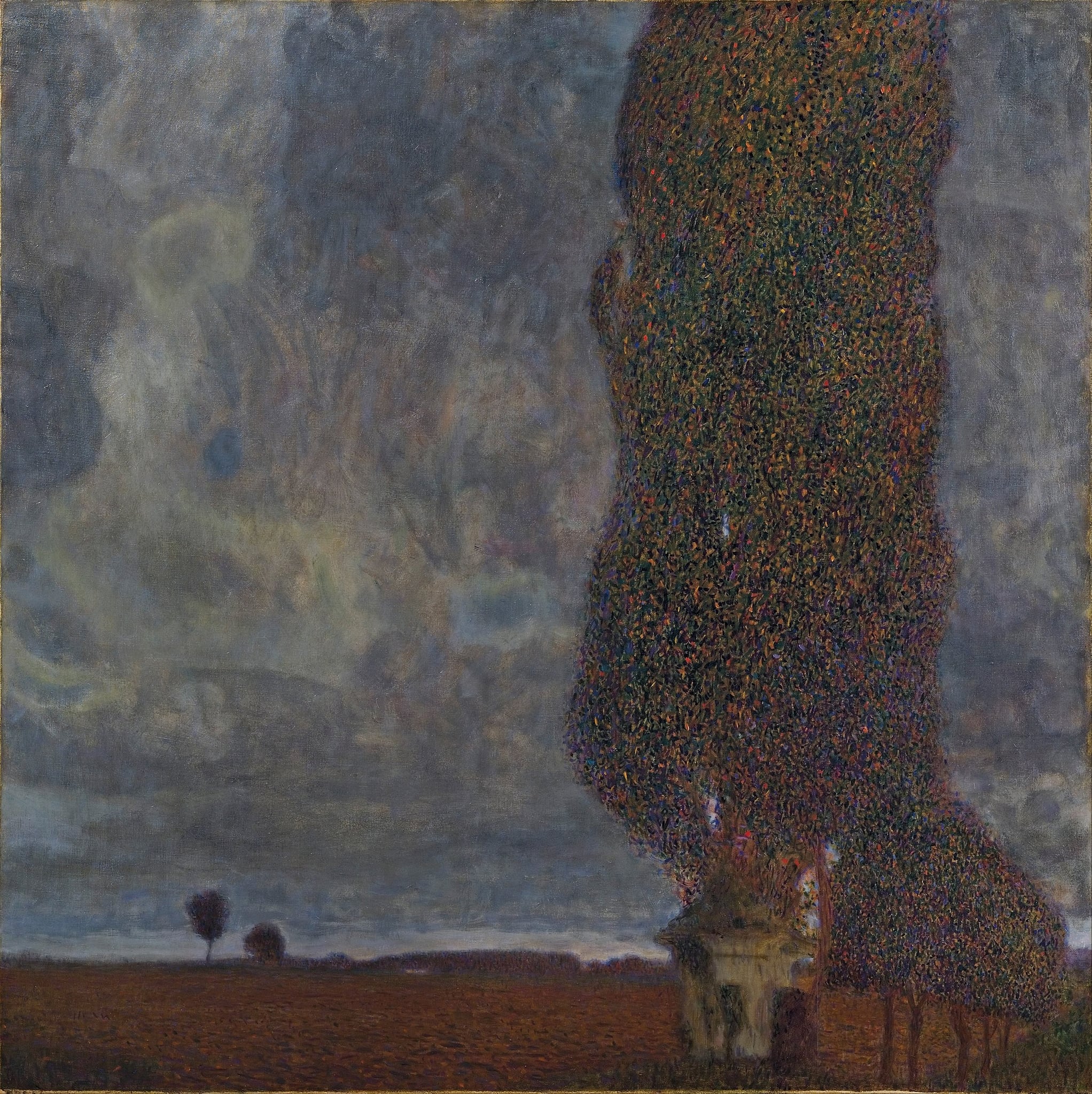
The Large Poplar II (Gathering Storm)
Gustav Klimt (1902/03)
In The Large Poplar II (Gathering Storm), a monumental poplar rises like a <strong>sentinel</strong> at the right edge while a low, rust-toned plain and tiny chapel anchor the horizon. Klimt devotes most of the square canvas to a <strong>charged, near-monochrome sky</strong>, making weather the protagonist and turning the tree’s flecked canopy into a shimmering, ominous <strong>mosaic</strong> <sup>[1]</sup><sup>[2]</sup>.
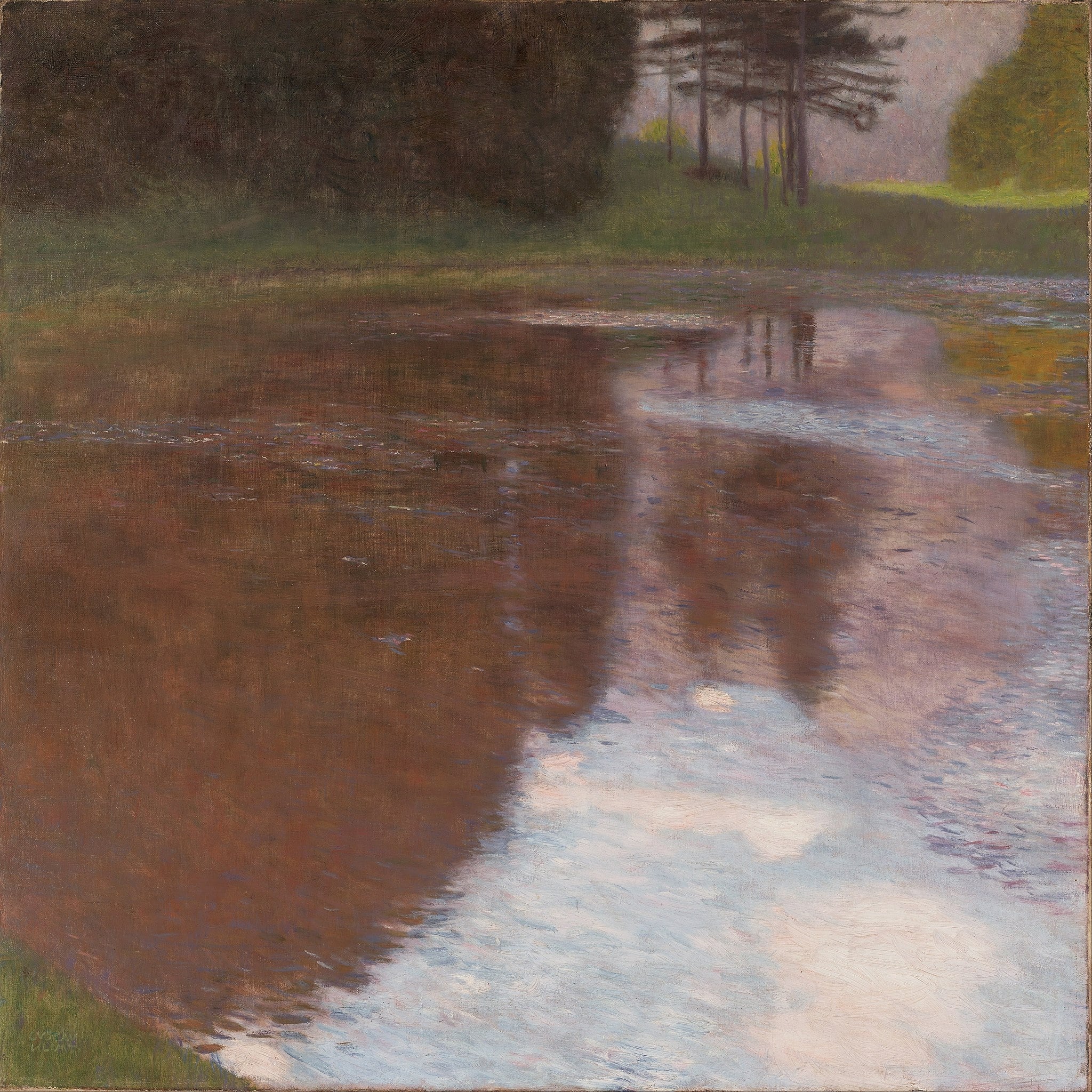
A Morning by the Pond
Gustav Klimt (1899)
A Morning by the Pond turns a quiet Egelsee shoreline into a field of <strong>reflection</strong> where trees, bank, and sky dissolve into one surface. Klimt’s first <strong>square format</strong> landscape compresses depth and makes water the true subject, staging a luminous <strong>threshold</strong> between night and day. The work establishes perception itself—what we see and how—as Klimt’s modern theme.
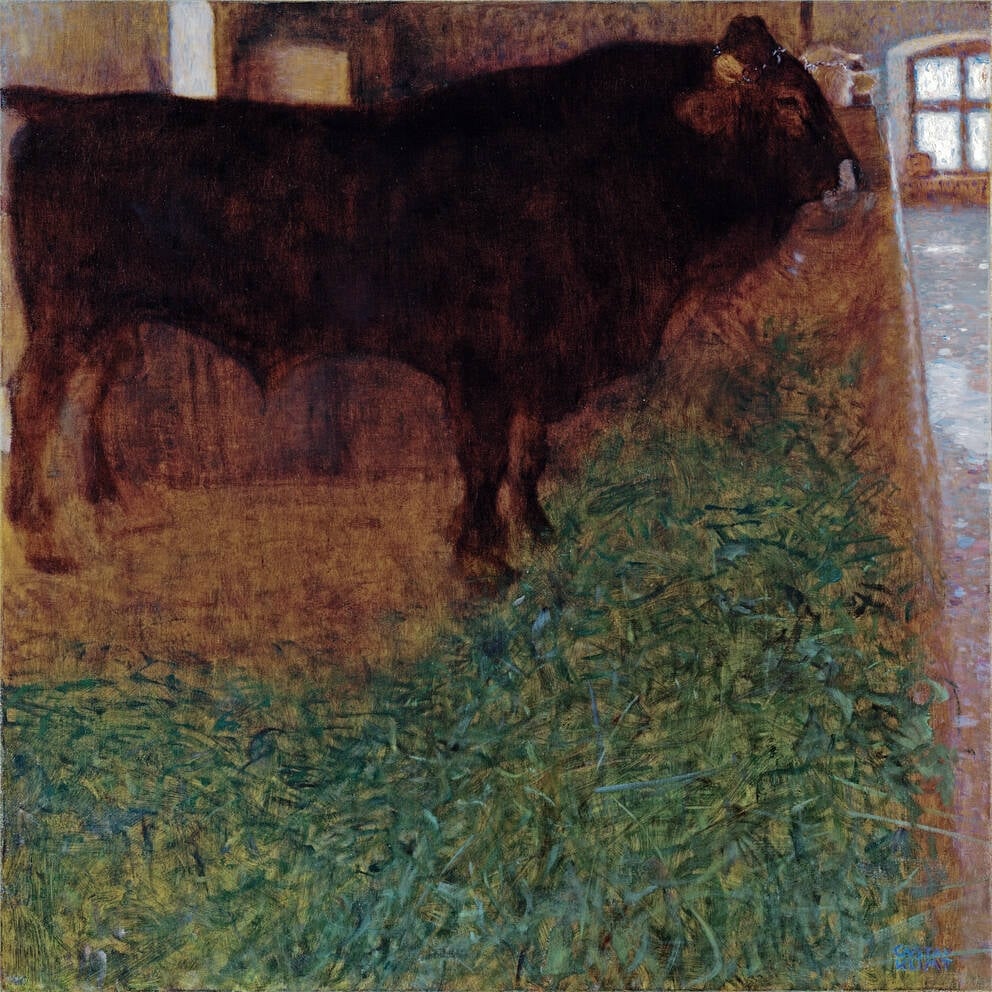
The Black Bull
Gustav Klimt (1900 (1900–1901 also cited))
<strong>The Black Bull</strong> distills raw animal power into a near-monolithic presence, its dark mass occupying the square field while a cool window flare touches the snout and horn. <strong>Gustav Klimt</strong> transforms a stable interior into a drama of force and limit, the diagonal swath of green fodder channeling energy toward the tethered head. The work finds grandeur in a local motif from Klimt’s first Attersee summer, uniting tactile surface with psychological tension <sup>[1]</sup><sup>[4]</sup>.
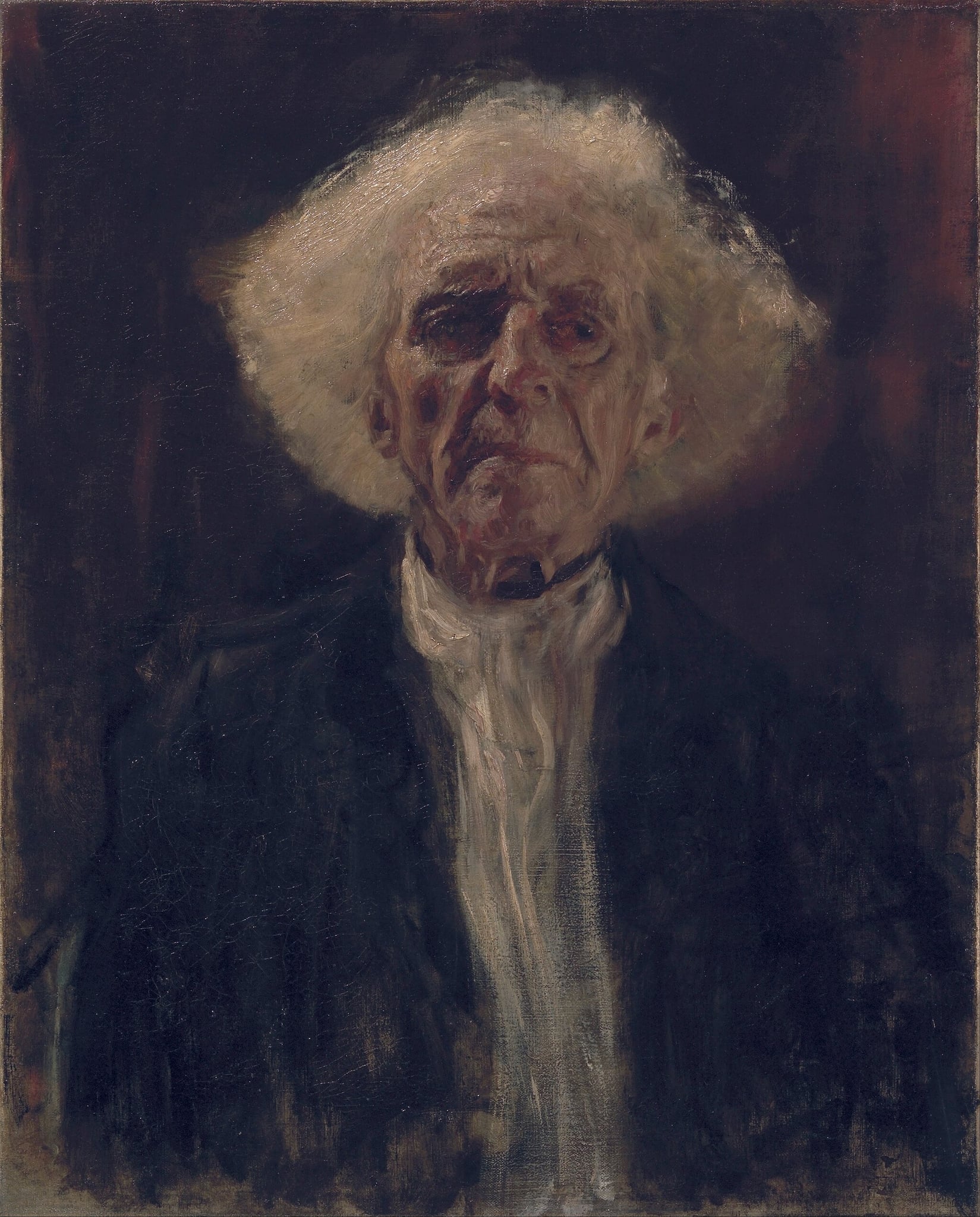
The Blind Man
Gustav Klimt (c. 1896)
Gustav Klimt’s The Blind Man confronts the viewer with a monumental head and torso emerging from a near-black field, where <strong>chiaroscuro</strong>, <strong>tactile paint</strong>, and an <strong>occluded gaze</strong> redirect attention from sight to touch and memory. The dissolving white collar and scumbled halo of hair make the figure feel carved from darkness, asserting <strong>dignity without sentiment</strong> and turning blindness into a form of inward presence <sup>[1]</sup>.
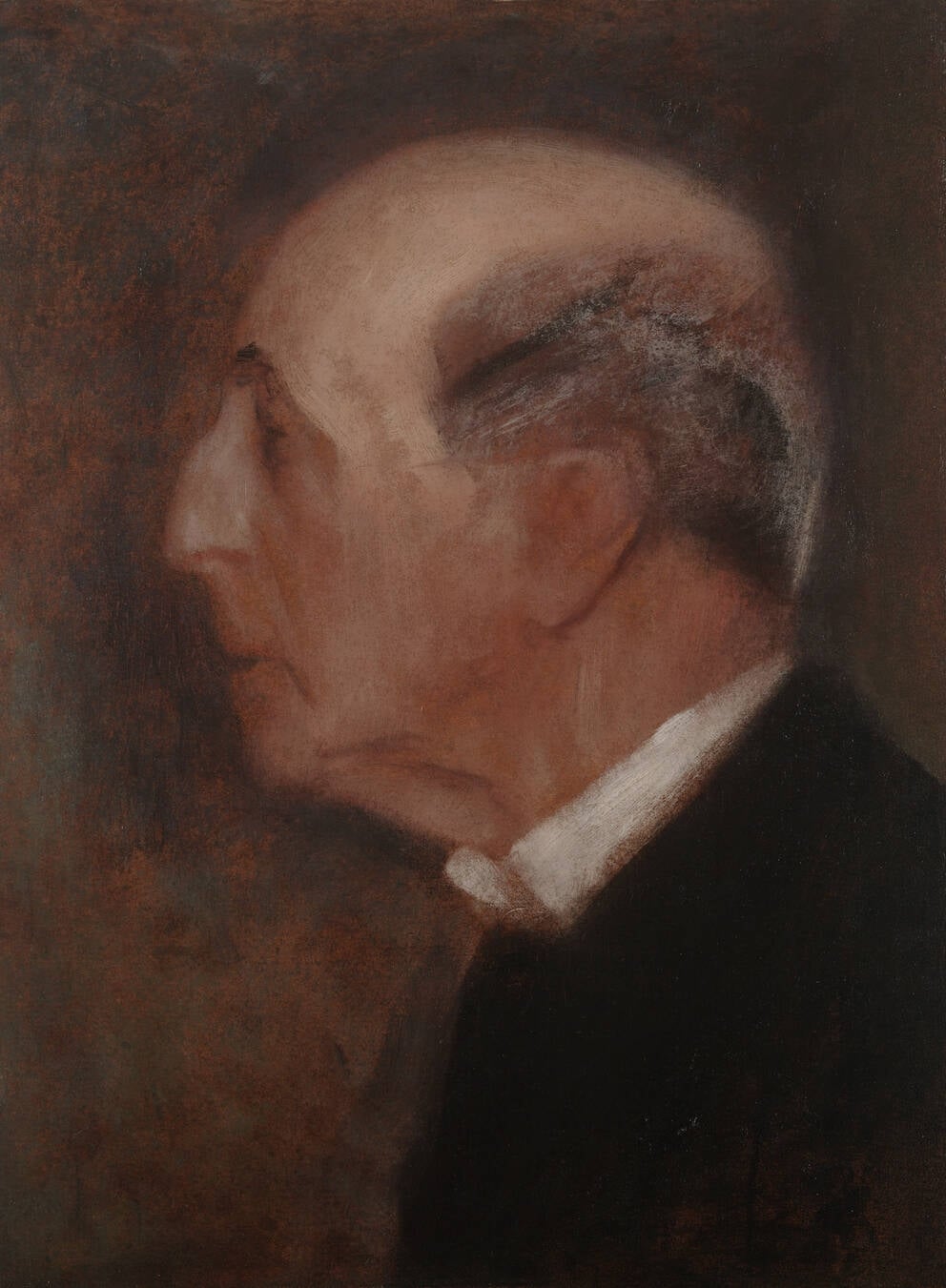
Portrait of an Old Man in Profile (Count Traun?)
Gustav Klimt (c. 1896)
Gustav Klimt’s Portrait of an Old Man in Profile (Count Traun?) distills human presence to a <strong>strict profile</strong> set against a <strong>dusky, earth‑toned</strong> field. With thin oil on cardboard, Klimt lets edges <strong>dissolve into atmosphere</strong>, turning the bald crown, graying wisps, and slack jaw into a meditation on <strong>age and transience</strong> <sup>[1]</sup>.
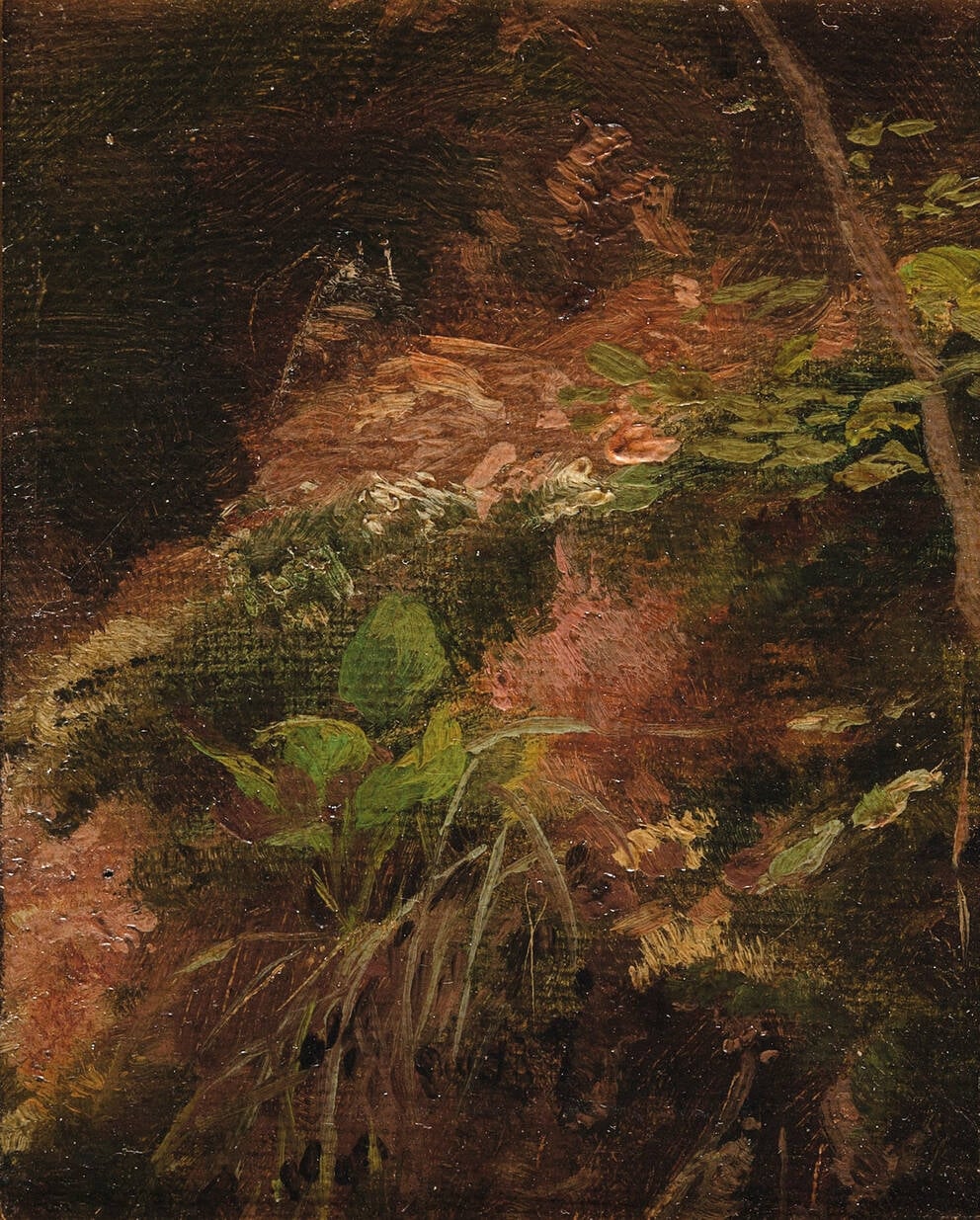
Forest Floor
Gustav Klimt (c. 1881/1882)
Forest Floor concentrates the eye on a miniature world of soil, moss, and leaf-litter rendered in tactile strokes and dark-to-amber light. Klimt frames a diagonal bank with a small sapling and sprouting leaves, turning the ground into a <strong>living tapestry</strong> of decay and renewal <sup>[1]</sup>. As an early oil sketch, it fuses <strong>academic chiaroscuro</strong> with a proto-decorative rhythm that hints at later developments <sup>[1]</sup>.
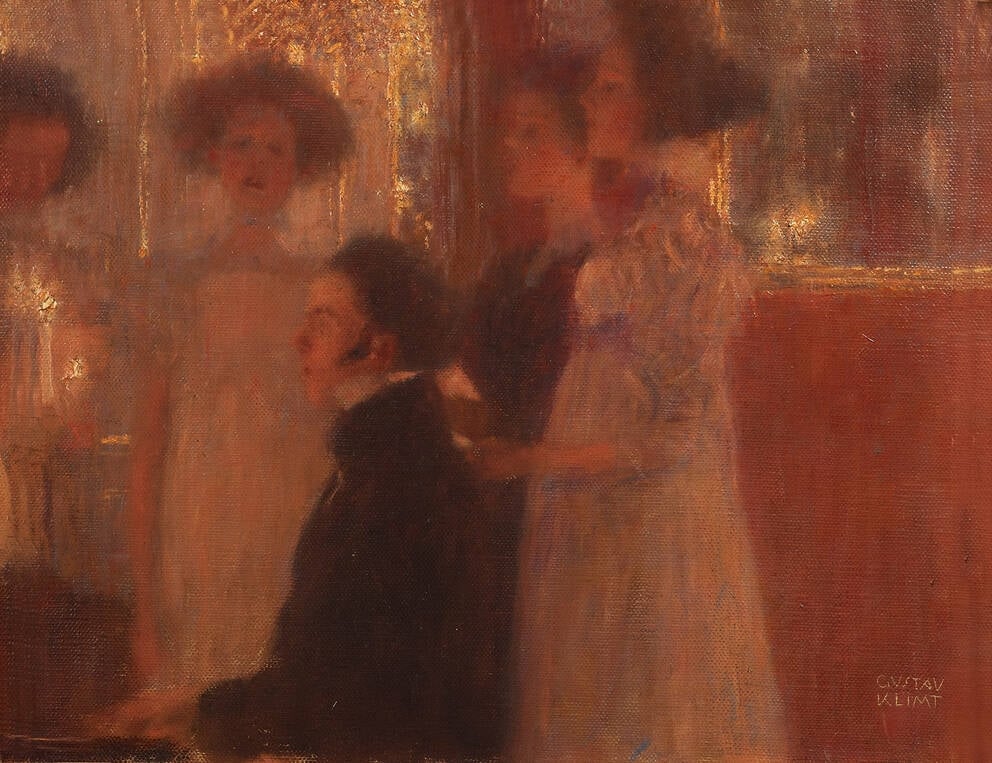
Schubert at the Piano. Design for the music room by Nikolaus Dumba
Gustav Klimt (1896)
Klimt’s 1896 oil study <strong>Schubert at the Piano. Design for the music room by Nikolaus Dumba</strong> turns a domestic recital into a glowing myth of listening. In dim, rosy-gold light, a dark-clad pianist is encircled by a soft choir of women whose blurred faces dissolve into the shimmer of the room. Klimt fuses contour and light so that sound seems to become <strong>radiance</strong>, anticipating his decorative modernism <sup>[1]</sup><sup>[2]</sup>.
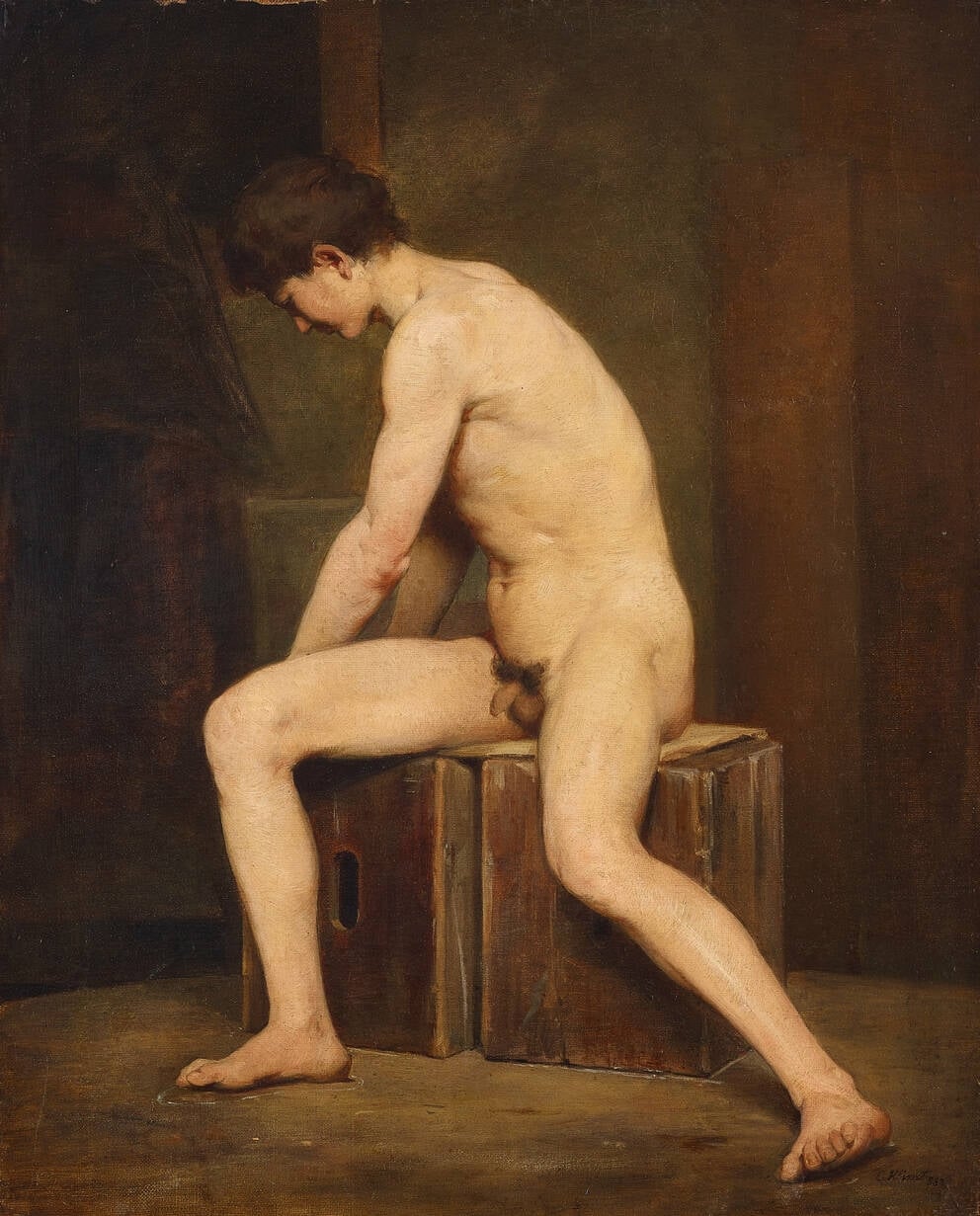
Sitting Nude Man Turned to the Left
Gustav Klimt (1883)
Painted in 1883, Sitting Nude Man Turned to the Left shows Klimt’s academic command of the male figure through a <strong>Naturalist/Realist</strong> approach. The model’s bowed head, splayed legs, and braced forearms form a taut <strong>triangular structure</strong> against rough wooden crates, where <strong>soft flesh meets hard geometry</strong> <sup>[1]</sup>. The restrained, earthy chiaroscuro isolates the body, turning a studio exercise into a quiet study of <strong>concentrated presence</strong>.
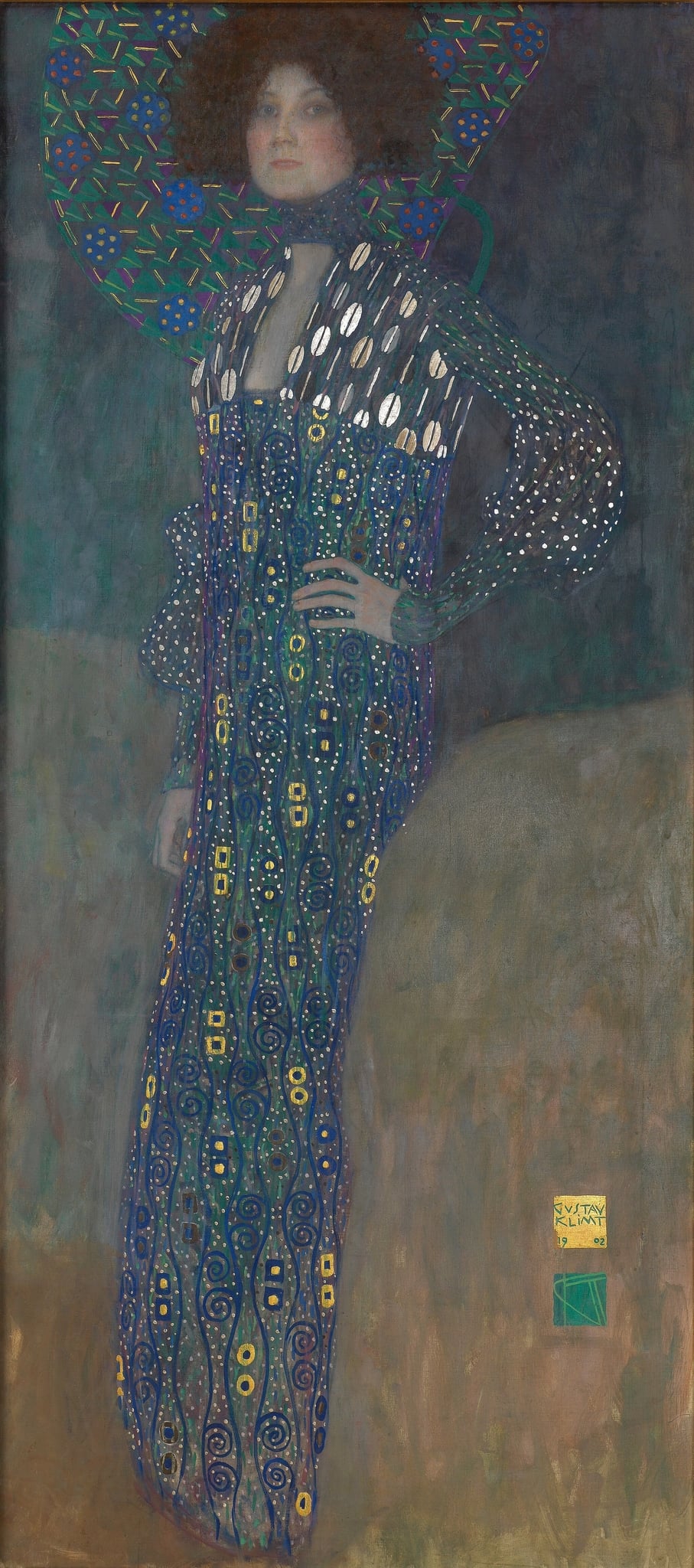
Emilie Flöge
Gustav Klimt (1902)
Gustav Klimt’s Emilie Flöge stages a modern identity as a work of <strong>design</strong> as much as portraiture: a columnar figure, hand on hip, radiates self-possession within a field of spirals, dots, and gold squares. The circular, flowered fan behind the head acts as a <strong>modern halo</strong>, collapsing depth and elevating presence in the Secessionist spirit of the <strong>Gesamtkunstwerk</strong> <sup>[1]</sup><sup>[2]</sup>.
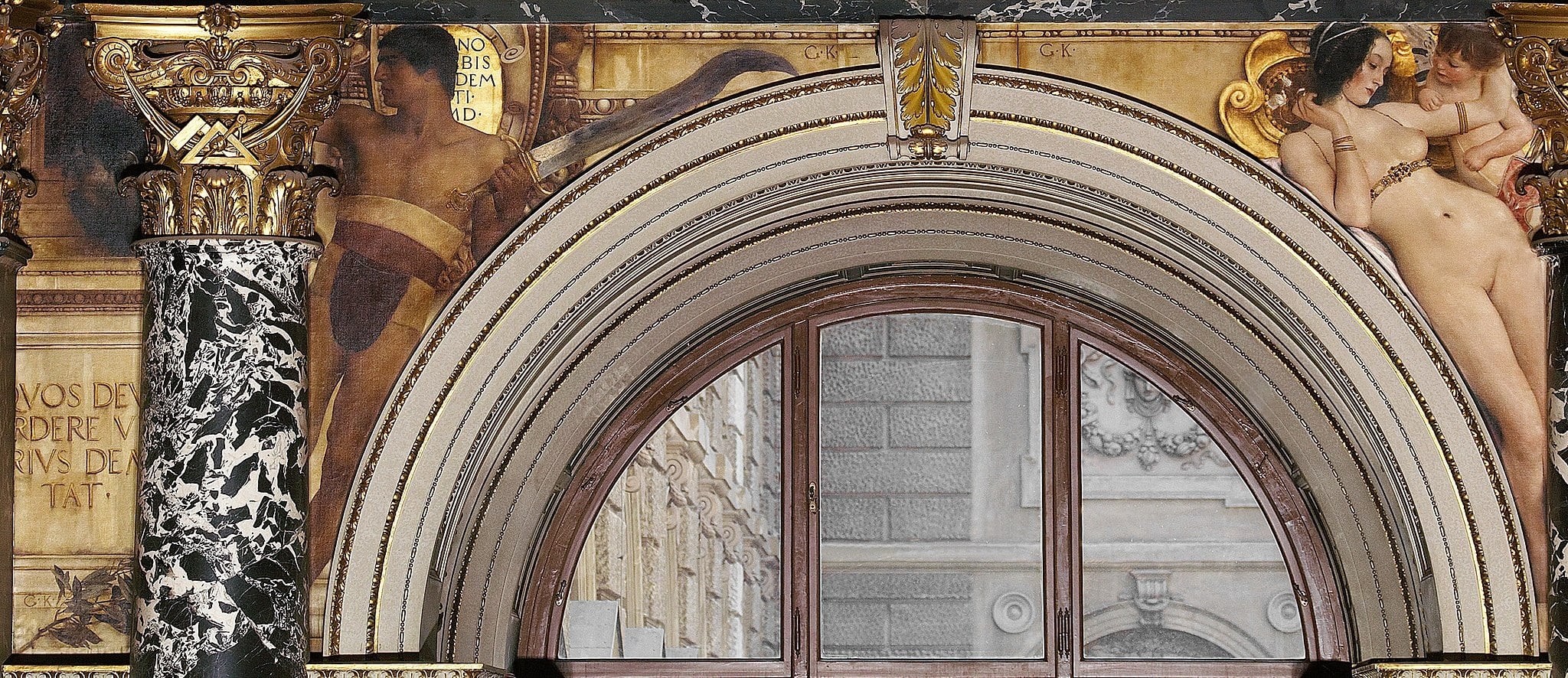
Florentine Cinquecento and Quattrocento
Gustav Klimt (1891)
Gustav Klimt’s Florentine Cinquecento and Quattrocento stages a dialogue between <strong>heroic virtue</strong> and <strong>ideal beauty</strong>. A trophy-like Goliath head (standing for Michelangelo’s David) faces a reclining <strong>Venus with Cupid</strong>, all set within a gilded, marbleized architectural frame that fuses painting and ornament <sup>[1]</sup><sup>[2]</sup>.
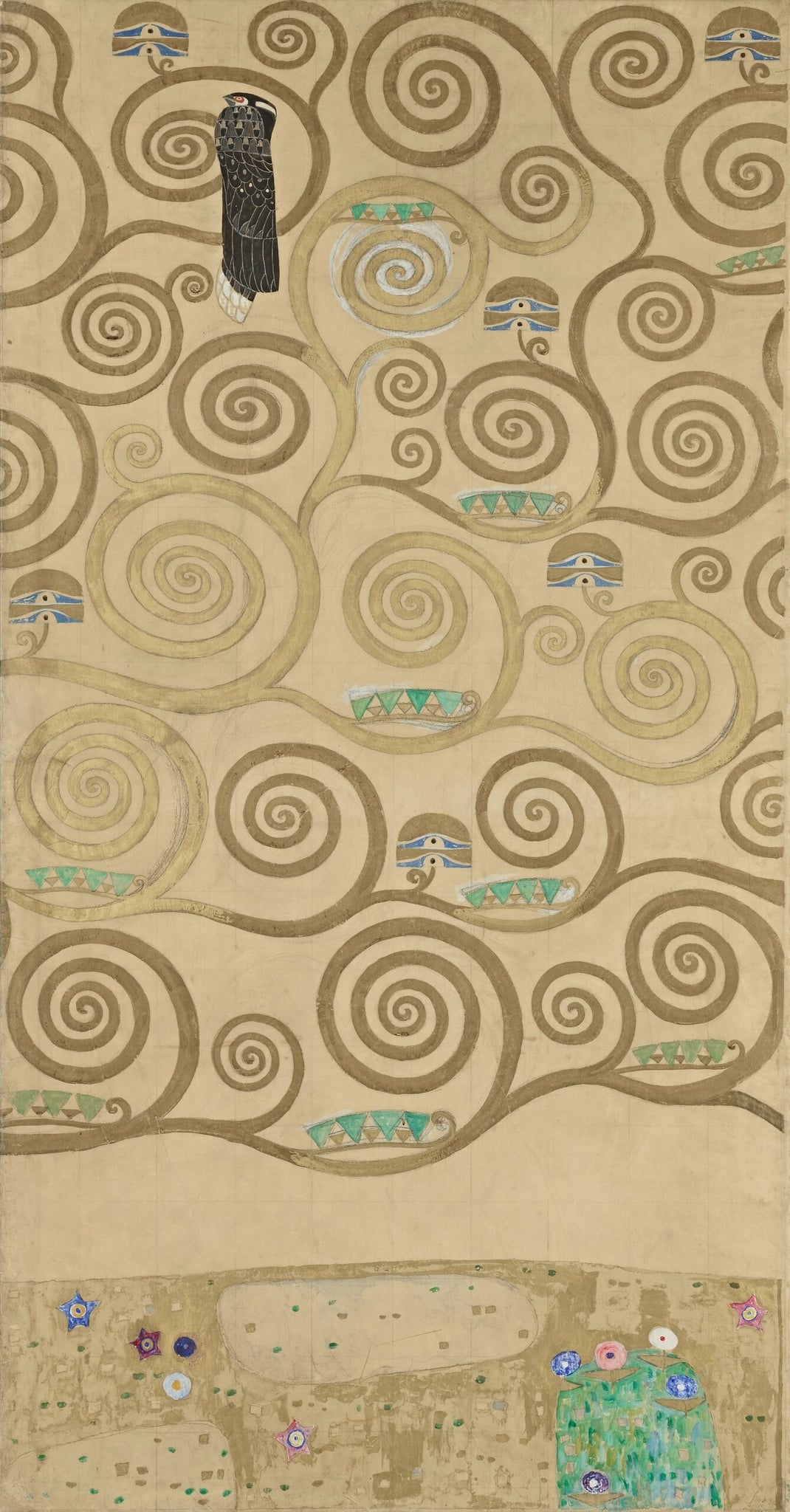
Part of the Tree of Life (Part 5)
Gustav Klimt (1910–1911)
In Part of the Tree of Life (Part 5), Gustav Klimt renders a cosmos of spiraling branches studded with <strong>Eyes of Horus</strong>, turquoise tesserae, and a solitary dark <strong>bird</strong>. The panel condenses themes of vigilance, renewal, and mortality into a decorative grammar that served as a full-scale working <strong>cartoon</strong> for the Stoclet dining-room mosaics—a key Secessionist <strong>Gesamtkunstwerk</strong> <sup>[1]</sup><sup>[2]</sup>.
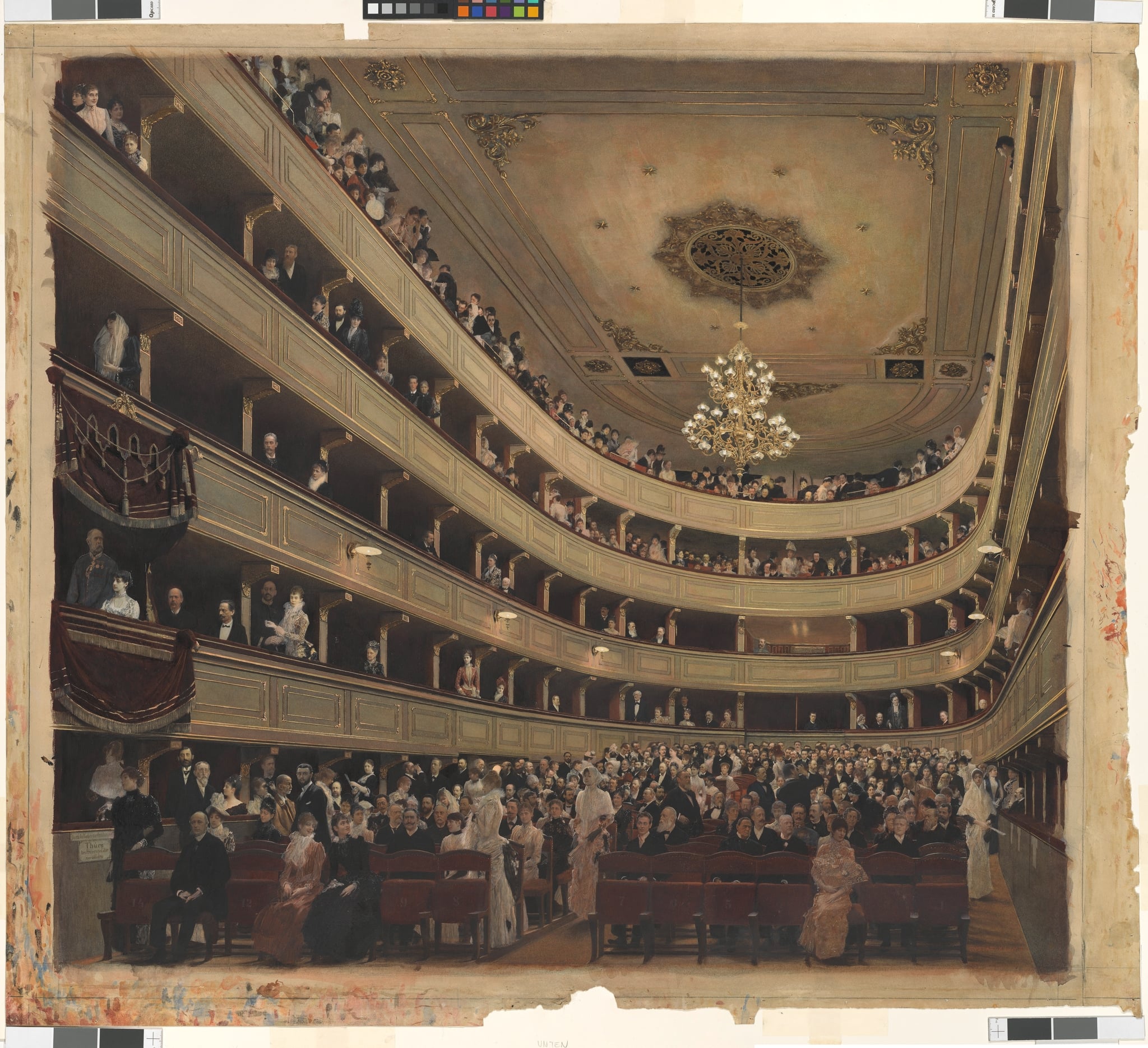
Auditorium of the Old Burgtheater
Gustav Klimt (1888–1889)
<strong>Auditorium of the Old Burgtheater</strong> turns the stage around: the audience becomes the show beneath a glowing chandelier and sweeping tiers. Klimt fuses hundreds of individualized faces into a single, wave‑like body of spectators, lit by gaslight and framed by gilded medallions. The result is a civic mirror—Vienna watching itself—at the very moment its old theater was disappearing.
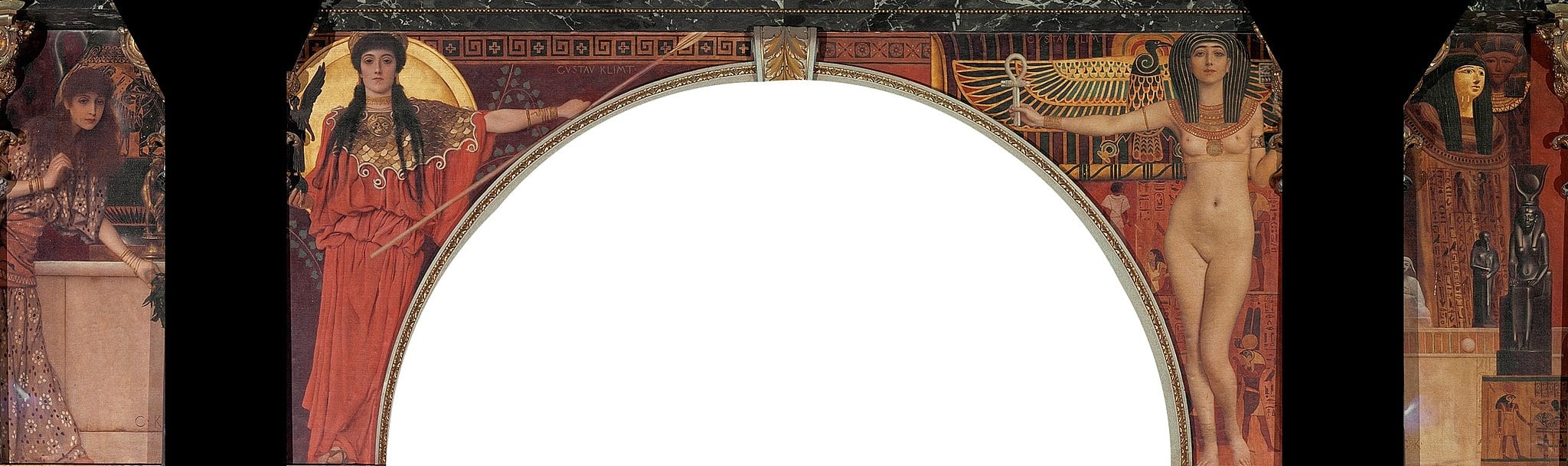
Ancient Greece and Egypt
Gustav Klimt (1891)
Gustav Klimt’s staircase pair Ancient Greece and Egypt stages two <strong>female allegories</strong> flanking an empty arch: a robed, animated <strong>Athena</strong> to the left and a frontal, nude Egyptian goddess aligned with <strong>Nekhbet’s vulture</strong> to the right. Klimt fuses collection-based citations with <strong>ornamental gold, red, and black</strong> to declare a canon in which Western art passes through Greece’s humanist clarity and Egypt’s sacral permanence <sup>[1]</sup><sup>[2]</sup><sup>[3]</sup>.
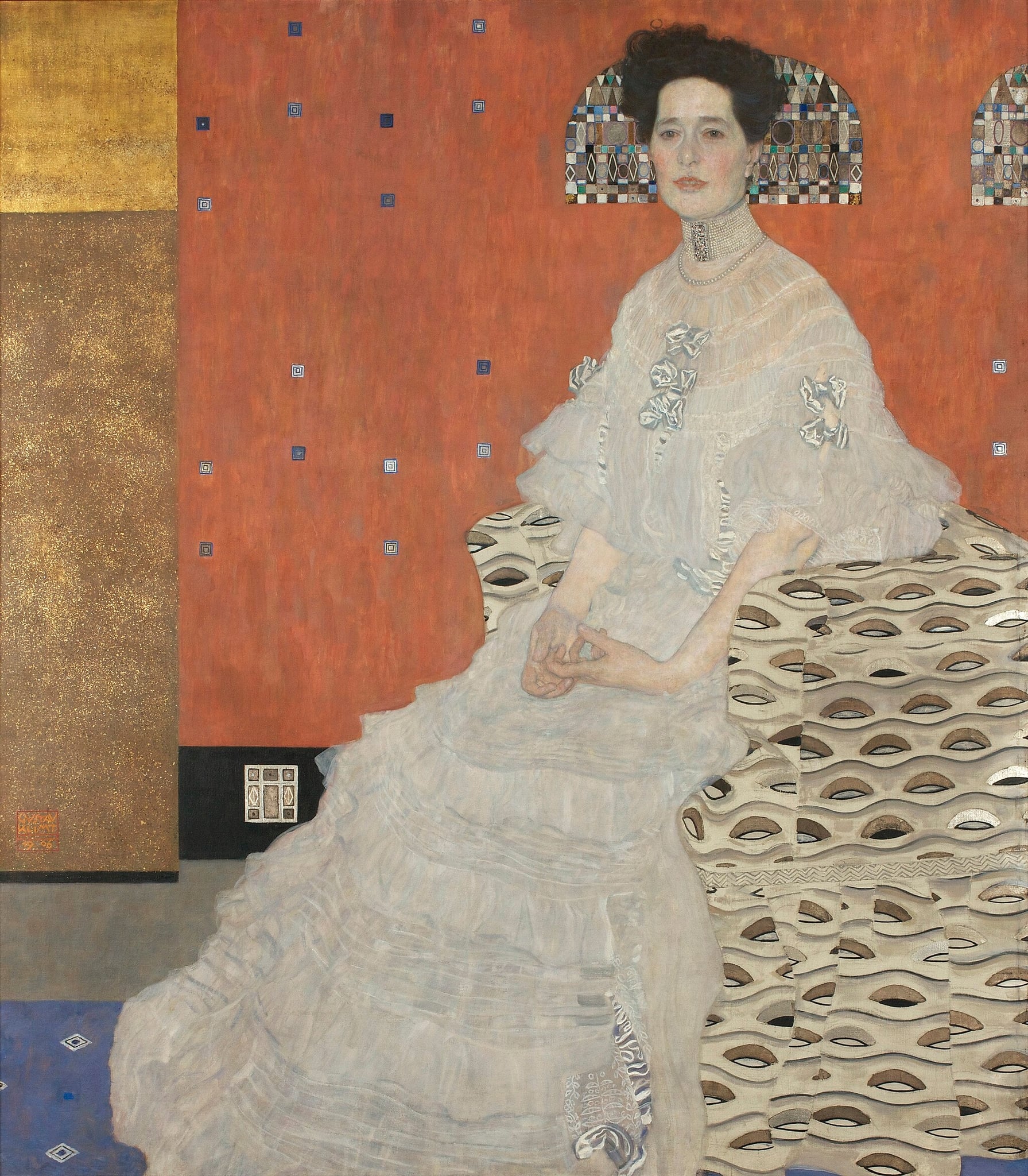
Fritza Riedler
Gustav Klimt (1906)
In Fritza Riedler, Gustav Klimt fuses a hyper‑real face and hands with an emphatically flat, ornamental world to stage a modern self caught between individuality and design. The sitter’s mist‑pale, ruffled gown seems to dissolve as she sits in a chair patterned with almond‑shaped <strong>“eyes,”</strong> before a terracotta wall, arched mosaic <strong>“windows,”</strong> and a radiant block of <strong>gold</strong>. The image reads like a secular icon: bourgeois portraiture elevated to ritual presence.
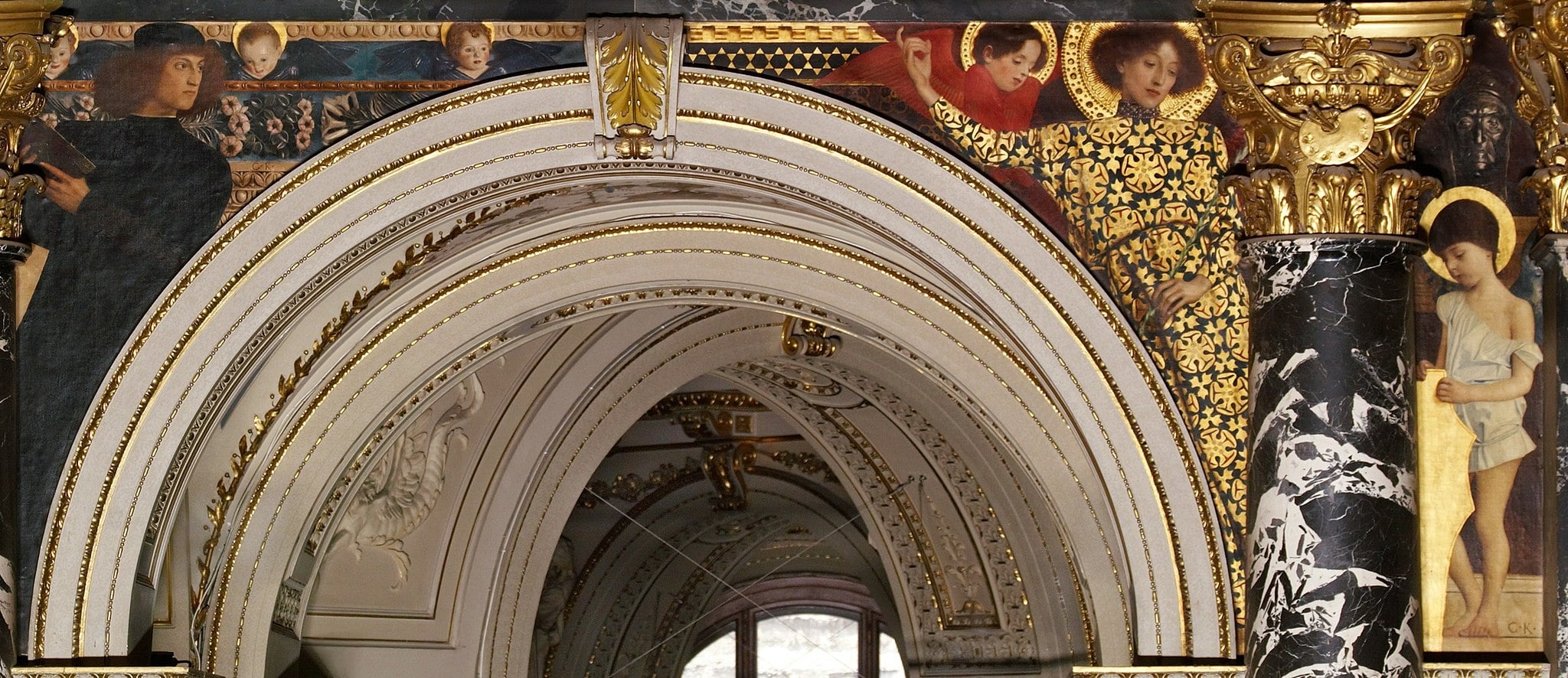
Old Italian Art
Gustav Klimt (1891)
Gustav Klimt’s <strong>Old Italian Art</strong> (1891) crowns the Kunsthistorisches Museum’s grand staircase with a shimmering allegory of trecento–quattrocento culture. A Florentine <strong>reader</strong>, a <strong>haloed</strong> saint-like figure in brocaded gold, putti, and a bust of <strong>Dante</strong> articulate a lineage of learning and piety, all fused to the building’s gilded architecture. Klimt’s patterned textiles and hovering angels already signal his move from Ringstraße historicism toward a <strong>decorative modern</strong> vision <sup>[1]</sup><sup>[2]</sup>.
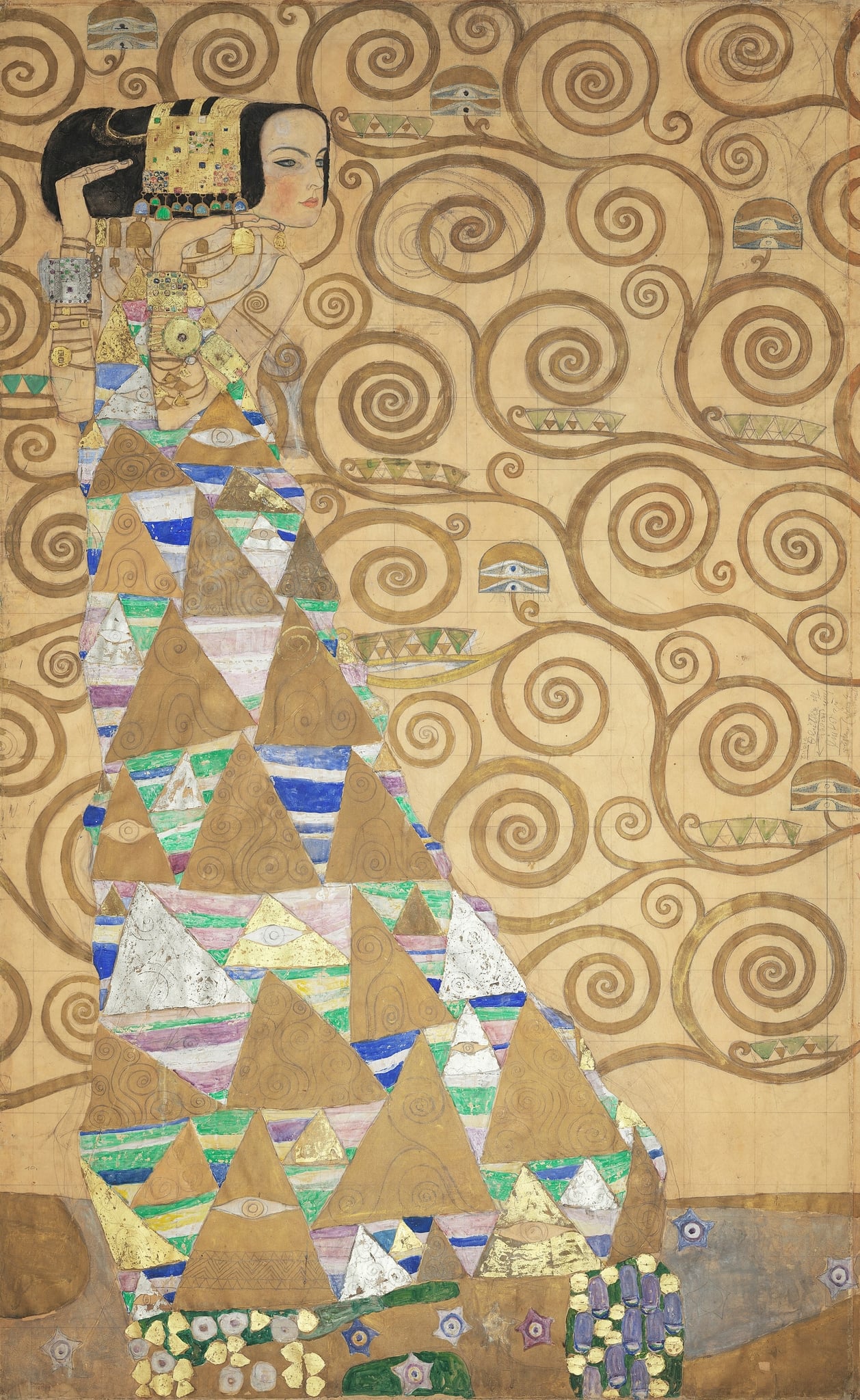
Expectation (Dancer)
Gustav Klimt (1911)
Expectation (Dancer) crystallizes a <strong>charged pause</strong>: a profile figure, rigid as an <strong>Egyptian relief</strong>, advances through a field of spiraling <strong>Tree of Life</strong> coils while a mosaic robe of triangles and watchful <strong>eyes</strong> armors her body. Klimt fuses <strong>ornament and symbol</strong> so that anticipation itself becomes pattern and gold-lit ritual <sup>[1]</sup><sup>[4]</sup>.
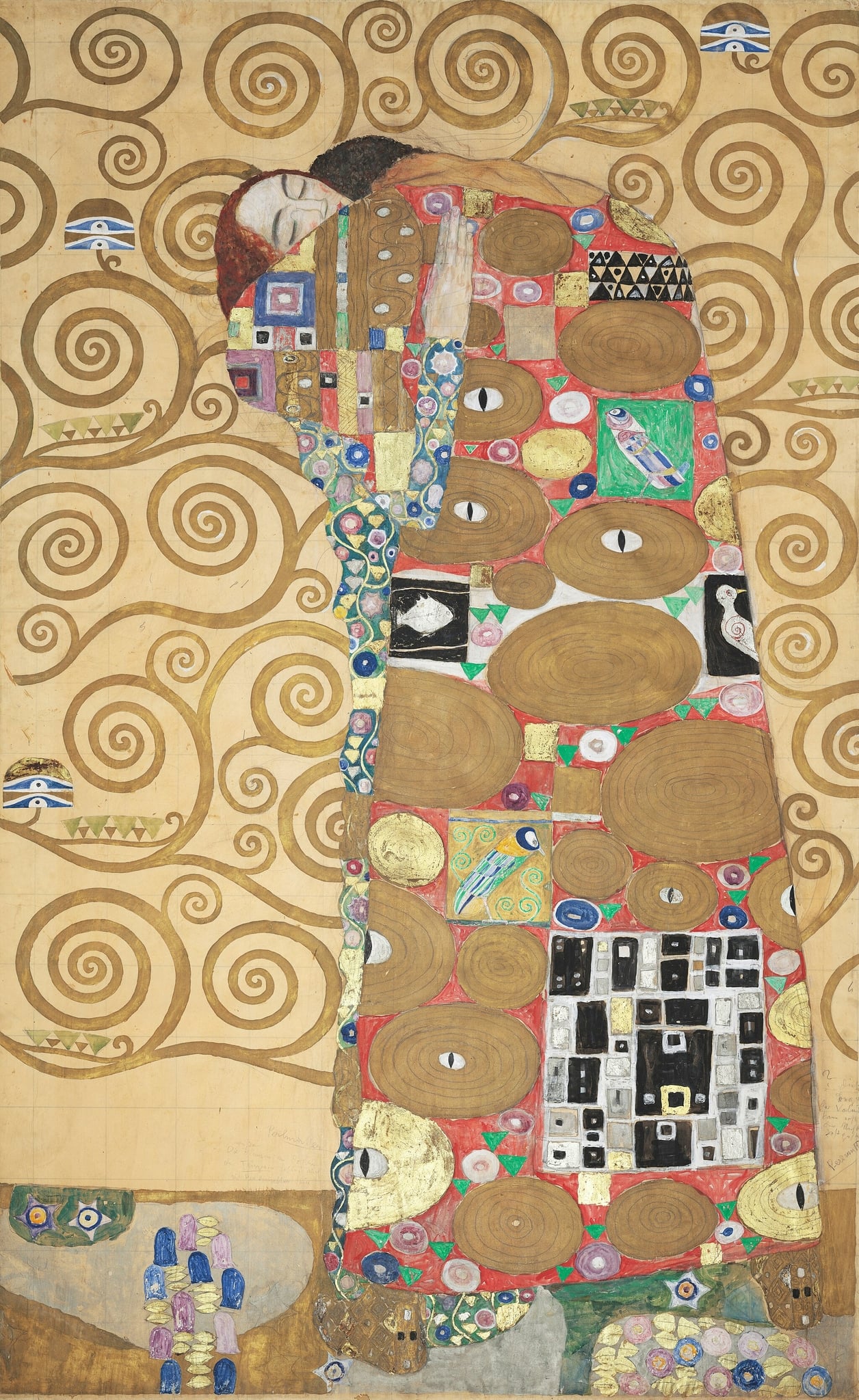
Fulfillment
Gustav Klimt (1910–1911 (cartoon); mosaic installed by 1911)
Klimt’s Fulfillment fuses two lovers into a single, radiant figure set before the spiraling <strong>Tree of Life</strong>, turning private embrace into a <strong>sacral consummation</strong>. Patterned robes—ovals, eyes, and flowers against black‑and‑white rectangles—stage a union of <strong>feminine/masculine energies</strong> within a golden, eternal field <sup>[1]</sup><sup>[3]</sup>.
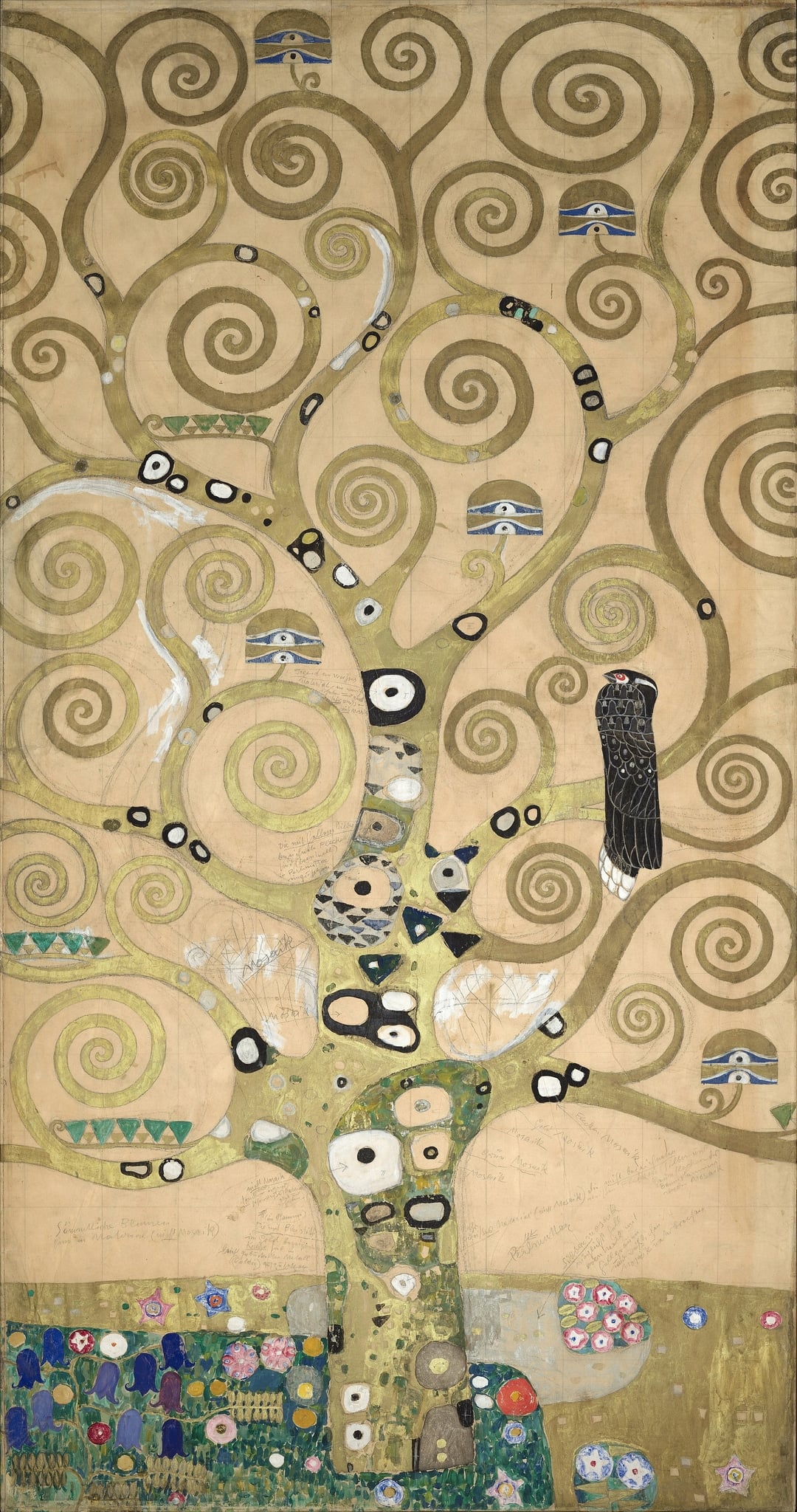
Tree of Life (Part 4)
Gustav Klimt (1910–1911)
Tree of Life (Part 4) stages a gilded axis where <strong>spiraling branches</strong>, <strong>amuletic eyes</strong>, and a <strong>black raptor</strong> compress growth, vigilance, and mortality into a single ornamental system. The mosaic-like bark and jewel-bright flower carpet root the image in fecund earth while the volutes coil upward toward the abstract and the eternal <sup>[1]</sup><sup>[6]</sup>.
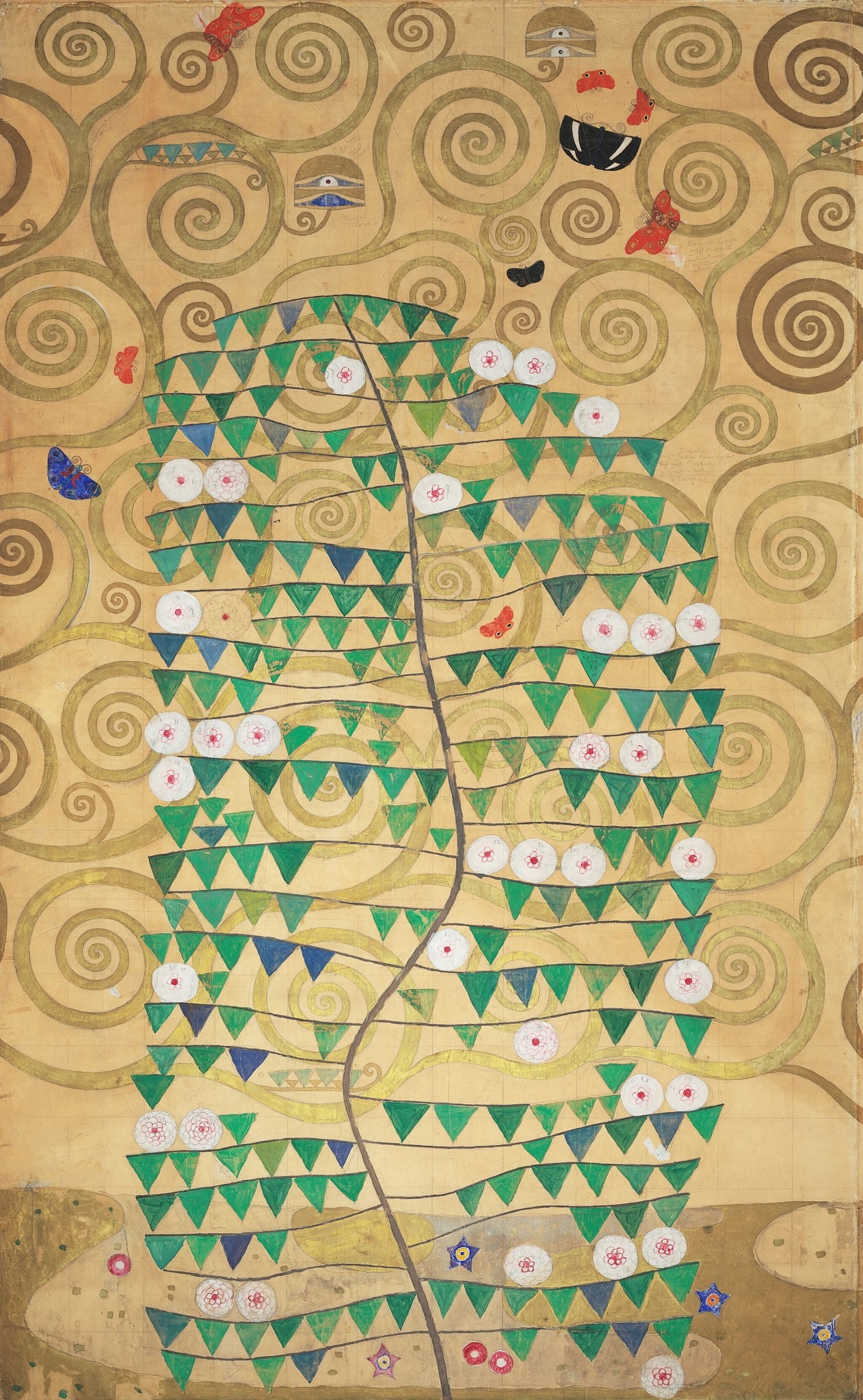
Rosebush (Part 6)
Gustav Klimt (1910/11)
In Rosebush (Part 6), a single, wavering stem climbs through a field of gold spirals while regimented green-and-blue triangular leaves and pale, jewel-like blossoms punctuate its path. Around it, vivid butterflies and star-flowers animate the surface. Klimt fuses nature and ornament into a <strong>precious</strong>, <strong>cyclical</strong> emblem of growth, metamorphosis, and renewal.
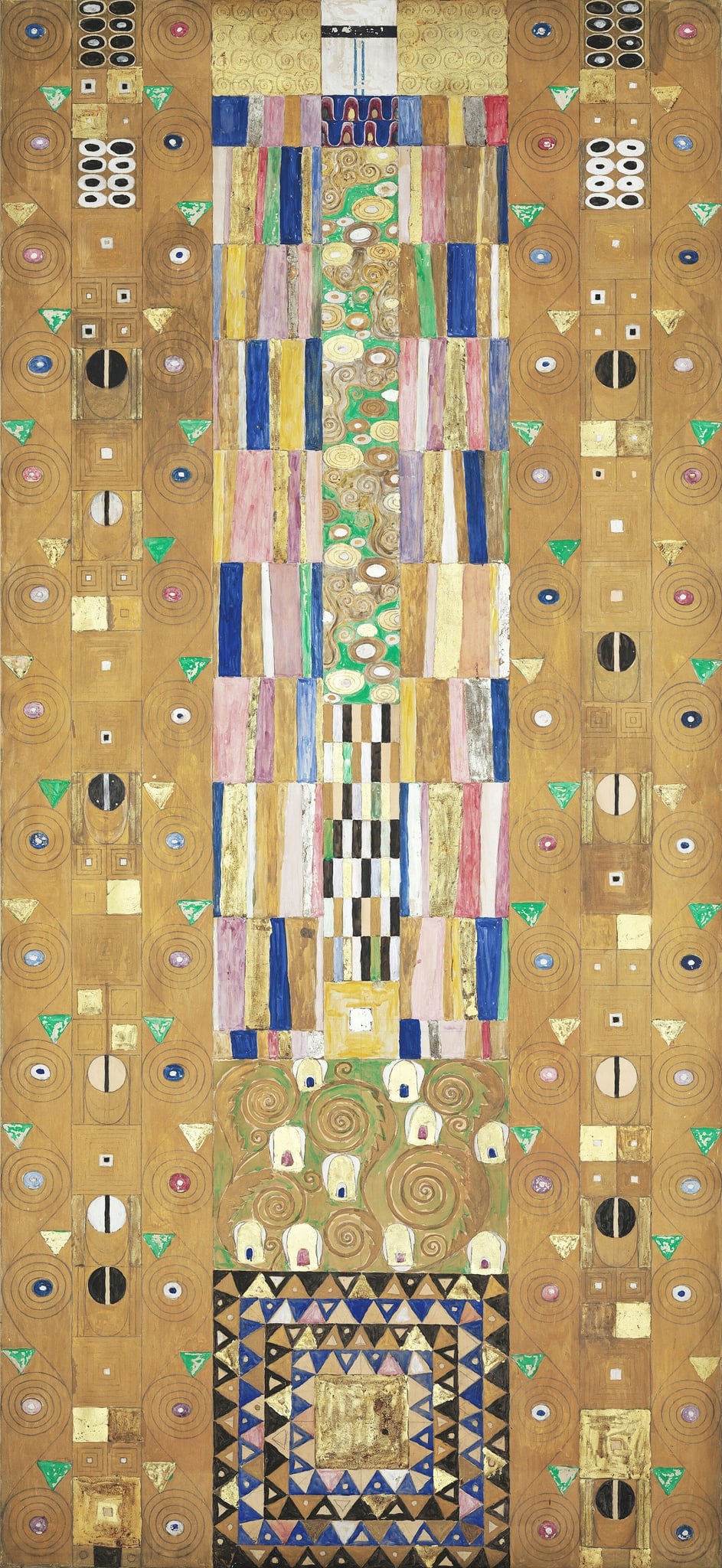
Knight (Part 9)
Gustav Klimt (1910–1911)
Klimt’s Knight (Part 9) turns chivalry into a <strong>geometric icon</strong>: a vertical standard of stacked bars and checks flanked by <strong>ranks of circles and triangles</strong> that read as shields and studs. Set on a <strong>golden ground</strong> and crowned and undergirded by ornamental zones, it proclaims vigilance and ethical guardianship between the frieze’s figural scenes. <sup>[1]</sup>
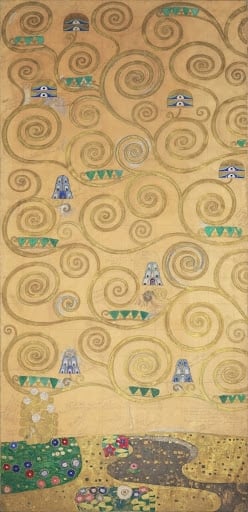
Part of the Tree of Life (Part 1)
Gustav Klimt (1910–1911)
Gustav Klimt’s Part of the Tree of Life (Part 1) is a full‑scale design cartoon for the Stoclet dining‑room frieze, where a gold ground hosts branching spirals, <strong>Eye‑of‑Horus</strong> rosettes, falcon emblems, and crisp triangular leaves. The panel fuses <strong>symbolism</strong> and <strong>ornament</strong> to stage life’s cyclical renewal within a luxurious, sacred‑like register <sup>[1]</sup><sup>[3]</sup>.
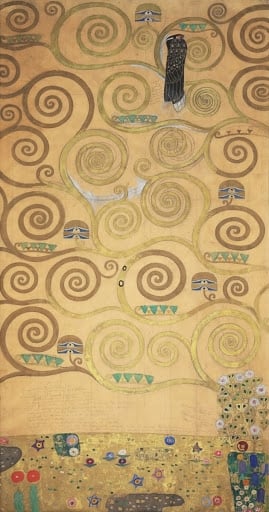
Part of the Tree of Life (Part 3)
Gustav Klimt (1910–1911)
Gustav Klimt’s Part of the Tree of Life (Part 3) is a full‑scale cartoon for the Stoclet Frieze, where a gold ground hosts spiraling branches studded with <strong>Eyes of Horus</strong> and jewel‑like emblems. A perched <strong>Horus falcon</strong> and a carpet of stylized flowers fuse myth, ornament, and cyclical vitality into a single, curling design <sup>[1]</sup><sup>[2]</sup>.