The Kiss (Lovers)
by Gustav Klimt
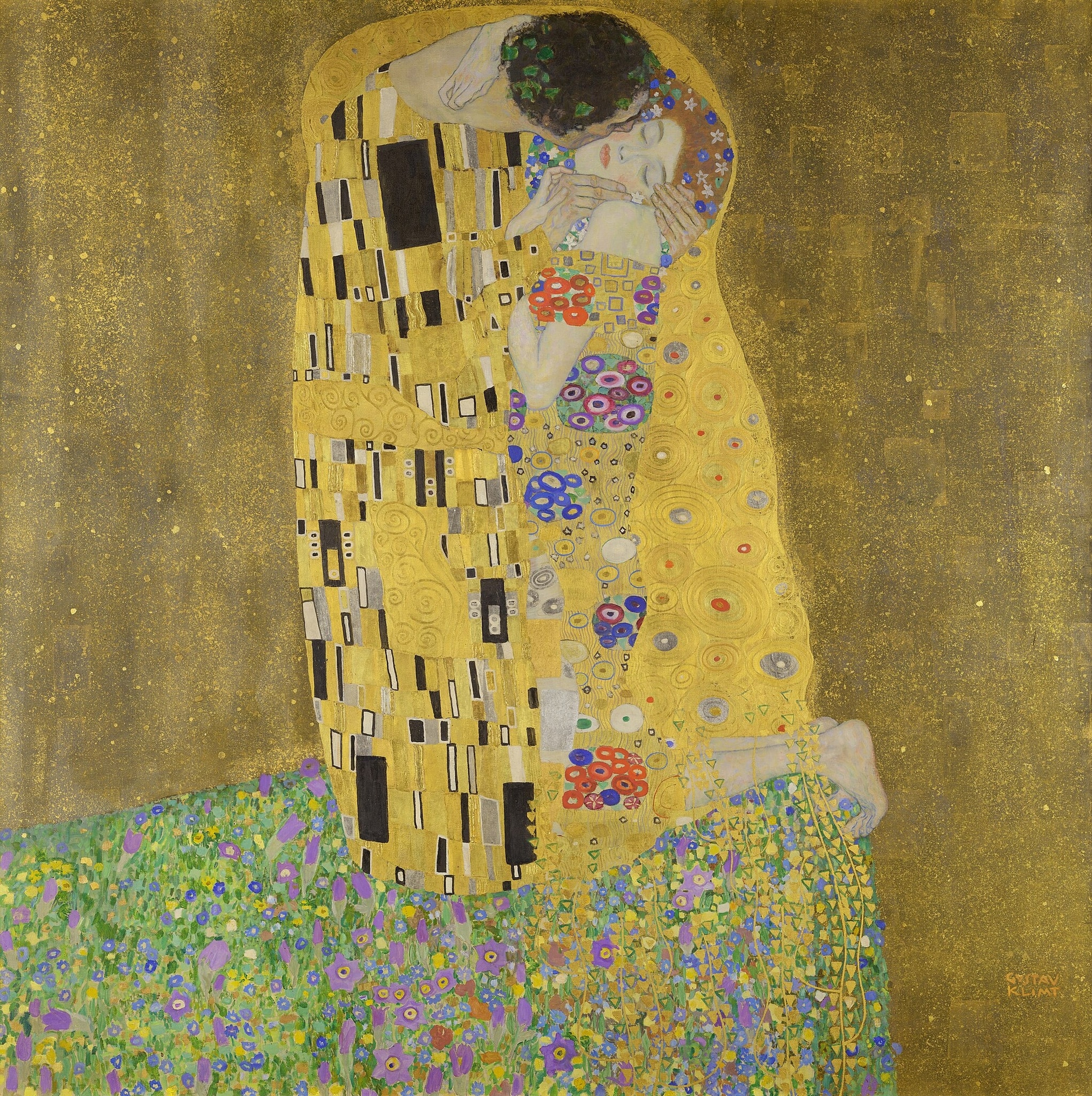
The Kiss (Lovers) fuses two figures into a single golden field, where angular black-and-white rectangles meet soft spirals and blossoms. The carpet of flowers and the gilt, icon-like ground stage intimacy as both ecstasy and risk, with bare toes curling at the precipice. Klimt turns private desire into a modern icon of union and transcendence [1][3].
Fast Facts
- Year
- 1907–08 (completed 1909)
- Medium
- Oil with gold and silver leaf on canvas
- Dimensions
- 180 × 180 cm
- Location
- Österreichische Galerie Belvedere (Upper Belvedere), Vienna

Click on any numbered symbol to learn more about its meaning
Meaning & Symbolism
Klimt constructs union as pattern. The man’s mantle, stacked with black bars and white rectangles, presses over the woman’s spiraled, floral robe; the two garments meet and fuse, yet their motifs remain legible. This is not mere ornament but a grammar of difference-in-harmony: rectilinear pressure meets circular yielding, an emblematic pairing of so-called masculine and feminine principles that scholars have linked to biological imagery—from sperm-like bars to ovum-like disks—folded into the visual fabric of desire 14. The fusion is not anatomical exposure but absorptive design: the lovers’ bodies are largely veiled, yet the intensity of touch is heightened by the enclosing gold skin of the robes. Klimt thus shifts intimacy away from the physical outline of bodies toward a field where identity dissolves into rhythm, repetition, and shimmering surface. The pressed gold ground, recalling Ravenna’s mosaics, lifts the scene into an icon-like register; halos are replaced by an all-over aureole, as if the very air has turned liturgical, converting a kiss into a sanctified rite of mutuality 12.
Yet transcendence is edged by peril. The woman’s bare toes curl at the margin of a ledge; the meadow stops in an abrupt brink where green gives way to sheer gold. This compositional cliff makes rapture contingent—love is achieved at the edge of ungrounding, a threshold where surrender risks falling. Her posture registers this duality: eyes closed, neck exposed, she leans into the kiss, but one hand clasps the man’s wrist, a delicate counter-pressure that secures intimacy without ceding agency. The floral carpet that seems to spill from her robe becomes a visual metaphor for fecundity and psychic flowering, yet its tapering trail toward the edge warns that generative abundance can end suddenly. The man’s ivy-like crown and her wreath of blossoms restate this dialectic—vigor and blooming—while the dense embroidery of circles and rosettes around her torso concentrates the painting’s life-force at the site of embrace 13.
Within Vienna 1900’s project of uniting art and life, The Kiss (Lovers) performs a synthesis: it is both painting and patterned textile; image and object; private scene and public icon. Its square format, tight cropping, and flattened depth align with Secessionist design strategies and Japonisme, while its gold-and-silver leaf conflate precious materiality with metaphysical light, an alchemy that converts matter into meaning 12. The work’s public debut as Liebespaar in 1908—immediately purchased for the state collection—signaled a cultural hunger for an affirmative, decoratively rich modernism after the scandals around Klimt’s more confrontational university murals 23. Read through contemporary science and psychology, its ornamental forms can be seen to encode the biology of union—gametes, blood cells, organic proliferation—translating fin-de-siècle inquiry into a sensuous visual system 4. Read through music and myth, it resonates with the Beethoven Frieze’s climactic embrace, proposing eros as a path to communal joy and release 6. This productive ambiguity—between sacred and sensual, safety and brink, design and body—is why The Kiss (Lovers) continues to function as a modern icon of love: not a sentimental illustration, but a precise structure where pattern thinks, touch shines, and two become one luminous field 156.
Explore Deeper with AI
Ask questions about The Kiss (Lovers)
Popular questions:
Powered by AI • Get instant insights about this artwork
💬 Ask questions about this artwork!
Interpretations
Biological Modernism
Read through Viennese science, the painting’s ornament functions like a diagram of fusion. Rectangles and bars on the man’s mantle have been read as spermlike; the woman’s circles and rosettes as ovum- and cell-like forms, a decorative codex of gametes that relocates eros from anatomy to pattern. Klimt’s milieu—rich with contact to medical and psychological inquiry—encouraged translating biological knowledge into visual systems. Here, the blooming meadow and the densely beaded torso stage an image of proliferation rather than mere embrace, aligning aesthetic rhythm with organic processes. This is not illustration but symbolic compression: a modernist surface that lets viewers “feel” fecundity through repetition, scaling, and cluster. In this lens, The Kiss is a humane synthesis of ornament and life science, making desire legible as living structure 41.
Source: JAMA Humanities; Encyclopaedia Britannica
Secessionist Design + Japonisme
The Kiss epitomizes the Secession’s program to unite art and life by collapsing painting into patterned objecthood. Its square format, tight cropping, and flattened spatial cues echo Japanese prints; its textile-like robes align with the Wiener Werkstätte’s applied-arts ethos. Klimt turns composition into a designed field, where figure-ground is negotiated by ornamental densities rather than classical depth. The gold plane works as a totalizing backdrop—more screen than sky—while robe motifs behave like modular units in a repeat. This aesthetic of synthesis elevates decorative logic to primary content, positioning the painting at the apex of Viennese Jugendstil’s ambition: to make beauty a system that orders experience. In this view, The Kiss is not merely romantic; it is a manifesto of decorative modernism 27.
Source: Belvedere Museum; The Art Story
Icon, Liturgy, and Secular Sanctity
Klimt’s gold ground and pressed textures deliberately recall Byzantine mosaics, shifting the embrace into an icon-like register. Instead of halos, the lovers inhabit an all-over aureole, as if devotion has widened to fill the air. This is a secular liturgy: precious metals double as metaphysical light, turning touch into ceremony. The effect resonates with Klimt’s Beethoven Frieze, where a climactic embrace performs communal release—an echo of Schiller’s “Ode to Joy.” The Kiss carries that public, near-religious exultation into an intimate scene, suggesting that private eros can model collective harmony. Materiality thus becomes theology by other means: gold leaf is not ornament alone but a medium of sanctification for modern love 162.
Source: Encyclopaedia Britannica; The Guardian; Belvedere Museum
Precipice Aesthetics: Risk in Rapture
The woman’s curled toes at the meadow’s brink install peril inside ecstasy. The floral carpet tapers toward an abrupt ledge, so the union unfolds at a literal and metaphorical threshold. Her closed eyes and extended neck signal surrender, yet the hand clasping his wrist introduces a delicate counter-agency—contact that secures without submission. The painting engineers suspense by compressing figure and ground into a gleaming plane, so stability feels provisional; one step more, and pattern becomes abyss. This precarious staging complicates sentiment: love is heightened precisely because it risks ungrounding. Klimt thus composes a phenomenology of embrace—weight, edge, hold—where rapture is credible only at the border of a fall 35.
Source: Wikipedia (object description); Artsy (critical debate and agency readings)
Reception and Cultural Repair
Unveiled as Liebespaar at the 1908 Kunstschau and promptly acquired for the state collection, The Kiss operated as public balm after the furor over Klimt’s University murals. Where the murals exposed the body and scandalized viewers, The Kiss veils bodies in gold, offering affirmation without relinquishing modernist edge. Its immediate canonization suggests a cultural appetite for a decoratively rich, optimistic emblem of modern love—an image that could stand as a national icon while staying conversant with avant-garde form. The work’s success marks a pivot in Vienna 1900: reconciliation between innovation and public desire, between ornament and ideology, as the state effectively anoints a new, domesticated modern sublime 312.
Source: Wikipedia; Encyclopaedia Britannica; Belvedere Museum
Related Themes
About Gustav Klimt
Gustav Klimt (1862–1918), co-founder of the Vienna Secession, pivoted from controversial public commissions to a decorative-symbolist language in his Golden Period. Drawing on Byzantine mosaics and modern design, he fused opulent surfaces with psychological intensity. By 1908–09, he transformed scandal into canon, and The Kiss became Vienna’s emblem of modern love.
View all works by Gustav Klimt →