The Kiss
by Gustav Klimt
Study print
Prefer the curated version?
View the study print we made for this artwork, pairing the full painting with a close reading of one meaningful detail.

Study Print Studio
Create a personal study print
Build a companion study sheet around the part of this painting that speaks to you most. Choose a detail, shape an interpretation, and walk away with something personal and display-worthy.
Fast Facts
- Year
- 1908 (completed 1909)
- Medium
- Oil on canvas
- Dimensions
- 180 × 180 cm
- Location
- Österreichische Galerie Belvedere (Upper Belvedere), Vienna
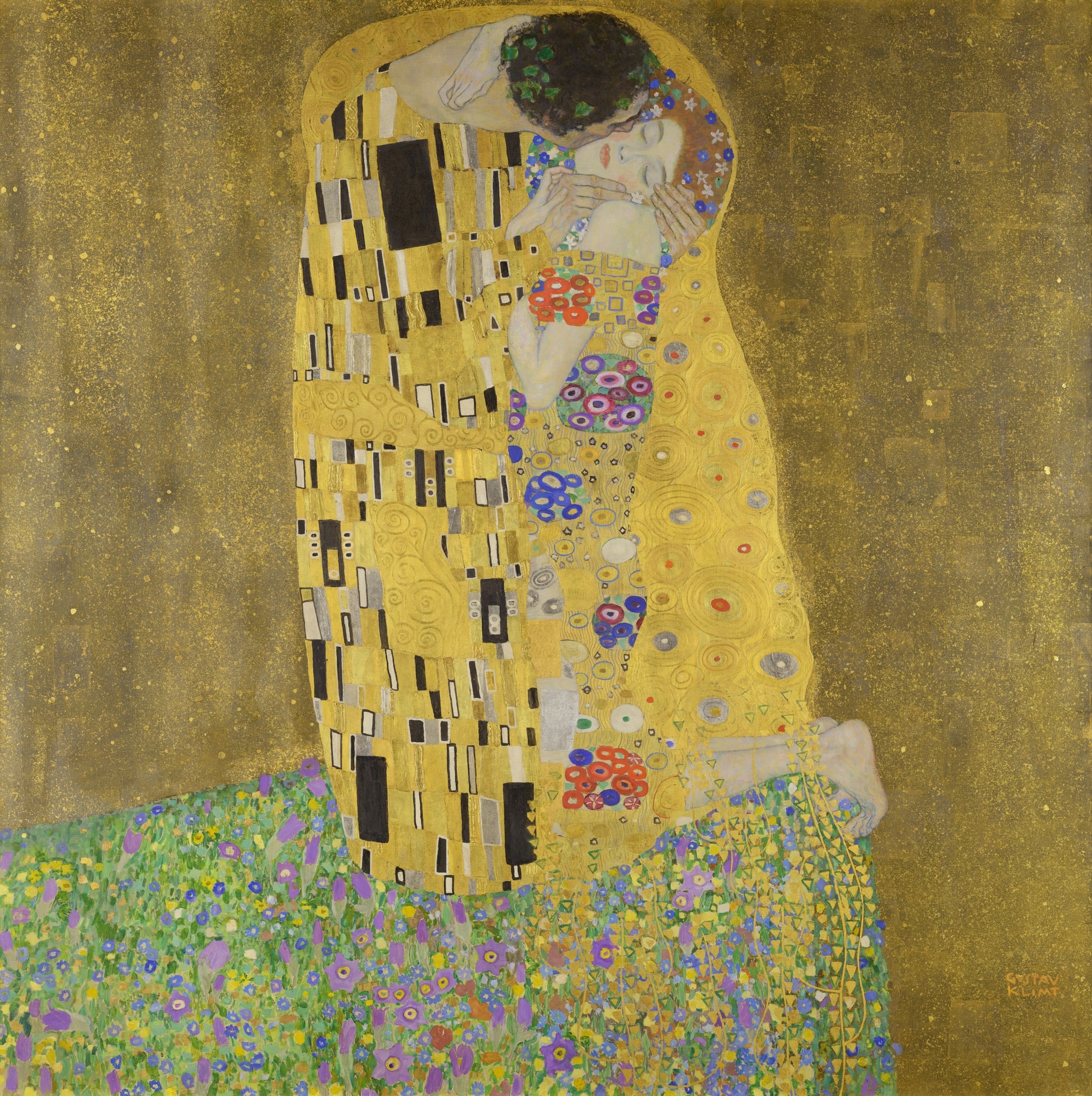
Click on any numbered symbol to learn more about its meaning
Meaning & Symbolism
Explore Deeper with AI
Ask questions about The Kiss
Popular questions:
Powered by AI • Get instant insights about this artwork
Interpretations
Formal/Technical Analysis
Source: Belvedere Museum (technical note) and Encyclopaedia Britannica
Gendered Ornament + Science
Source: Encyclopaedia Britannica; Journal of Korean Medical Science (biomotif hypothesis)
Secular Icon and Civic Religion
Source: Tate Etc. (Kunstschau 1908 essay); Belvedere Museum
Psychological Tension at the Edge
Source: Encyclopaedia Britannica; The Guardian (Jonathan Jones)
Mythic Palimpsest (Debated)
Source: Encyclopaedia Britannica; Glasstire (critical survey of Apollo/Daphne reading)
Explore Specific Elements
Dive deeper into individual scenes and details within The Kiss.
The Golden Cloak
The Golden Cloak in Klimt’s The Kiss is a single, metal‑leaf mantle that fuses two lovers into one radiant figure. Hard black‑and‑white rectangles on his side meet rounded circles and flowers on hers, while the continuous gold turns private embrace into a modern icon.
The Flower Meadow Edge
At the base of Klimt’s The Kiss, a dense flower meadow flattens into a patterned carpet that ends in a sudden brink beneath the woman’s curled toes. This cliff-like edge fuses sensual nature with a shimmering, icon-like beyond—an engineered threshold that charges the embrace with risk, fecundity, and transcendence.
The Geometric Patterns
On the man’s robe in The Kiss, Klimt arrays a field of black‑and‑white rectangles that read like inlaid tesserae. These hard-edged motifs, set against the woman’s circular florals, crystallize the painting’s drama: the union of structured, masculine force with organic, feminine flow [2][3].
Seen in Comparisons
Related Themes
About Gustav Klimt
More by Gustav Klimt
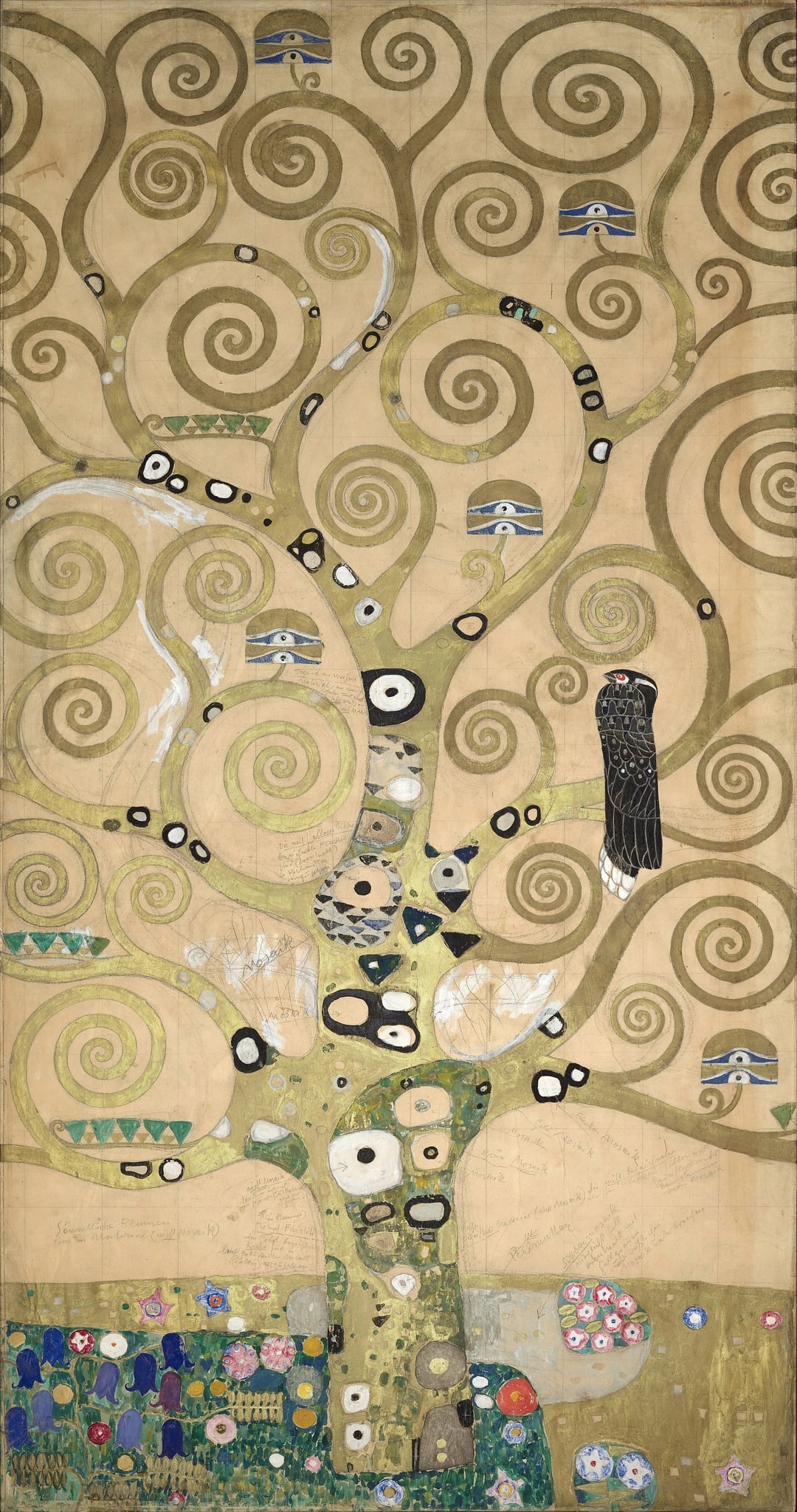
The Tree of Life
Gustav Klimt (1910–1911 (design; mosaic installed 1911))
Gustav Klimt’s The Tree of Life crystallizes a <strong>cosmological axis</strong> in a gilded ornamental language: a rooted trunk erupts into <strong>endless spirals</strong>, embedded with <strong>eye-like rosettes</strong> and shadowed by a black, red‑eyed bird. Designed as part of the Stoclet dining‑room frieze, it fuses <strong>symbolism and luxury materials</strong> to link earthly abundance with timeless transcendence <sup>[1]</sup><sup>[2]</sup>.
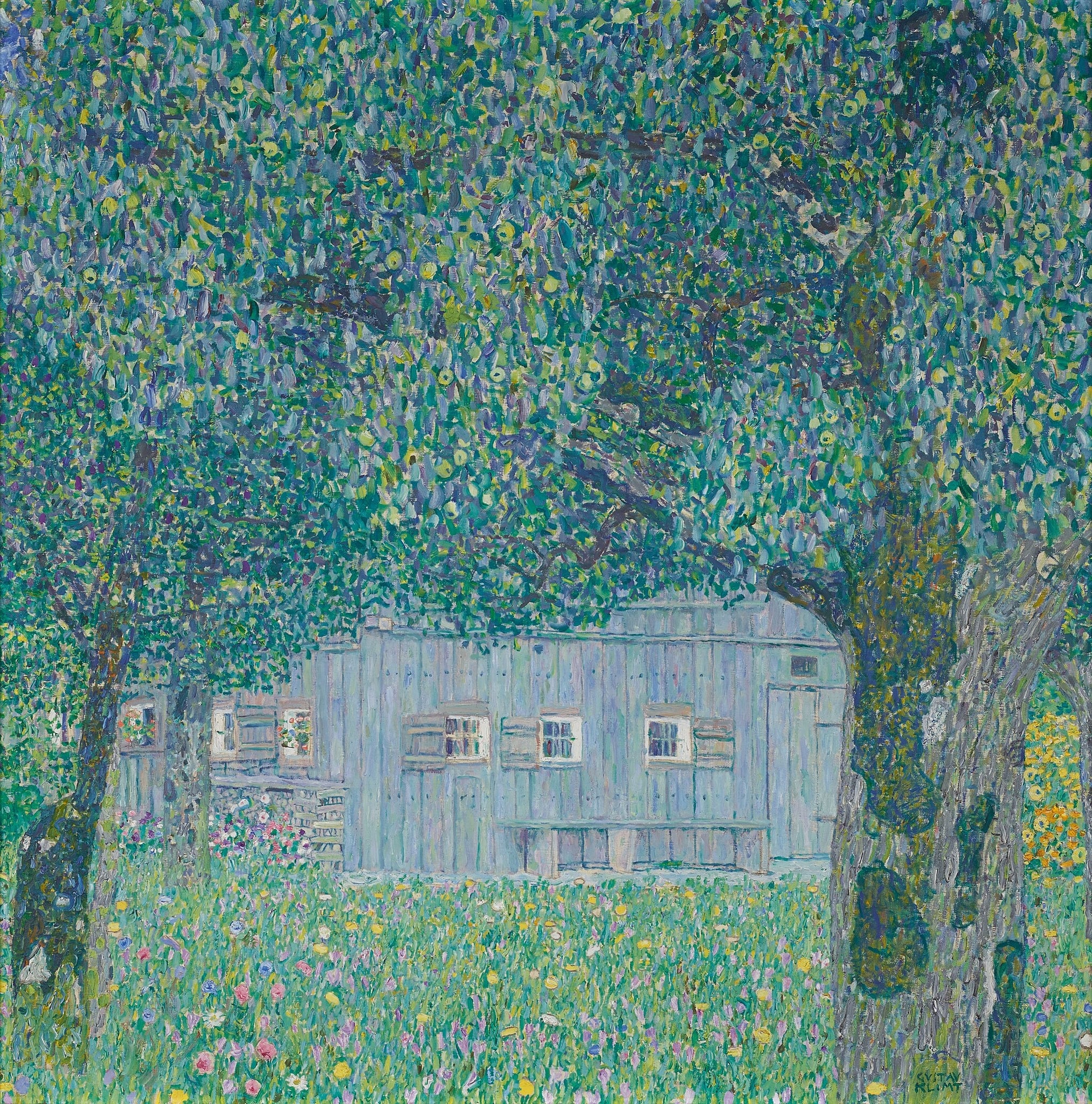
Farmhouse in Buchberg (Upper Austrian Farmhouse)
Gustav Klimt (1911)
Gustav Klimt’s Farmhouse in Buchberg (Upper Austrian Farmhouse) renders a rural dwelling almost absorbed by an orchard, its cool façade held in balance against a vibrating canopy of leaves and a jewel-like meadow. Through a square format and <strong>selective pointillism</strong>, Klimt fuses house, trees, and flowers into a contemplative, patterned field that privileges <strong>stillness</strong> over incident <sup>[1]</sup><sup>[6]</sup>. The work turns everyday architecture into an emblem of <strong>refuge within fecund nature</strong>.
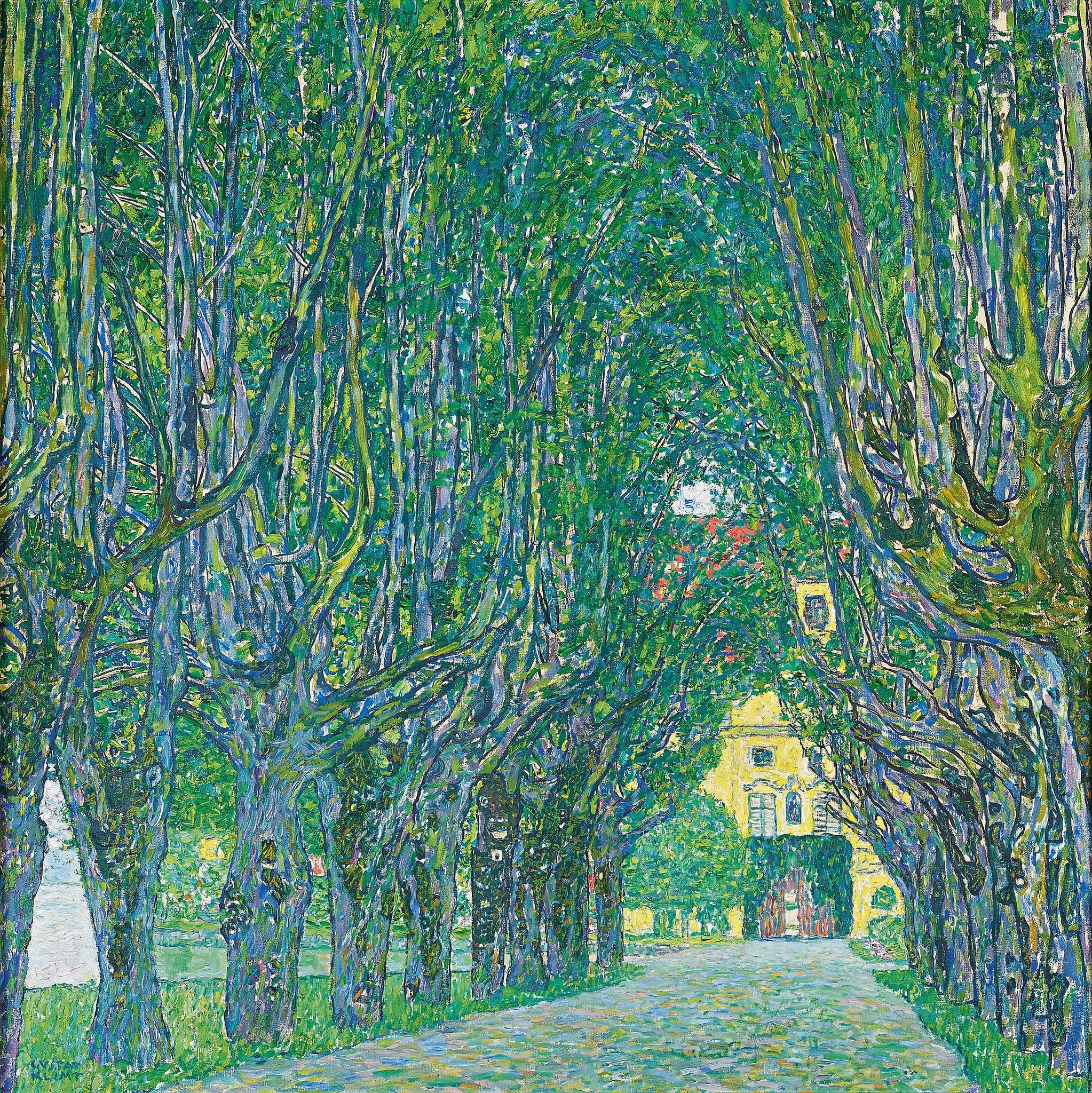
Avenue in Schloss Kammer Park
Gustav Klimt (1912)
Gustav Klimt’s Avenue in Schloss Kammer Park stages a ceremonial approach beneath a vaulted <strong>tunnel of linden trees</strong>, their pollarded limbs clasping to form a green nave. A cobbled axis pulls the eye toward a sunlit <strong>ocher façade and arched doorway</strong>, while Klimt’s tessellated strokes make foliage, bark, and shadow flicker between <strong>pattern and depth</strong> <sup>[1]</sup><sup>[5]</sup><sup>[6]</sup>.
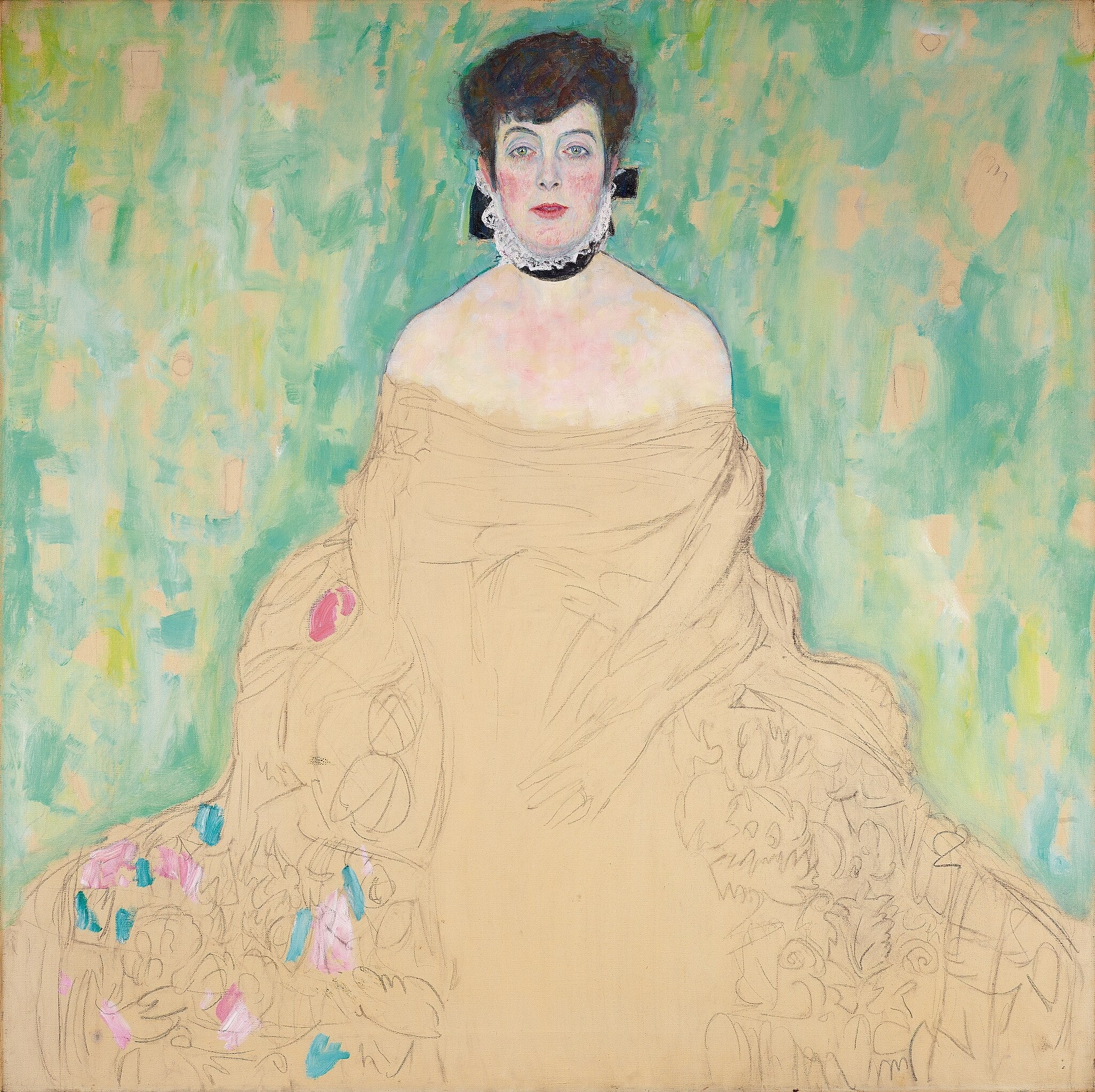
Amalie Zuckerkandl
Gustav Klimt (1917–1918)
Gustav Klimt’s Amalie Zuckerkandl is an <strong>unfinished</strong> late portrait in which a fully realized head and shoulders float above a gown left as <strong>skeletal graphite and washes</strong>. Set against a mottled, cool <strong>green ground</strong>, her flushed face, direct gaze, black <strong>choker</strong> and crisp lace collar stage a drama of poise, sensuality, and restraint <sup>[1]</sup><sup>[6]</sup>. The painting’s incompletion becomes the work’s meaning: a vivid selfhood <strong>emerging</strong> while ornament remains <strong>in potential</strong>.
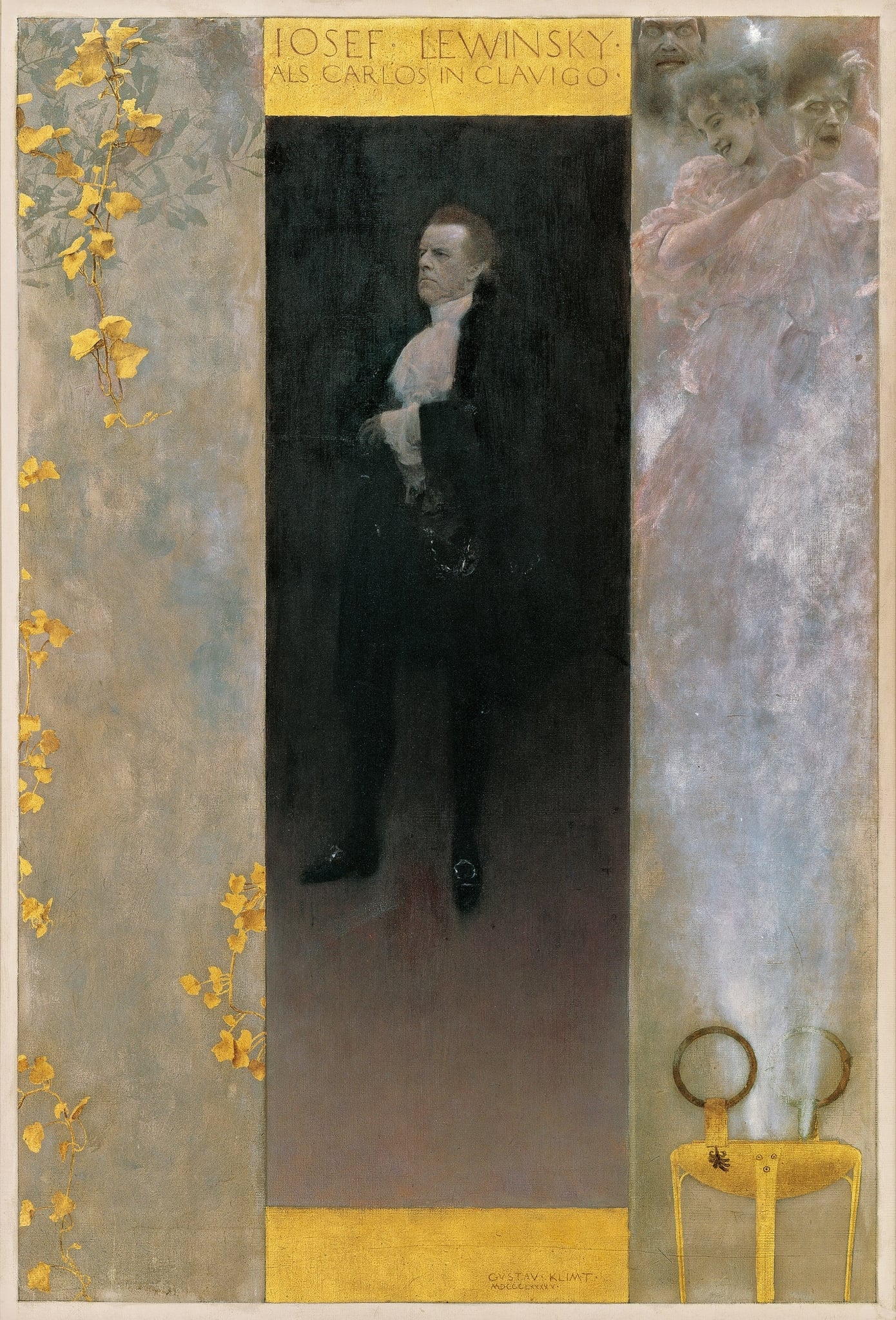
Josef Lewinsky as Carlos in Clavigo
Gustav Klimt (1895)
A stark, triptych-like design turns the actor’s upright silhouette into a test of <strong>will</strong> against a surrounding chorus of <strong>masks</strong>, <strong>laurel/ivy</strong>, and a smoking <strong>antique tripod</strong>. Klimt fuses <strong>portrait</strong> and <strong>allegory</strong> to stage the psychic weather of Goethe’s drama while previewing his turn toward <strong>Symbolism</strong> and ornamental modernity <sup>[1]</sup><sup>[2]</sup>.
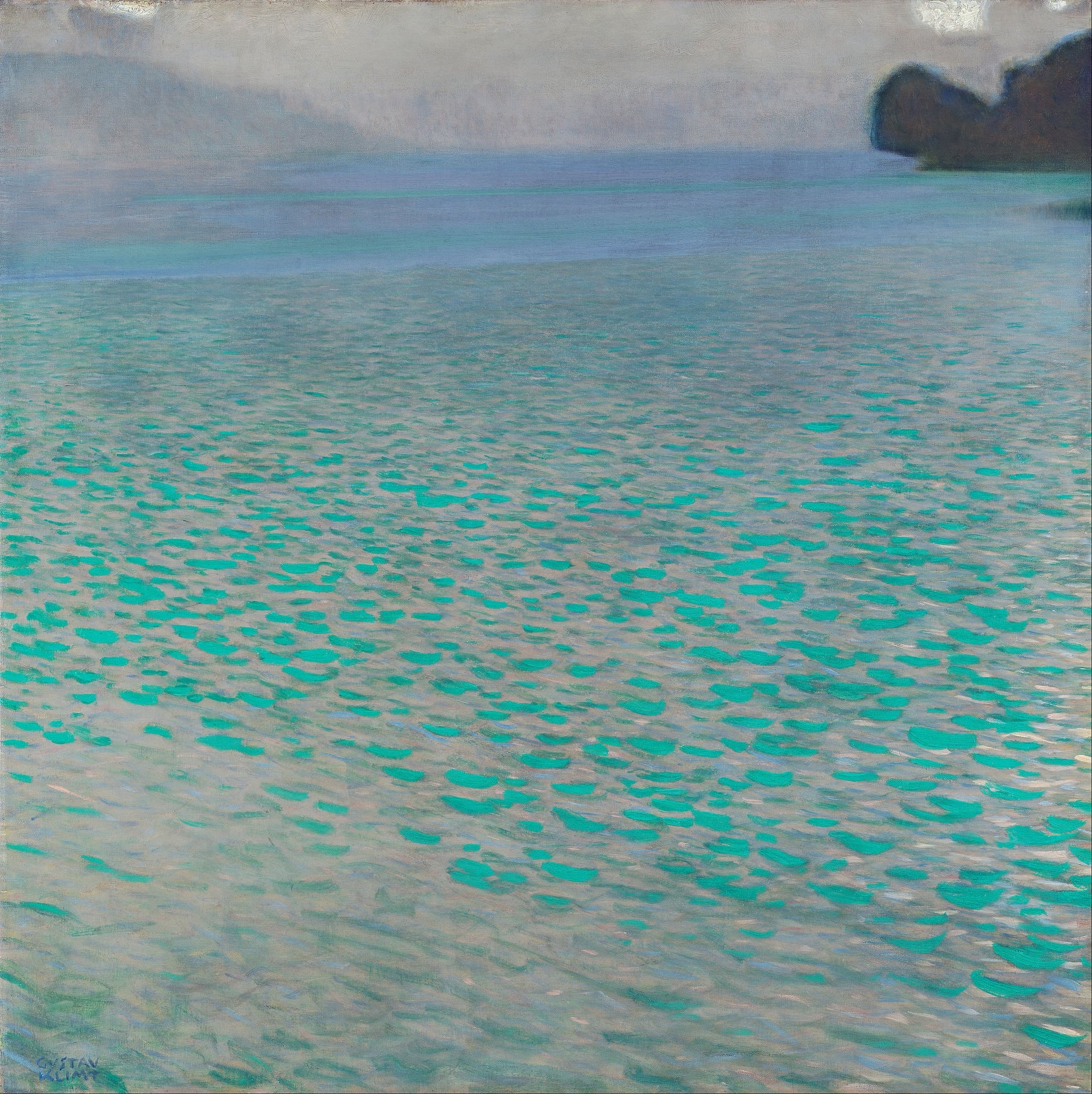
On Lake Attersee
Gustav Klimt (1900)
Gustav Klimt’s On Lake Attersee (1900) turns a summer lake into a <strong>woven field of light</strong>. A square canvas nearly filled with water, it stages a quiet duel between <strong>surface pattern</strong> and <strong>atmospheric depth</strong>, letting a tiny dark headland at the upper right anchor an otherwise hypnotic expanse <sup>[1]</sup><sup>[2]</sup>.