The Tree of Life

by Gustav Klimt

Gustav Klimt’s The Tree of Life crystallizes a cosmological axis in a gilded ornamental language: a rooted trunk erupts into endless spirals, embedded with eye-like rosettes and shadowed by a black, red‑eyed bird. Designed as part of the Stoclet dining‑room frieze, it fuses symbolism and luxury materials to link earthly abundance with timeless transcendence [1][2].

Fast Facts

Year
1910–1911 (design; mosaic installed 1911)
Medium
Full-scale working drawing (cartoon) on tracing paper with graphite, gouache, gold, silver, platinum, bronze, pastel, and appliqué
Dimensions
approx. 200 × 102 cm
Location
MAK – Museum of Applied Arts, Vienna (cartoon); final mosaic in Stoclet House, Brussels
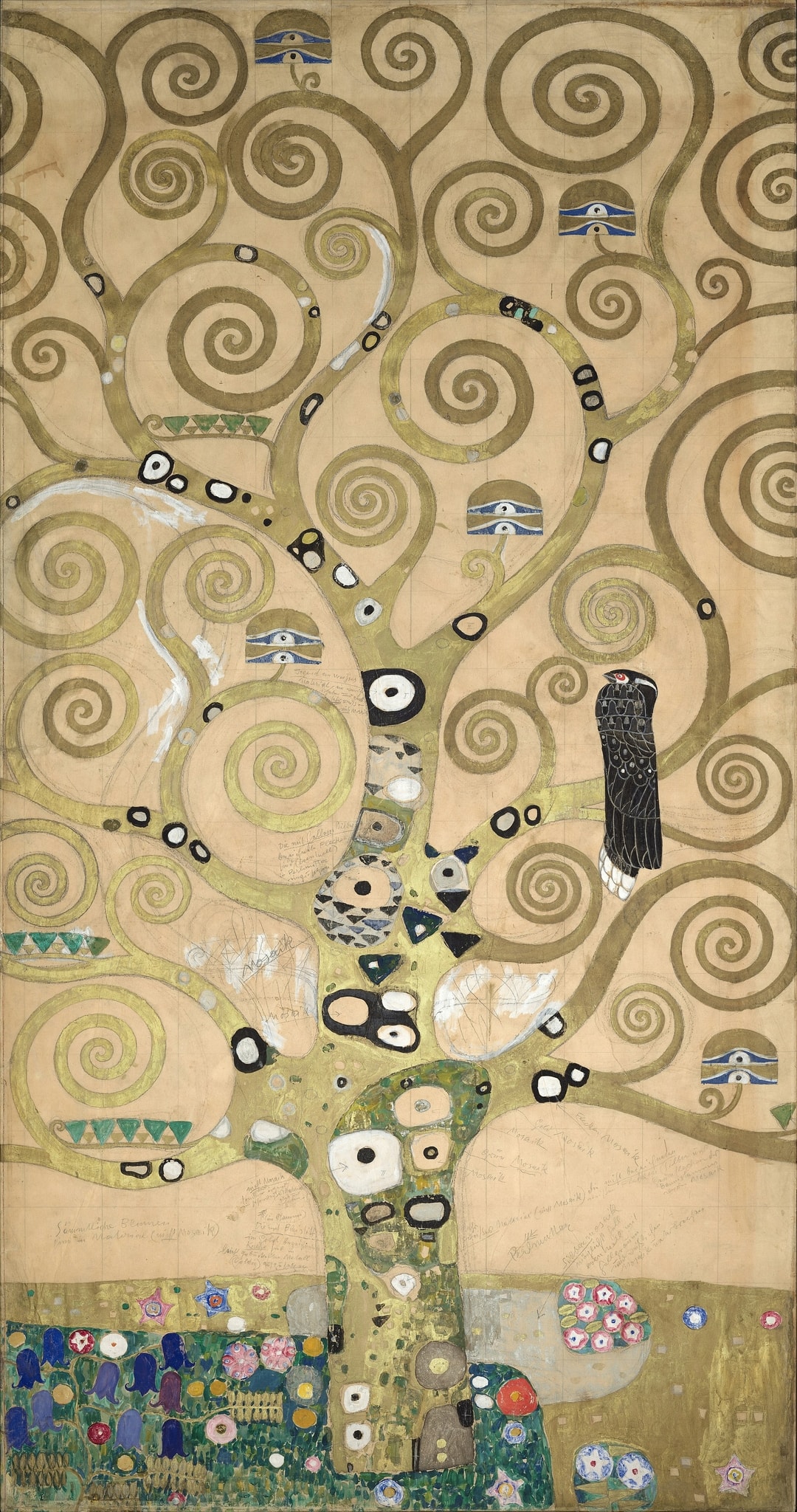
The Tree of Life by Gustav Klimt (1910–1911 (design; mosaic installed 1911)) featuring Spiraling branches, Eye-like rosettes, Black bird with red eye, Gold ground and gilded surfaces

Click on any numbered symbol to learn more about its meaning

Meaning & Symbolism

Klimt builds conviction through decision, not anecdote. The trunk—patched with light‑catching tiles, oculi, and seed‑like lozenges—declares the present as a living graft between past and future. From this core, the branches spiral with deliberate redundancy, a visual logic of return: every coil curves back upon itself, refusing straight-line destiny and asserting cyclical time. The spirals do not merely decorate; they legislate a rhythm of becoming, aligning with long‑standing Tree‑of‑Life traditions in which a central axis weds earth to heaven 4. That axis here is overtly sacralized: Klimt’s gold ground and his instructions for enamel, mother‑of‑pearl, and gold leaf install the tree within a timeless, Byzantine register, making precious substance carry metaphysical weight 1. Material and meaning close ranks; the noble surfaces pledge permanence, so the cosmology they host can claim authority. Klimt complicates vitality with watchfulness and threat. Across the boughs, eye‑like rosettes punctuate the spirals, a deliberate, Egyptianizing cue in a frieze that scholarship links to Nile‑rebirth and the Isis–Osiris cycle 3. The eyes are not passive emblems; they behave like guardians that survey the looping pathways of life. Their placement near nodal turns of the branches frames each spiral’s cusp as a moment under protective sight, proposing that fate is both seen and measured. Then Klimt installs a counter-signer: the black bird with a red eye gripping a right‑hand branch. Its concentrated profile interrupts the field of golden arabesques like a memento mori. Whether read as raven or falcon—motifs long associated with death, vigilance, and Egyptian solar lore—it functions as a vanitas device, the sober partner to the floral carpet at the base 34. The lower register’s patterned flowers, rendered as tessellated bells, rosettes, and berries, proclaim earthly plenitude; the bird establishes the cost of such plenitude: every bloom is time‑bound. What distinguishes the meaning of The Tree of Life is not an inventory of symbols but their integration into an architectural drama. Commissioned for the Stoclet House dining room, the panel participates in a room‑spanning sequence flanked by Expectation and Fulfillment and anchored by a vertical Knight—the ensemble that turns daily ritual into a rite of passage between desire and embrace 24. Klimt’s cartoon preserves his hand‑written directives to the mosaicists, proof that the image’s theology depends on specific, luxurious matter—gold, enamel, semi‑precious inlays—so that the frieze would gleam with a liturgical authority in situ 1. In this total work, form is fate: the signature Art Nouveau spiral casts life as ornamental necessity; the eyes and bird legislate accountability and limit; the gold confers timelessness. Why The Tree of Life is important is therefore twofold. First, it perfects the Secessionist synthesis of cross‑cultural sources—Egyptian eyes and birds, Byzantine shine, Japanese pattern—into a modern symbolic system that is neither pastiche nor illustration but operative myth for a new domestic temple 12. Second, it demonstrates how modern painting could migrate into craft and architecture without losing intellectual force: Klimt’s “painting” becomes instruction, his instruction becomes mosaic, and the mosaic becomes environment. Standing before the panel’s spirals and sentinels, one confronts a proposition about human time itself: rooted inheritance, vigilant present, and a future that always returns, beautifully, to its origin 34.

Explore Deeper with AI

Ask questions about The Tree of Life

Popular questions:

Powered by AI • Get instant insights about this artwork

💬 Ask questions about this artwork!

Interpretations

Symbolic Reading: Egyptian Rebirth Program

Read through Viennese Egyptomania, the rosette-“eyes” and the perched black bird activate an Isis–Osiris matrix of death and return. The eye motifs evoke the Udjat’s apotropaic force; the bird—variously read as falcon or raven—sharpens a dialectic of mortality and renewal. Warlick argues that, across the Stoclet cycle, vegetal overflow and sinuous line echo Nile flood and rebirth rites, so Klimt’s spirals legislate not mere décor but a cosmology of cyclical regeneration. This framework enriches the panel’s watchfulness: fate is not blind but seen, guarded, and measured. While individual identifications remain interpretive, the Egyptianizing program makes the Tree an axis where protection, loss, and return cohere—an esoteric substrate powering the frieze’s domestic ritual 34.

Source: M. E. Warlick, The Art Bulletin

Materiality & Medium: Luxurious Matter as Theology

Klimt’s working drawings preserve handwritten directives for enamel, mother‑of‑pearl, gold, silver, and bronze inlays. This is not ornament for its own sake; it’s material semiotics. By specifying a Byzantine-like gold ground and gem-like tesserae, Klimt harnesses the historical aura of liturgical mosaics so the work speaks in a sacral timbre. Precious substance becomes carrier of timelessness, making the panel’s cosmology claim authority through sheen and weight. The MAK’s object records confirm the cartoons’ mixed-media strata and their role as operational documents for Leopold Forstner’s mosaic workshop. In this view, theology is embedded in fabrication: the frieze’s metaphysics is inseparable from its matter, and belief is produced by craft at the highest register 15.

Source: MAK – Museum of Applied Arts, Vienna

Historical Context: Gesamtkunstwerk and Domestic Rite

Commissioned for Josef Hoffmann’s Stoclet House and executed by the Wiener Werkstätte, the Tree is one wall in a room‑encircling Gesamtkunstwerk. Flanked by Expectation and Fulfillment and anchored by a vertical Knight, the sequence choreographs dining into a rite of passage: desire, consummation, vigilance. UNESCO underscores the residence as a consummate Secessionist collaboration—architecture, surface, object, and image fused. In situ, the frieze was not a picture but an environment: marble grounds, gilded inlays, and patterned floors created a liturgical ambience for everyday life. The panel’s cosmology thus functioned socially, shaping bourgeois ritual through designed experience, and demonstrating how modern art could inhabit domestic space without losing intellectual force 21.

Source: UNESCO World Heritage Centre

Formalist Analysis: Spiral Logic and Ornamental Necessity

The branch system’s spirals display Art Nouveau’s signature whiplash line, but here line becomes law. Reiterated coils generate a visual redundancy that enacts return, refusing vectorial progress. Eye-rosettes punctuate nodal turns, converting arabesque into syntax: pause, look, proceed. Butterflies and geometric blossoms interleave with the trunk’s tile‑patchwork, flattening depth so figure and ground fuse into a continuous decorative field. This stylization stages a tension between mimesis and abstraction—a tree that is at once botanical emblem and ornamental machine. In Klimt’s formulation, ornament is not adjunct but ontology: the pattern doesn’t adorn life; it is life’s rule, the structural rhythm by which time curls back on itself 41.

Source: Web Gallery of Art (overview), MAK – Museum of Applied Arts

Patronage & Class: Luxury, Privacy, and Power

Adolphe Stoclet’s “no‑expense‑spared” commission mobilized elite craft—mosaic, marble, metals—to convert a dining room into a private temple of taste. The Wiener Werkstätte’s integration of art and life here depends on costly, globalized materials and specialized labor, visible in Klimt’s execution notes. This politics of luxury persists: the frieze remains in a UNESCO‑listed residence that is not publicly accessible, its aura partly secured by exclusivity. Read against Vienna 1900’s culture of display, the Tree’s sacred shimmer is also a statement about class: metaphysical claims materialize through capital, and access to the “operative myth” is mediated by ownership and setting 216.

Source: UNESCO World Heritage Centre; MAK – Museum of Applied Arts; Belvedere Museum

Cross‑Cultural Synthesis: Originality Beyond Pastiche

Klimt’s program fuses Egyptian eyes and birds, Byzantine shine, and Japanese pattern into an operative myth for modern domesticity. Rather than illustrative pastiche, this synthesis produces meaning through function: Egyptianizing watchfulness governs fate; Byzantine materiality confers timelessness; Japonisme refines flatness and pattern logic. Authorship is likewise reframed: Klimt’s cartoons with precise material instructions distribute making across workshop expertise, complicating singular genius with orchestrated authorship. In this light, originality resides in the system—iconography, medium, and site—more than in isolated motifs. The result is a modern symbolic language calibrated to architecture and ritual, not a collage of borrowings 132.

Source: MAK – Museum of Applied Arts; M. E. Warlick; UNESCO World Heritage Centre

Related Themes

About Gustav Klimt

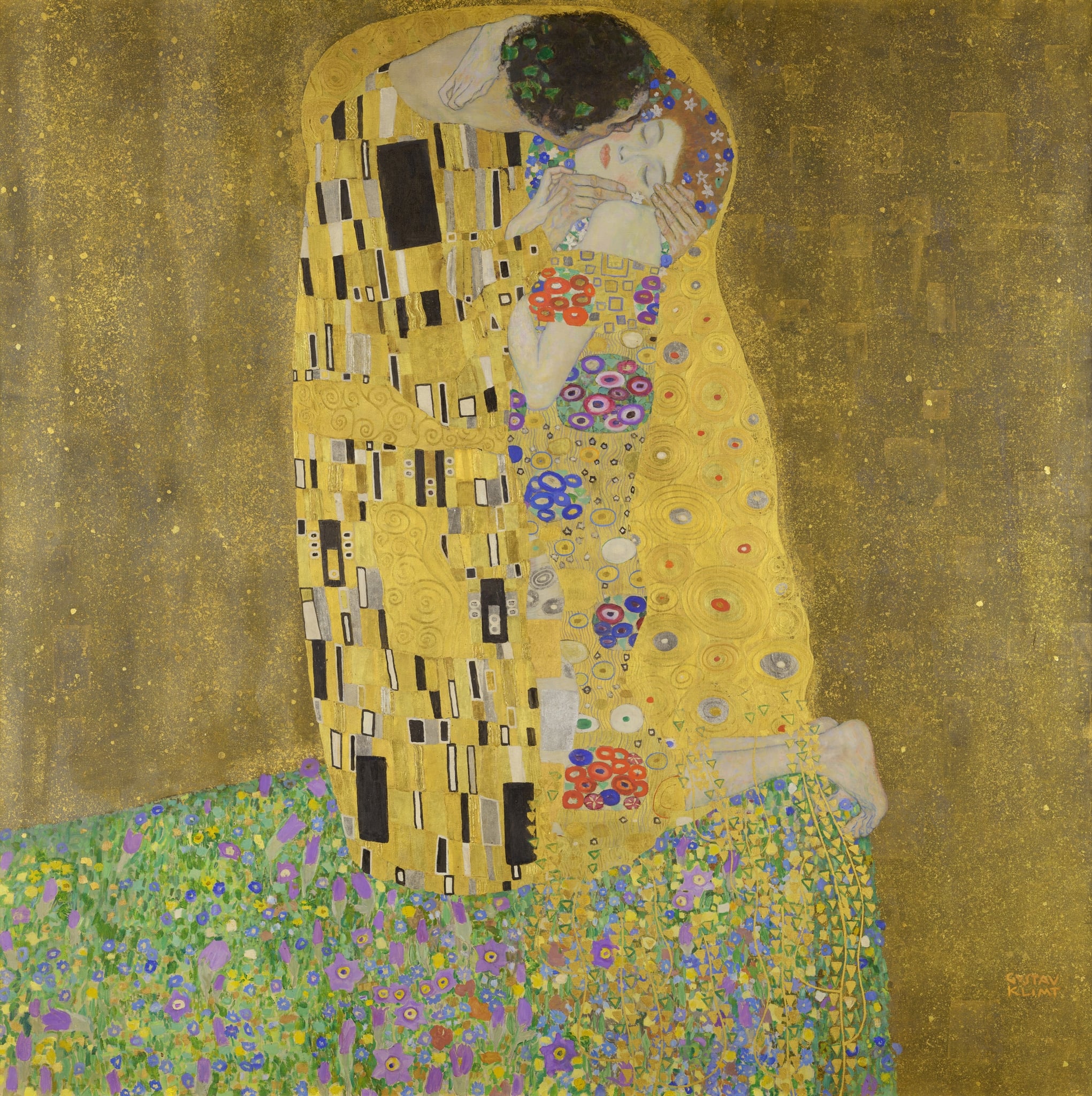
Gustav Klimt (1862–1918), co-founder of the Vienna Secession, pivoted from controversial public commissions to a decorative-symbolist language in his Golden Period. Drawing on Byzantine mosaics and modern design, he fused opulent surfaces with psychological intensity. By 1908–09, he transformed scandal into canon, and The Kiss became Vienna’s emblem of modern love.
View all works by Gustav Klimt

More by Gustav Klimt