Old Italian Art

by Gustav Klimt

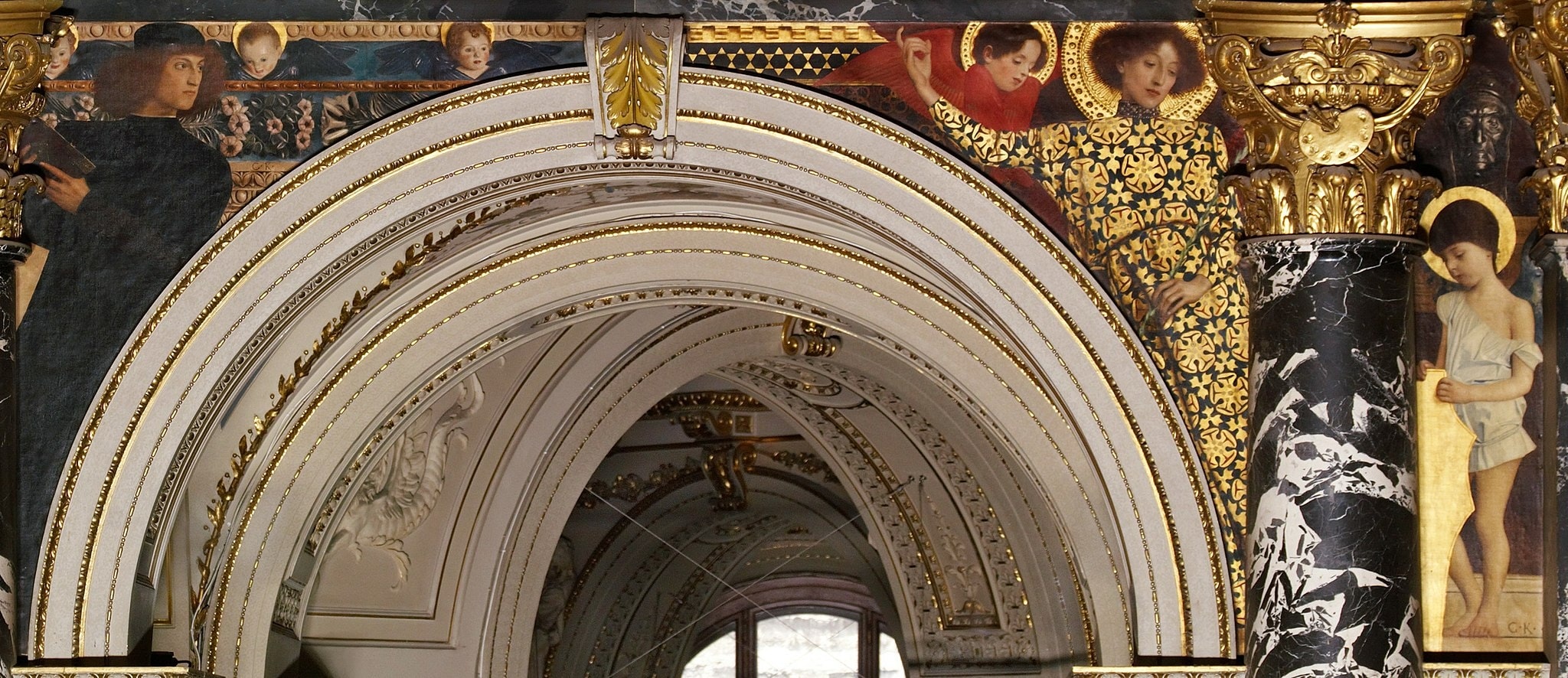
Gustav Klimt’s Old Italian Art (1891) crowns the Kunsthistorisches Museum’s grand staircase with a shimmering allegory of trecento–quattrocento culture. A Florentine reader, a haloed saint-like figure in brocaded gold, putti, and a bust of Dante articulate a lineage of learning and piety, all fused to the building’s gilded architecture. Klimt’s patterned textiles and hovering angels already signal his move from Ringstraße historicism toward a decorative modern vision [1][2].

Study Print Studio

Create a personal study print

Build a companion study sheet around the part of this painting that speaks to you most. Choose a detail, shape an interpretation, and walk away with something personal and display-worthy.

Fast Facts

Year
1891
Medium
Oil on canvas (installed on the wall; marouflage)
Location
Grand Staircase, Kunsthistorisches Museum, Vienna
See all Gustav Klimt paintings in Vienna
Old Italian Art by Gustav Klimt (1891) featuring Book, Halo, Shield

Click on any numbered symbol to learn more about its meaning

Meaning & Symbolism

Seen across the spandrel, Klimt stages a compact grammar of Italian art. At left, the young man in Florentine fifteenth‑century dress pauses mid‑reading; his turned head links intellect to vision, asserting the primacy of textual study in the quattrocento revival 1. Above him runs a garlanded frieze of putti heads modeled after Luca della Robbia, a direct citation of Florentine sculpture that locates the panel in a specific civic tradition even as it hovers outside narrative time 1. To the right, an angel in an exquisitely patterned gold robe—its motif lifted from Antonio da Fabriano’s Coronation of the Virgin—bends toward a smaller, nimbused putto who steadies a shield, a sign of civic identity and sacred service alike 1. The male reader’s features echo Marco Palmezzano’s Portrait of a Young Man, confirming Klimt’s method of learned quotation rather than copy, while the bronze bust of Dante above consolidates literature as the keystone of Italian culture 1. The museum’s own black‑and‑white marble columns and heavy gilded capitals frame the scene, so that architecture and image read as one continuous field: a Gesamtkunstwerk that converts entrance into initiation 2. Yet Klimt’s real argument lies in how he handles form. The bodies “vacillate between surface and space”: faces and hands retain volumetric presence, but garments and halos dissolve into pure pattern, slipping free of depth to become autonomous ornament 1. In the image itself this is felt in the saint’s tessellated brocade and in the crisp red‑gold swath that floats behind the angel’s shoulder—elements that refuse to behave as mere drapery. Klimt thereby empties the panel of episodic drama and replaces it with symbolic equivalences: book equals learning; halo equals sanctity; shield equals civic art; Dante equals textual authority. The frieze of della Robbia heads is not background décor but a claim that sculpture, painting, and architecture cohere in a single tradition. This didactic compression suits the staircase’s program, which personifies epochs of art to orient visitors as they ascend into the collections 24. As an early public commission, the panel also discloses how Klimt is already modernizing historicism. He mines the past for motifs but declines to “stage the protagonists of a historical drama”; instead he abstracts textiles, flattens gold into signal, and privileges the decorative continuum that binds object to setting 1. In doing so, he anticipates the Secessionist fusion of allegory and design: reverence becomes style-conscious devotion, and ornament becomes thought. The result is an image that teaches twice—first, that Italian art is a chain joining devotion, civic pride, and learning; second, that modern art can honor that chain by transforming it into a sensual, pattern‑rich surface. Old Italian Art thus marks a hinge in Klimt’s career: a Ringstraße commission that already speaks the language of the future 13.

Explore Deeper with AI

Ask questions about Old Italian Art

Popular questions:

Powered by AI • Get instant insights about this artwork

💬 Ask questions about this artwork!

Interpretations

Institutional Pedagogy and Civic Myth

Read as institutional theater, the panel mobilizes Dante, the shield, and Florentine citations to naturalize a civic‑sacred genealogy of Italian art inside a Habsburg museum. This is not neutral décor: it is a didactic script that folds Italian humanism into the museum’s imperial self‑fashioning, where visitors ascend under allegories that standardize art history into nation‑coded epochs. Klimt’s choice of emblematic, easily legible signs—book, halo, bust—matches the staircase’s programmatic need for mnemonic clarity, compressing complexity into heraldic units. In this view, Old Italian Art engineers consensus: humanist learning (reader), sanctity (nimbus), and civic identity (shield) appear as a ready‑made myth of origins for the Italian rooms awaiting above 12.

Source: Kunsthistorisches Museum (object entry and museum-history 'Gesamtkunstwerk' page)

Material Strategy: Marouflage and the Surface-Depth Game

Executed in oil on canvas and affixed to the architecture, the panel’s marouflage condition amplifies Klimt’s oscillation between volume and pure pattern. Faces and hands retain plasticity, but brocades and halos perform as autonomous ornaments that sit on the wall like applied textiles. The technique literalizes the work’s argument: the picture is a decorative skin that both belongs to, and floats upon, the building. This material setup lets Klimt rehearse modern flatness within a historicist brief, anticipating later Secessionist planar luxuries while still acknowledging sculptural citation (della Robbia heads) and pictorial depth. Medium and message converge: the installation method stages the very vacillation between surface and space that the imagery thematizes 12.

Source: Kunsthistorisches Museum; Staircase program overviews

Appropriation as Method, Curation as Style

Klimt’s “learned quotation rather than copy” turns the image into a mini‑museum: Antonio da Fabriano for textile pattern, Marco Palmezzano for the young man’s head, della Robbia for the cherubic frieze. Instead of reenacting a historical scene, Klimt curates fragments across media and periods, asserting authorship through selection, juxtaposition, and stylization. Such appropriation is not pastiche; it is epistemic—teaching viewers to recognize sources while enjoying their transformation into ornamental syntax. This anticipates Secessionist strategies where citation becomes a vehicle for modern style and authority migrates from historical accuracy to compositional editing. The panel thus models how a modern artist and a modern museum co‑author cultural memory via montage 13.

Source: Kunsthistorisches Museum; Routledge Encyclopedia of Modernism

Spectatorship and Ritual Ascent

Situated on the grand staircase, the image participates in a choreographed rite of passage: turning heads, pointing gazes, and lateral friezes guide visitors upward, suturing bodily movement to art‑historical time. The panel’s compositional vectors—reader’s glance to haloed figure to putto and shield—double as wayfinding cues, a pedagogy of looking embedded in architecture. This is the museum as Gesamtkunstwerk, where ornament manages attention and converts circulation into initiation. By replacing narrative drama with emblematic equivalences, Klimt optimizes the panel for transit: meanings arrive at a glance, then repeat rhythmically across bays, building an auralike familiarity that stabilizes the museum’s historical script 24.

Source: KHM 'Gesamtkunstwerk' page; Staircase cycle overview

Gendered Allegory and the Birth of Style

Klimt codes learning as masculine (the humanist reader) and sanctity/ornament as feminized (the haloed, richly robed angel), a pairing he will amplify in later Secessionist allegories. Yet the feminine here is not passive: the patterned gold robe is an active force that flattens depth and redefines value around textile brilliance, making ornament itself the bearer of meaning. This redistribution of agency—from narrative action to decorative presence—prefigures Klimt’s modern elevation of surface as thought. The panel thus rehearses a gendered aesthetics where knowledge and devotion interlock, but style—mediated through feminized adornment—emerges as the decisive, modern power that organizes the image and the viewer’s attention 13.

Source: Kunsthistorisches Museum; Routledge Encyclopedia of Modernism

Related Themes

About Gustav Klimt

Gustav Klimt (1862–1918), co-founder of the Vienna Secession, pivoted from controversial public commissions to a decorative-symbolist language in his Golden Period. Drawing on Byzantine mosaics and modern design, he fused opulent surfaces with psychological intensity. By 1908–09, he transformed scandal into canon, and The Kiss became Vienna’s emblem of modern love.
View all works by Gustav Klimt

More by Gustav Klimt

Portrait of Adele Bloch-Bauer I by Gustav Klimt

Portrait of Adele Bloch-Bauer I

Gustav Klimt (1907)

Gustav Klimt’s Portrait of Adele Bloch-Bauer I stages its sitter as a <strong>secular icon</strong>—a living presence suspended in a field of gold that converts space into <strong>pattern and power</strong>. The naturalistic face and hands emerge from a reliquary-like cascade of eyes, triangles, and tesserae, turning light, ornament, and status into the painting’s true subjects <sup>[1]</sup><sup>[2]</sup>.

Sunflower by Gustav Klimt

Sunflower

Gustav Klimt (1907/1908)

Gustav Klimt’s Sunflower turns a single bloom into a <strong>monumental, figure-like presence</strong>. A tapering stack of broad, drooping leaves rises from a <strong>mosaic-like carpet of round blossoms</strong>, crowned by a gold-flecked disc that glows against a cool, stippled field. The work fuses <strong>portrait, icon, and landscape</strong> into one emblem of vitality and quiet sanctity <sup>[1]</sup><sup>[2]</sup>.

Cottage Garden with Sunflowers by Gustav Klimt

Cottage Garden with Sunflowers

Gustav Klimt (1906–1907 (signed 1907))

Cottage Garden with Sunflowers is a square, horizonless field of blooms where a vertical column of <strong>sunflowers</strong> anchors an all-over weave of color and pattern. Klimt fuses <strong>ornament and nature</strong>, turning a humble Litzlberg cottage plot into a radiant matrix of cyclical life and renewal <sup>[1]</sup><sup>[4]</sup><sup>[5]</sup>.

The Kiss by Gustav Klimt

The Kiss

Gustav Klimt (1908 (completed 1909))

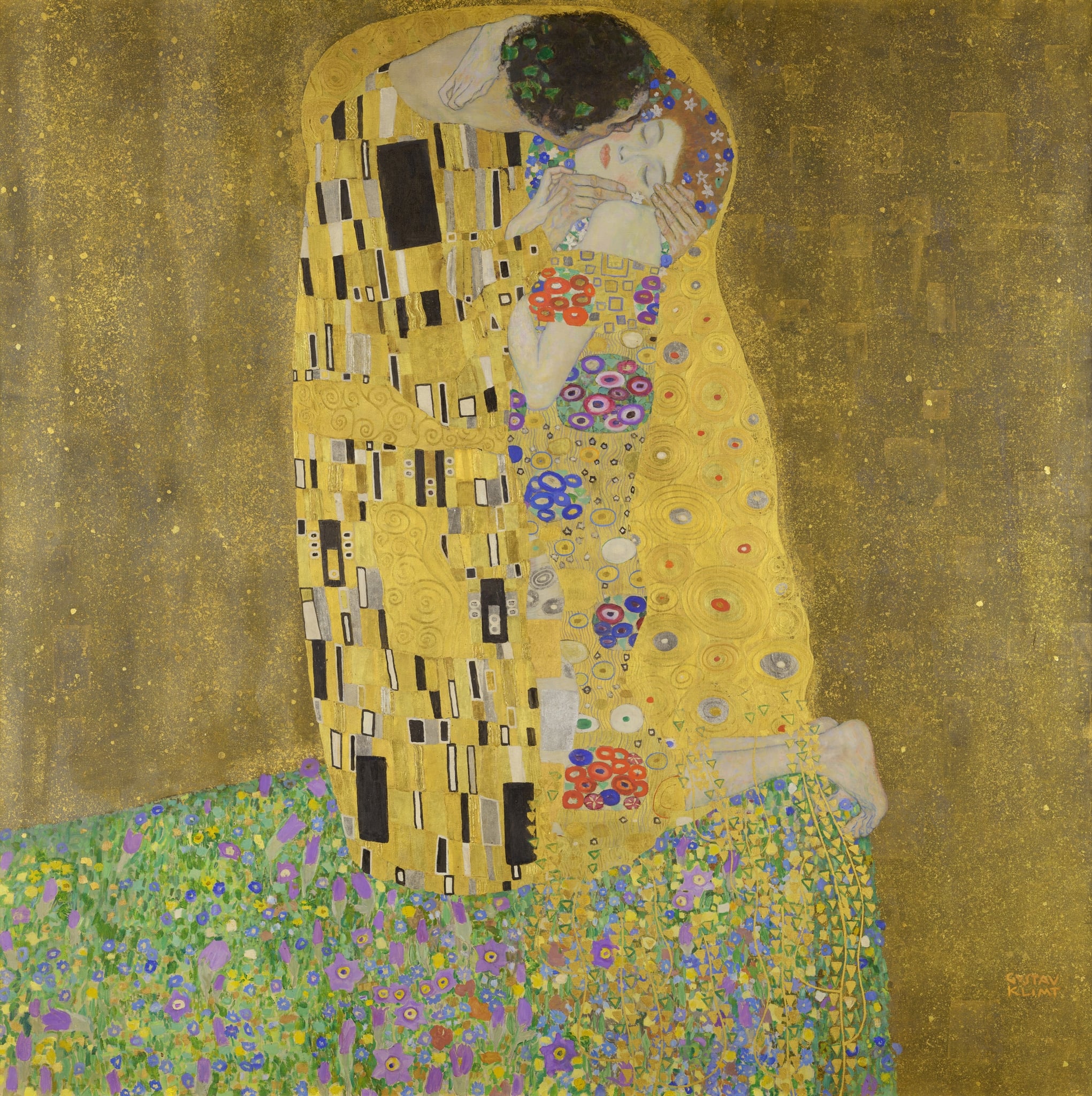
The Kiss stages human love as a <strong>sacred union</strong>, fusing two figures into a single, gold-clad form against a timeless field. Klimt opposes <strong>masculine geometry</strong> (black-and-white rectangles) to <strong>feminine organic rhythm</strong> (spirals, circles, flowers), then resolves them in radiant harmony <sup>[1]</sup><sup>[2]</sup>.
The Tree of Life by Gustav Klimt

The Tree of Life

Gustav Klimt (1910–1911 (design; mosaic installed 1911))

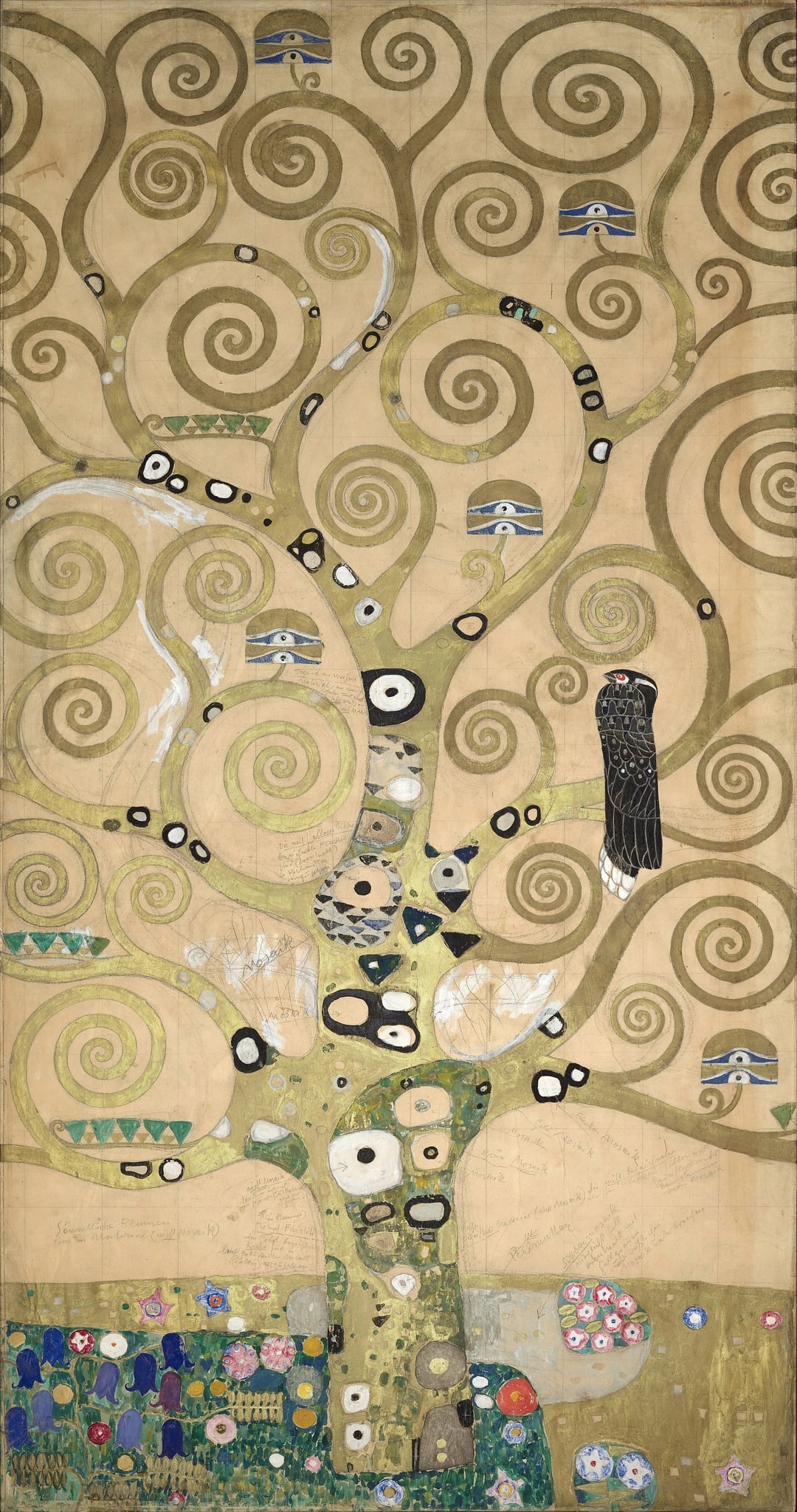
Gustav Klimt’s The Tree of Life crystallizes a <strong>cosmological axis</strong> in a gilded ornamental language: a rooted trunk erupts into <strong>endless spirals</strong>, embedded with <strong>eye-like rosettes</strong> and shadowed by a black, red‑eyed bird. Designed as part of the Stoclet dining‑room frieze, it fuses <strong>symbolism and luxury materials</strong> to link earthly abundance with timeless transcendence <sup>[1]</sup><sup>[2]</sup>.
The Kiss (Lovers) by Gustav Klimt

The Kiss (Lovers)

Gustav Klimt (1907–1908 (Belvedere lists 1908/09))

The Kiss (Lovers) crystallizes Klimt’s <strong>Golden Period</strong> ideal: erotic union staged as a sacred vision. Two bodies fuse beneath a single golden mantle, poised on a flowered ledge at the brink of the unknown, where <strong>pattern becomes symbol</strong> and intimacy becomes icon.