Part of the Tree of Life (Part 1)

by Gustav Klimt

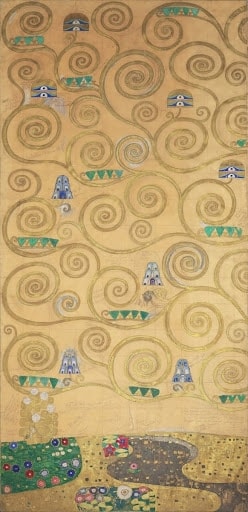
Gustav Klimt’s Part of the Tree of Life (Part 1) is a full‑scale design cartoon for the Stoclet dining‑room frieze, where a gold ground hosts branching spirals, Eye‑of‑Horus rosettes, falcon emblems, and crisp triangular leaves. The panel fuses symbolism and ornament to stage life’s cyclical renewal within a luxurious, sacred‑like register [1][3].

Study Print Studio

Create a personal study print

Build a companion study sheet around the part of this painting that speaks to you most. Choose a detail, shape an interpretation, and walk away with something personal and display-worthy.

Fast Facts

Year
1910–1911
Medium
Cartoon: chalk, pencil, gouache, bronze, silver, gold, platinum on transparent and draft paper
Dimensions
200 × 102 cm
Location
MAK – Museum of Applied Arts, Vienna
See all Gustav Klimt paintings in Vienna
Part of the Tree of Life (Part 1) by Gustav Klimt (1910–1911) featuring Spiraling branches (Tree of Life)

Click on any numbered symbol to learn more about its meaning

Meaning & Symbolism

Klimt constructs Part of the Tree of Life (Part 1) as a doctrine of recurrence. The sinuous trunk issues spirals that multiply across the gold field; none runs in a straight line, and few terminate without curling back. That looping grammar performs the artwork’s thesis: life proceeds through cyclical time, not linear progress. The panel’s upper half intensifies this claim by packing the spirals most densely where vision naturally seeks horizon and sky, making ascension synonymous with return. The small bands of green triangular leaves inserted among the coils proclaim order within flux: geometry arrests the organic line, dramatizing a pact between growth and design that is characteristic of Vienna Secession aesthetics 1. Seen in situ as mosaic, those geometries would sparkle as hard‑edged tesserae, turning abstraction into a tactile law that governs the tree’s exuberance 2. Protection underwrites renewal. Scattered through the spirals are blue‑and‑white oculiform rosettes that curators identify as Eyes of Horus; perched forms read as Horus falcons 1. These are not merely quotations from Egyptomania; they are structural actors. The eyes punctuate the visual rhythm like beats in a pulse, making guardianship a metric of life itself. Their placement high in the canopy and along key junctions of the volutes asserts that watchfulness accompanies every turn of fate. Warlick’s reading of the Stoclet program through the Isis–Osiris myth clarifies why: rebirth requires both the wounding of fragmentation and the healing presence of protective gods. In Part 1, the eye and falcon ensure that each spiral—each loss of linear direction—returns safely to form, staging an initiatory passage from dispersion to recomposition 3. The pebble‑like ground band at the base, resolved in the final installation with marble and inlays, literalizes threshold: matter holds the roots while the gilded field iconizes the canopy, so the panel binds earth and transcendence in one continuum 24. Klimt’s medium makes meaning. This is a 1:1 working cartoon laced with gold, silver, bronze, and even platinum on paper, annotated for translation into marble, enamel, and glass by the Wiener Werkstätte and Forstner’s mosaic workshop 12. The preciousness is programmatic: by clothing the natural motif in metallized shimmer, Klimt converts the tree into an icon of life, aligning the dining room with Byzantine sanctuaries while honoring the Stoclets’ collection of ancient objects that nourished the Egyptianizing vocabulary 1. Within Hoffmann’s total design, the panel is not a picture on a wall; it is a segment of an architectural liturgy that encircles the table—an environment where eating, looking, and remembering are fused. That is why Part 1 is important: it inaugurates the frieze’s narrative of expectation, union, and fulfillment by asserting continuity before any human figure appears, and it demonstrates how modern art can stage metaphysical content through orchestrated collaboration of image, craft, and setting—hallmarks of Klimt’s Golden‑phase ambition and the Vienna Secession’s ideal of unity 25.

Explore Deeper with AI

Ask questions about Part of the Tree of Life (Part 1)

Popular questions:

Powered by AI • Get instant insights about this artwork

💬 Ask questions about this artwork!

Interpretations

Phenomenology of Vision

Klimt engineers a paced gaze. In mosaic, metallic and glass tesserae produce micro‑flashes that activate the spirals as viewers shift position; the oculiform rosettes answer with a counter‑look, staging a reciprocal seeing between beholder and canopy. The eye‑motifs punctuate sightlines like rests and accents, while the branching volutes distribute attention across the frieze, resisting a single vanishing point. Dining amplifies this: seated rotation, passing dishes, and conversation create a rhythmic scan of the field, so protection, return, and continuity are not only represented—they are temporally experienced through looking itself 15.

Source: MAK – Museum of Applied Arts; Web Gallery of Art

Material-Process Lens

Klimt’s cartoon is already a metallic object—gold, silver, bronze, and platinum on paper—engineered to become marble, enamel, and glass. That deliberate over-specification makes the work about its own translation: contours are cues for cutting, glints prefigure tesserae, and tonal fields forecast how mosaic scintillation will regulate viewing. The cartoon thus functions as a performative score for the Wiener Werkstätte and Forstner’s workshop, collapsing design and execution into a single authored continuum. Reading Part 1 this way, the “Tree” is not just pictured vitality; it is a protocol for embodiment, binding image to craft and ensuring that meaning emerges through the friction of media—paper to stone, shimmer to shine 12.

Source: De Gruyter/Brill (technical studies); MAK – Museum of Applied Arts

Egyptianizing Iconography

The blue‑white oculi (Udjat) and Horus falcons are not decorative quotations; they are structural agents that meter the arabesque. Following Warlick’s Isis–Osiris reading, guardianship is prerequisite to reconstitution: eyes secure the passage through dispersal; the falcon—Horus as avenger and heir—ensures the return of form after fragmentation. In Part 1, these emblems punctuate junctions in the spirals, turning protection into a visual beat that synchronizes fate with renewal. Their presence also maps the Stoclets’ taste for antiquity onto Viennese modernism, where archaic signs are re-coded through Secessionist geometry, producing a hybrid, pan-historic symbolic grammar 13.

Source: M. E. Warlick (The Art Bulletin); MAK – Museum of Applied Arts

Architectural-Ritual Context

Installed as a mosaic frieze in the Stoclet dining room, the panel becomes environmental ritual rather than mere image. Hoffmann’s gesamtkunstwerk frames eating as a choreographed act—circulation around the table mirrors the processional logic of a sanctuary, while the gold ground courts Byzantine precedents. Within this setting, Part 1 serves as a threshold of expectation before human figures enter elsewhere in the sequence, priming viewers with a doctrine of continuity as they move. The UNESCO status underlines that significance: the work’s meaning is inseparable from its site, where precious materials and total design convert domestic space into a stage for collective memory and aesthetic devotion 145.

Source: UNESCO World Heritage Centre; Web Gallery of Art; MAK – Museum of Applied Arts

Ornament as Law (Formal Analysis)

Secessionist aesthetics reconcile Naturformen with abstract order. In Part 1, triangles and rosettes act like syntax that disciplines the vegetal sentence of the spiral. This is less illustration than jurisprudence: ornament becomes the law that both constrains and enables growth. The upper register densifies the volutes near the horizon, intensifying return where one expects ascent, while the pebble band anchors the trunk’s vertical with a tactile base. Such calibrated oppositions—hard/soft, linear/curvilinear, ground/canopy—are formal couplings that make philosophical claims: freedom is legible only against rule; becoming is measured by design 16.

Source: MAK – Museum of Applied Arts; Encyclopaedia Britannica (Vienna Secession context)

Related Themes

About Gustav Klimt

Gustav Klimt (1862–1918), co-founder of the Vienna Secession, pivoted from controversial public commissions to a decorative-symbolist language in his Golden Period. Drawing on Byzantine mosaics and modern design, he fused opulent surfaces with psychological intensity. By 1908–09, he transformed scandal into canon, and The Kiss became Vienna’s emblem of modern love.
View all works by Gustav Klimt

More by Gustav Klimt

Sunflower by Gustav Klimt

Sunflower

Gustav Klimt (1907/1908)

Gustav Klimt’s Sunflower turns a single bloom into a <strong>monumental, figure-like presence</strong>. A tapering stack of broad, drooping leaves rises from a <strong>mosaic-like carpet of round blossoms</strong>, crowned by a gold-flecked disc that glows against a cool, stippled field. The work fuses <strong>portrait, icon, and landscape</strong> into one emblem of vitality and quiet sanctity <sup>[1]</sup><sup>[2]</sup>.

Cottage Garden with Sunflowers by Gustav Klimt

Cottage Garden with Sunflowers

Gustav Klimt (1906–1907 (signed 1907))

Cottage Garden with Sunflowers is a square, horizonless field of blooms where a vertical column of <strong>sunflowers</strong> anchors an all-over weave of color and pattern. Klimt fuses <strong>ornament and nature</strong>, turning a humble Litzlberg cottage plot into a radiant matrix of cyclical life and renewal <sup>[1]</sup><sup>[4]</sup><sup>[5]</sup>.

The Kiss by Gustav Klimt

The Kiss

Gustav Klimt (1908 (completed 1909))

The Kiss stages human love as a <strong>sacred union</strong>, fusing two figures into a single, gold-clad form against a timeless field. Klimt opposes <strong>masculine geometry</strong> (black-and-white rectangles) to <strong>feminine organic rhythm</strong> (spirals, circles, flowers), then resolves them in radiant harmony <sup>[1]</sup><sup>[2]</sup>.
Tree of Life (Part 4) by Gustav Klimt

Tree of Life (Part 4)

Gustav Klimt (1910–1911)

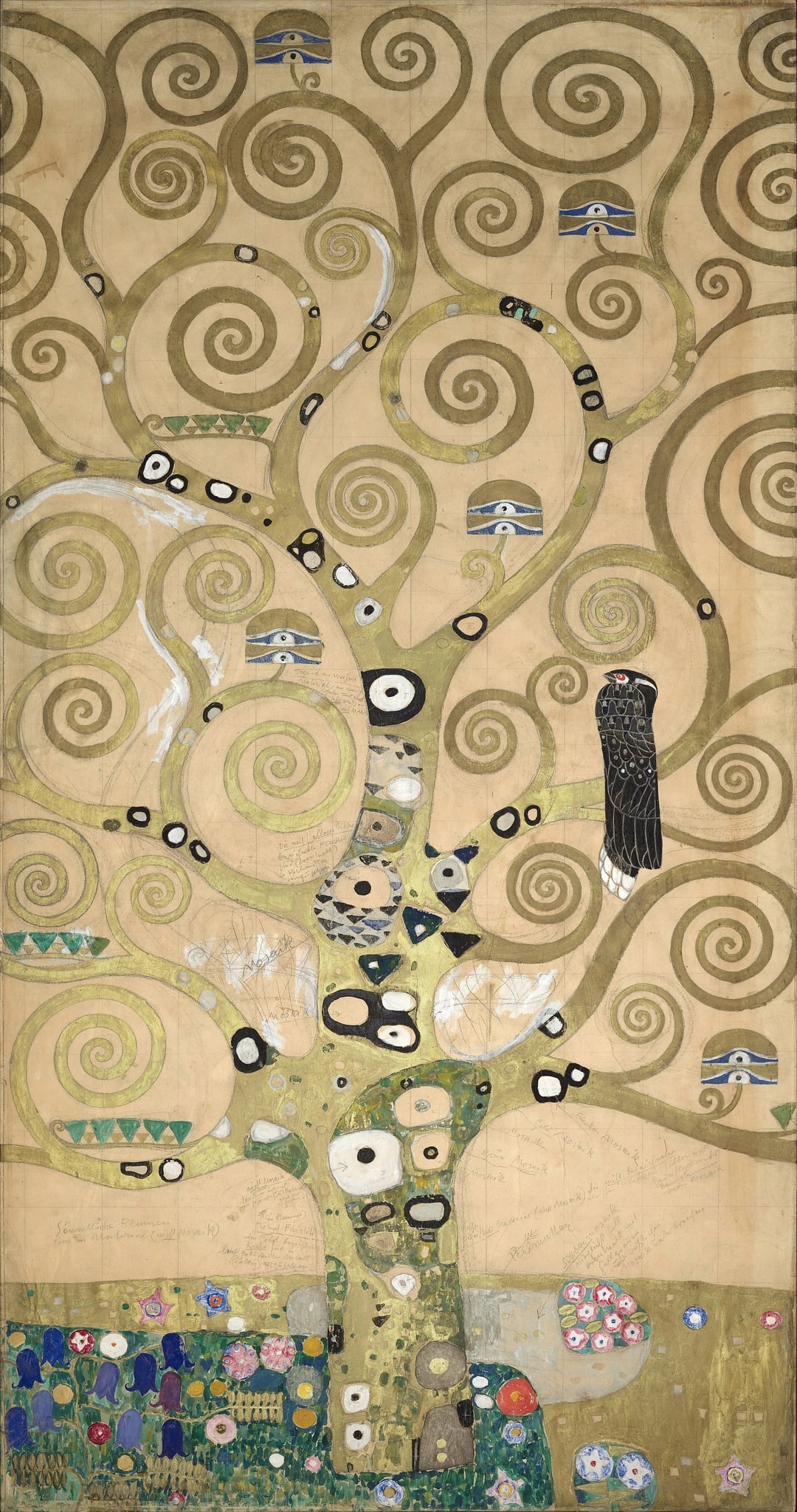
Tree of Life (Part 4) stages a gilded axis where <strong>spiraling branches</strong>, <strong>amuletic eyes</strong>, and a <strong>black raptor</strong> compress growth, vigilance, and mortality into a single ornamental system. The mosaic-like bark and jewel-bright flower carpet root the image in fecund earth while the volutes coil upward toward the abstract and the eternal <sup>[1]</sup><sup>[6]</sup>.

Rosebush (Part 6) by Gustav Klimt

Rosebush (Part 6)

Gustav Klimt (1910/11)

In Rosebush (Part 6), a single, wavering stem climbs through a field of gold spirals while regimented green-and-blue triangular leaves and pale, jewel-like blossoms punctuate its path. Around it, vivid butterflies and star-flowers animate the surface. Klimt fuses nature and ornament into a <strong>precious</strong>, <strong>cyclical</strong> emblem of growth, metamorphosis, and renewal.

Knight (Part 9) by Gustav Klimt

Knight (Part 9)

Gustav Klimt (1910–1911)

Klimt’s Knight (Part 9) turns chivalry into a <strong>geometric icon</strong>: a vertical standard of stacked bars and checks flanked by <strong>ranks of circles and triangles</strong> that read as shields and studs. Set on a <strong>golden ground</strong> and crowned and undergirded by ornamental zones, it proclaims vigilance and ethical guardianship between the frieze’s figural scenes. <sup>[1]</sup>