How Much Is Old Italian Art Worth?
Last updated: April 19, 2026
Quick Facts
- Insurance Value
- $50.0M (Analyst estimate based on institutional indemnity practice and in-situ irreplaceability)
- Methodology
- comparable analysis
Old Italian Art is an in-situ, marouflaged mural by Gustav Klimt for the Grand Staircase of Vienna’s Kunsthistorisches Museum and has never been on the market. Using Klimt’s recent top auction benchmarks and applying significant discounts for early-period authorship, site-specific format, and legal/portability constraints, we estimate a hypothetical fair-market value of $25–45 million. For insurance/indemnity, a notional $50 million is appropriate to reflect irreplaceability and deinstallation risk.
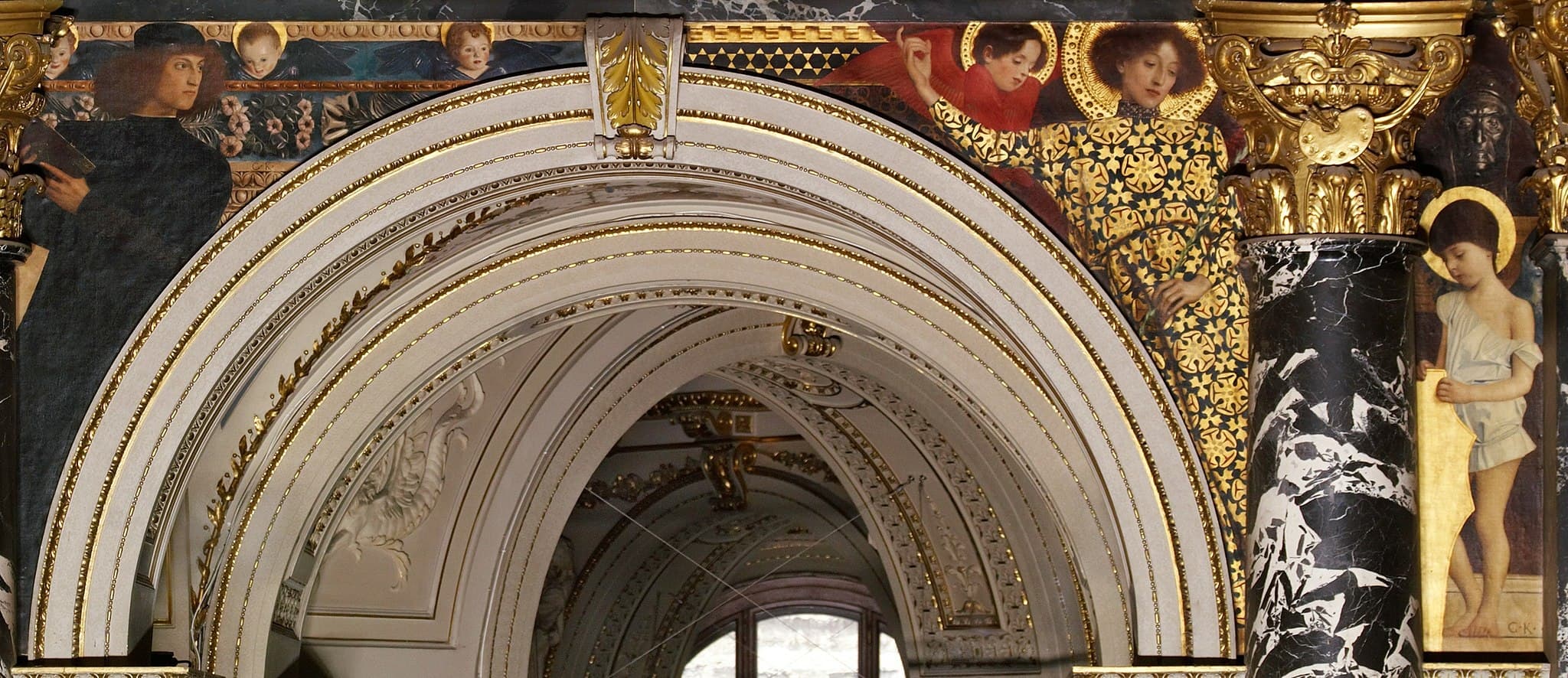
Old Italian Art
Gustav Klimt, 1891 • Oil on canvas (installed on the wall; marouflage)
Read full analysis of Old Italian Art →Valuation Analysis
What it is: Old Italian Art (Alt‑Italienische Kunst) is one of Gustav Klimt’s staircase panels for the Grand Staircase of the Kunsthistorisches Museum, Vienna, executed circa 1890–91 within the Künstler‑Compagnie collaboration and installed in situ as part of the museum’s architectural decoration. The work is documented by the museum and treated as part of the building’s permanent fittings, with no public sale history and no record of deinstallation [1][2].
Method and range: We derive a hypothetical fair‑market value by bracketing against recent, best‑in‑class Klimt auction results and then applying material discounts for period, subject, format, and marketability. Klimt’s market has reset at the apex: Sotheby’s New York established a $236.4m auction record for Portrait of Elisabeth Lederer in November 2025, with additional eight‑figure landscape results on the same evening [3]. Other high‑confidence anchors include Lady with a Fan at ~$108m (Sotheby’s London, 2023) and Birch Forest at ~$104.6m (Christie’s New York, 2022) [4][5]. These works, however, are late, freestanding, and highly commercial—unlike an early, site‑specific decorative panel.
Discounting logic: Relative to the above anchors, we apply a steep period/genre discount: Old Italian Art belongs to Klimt’s pre‑Secession, historicist‑decorative phase rather than his mature “golden period” or iconic landscapes favored by today’s top collectors. We also apply a substantial liquidity/format discount for a marouflaged, architectural installation with high conservation complexity and limited portability. Finally, any real‑world transaction would face Austrian cultural‑property controls and deaccession hurdles that thin the buyer pool and depress realizable price, even if a hypothetical sale were legally permitted [6].
Conclusion: After calibrating to recent Klimt price levels and incorporating the above discounts, we estimate a hypothetical fair‑market value of $25–45 million if the panel were professionally deinstalled, legally exportable, and offered at a premier auction. This range acknowledges Klimt’s brand power and the commission’s scholarly importance while reflecting its lesser commercial appeal versus late portraits and prime landscapes. For insurance or indemnity, a higher notional figure is justified to capture irreplaceability and deinstallation risk; we set $50 million as a prudent single‑object limit within institutional policy norms. This valuation is intended for benchmarking and risk management; in practice, the work is effectively non‑marketable due to its in‑situ status and public ownership [1][2][6].
Key Valuation Factors
Art Historical Significance
High ImpactCommissioned for the Grand Staircase of the Kunsthistorisches Museum (KHM), this panel sits at the heart of Klimt’s pre‑Secession public career. The staircase program helped establish Klimt’s reputation and remains among the most visited ensembles of Viennese historicist decoration. As part of a Gesamtkunstwerk that integrates painting and architecture, the panel has strong scholarly value and sustained public exposure. While it lacks the breakthrough symbolism and ornamental innovations of Klimt’s later “golden period,” its significance within the artist’s developmental arc and within a major national museum is incontestable, elevating cultural importance even as it tempers commercial comparability to freestanding masterpieces.
Oeuvre Positioning (Period, Subject, Attribution)
Medium ImpactDated to 1890–91, the work belongs to Klimt’s early, historicist‑decorative phase and to the Künstler‑Compagnie period, distinct from the late portraits and jewel‑like landscapes that drive peak valuations. This makes it academically vital but less aligned with top private‑collector taste. If the panel is credited primarily to Gustav Klimt (as KHM indicates), its authorship is strong; nevertheless, the collaborative context subtly reduces the singular “trophy” aura that attaches to iconic solo late works. Subject matter—an allegorical homage to Old Italian painting—adds historical resonance but does not compete in market desirability with Klimt’s celebrated female portraits or prime Attersee landscapes.
Medium, Condition, and Portability
High ImpactAs a marouflaged, site‑specific panel integrated into a 19th‑century grand staircase, the work’s physical format imposes significant conservation and logistical constraints. Professional detachment is technically possible in some cases but entails risk of loss, complex stabilization, and high cost; the resulting work may still carry structural limitations for display. Collectors typically prefer portable, autonomous canvases with clear condition profiles. These format realities translate into thinner demand and a prudent discount to prices achieved by mature Klimt easel paintings in excellent, ready‑to‑hang condition—despite the panel’s imposing scale and impressive visual impact in situ.
Legal/Export and Marketability
High ImpactHeld by a federal Austrian museum and integrated into a protected cultural monument, the panel is subject to stringent deaccession and export controls. In practical terms, it is non‑saleable; even a theoretical disposal would require exceptional approvals, state retention options, and export permits. Such constraints materially reduce the universe of potential buyers and depress achievable pricing relative to otherwise equivalent, freely tradeable Klimt paintings. Our estimate assumes a counterfactual scenario in which lawful deinstallation and export are granted, but the mere presence of these hurdles warrants a meaningful discount and underpins a higher notional insurance value for risk management.
Provenance and Brand Strength
Medium ImpactProvenance is unimpeachable: commissioned for and continuously held by the KHM, with no gaps or restitution clouds. Brand-wise, Klimt remains a top-tier blue-chip artist with deep global demand, underscored by multiple nine‑figure auction results in recent years. That brand strength lifts even non‑iconic works. However, the market premiums concentrate in late portraits and pinnacle landscapes; an early decorative panel benefits from the Klimt name but will not command the same intensity of competition. Net effect: provenance and brand support robust valuation floors, but do not overcome discounts tied to period, format, and marketability.
Sale History
Old Italian Art has never been sold at public auction.
Gustav Klimt's Market
Gustav Klimt is one of the most coveted names in Modern art. The top of his market reset in November 2025 when Sotheby’s New York sold Portrait of Elisabeth Lederer for $236.4 million, alongside two landscapes at $86.0 million and $68.3 million. Prior to that, Lady with a Fan made about $108.4 million in London (2023), and Birch Forest achieved $104.6 million in New York (2022). A wider band of strong results in 2023–2025 confirms deep, global demand—particularly for late portraits and prime landscapes—supported by guarantees, international marketing, and an expanding Asian buyer base. While drawings and secondary-tier works are more selective, A‑tier Klimt paintings consistently attract aggressive bidding.
Comparable Sales
Portrait of Elisabeth Lederer
Gustav Klimt
Same artist; a pinnacle late portrait establishing the very top of Klimt’s market. Serves as an upper-bound benchmark for any Klimt valuation even though it differs in period, format, and portability from the KHM staircase panel.
$236.4M
2025, Sotheby's New York
Blumenwiese (Blooming Meadow)
Gustav Klimt
Same artist; a prime mature-period landscape confirming depth of demand for top Klimt paintings. Useful as a strong-but-lower anchor than the top portrait, while still materially different from an early, site-specific decorative panel.
$86.0M
2025, Sotheby's New York
Forest Slope in Unterach on the Attersee
Gustav Klimt
Same artist; late landscape with strong result, showing robust liquidity for mature, freestanding Klimt oils. Serves as a mid-to-upper anchor relative to top-tier Klimts.
$68.3M
2025, Sotheby's New York
Dame mit Fächer (Lady with a Fan)
Gustav Klimt
Same artist; late portrait that set the (then) European auction record, demonstrating demand at the apex of Klimt’s market. Acts as an upper-bound reference, though later in date and far more commercial than an in-situ decorative panel.
$108.4M
2023, Sotheby's London
~$113.8M adjusted
Insel im Attersee (Island in the Attersee)
Gustav Klimt
Same artist; a strong but not record-level landscape illustrating pricing for desirable Klimt oils below the absolute top tier. Helpful as a more conservative anchor relative to the highest Klimt results.
$53.2M
2023, Sotheby's New York
~$55.9M adjusted
Birch Forest (1903)
Gustav Klimt
Same artist; blue-chip landscape from the Paul G. Allen Collection illustrating near-peak pricing for mature Klimt landscapes. Serves as a high-quality pricing anchor despite differences in date/format from the KHM panel.
$104.6M
2022, Christie's New York
~$114.0M adjusted
Current Market Trends
The Modern market has been top‑heavy, with renewed strength at the apex since late 2025. Masterpiece‑quality works with pristine provenance and institutional visibility outperform, while middling material remains selective. For Viennese fin‑de‑siècle and Symbolist art, high‑profile exhibitions and scholarship have reinforced demand for blue‑chip names, and restitution‑resolved provenances are prized. However, architectural or in‑situ works are less liquid due to portability and legal issues, which depress pricing relative to freestanding canvases. Against this backdrop, Klimt’s brand continues to command premiums, but discounts for early decorative period and site‑specific format remain decisive in setting fair‑market expectations.
Study print
Study this painting as a print
Pair the full artwork with a museum-style study sheet focused on one meaningful detail.
Sources
- Kunsthistorisches Museum Vienna – Alt-Italienische Kunst (object page)
- KHM – Grand Staircase program (Roman and Venetian Quattrocento; staircase ensemble context)
- Sotheby’s – New York Sales, November 2025 (results overview incl. Klimt record)
- Bloomberg – Klimt’s Lady with a Fan sets European auction record (2023)
- Christie’s – Paul G. Allen Collection totals $1.62b (includes Klimt Birch Forest result)
- Austrian Ministry of Finance – Cultural property protection and export restrictions