Sitting Nude Man Turned to the Left

by Gustav Klimt

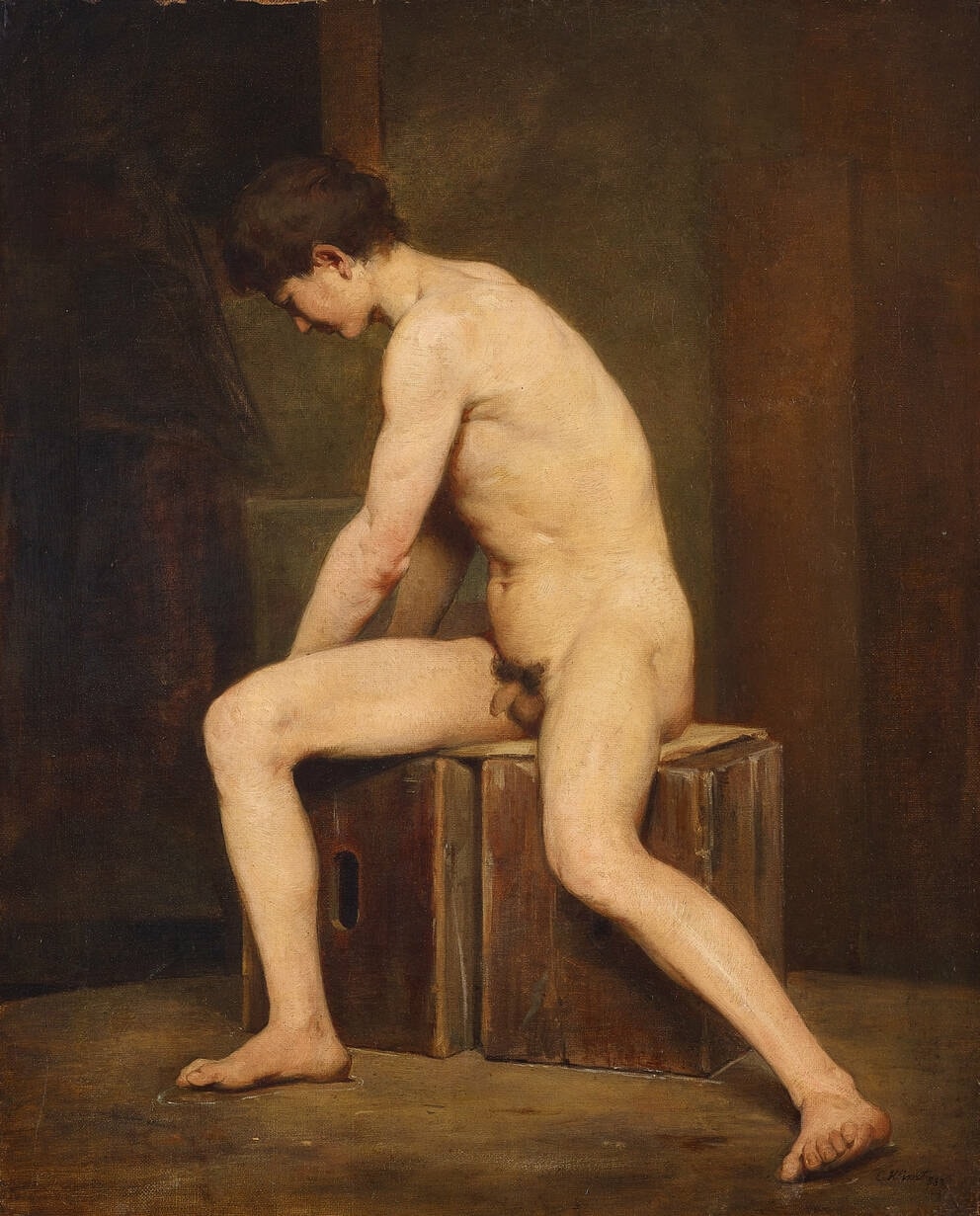
Painted in 1883, Sitting Nude Man Turned to the Left shows Klimt’s academic command of the male figure through a Naturalist/Realist approach. The model’s bowed head, splayed legs, and braced forearms form a taut triangular structure against rough wooden crates, where soft flesh meets hard geometry [1]. The restrained, earthy chiaroscuro isolates the body, turning a studio exercise into a quiet study of concentrated presence.

Study Print Studio

Create a personal study print

Build a companion study sheet around the part of this painting that speaks to you most. Choose a detail, shape an interpretation, and walk away with something personal and display-worthy.

Fast Facts

Year
1883
Medium
Oil on canvas
Dimensions
46 × 37 cm
Location
Leopold Museum, Vienna (permanent loan, private collection)
See all Gustav Klimt paintings in Vienna
Sitting Nude Man Turned to the Left by Gustav Klimt (1883) featuring Triangular Pose, Wooden Crates (Studio Props), Bowed Head, Braced Forearms and Diagonals

Click on any numbered symbol to learn more about its meaning

Meaning & Symbolism

Sitting Nude Man Turned to the Left is a manifesto of learned seeing. Klimt builds the picture on diagonals—the forearms leaning into the thighs, the open angle of the knees, the droop of the neck—so that the figure locks into a triangular chassis that is both stable and tense. The studio props do not recede as neutral furniture; their squared edges bite into skin, indexing weight at the ischium and along the lower back. This friction is the picture’s engine: soft tissue is modeled by light, but also by contact. The warm, ochre-to-umber ground and measured chiaroscuro articulate tendons at the popliteal fossa, the deltoid’s curve, and the subtle ridge of the scapula without idealization, aligning the work with the Leopold Museum’s classification of Naturalism | Realism within a Historicist academic framework 1. The head bowed toward the left knee compacts the thorax and abdomen, compressing forms and slowing breath; the study becomes less about nude display than about the body organizing itself around effort. As a document of 1883—the year Klimt finished at the Vienna School of Arts and Crafts and entered professional practice with the Künstler-Compagnie—the painting fixes a pivotal threshold: training completed, craft certified, vision still incubating 13. Within nineteenth-century pedagogy, male life studies were the crucible for mastering proportion, foreshortening, and the translation of weight into surface; Klimt’s canvas fulfills those objectives with sober precision 4. Yet its affect exceeds curriculum. The unadorned backdrop and the vertical plank sliding up behind the torso function like silencers, stripping away anecdote so the eye reads only mass, temperature, and balance. The model is turned outward to the left, but the gesture folds inward: shoulders roll, gaze drops, arms draw close. That contradiction—outward turn, inward pressure—gives the figure psychological density. It is the same tension that will animate Klimt’s later subjects, where pose and pattern choreograph an interior state; here, before gold leaf and ornament, the grammar is already present in bone, muscle, and light 2. The meaning of Sitting Nude Man Turned to the Left, then, is not iconographic but procedural and humane: it declares that form is thought. The crates are not symbols but constraints that let the painter count weight; the triangular pose is not allegory but a tool for mapping energy; the earth palette is not mood-setting but a means to keep temperatures legible across skin. Nevertheless these academic means produce an ethical image of masculinity—as concentrated, contemplative presence rather than bravura display. Why Sitting Nude Man Turned to the Left is important is twofold: historically, it is a rare, self-dated anchor for Klimt’s student-period chronology, one of a small group of early nude studies; artistically, it shows the exacting observational matrix that underlies the later Secessionist splendor, proving that Klimt’s eventual symbolism rested on a precise, rigorously trained eye 132.

Explore Deeper with AI

Ask questions about Sitting Nude Man Turned to the Left

Popular questions:

Powered by AI • Get instant insights about this artwork

💬 Ask questions about this artwork!

Interpretations

Pedagogy and the Male Body

Read as a document of 19th‑century pedagogy, the canvas shows how the male body served as a didactic instrument: a site to test foreshortening, proportion, and the translation of weight into surface. The seated pose compacts the thorax and flexes the hips, activating landmarks—scapula, deltoid, popliteal fossa—that teachers expected students to render with measured chiaroscuro. The timing matters: 1883 coincides with Klimt’s completion of studies at the Vienna School of Arts and Crafts and his entry into professional practice, so the work consolidates curricular objectives at a threshold moment 12. Later exhibitions on the male nude underscore this academic function, reminding us that such images were first and foremost exercises in seeing, not yet vehicles for symbolism or narrative 4.

Source: Leopold Museum; Belvedere archive; Artmagazine (Naked Men exhibition)

Material Intelligence and Contact

Klimt’s handling of oil—earth pigments modulated across a warm ground—performs a kind of material empiricism. Flesh is not idealized glaze; it is built through small temperature shifts and the index of contact: where crate edges press into skin, chroma cools, contours harden, and planes tilt. This is Naturalism not as style label but as method, calibrated to how light, pressure, and support shape tissue in real time. The studio apparatus becomes a measuring device, enabling the painter to count weight along the ischium and lower back. Such method foregrounds mimesis over decorum, prefiguring later virtuosity by proving that Klimt’s future symbolism rests on a technically exacting substrate 1.

Source: Leopold Museum

Rethinking Masculinity

Rather than heroic display, the painting frames masculinity as concentration and inwardness: gaze lowered, shoulders rolled, limbs drawing mass toward the core. This contradicts the period’s exhibitionist templates for the male nude while aligning with curatorial reappraisals that read 19th‑century male bodies as sites of vulnerability and self-scrutiny, not only virility 4. Within the Leopold’s classification of Naturalism/Realism, such a stance is ethical as much as optical: observation refuses bravura idealization and instead offers contemplative presence as a mode of male strength 1. The image thus anticipates later Viennese modernism’s psychological turn, but achieves it with bones, muscles, and light rather than ornament.

Source: Leopold Museum; Artmagazine (Naked Men exhibition)

Threshold Work: From School to Secession

As a self-dated study from 1883, the canvas captures Klimt between systems: still within Historicist-academic protocols, already crafting the compositional tensions that will animate the Secession years. The year marks both the end of formal training and the founding of the Künstler‑Compagnie, tying this nude to a workshop ethos of precision and commission-ready craft 12. Biographical arcs often leap from student to “Golden Phase,” but this work shows the hinge: pose as structural grammar, surface as disciplined notation. The later symbolism and gold ground do not replace this matrix; they ride on it, confirming that Klimt’s mature originality is inseparable from the training that formed his eye 15.

Source: Leopold Museum; Belvedere archive; Britannica

Comparative Lens: The 1883 Male Nude at the Belvedere

Placed beside the Belvedere’s 1883 "Male Nude," this study reveals a consistent academic program: naturalistic modeling, sparse backdrops, and poses engineered to expose key anatomical junctures. Yet the Leopold canvas intensifies the mechanics of support—crates and plank—as active constraints, turning contact into form. The comparison shows Klimt testing multiple pictorial recipes in the same year: one prioritizing a standing/classical formula, the other a seated, weight-bearing configuration. Both attest that before ornament, Klimt’s project was an inquiry into how bodies occupy space and how paint can track that occupation with economy and precision 13.

Source: Leopold Museum; Belvedere (Google Arts & Culture partner page)

Studio as Device: Medium Reflexivity

The painting thematizes its own making. Crates, a vertical plank, and a neutral wall are not backdrop but instruments that discipline the pose, strip anecdote, and reveal mass and balance. In doing so, the picture becomes about the conditions of representation: how to stabilize a living model, how to register pressure, how to keep temperatures legible across skin without narrative distraction. Such medium reflexivity keeps the work within Historicist schooling while already practicing a modernist self-awareness: art that shows its scaffolding. This is why the image reads as procedural and humane—declaring, in effect, that form is thought, and that thinking is visible in the studio’s plain mechanics 1.

Source: Leopold Museum

Related Themes

About Gustav Klimt

Gustav Klimt (1862–1918), co-founder of the Vienna Secession, pivoted from controversial public commissions to a decorative-symbolist language in his Golden Period. Drawing on Byzantine mosaics and modern design, he fused opulent surfaces with psychological intensity. By 1908–09, he transformed scandal into canon, and The Kiss became Vienna’s emblem of modern love.
View all works by Gustav Klimt

More by Gustav Klimt

Portrait of Adele Bloch-Bauer I by Gustav Klimt

Portrait of Adele Bloch-Bauer I

Gustav Klimt (1907)

Gustav Klimt’s Portrait of Adele Bloch-Bauer I stages its sitter as a <strong>secular icon</strong>—a living presence suspended in a field of gold that converts space into <strong>pattern and power</strong>. The naturalistic face and hands emerge from a reliquary-like cascade of eyes, triangles, and tesserae, turning light, ornament, and status into the painting’s true subjects <sup>[1]</sup><sup>[2]</sup>.

Sunflower by Gustav Klimt

Sunflower

Gustav Klimt (1907/1908)

Gustav Klimt’s Sunflower turns a single bloom into a <strong>monumental, figure-like presence</strong>. A tapering stack of broad, drooping leaves rises from a <strong>mosaic-like carpet of round blossoms</strong>, crowned by a gold-flecked disc that glows against a cool, stippled field. The work fuses <strong>portrait, icon, and landscape</strong> into one emblem of vitality and quiet sanctity <sup>[1]</sup><sup>[2]</sup>.

Cottage Garden with Sunflowers by Gustav Klimt

Cottage Garden with Sunflowers

Gustav Klimt (1906–1907 (signed 1907))

Cottage Garden with Sunflowers is a square, horizonless field of blooms where a vertical column of <strong>sunflowers</strong> anchors an all-over weave of color and pattern. Klimt fuses <strong>ornament and nature</strong>, turning a humble Litzlberg cottage plot into a radiant matrix of cyclical life and renewal <sup>[1]</sup><sup>[4]</sup><sup>[5]</sup>.

The Kiss by Gustav Klimt

The Kiss

Gustav Klimt (1908 (completed 1909))

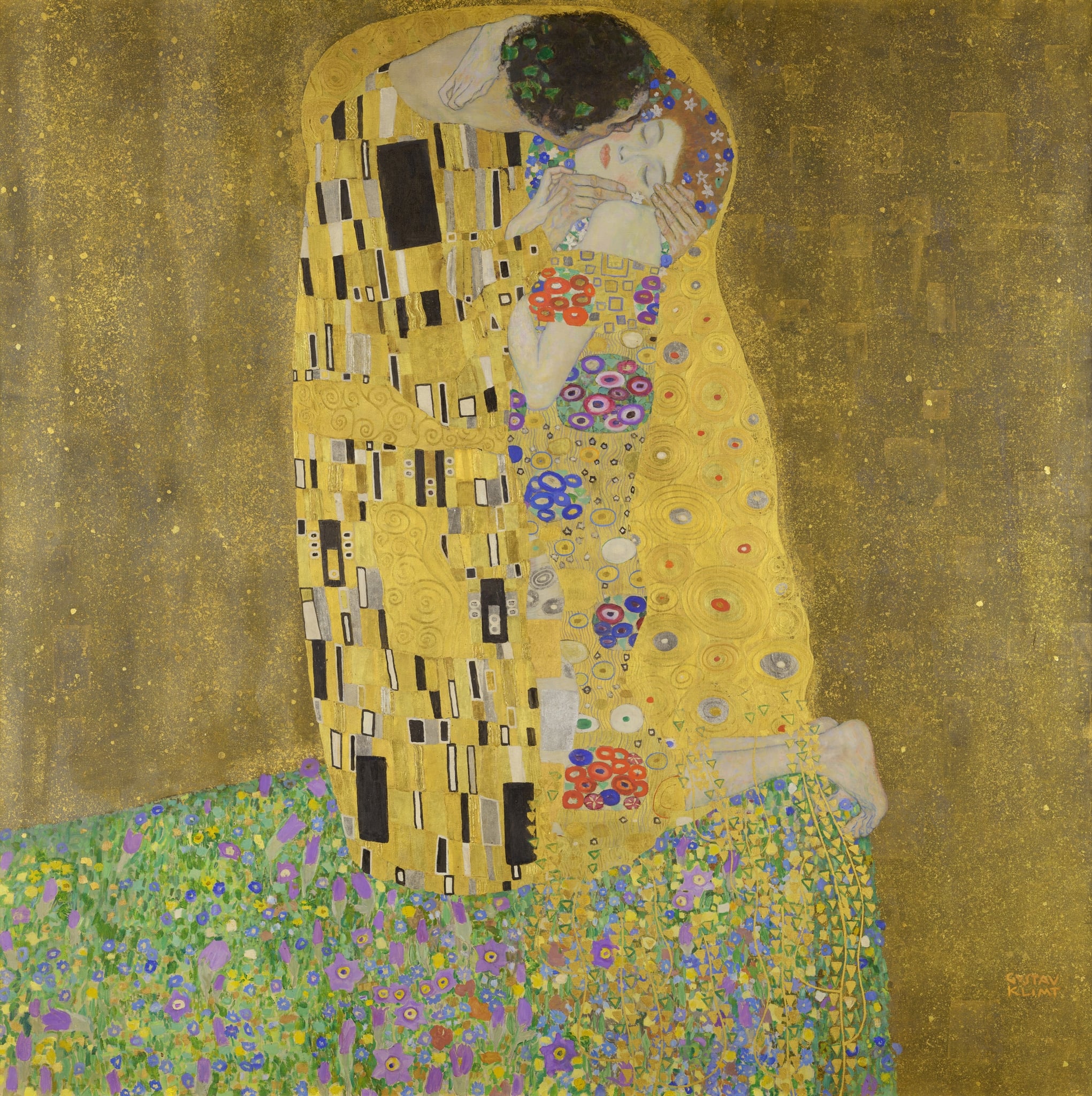
The Kiss stages human love as a <strong>sacred union</strong>, fusing two figures into a single, gold-clad form against a timeless field. Klimt opposes <strong>masculine geometry</strong> (black-and-white rectangles) to <strong>feminine organic rhythm</strong> (spirals, circles, flowers), then resolves them in radiant harmony <sup>[1]</sup><sup>[2]</sup>.
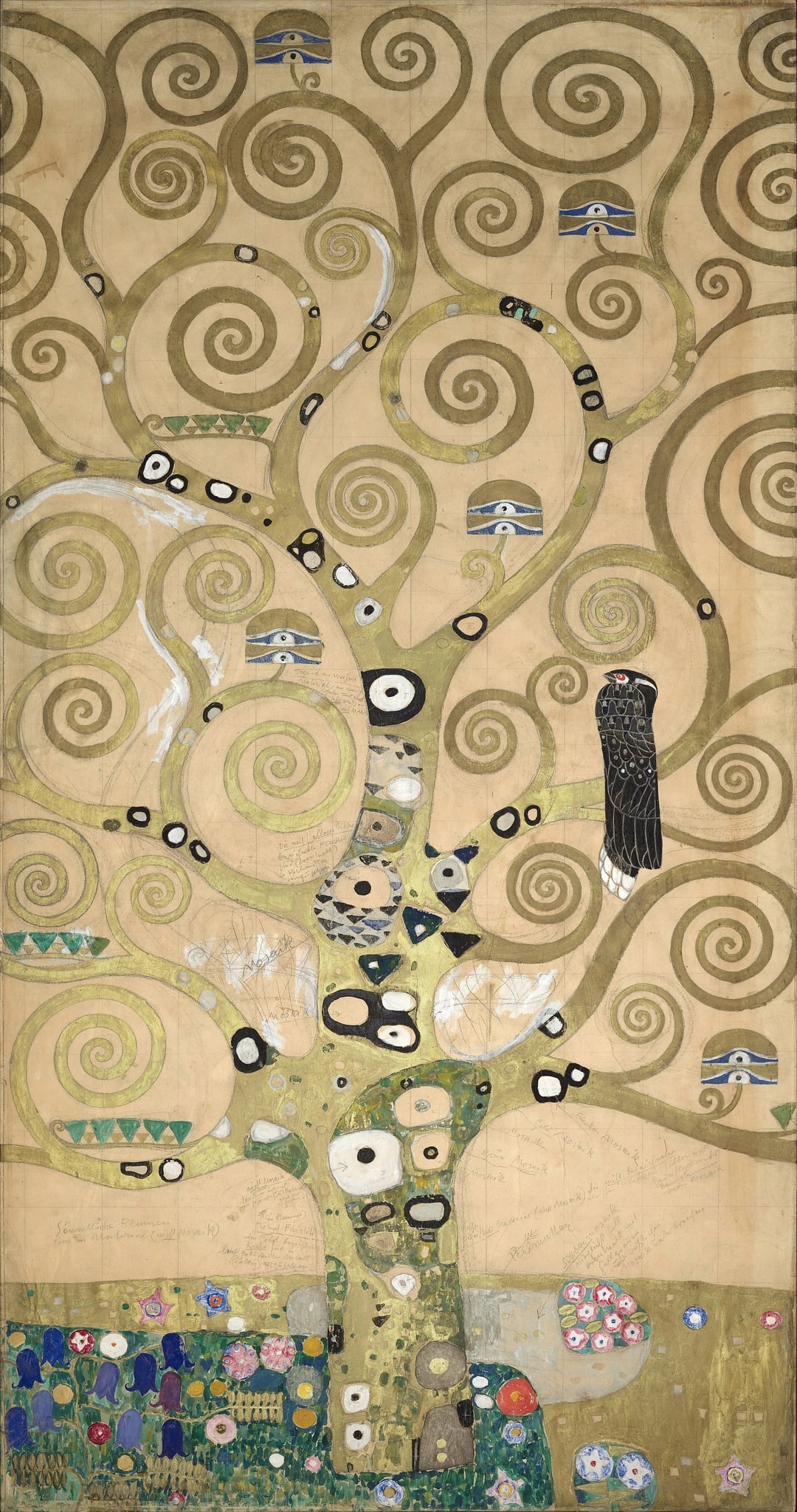
The Tree of Life by Gustav Klimt

The Tree of Life

Gustav Klimt (1910–1911 (design; mosaic installed 1911))

Gustav Klimt’s The Tree of Life crystallizes a <strong>cosmological axis</strong> in a gilded ornamental language: a rooted trunk erupts into <strong>endless spirals</strong>, embedded with <strong>eye-like rosettes</strong> and shadowed by a black, red‑eyed bird. Designed as part of the Stoclet dining‑room frieze, it fuses <strong>symbolism and luxury materials</strong> to link earthly abundance with timeless transcendence <sup>[1]</sup><sup>[2]</sup>.
The Kiss (Lovers) by Gustav Klimt

The Kiss (Lovers)

Gustav Klimt (1907–1908 (Belvedere lists 1908/09))

The Kiss (Lovers) crystallizes Klimt’s <strong>Golden Period</strong> ideal: erotic union staged as a sacred vision. Two bodies fuse beneath a single golden mantle, poised on a flowered ledge at the brink of the unknown, where <strong>pattern becomes symbol</strong> and intimacy becomes icon.