Litzlbergkeller

by Gustav Klimt

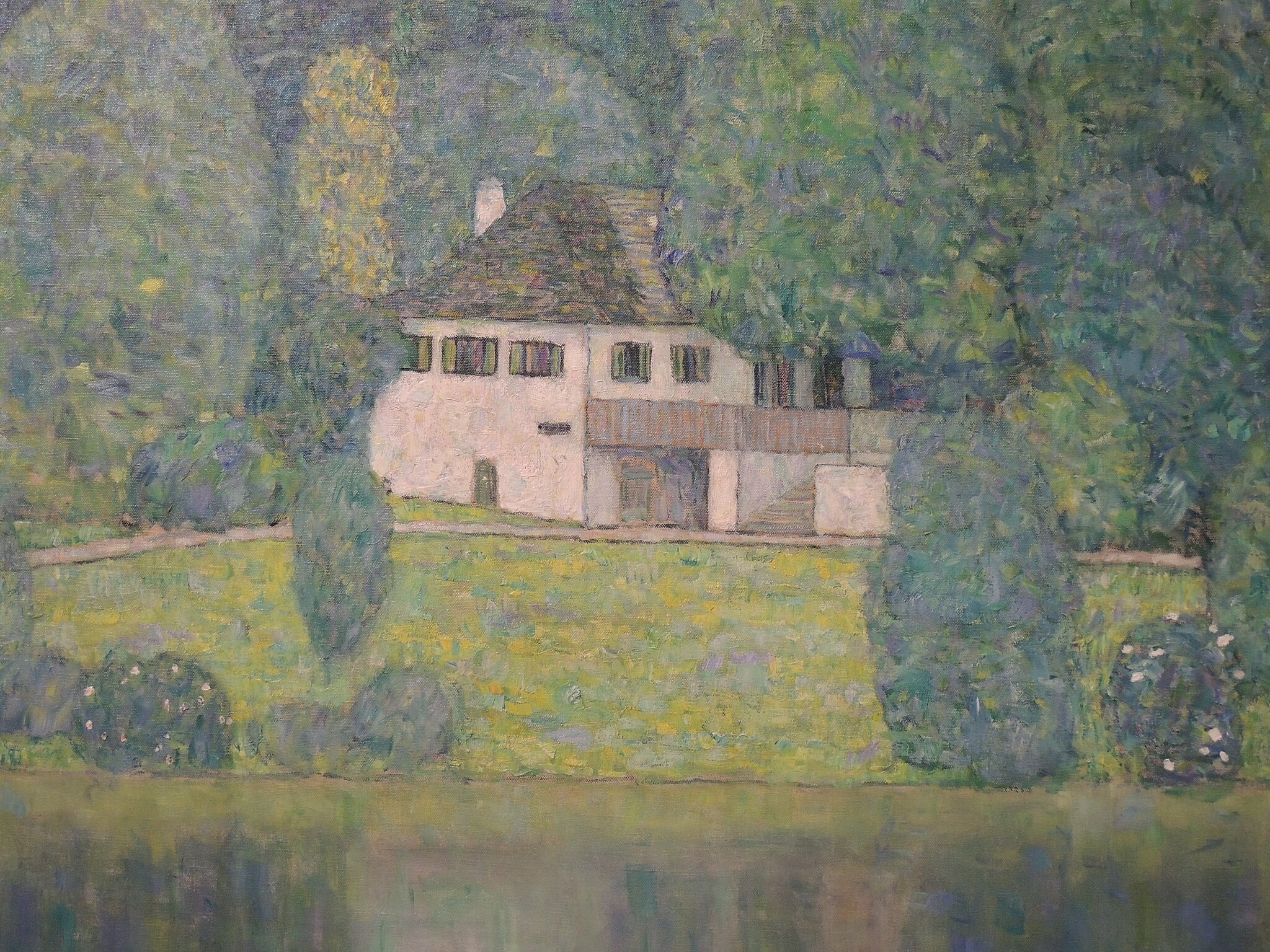
Litzlbergkeller distills a lakeside inn into a square, shimmering field where the house’s pale rectangle and window rhythm quietly answer the vertical screen of trees and the calm band of water below. Klimt fuses geometry and foliage into a decorative, contemplative refuge, converting observation into patterned memory [1][2].

Study Print Studio

Create a personal study print

Build a companion study sheet around the part of this painting that speaks to you most. Choose a detail, shape an interpretation, and walk away with something personal and display-worthy.

Fast Facts

Year
1915–1916
Medium
Oil on canvas
Dimensions
110 × 110 cm
Location
Private collection
See all Gustav Klimt paintings in Vienna
Litzlbergkeller by Gustav Klimt (1915–1916) featuring Pale rectilinear house, Window rhythm, Vertical tree screen, Veranda/railing band

Click on any numbered symbol to learn more about its meaning

Meaning & Symbolism

Klimt organizes Litzlbergkeller as a tension between planar order and vegetal flux. The architecture arrives as a pale, rectilinear block crowned by a low roof, its windows marching in a measured cadence. That cadence is immediately counter‑pointed by the vertical arbor of trees that flank and partly mask the façade, turning the trees into a rhythmic screen that both conceals and reveals. A narrow shore path and the long veranda introduce stabilizing horizontal bands, while the reflective lake forms a quiet threshold at the bottom edge—an intentional distance that keeps the viewer outside the scene. Across the surface, small, tessellating strokes of greens, violets, and ochres deny precise leaf or blade, so the eye registers a living textile before it assembles depth. This is not topography; it is designed perception, where the human‑made is willingly absorbed into nature’s patterned mantle 26. Such orchestration reflects Klimt’s mature working method at the Attersee. By 1915–16 he almost exclusively adopted the square, employing a viewfinder‑like crop and often consulting correspondence cards or photographs to refine the frame; Litzlbergkeller’s tight cut—no sky, a clipped shore, and a shallow band of water—betrays this deliberate selection 234. The result is a modern optics without doctrinaire pointillism: a surface that shimmers, slows looking, and privileges lateral scanning over recession. The absence of figures intensifies the mood; even the central stair and open veranda invite no entry. Commissioned within the Primavesi circle that cultivated Gesamtkunstwerk ideals, the painting aligns with Secessionist ambitions to reconcile art, design, and life: windows echo tree‑trunks, masonry echoes shoreline, and brushwork knits the ensemble into an integrated field 21. In the wartime context, this compositional privacy reads as a form of symbolic shelteran idyll glimpsed from across the water, where culture and nature momentarily balance. That is why Litzlbergkeller is important: it condenses Klimt’s late landscape project into a lucid pattern of screens and bands, demonstrating how a square of oil paint can hold refuge, memory, and modern design thinking at once 46.

Explore Deeper with AI

Ask questions about Litzlbergkeller

Popular questions:

Powered by AI • Get instant insights about this artwork

💬 Ask questions about this artwork!

Interpretations

Formal Analysis: The Square as Decorative Engine

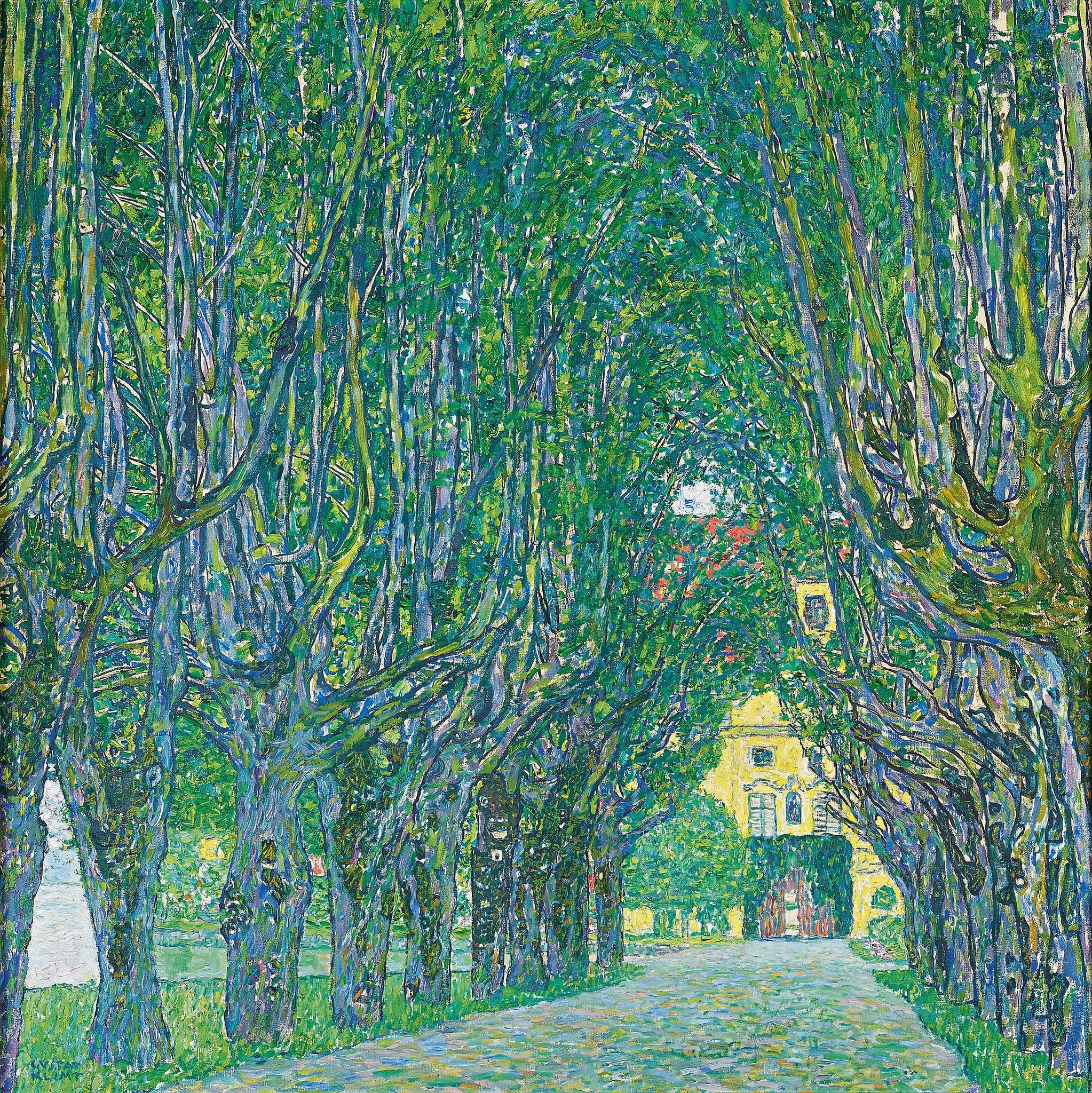
Klimt’s late landscapes operationalize the square as a device that compresses depth into pattern, promoting lateral scanning over perspectival recession. In Litzlbergkeller, the foliage operates like a pictorial scrim, a near-textile field from which the house only gradually emerges. This aligns with Evelyn Benesch’s account of Klimt’s push toward decorative abstraction: the vertical tree “colonnade” and window rhythms are not secondary description but primary patterning that structures the field. Rather than doctrinaire pointillism, Klimt assembles micro-strokes into a mosaic that slows perception, making the act of looking itself the subject. Comparable strategies in The Park reinforce how the square fosters a wall-like image that toggles between surface and glimpse—here, a screened architecture measured against vegetal cadence 45.

Source: Evelyn Benesch (via Sotheby’s scholarship); Klimt-Database

Historical Context: Patronage, Werkstätte, and Designed Living

Commissioned by Otto Primavesi, a key backer of the Wiener Werkstätte, Litzlbergkeller sits within a network that prized the Gesamtkunstwerk—a seamless weave of art, design, and life. The painting’s calibrated correspondences—window rhythms echoing trunks, masonry echoing shoreline—read as a pictorial analogue to Werkstätte ideals of integrated surfaces and repeated motifs. The Primavesi link also clarifies the image’s cultivated privacy: leisure architecture is present, yet socially hushed, aligning with the family’s taste for refined retreat rather than public spectacle. The Leopold Museum notes both the commission and Klimt’s unusually tight crop, suggesting a conception shaped as much by design thinking as by on-site observation. Patronage here isn’t background; it’s a blueprint for how nature and culture are made to cohere within the square 21.

Source: Leopold Museum (online entry; press image list)

Method & Mediation: Viewfinders, Postcards, and Modern Optics

The extreme cropping—no sky, clipped shore—betrays a mediated gaze. The Leopold Museum points to Klimt’s use of correspondence cards or photographs as templates; Christie’s adds his reliance on a handheld viewfinder and optical aids. Rather than plein-air transparency, Litzlbergkeller is an image pre-edited by devices: the lake becomes a narrow threshold, the trees a planar screen, the house a rectilinear insert. This is “modern optics” without dogma, an artisanal remix of photographic framing and painterly tessellation. The square acts like a camera plate; the arboreal grid like a halftone that withholds legibility until the eye lingers. In this reading, Klimt stages a dialogue between mechanical framing and sensuous facture, crafting a landscape about how seeing is constructed as much as what is seen 23.

Source: Leopold Museum (online entry); Christie’s catalog note

Symbolic Reading: Wartime Pastoral and the Ethics of Distance

Painted in 1915–16, the work’s compositional reticence—absence of figures, interposed screen, a water band as threshold—reads as a symbolic ethics of distance during war. Sotheby’s scholarship stresses that Klimt’s Attersee paintings transform observed nature into mood rather than reportage; here, the mood is a private refuge held at arm’s length. The veranda and steps promise hospitality yet remain unentered, converting leisure into shelter rather than society. The pastoral is not escapism but a deliberately moderated space where culture and nature balance without collapse. Klimt’s decorative surface performs a quieting function: pattern absorbs the world’s noise, producing a still field that dignifies looking and recuperation amid crisis 42.

Source: Sotheby’s scholarship; Leopold Museum (online entry)

Place & Memory: Genius Loci and the Return to Attersee

The Klimt Foundation’s 2019 presentation of the original painting at the Attersee—its genius loci—reframed Litzlbergkeller as a site-specific memory device. Seeing the work near its motif underscores how Klimt converts local architecture into a universalizable pattern: the picture’s screening trees and measured bands become an abstract grammar of shore-life rather than a single viewpoint. Displayed back at the lake, the painting functions almost archaeologically, testing the fidelity of memory against place while confirming that Klimt’s aim was never topographic exactitude. The return amplifies the painting’s threshold logic: even on site, the viewer is kept outside, reminded that Klimt’s Attersee is a constructed idyll—an image of belonging deferred into pattern and rhythm 65.

Source: Klimt Foundation; Klimt-Database

Related Themes

About Gustav Klimt

Gustav Klimt (1862–1918), co-founder of the Vienna Secession, pivoted from controversial public commissions to a decorative-symbolist language in his Golden Period. Drawing on Byzantine mosaics and modern design, he fused opulent surfaces with psychological intensity. By 1908–09, he transformed scandal into canon, and The Kiss became Vienna’s emblem of modern love.
View all works by Gustav Klimt

More by Gustav Klimt

Portrait of Adele Bloch-Bauer I by Gustav Klimt

Portrait of Adele Bloch-Bauer I

Gustav Klimt (1907)

Gustav Klimt’s Portrait of Adele Bloch-Bauer I stages its sitter as a <strong>secular icon</strong>—a living presence suspended in a field of gold that converts space into <strong>pattern and power</strong>. The naturalistic face and hands emerge from a reliquary-like cascade of eyes, triangles, and tesserae, turning light, ornament, and status into the painting’s true subjects <sup>[1]</sup><sup>[2]</sup>.

Sunflower by Gustav Klimt

Sunflower

Gustav Klimt (1907/1908)

Gustav Klimt’s Sunflower turns a single bloom into a <strong>monumental, figure-like presence</strong>. A tapering stack of broad, drooping leaves rises from a <strong>mosaic-like carpet of round blossoms</strong>, crowned by a gold-flecked disc that glows against a cool, stippled field. The work fuses <strong>portrait, icon, and landscape</strong> into one emblem of vitality and quiet sanctity <sup>[1]</sup><sup>[2]</sup>.

Cottage Garden with Sunflowers by Gustav Klimt

Cottage Garden with Sunflowers

Gustav Klimt (1906–1907 (signed 1907))

Cottage Garden with Sunflowers is a square, horizonless field of blooms where a vertical column of <strong>sunflowers</strong> anchors an all-over weave of color and pattern. Klimt fuses <strong>ornament and nature</strong>, turning a humble Litzlberg cottage plot into a radiant matrix of cyclical life and renewal <sup>[1]</sup><sup>[4]</sup><sup>[5]</sup>.

The Kiss by Gustav Klimt

The Kiss

Gustav Klimt (1908 (completed 1909))

The Kiss stages human love as a <strong>sacred union</strong>, fusing two figures into a single, gold-clad form against a timeless field. Klimt opposes <strong>masculine geometry</strong> (black-and-white rectangles) to <strong>feminine organic rhythm</strong> (spirals, circles, flowers), then resolves them in radiant harmony <sup>[1]</sup><sup>[2]</sup>.
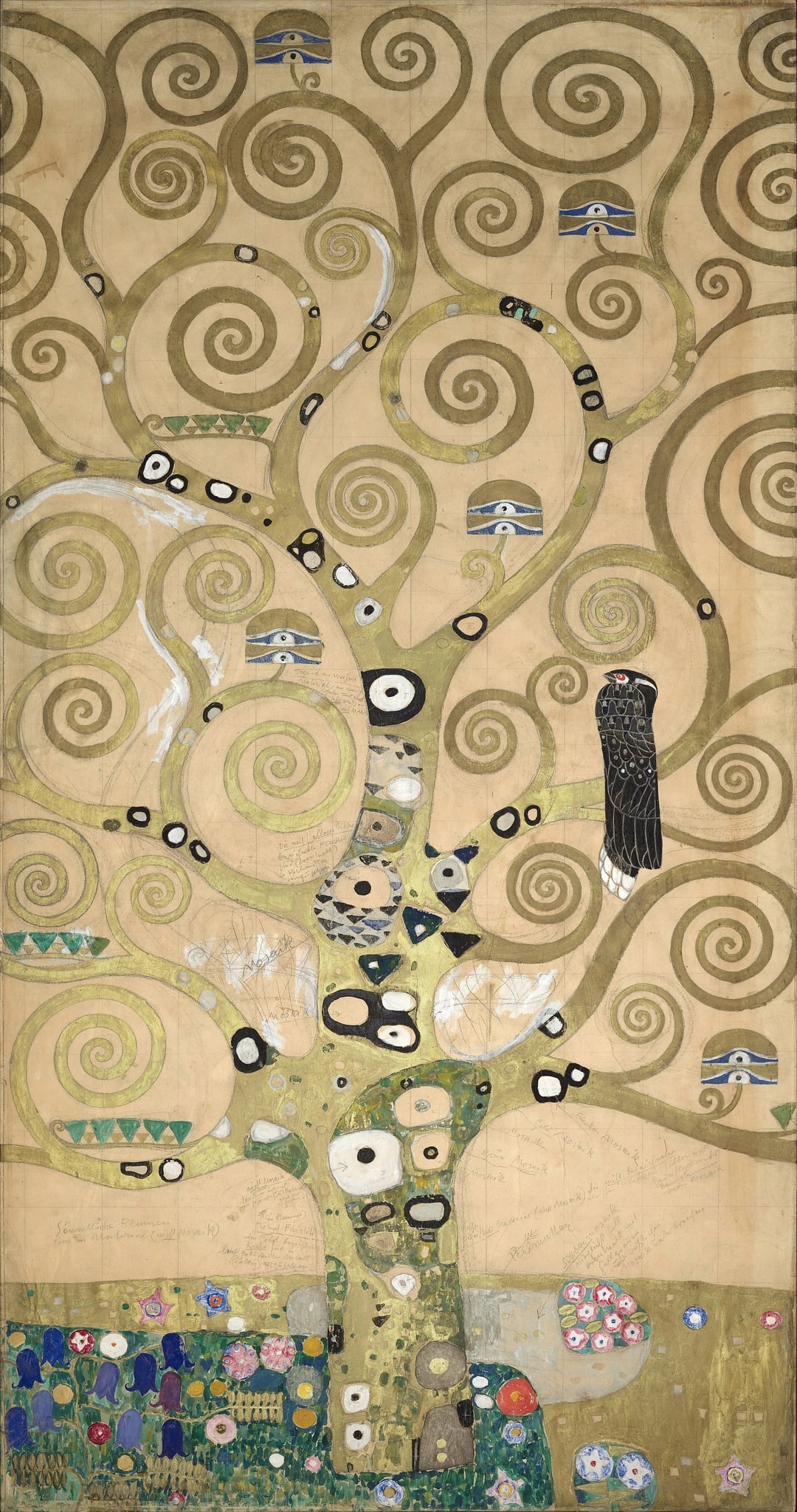
The Tree of Life by Gustav Klimt

The Tree of Life

Gustav Klimt (1910–1911 (design; mosaic installed 1911))

Gustav Klimt’s The Tree of Life crystallizes a <strong>cosmological axis</strong> in a gilded ornamental language: a rooted trunk erupts into <strong>endless spirals</strong>, embedded with <strong>eye-like rosettes</strong> and shadowed by a black, red‑eyed bird. Designed as part of the Stoclet dining‑room frieze, it fuses <strong>symbolism and luxury materials</strong> to link earthly abundance with timeless transcendence <sup>[1]</sup><sup>[2]</sup>.
The Kiss (Lovers) by Gustav Klimt

The Kiss (Lovers)

Gustav Klimt (1907–1908 (Belvedere lists 1908/09))

The Kiss (Lovers) crystallizes Klimt’s <strong>Golden Period</strong> ideal: erotic union staged as a sacred vision. Two bodies fuse beneath a single golden mantle, poised on a flowered ledge at the brink of the unknown, where <strong>pattern becomes symbol</strong> and intimacy becomes icon.