Pallas Athena

by Gustav Klimt

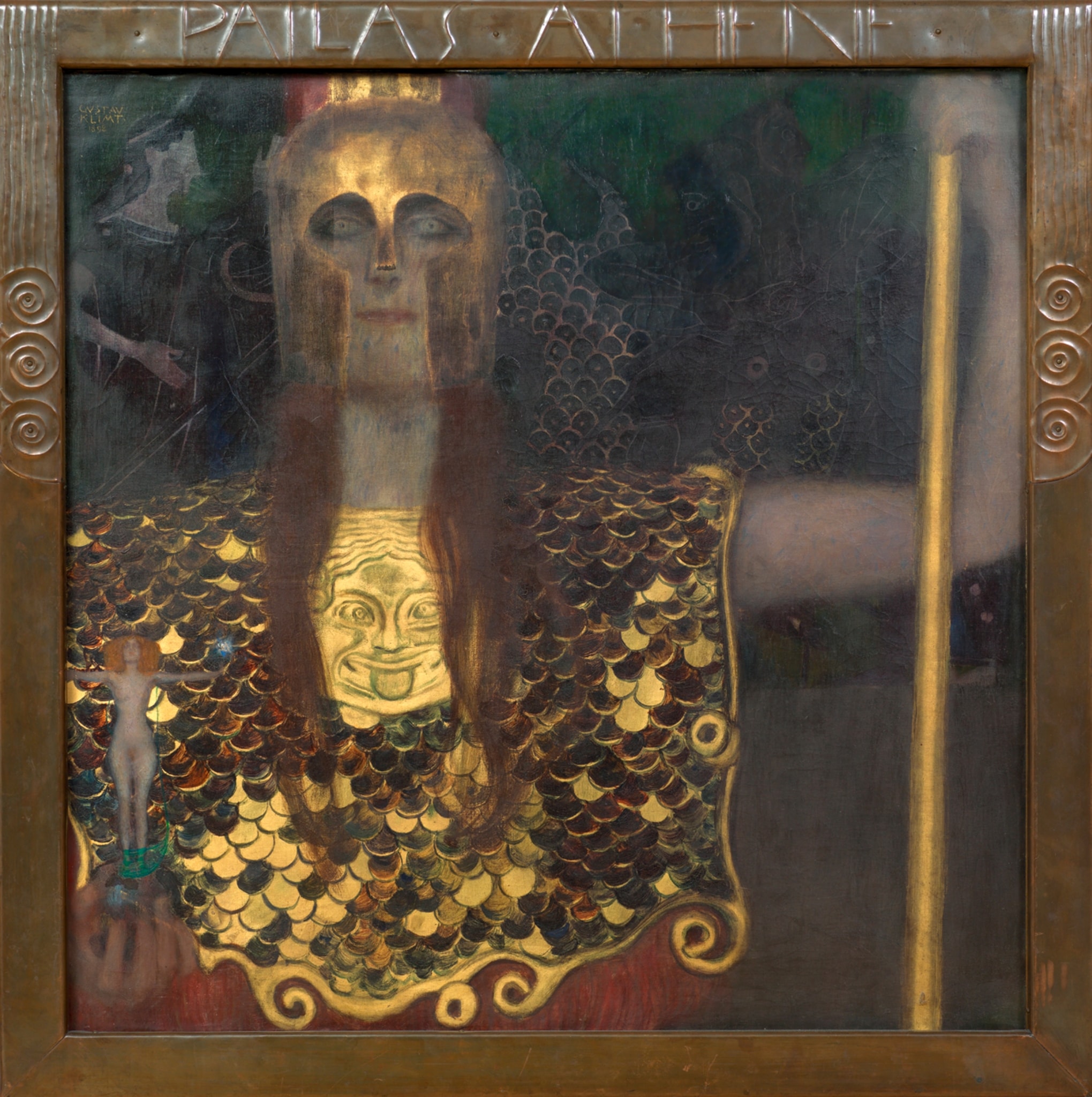
Pallas Athena confronts the viewer as a frontal icon of power: helmeted, impassive, and armored in gleaming scale aegis crowned by a gorgoneion. Klimt fuses archaic authority with modern ornament to proclaim Vienna Secession ideals—reason, strategy, and artistic truth held in a single, implacable image [1][2].

Study Print Studio

Create a personal study print

Build a companion study sheet around the part of this painting that speaks to you most. Choose a detail, shape an interpretation, and walk away with something personal and display-worthy.

Fast Facts

Year
1898
Medium
Oil on canvas
Dimensions
75 × 75 cm
Location
Wien Museum, Vienna
See all Gustav Klimt paintings in Vienna
Pallas Athena by Gustav Klimt (1898) featuring Corinthian helmet with nose-guard, Spear, Aegis (scale armor), Gorgoneion (Medusa’s head)

Click on any numbered symbol to learn more about its meaning

Meaning & Symbolism

Klimt constructs Pallas Athena as a deliberate collision of antiquity and the present, making frontality a weapon. The helmet with nose-guard bisects the masklike face; the eyes meet us without yielding, while the vertical shaft of the spear at the right edge fixes the picture’s authority in space. Across her chest, the metallic shimmer of the scale aegis operates like a mosaic field—flat, ornamental, and insistently modern—yet it bears the archaic gorgoneion with protruding tongue, an apotropaion that both protects and threatens. In 1898 Vienna, that tongue could read as a provocative retort to academic gatekeepers, a defensive and offensive sign rolled into one 2. Klimt’s paint handling intensifies the effect: the hard, iconic planes of the head and armor collide with a softer, atmospheric darkness, so that Athena appears to precipitate from shadow as a principle of luminous order. The bronze frame Klimt designed, inscribed “PALLAS ATHENE,” extends this rhetoric into the object’s threshold; even the border becomes part of the goddess’s charged field 2. Klimt embeds a second, more polemical layer through quotation and scale play. Behind Athena, barely legible in the dusk of the background, a mythic struggle unfolds: Herakles wrestles Triton, adapted from an Attic hydria attributed to the Painter of Vatican G 43 (Toledo Museum of Art) 256. By ghosting this archaic combat behind the goddess, Klimt converts myth into allegory for the Secession’s contemporary “struggle” with entrenched institutions; Athena presides as arbiter of strategy and right order. In her raised right hand, a miniature nude balances atop a sphere. The Klimt-Database identifies her as Nike, while also noting her visual kinship to Klimt’s emerging icon of Nuda Veritas—a conflation that declares victory through naked truth, the Secession’s credo 2. The figure’s bright, mirror-like accent acts as a flash of truth in the painting’s nocturne, a signal to viewers that artistic clarity—not mere shock—is the goal. Contemporary critics recognized this combative clarity: even detractors admitted the picture’s new “golden” splendor and programmatic force, while supporters hailed a “genuine Secessionist goddess” 23. Formally, Klimt’s orchestration of flatness, pattern, and precious luster anticipates his mature synthesis of Byzantine glitter and Symbolist reserve. The square format, compressed space, and ornamental rhythms subordinate naturalism to emblem—Athena is not a narrative actor but a principle. This choice mattered historically. Shown at the Secession’s Second Exhibition in the new Olbrich building, the painting functioned like a frontispiece for a movement: a claim that art could be both archaic and new, sensual and severe, decorative and intellectually armed 123. It also telescopes Klimt’s own trajectory—from Ringstraße decorator to leader of a modern vanguard—by placing authority in the image’s surface itself. The “golden” luster reads not as material display but as a metaphoric currency for artistic value, aligning Klimt’s craft with the precious while refusing academic illusionism 12. Thus the meaning of Pallas Athena is not only iconographic; it is procedural. It models how modern art authorizes itself—by strategically reworking the past to defend a future. That is why Pallas Athena is important: it crystallizes the Vienna Secession’s ethos into a single, unforgettable emblem—beauty armed by intellect, tradition weaponized for renewal, and truth held aloft as victory 124.

Explore Deeper with AI

Ask questions about Pallas Athena

Popular questions:

Powered by AI • Get instant insights about this artwork

💬 Ask questions about this artwork!

Interpretations

Exhibition Politics (Propaganda & Ideology)

Displayed at the Secession’s Second Exhibition in Olbrich’s brand-new building, Pallas Athene functioned as a calibrated piece of institutional theater: a frontal emblem at the movement’s architectural altar. The Klimt-designed frame—inscribed “PALLAS ATHENE”—extends the image’s claim-making into the gallery’s threshold, transforming painting into manifesto-object. In this setting, Athena’s rigid spear and gorgoneion became not just attributes but programmatic signals, aligning the Secession’s public identity with disciplined order and strategic defiance. Contemporary press noted its shock and “golden” splendor, evidence that the work operated as propaganda for a modern taste while acknowledging its own polemical edge. The picture thus stages authority at the very site of cultural power: the exhibition hall itself 1236.

Source: Wien Museum; Klimt-Database (Kallir Research Institute); Wien Museum press dossier; Christie’s

Quotation as Strategy (Originality & Appropriation)

Klimt’s ghosted scene of Herakles wrestling Triton—lifted from an Attic hydria attributed to the Painter of Vatican G 43—does not illustrate myth so much as instrumentalize it. Scaled, dimmed, and relegated to a nocturnal frieze, the archaic citation becomes a structural allegory for the Secession’s struggle, while Athena presides as guarantor of right order. Likewise, the tiny nude in her hand reads as Nike but flashes the mirror-sign of Nuda Veritas: a purposeful conflation that turns quotation into a modern badge of authorship. Such appropriations advertise Klimt’s method: selective, legible, and polemically placed, declaring that modern originality emerges by curating and re-scaling the past to meet present needs 25.

Source: Klimt-Database (Kallir Research Institute); Beazley Archive Pottery Database

Gendered Armature (Gender & the Monstrous Feminine)

Athena’s “masklike” face and uncompromising gaze re-code femininity as tactical restraint, while the gorgoneion’s protruding tongue weaponizes the monstrous feminine as apotropaic display. Klimt compounds the charge by miniaturizing a nude—Nike/Nuda Veritas—into a hand-held standard, rendering female nudity a concentrated emblem of victory-through-truth rather than passivity. The result is a double bind made visible: female power is at once armored and ornamented; truth is both exposed and mediated by the goddess’s grasp. This dialectic unsettled 1898 viewers, who registered both disapproval and awe, and it forecasts Klimt’s later explorations of erotic candor fused with symbolic severity 2.

Source: Klimt-Database (Kallir Research Institute)

Material Rhetoric (Medium Reflexivity)

Despite its “golden” splendor, the work is catalogued as oil on canvas, not gold-leafed—meaning Klimt simulates preciousness to argue that value resides in pictorial surface, not costly matter. The metallic scale-aegis behaves like a mosaic field—flat, ornamental, insistently modern—while the custom bronze-toned frame bearing the title folds architecture and text into the artwork’s communicative system. This is medium reflexivity by design: frame, luster, and planar flatness become content, modeling how modern art declares its worth without academic illusionism or literal gilding. It is a lesson the Secession meant to broadcast: craft a new currency of value within the image itself 12.

Source: Wien Museum; Klimt-Database (Kallir Research Institute)

Reception as Meaning (Ideology & Criticism)

Period critics acknowledged the painting’s programmatic force even when resisting its style—an ambivalent chorus that effectively completed the work’s meaning in the public sphere. Reports cited its “golden helmet,” “cyan and golden scale aegis,” and uncompromising frontality, terms that mirror the picture’s self-assertive rhetoric. Supporters hailed a “genuine Secessionist goddess,” while detractors registered disapproval at its audacity: both responses confirm that Klimt engineered visibility and controversy as components of modern authorship. In this light, Pallas Athene reads as a feedback device between artwork and discourse, with reception functioning as the final ideological frame that secures Athena’s authority for the movement 23.

Source: Klimt-Database (Kallir Research Institute); Wien Museum press dossier

Formal Aggression (Urban Modernity)

Klimt mobilizes strict frontality and the vertical shaft of the spear as formal aggression, compressing space into an emblem that confronts viewers like a modern urban poster. This planar, high-contrast rhetoric anticipates the Secession’s embrace of graphic clarity and street-level address, translating ancient authority into a language of immediate impact. The square format and ornamental rhythms further suppress narrative in favor of signal: an image that operates as a civic sign in a culture of exhibitions, posters, and programmatic façades. As Klimt moved from Ringstraße decoration to vanguard leadership, such formal terseness became his trademark vehicle for modernity’s new publics 24.

Source: Klimt-Database (Kallir Research Institute); Britannica

Related Themes

About Gustav Klimt

Gustav Klimt (1862–1918), co-founder of the Vienna Secession, pivoted from controversial public commissions to a decorative-symbolist language in his Golden Period. Drawing on Byzantine mosaics and modern design, he fused opulent surfaces with psychological intensity. By 1908–09, he transformed scandal into canon, and The Kiss became Vienna’s emblem of modern love.
View all works by Gustav Klimt

More by Gustav Klimt

Portrait of Adele Bloch-Bauer I by Gustav Klimt

Portrait of Adele Bloch-Bauer I

Gustav Klimt (1907)

Gustav Klimt’s Portrait of Adele Bloch-Bauer I stages its sitter as a <strong>secular icon</strong>—a living presence suspended in a field of gold that converts space into <strong>pattern and power</strong>. The naturalistic face and hands emerge from a reliquary-like cascade of eyes, triangles, and tesserae, turning light, ornament, and status into the painting’s true subjects <sup>[1]</sup><sup>[2]</sup>.

Sunflower by Gustav Klimt

Sunflower

Gustav Klimt (1907/1908)

Gustav Klimt’s Sunflower turns a single bloom into a <strong>monumental, figure-like presence</strong>. A tapering stack of broad, drooping leaves rises from a <strong>mosaic-like carpet of round blossoms</strong>, crowned by a gold-flecked disc that glows against a cool, stippled field. The work fuses <strong>portrait, icon, and landscape</strong> into one emblem of vitality and quiet sanctity <sup>[1]</sup><sup>[2]</sup>.

Cottage Garden with Sunflowers by Gustav Klimt

Cottage Garden with Sunflowers

Gustav Klimt (1906–1907 (signed 1907))

Cottage Garden with Sunflowers is a square, horizonless field of blooms where a vertical column of <strong>sunflowers</strong> anchors an all-over weave of color and pattern. Klimt fuses <strong>ornament and nature</strong>, turning a humble Litzlberg cottage plot into a radiant matrix of cyclical life and renewal <sup>[1]</sup><sup>[4]</sup><sup>[5]</sup>.

The Kiss by Gustav Klimt

The Kiss

Gustav Klimt (1908 (completed 1909))

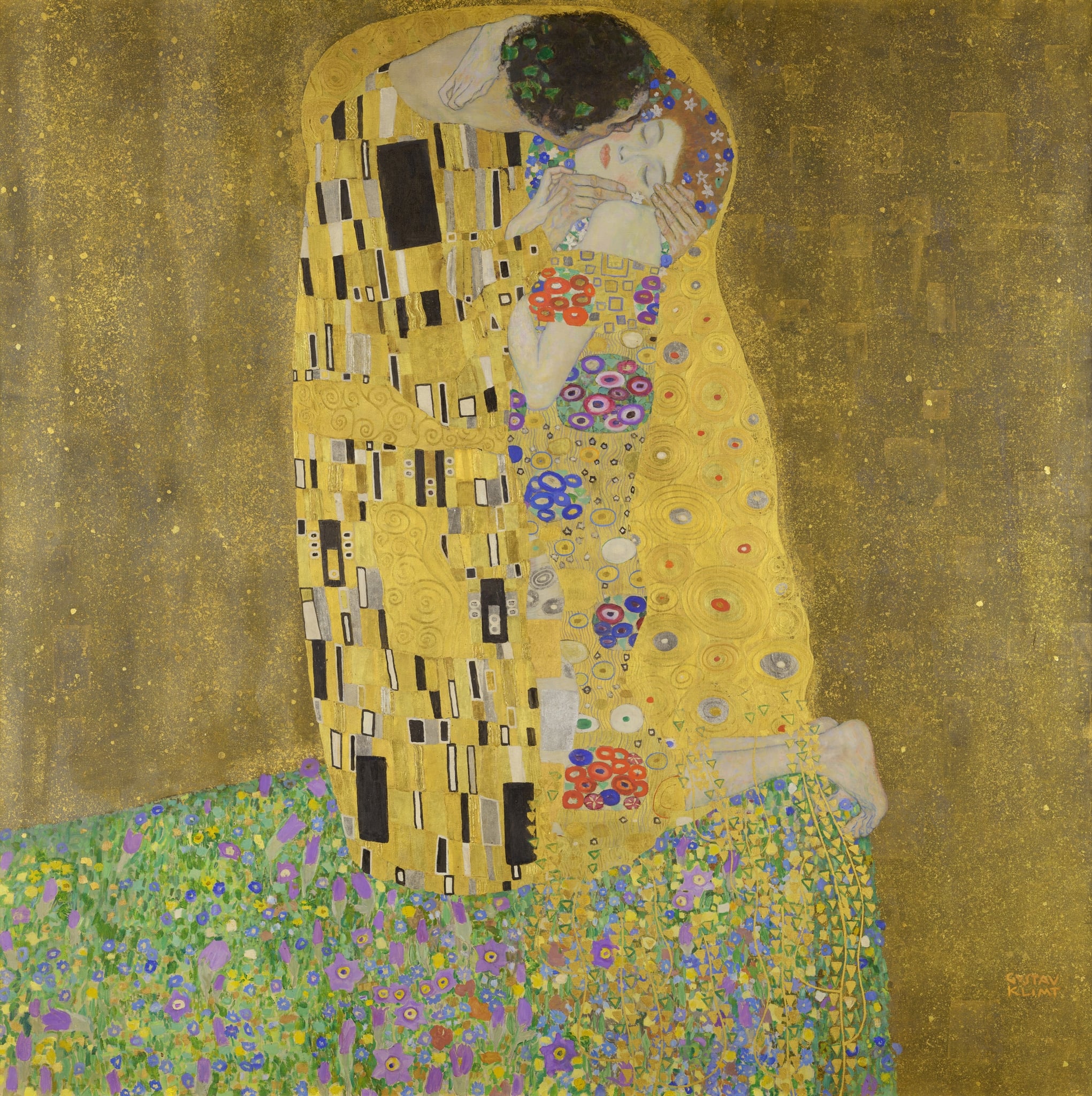
The Kiss stages human love as a <strong>sacred union</strong>, fusing two figures into a single, gold-clad form against a timeless field. Klimt opposes <strong>masculine geometry</strong> (black-and-white rectangles) to <strong>feminine organic rhythm</strong> (spirals, circles, flowers), then resolves them in radiant harmony <sup>[1]</sup><sup>[2]</sup>.
The Tree of Life by Gustav Klimt

The Tree of Life

Gustav Klimt (1910–1911 (design; mosaic installed 1911))

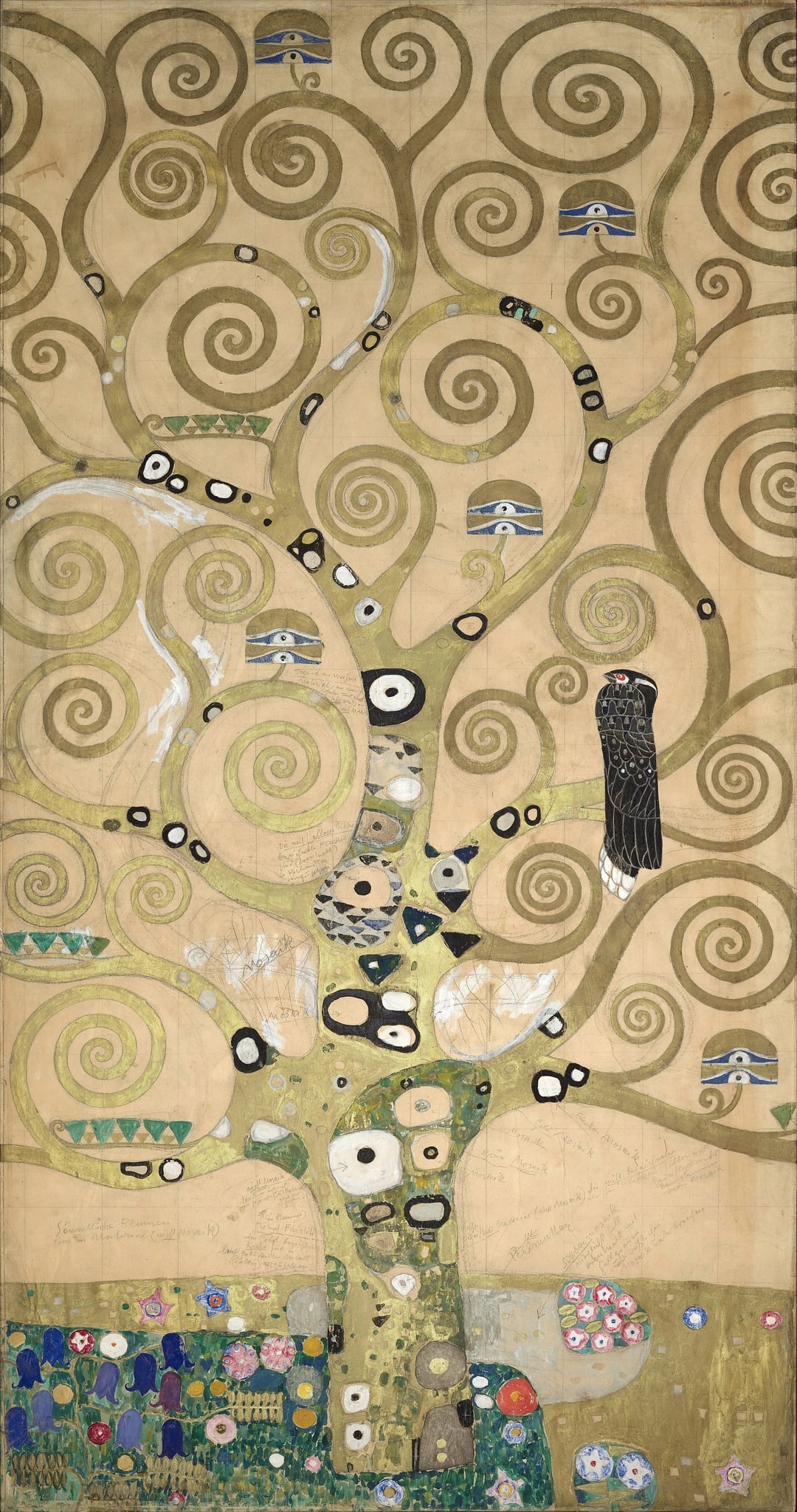
Gustav Klimt’s The Tree of Life crystallizes a <strong>cosmological axis</strong> in a gilded ornamental language: a rooted trunk erupts into <strong>endless spirals</strong>, embedded with <strong>eye-like rosettes</strong> and shadowed by a black, red‑eyed bird. Designed as part of the Stoclet dining‑room frieze, it fuses <strong>symbolism and luxury materials</strong> to link earthly abundance with timeless transcendence <sup>[1]</sup><sup>[2]</sup>.
The Kiss (Lovers) by Gustav Klimt

The Kiss (Lovers)

Gustav Klimt (1907–1908 (Belvedere lists 1908/09))

The Kiss (Lovers) crystallizes Klimt’s <strong>Golden Period</strong> ideal: erotic union staged as a sacred vision. Two bodies fuse beneath a single golden mantle, poised on a flowered ledge at the brink of the unknown, where <strong>pattern becomes symbol</strong> and intimacy becomes icon.