Fritza Riedler

by Gustav Klimt

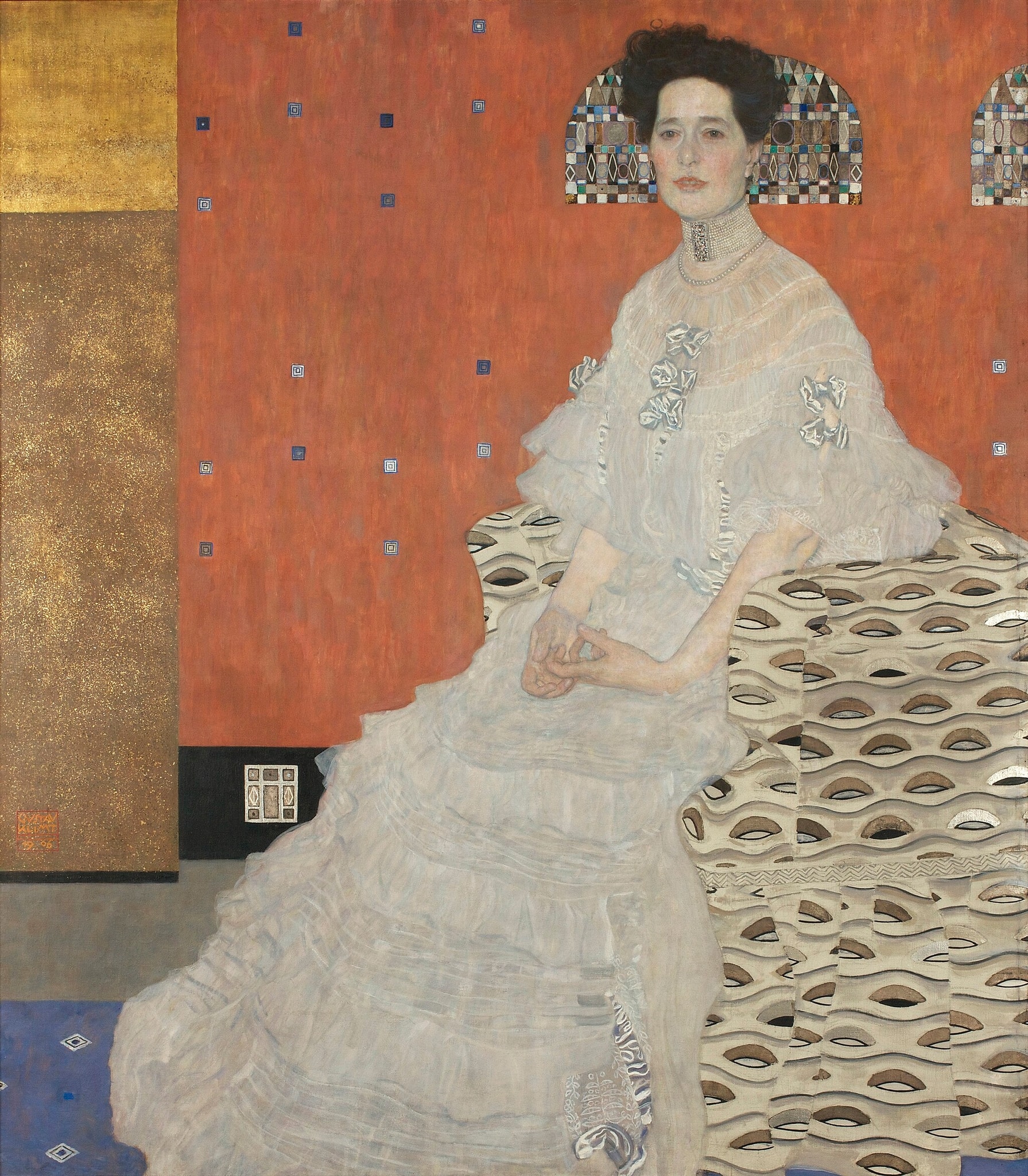
In Fritza Riedler, Gustav Klimt fuses a hyper‑real face and hands with an emphatically flat, ornamental world to stage a modern self caught between individuality and design. The sitter’s mist‑pale, ruffled gown seems to dissolve as she sits in a chair patterned with almond‑shaped “eyes,” before a terracotta wall, arched mosaic “windows,” and a radiant block of gold. The image reads like a secular icon: bourgeois portraiture elevated to ritual presence.
💰

Market Value

$200-260 million

How much is Fritza Riedler worth?

Study Print Studio

Create a personal study print

Build a companion study sheet around the part of this painting that speaks to you most. Choose a detail, shape an interpretation, and walk away with something personal and display-worthy.

Fast Facts

Year
1906
Medium
Oil on canvas
Dimensions
153 × 133 cm
Location
Upper Belvedere, Belvedere Museum, Vienna
See all Gustav Klimt paintings in Vienna
Fritza Riedler by Gustav Klimt (1906) featuring Almond-shaped eyes on the chair, Gold panel, Arched mosaic windows / halo effect, Blue squares grid

Click on any numbered symbol to learn more about its meaning

Meaning & Symbolism

Klimt builds a ceremonial architecture around Fritza that both crowns and cages her. Behind the upright figure, the wall becomes a terracotta plane punctuated by small blue squares, a grid that flattens space and suppresses bourgeois interior detail into pure sign. Two arched, mosaic-like windows hover near her head, reading as stained glass or a secular halo, intensifying the aura of sanctity without invoking religion outright 13. To the left, a vertical field of shimmering gold abuts the wall like an icon panel, aligning portraiture with the timelessness of Byzantine surfaces central to Klimt’s Golden Period 1. At the bottom, a black baseboard and a blue floor marked by white diamond lozenges function as visual thresholds: they anchor the composition while insisting on planarity, so that the sitter appears to occupy a shallow niche between picture and pattern. Within this ornamental armature, Klimt renders the human with ruthless economy—the pale face, the precise blush along the cheekbones, the concentration of color in the lips, the knotted tension of clasped fingers—signaling vitality pressed against formality 1. The chair’s upholstery is the painting’s decisive statement. Klimt converts furniture into a dense field of wavy bands studded with almond-shaped Egyptian eye motifs—ornament that also acts as a gaze 1. These “eyes” seem to look out at the viewer and, by extension, at Fritza herself, staging a social world that surveils and decorates in the same gesture. The effect is cognitive as much as visual: our attention flickers between the sitter’s finely modeled hands and face and the hypnotic pattern-fields that absorb and scatter the eye, a push-pull dynamic that modern neuroscience and aesthetic theory identify as key to Klimt’s appeal 5. The gown, sheer and vaporous, participates in both camps—it is drawn with material sensitivity (ruffles, ribbons, faint shadows) yet its tonality dissolves into the surrounding fields, as if individuality were seeping into culture’s decorative matrix. Fritza’s posture—erect, corseted, chin lifted—reads less as psychology than as a performed role; Klimt withholds confessional expression, offering instead dignity, reserve, and majesty as public codes of identity 1. In this light, the mosaic halo and gold plane elevate not personal confession but the ritual of social presentation. Thus the painting asserts a thesis about modern subjecthood in Vienna: a person is a negotiated surface where private presence and public ornament interlock. Commissioned within a network of elite patrons, the portrait refuses mere likeness; it formalizes a contract between sitter and society in which visibility is traded for encasement 24. The work is pivotal because it consolidates Klimt’s breakthrough strategy—naturalistic islands (head, hands) floating in seas of abstraction—into a coherent language that would shape his greatest images of the period 13. By turning décor into structure and surveillance into symbolism, Fritza Riedler demonstrates how the Secession’s credo—“to every age its art, to art its freedom”—could materialize as a portrait that is at once icon and critique, celebration and constraint.

Explore Deeper with AI

Ask questions about Fritza Riedler

Popular questions:

Powered by AI • Get instant insights about this artwork

💬 Ask questions about this artwork!

Interpretations

Formal Analysis: Byzantine Planarity Meets Lifelike Islands

Klimt’s orchestration pivots on a calculated clash between planarity and naturalism. Around Riedler’s head, a semicircular, mosaic‑like field recalls stained glass, while a contiguous gold zone works like an icon panel—both compress depth and redirect attention to the surface as a meaning‑bearing skin 13. Against this, the face and hands are rendered with cooler, high‑key naturalism—minute blushes, taut tendons—creating “islands” of verisimilitude set in seas of ornament. The wall’s terracotta grid, black baseboard, and diamonded floor act as spatial brakes, preventing perspectival recession and keeping the sitter in a shallow niche between picture and pattern. The result is a rigorously modern syntax: décor is not background but structure; likeness is a local exception negotiated within a dominant, anti‑illusionistic field 13.

Source: Belvedere Museum (collection entry); Franz Smola, Belvedere/Google Arts & Culture

Gender Performance: Public Codes Instead of Inner Psychology

Rather than probing Riedler’s interiority, Klimt builds a repertoire of public signs—erect posture, corseted carriage, lifted chin—that stage femininity as a performed office of dignity, reserve, and majesty 1. The sheer gown, crisply notated yet dissolving chromatically into the ornamental field, encodes the paradox of elite womanhood in fin‑de‑siècle Vienna: simultaneously an individuated subject and a bearer of social display. With expression kept impassive, agency is displaced to minute physiological cues (the knotted hands) and to the negotiation with surrounding patterns, which script how a woman of status should appear. In this feminist reading, the portrait is less a confession than a choreography of legibility—an image of gendered self‑presentation shaped by norms that the painting aestheticizes and quietly interrogates 1.

Source: Belvedere Museum (collection entry)

Patronage & Social Contract: Visibility for Encasement

Commissioned by Alois Riedler for his wife, the portrait exemplifies how elite patronage engineers a contract between sitter and society: the promise of cultural permanence in exchange for submission to ceremonial display 12. Klimt literalizes this bargain by inserting Riedler into an architecture of frames—grids, halos, gilded panels—that canonize yet confine. The upholstery’s Egyptian eye motifs amplify the social optics of surveillance, suggesting that status is inseparable from being seen, and being seen from being structured by decorum 1. Thus, “visibility is traded for encasement”: the painting guarantees social legibility and museum fate, but only through a tightly managed image‑regime where ornament becomes law. Patronage here is not neutral support; it is a shaping force inscribed in the portrait’s very geometry 12.

Source: Belvedere Museum (collection entry); Encyclopaedia Britannica

Cognitive Aesthetics: Ornaments that Look Back

The armchair’s field of almond‑shaped Egyptian eyes is more than style; it is a perceptual engine that both absorbs and redirects the gaze. Viewers oscillate between focal realism (face, hands) and hypnotic pattern, a push–pull dynamic that contemporary neuroaesthetics links to how the brain rewards switching between detail and global configuration 15. The eye‑motifs enact a metafiction of looking—they “watch” us looking, and by extension watch the sitter, embedding surveillance into ornament. This duplex attention heightens arousal while stabilizing composition, explaining the portrait’s peculiar spell: we are never allowed to rest solely on personhood or pattern. Klimt thus designs a cognitive choreography in which perception itself becomes the subject, making the picture a laboratory for how modern viewers assemble meaning piece by piece 15.

Source: Belvedere Museum (collection entry); Open-access neuroaesthetics article (with Kandel references)

Secessionist Politics of Form: After the Faculty Fracas

Painted in the wake of the Faculty Paintings controversy, Fritza Riedler retools Klimt’s radicalism into the seemingly safer sphere of society portraiture—yet its formal politics persist 4. The emphatic flatness, mosaic syntax, and near‑architectonic framing align with the Secession’s creed that each age must find its art by rejecting academic illusionism 14. By yoking rigorous geometry to living physiognomy, Klimt proposes a civic image of the modern subject: stabilized by cultural pattern, yet retaining islands of autonomy. This is not retreat but strategic displacement—turning décor into structure to smuggle avant‑garde values into domestic and museum spaces. In effect, the painting operates as a quiet manifesto for a Vienna in transition, where formal innovation stands in for political dissent and taste becomes a vehicle of reform 14.

Source: Klimt Foundation, Klimt-Database; Belvedere Museum (collection entry)

Related Themes

About Gustav Klimt

Gustav Klimt (1862–1918), co-founder of the Vienna Secession, pivoted from controversial public commissions to a decorative-symbolist language in his Golden Period. Drawing on Byzantine mosaics and modern design, he fused opulent surfaces with psychological intensity. By 1908–09, he transformed scandal into canon, and The Kiss became Vienna’s emblem of modern love.
View all works by Gustav Klimt

More by Gustav Klimt

Portrait of Adele Bloch-Bauer I by Gustav Klimt

Portrait of Adele Bloch-Bauer I

Gustav Klimt (1907)

Gustav Klimt’s Portrait of Adele Bloch-Bauer I stages its sitter as a <strong>secular icon</strong>—a living presence suspended in a field of gold that converts space into <strong>pattern and power</strong>. The naturalistic face and hands emerge from a reliquary-like cascade of eyes, triangles, and tesserae, turning light, ornament, and status into the painting’s true subjects <sup>[1]</sup><sup>[2]</sup>.

Sunflower by Gustav Klimt

Sunflower

Gustav Klimt (1907/1908)

Gustav Klimt’s Sunflower turns a single bloom into a <strong>monumental, figure-like presence</strong>. A tapering stack of broad, drooping leaves rises from a <strong>mosaic-like carpet of round blossoms</strong>, crowned by a gold-flecked disc that glows against a cool, stippled field. The work fuses <strong>portrait, icon, and landscape</strong> into one emblem of vitality and quiet sanctity <sup>[1]</sup><sup>[2]</sup>.

Cottage Garden with Sunflowers by Gustav Klimt

Cottage Garden with Sunflowers

Gustav Klimt (1906–1907 (signed 1907))

Cottage Garden with Sunflowers is a square, horizonless field of blooms where a vertical column of <strong>sunflowers</strong> anchors an all-over weave of color and pattern. Klimt fuses <strong>ornament and nature</strong>, turning a humble Litzlberg cottage plot into a radiant matrix of cyclical life and renewal <sup>[1]</sup><sup>[4]</sup><sup>[5]</sup>.

The Kiss by Gustav Klimt

The Kiss

Gustav Klimt (1908 (completed 1909))

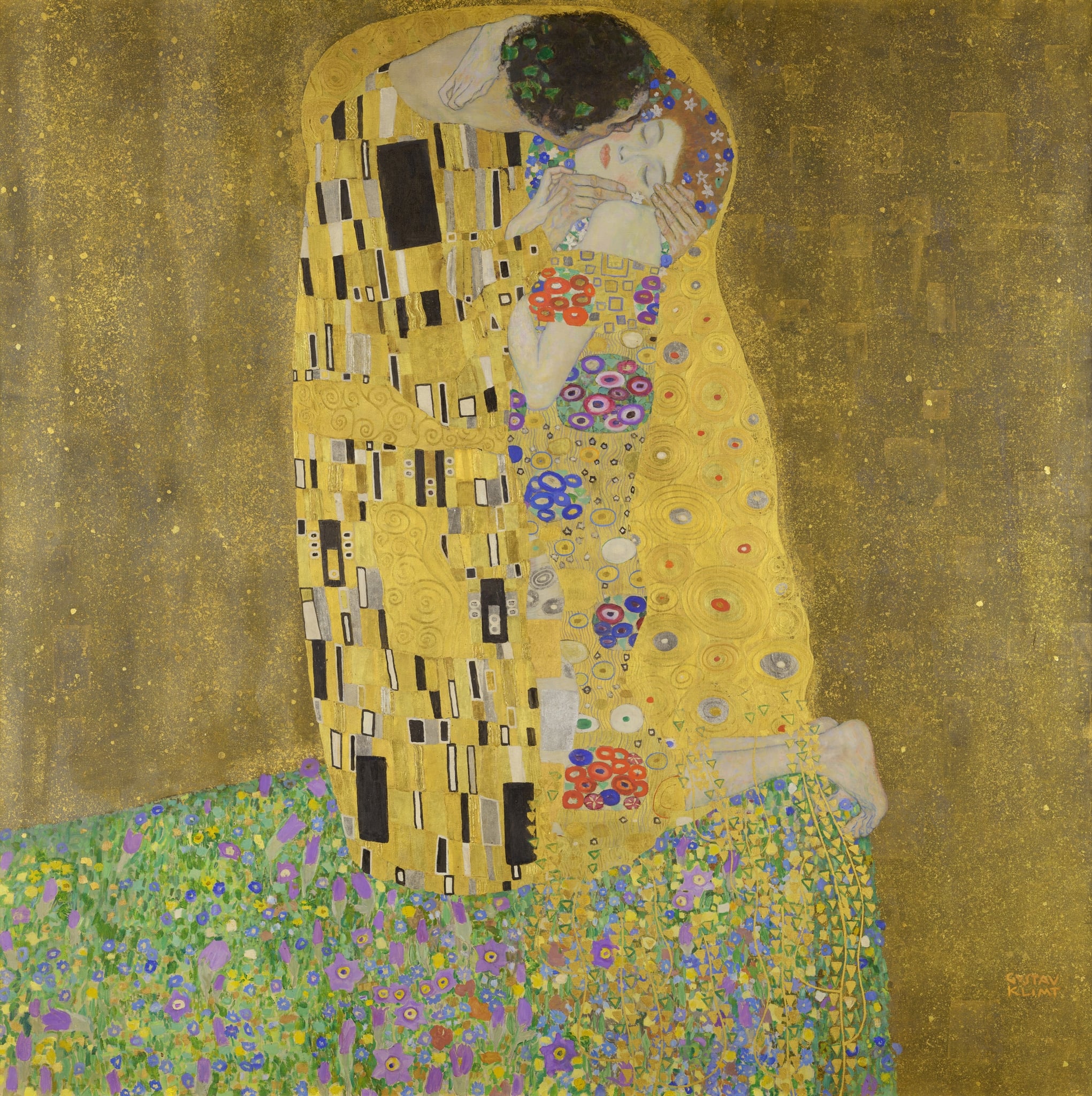
The Kiss stages human love as a <strong>sacred union</strong>, fusing two figures into a single, gold-clad form against a timeless field. Klimt opposes <strong>masculine geometry</strong> (black-and-white rectangles) to <strong>feminine organic rhythm</strong> (spirals, circles, flowers), then resolves them in radiant harmony <sup>[1]</sup><sup>[2]</sup>.
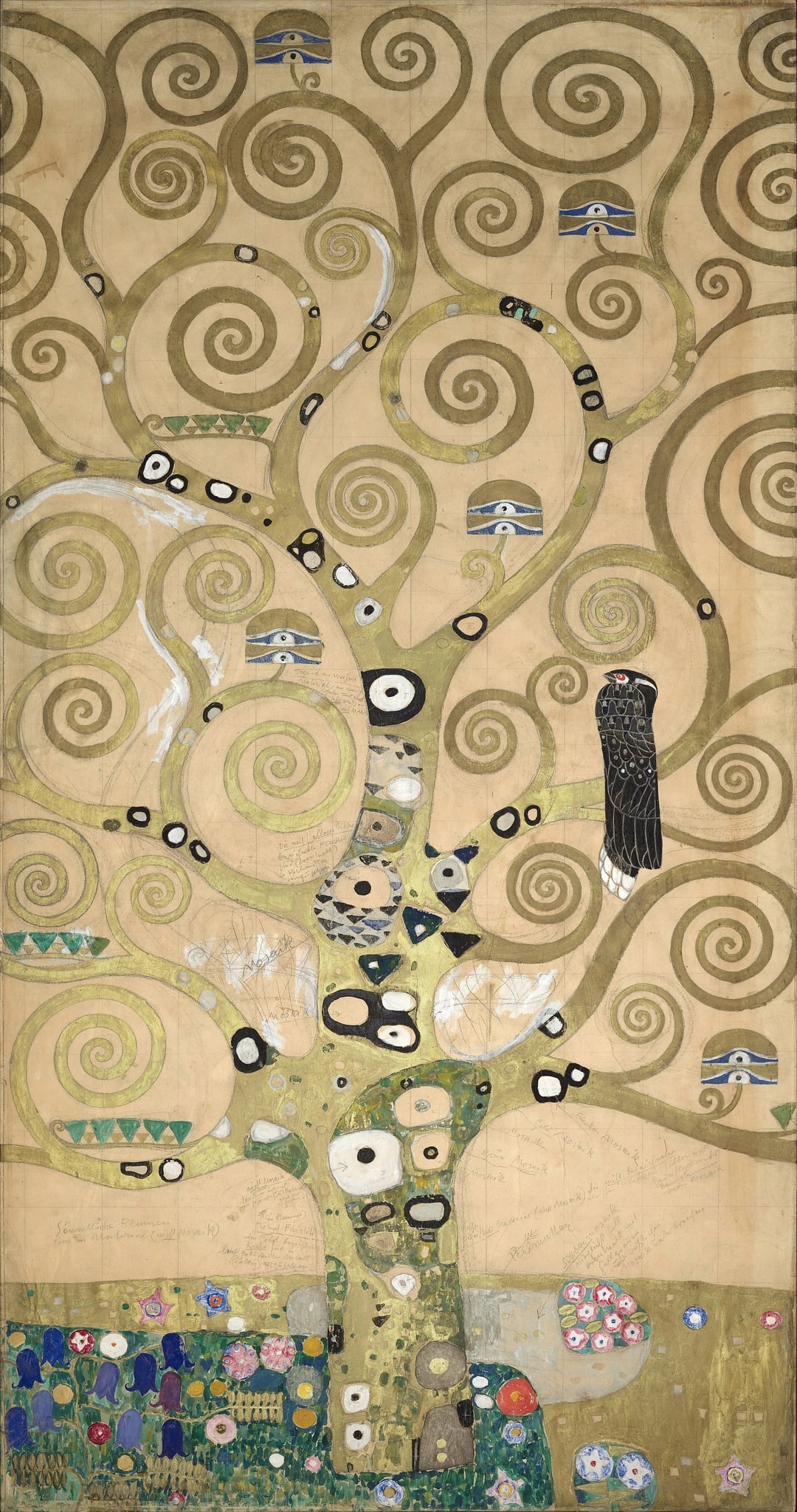
The Tree of Life by Gustav Klimt

The Tree of Life

Gustav Klimt (1910–1911 (design; mosaic installed 1911))

Gustav Klimt’s The Tree of Life crystallizes a <strong>cosmological axis</strong> in a gilded ornamental language: a rooted trunk erupts into <strong>endless spirals</strong>, embedded with <strong>eye-like rosettes</strong> and shadowed by a black, red‑eyed bird. Designed as part of the Stoclet dining‑room frieze, it fuses <strong>symbolism and luxury materials</strong> to link earthly abundance with timeless transcendence <sup>[1]</sup><sup>[2]</sup>.
The Kiss (Lovers) by Gustav Klimt

The Kiss (Lovers)

Gustav Klimt (1907–1908 (Belvedere lists 1908/09))

The Kiss (Lovers) crystallizes Klimt’s <strong>Golden Period</strong> ideal: erotic union staged as a sacred vision. Two bodies fuse beneath a single golden mantle, poised on a flowered ledge at the brink of the unknown, where <strong>pattern becomes symbol</strong> and intimacy becomes icon.