The Large Poplar II (Gathering Storm)

by Gustav Klimt

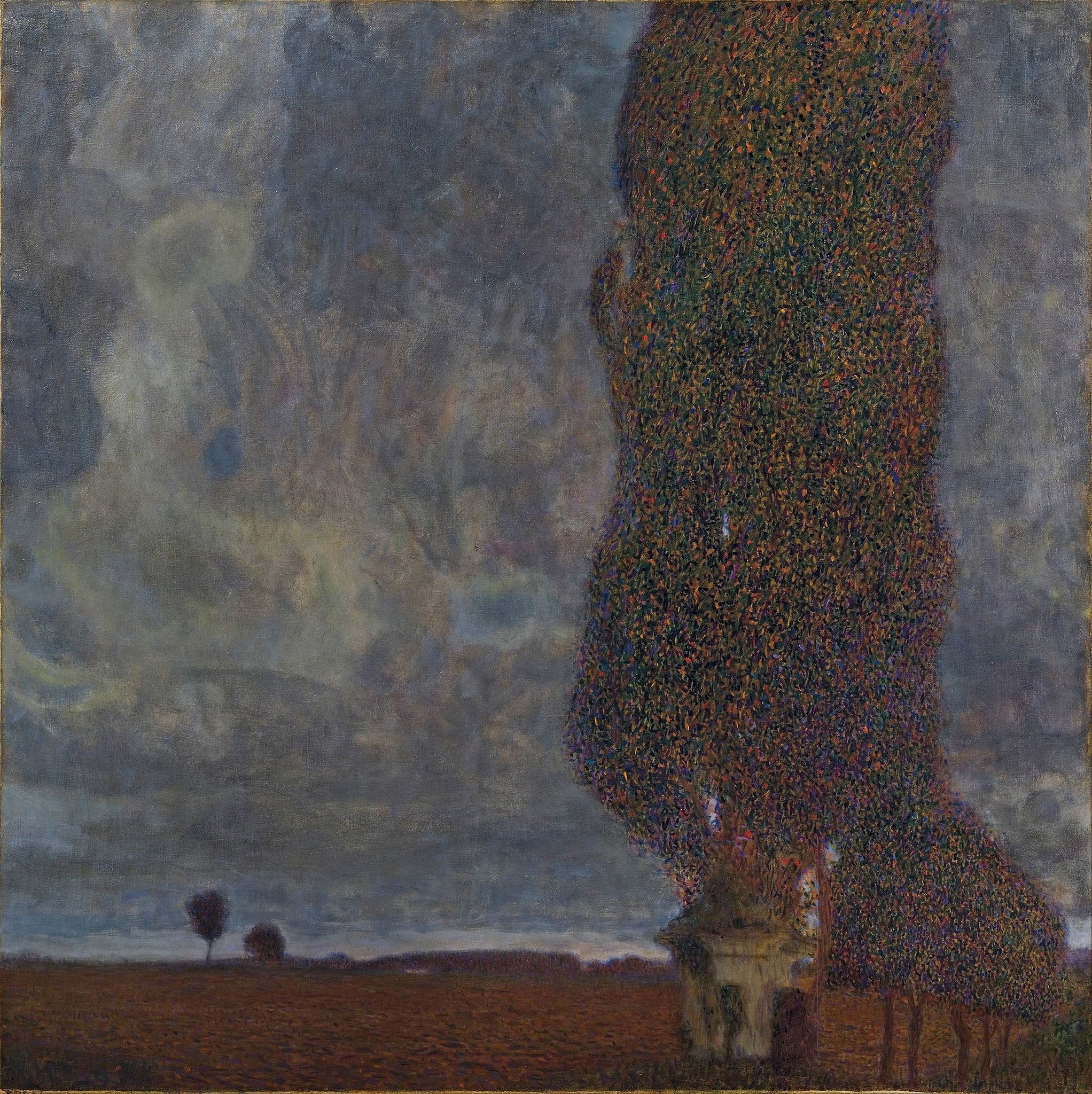
In The Large Poplar II (Gathering Storm), a monumental poplar rises like a sentinel at the right edge while a low, rust-toned plain and tiny chapel anchor the horizon. Klimt devotes most of the square canvas to a charged, near-monochrome sky, making weather the protagonist and turning the tree’s flecked canopy into a shimmering, ominous mosaic [1][2].

Study Print Studio

Create a personal study print

Build a companion study sheet around the part of this painting that speaks to you most. Choose a detail, shape an interpretation, and walk away with something personal and display-worthy.

Fast Facts

Year
1902/03
Medium
Oil on canvas
Dimensions
100.8 × 100.8 cm
Location
Leopold Museum, Vienna
See all Gustav Klimt paintings in Vienna
The Large Poplar II (Gathering Storm) by Gustav Klimt (1902/03) featuring Sentinel Poplar, Gathering-Storm Sky, Chapel/Sanctuary, Horizontal Horizon Bands

Click on any numbered symbol to learn more about its meaning

Meaning & Symbolism

Klimt constructs tension through compositional oppositions that the eye can verify immediately in the image. The poplar is thrust to the extreme right, a dark, tapering column whose crown nearly sutures the canvas edge; the land runs in uncompromising horizontals—thin blue lake strip, rust field, and a low band of hedgerow—punctuated only by two distant trees that read as scale markers. Between these poles, the chapel at the poplar’s foot occupies the intersection of vertical and horizontal axes, an architectural fulcrum that asserts human order while conceding human smallness. Above, the sky is the true field of action: a vast, churned expanse of gray-blue and violet with pale, smoky eddies that register wind and imminent rain. Klimt’s facture is decisive to the painting’s meaning. The canopy and flanking trees are woven from countless specks of red, green, purple, and blue—Ludwig Hevesi’s “Forellentupfen,” or trout spots—so the surface shivers with decorative life even as the palette darkens the mood 2. That duality—surface delight amid atmospheric threat—converts weather into a symbolist mood-image: not reportage of a front, but an externalization of psychic pressure 2. The square format, typical of Klimt’s Attersee summers, suppresses recession and turns sky and foliage into near-planes of pattern, an unmistakable Jugendstil strategy that modernizes the landscape tradition 12. Site and symbol reinforce one another. Painted at Litzlberg, the motif binds a recognizable chapel (Seehofkapelle) to the sentinel poplar, a pairing that carries legible connotations: sanctuary and vigilance set against nature’s sublime volatility 12. The poplar’s columnar thrust reads as a conduit between earth and sky, while the chapel’s small pediment grounds faith to the plain; together, they stage a drama of protection under threat. Critics already perceived the work’s unusual darkness when it appeared in the 1903 Secession exhibition, noting the brooding atmosphere that distinguishes it from brighter Attersee scenes 2. In this light, the picture converses with Klimt’s earlier Large Poplar I (1900), which treats the same motif in calmer weather; by 1902/03 the artist compresses storm energy into the tree’s very skin, so that foliage becomes an almost abstract charge, what one modern critic describes as a force concentrated into an inarticulate “bolt” of form 34. The result is not pastoral but sublime: beauty edged by dread, where the small chapel intimates refuge and the immense sky insists on transience. Formally, the low horizon and dominant sky invert conventional hierarchies and foreground Klimt’s surface modernity; symbolically, the vertical/horizontal standoff crystallizes the work’s core claim that endurance (the poplar, the chapel) holds, but only provisionally, before the gathering storm. In this synthesis—site-specific, decorative, and metaphysical—Klimt articulates a landscape that is both place and state, a cornerstone of his landscape corpus and a touchstone for the Secession’s pursuit of total work through the union of pattern, mood, and meaning 125.

Explore Deeper with AI

Ask questions about The Large Poplar II (Gathering Storm)

Popular questions:

Powered by AI • Get instant insights about this artwork

💬 Ask questions about this artwork!

Interpretations

Formal Analysis

The painting’s square format compresses recession and converts sky and canopy into near-planes of pattern, a quintessential Jugendstil maneuver that privileges surface over depth 12. Klimt anchors the scene in a standoff of vectors: the poplar’s emphatic vertical at the far right counters the land’s strict horizontals, while the chapel sits at their intersection, a measured fulcrum within destabilized space 1. The low horizon cedes dominance to the sky, whose nuanced grays and violets become the true stage of action. This calibrated layout modernizes landscape conventions: rather than a window onto nature, the canvas functions as a constructed field where compositional oppositions do the expressive work. The result is a decoratively charged, quasi-abstract order that still reads as place—Klimt’s synthesis of Secessionist surface thinking with empirical motif.

Source: Leopold Museum (object record and Highlights) [1][2]

Symbolic Reading

Site specificity intensifies symbolism: the Seehofkapelle provides a legible node of sanctuary, while the Lombardy poplar—columnar, sentinel-like—mediates earth and sky as a conduit of vigilance under pressure 12. The storm is not mere meteorology but a sign-system of threat and protection: human order is asserted (chapel, hedgerow), yet instantly relativized by the sky’s scale and turbulence. The pairing of sacred architecture with a weather front is a Symbolist strategy for externalizing psychic and spiritual states, in which the landscape becomes a mood-image rather than topographical report 2. Thus, refuge exists, but it is provisional; the very placement of the chapel at the compositional fulcrum figures faith as balance—precarious, necessary, and contingent—before forces that exceed human measure.

Source: Leopold Museum (Highlights) [2]

Psychological Interpretation

Klimt’s storm operates as Stimmung: an atmospherics of psychic pressure rendered through a nearly monochrome, churned sky and a treetop packed with agitated, pointillist touches 2. Critics like Tom Lubbock note how the poplar’s crown concentrates into an inarticulate “bolt”—a form that compresses unreadable force, edging landscape toward metaphorical abstraction 3. This is weather as inner weather: wind and eddies register unsettled mind-states, while the chapel’s diminutive pediment models the ego’s fragile ordering impulse. The painting thus becomes a modern affective machine, translating environmental cues into emotional charge. By withholding narrative and personhood, Klimt intensifies identification: viewers “feel” the front arriving as a pressure system across the surface itself.

Source: The Independent (Tom Lubbock) and Leopold Museum [3][2]

Reception & Comparative Lens

Shown at the 1903 Secession exhibition, the work’s unusual darkness within Klimt’s Attersee corpus was noted by contemporaries, marking a departure from the brighter lacustrine scenes of 1900–01 2. Set beside Large Poplar I (1900), which treats the same motif in calmer weather, Large Poplar II compresses energy into the tree’s very skin—denser speckling, tighter contour, more turbulent sky—shifting the motif from descriptive serenity to a charged sublime 4. This serial method reveals Klimt’s iterative problem-setting: how far can the decorative surface carry mood without dissolving recognizability? The 1903 canvas answers by tipping the balance toward tension, using format and facture to stage not place-as-panorama but place-as-pressure.

Source: Leopold Museum (Highlights) and Neue Galerie New York (for Large Poplar I) [2][4]

Material/Facture Focus

Ludwig Hevesi’s term “Forellentupfen” (“trout spots”) captures Klimt’s micro-marking of foliage: innumerable red, green, purple, and blue flecks that produce a vibrating, decorative skin 2. This facture enacts a double move. Visually, it animates leaf-mass as a living surface; conceptually, it asserts the painting’s artifice, reminding us that the storm’s menace is constructed through pattern and touch. The near-pointillist field refuses plein-air descriptiveness in favor of Secessionist design logic—modularity, repetition, and chromatic shimmer—thus advancing a modernist mimesis vs. abstraction inquiry within landscape. The sensual pleasure of speckled color intensifies precisely as the palette darkens, yielding a paradox: the grimmer the sky, the more the surface delights, and the more ambivalent the mood it communicates.

Source: Leopold Museum (Highlights) [2]

Topography, Memory, and Time

Rooted in Litzlberg, the motif’s specificity extends beyond 1903: local accounts record that the very poplar by the Seehofkapelle fell in a 1928 storm, later replanted—a poignant afterhistory of endurance and loss 56. Read back onto Klimt’s canvas, the small chapel and towering tree already stage a contest of temporalities: human cult site (long durée), fast-growing yet fragile poplar (life-cycle volatility), and the weather front (instantaneous change). The painting suspends these timescales in a single square, making the landscape a memory device where place, ritual, and accident intersect. Such site-consciousness clarifies why the work feels elegiac despite its decorative vigor: it encodes the inevitability that what shelters today may succumb tomorrow.

Source: Leopold Museum; Google Arts & Culture (Leopold collaboration); Atterwiki (local history) [2][5][6]

Related Themes

About Gustav Klimt

Gustav Klimt (1862–1918), co-founder of the Vienna Secession, pivoted from controversial public commissions to a decorative-symbolist language in his Golden Period. Drawing on Byzantine mosaics and modern design, he fused opulent surfaces with psychological intensity. By 1908–09, he transformed scandal into canon, and The Kiss became Vienna’s emblem of modern love.
View all works by Gustav Klimt

More by Gustav Klimt

Part of the Tree of Life (Part 1) by Gustav Klimt

Part of the Tree of Life (Part 1)

Gustav Klimt (1910–1911)

Gustav Klimt’s Part of the Tree of Life (Part 1) is a full‑scale design cartoon for the Stoclet dining‑room frieze, where a gold ground hosts branching spirals, <strong>Eye‑of‑Horus</strong> rosettes, falcon emblems, and crisp triangular leaves. The panel fuses <strong>symbolism</strong> and <strong>ornament</strong> to stage life’s cyclical renewal within a luxurious, sacred‑like register <sup>[1]</sup><sup>[3]</sup>.

The Kiss by Gustav Klimt

The Kiss

Gustav Klimt (1908 (completed 1909))

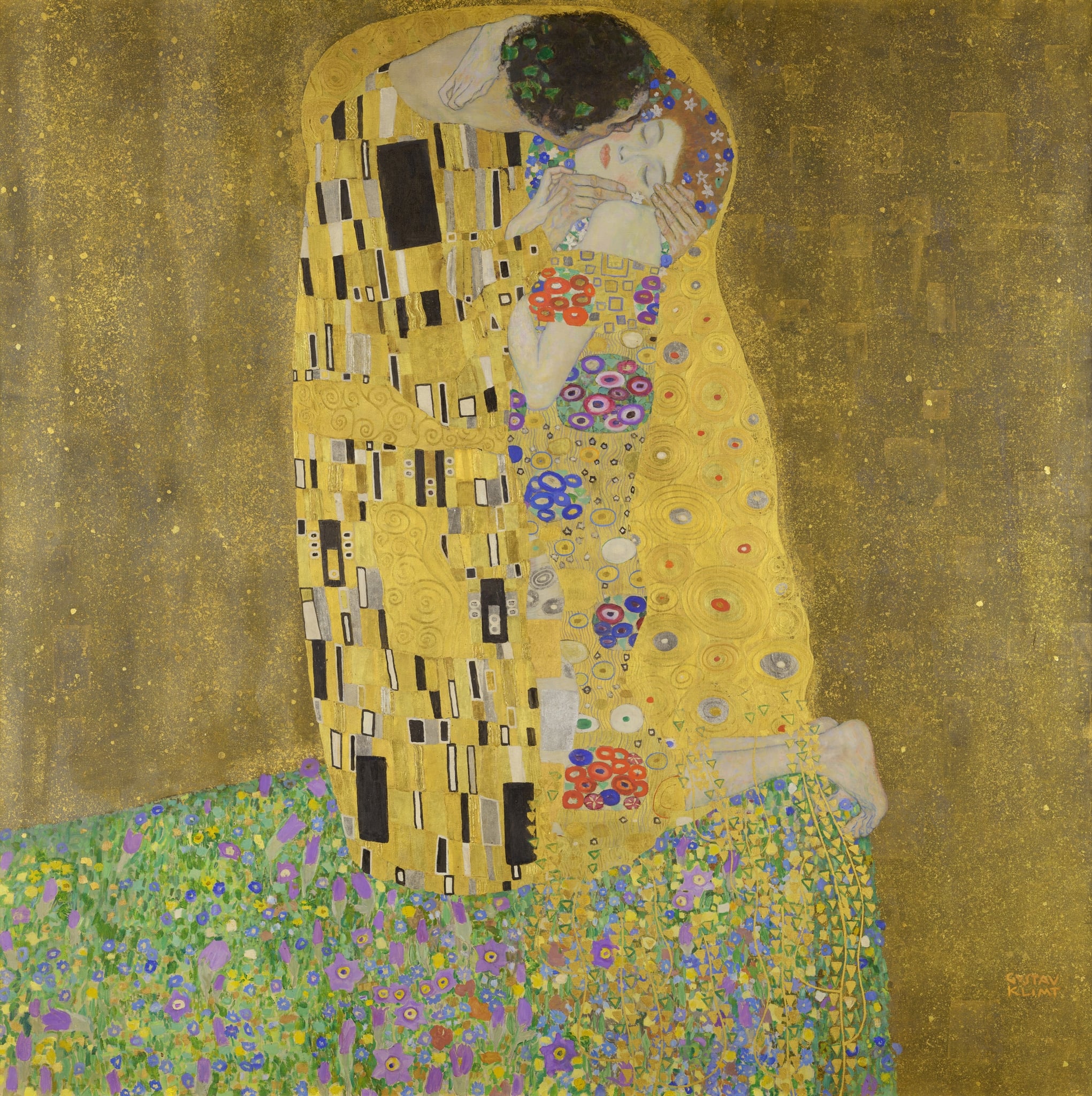
The Kiss stages human love as a <strong>sacred union</strong>, fusing two figures into a single, gold-clad form against a timeless field. Klimt opposes <strong>masculine geometry</strong> (black-and-white rectangles) to <strong>feminine organic rhythm</strong> (spirals, circles, flowers), then resolves them in radiant harmony <sup>[1]</sup><sup>[2]</sup>.
Tree of Life (Part 4) by Gustav Klimt

Tree of Life (Part 4)

Gustav Klimt (1910–1911)

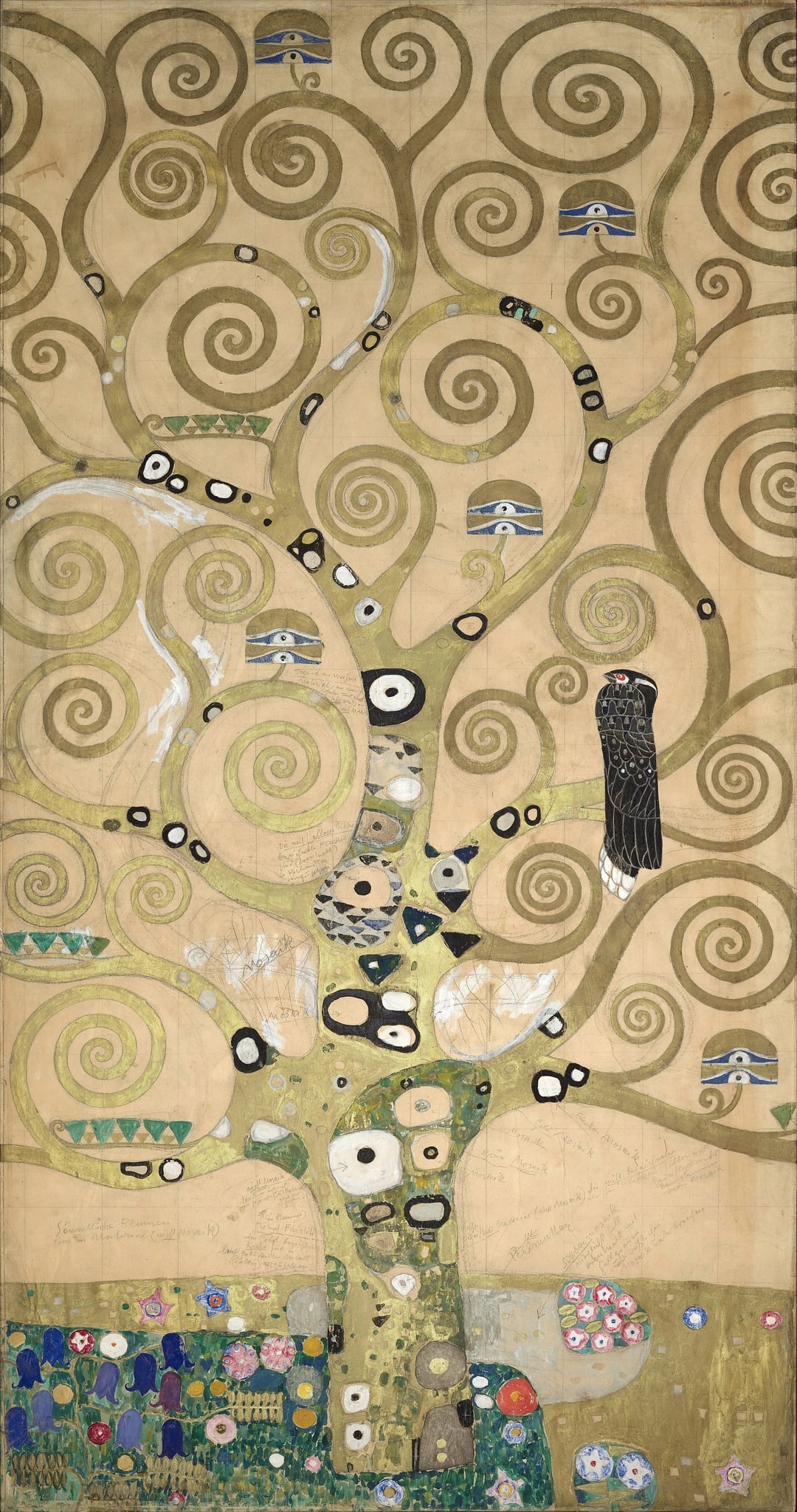
Tree of Life (Part 4) stages a gilded axis where <strong>spiraling branches</strong>, <strong>amuletic eyes</strong>, and a <strong>black raptor</strong> compress growth, vigilance, and mortality into a single ornamental system. The mosaic-like bark and jewel-bright flower carpet root the image in fecund earth while the volutes coil upward toward the abstract and the eternal <sup>[1]</sup><sup>[6]</sup>.

Rosebush (Part 6) by Gustav Klimt

Rosebush (Part 6)

Gustav Klimt (1910/11)

In Rosebush (Part 6), a single, wavering stem climbs through a field of gold spirals while regimented green-and-blue triangular leaves and pale, jewel-like blossoms punctuate its path. Around it, vivid butterflies and star-flowers animate the surface. Klimt fuses nature and ornament into a <strong>precious</strong>, <strong>cyclical</strong> emblem of growth, metamorphosis, and renewal.

Knight (Part 9) by Gustav Klimt

Knight (Part 9)

Gustav Klimt (1910–1911)

Klimt’s Knight (Part 9) turns chivalry into a <strong>geometric icon</strong>: a vertical standard of stacked bars and checks flanked by <strong>ranks of circles and triangles</strong> that read as shields and studs. Set on a <strong>golden ground</strong> and crowned and undergirded by ornamental zones, it proclaims vigilance and ethical guardianship between the frieze’s figural scenes. <sup>[1]</sup>

The Tree of Life by Gustav Klimt

The Tree of Life

Gustav Klimt (1910–1911 (design; mosaic installed 1911))

Gustav Klimt’s The Tree of Life crystallizes a <strong>cosmological axis</strong> in a gilded ornamental language: a rooted trunk erupts into <strong>endless spirals</strong>, embedded with <strong>eye-like rosettes</strong> and shadowed by a black, red‑eyed bird. Designed as part of the Stoclet dining‑room frieze, it fuses <strong>symbolism and luxury materials</strong> to link earthly abundance with timeless transcendence <sup>[1]</sup><sup>[2]</sup>.