Orchard in the Evening

by Gustav Klimt

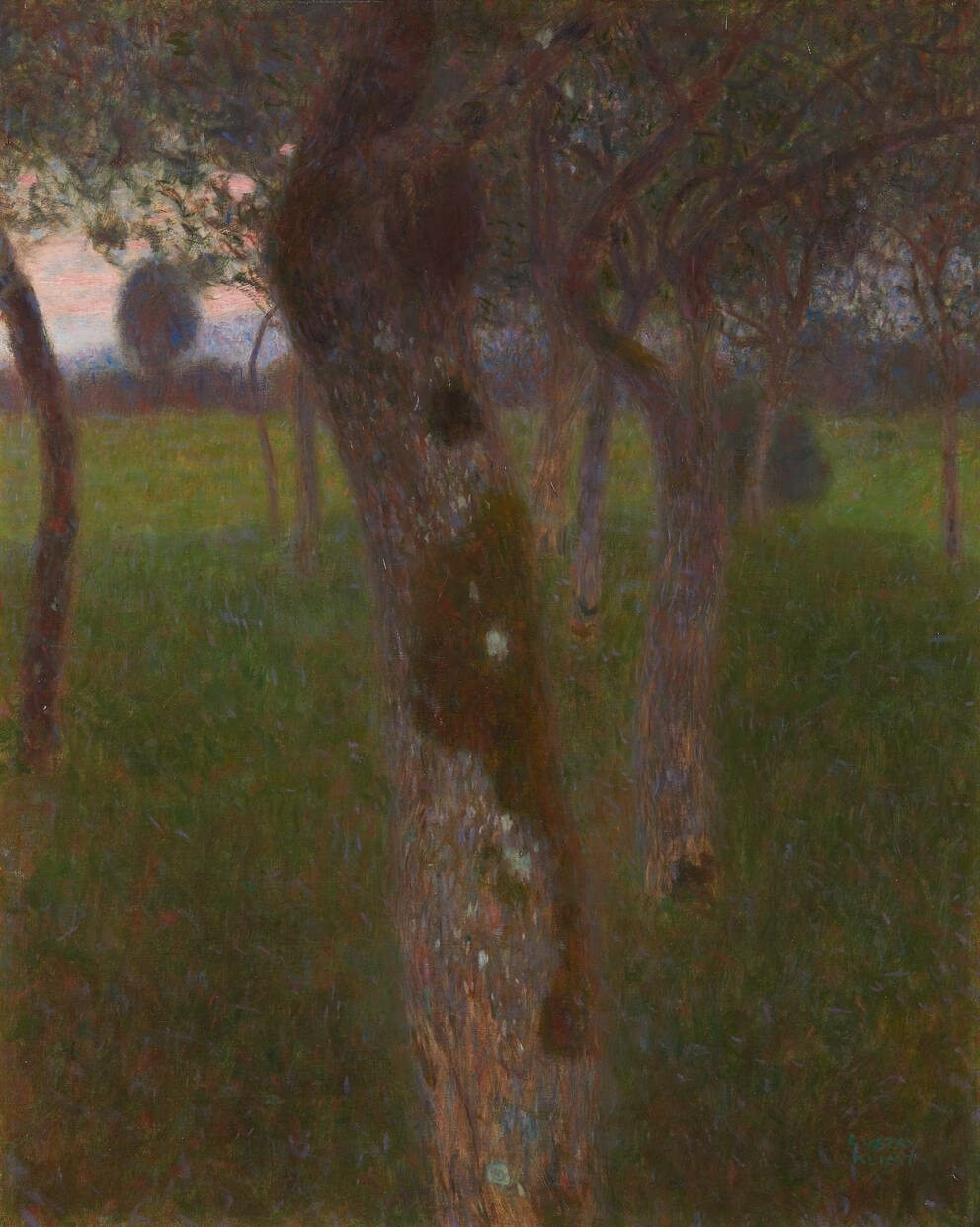
Gustav Klimt’s Orchard in the Evening compresses a grove of fruit trees into a shallow, planar field where trunks press forward and dusk thins the color. A pale twilight band at the high horizon seals the space, turning observed nature into a contemplative, ornamental enclosure [1][2].
💰

Market Value

$30-50 million

How much is Orchard in the Evening worth?

Study Print Studio

Create a personal study print

Build a companion study sheet around the part of this painting that speaks to you most. Choose a detail, shape an interpretation, and walk away with something personal and display-worthy.

Fast Facts

Year
1898
Medium
Oil on canvas
Dimensions
69 x 55.6 cm
Location
Leopold Museum, Vienna (permanent loan, on view status subject to change)
See all Gustav Klimt paintings in Vienna
Orchard in the Evening by Gustav Klimt (1898) featuring Central trunk (vertical axis), Flanking trunks as screen, Twilight ribbon at the horizon, Dark, continuous canopy

Click on any numbered symbol to learn more about its meaning

Meaning & Symbolism

Klimt engineers a frontally charged encounter. The thick, mottled trunk planted just off center operates like a vertical axis—neither path nor vista invites passage—and adjacent trees bracket it as a living screen. Their bark flickers with russets, violets, and bruised greens, painted in broken touches that refuse stable modeling. The ground is stitched from countless dabs, producing a low, tapestry‑like vibration; blades of grass register as specks more than forms. Above, the canopy coheres into a dark, breathing mass that softens toward the high horizon, where a narrow ribbon of pink dusk cools into blue-grey. This horizontal seal halts recession and locks the space into planes—foreground trunks, mid‑field green, distant haze—thereby converting the orchard into an optical enclosure rather than a traversable place 12. The effect is purposeful: by reducing traditional perspective and compressing forms, Klimt relocates meaning from narrative incident to felt atmosphere. The grove becomes a vessel for twilight’s color‑reduction, a symbolist hour when distinctions wane and perception turns inward 2. This strategy aligns with the Vienna Secession’s program to liberate painting from academic storytelling and to integrate fine and decorative art. Klimt absorbs Japanese pictorial ideas—cropped edges, elevated horizon—to reinforce surface flatness, while the pointillist, “mosaic” touch animates the picture skin like textile, anticipating the artist’s mature decorative language 234. The orchard motif, tended yet not overtly cultivated in the image, reads as consciously de‑personalized nature: no figures, no fruit, only rhythmic trunks and a canopy that hums at dusk. That restraint is decisive. It invites a contemplative stance in which endurance (rooted trunks) and transience (the day’s last light) coexist without allegorical props. Contemporary reception recognized this shift: when shown at the 7th Secession in 1900, Klimt’s landscapes were praised as “delightful atmospheric landscapes,” and this work was acquired by the forward‑looking patron Fritz Waerndorfer—evidence that Klimt’s new idiom of mood and surface had immediate resonance 1. Viewed within Klimt’s evolution, Orchard in the Evening is a hinge. Though earlier than his famous square landscapes, its vertical format still stages the key moves: an emphatically ornamental conception of nature, a curtailed spatial depth, and a mood‑driven chromatic register keyed to evening. The painting therefore does more than depict trees at dusk; it codifies a method—using planar pattern to create an almost sacred quiet—that would structure Klimt’s landscape practice for the next decade. In that sense, the meaning of Orchard in the Evening is the assertion that atmosphere itself can be subject, and why Orchard in the Evening is important is that it crystallizes the Secessionist synthesis of sensation and design that became Klimt’s signature 123.

Explore Deeper with AI

Ask questions about Orchard in the Evening

Popular questions:

Powered by AI • Get instant insights about this artwork

💬 Ask questions about this artwork!

Interpretations

Formal Analysis: Axis, Horizon, and Planarity

Klimt organizes the composition around a near‑central trunk that acts as a vertical axis, checked by a deliberately high horizon that suppresses recession. This dual armature converts the view into layered planes—trunks, green field, dusky band—so that surface pattern, not linear perspective, carries meaning. The mottled, broken touch across bark and ground functions like a mosaic or textile, animating the picture skin while keeping volumes from cohering into classical modeling. Such frontality and edge‑cropping echo Japanese pictorial strategies circulating in Vienna, which Klimt repurposes to privilege planarity and optical vibration over narrative detail. The result is not a path into depth but a sustained encounter with a living, patterned screen—an Art Nouveau recalibration of landscape toward design and sensation 12.

Source: Leopold Museum; Klimt Foundation

Historical Context: Secession Display and Immediate Reception

Shown at the 7th Vienna Secession in 1900 alongside the embattled Faculty paintings, Orchard in the Evening offered viewers a counterpoint: a decoratively unified, atmospheric landscape that sidestepped academic storytelling. Critic Ludwig Hevesi singled out Klimt’s landscapes as “delightful atmospheric” works, signaling contemporary recognition that mood and surface had become the content. The painting’s purchase by Fritz Waerndorfer—soon to be a co‑founder of the Wiener Werkstätte—further situates the work within a forward‑looking network where fine and decorative arts intertwined. The Leopold Museum’s classification of the picture as Art Nouveau (Jugendstil) underscores this milieu: an ethos of integrated design, stylization, and refined materiality that Klimt channels through landscape rather than allegory 1.

Source: Leopold Museum

Symbolic Reading: Dusk as a Mechanism of Meaning

The painting hinges on twilight’s reduction of color: a symbolist device that mutes local hues into a narrow, breath‑like register, dissolving hard distinctions between trunk, grass, and sky. This chromatic contraction engenders a contemplative, even oneiric mood in which narrative incident recedes and sensation becomes subject. Klimt’s deliberate suppression of depth—via the high horizon and planar canopy—supports this inward turn, trapping the gaze in a softly pulsing screen where time seems suspended between day and night. Instead of allegorical props, the work uses the hour itself to intimate transience and passage, aligning with fin‑de‑siècle preoccupations with interior states and symbolist atmosphere 2.

Source: Klimt Foundation

Decorative Arts Lens: From Landscape to Textile

The orchard reads like a carpet‑field: foliage, bark, and grass rendered as countless dabs that cohere into an ornamental fabric. This “tapestry‑like” handling anticipates the Wiener Werkstätte’s valorization of pattern, flattening, and rhythmic repeat, and it aligns with Secessionist ambitions to integrate art and design. In visual terms, the pointillist flicker substitutes optical life for descriptive finish; in conceptual terms, it relocates value from depicted objects to the worked surface itself. Klimt’s move thus bridges fine painting and applied arts aesthetics, demonstrating how a landscape can operate as a designed surface without forfeiting mood. The Belvedere’s account of Klimt’s landscapes—hovering color masses, ornamental organization—maps directly onto this early, orchard experiment 234.

Source: Klimt Foundation; Belvedere Museum; comparative notes via The Park

Comparative Format Study: Vertical Orchard vs. Square Fields

Unlike Klimt’s later square landscapes, this canvas is a vertical rectangle—a choice that magnifies the trunk’s totemic rise and compresses lateral spread, intensifying frontality. The format works in concert with a raised horizon to curtail depth, a structural preference that will persist even as Klimt shifts to squarer supports. Comparative readings of works such as The Park emphasize a dense, tapestry‑like foliage plane and suppressed recession; Orchard in the Evening already prototypes these moves, but channels them through a tall, axial frame that dramatizes ascent rather than breadth. The vertical orchard thus serves as a hinge: testing the ornamental field while staging a more columnar, icon‑like nature that later becomes more panoramic in square compositions 14.

Source: Leopold Museum; comparative notes via The Park (MoMA/Belvedere literature)

Related Themes

About Gustav Klimt

Gustav Klimt (1862–1918), co-founder of the Vienna Secession, pivoted from controversial public commissions to a decorative-symbolist language in his Golden Period. Drawing on Byzantine mosaics and modern design, he fused opulent surfaces with psychological intensity. By 1908–09, he transformed scandal into canon, and The Kiss became Vienna’s emblem of modern love.
View all works by Gustav Klimt

More by Gustav Klimt

The Kiss by Gustav Klimt

The Kiss

Gustav Klimt (1908 (completed 1909))

The Kiss stages human love as a <strong>sacred union</strong>, fusing two figures into a single, gold-clad form against a timeless field. Klimt opposes <strong>masculine geometry</strong> (black-and-white rectangles) to <strong>feminine organic rhythm</strong> (spirals, circles, flowers), then resolves them in radiant harmony <sup>[1]</sup><sup>[2]</sup>.
The Tree of Life by Gustav Klimt

The Tree of Life

Gustav Klimt (1910–1911 (design; mosaic installed 1911))

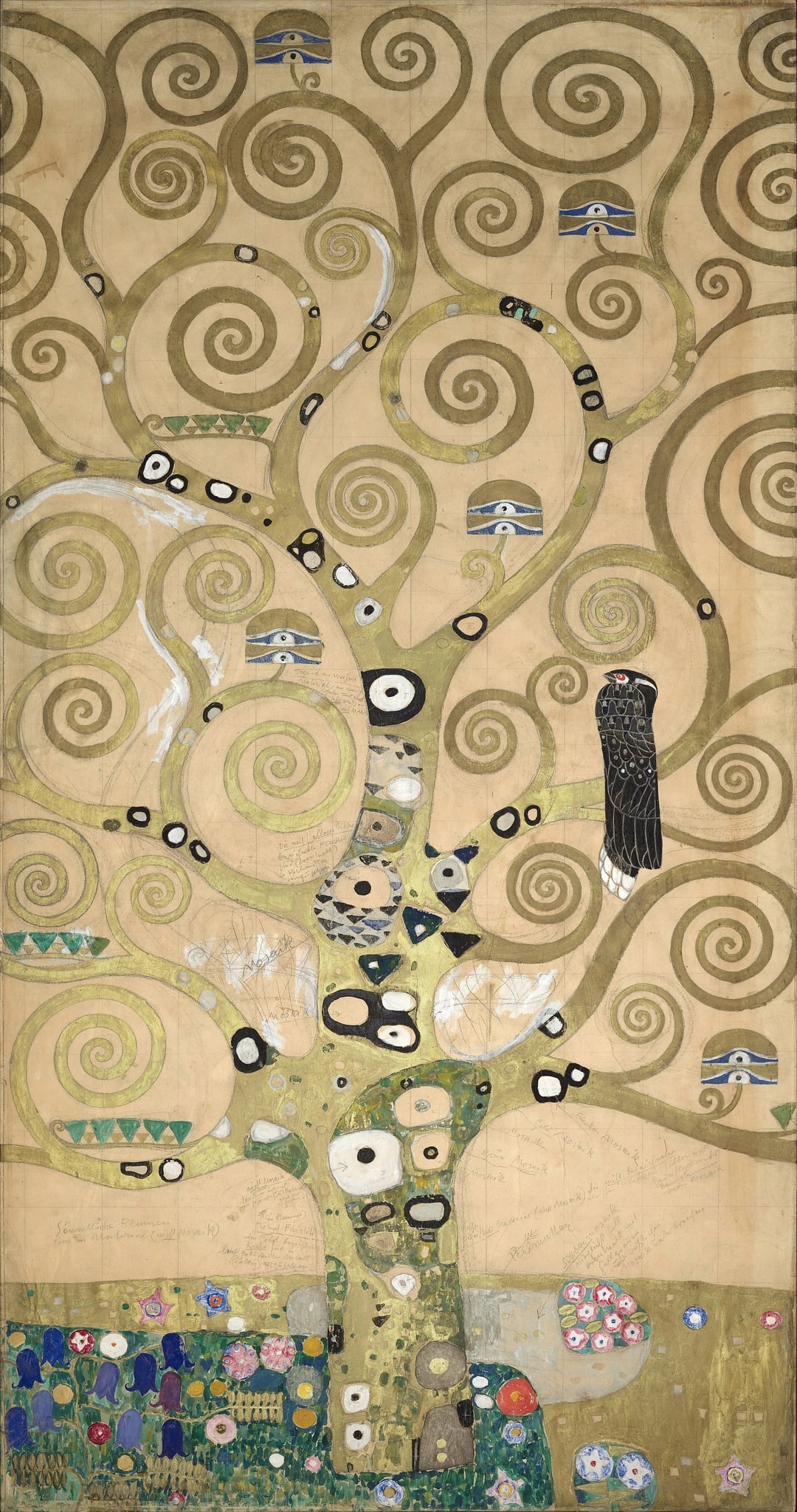
Gustav Klimt’s The Tree of Life crystallizes a <strong>cosmological axis</strong> in a gilded ornamental language: a rooted trunk erupts into <strong>endless spirals</strong>, embedded with <strong>eye-like rosettes</strong> and shadowed by a black, red‑eyed bird. Designed as part of the Stoclet dining‑room frieze, it fuses <strong>symbolism and luxury materials</strong> to link earthly abundance with timeless transcendence <sup>[1]</sup><sup>[2]</sup>.
Farmhouse in Buchberg (Upper Austrian Farmhouse) by Gustav Klimt

Farmhouse in Buchberg (Upper Austrian Farmhouse)

Gustav Klimt (1911)

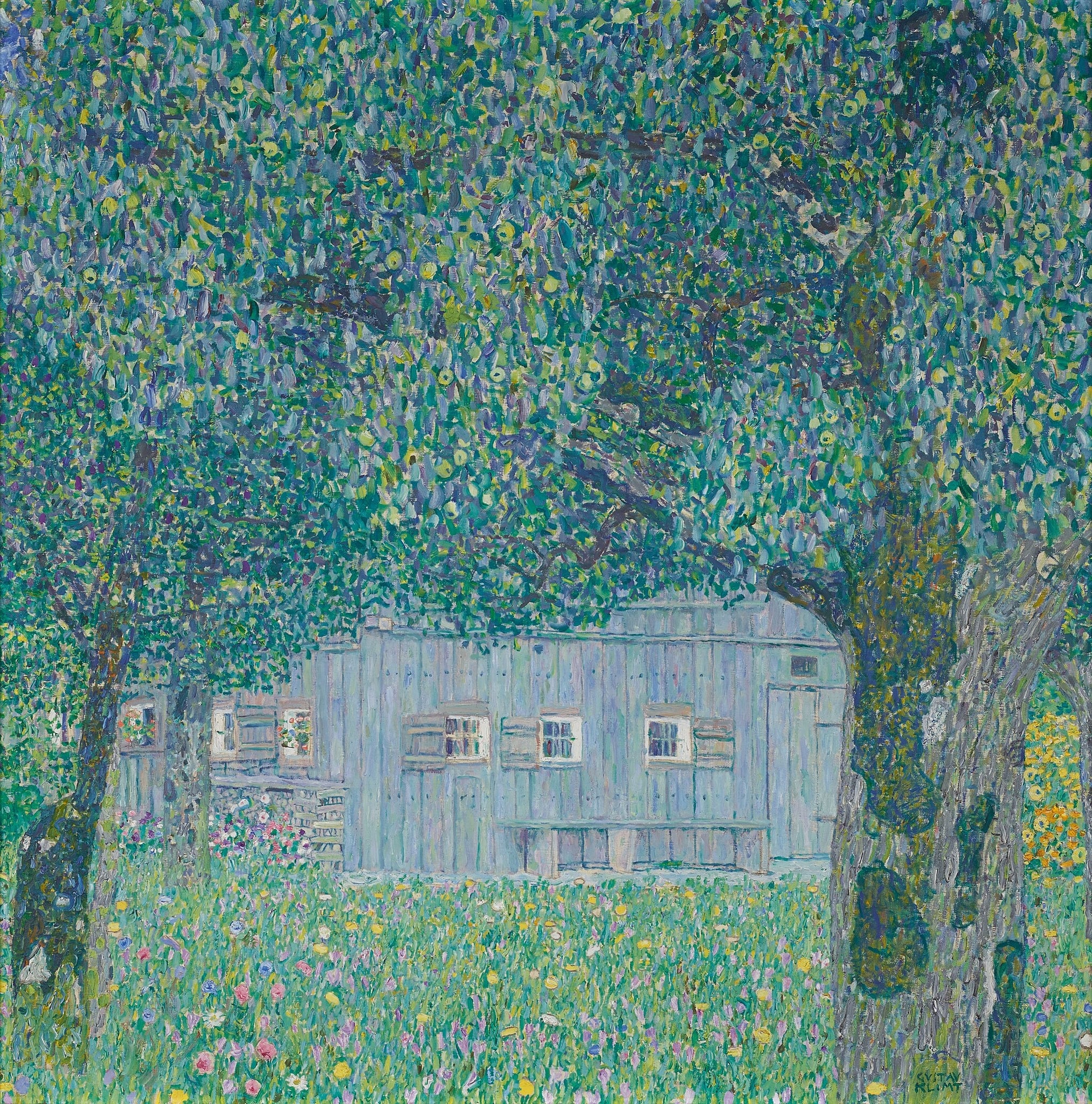
Gustav Klimt’s Farmhouse in Buchberg (Upper Austrian Farmhouse) renders a rural dwelling almost absorbed by an orchard, its cool façade held in balance against a vibrating canopy of leaves and a jewel-like meadow. Through a square format and <strong>selective pointillism</strong>, Klimt fuses house, trees, and flowers into a contemplative, patterned field that privileges <strong>stillness</strong> over incident <sup>[1]</sup><sup>[6]</sup>. The work turns everyday architecture into an emblem of <strong>refuge within fecund nature</strong>.
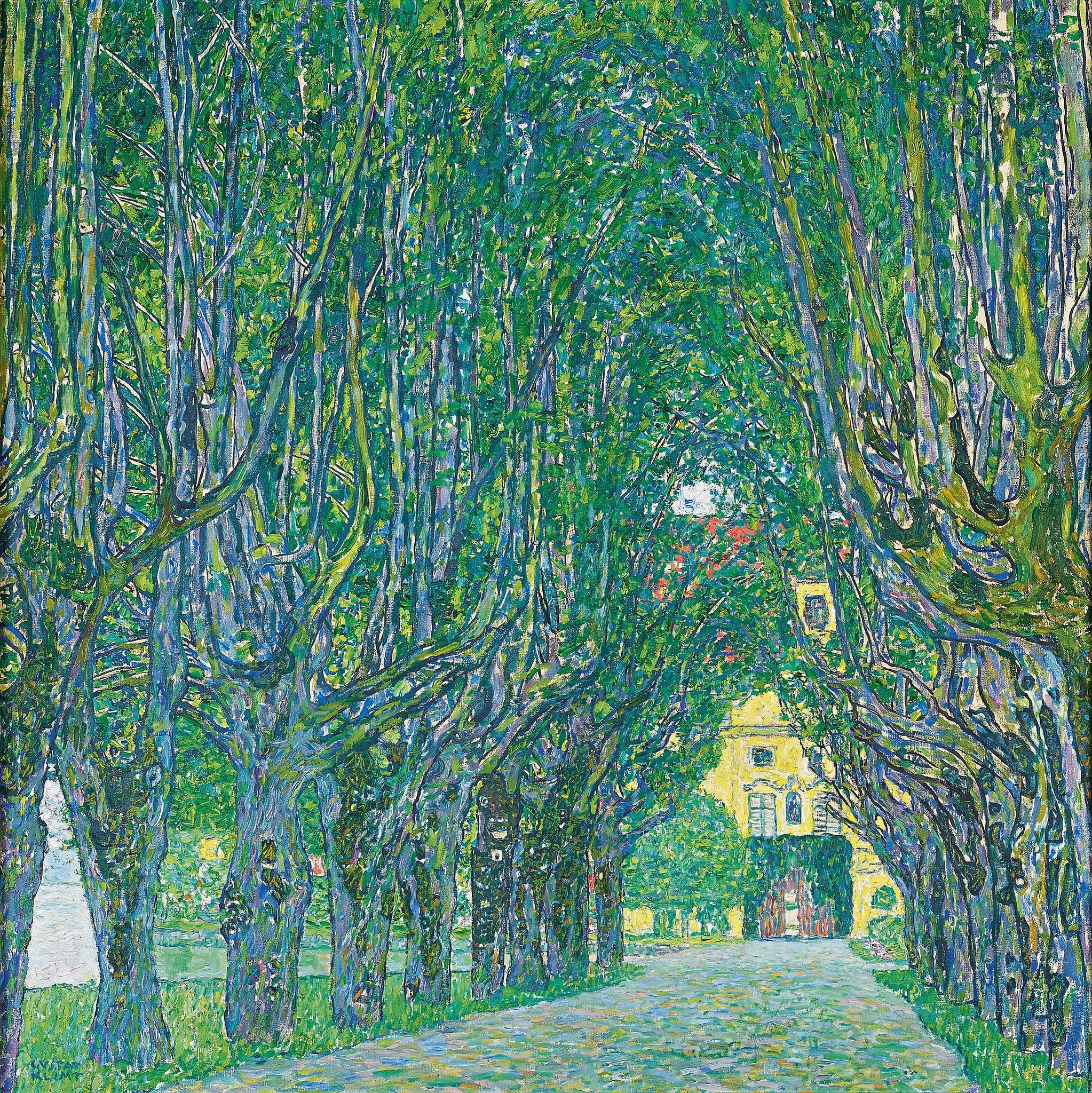
Avenue in Schloss Kammer Park by Gustav Klimt

Avenue in Schloss Kammer Park

Gustav Klimt (1912)

Gustav Klimt’s Avenue in Schloss Kammer Park stages a ceremonial approach beneath a vaulted <strong>tunnel of linden trees</strong>, their pollarded limbs clasping to form a green nave. A cobbled axis pulls the eye toward a sunlit <strong>ocher façade and arched doorway</strong>, while Klimt’s tessellated strokes make foliage, bark, and shadow flicker between <strong>pattern and depth</strong> <sup>[1]</sup><sup>[5]</sup><sup>[6]</sup>.
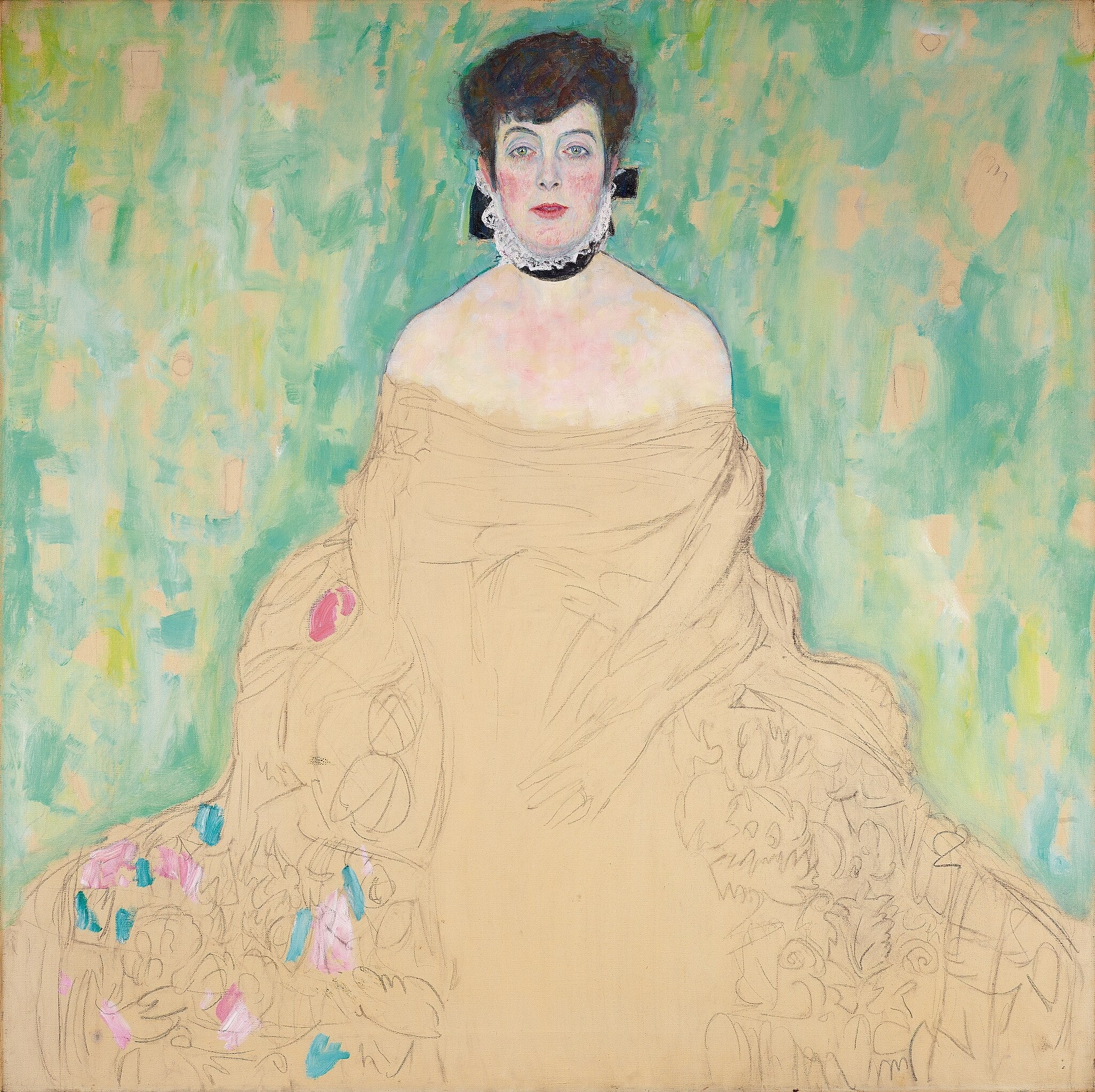
Amalie Zuckerkandl by Gustav Klimt

Amalie Zuckerkandl

Gustav Klimt (1917–1918)

Gustav Klimt’s Amalie Zuckerkandl is an <strong>unfinished</strong> late portrait in which a fully realized head and shoulders float above a gown left as <strong>skeletal graphite and washes</strong>. Set against a mottled, cool <strong>green ground</strong>, her flushed face, direct gaze, black <strong>choker</strong> and crisp lace collar stage a drama of poise, sensuality, and restraint <sup>[1]</sup><sup>[6]</sup>. The painting’s incompletion becomes the work’s meaning: a vivid selfhood <strong>emerging</strong> while ornament remains <strong>in potential</strong>.
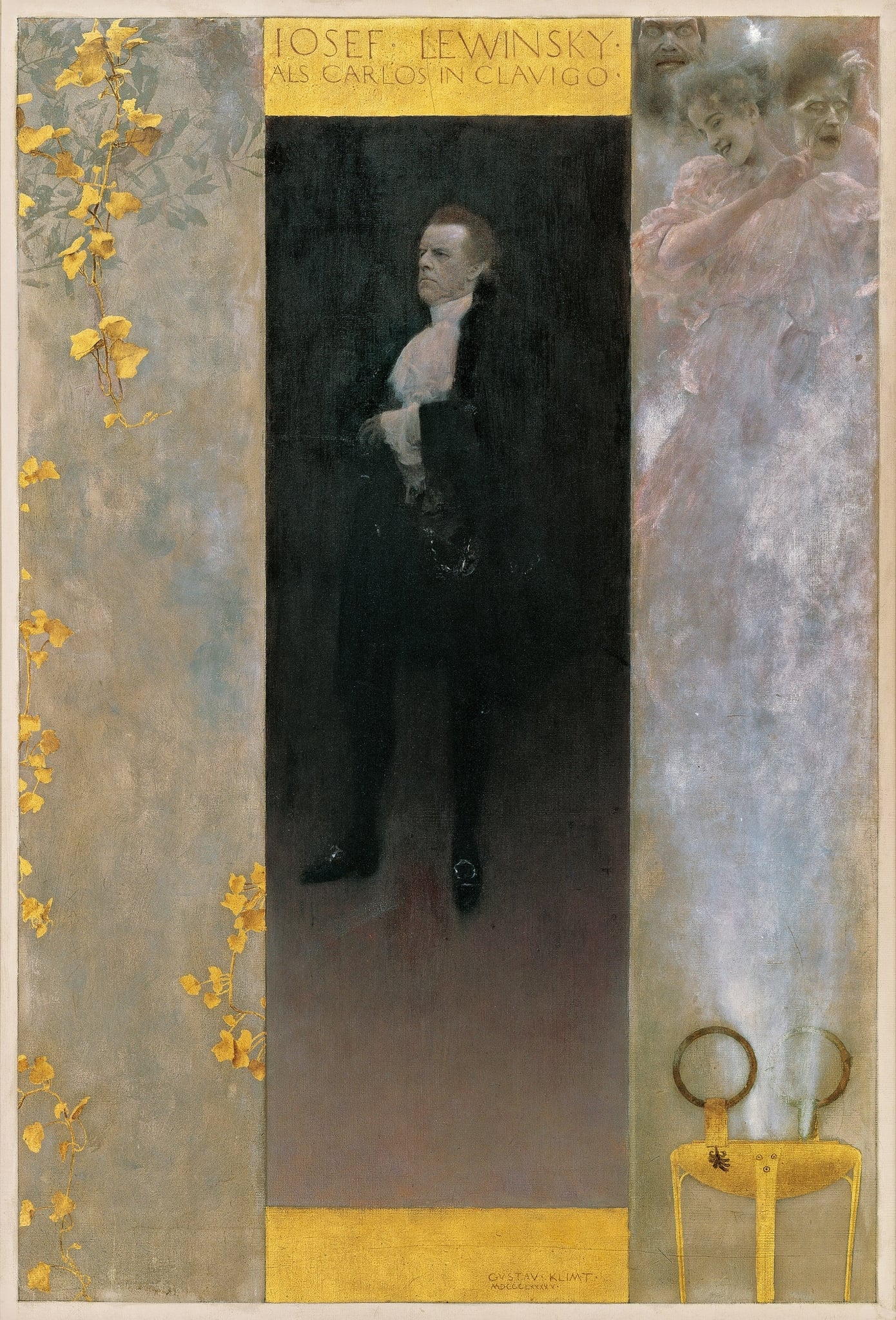
Josef Lewinsky as Carlos in Clavigo by Gustav Klimt

Josef Lewinsky as Carlos in Clavigo

Gustav Klimt (1895)

A stark, triptych-like design turns the actor’s upright silhouette into a test of <strong>will</strong> against a surrounding chorus of <strong>masks</strong>, <strong>laurel/ivy</strong>, and a smoking <strong>antique tripod</strong>. Klimt fuses <strong>portrait</strong> and <strong>allegory</strong> to stage the psychic weather of Goethe’s drama while previewing his turn toward <strong>Symbolism</strong> and ornamental modernity <sup>[1]</sup><sup>[2]</sup>.